

An office can look busy and still work badly. Desks are full on Tuesday, empty on Friday, meeting rooms are always booked, and the lease end date is getting uncomfortably close. That’s the point where office space planning uk stops being a design exercise and becomes a business decision.
For many firms, the problem isn’t lack of space. It’s space being used in the wrong way. A team may need fewer fixed desks, more quiet rooms, better circulation, stronger acoustics, or a layout that won’t trigger a costly reinstatement bill later. In Essex and Hertfordshire, that mix of pressure is now common across growing SMEs, established occupiers, and landlords trying to protect value.
A workable plan has to join up four things at once. Legal compliance. Daily workflow. Staff wellbeing. End-of-lease reality. When those are handled together, the office starts doing its job properly.
Table of Contents
- Is Your Office Working For You or Against You?
- Navigating UK Office Regulations and Standards
- Calculating Your Space Needs for 2026 and Beyond
- Choosing the Right Workplace Strategy
- Your 6-Stage Office Planning and Fit-Out Process
- How GIBBSONN Interiors Delivers Your Perfect Workspace
- Start Your Office Transformation Today
Is Your Office Working For You or Against You?
A familiar pattern shows up in office projects. The business grows, but the space doesn’t improve with it. Teams start taking calls in corridors. Storage spills into shared areas. Managers keep adding desks to solve a people problem that’s really a planning problem.
Another version appears near lease renewal. A company likes the location, but the space no longer fits how people work. Moving sounds expensive. Refurbishing sounds disruptive. Staying put without a clear plan usually creates the worst outcome of all. The business keeps paying for a workplace that frustrates staff and wastes floor area.
Practical rule: If people are creating workarounds every day, the office layout is already underperforming.
That’s where proper office space planning uk earns its value. It turns a vague brief like “we need more room” into practical decisions about occupancy, zoning, privacy, flow, storage, and flexibility. It also reveals what should not be built. Permanent walls in the wrong place, oversized desk banks, and badly positioned tea points often create problems that are costly to undo.
Some buildings also need a wider look at capacity. Where floor area is tight, businesses sometimes explore smart vertical design solutions to use volume more effectively rather than forcing an overcrowded ground plan. That won’t suit every office, but it shows why planning must start with the building’s real constraints, not assumptions.
A strong office plan should answer a few blunt questions:
- How people work now: Are staff mainly focused, collaborative, client-facing, or mixed?
- Where friction sits: Is the problem noise, layout, storage, privacy, or poor circulation?
- What the lease allows: Can the occupier reconfigure freely, or will reinstatement matter later?
- What growth looks like: Will the business need flexibility rather than a fixed layout?
An office should support the business without drawing attention to itself. When it doesn’t, people feel it long before anyone redraws a floor plan.

Navigating UK Office Regulations and Standards
The most expensive office mistakes often start with a sketch that looked fine on paper but ignored the rules underneath it. Compliance shapes layout from day one. It affects headcount, escape routes, ventilation, accessibility, and what can be signed off at handover.
The legal baseline that affects occupancy
Under the UK’s Workplace (Health, Safety and Welfare) Regulations 1992, Regulation 10 requires a minimum space allocation of 11 cubic metres per person, which is the starting point for compliant office design according to Designing Buildings Wiki on office space planning. That requirement directly affects desk layouts, meeting room capacity, and how many people can safely occupy a room.
A layout isn’t compliant just because furniture fits. If a space is overfilled, the design may create safety, comfort, and enforcement issues. The better route is to test occupancy early, before design decisions become expensive.
Best practice goes beyond minimum compliance
A compliant office isn’t always a good office. Basic legal standards set the floor, not the target. Good planning also considers practical guidance used across workplace design, including circulation, daylight, acoustic control, and usable support space.
Three areas usually need attention early:
- Accessibility: Routes, thresholds, door widths, furniture spacing, and shared facilities need to work for more than the average user.
- Fire safety: Escape paths, alarm coverage, and compartment decisions can shape the whole floor plan.
- Ventilation and comfort: A packed layout may look efficient, but if airflow, temperature, and noise are poor, staff feel the impact quickly.
When a fit-out includes life safety upgrades, external specialists may also need to check and sign off systems such as commissioning fire alarm systems. That work should never be treated as a late-stage bolt-on after the layout is fixed.
A practical office plan respects the building first. Then it improves the experience inside it.
What this means in day-to-day design decisions
These standards influence simple choices that clients often see as purely aesthetic. A glazed meeting room may need a different position because of escape paths. A bank of lockers may have to move because it narrows circulation. A collaboration zone may need to shift because it conflicts with quieter work settings or access requirements.
The safest way to handle regulations is to test them against the brief at the start:
- Confirm occupancy assumptions before fixing desk numbers.
- Review base building constraints such as cores, risers, windows, and access routes.
- Check accessibility needs across the full user group, not just a minimum interpretation.
- Coordinate fire and M&E input before detailed design is signed off.
That approach is especially important in older buildings, where inherited layouts often hide awkward constraints. A clean plan on screen doesn’t always reflect what can be built on site.
For businesses in Milton Keynes or Luton, the same principle applies. Start with the statutory baseline, then shape a workplace that is safe, comfortable, and practical to use every day.
Calculating Your Space Needs for 2026 and Beyond
A common 2026 scenario looks like this. A business still has a lease sized for five-day attendance, but on most Tuesdays and Thursdays the office is full, while other days feel half empty. The problem is rarely a simple shortage of desks. It is a mismatch between peak attendance, team behaviours, support spaces, and the cost of carrying space that no longer earns its keep.
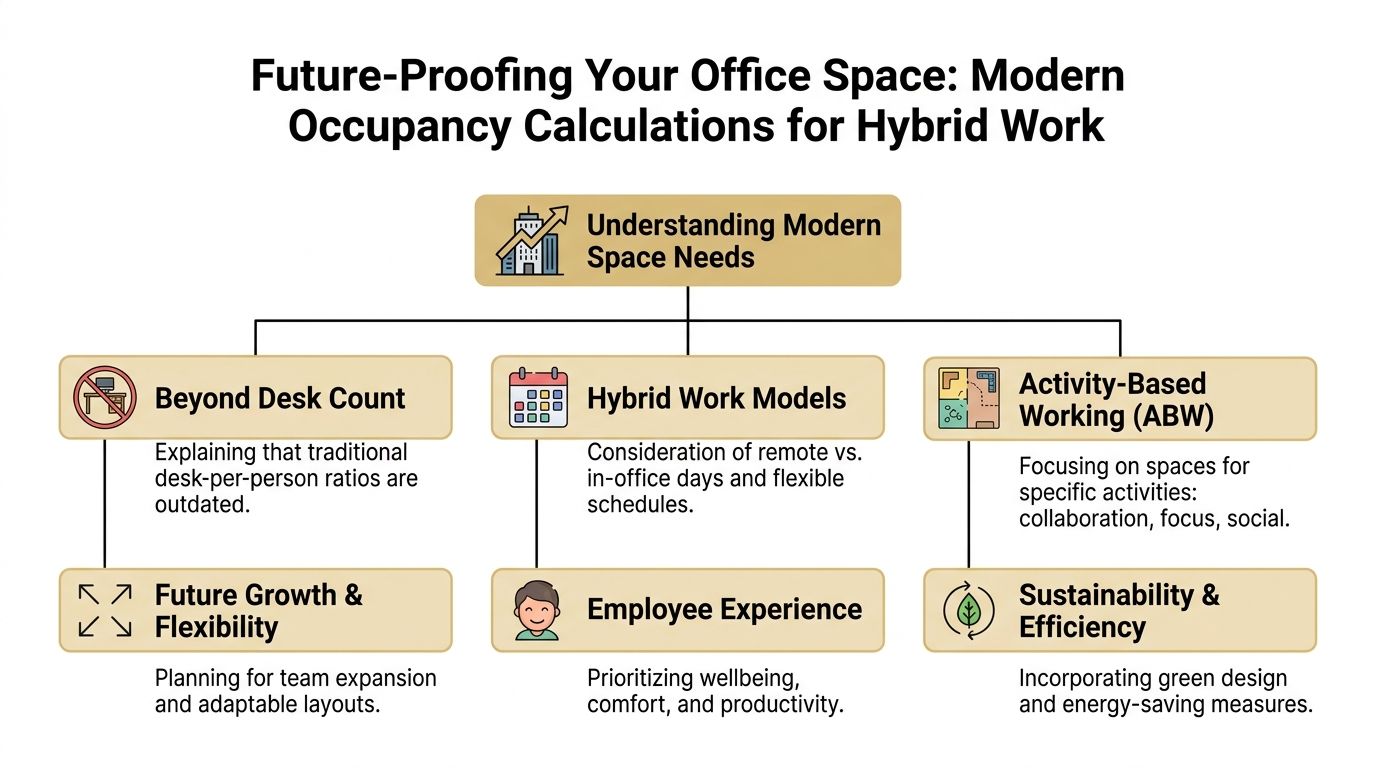
Modern office space planning uk starts with demand patterns. Headcount still matters, but it is only one input. The more useful question is how many people are likely to be in the office at the same time, what they need to do there, and how much of the floorplate must support that mix of work.
Start with attendance patterns, then test the floorplate
Best practice has shifted. Oktra’s office space planning guidance notes that many UK workplaces now plan on roughly 8 to 12 square metres per person, that hybrid models can reduce space needs by 20 to 40%, and that average attendance often sits around 60% rather than full payroll headcount.
Those figures are useful, but they are only the starting point. A legal team with frequent confidential calls will need a different balance of settings from a sales team that spends large parts of the day in the field. A business may be able to reduce desk numbers on paper and still fail in practice if meeting rooms, acoustic booths, lockers, and circulation are underprovided.
That is why we calculate in layers. First, establish average and peak attendance by team. Second, test how many people need desks, rooms, or touchdown space at the same time. Third, check whether the building can support that occupancy comfortably, not just mathematically.
A more detailed method sits in this guide on how to calculate office space per person for a UK office.
Plan around realistic peak use and the cost of supporting it over the life of the lease.
A simple benchmark table
| Space Type | Sq Metres per Person | Primary Use |
|---|---|---|
| Focus desk area | 8-12 | Individual work in a hybrid office |
| Collaboration zone | qualitative allowance | Team sessions, project work, informal meetings |
| Support space | qualitative allowance | Storage, tea points, print, lockers, utilities |
The desk area is only part of the calculation. Collaboration and support spaces need to be included early because they affect occupancy, compliance, and cost. If they are added late, the result is usually cramped circulation, oversubscribed meeting rooms, and a floorplan that looks efficient but works badly day to day.
What usually goes wrong
Three problems turn up repeatedly in workplace reviews:
- Planning by contract headcount: A team of 100 rarely needs 100 permanent desks, but it may still need enough shared settings to handle busy overlap days.
- Ignoring the hidden area load: Tea points, storage, comms rooms, printing, lockers, and internal circulation all consume space and all affect usability.
- Forgetting the lease position: A smaller footprint may reduce ongoing costs, but the decision has to be weighed against dilapidations, reinstatement obligations, and the cost of altering or exiting the current space.
Office planning extends beyond a mere space test. The right answer is not always “take less space.” Sometimes keeping part of an existing fit-out and reworking the layout is financially smarter than relocating. Sometimes consolidation makes sense, but only if the business has checked occupancy risk, programme impact, and end-of-lease exposure first.
For occupiers reviewing options in London or Braintree, the strongest plans connect workplace strategy, building constraints, and property obligations in one exercise. That joined-up view helps businesses avoid paying for space they do not need while still protecting staff experience and compliance.
Choosing the Right Workplace Strategy
A layout on its own won’t fix a weak workplace model. If the business hasn’t decided how people should work together, the plan usually ends up trying to satisfy every need at once. That creates noisy open areas, underused private rooms, and staff who don’t know where to go for focused work.
Why strategy matters more than layout style
The strongest workplaces are built around use patterns. Some teams need long focus periods. Others spend most of the day on calls, project reviews, or client meetings. Office planning should separate those activities instead of forcing them into one setting.
That’s why many businesses now lean towards a blended strategy. Part hybrid model, part activity-based working. Staff move between spaces designed for different tasks rather than being tied to one seat all day.
Useful settings often include:
- Focus zones: Quiet desks, screened areas, or enclosed booths for concentration.
- Collaborative zones: Open tables, project rooms, and casual meeting settings.
- Private call space: Pods or small enclosed rooms for video calls and sensitive conversations.
- Reset space: Breakout areas that help people step away without leaving the workplace.
For teams reviewing options, workplace strategy consulting can help turn those needs into a usable brief before detailed design begins.
Acoustics and inclusion need to be built in
Noise is one of the quickest ways to make a new office fail. A space can look sharp and still feel exhausting to use. That’s why acoustic planning matters early, especially in open-plan floors. Modular pods from manufacturers such as Vetrospace and BlockO are often used to create private, acoustically controlled settings without fully hard-partitioning the office.
Inclusive design needs the same early attention. Designing beyond basic compliance to include sensory zoning, acoustic pods, and environmental autonomy is a growing priority. 1 in 7 UK adults identify with a neurodiverse condition, and inclusive environments can boost productivity by up to 15%, according to the Government Property Agency’s accessible workplace design insight.
That doesn’t mean every office needs a complex specialist scheme. It does mean the workplace should offer choice. Different light levels, better acoustic control, and settings with more or less stimulation help more people work well.
An office works better when it gives people options, not when it forces everyone into the same environment.
For occupiers in Cambridge and Stansted, that usually leads to a more balanced office. Not louder. Not denser. Just more usable.
Your 6-Stage Office Planning and Fit-Out Process
Office projects run more smoothly when the process is clear from the start. Problems tend to appear when briefing, design, costing, and delivery are handled in isolation. A joined-up route gives the client better control over programme, budget, and risk.
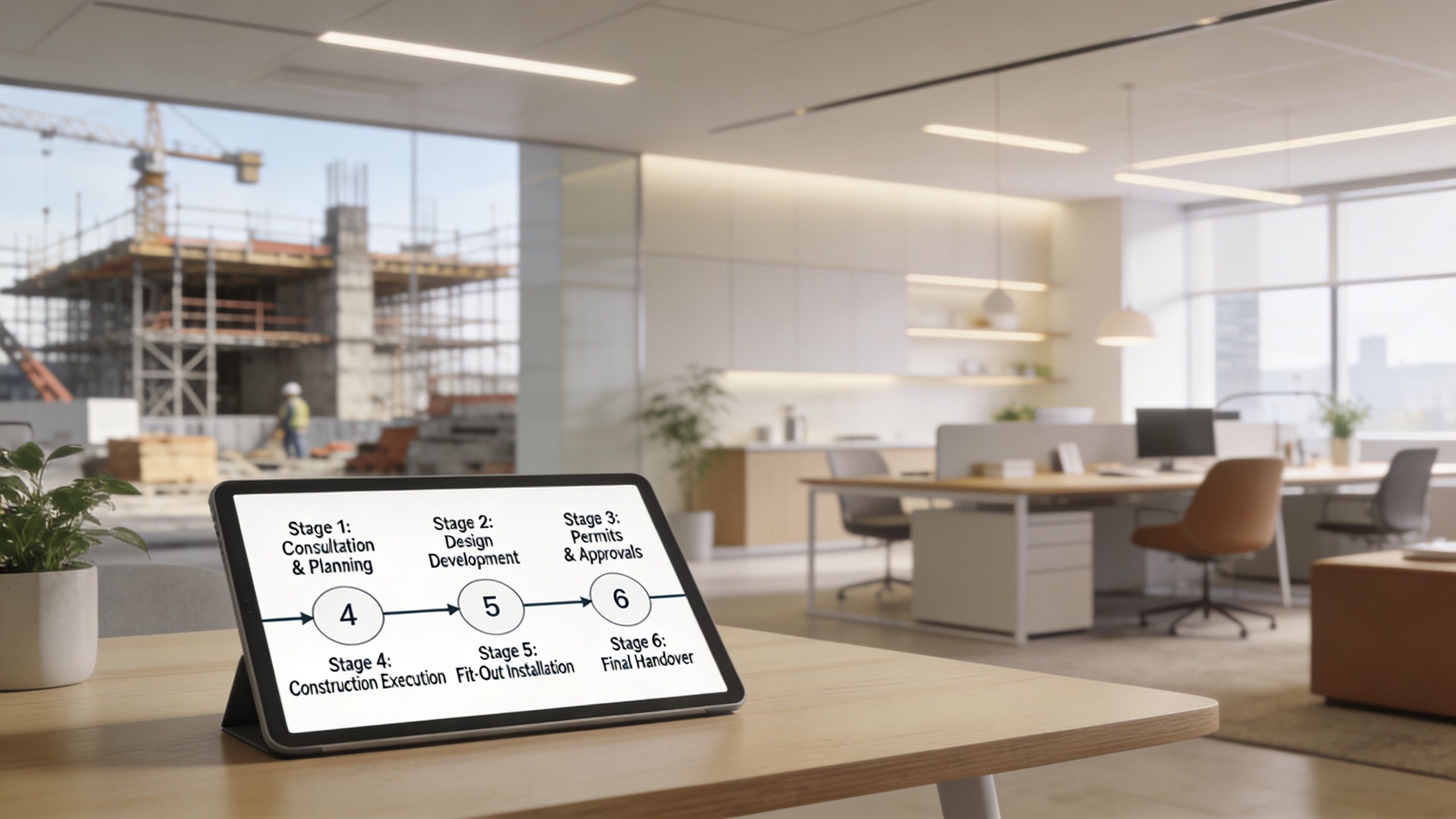
Stage 1 and 2 brief and survey
Stage 1 is briefing and discovery. During this stage, the practical questions get answered properly. How many people attend regularly. What work settings are missing. What the lease allows. What the business wants the office to do better.
A useful brief usually covers:
- Headcount and attendance patterns: Not just total staff numbers.
- Operational needs: Calls, meetings, storage, client use, privacy, brand image.
- Project limits: Budget, timescale, phasing, and disruption tolerance.
- Property context: Lease dates, approvals, and reinstatement obligations.
Stage 2 is the survey and audit. This takes the project out of the abstract. Measured surveys, building constraints, service points, and existing condition checks stop assumptions from driving design. At this point, teams also start testing what can stay, what should change, and what isn’t worth carrying forward.
Some clients find it helpful to review visual planning methods early with tools and examples similar to these interior design rendering software tools, especially when several stakeholders need to compare options before sign-off.
Stage 3 and 4 concept and detail
Stage 3 is concept design and space planning. During this stage, the office starts to take shape. Different layouts are tested against occupancy, workflow, acoustic needs, support areas, and circulation. The aim is not to produce the prettiest plan. It is to produce the one that works best under real use.
A solid concept review should test trade-offs like these:
| Decision area | Works well when | Usually fails when |
|---|---|---|
| Open plan desks | Team visibility and flexibility matter | Noise and calls dominate the day |
| Pods and enclosed rooms | Privacy is needed without major structural change | Too few are provided for actual demand |
| Demountable partitions | Flexibility and future change matter | The layout is treated as permanent anyway |
Stage 4 is detailed design and costing. At this point, finishes, joinery, partitions, power, lighting, acoustic treatment, and programme sequencing all need to align. This is also where smart clients think seriously about the end of the lease, not just the start of occupation.
Integrating dilapidations into the early plan is often overlooked, yet reversible installations such as modular glass partitions can reduce end-of-lease costs by 20 to 30%, according to Fenway’s guidance on planning build and reinstatement strategy. That matters because a beautifully fitted office can still become an expensive exit if the reinstatement position is ignored.
A useful visual summary of staged delivery sits below.
Stage 5 and 6 delivery and aftercare
Stage 5 is fit-out and installation. Phasing, site coordination, health and safety, and live-business logistics matter during this period. Good delivery protects the design intent. Poor delivery forces compromises on the ground.
Stage 6 is handover and aftercare. That includes snagging, user feedback, final adjustments, and making sure the space performs as intended. A handover should not be treated as a finish line only. It is also the point where the workplace starts being tested by real use.
The best fit-outs don’t just look finished on day one. They stay usable when the business settles in.
How GIBBSONN Interiors Delivers Your Perfect Workspace
A workplace project usually gets harder when too many parties own too little of it. One consultant develops the brief. Another produces layouts. A separate contractor builds it. Dilapidations, pods, partitions, finishes, and programme risk all sit in different places. The gaps between those packages are where delays and confusion usually appear.
One joined-up route from brief to handover
A turnkey route avoids much of that friction. Design decisions can be tested against buildability earlier. Budget can be checked while the plan is still flexible. Programme risks can be flagged before site work starts. That is especially helpful when the office must stay live during works or when lease obligations affect design choices.
GIBBSONN Interiors provides workplace consultancy, space planning, office fit-out, refurbishment, architectural wrapping, partitioning, and modular pod integration as part of one joined-up delivery model. For clients, that means fewer handovers between separate teams and a clearer line of accountability.
That matters in practical ways:
- Faster decisions: Design and delivery questions are resolved together.
- Less disruption: Phasing can be planned around business operations.
- Cleaner coordination: Partitions, finishes, furniture, and detailing are not treated as separate silos.
- Better future flexibility: Reconfiguration is easier when adaptability is considered from the start.
What clients usually need help solving
Some clients need a full redesign because the office no longer reflects the business. Others only need selective intervention. A glazed meeting room in the right place. Architectural wrapping to refresh tired surfaces without full replacement. A bank of pods to fix privacy issues in open plan. Demountable systems that support later reinstatement.
The same joined-up thinking applies across different sites and sectors. A refurbishment in Bishop’s Stortford may focus on better use of an existing footprint. A fit-out in Chelmsford may need a stronger hybrid layout. In Dartford or Colchester, the challenge may be programme control, landlord approvals, or reducing disruption during phased works.
Good office planning is not about forcing every workplace into the same template. It is about making the building, the brief, and the business work together.
Start Your Office Transformation Today
A poor office erodes time. Teams lose focus. Rooms get used for the wrong tasks. Space sits empty in one corner and overloaded in another. Those issues rarely fix themselves.
Good office space planning uk gives a business clearer control over how the workplace performs. It helps balance compliance, staff experience, occupancy, flexibility, and lease risk in one plan instead of treating them as separate problems. That’s why it should be viewed as an investment in operational performance, not just a project cost.
For many organisations, the best first step is a structured review of what the office needs to do. This office space planning checklist is a useful place to start if the brief still feels broad or internal stakeholders are not yet aligned.
The strongest projects usually begin with a few honest questions. How is the office being used today. What is frustrating staff. What can the building realistically support. What should be flexible in case the business changes. Once those answers are clear, the design process becomes much easier.
Whether the requirement is a full fit-out, a smarter hybrid layout, better acoustic privacy, or a plan that reduces future reinstatement pain, the right strategy will save stress later.
Ready to transform your workspace? Speak to the GIBBSONN Interiors team today. Looking for bespoke pod solutions or interior support? We’re here to help. Contact Us