
You’re probably looking at a floor plan, a rent figure, and a team list that no longer tells the full story. Some people are in every day, some come in twice a week, and a few only need a desk when a project lands. That’s why how to calculate office space per person has changed. Counting total headcount and multiplying by a rough number isn’t enough anymore.
A better office brief starts with one practical question. How many people need to be in the space at the busiest realistic point, and what do they need to do when they’re there? Get that right and the office becomes easier to lease, plan, fit out, and adapt for 2026.
Table of Contents
- Your Guide to Calculating Office Space Per Person
- First Understand the Language of Office Space
- Choose Your 2026 Office Density Model
- The Core Calculation A Step-by-Step Guide
- Allocating Space for Modern Work Needs
- Practical Tips for a Future-Proof 2026 Workspace
- From Calculation to Creation Your New Office Awaits
Your Guide to Calculating Office Space Per Person
Most office space mistakes happen before a single wall moves. A team takes the total floor area from an agent’s brochure, divides it by headcount, and assumes the answer is done. It isn’t. The number only becomes useful when it reflects the way people use the workplace.
The UK standard approach is based on net internal area, often shortened to NIA. That means the usable office area, not the full building footprint. In practice, that’s the part of the workplace that can support desks, meeting rooms, collaboration areas, pods, and other day-to-day working zones.
For clients reviewing sites in London or planning a move within Hertfordshire, the same rule applies. The most expensive mistake isn’t always taking too little space. It’s paying for square metres that don’t match the way the team works.
What a good calculation needs to answer
A useful office space plan should cover more than desk numbers:
- How many people attend at peak times: This matters more than total contracted headcount in hybrid teams.
- What work happens in the office: Quiet focus, team collaboration, client meetings, calls, or all of them.
- How much support space is needed: Kitchens, meeting rooms, pods, storage, print points, and circulation all affect the final figure.
- How much flexibility is sensible: A rigid plan can date quickly if attendance patterns change.
Practical rule: If the office only works when every person follows the same weekly pattern, the plan is already too tight.
There’s also a language problem that catches people out. Terms like GIA, NIA, usable area, and circulation are often treated as if they mean the same thing. They don’t. Once those are clear, the calculation becomes much simpler and far more accurate.
First Understand the Language of Office Space
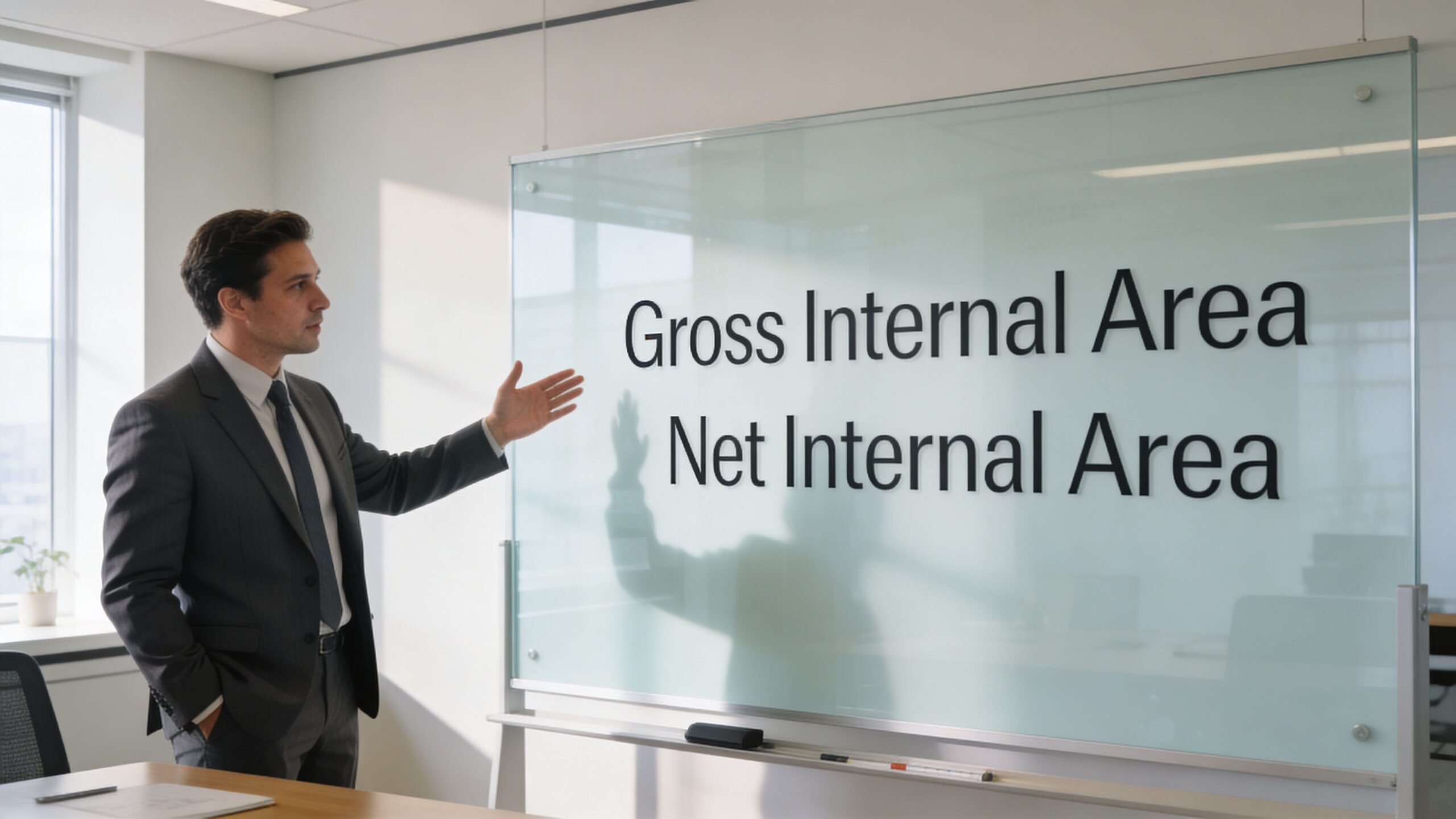
Commercial property language can make a simple job feel harder than it needs to be. But if the terms are clear, the rest of the planning falls into place. The biggest one to understand is the difference between Gross Internal Area and Net Internal Area.
Why NIA matters more than the headline floor area
In the UK, office space per person is calculated by dividing the total net internal area by the number of occupants. The British Council for Offices Occupier Density Guide 2023 reports that the UK national average office density reached 9.4 m²/pps in 2022, up from 10.2 m²/pps in 2019, and this measure excludes common areas like toilets and circulation spaces, which typically add 20-30% to the gross internal area, as outlined in this summary of the BCO office density benchmark.
That distinction matters because a brochure might make a floor look generous, while the usable area tells a different story. If a business bases its layout on the larger number, desks and meeting spaces can end up squeezed in later.
A simple way to think about office area types
The easiest way to understand this is to think about a house.
GIA is the whole house inside the external walls.
NIA is the part you can use for daily living.
The planning question is not “how big is the house?” It’s “how much space can people live in comfortably?”
In an office, that usually breaks down like this:
| Area type | What it includes | Why it matters |
|---|---|---|
| GIA | Overall internal footprint | Useful for broad property comparison |
| NIA | Usable working space | Best figure for office density planning |
| Support and circulation | Routes, shared amenities, non-desk functions | Needs to be allowed for before finalising layout |
A good plan also separates NIA into practical zones. Not every square metre should become a workstation. Some of it needs to support movement, privacy, collaboration, and basic workplace functions.
- Usable workspace: Desks, touchdown benches, quiet tables, small collaboration points.
- Primary circulation: Main routes that let people move around safely and comfortably.
- Ancillary areas: Meeting rooms, tea points, reception, lockers, copy points, and pods.
The cleanest floor plans aren’t the ones with the most desks. They’re the ones where people can work, move, and meet without friction.
This is often where offices in Chelmsford run into trouble during a refit. The lease area looks workable on paper, but once meeting space and circulation are added properly, the desk count that seemed possible starts to fall. That isn’t a design failure. It’s a planning correction.
Choose Your 2026 Office Density Model
Once the area terms are clear, the next decision is the density model. This shapes the culture of the workplace as much as the floor plan. The wrong model creates empty desks, crowded collaboration areas, or both.
UK Government data from the Office for National Statistics 2025 Workplace Survey indicates that 62% of UK office workers in SMEs adopt hybrid models with 2-3 days in-office, and traditional calculations often overprovision space by 30-40%. A modern approach uses peak daily attendees rather than full headcount, as explained in this guide to office space planning for hybrid work.
Comparison of Office Density Models for 2026
| Density Model | Best For | Typical UK NIA Density (per person) |
|---|---|---|
| Assigned desks | Teams in daily attendance with fixed roles | Qualitatively higher space use per person |
| Hot-desking | Hybrid teams with predictable attendance swings | Based on peak daily attendance rather than full headcount |
| Activity-based working | Businesses needing a mix of focus, meeting, and social zones | Often planned across varied settings instead of one desk standard |
Assigned desks
Assigned desks are the most familiar model. Every person has a permanent workstation, often with storage and a fixed neighbourhood. It can suit businesses where people handle paper files, specialist equipment, or highly routine work.
The downside is simple. If attendance varies, those desks sit empty for long periods. The office can feel half-used even when the rent and fit-out budget say otherwise.
Hot-desking and peak occupancy planning
Hot-desking works best when attendance patterns are real and measurable. It replaces one-desk-per-person planning with a desk-sharing ratio and focuses on the busiest likely day.
That doesn’t mean cramming more people into less room. It means matching provision to use. For teams reviewing workplace utilization strategies, the important lesson is this. Density only works when booking habits, meeting demand, and call privacy are planned together.
A hot-desking model usually works well when:
- Attendance is predictable: Team days and regular in-office patterns are already visible.
- People don’t need fixed storage: Lockers and shared storage can replace desk pedestals.
- The office includes alternative settings: Pods, booths, meeting rooms, and quiet corners stop the desk from doing every job.
Activity-based working
Activity-based working, often called ABW, treats the office as a set of tools rather than a row of assigned positions. Staff choose the setting that suits the task. A focused report needs one kind of space. A quick project huddle needs another. A confidential call needs something else again.
This model usually creates the most balanced workplace, but it also needs the clearest planning discipline. If the business calls it ABW but still measures success by desk count alone, it won’t work.
For a useful overview of how this kind of flexible setup supports changing work patterns, agile working in modern offices is worth reviewing alongside density planning.
Decision point: If the office is mainly a place for collaboration, culture, and focused project work, planning by total headcount is usually the wrong starting point.
The best model is the one that matches real behaviour. Not aspiration. Not trend language. Not what another company did.
The Core Calculation A Step-by-Step Guide
Here, planning gets practical. The strongest office calculations are built in layers, not guessed from a single benchmark. The biggest shift for 2026 is that the calculation should start with peak occupancy, not payroll headcount.
Start with peak occupancy not payroll headcount
The UK’s Workplace (Health, Safety and Welfare) Regulations 1992 mandate a legal minimum of 11 cubic metres of space per person. Government benchmarks suggest 8-12 m² per person, and a 2024 BCO survey found average density is now 9.0 m²/pps as 42% of firms adopt desk-sharing, saving 25-35% on space costs, according to this UK office space benchmark guide.
That doesn’t mean every workplace should aim for the lowest possible density. It means compliance is only one checkpoint. A workable office must also support the way people move through the day.
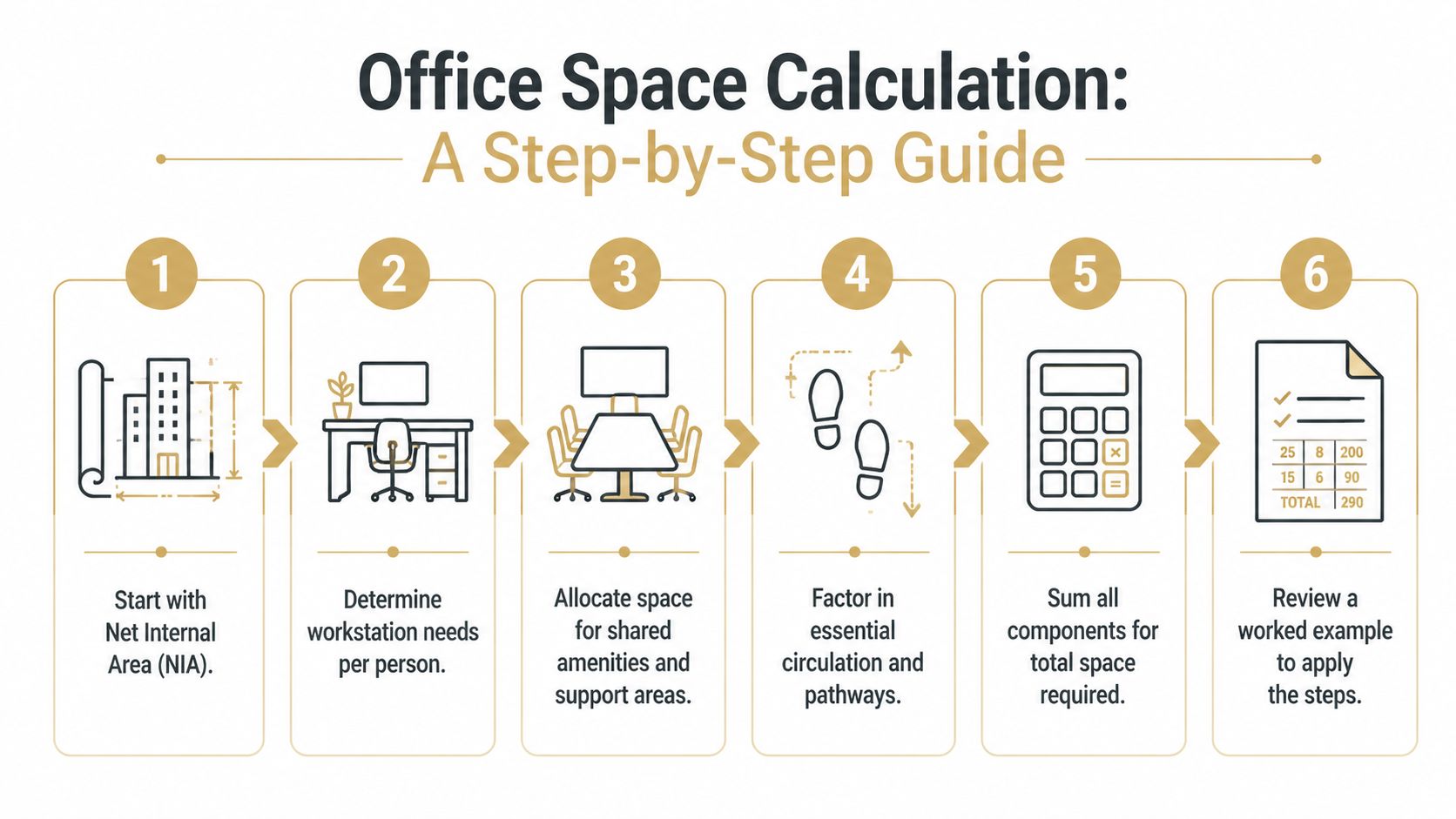
A simple calculation process looks like this:
Set the peak attendance figure
Use booking data, manager input, or attendance records. Don’t use total headcount unless everyone works in full-time.Choose the working model
Decide whether the office is mostly assigned desks, desk-sharing, or a broader activity-based setup.Apply a sensible workspace allowance
This gives a base area for desks or core working settings.Add support spaces
Meeting rooms, phone booths, tea points, informal seating, print points, and storage all need room.Check the final figure against building realities
Shape of floor plate, columns, access routes, natural light, and landlord constraints will affect what fits well.
For businesses that want to test rough room sizes early, Room Sketch 3D's room size calculator can help visualise area before layout work starts.
Build the calculation in layers
A practical office brief usually works best when the total requirement is split into three parts:
| Layer | What it covers | Planning note |
|---|---|---|
| Core work area | Desks and primary working positions | Based on peak users |
| Shared work settings | Meeting rooms, pods, focus booths, breakout points | Driven by how people use the office |
| Support space | Circulation, storage, reception, kitchen, utilities | Often underestimated in early briefs |
This is also where budget joins the conversation. Space decisions affect rent, fit-out, furniture, and services. Anyone reviewing total occupancy cost should pair area planning with pricing per square foot in office fit-out projects, because a badly sized office usually costs twice. Once in the lease, and again in the corrective works.
A short explainer can help when teams need to visualise the process before committing to a brief:
A worked example for a hybrid SME
Take a hybrid SME in Bishop’s Stortford with 50 staff. If peak attendance is 60%, that means 30 people need to be accommodated on the busiest regular day, using the hybrid planning approach described in the earlier office planning source.
The next step is to apply a target density to those 30 peak attendees. Using the hybrid guidance already referenced, a practical planning range is 10-12 sqm per person for that style of office. That gives a base working area of 300 to 360 sqm.
Then add 25-30% for modular pods, glass partitioned meeting areas, and other support settings from the same hybrid methodology. That produces a total of 450-540 sqm.
This is a more useful number than planning for the full team of 50 at the same time. It reflects the way the office is used. It also gives the design team something realistic to work with when placing collaboration zones, private rooms, and shared amenities.
A smart brief doesn’t ask, “How many employees do we have?” It asks, “How many people need the office to perform well at the same time?”
Allocating Space for Modern Work Needs
Once the total figure is clear, the next challenge is distribution. Many offices make mistakes at this stage. They calculate the right total area, then give too much of it to desks and too little to everything else that makes the workplace function.
What deserves space besides desks
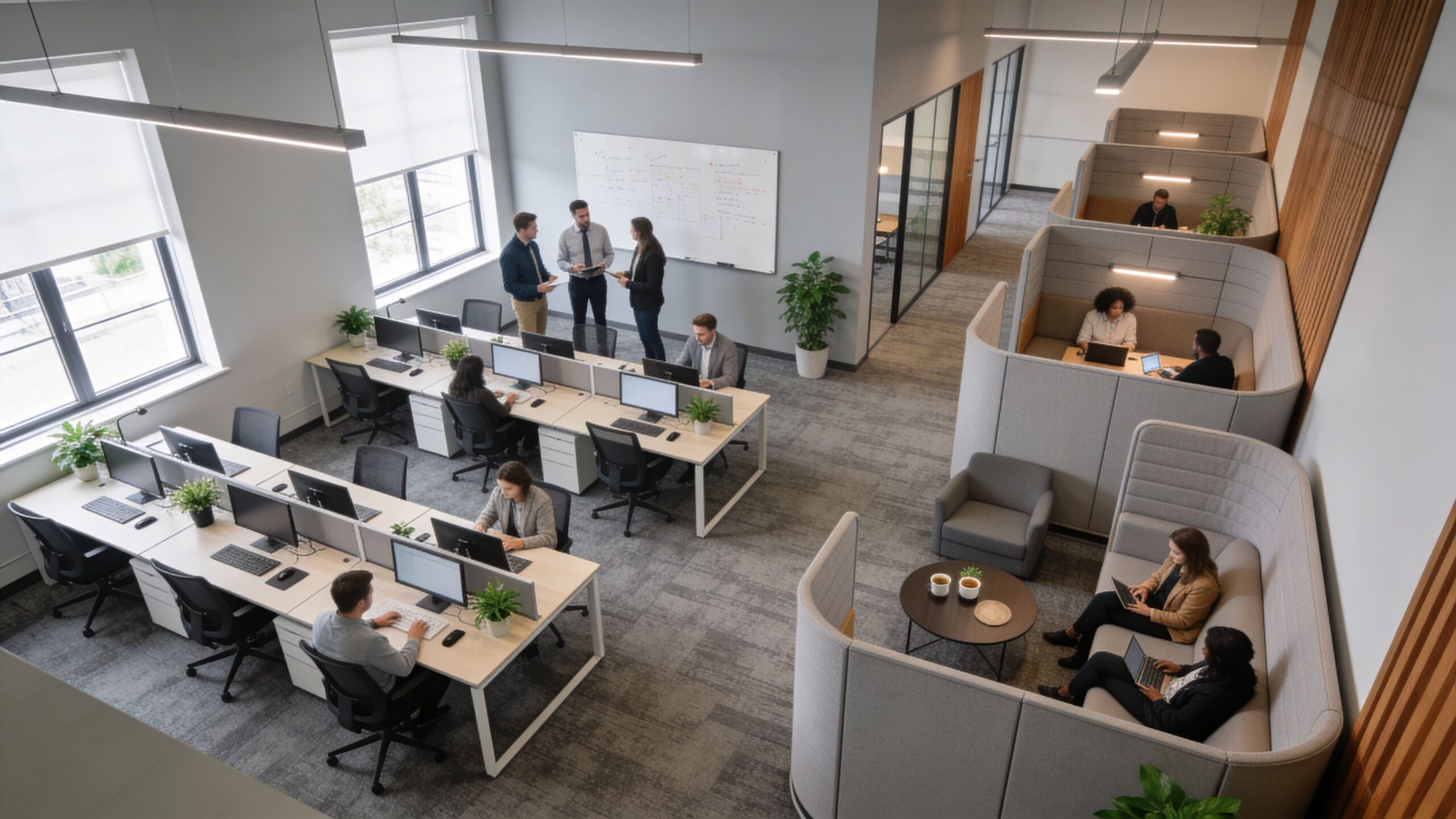
For hybrid workplaces, peak-demand methodology is key. Guidance for this model suggests allocating 12-15 m² for open workstations and 8-10 m² for acoustic pods. It also warns that overlooking hybrid peaks causes 35% underutilisation in many UK offices, while 12% of setups under 10 m² risk HSE violations and fines of up to £20,000 for overcrowding, according to this office space planning article on hybrid needs.
That’s why a modern office needs a mix of settings, not just more benching.
A balanced layout often includes:
- Open desks: For planned team attendance and day-to-day work.
- Small enclosed pods: For calls, video meetings, and focused solo work.
- Meeting rooms: For group sessions that need privacy or screens.
- Breakout areas: For informal chats, short laptop sessions, and social use.
- Quiet corners: For concentrated work away from busy circulation routes.
For an early view of how these pieces fit together, office floor planning for practical workplace layouts is a useful companion to the area calculation itself.
Pods and quiet rooms
Acoustic privacy has become one of the most important parts of office planning. In a hybrid office, people often come in specifically for meetings, calls, collaboration, and project work. That creates more noise pressure, not less.
Well-chosen pod systems can solve that without heavy building work. Manufacturers such as Vetrospace, BlockO, and Framery all offer enclosed settings that can support phone use, focused work, or short meetings depending on the model.
The key is not to treat pods as spare furniture. They’re part of the density calculation. If the office doesn’t provide enough enclosed space, private conversations spill into open areas and desk settings become less useful.
Where layouts usually go wrong
Poor space allocation usually comes from one of three habits:
- Too many desks too early: The layout is fixed around seat count before work patterns are understood.
- Meeting rooms that are too large: Big rooms stay empty while people hunt for somewhere to take a quick call.
- No buffer between noisy and quiet zones: Focus areas fail because they sit next to circulation or social space.
Layout warning: An office can meet the maths and still fail the day-to-day test if every task happens in the same acoustic environment.
This matters even more in places with visiting teams and client traffic, such as around Stansted. In those offices, bookable pods and flexible rooms tend to work harder than fixed desk banks because the demand shifts throughout the week.
Practical Tips for a Future-Proof 2026 Workspace
A good calculation gives a strong starting point. A future-proof office needs a little more discipline. The space must be legally sound, comfortable to use, and adaptable when the business changes direction.
Treat compliance as the floor not the goal
Minimum legal standards are there to prevent poor conditions. They are not a design ambition. A workplace that only just complies can still feel cramped, noisy, and hard to use.
That’s why space planning should be tested against daily behaviour, not just regulations. Teams need clear routes, good sight lines, sensible acoustic separation, and furniture that supports posture and screen use. If those elements are ignored, the office can look efficient on a plan and still perform badly in practice.
A few checks make a big difference:
- Watch how people really work: Are they mostly on calls, mostly collaborating, or mostly focused at screens?
- Protect circulation: Main routes should stay clear and obvious, especially near shared areas.
- Test privacy points: If confidential calls happen often, open-plan density alone won’t solve the brief.
Build flexibility into the fit-out
The most resilient workplaces aren’t overbuilt. They’re adjustable. Modular glass partitioning, movable furniture, reconfigurable meeting spaces, and bookable pods all make it easier to respond when attendance patterns shift.
That matters for growing businesses in fast-moving areas such as Milton Keynes and Dartford. A fixed plan can force an expensive refit sooner than expected. A flexible plan usually buys more useful life from the same footprint.
Future-proofing also depends on restraint. Not every square metre should be assigned on day one. Leaving controlled flexibility in the layout creates room for change without turning the office into dead space.
Good workplace planning leaves enough structure for clarity and enough freedom for change.
The best offices don’t just fit the team that exists today. They support the team the business is becoming.
From Calculation to Creation Your New Office Awaits
The core method is simple once the noise is stripped away. Start with usable area, not brochure area. Plan for peak attendance, not total headcount. Add the spaces that modern work needs, especially meeting settings, private call space, and circulation. Then test the layout against comfort, compliance, and change.
That approach produces a workplace that feels intentional. It avoids the common trap of paying for empty desks or forcing too much activity into one open room. It also makes later design decisions easier, because the brief is grounded in how the office will be used rather than what looked neat in a spreadsheet.
These principles hold whether a business is planning a refit in Braintree, reviewing space in Luton, or shaping a new layout in Colchester. The location changes. The logic doesn’t.
The right office space calculation is never just about square metres. It’s about making sure every part of the workplace earns its place.
Ready to transform your workspace? Speak to the GIBBSONN Interiors team today. Looking for bespoke pod solutions or interior support? They’re here to help. Contact Us