
A lot of office projects start the same way. The team has grown, the diary is full, and the space still somehow feels half empty and overcrowded at the same time. Desks sit unused on some days, meeting rooms are impossible to book on others, and the noisiest corner always seems to be where focused work needs to happen.
That’s usually the moment when planning office space stops being a nice idea and becomes a business decision. Done well, it fixes more than layout. It improves how people meet, concentrate, move through the day, and feel about coming in at all. In 2026, that matters even more because hybrid working, compliance, acoustics, and adaptability are all tied together now.
Table of Contents
- Your Office Isn't Working Anymore What's Next?
- Laying the Groundwork Analysing Your Real Needs for 2026
- Decoding Space Layouts Zoning and Flow
- The Building Blocks Furniture Acoustics and Modern Solutions
- Beyond the Desks Wellbeing Branding and Future-Proofing
- The Practical Side Budgeting Compliance and MEP
- Partnering for Success Why You Need a Fit-Out Specialist
- Frequently Asked Questions about Office Planning
Your Office Isn't Working Anymore What's Next?
A familiar pattern shows up in growing businesses. One part of the office is loud all day, another becomes a dumping ground for spare chairs and deliveries, and every private call turns into a hunt for an empty room. The office still functions, but it no longer supports the way the business works.
That doesn’t always mean a full relocation is needed. Often, it means the workplace has drifted away from the team’s habits. Hybrid schedules changed attendance. Departments changed shape. Video calls became constant. A layout that made sense a few years ago can quickly become frustrating.
Planning office space has always been about organising work properly. That isn’t a new idea. The first dedicated office building in the UK, the Old Admiralty Office, was built in 1726 in London, and it set out early principles of separated work areas, including “separate rooms for intellectual work” and “working in concert under proper superintendence” according to this history of office design in the UK.
Practical rule: Office planning works best when it starts with how people need to work, not with what the current floor plan happens to look like.
That old principle still holds up. Some tasks need quiet. Some need quick access to colleagues. Some need privacy, especially in client-facing or regulated environments. The office performs better when those needs are visible in the plan.
A business with a tired open plan often assumes the answer is more meeting rooms. Sometimes it is. Sometimes the answer is fewer fixed desks, better circulation, improved acoustic separation, and a clear split between focus space and social space.
That’s why a planning exercise should feel reassuring, not overwhelming. It gives structure to problems that already exist. It also creates a chance to shape culture in a very practical way, through layout, behaviour, and the daily experience of work.
Laying the Groundwork Analysing Your Real Needs for 2026
A 2026 office brief can go wrong before a single plan is drawn. The usual pattern is familiar. A business takes its old headcount, adds a bit of growth, asks for more meeting rooms, and only later realises the actual problem was uneven attendance, poor acoustic privacy, or a building that cannot easily absorb structural change.

Start with behaviour not headcount
The first number to test is peak occupancy. In hybrid workplaces, contracted staff numbers rarely reflect how the office is used. A widely cited hybrid workplace planning methodology points to typical UK hybrid occupancy patterns well below full attendance, which is why desk-heavy layouts so often underperform.
That has direct cost implications. Too many fixed desks can leave valuable floor area underused for most of the week, while teams still struggle to find enclosed space for calls, project work, or confidential conversations on busy days.
At GIBBSONN, we usually start by checking four things before discussing layout options:
- Attendance patterns: which days peak, which teams come in together, and whether managers are setting fixed anchor days.
- Task mix: who needs long periods of concentration, who spends the day on video calls, and who needs quick access to shared tables or secure storage.
- Pressure points: which spaces are overbooked, where noise spills, and where circulation cuts through working areas.
- Building constraints: whether the site is a modern CAT A floor, a subdivided multi-let suite, or a heritage property with listed features, limited riser space, and tighter rules on what can be altered.
That last point matters more than many clients expect. A Victorian or listed building can be an excellent office, but the planning brief has to reflect realities such as protected cornices, uneven structural grids, restricted service routes, and windows that affect glare, ventilation, and furniture placement. In those settings, modular pods and glass partitions are often practical planning tools from the outset, not late-stage add-ons.
Offices usually have enough area on paper. The problem is that the area is assigned badly.
A measured survey, occupancy review, and short round of staff feedback will usually produce a far clearer brief than a spreadsheet of departments. If you need a baseline, this guide on how to calculate office space per person is a useful starting point.
Build a brief from evidence
Once the facts are clear, the brief becomes specific and workable. It stops being a vague request for a better office and turns into practical decisions such as reducing fixed desking, adding enclosed call rooms, protecting a quiet zone from through-traffic, or reclaiming an oversized reception area for client meeting space.
That level of detail helps with more than design. It gives leadership a basis for approving spend, helps landlords understand what alterations are justified, and makes it easier to separate genuine requirements from preferences.
For useful early-stage reading, some of the best London architecture articles are the ones that show how workplace planning links building constraints with daily use, rather than treating layout as a purely visual exercise.
A good brief should cover three areas:
- Must-haves such as privacy requirements, team adjacencies, accessibility, IT infrastructure, and any compliance issues linked to hybrid use.
- Current problems such as poor acoustics, wasted rooms, storage that blocks better uses, or meeting spaces that are the wrong size.
- Flexible elements that can adapt over time, including touchdown areas, modular pods, and glazed partitions that improve separation without cutting off light.
Projects stay under control when these points are agreed early. It is much easier to test options, protect the budget, and make sensible trade-offs when the brief reflects how people work and what the building will realistically allow.
Decoding Space Layouts Zoning and Flow
Once the brief is clear, the next job is turning it into movement, boundaries, and usable zones. Planning office space then shifts from data into day-to-day experience. A layout isn’t just a drawing. It controls noise, privacy, visibility, and how easy it is for people to get work done.
Zoning comes before furniture
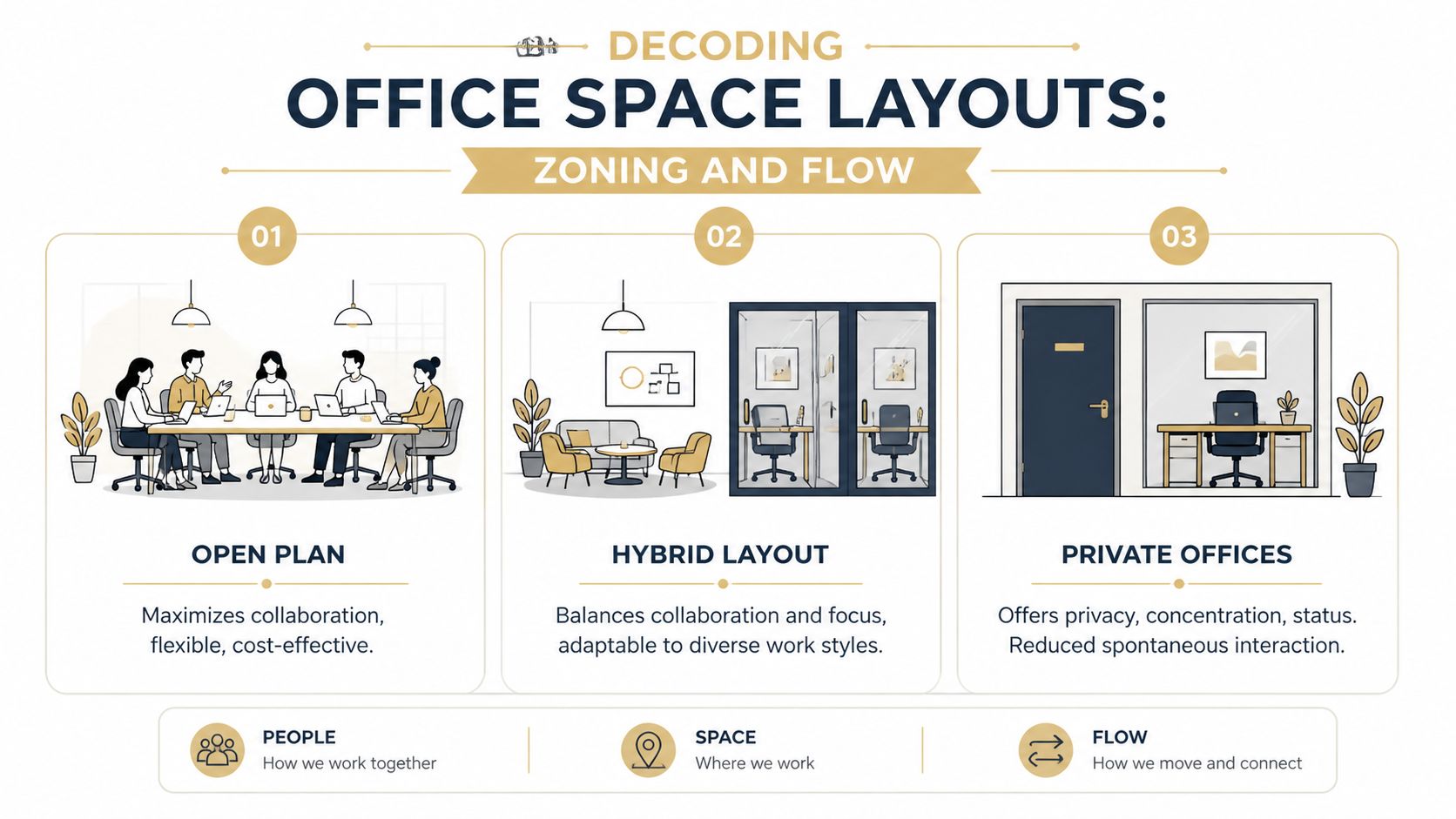
A common trap is choosing desks, booths, and finishes too early. Good layouts start with zoning. That means deciding where focused work happens, where informal collaboration happens, where people meet formally, and how they move between those areas without constantly disturbing each other.
The best layouts usually include a mix of settings rather than a single planning model. Some businesses still need private rooms for confidential work. Others do better with an activity-based setup, where people choose the setting that fits the task.
Here’s a simple way to compare the options:
| Layout Type | Best For | Key Consideration |
|---|---|---|
| Open plan | Fast-moving teams that need visibility and casual interaction | Noise control has to be designed in from the start |
| Hybrid layout | Businesses balancing collaboration, focus, and flexible attendance | Zoning needs clear rules or it becomes muddled |
| Private offices | Roles needing confidentiality, concentration, or formal client meetings | Can reduce openness if overused |
Circulation matters just as much as room count. If people cut through a quiet zone to reach the kitchen, that quiet zone won’t stay quiet. If a busy collaboration area sits right beside a bank of video call desks, both settings will underperform.
A practical way to think about flow is to place the loudest uses at the edges of quieter ones, not through the middle of them. Reception, café points, and casual meeting spots can absorb movement. Focus areas need protection.
Businesses reviewing a layout in Cambridge often run into another factor as well. The building itself doesn’t behave like a simple rectangle.
Older buildings need smarter planning
In the UK, 35% of commercial spaces are in listed buildings, and irregular geometry is part of the challenge. The same study summary on heritage and office layouts notes that angular planning with partitions can improve productivity by 18% by creating “focus angles”, while 62% of facility managers report noise fatigue in pure open-plan settings.
That matters because awkward corners are often treated as wasted space when they can become some of the most useful parts of the office.
Design note: An angled wall doesn't have to be a compromise. It can become the natural edge of a quiet nook, a pod location, or a small meeting setting.
This is especially relevant in older commercial stock across Chelmsford and similar heritage-heavy locations, where symmetry isn’t guaranteed and services may already be threaded through the building in odd ways.
A few layout moves work particularly well in irregular spaces:
- Use corners for enclosed focus settings: Small rooms, pods, and one-to-one booths often fit better in awkward zones than banks of desks.
- Turn angles into visual separation: A slight change in wall line can naturally break up activity types without making the office feel chopped up.
- Keep primary routes simple: Even in a quirky shell, the main circulation path should feel obvious.
- Use glazing carefully: Glass partitions can preserve borrowed light where solid walls would make a difficult plan feel tighter.
Detailed layout design then becomes much easier to resolve through a specialist office layout design process, especially where zoning, joinery, and circulation all need to work together.
The Building Blocks Furniture Acoustics and Modern Solutions
Once the floor plan is settled, the project becomes more physical. Furniture, finishes, partitions, lighting, and specialist products all shape how the office feels in use. At this stage, many workplaces either become calm and functional or stay noisy and frustrating.
Acoustics aren't a finishing touch
Noise is still one of the biggest reasons a workplace looks good on paper but fails in practice. A beautiful open area can be exhausting if every call, chair movement, and passing conversation carries across the floor.
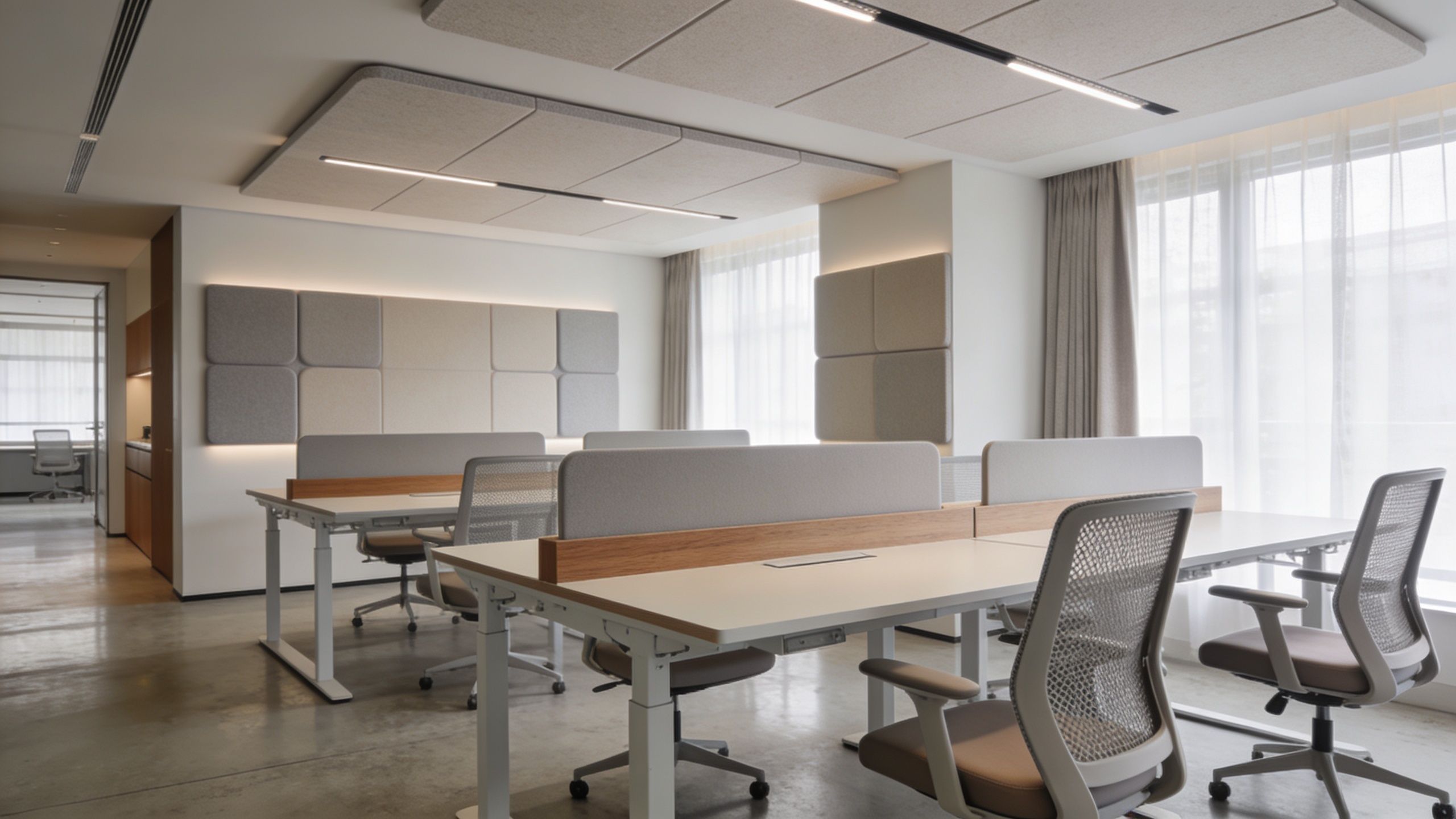
That’s why acoustic planning should sit beside layout planning, not after it. Materials, ceiling treatment, floor finishes, partition choice, and furniture placement all play a part. Soft seating helps, but it won’t fix an environment where loudness is pervasive on its own.
A lot of businesses start by asking for more enclosed rooms. Sometimes that’s right. Often the smarter move is a mix of measures. Acoustic wall panels, rugs in lounge settings, screen-backed booths, and glazed partitions can all reduce the spread of sound without making the office feel boxed in.
For teams dealing with persistent noise problems, this guide on how to reduce noise in open plan office gives a useful breakdown of what to tackle first.
Pods and partitions solve different problems
Glass partitions and modular pods are sometimes grouped together, but they do different jobs.
Glass partitions are ideal when a business wants to divide space, improve acoustic separation, and keep a sense of openness. They work particularly well for meeting rooms, manager rooms, project areas, and internal fronts where natural light matters. They also allow future changes with less upheaval than permanent construction in many settings.
Pods are different. They create a self-contained room within the room. That makes them especially useful for confidential calls, focused solo work, and small hybrid meetings where privacy on demand matters.
Brands such as Vetrospace, BlockO, and Framery are widely recognised options when a project needs enclosed acoustic products rather than fixed construction. In the same category, GIBBSONN Interiors provides modular pod systems and glass partitioning as part of a wider fit-out scope, which can be useful where planning, installation, and reconfiguration need to sit under one delivery route.
A good rule is simple:
- Use partitions when the space needs permanent zoning.
- Use pods when the business needs fast, flexible privacy.
- Use both when the office has mixed patterns of focus work, meetings, and changing team attendance.
Meeting technology also needs to be thought through at this stage. A room can be beautifully finished and still fail if the screen placement, microphones, booking interface, and cable management are awkward. For a practical example of how AV and room control can support meeting spaces, these conference system automation examples are useful because they show how the user experience depends on more than furniture alone.
A short product walkthrough helps bring that to life:
In dense workplaces, especially in London, these details make a real difference. Staff notice very quickly whether a room is easy to use, easy to hear in, and easy to trust for private conversations.
Beyond the Desks Wellbeing Branding and Future-Proofing
A team comes back in on Tuesday. The desks are there, the meeting rooms are there, and the Wi-Fi works. Yet the office still feels tiring to use. People drift to the same corners, calls happen in the wrong places, and visitors leave with no clear sense of the business. That usually means the planning stopped at layout.
People judge the workplace before the work starts
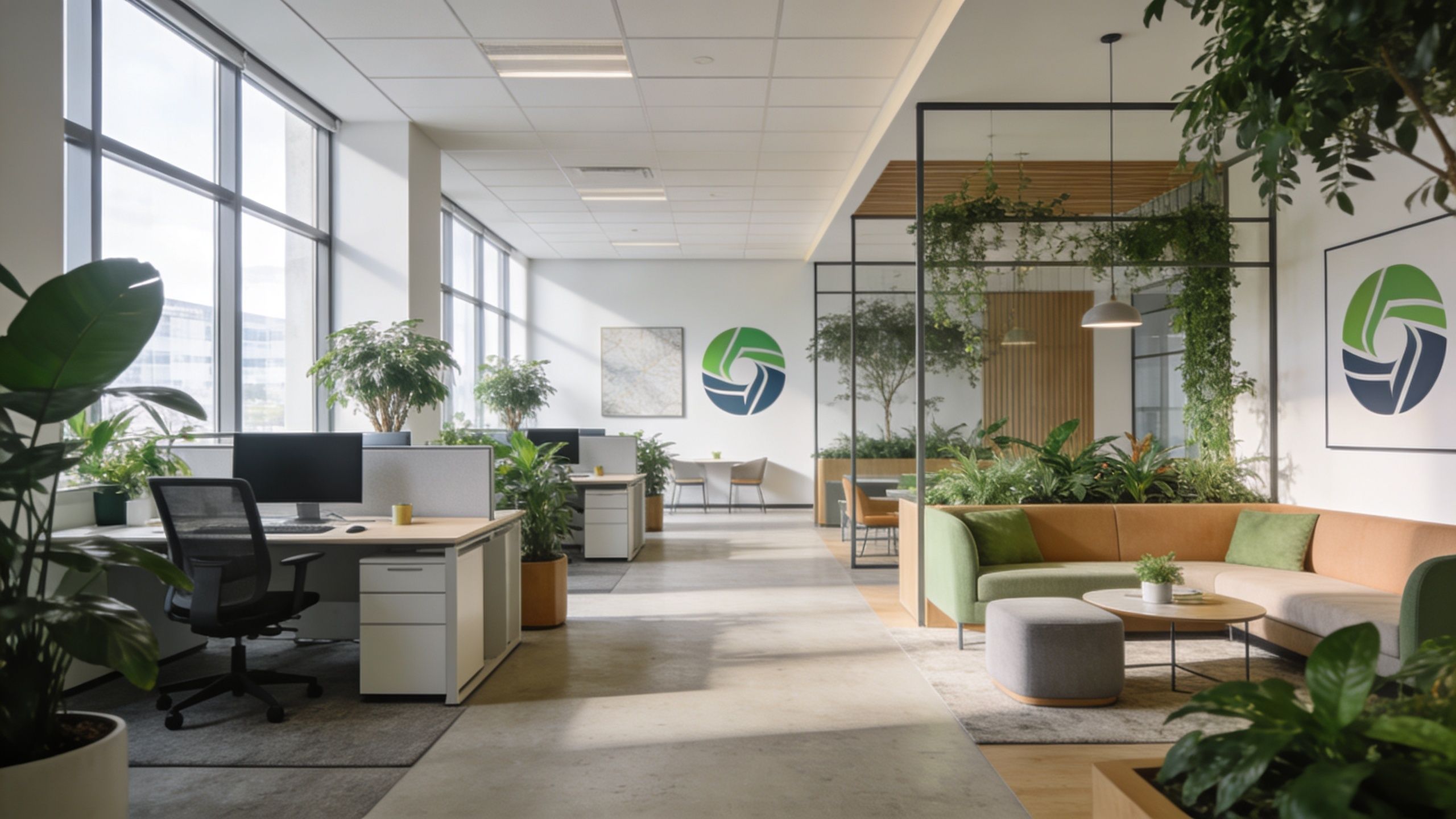
Staff and visitors form an opinion within minutes. Light levels, glare, noise spill, planting, materials, and sightlines all shape whether the space feels settled or draining. In practice, wellbeing is rarely about one feature. It is the result of many small decisions working together.
Natural light matters, but so does what sits around it. A bright perimeter lined with storage or high-backed furniture wastes one of the best assets in the office. Breakout areas need a reason to be used, with comfortable seating, nearby power, and enough acoustic separation to make an informal conversation possible without disturbing the whole floor.
Branding works in much the same way. The offices that feel most convincing are rarely covered in logos. They use colour, finishes, signage, joinery, and tone of voice consistently, so the space reflects the business without feeling staged.
Reception is usually where this succeeds or fails. A heritage property may need a lighter touch, with branding expressed through materials, graphics, and lighting rather than fixed architectural changes. A newer commercial building can often carry bolder interventions, but even then, restraint usually dates better than trend-led statements.
Future-proofing starts with realistic change
Hybrid work has changed the brief for most UK offices. The question is no longer how many desks fit on the floorplate. It is whether the space can support changing attendance, quiet work, team sessions, private calls, and client-facing moments without a full refit every 18 months.
That is why adaptable elements deserve a place in the core plan, not as add-ons. Modular pods, demountable partitions, and reconfigurable furniture give a business room to adjust without reopening every finish and service route. In buildings with listed features, uneven structure, or tight landlord controls, that flexibility becomes even more useful because change is often easier to manage through freestanding or lightly fixed elements.
A practical future-proofing brief usually includes:
- Spaces that can change use: Project rooms, touchdown areas, and meeting spaces should not be locked into one pattern of work.
- Infrastructure in the right places: Power, data, booking points, and ventilation need to support movement, not fight it.
- Branding that can evolve: Graphics, signage, and wayfinding should be easy to update as teams, services, or occupancies change.
- Wellbeing measures that hold up over time: Good light control, acoustic privacy, and access to quieter settings remain useful even as headcount shifts.
Security and life-safety planning sit inside this conversation too. If the office includes higher-security zones, visitor management requirements, or compartmented areas, those decisions need to align with the space plan early. Input from specialists such as Amax Fire & Security can help shape layouts that work operationally as well as visually.
The best future-proofed offices are not the ones trying to predict every change. They are the ones set up to absorb change with less cost, less disruption, and fewer compromises for the people using them every day.
The Practical Side Budgeting Compliance and MEP
Good ideas fall apart when the practical side is treated as an afterthought. Budget, approvals, building services, and programme all need just as much attention as the design concept. This is often where office projects become either smooth and controlled or expensive and drawn out.
Budget for the whole project not just the visible parts
Clients often begin by pricing the obvious items first. Desks, chairs, partitions, and finishes are visible, so they get attention. The hidden pieces can be just as important. Power changes, lighting adjustments, data work, fire alarm interfaces, ventilation, professional fees, landlord approvals, and decant costs all affect the final figure.
A realistic budget should include:
- Fit-out works: Partitions, finishes, flooring, decoration, ceilings, and joinery.
- Furniture and specialist products: Workstations, storage, seating, booths, and pods.
- Technology and infrastructure: Data, power, AV, screens, booking systems, and Wi-Fi support.
- Professional input: Design, surveying, compliance advice, and project management.
- Contingency: A buffer for the unknowns that appear once work starts on site.
Older buildings and live workplaces often uncover small surprises. Ceiling voids, hidden service routes, and legacy installations can all affect cost and programme. A contingency keeps those discoveries manageable rather than disruptive.
MEP and compliance should start early
Mechanical, electrical, and plumbing coordination is one of the least glamorous parts of planning office space, but it shapes almost everything. Meeting rooms need ventilation. Pods need power. New partitions affect lighting layouts, air paths, fire detection, and escape routes. If MEP work is left too late, the project ends up redesigning decisions that already looked settled.
Compliance needs the same early attention. Building Regulations, fire safety, accessibility, and landlord or estate requirements should be checked before layouts become fixed. That’s especially important in shared buildings, regulated environments, and multi-occupancy offices.
Site reality: Most costly changes happen when the design team and building services team start solving the same problem at different times.
For businesses seeking an early view on fire and security integration, the design consultancy approach shown by Amax Fire & Security is a helpful example of how specialist requirements can be considered from the outset rather than bolted on later.
A grounded programme also helps. Ordering long-lead items early, sequencing works around occupancy, and agreeing decision dates in advance keeps momentum up. In practical terms, the smoothest projects are usually the ones that make technical coordination visible from day one.
Partnering for Success Why You Need a Fit-Out Specialist
Planning office space sounds manageable when each decision is looked at on its own. Choose a layout. Add some meeting rooms. Improve acoustics. Refresh the finishes. In reality, all of those choices affect each other.
That’s why many office projects become difficult when too many separate parties are making linked decisions in isolation. The layout affects building services. The acoustic plan affects furniture selection. The programme affects landlord approvals. The budget affects every stage.
A fit-out specialist brings those moving parts together under one route. That gives the client a clearer brief, a coordinated design, and one point of accountability from concept through to handover. It also means the project team can resolve clashes earlier, before they become delays on site.
The value isn’t just convenience. It’s risk reduction. When one team is responsible for design intent, technical coordination, procurement, and delivery, decisions happen faster and with less confusion. That matters whether the project is a full refurbishment, a phased upgrade, or a workplace reconfiguration ahead of lease events.
For busy office managers and business owners, that single-thread approach often makes the difference between a stressful project and one that feels controlled from start to finish.
Frequently Asked Questions about Office Planning
How long does an office fit-out usually take?
Every office is different, so the programme depends on scope, approvals, procurement, and whether the space stays occupied during works. Small refurbishments move faster than full redesigns with service changes. The best approach is to build the timeline around the complexity of the site, not just the floor area.
What's the single biggest mistake to avoid?
Planning the new office around old habits. That usually leads to too many assigned desks, not enough task-specific space, and expensive decisions that don’t reflect how the team works now. The strongest projects are based on future working patterns, not nostalgia for the previous setup.
Can a team stay in the office while the work is being done?
Often, yes. A phased programme can keep part of the workplace live while work happens elsewhere. That needs careful sequencing, clear safety controls, and realistic expectations about noise and access, but it’s a common way to reduce disruption when a temporary move isn’t practical.
Ready to transform your workspace? Speak to the GIBBSONN Interiors team today. For customized help with planning office space, fit-out strategy, pods, partitions, or a full workplace review, Contact Us.