

The day usually starts well enough. A few people arrive early, coffee goes down, laptops open, and there’s a brief window when the office feels calm. Then the phones start, one team begins a stand-up nearby, someone takes a sales call at their desk, chairs scrape across a hard floor, and by mid-morning the whole place has a low, constant buzz that makes focused work far harder than it should be.
That’s the core problem with open plan space. Noise rarely comes from one dramatic source. It builds from dozens of ordinary sounds that bounce around hard surfaces and travel much further than anyone expects. For businesses trying to work out how to reduce noise in open plan office layouts, the answer isn’t one magic product. It’s a phased plan that starts with understanding the problem, then fixing it in the right order.
Table of Contents
- The Open Plan Dilemma Finding Focus in a Noisy Office
- Your First Step for 2026 Assessing Your Office Noise Problem
- Quick Wins Low-Cost Noise Reduction Strategies
- Mid-Term Investments Upgrading Your Acoustic Performance for 2026
- Major Fit-Out Solutions for Lasting Quiet and Productivity
- Creating Your 2026 Noise Reduction Roadmap and Measuring ROI
- Frequently Asked Questions About Office Acoustics
The Open Plan Dilemma Finding Focus in a Noisy Office
Open plan offices were meant to make work more connected. In practice, many of them create the opposite effect. Staff can hear everything, privacy disappears, and concentration gets broken over and over again by conversations that aren’t even relevant to the task in front of them.
In UK open-plan offices, noise levels frequently exceed 60 to 65 dB, which is well above the 40 to 55 dB range recommended for focused work. The same source notes that face-to-face interactions can drop by 70% and sick days can rise by 62%, while the UK Health and Safety Executive says noise above 55 dB impairs concentration on complex work, according to open office statistics collected for 2026.
That combination catches many businesses off guard. People assume noise is just part of office life, so they try to manage it person by person. Headphones go on. Teams whisper for a week, then drift back into old habits. Managers ask people to take calls elsewhere, but there often isn’t anywhere else.
Why noise feels worse than it measures
Noise in offices isn’t only about loudness. It’s also about speech intelligibility, echo, and distance. If one conversation from several desks away can still be clearly understood, the room has an acoustic problem even if nobody would call it “very loud”.
Hard ceilings, plasterboard walls, glass, exposed services, vinyl floors, and bench desking all push sound back into the room. That’s why modern offices can look sharp but feel tiring.
Practical rule: If staff mention “constant background chatter” more often than “one noisy team”, the issue is usually the room, not the people.
The real trade-off in open plan design
Open layouts still have value. They support visibility, speed, and casual teamwork. The problem starts when every activity happens in the same acoustic condition. Sales calls, heads-down finance work, online meetings, and informal chats don’t belong in one untreated sound field.
The best offices don’t try to remove collaboration. They give it a proper place, while protecting focus elsewhere. That’s the point of a phased acoustic plan. It fixes what the room is doing to people, not just what people are doing in the room.
Your First Step for 2026 Assessing Your Office Noise Problem
Most office noise projects go wrong at the start. Businesses buy panels because they look good, or they move desks around and hope for the best. That usually leads to patchy results because nobody has measured where the problem sits.
A proper acoustic assessment doesn’t need to be complicated. It just needs to be honest. The aim is to understand what staff are hearing, where the noisiest zones are, and which parts of the room are causing sound to linger.
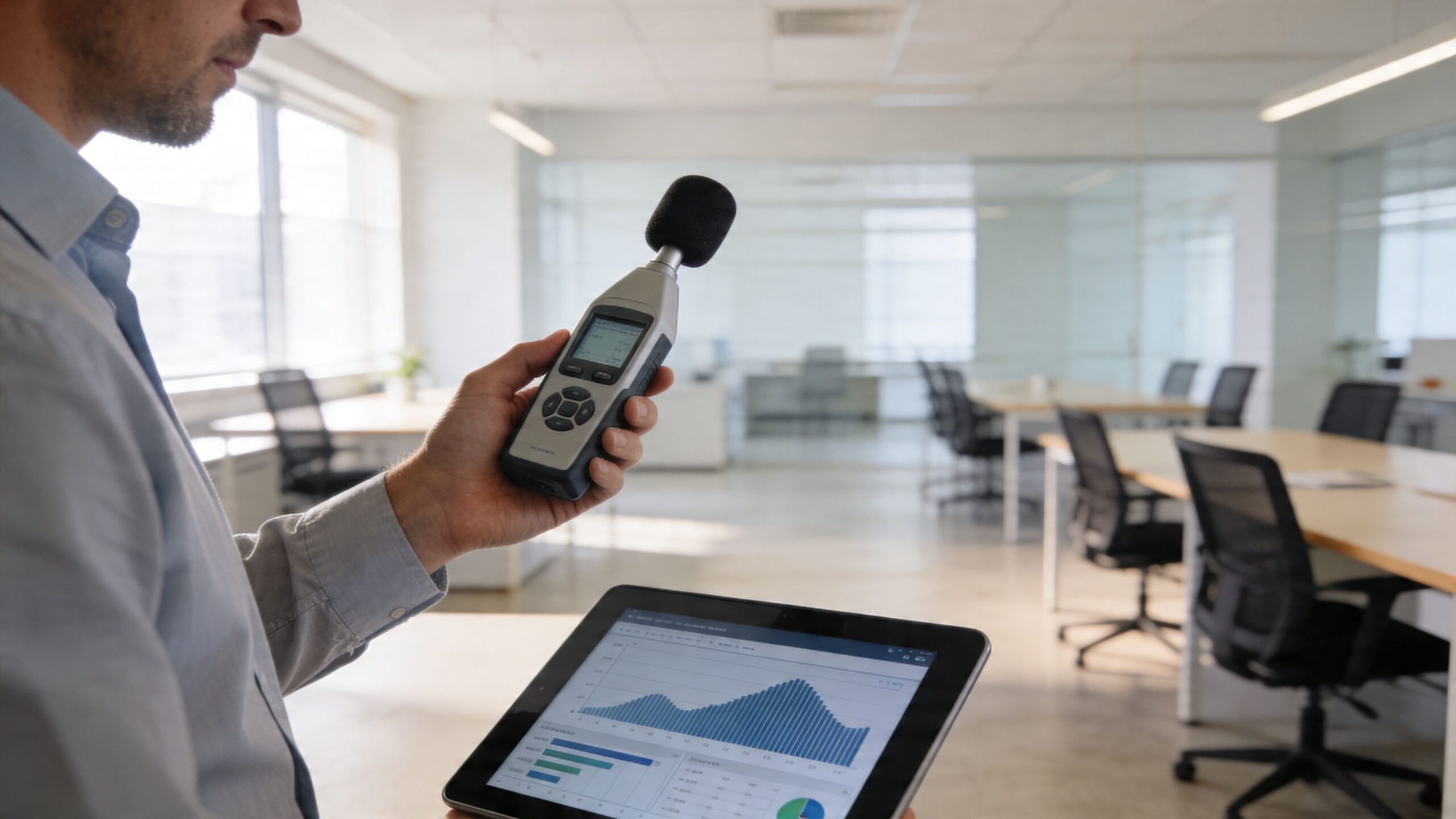
Many UK office refits fail their first acoustic tests, and BB93 recommends background noise below 35 dB(A) in open-plan areas. Businesses can check their own space with Class 2 sound meters costing £100 to £300, which is a modest spend compared with the cost of non-compliance and the productivity drops that can reach 66%, as outlined in this UK acoustic compliance guide.
For offices planning wider layout changes, it also helps to review how space is being used before any acoustic products are chosen. This guide to office layouts and planning is a useful starting point for that broader decision.
What to measure first
A simple office audit should focus on three things:
Overall noise level
Take readings at different times of day. Mid-morning, lunchtime, and mid-afternoon often tell very different stories.Reverberation
This is how long sound hangs around after it’s made. In plain terms, it’s the echo effect that makes speech spread.Noise hotspots
Kitchens, breakout edges, printer points, corridors, and meeting-table spillout are common culprits.
A short written log matters just as much as the meter. Note what was happening when the reading was taken. A number without context won’t help much later.
What good and bad results look like
A room can seem acceptable on paper and still perform badly for concentration. That’s why results should be read alongside staff feedback.
Look for patterns like these:
- Consistent complaints near one edge of the floorplate usually point to a local source such as circulation routes or a busy support area.
- A general complaint across the whole office usually points to too much reverberation and too many reflective finishes.
- Problems only at certain hours often suggest operational issues rather than a full fit-out failure.
Offices in London often face this during refurbishments because denser floorplates and more mixed-use activity make zoning harder if it isn’t designed in from the start.
Keep the audit simple but repeatable
The best baseline is one that can be repeated after changes are made. That means using the same meter, the same locations, and roughly the same times of day. Without that, it’s hard to tell if the intervention worked or if the office happened to be quieter on the day.
A practical baseline review should include:
- Desk areas where focused work happens
- Call-heavy zones where speech travels most
- Shared areas such as kitchens and touchdown points
- Enclosed spaces to check whether meeting rooms are containing sound properly
The target isn’t a perfect silent office. It’s a workspace where the sound level matches the work being done.
Quick Wins Low-Cost Noise Reduction Strategies
Not every office needs a full acoustic fit-out straight away. Some spaces improve noticeably with better zoning, softer finishes, and a few behaviour changes that people can stick to.
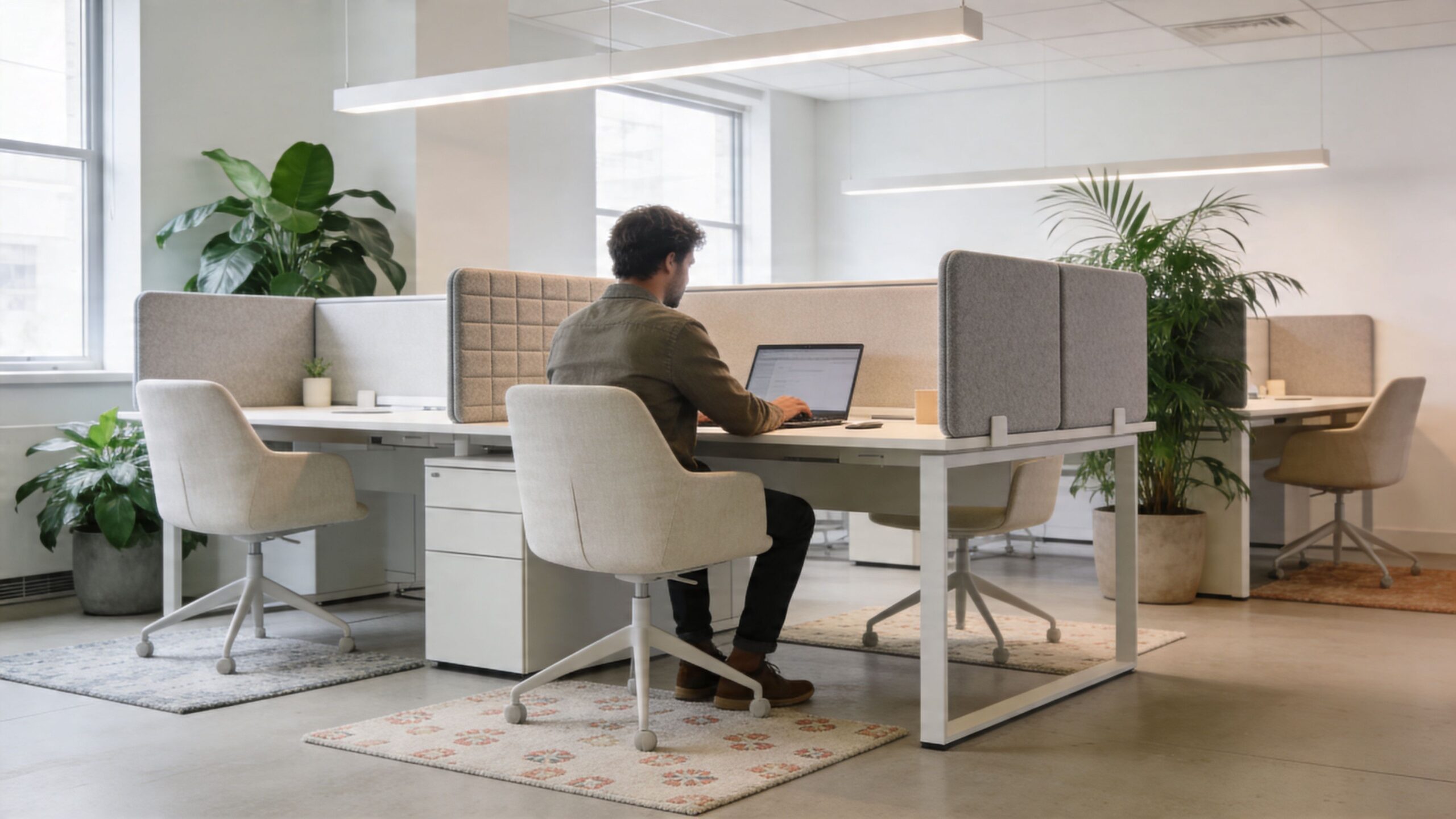
Quick wins work best when they tackle the most obvious mismatch in the room. If calls happen beside focused work, separate them. If a hard breakout area spills noise into desks, soften the edge and change how people move through it.
Layout changes that help straight away
The fastest gains usually come from rethinking what sits next to what.
Group similar noise profiles together
Sales, support, and project teams that spend much of the day on calls shouldn’t sit beside teams doing detailed written or financial work.Create a genuine quiet zone
This doesn’t need construction work. It can start as a clearly designated area with fewer calls, fewer visitors, and less through-traffic.Pull noisy functions off circulation routes
Printers, bins, coffee points, and shared touchdown benches often create repeated bursts of distraction.Turn spare corners into call points
A modest reallocation of underused space often reduces desk-based phone noise more effectively than asking staff to “keep it down”.
Some offices also benefit from simple etiquette rules, but those rules need backing from the environment. If there’s nowhere suitable for calls, noise policy won’t last.
A good rule is simple. Don’t ask people to behave against the layout. Fix the layout so the right behaviour feels natural.
Small additions that soften the room
Hard surfaces make ordinary office noise feel sharper and more persistent. That’s why softening even part of the room can help.
Useful low-cost additions include:
Carpet tiles in key areas
These help where chair movement and footsteps are part of the problem.Curtains or acoustic drapes near glass-heavy zones
These can make a noticeable difference in breakout edges and meeting spill areas.Upholstered seating and booths
Soft seating absorbs sound better than hard-shell furniture and makes informal meeting spots less noisy.Plants used as soft dividers
They won’t solve a serious acoustic issue on their own, but they can help break up sound paths and improve the feel of a space.
This video gives a helpful visual overview of practical workplace noise issues and common treatment ideas.
What quick wins can and can’t do
Quick changes are good for reducing obvious friction. They are less effective when the room has a deep reverberation problem caused by exposed soffits, extensive glazing, or large uninterrupted ceilings.
That’s where businesses often get stuck. They make sensible low-cost changes, but the office still feels noisy because the shell of the room is working against them.
A useful checklist for the first month looks like this:
- Move call-heavy teams away from focus work
- Set one clear quiet zone and protect it
- Add soft finishes where sound is bouncing
- Reduce casual meeting spillout into desk areas
- Check whether complaints fall after the changes
If complaints drop, the business has bought some breathing room. If they don’t, the next step is to treat the room itself rather than the symptoms.
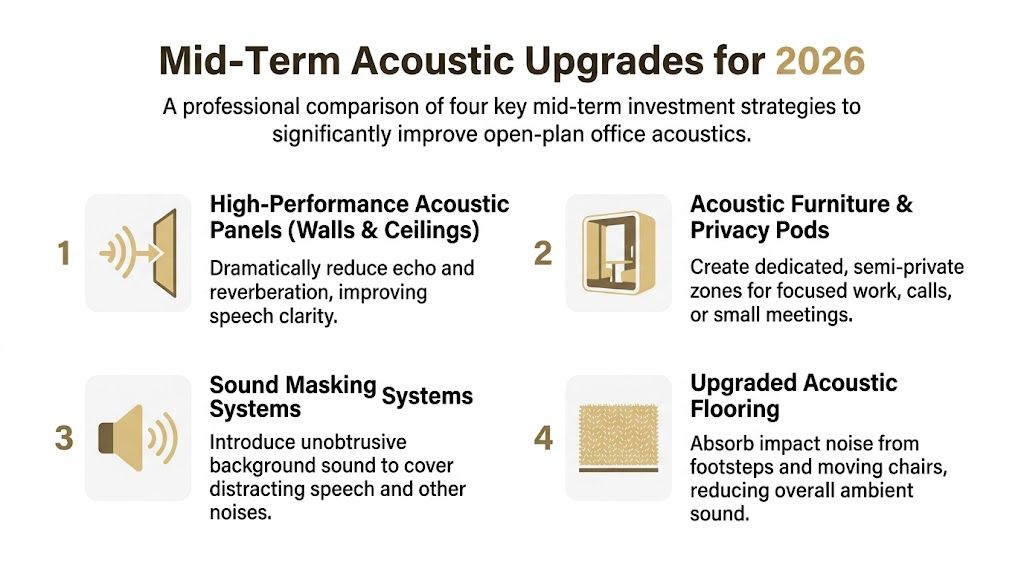
Mid-Term Investments Upgrading Your Acoustic Performance for 2026
When layout tweaks stop delivering, acoustic treatment needs to become more deliberate. This is usually the stage where businesses get the best balance between spend, disruption, and measurable improvement.
Mid-term investment usually means treating the surfaces that are throwing sound back into the room. In most open plan offices, the ceiling is the first place to look, then the walls, then the furniture and screens that shape local zones.
A 2022 BRE case study on commercial refits found that installing ceiling baffles with NRC of 0.85 or above and zoning with partitions achieved 25 to 35% noise reduction and a 15% productivity boost. The same source says the target should be to bring RT60 from 0.8 to 1.2 seconds down to below 0.5 seconds, in line with BS 8233:2014 guidance summarised here.
Ceilings first then walls
The ceiling often does most of the damage in modern open plan space, especially with exposed services or hard plaster finishes. Sound rises, reflects, and spreads across the room. Baffles and ceiling rafts interrupt that path.
What matters most is choosing the right specification, not just adding something decorative.
- NRC tells you how much sound a material absorbs. For office speech control, higher absorption is usually the safer choice.
- Placement matters as much as the product. Hanging treatment over workstations and reflective zones is more effective than placing it only where it looks balanced.
- Fire compliance matters in UK workplaces, so panel specifications should be checked properly before any order is placed.
Wall panels become more useful once the ceiling has been addressed or where the room has long hard perimeters. They are especially helpful near circulation edges, breakout walls, and places where speech reflects back into desk areas.
Comparing mid-level options
Not every acoustic product solves the same problem. Some reduce echo across the room. Others create local privacy. Some help both.
| Intervention | Estimated Cost (per 100 sq m) | Impact Level |
|---|---|---|
| Ceiling baffles or rafts | Moderate | High |
| Wall acoustic panels | Moderate | Medium to high |
| High-backed screens and booths | Low to moderate | Medium |
| Modular pods | Higher | High |
The cost ranges above are intentionally broad because pricing shifts based on specification, access, fire rating, finishes, and whether installation happens during a live office programme or a planned shutdown.
For businesses weighing enclosed options as part of this phase, these office meeting pods show where a modular solution can sit between light treatment and a major fit-out.
What to look for in wall-based treatments
Some wall systems perform far better than others. The useful details are usually hidden in the specification sheet.
A strong brief should ask for:
- High absorption performance for speech frequencies
- Suitable thickness, because very thin decorative products often underperform
- UK fire-rated compliance
- A finish that suits the office, so the solution stays in place and isn’t removed later for aesthetic reasons
One verified data point is worth noting here. High-quality wall panels with NRC 0.9+ and coverage across 25 to 40% of wall surfaces can be effective when paired with soft furnishings and booths, but those integrated outcomes belong to a wider package rather than a panel-only fix, as discussed later in the article.
Ceiling treatment usually gives the broadest acoustic reset. Wall treatment then fine-tunes the room.
What tends to go wrong
Three mistakes come up again and again in mid-range acoustic upgrades.
First, businesses under-specify. They choose a panel because it looks the part, then discover it has little real absorbency.
Second, they spread treatment too thinly. Small scattered panels can make a room look treated without changing the acoustic behaviour enough to matter.
Third, they ignore services noise. HVAC sound and reflected air movement can undermine otherwise solid acoustic work if mechanical systems are left out of the review.
That’s why a mid-term programme works best when it follows the survey rather than the mood board. Good acoustic design still needs to look right, but performance has to lead.
Major Fit-Out Solutions for Lasting Quiet and Productivity
Some offices reach a point where treatment alone won’t do enough. If the business needs reliable speech privacy, enclosed focus settings, and calmer collaboration zones, major fit-out moves become the sensible option rather than the expensive one.
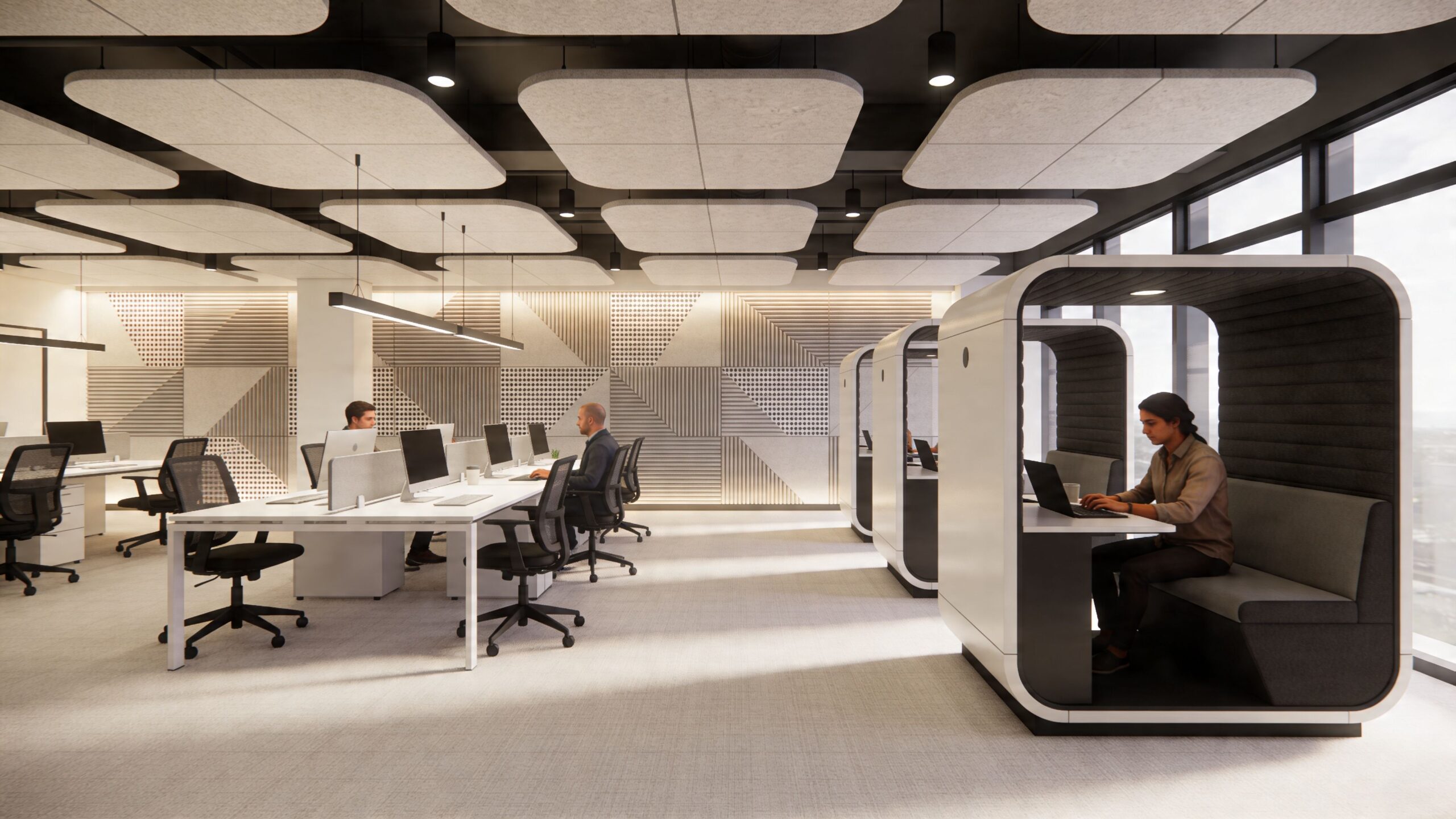
Partitions, pods, enclosed booths, and integrated material choices start to change the way the workplace functions. Instead of trying to reduce distraction everywhere equally, the office begins to offer clearly different settings for different types of work.
Why enclosed spaces matter
Open plan layouts struggle most when work modes collide. A confidential call and a concentration-heavy report can’t comfortably happen side by side for long.
That’s why enclosed spaces matter so much. Glass-fronted rooms, phone booths, and meeting pods give noise somewhere to go. They contain it, rather than expecting the whole floor to tolerate it.
For many teams, this creates a better balance than building more permanent cellular offices. Glass keeps sightlines open and preserves daylight, while modular enclosed settings add privacy without forcing a full structural rebuild.
The strongest workplaces don’t choose between openness and privacy. They build both into the same floorplate.
Pods partitions and integrated acoustic design
Modular pods have changed what’s practical in live office environments. Brands such as Vetrospace, BlockO, and Framery give businesses an option that sits between furniture and construction. They can be introduced with far less disruption than traditional building work, and they’re easier to adapt if the office changes later.
Glass partitioning still has a major role as well. It’s one of the best ways to create meeting rooms and quieter enclosed zones while keeping the office visually open. For businesses exploring that route, these office partition systems show how modern glazed solutions can support both privacy and flexibility.
The best results usually come from combining several elements:
- Acoustic wall panels to reduce reflection
- Carpet tiles and upholstered booths to soften activity zones
- Pods or phone booths for calls and focused solo work
- Glass partitions to separate louder team areas from quieter zones
A 2024 CIPD UK Workplace Report linked integrated solutions such as high-quality wall panels with NRC 0.9+, covering 25 to 40% of wall surfaces, alongside soft furnishings and booths, to an average 28% noise drop, a 22% productivity gain, and an 18% reduction in absenteeism, as cited in this summary of integrated acoustic solutions.
When a major solution makes financial sense
A larger intervention usually makes sense when one or more of these signs show up:
- The office has enough space but not enough enclosed settings
- Meeting rooms are overbooked because people use them for solo calls
- Staff keep raising privacy concerns
- Previous low-cost and mid-cost fixes improved things but didn’t solve the problem
- The business wants flexibility without committing to heavy structural change
For teams around Bishop’s Stortford or Cambridge, this often matters in offices that need to support hybrid patterns, client calls, and focused work all within the same footprint.
A major fit-out should still be disciplined. More enclosed spaces are not always better. The right mix is what matters. Too many pods can eat floor area and leave collaboration feeling squeezed. Too few will be booked solid from day one. The answer sits in matching the number and type of enclosed spaces to real use patterns, not trends.
Creating Your 2026 Noise Reduction Roadmap and Measuring ROI
A strong acoustic plan is staged. Businesses that try to solve everything in one move often overspend in the wrong places. Businesses that only chase quick fixes usually end up spending twice.
A phased roadmap keeps the project practical. It also makes it easier to explain the spend internally, because each stage has a clear purpose and a simple way to judge whether it worked.
A simple phased roadmap
A workable roadmap usually looks like this:
Phase one. Audit the space
Measure sound, log complaints, identify hotspots, and map where different work types happen.Phase two. Make low-disruption changes
Move noisy teams, define quiet areas, reduce spill from shared spaces, and add softer finishes where possible.Phase three. Treat the room
Introduce ceiling and wall absorption where reverberation is driving distraction.Phase four. Add enclosed settings
Use pods, booths, or glazed rooms where the business needs dependable privacy and focus.Phase five. Review and tune
Re-test the space, ask staff what changed, and adjust underused or overloaded areas.
This approach suits both small offices and larger phased refurbishments. It also helps landlords and tenants dealing with changing occupancy because not every improvement needs to be structural.
How to make the business case
The clearest ROI case usually comes from three angles.
First, look at time lost to distraction. If teams are repeatedly interrupted, managers already know the cost even if it hasn’t been formally measured.
Second, look at space misuse. If meeting rooms are being used for solo calls, the office isn’t functioning properly.
Third, look at staff experience. Acoustic problems tend to sit behind wider complaints about focus, fatigue, and the feeling that the office is harder work than home.
For businesses in Essex and Hertfordshire, this often becomes part of a broader workplace upgrade rather than a standalone acoustic project. That’s usually the right way to think about it. Sound, layout, privacy, and wellbeing affect each other.
Better acoustics rarely create value in isolation. They unlock the value of the workspace the business already pays for.
Measure what matters after installation
Post-project reviews should stay simple and consistent.
Track:
- Repeat sound readings in the same spots as the original audit
- Staff feedback on focus, privacy, and comfort
- Room usage patterns to see whether pods and enclosed spaces are solving the intended problem
- Complaint themes rather than only complaint volume
A quieter office isn’t the final aim. The true aim is an office where people can do different kinds of work without constantly getting in each other’s way.
Frequently Asked Questions About Office Acoustics
Do noise-cancelling headphones solve office noise
They reduce the symptom for one person. They do not fix the workplace.
Headphones can help with short periods of focused work, especially in teams doing detailed screen-based tasks. They also come with trade-offs. People are less approachable, quick questions turn into messages, and some settings raise health and safety concerns if staff cannot hear alarms, warnings, or activity around them. If day-to-day productivity depends on everyone blocking out the office, the layout and acoustic treatment need attention.
Is acoustic paint worth it
Acoustic paint sits at the margins of a noise strategy.
It may soften a small amount of high-frequency reflection on hard surfaces, but the effect is limited. In practice, I would treat it as a finishing item for a space that already has proper ceiling absorption, wall panels, screens, or soft furnishings in place. On its own, it will not make an open plan office feel materially quieter, so it is rarely the best use of budget in an early phase.
How should breakout areas and kitchens be handled
Breakout spaces and kitchens need to be planned as separate acoustic zones from the start.
The problem is not that people talk. The problem is that social noise carries straight into focus areas when there is no buffer, no absorption, and no physical definition between uses. In UK office projects, that usually means reviewing adjacency first, then adding the right layer of control through ceiling treatment, booth seating, glazed partitions, screens, and more forgiving surface finishes. Any changes should also sit comfortably with fire escape routes, general workplace safety, and the way the office is used day to day.
The practical rule is simple. Put collaboration where collaboration belongs, and protect concentration areas properly.
A few measures usually make the difference:
- Keep kitchens and breakout seating clear of focus desks
- Use softer finishes to reduce clatter and reverberation
- Add ceiling absorption above high-use social zones
- Create a clear boundary with booths, screens, or partitions
“A quiet office is a workplace that supports different types of work properly. Teams need space to collaborate, space to take calls, and space to concentrate without constant interruption.”
If your office noise problems are affecting focus, privacy, or space use, GIBBSONN Interiors can help you build a phased solution that fits your budget, programme, and compliance duties. We advise UK businesses on quick fixes, mid-range acoustic upgrades, and full fit-out changes that improve day-to-day performance without wasting spend on the wrong measures. Speak to GIBBSONN Interiors to discuss the right next step for your workspace.