

A growing business often reaches the same point at the same time. The team has outgrown the current office, hybrid working has changed the amount of space needed, and the lease paperwork looks far more serious than the viewing did.
That’s where office space leasing gets complicated. The decision isn’t just about postcode, rent, or whether the meeting room has enough daylight. It affects layout, staffing, budget, legal risk, fit-out cost, and the bill that can arrive when the lease ends. Many businesses treat those as separate jobs. They aren’t.
The smarter approach is to look at the full life of the space before heads of terms are agreed. That means understanding what kind of lease suits the business, what should be negotiated beyond rent, how the office will be fitted out, and how reinstatement and dilapidations will be handled later. Businesses comparing options can also benefit from reviewing office space rental prices early, so the shortlist reflects the actual market rather than guesswork.
Table of Contents
- Understanding UK Office Lease Types and Key Terms for 2026
- The Search and Negotiation Playbook
- Budgeting Beyond the Rent Your Complete Cost Planner
- Integrating Your Office Fit Out for Maximum Value
- Planning Your Exit Dilapidations and End of Lease Strategy
- Flexible Futures Subleasing and Post 2026 Lease Strategies
- Conclusion Your Partner in Workspace Transformation
Understanding UK Office Lease Types and Key Terms for 2026
The lease type shapes almost everything that follows. It affects control, responsibility, speed of move-in, and the amount of risk the tenant carries later.
A business that wants full control over branding, layout, and long-term occupation may prefer a traditional lease. A team that needs speed and less operational responsibility may lean toward a serviced office. Neither is automatically better. The right answer depends on how much certainty the business has about headcount, growth, and working style.
For firms reviewing options in Bishop’s Stortford, this is often the first point where expectations need to be reset. A cheaper headline rent can still lead to a more expensive occupation if the lease pushes too much responsibility onto the tenant.
Comparison of UK Office Lease Types
| Lease Type | Typical Term | Who Manages It? |
|---|---|---|
| Full Repairing and Insuring lease | Longer-term | Tenant manages most obligations |
| Managed office | Medium-term | Operator manages much of the day-to-day |
| Serviced office agreement | Shorter-term | Provider manages space and services |
The terms that matter most
A few lease terms do most of the heavy lifting in office space leasing.
- Break clause means the tenant or landlord may have the right to end the lease early if certain conditions are met. A break clause sounds flexible, but it only works if the notice period, timing, and conditions are realistic.
- Rent review sets out how rent may change during the term. The wording matters because it affects future affordability.
- Alienation covers assignment and subletting. This becomes critical if the business later wants to dispose of space.
- Service charge is the contribution to shared building costs. Tenants need clarity on what’s included and how it is controlled.
- Repairing obligation sets the standard the tenant must maintain. This is one of the biggest drivers of later dilapidations claims.
Practical rule: If a lease term can create cost at the end, it should be reviewed at the start, not after occupation.
What works and what doesn’t
What works is matching the lease to the business model. If the team expects change, a rigid term with poor break rights can become a problem quickly. If the business needs a branded environment, a plug-and-play serviced model may feel easy at first and limiting later.
What doesn’t work is signing a lease before the space plan exists. A tenant can’t sensibly judge term, flexibility, or value if it hasn’t decided how the office will function.
Another common mistake is focusing only on rent. Lease language around reinstatement, approvals, repairs, alterations, and subletting can be just as important as the annual figure on the front page.
The Search and Negotiation Playbook
The strongest negotiations start before the first viewing. A tenant that knows its working pattern, density target, storage needs, meeting room demand, and technical requirements is far harder to steer into the wrong building.

Start with the brief, not the building
Many office searches go wrong because the team falls for reception space, views, or a good tour route. That’s understandable, but it’s rarely enough.
The brief should answer a few plain questions. How many people attend on the busiest days. How much enclosed space is needed. What level of acoustic privacy is required. Whether the business needs client-facing polish or practical efficiency. Anyone working through these questions should also review how to calculate office space per person before comparing floorplates.
A good shortlist usually balances five things:
- Location fit for staff, clients, and transport
- Floorplate efficiency so usable space matches real need
- Building condition including what is already installed
- Landlord position and how motivated they are
- Exit flexibility if the business changes direction later
What usually works in negotiation
Rent gets attention because it’s easy to compare. The better savings often sit elsewhere.
Tenants should push hardest on the items that shape setup cost and future flexibility. That can include a rent-free period to cover fit-out time, licence for alterations, fit-out contributions, break options, and practical wording on reinstatement. If the business is taking space with existing finishes, the discussion should also cover what can stay and what must be removed later.
The best negotiated lease is not the one with the lowest rent. It’s the one with the fewest expensive surprises.
This is also where tone matters. A landlord is more likely to concede on fit-out support when the tenant presents a clear occupation plan, a realistic programme, and a sensible list of asks rather than a scattergun demand sheet.
Why second-hand space can be the smarter deal
The current market has created a useful opening for tenants. In the UK office market as of Q1 2025, second-hand space demand made up 52% of total take-up, and that has helped tenants negotiate fit-out allowances of up to £60/sq ft while reducing future dilapidations liabilities by 20-30% in some cases, as noted in this office market analysis.
That matters because second-hand space often comes with practical advantages. Existing partitions may be reusable. Raised floors, tea points, lighting, and meeting rooms may already be in place. The tenant avoids paying to strip out someone else’s legacy fit-out and then rebuild from scratch.
Later in the process, it helps to watch a clear overview of how lease terms affect the end result:
For occupiers taking space in London, this can be especially useful. High prime rents tend to sharpen the case for good second-hand space, provided the lease and the fit-out scope are aligned from day one.
Budgeting Beyond the Rent Your Complete Cost Planner
A lease budget fails when it treats rent as the main event. Rent is only one line in a much longer list.
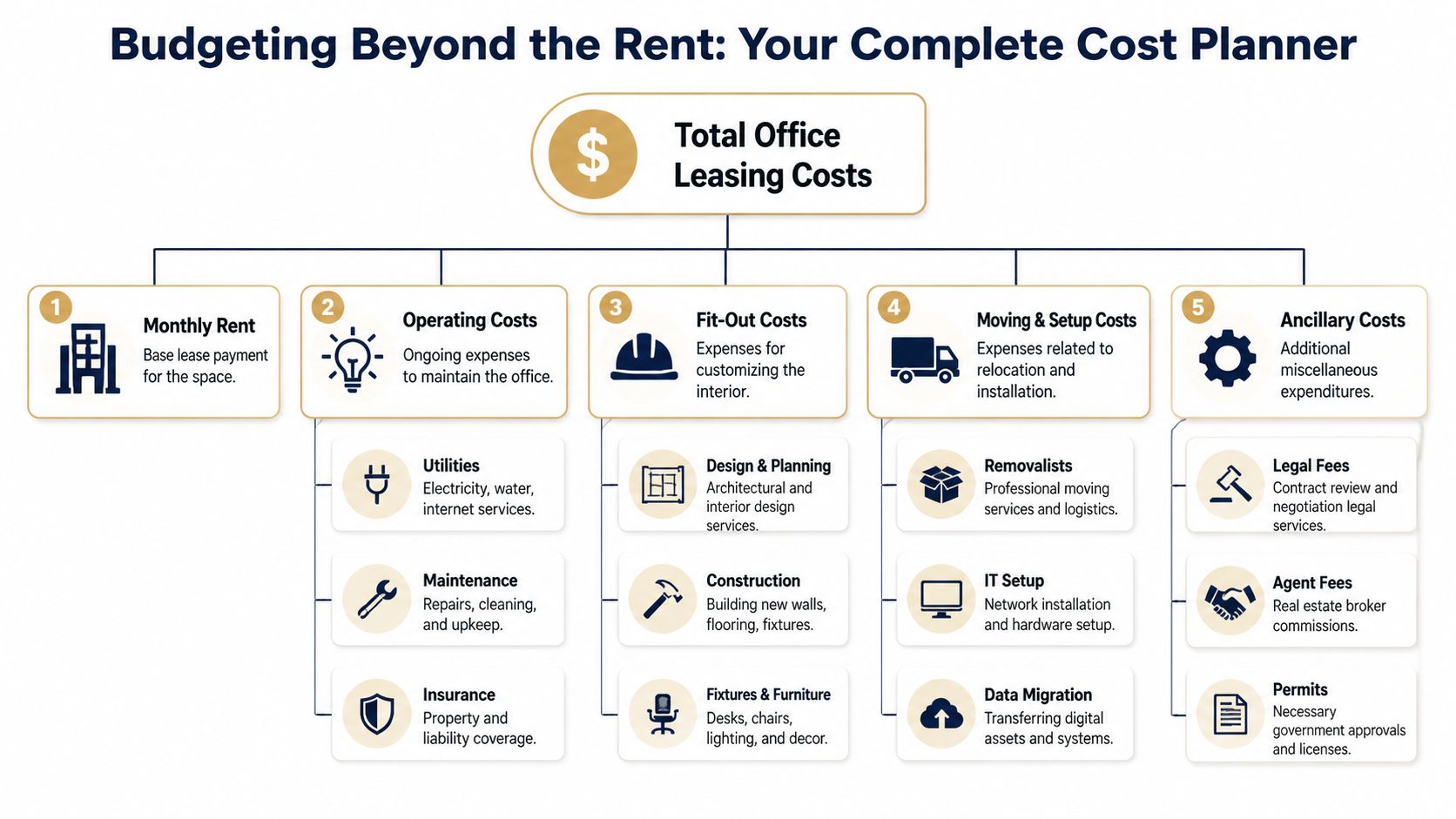
The total cost of occupation includes legal work, surveys, professional advice, rates, service charge, IT setup, furniture, fit-out works, signage, removals, approvals, and eventual reinstatement. If those costs are not mapped at the start, the move can look affordable on paper and painful in practice.
The costs that catch tenants out
Some costs are obvious. Others arrive later and feel like surprises only because they were never modelled properly.
A practical cost planner should include:
- Property costs such as rent, business rates, service charge, insurance, and utilities
- Professional fees including solicitor review, surveys, and any agent support
- Physical move costs such as removals, comms room setup, furniture delivery, and installation
- Fit-out items from drawings and approvals through to partitions, finishes, furniture, and signage
- Exit costs including reinstatement, repairs, cleaning, and dilapidations settlement
For teams trying to structure an early capex plan, a guide to interior project budgeting is useful because it helps separate design spend, build spend, and setup costs in a practical way.
Why the fit-out budget belongs in the lease conversation
Fit-out is often treated as a later project. That’s a mistake. The more expensive the planned works, the more important the lease wording becomes.
If the tenant needs meeting pods, glazed rooms, data-heavy collaboration areas, or branded finishes, the lease must support that. The licence for alterations, reinstatement obligations, access periods, and landlord approvals all shape the final cost. A budget should also test whether the building’s existing condition reduces spend or hides future liability.
A useful starting point is to compare the lease against a fuller fit-out model, such as this guide to office fit out cost. That makes it easier to see whether the deal still works once the actual occupation costs are added in.
This matters just as much in Essex as it does anywhere else. A lower rent on a poor building can still become the more expensive option if the tenant has to spend heavily to make it workable.
Integrating Your Office Fit Out for Maximum Value
A well-negotiated lease can still deliver a poor workplace if the fit-out thinking starts too late. The building may be secured, but the day-to-day experience can still fail. That usually happens when legal, commercial, and design decisions are made in isolation.

Category A and Category B in plain English
Landlords often talk about Category A and Category B. Tenants need to understand the difference early.
Category A usually means the basic shell is ready for occupation in a generic sense. That can include ceilings, lighting, core services, flooring in some cases, and decorated walls. Category B is the part that turns a shell into a working office for a specific occupier. That includes partitions, furniture, branding, tea points, collaboration zones, quiet rooms, and specialist features.
The key point is simple. The lease and the fit-out can’t be separated neatly. A tenant that accepts space as-is may gain speed and cost savings, but it also needs to know what can be adapted, what approvals are needed, and what may need to be removed later.
Design decisions that affect lease value
Office utilisation data has changed how sensible fit-outs are planned. UK office utilisation has averaged 42%, creating an annual cost of £1,200 per unused desk, according to this workplace utilisation report. The same source notes that smart design interventions such as glass partitions and acoustic pods can boost effective utilisation by up to 18%.
That doesn’t mean every office needs the same kit. It means poor space planning has a cost, and layout choices should respond to how people work.
Useful design questions include:
- Where is privacy really needed for calls, HR conversations, and focused work
- Which meetings need enclosure and which can happen in open collaboration areas
- How much flexibility is required if team structures change
- What should stay modular so the office can be adapted without major rebuild
- Which finishes are durable enough to reduce repair and reinstatement pain later
On site advice: A meeting pod is not a design accessory. It’s a tool for reclaiming usable space in an office that can’t keep building more rooms.
For teams planning new layouts, Facility Management Insights’ planning tips offer a helpful external view on translating attendance patterns into room mix and workplace zoning.
Choosing products that solve real workplace problems
Product choice should follow a workplace need. If the office suffers from noise spill, glazed fronts alone won’t solve it. If hybrid teams need enclosed call space without a full construction programme, modular pods may be the better answer. If a legacy office looks tired but the programme is tight, architectural wrapping can refresh surfaces quickly without major strip-out.
Manufacturers matter too. Acoustic pod options from Vetrospace, BlockO, and Framery each suit different visual and functional briefs. Some clients want a strong design statement. Others want compact, practical units that can be relocated if the space changes.
At this stage, the earlier leasing choices pay off. If the tenant has already negotiated access, approval routes, contribution levels, and sensible reinstatement terms, the fit-out team can focus on performance rather than workaround after workaround.
For occupiers in Cambridge and Braintree, that joined-up thinking often makes the difference between a workspace that merely looks finished and one that truly works.
Planning Your Exit Dilapidations and End of Lease Strategy
Dilapidations worry most tenants because they are often left too late. The fear is understandable, but the process is manageable when the right decisions are made early.
The lease sets the legal position, but the practical outcome depends on records, maintenance, approvals, and how the fit-out was carried out. A tenant that can show what was there at the start, what was added later, and what condition the premises were kept in is in a much stronger position than one relying on memory and old emails.
Dilapidations are manageable when planned early
The scale of the issue is real. Average UK dilapidations claims reached £1.2 million per property in 2024-2025, with disputes rising 25%, according to this end-of-lease insight. The same source notes that tenants who use specialist fit-out support and negotiate proactively can prevent cost overruns of 30-50%.
Those figures are large, but they should push tenants toward planning, not panic.
A sound approach usually includes:
- A proper Schedule of Condition at the start, with dated photos and clear notes
- Controlled alterations records so every landlord approval is easy to retrieve
- Mid-term reviews of wear, repairs, and space changes rather than waiting until the last year
- Early dilapidations advice before notice is served or exit works are priced
- A reinstatement plan that separates essential work from landlord overreach
Tenants often lose money on dilapidations for simple reasons. Missing records, rushed strip-out, and no challenge to the claim.
What reduces end-of-lease risk
Not every office needs to be stripped back to bare shell. That depends on the lease, later licences, and what the landlord wants for reletting. Some improvements may add value. Some may be accepted in place. Others will need removal.
The most effective tenants don’t wait for the terminal schedule to learn what the landlord expects. They ask earlier. They also avoid overfitting the space in ways that are costly to reverse unless there is a clear business case for doing so.
Hertfordshire occupiers often face this issue in mixed-age building stock where documentation is inconsistent and past alterations are poorly recorded. The same challenges apply further afield, including projects in Milton Keynes, where early reinstatement planning can protect both budget and programme.
Flexible Futures Subleasing and Post 2026 Lease Strategies
A lease shouldn’t assume the business will stand still. Teams change. Attendance patterns shift. Departments grow and shrink. Space that felt right at signing can become awkward later.
That’s why flexibility needs to be built into office space leasing before the document is final. Leaving it until the business wants to dispose of surplus space is usually too late.
Subletting sounds simple until the lease says otherwise
Subletting has become more common. With UK office vacancy rates at recent highs, subletting unused space rose by 35% in 2025, but 60% of deals fail because of restrictive alienation clauses, according to this leasing flexibility analysis.
That failure rate tells its own story. Subletting isn’t just a marketing exercise. The lease may restrict who can take space, on what terms, at what rent level, with what approvals, and whether part-only subletting is allowed.
How to build flexibility into the original deal
The best time to negotiate flexibility is before completion. After that, negotiating power diminishes.
A tenant looking for future options should review:
- Alienation wording so assignment and subletting are workable in real life
- Break rights that can be exercised without unrealistic conditions
- Part-only disposal rights if the business might not need the whole floor later
- Alteration rights that support reconfiguration for shared or sublet use
- Documentation discipline so consent processes don’t become a bottleneck
There are trade-offs. Flexible rights can make a landlord more cautious, and a shorter commitment may reduce the support they offer at the start. But a rigid lease can be much more expensive if the business later needs to reshape its footprint.
This applies whether the office is in Chelmsford or Stansted. It also matters for firms planning regional change in Dartford, Luton, or Colchester, where future adaptability can be worth more than a small day-one saving.
Conclusion Your Partner in Workspace Transformation
The best office space leasing decisions are made with the whole tenancy in mind. The lease, the fit-out, the day-to-day operation, and the exit plan all affect each other. When those parts are handled together, costs are clearer, risk is lower, and the finished space works harder for the business.
For readers who want a wider view of the property side of the market, it’s worth taking time to explore commercial real estate insights from JRG Property UK Ltd alongside the practical workplace points covered here.
Ready to transform your workspace? Speak to the GIBBSONN Interiors team today. Whether support is needed with office fit out, refurbishment, dilapidations, partitioning, or pod solutions, the team is here to help. Contact Us