
Your 2026 Guide to UK Office Space Rental Prices
Table of Contents
If you’re starting the search for a new office, you’ve probably noticed that rental prices seem to be all over the map. That’s because they are. The simple truth is that costs vary hugely based on location, building quality, and what’s included in your deal. This makes it incredibly difficult to compare your options fairly.
What to Expect From the Market in 2026
Finding the right home for your business is a massive decision, and the headline rent is often the first number you see. But to make a truly smart choice, you have to understand what’s actually baked into that price tag. This guide will walk you through everything, giving you the confidence you need to navigate the market.
First, we’ll get to grips with the different ways rent is quoted, from the traditional per-square-foot model to the more modern per-desk price. This is crucial for fairly comparing a conventional lease in an Essex business park with a flexible desk space in a bustling city centre. We’ll also unpack the key factors that make one office command a premium over another.
The UK office rental market is nothing if not diverse. A space in a prime London location will naturally carry a much higher price tag than a similar-sized office in a regional hub. A recent Statista report confirmed this, highlighting that prime rents in London’s West End remain the highest in the UK. To give you a clearer picture, here’s a quick snapshot of what you can expect to pay for top-tier office space across a few key UK cities.
These figures from a 2026 forecast show the typical range for ‘prime’ (the highest quality) office space. It’s a great way to benchmark costs as you begin your search.
A Quick Look At UK Prime Office Rents 2026 (Per Sq Ft)
| City | Prime Rent per sq ft (Low) | Prime Rent per sq ft (High) |
|---|---|---|
| London (West End) | £110 | £145 |
| Cambridge | £50 | £63 |
| Manchester | £40 | £45 |
These numbers give you a solid baseline, but they don’t tell the whole story. The “total cost of occupancy” involves much more than just the rent. Later in this guide, we’ll explore how a strategic office fit-out can help you get the most value from every pound of your rental spend. With clever design, even a smaller footprint can feel spacious and boost productivity, offering big long-term savings.
How Office Rental Prices Are Really Calculated
When you first dive into commercial property, the pricing can feel like a foreign language. One agent quotes a price per square foot per year, while the next offers a simple per desk per month fee. It’s enough to make your head spin, but once you understand the two main ways rent is calculated, you can compare apples with apples.
For traditional office leases, the industry standard is to price the space per square foot (£/sq ft) per year. Think of this as the base cost for the raw, empty space. In contrast, the flexible and serviced office market almost always uses a per desk per month model, which typically bundles many other costs into one figure.
Breaking Down the Numbers with Examples
Let’s put this into practice. Say you’re a business with a team of 10, looking at two different options.
- Option 1: The Traditional Lease
You find a promising 1,000 sq ft office in Braintree advertised at £25 per sq ft. The calculation for your annual rent is straightforward: 1,000 sq ft x £25 gives you a headline figure of £25,000 per year. But that’s just for the four walls. You’ll still need to budget separately for business rates, service charges, utilities, and internet. - Option 2: The Serviced Office
Down the road, a serviced office is offering space for £350 per desk per month. For your team of 10, that’s 10 desks x £350, which comes to £3,500 per month, or £42,000 per year. While that seems a lot more expensive at first glance, this price usually covers everything: rent, rates, heating, Wi-Fi, and even access to shared kitchens and meeting rooms.
This simple breakdown shows how rent is quoted and, crucially, how design and fit-out complete the picture.
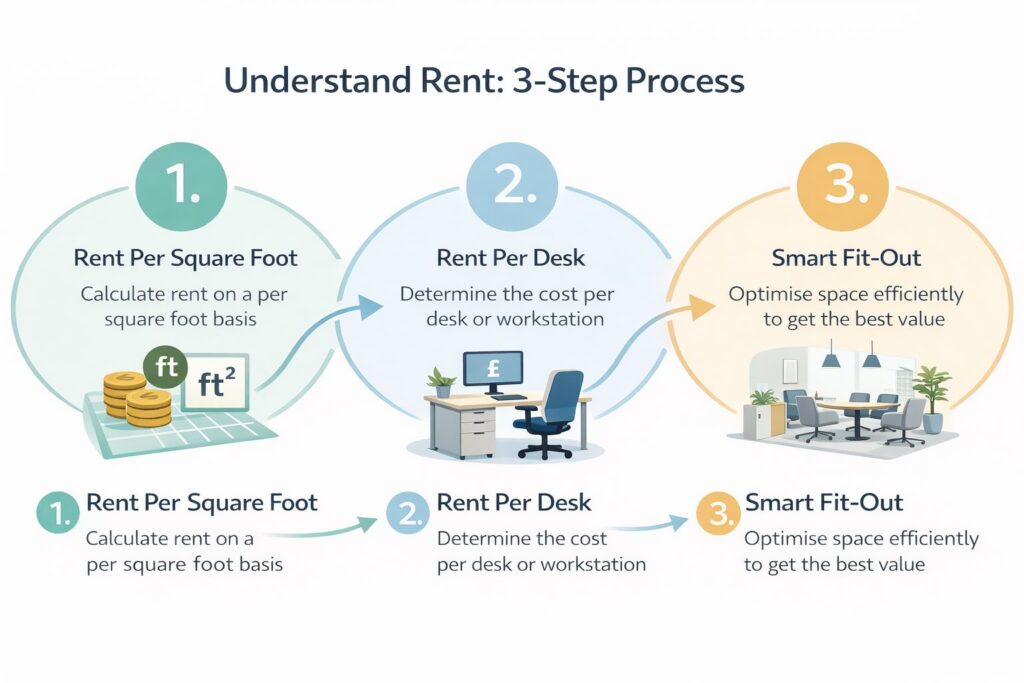
As you can see, figuring out if you’re paying per square foot or per desk is just the starting point. It’s the smart fit-out that turns that space into a productive and valuable asset for your business.
All-Inclusive vs. Traditional Leases
The real difference between these two models comes down to what’s included in the price you’re quoted. A traditional lease gives you the keys to an empty shell. This gives you complete freedom to design the layout and create a bespoke environment, but it also means you’re responsible for every additional cost. This is often called an **exclusive** price because it *excludes* all the bills and operational charges.
On the other hand, an all-inclusive price, which is the norm for serviced offices, bundles everything into a single monthly payment. It’s simple, predictable, and requires very little management. This makes it a popular choice for startups and smaller businesses that need to get up and running quickly.
Whenever you’re viewing a potential office, make sure you ask for a full, itemised breakdown of all costs. This is the only way to accurately compare different spaces and avoid any nasty surprises. Getting to grips with your total cost of occupancy is the key to making a sound financial decision for your business, whether you’re in Hertfordshire or anywhere else in the UK.
The Main Factors Affecting Office Rent
Have you ever wondered why an office in one part of a city costs double the price of a similar one just a few miles away? It’s not random. A few key factors are behind the huge differences you see in office rental prices. Understanding these drivers will help you know what you’re really paying for and decide what’s essential for your business.
1. Location, Location, Location
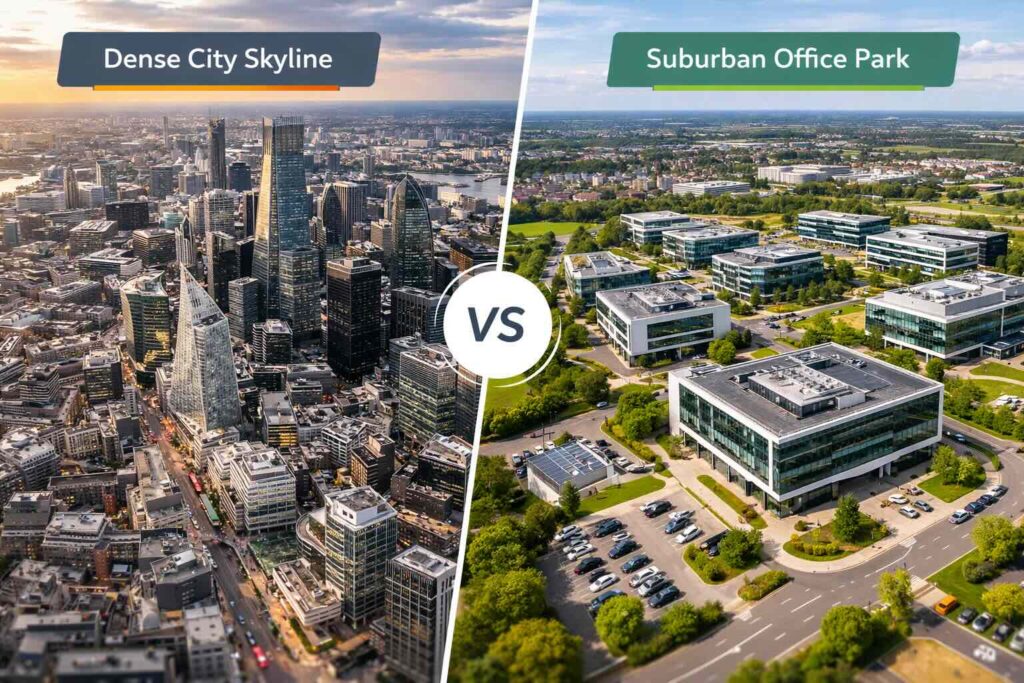
It’s the oldest rule in the property book for a reason. Where your office is located is the single biggest factor dictating its price. A postcode in a central business district brings prestige, fantastic transport links, and easy access to clients and talent. All of which push rents up.
For instance, an office in the heart of Stansted will always have a different price point to a business park in Essex. It all comes down to supply, demand, and pure convenience. This regional gap is clear when you look at the numbers. Data for 2025 heading into 2026 from Oktra’s in-depth office space report shows prime rents in London can climb as high as £182.50 per square foot. Meanwhile, a thriving innovation hub like Cambridge sits around the £50 to £62.50 mark.
2. Building Quality and Grade
Not all office buildings are created equal. They are typically categorised into three unofficial grades, which have a massive impact on the rent you’ll pay. Knowing these grades helps you match your budget and brand to the right type of property.
- Grade A: These are the best of the best. Think new or recently refurbished buildings in prime locations, complete with high-end finishes, impressive lobbies, and state-of-the-art systems. They naturally command the highest rents.
- Grade B: These are solid, functional buildings that are just a little older. Their common areas might be a bit dated, but they’re perfectly suitable for most businesses and strike a great balance between quality and cost.
- Grade C: This is your most budget-friendly option. These buildings are often over 20 years old with minimal upgrades. They are purely functional spaces for businesses where price is the top priority.
3. Lease Length and Amenities
Finally, two other crucial elements come into play: the length of your lease and the amenities on offer. Landlords love security, so they’ll often give you a better rate per square foot if you’re willing to sign a longer lease, say, five or ten years. A shorter, more flexible lease of one to three years will almost always come at a higher price.
The facilities a building provides also add to the final cost. Modern offices are in a race to attract tenants with desirable amenities. These can include anything from on-site gyms and cafes to dedicated event spaces, secure bike storage, and professional reception services. While these perks add to the headline rent, they can also boost employee wellbeing and help you attract and retain top talent. The key is to decide which factors are ‘must-haves’ and which are ‘nice-to-haves’. A clear understanding of your priorities is the foundation of any successful property search, and our guide on developing a workplace strategy can help you define exactly what you need.
How Smart Office Design Impacts Your Total Spend
When you’re budgeting for a new office, it’s easy to get fixated on the headline rent. But that figure is just one part of a much bigger financial picture. The real story of your total occupancy cost is often written in how you design and use the space.
A professional, well-thought-out office fit-out isn’t just an aesthetic upgrade; it’s a powerful financial tool. It’s about making every square foot you pay for work smarter, not just look prettier. Smart design helps you squeeze maximum value from your lease, boosts productivity and team morale, and can even let you thrive in a smaller, more cost-effective footprint without feeling the pinch.
Smart Space Planning in 2026
Great space planning is the secret weapon of an efficient office. In the past, the standard playbook was to allocate a generous 100-150 square feet per person. But the world of work has changed. With hybrid models and dynamic layouts, that old rule of thumb is becoming obsolete.
Let’s put that into perspective. Say you have a team of 30 people. A traditional layout might have you signing a lease for a 3,000 sq ft office. But with a clever fit-out that incorporates hot-desking, collaborative breakout zones, and private focus areas, you could find that a 2,200 sq ft space supports your team just as effectively. The savings on rent over a five-year term can be enormous. It can often far outweigh the initial fit-out investment.
The Rise of Flexible and Modular Solutions in 2026
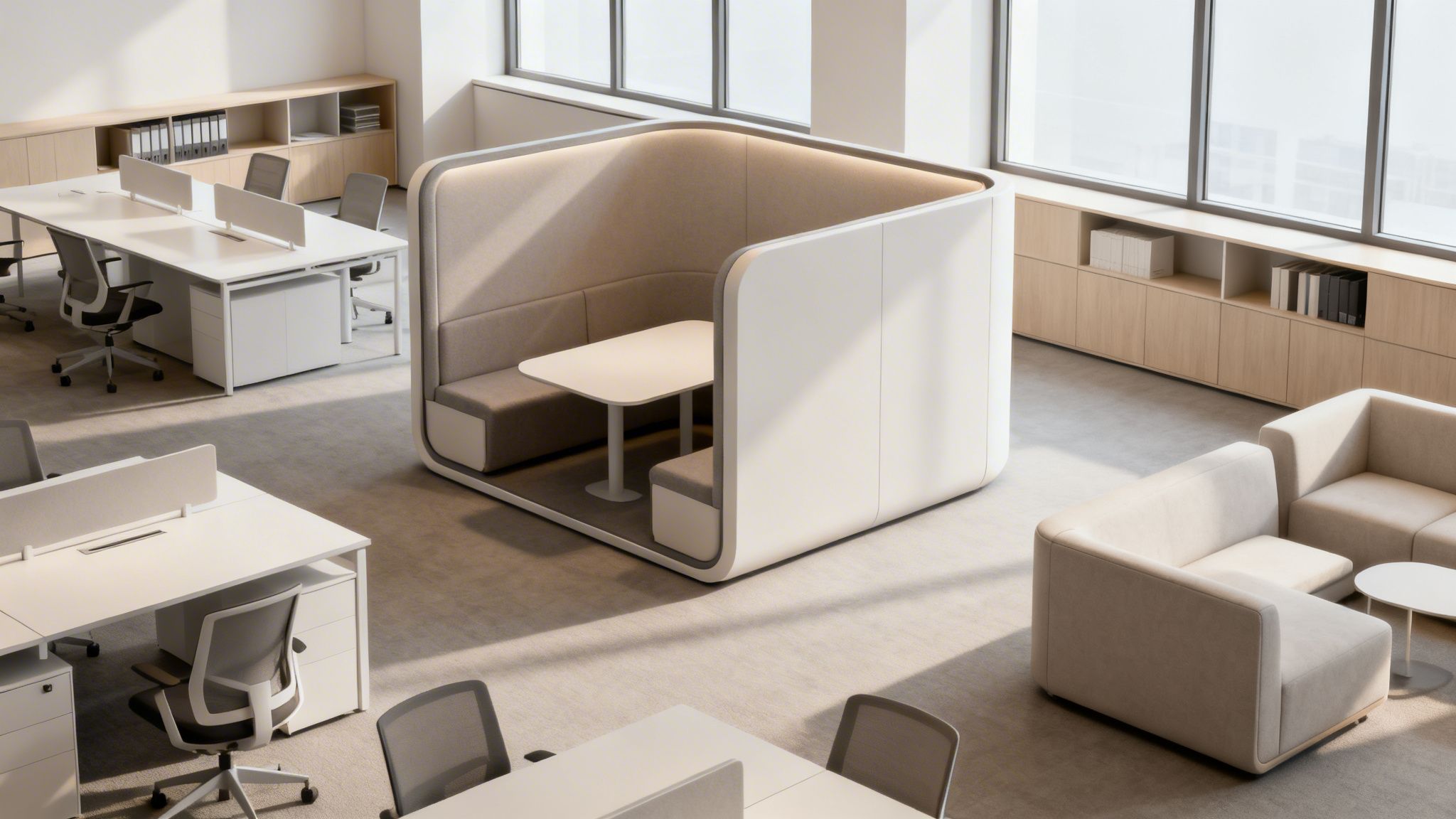
Business isn’t static, so why should your office be? Teams expand, projects shift, and the need for meeting rooms one quarter might give way to a need for quiet pods the next. This is where modular, flexible solutions truly shine. Instead of committing to permanent walls that are expensive to build and even more expensive to remove, you can embrace agility.
Acoustic meeting pods are a prime example. Top-tier pods from brands like Vetrospace or BlockO offer soundproof sanctuaries for confidential calls or small team huddles. They can be installed in a matter of hours with zero construction mess. The best part? They are assets you own. When your lease ends, you simply take them with you.
This approach completely sidesteps the headache of dilapidations, which is the contractual obligation to return the space to its original condition. To get a better handle on what’s involved, you can learn more about office fit-out costs in our detailed guide.
Smart Fit-Out vs Traditional Build: A Cost Idea
To see how this plays out financially, it helps to compare the two approaches. This table breaks down the long-term cost implications of choosing a flexible fit-out over a traditional build.
| Feature | Flexible Fit-Out (e.g. Pods) | Traditional Build (e.g. Walls) |
|---|---|---|
| Upfront Cost | Higher initial product cost | Lower initial material cost |
| Flexibility | High, can be moved or reconfigured | Low, permanent structure |
| End of Lease | Take it with you, zero dilapidation cost | Costly to remove and make good |
While the initial purchase price of a pod might be higher than the materials for a stud wall, its value is realised over the entire lease and beyond. It’s a one-time investment that moves and adapts with you, not a sunk cost tied to one building.
Turning Your Rental into a Brand Asset for 2026
Ultimately, your office space is a physical version of your company’s brand, culture, and ambition. It’s the first impression you make on a new client and the daily reality for your team. A drab, uninspired office sends one message; a vibrant, thoughtfully planned workspace communicates something else entirely.
A professional fit-out transforms an empty shell from a simple overhead into a strategic brand asset. At Gibbsonn Interiors, we partner with businesses in places like Chelmsford to do just that. We create environments that don’t just work efficiently but feel inspiring. When your space aligns with your values, you build a powerful magnet for attracting top talent and fostering a team that is proud of where they work.
What’s the Outlook for Office Rents After 2026?
Right then, let’s look beyond the immediate future. What’s the office rental market got in store for us after 2026? While we don’t have a crystal ball, the patterns emerging today paint a pretty clear picture of where we’re headed. For any business planning its next big move, understanding these shifts isn’t just smart, it’s essential for long-term survival.
The one trend that stands out is a steady, undeniable rise in office rental prices. It might sound strange with all the talk about remote work, but the appetite for high-quality, modern office space is as strong as ever. As we look past 2026, landlords are set to be in the driver’s seat, especially for buildings that tick all the boxes for today’s workforce.
What’s Driving the Price Hike?
So, what’s really fuelling this upward pressure on rents? It boils down to a few key factors, but the biggest is a “flight to quality.” Businesses have realised the office can’t just be a place to put desks anymore. It has to be a destination, an experience that pulls people away from their home office. This is increasing the demand for:
- Energy-Efficient Buildings: With energy costs soaring and stricter regulations on the horizon, a building’s Energy Performance Certificate (EPC) is no longer a footnote. It’s a headline feature, and spaces with excellent ratings are gold dust.
- Spaces Built for Hybrid Work: The modern office needs to be adaptable, effortlessly supporting focused individual tasks one moment and vibrant team collaboration the next. This means smart layouts with breakout zones, private pods, and flawless tech.
- Prime Locations: An easy commute has always mattered, but now it’s a deal-breaker. Buildings with brilliant transport links and great local amenities like coffee shops, gyms, and lunch spots will always command a premium because they make the journey worthwhile.
The long-term forecasts back this up. In their commercial property predictions and their drivers in their detailed statistical report, the Alan Boswell Group suggests that average commercial office rents in England could climb by over 19% between 2024 and 2034. That’s a jump from roughly £94 to £112 per square foot.
Protecting Your Business for 2026 and Beyond
With rents on an upward march, how do you shield your business from those climbing costs? The answer is to play the long game, starting today. Stop focusing only on the headline rent and start thinking about your total cost of occupancy and how intelligent design can bring it down.
One of the most powerful strategies is investing in a high-quality, adaptable office fit-out. By genuinely optimising your layout, you might discover you need far less square footage than you first thought, slashing your rental bill right from the off. Bringing in modular solutions like meeting pods gives you the power to reconfigure your space as your team evolves, without the expense and disruption of major construction work.
This kind of forward-thinking turns your office from a simple overhead into a hard-working strategic asset. It’s about future-proofing your business against market volatility and ensuring your workspace remains a powerful engine for productivity and growth, no matter what happens to office space rental prices down the line.
Your Next Steps and Final Checklist
Defining Your Budget and Must-Haves
So, you’ve got a much better handle on office rental prices and the market forces at play. Where do you go from here? Before you even think about browsing property sites, the most important work happens internally. It’s all about nailing down your budget and identifying your absolute must-haves.
First, map out your total occupancy budget. This is a common pitfall. The headline rent is never the final figure. You need to account for business rates, service charges, utilities, and insurance. As a good rule of thumb for a traditional lease, we advise clients to add 15-25% on top of the base rent to get a realistic all-in cost.
With a budget in place, create two simple lists: your ‘Needs’ and your ‘Wants’.
- Needs: These are the complete non-negotiables. Think about the minimum desk count, essential transport links, or a professional reception.
- Wants: These are the nice-to-haves. Perhaps an on-site gym, a private roof terrace, or premium end-of-trip facilities. This simple exercise keeps your search grounded and stops you from getting sidetracked by features that don’t serve your core business objectives.
The Search and Negotiation Phase
With your budget and checklist ready, the exciting part begins: the property search. Cast your net wide. Explore everything from conventional leases in areas like Dartford to the flexibility of serviced offices. It’s often wise to view a few properties that are slightly over budget, as asking prices are rarely the final word.
When you find a space that feels right, remember that nearly every aspect of the deal is on the table.
Always approach negotiation by looking at the total value of the deal, not just the rent per square foot. This could mean securing a generous rent-free period, negotiating a landlord contribution towards your fit-out, or including a break clause for future flexibility. And, of course, always have a solicitor review any lease agreement before you sign.
Planning The Perfect Fit-Out
Securing the right building is just one part of the puzzle. The real magic happens when you transform that empty shell into an environment that genuinely works for your people and your brand. This is where a professional fit-out partner becomes essential.
Bring your fit-out team into the conversation early, sometimes even before a lease is signed. An expert can assess a potential space and give you an honest view of what’s possible, helping you visualise the layout. They’ll help you craft a design that maximises every square foot, embodies your company culture, and creates a workspace your team is proud of.
This is also the time to get ahead of your end-of-lease responsibilities. Understanding what a dilapidation survey entails right from the start can save you a lot of money and stress when your tenancy eventually ends.
Final Pre-Move Checklist
As moving day approaches, a final checklist is your best friend for a seamless transition. Think of this as your project plan for the final, crucial weeks to ensure nothing falls through the cracks.
- Confirm All Costs: Do a final review of all agreed terms, service charges, and fit-out quotations. No surprises.
- Set Up Utilities: Make sure electricity, water, and especially your broadband are all scheduled to be active for day one.
- Plan the IT Setup: Liaise with your IT provider to coordinate the installation of servers, networks, and workstations.
- Coordinate with Movers: Book a reputable commercial moving company well ahead of time.
- Communicate with Your Team: Keep your staff in the loop on the move-in date, the new address, and any changes to their daily commute.
Finding the right office at the right price is a huge milestone. By taking a structured approach, you can move forward with the confidence that you’ve made a strategic investment that will support your company’s growth and culture for years to come.
Ready to transform your workspace? Speak to the Gibbsonn Interiors team today.
Contact Us