
Organizations begin considering an interior office fit out when the space stops matching how people work. Desks feel cramped, meeting rooms are always full, quiet work is hard to find, and the office no longer reflects the standard of the business itself. The layout may have worked a few years ago. It often doesn’t work now.
An interior office fit out is the process of making an internal commercial space ready for real use. That can mean turning a blank shell into a functioning workplace, or reshaping an existing office so it supports current working patterns, brand identity, staff wellbeing, and day-to-day efficiency. It covers the practical side, such as partitions, finishes, power, lighting, and furniture, but it also covers how the space feels and performs.
For many businesses, the challenge isn’t deciding whether change is needed. It’s knowing how to approach it without delays, wasted spend, or disruption to operations. A good fit out solves those concerns through proper planning, realistic budgeting, careful delivery, and smart choices that still make sense years later.
Projects vary widely across the UK. Priorities in London often differ from those in regional business centres, but the basics stay the same. The office has to work hard, look right, and stay practical over time. That applies just as much in Hertfordshire as it does in larger city locations.
Table of Contents
- Introduction Your Complete Guide to an Interior Office Fit Out in 2026
- Why a 2026 Office Fit Out is Your Best Business Move
- The Five Key Stages of an Office Fit Out Project
- Budgeting and Timelines for Your 2026 Fit Out
- Bringing Your 2026 Vision to Life with Modern Solutions
- Navigating UK Compliance and Technical Details
- How to Choose Your Perfect Office Fit Out Partner
- Frequently Asked Questions About Office Fit Outs
- Conclusion Let's Build Your Future Workspace
Introduction Your Complete Guide to an Interior Office Fit Out in 2026
By 2026, most offices won’t be judged only by how they look. They’ll be judged by how well they support the people using them every day. That means giving teams proper places to focus, meet, take calls, collaborate, and reset. If the space can’t do that, it starts to hold the business back.
A strong interior office fit out brings structure to that problem. It turns underused floor space into something organised and useful. It helps businesses make better use of square metres they already pay for. It also removes the patchwork effect that builds up when offices are changed bit by bit over time.
The best fit outs aren’t built around trends alone. They’re shaped by how the business works, who uses the space, what the lease allows, and what has to happen after handover. A finance office, a healthcare admin hub, and a creative studio may all want a modern finish, but they won’t need the same plan.
Practical rule: A fit out should solve working problems first and design problems second. When that order is reversed, the office often looks better but works worse.
A sensible project usually comes down to a few key decisions:
- Space use: Where does focused work happen, and where does collaboration belong?
- Privacy: Does the team need enclosed rooms, pods, or just better zoning?
- Performance: Are lighting, acoustics, and thermal comfort helping or hindering the day?
- Flexibility: Can the space adapt if headcount, teams, or lease terms change?
- Lifecycle value: Will today’s design choices create costs at end of lease?
This matters in established business locations as much as it does in growing towns such as Bishop’s Stortford. Businesses want a workplace that feels current, but they also want a process that feels controlled and calm.
Why a 2026 Office Fit Out is Your Best Business Move
A well-planned office fit out isn’t a cosmetic exercise. It changes how people move through the day, how clients read the business, and how much value a company gets from its space. That’s why the strongest projects are tied to business aims from the start.

A better office changes behaviour
When teams are forced to do every task in one type of space, the office becomes frustrating very quickly. Focus work gets interrupted. Informal catch-ups drift into noisy desk areas. Video calls happen in walkways or corners. Staff adapt, but not efficiently.
A fit out fixes that by creating the right mix of environments. Open desks still matter, but so do enclosed meeting rooms, quiet booths, breakout areas, and well-placed touchdown points. The layout should guide behaviour without needing rules pinned to the wall.
Poor acoustics are one of the biggest hidden problems in open-plan offices. HSE workplace studies found that poor acoustics can cause a 15-23% productivity drop, while modern modular meeting pods can achieve Rw 38-45 dB and contribute to an 18% improvement in wellbeing scores, according to the verified data provided for this article. That’s why acoustic planning shouldn’t be left until late in the job.
A smart office doesn’t try to make one space do everything. It gives each task a proper setting.
The office still shapes first impressions
Clients, recruits, and partners all read a business through its workspace. They notice whether reception feels considered, whether meeting rooms are well set up, and whether the whole place feels coherent. A tired interior sends a message, even when nobody says it out loud.
That doesn’t mean every office needs to be flashy. In fact, over-designed spaces often age badly. What works better is clear branding, good materials, simple detailing, and a plan that feels confident without trying too hard.
The office also helps with hiring and retention. People want a workplace that feels organised, comfortable, and worth commuting to. They notice light, air, privacy, storage, and whether the day feels easier in the space. Those things aren’t soft extras. They influence whether people want to stay.
A good fit out also creates confidence internally:
- Leadership sees control: budget, programme, and output are aligned
- Staff see investment: the business has improved the space they use every day
- Visitors see standards: the workplace matches the quality of the service or product
- Landlords see care: the premises have been improved properly and thoughtfully
For many companies, that combination is what turns a fit out from a spend into a business decision.
The Five Key Stages of an Office Fit Out Project
Most fit out problems begin before any building work starts. They come from unclear briefs, rushed decisions, or a gap between design ambition and delivery reality. A structured process avoids that.
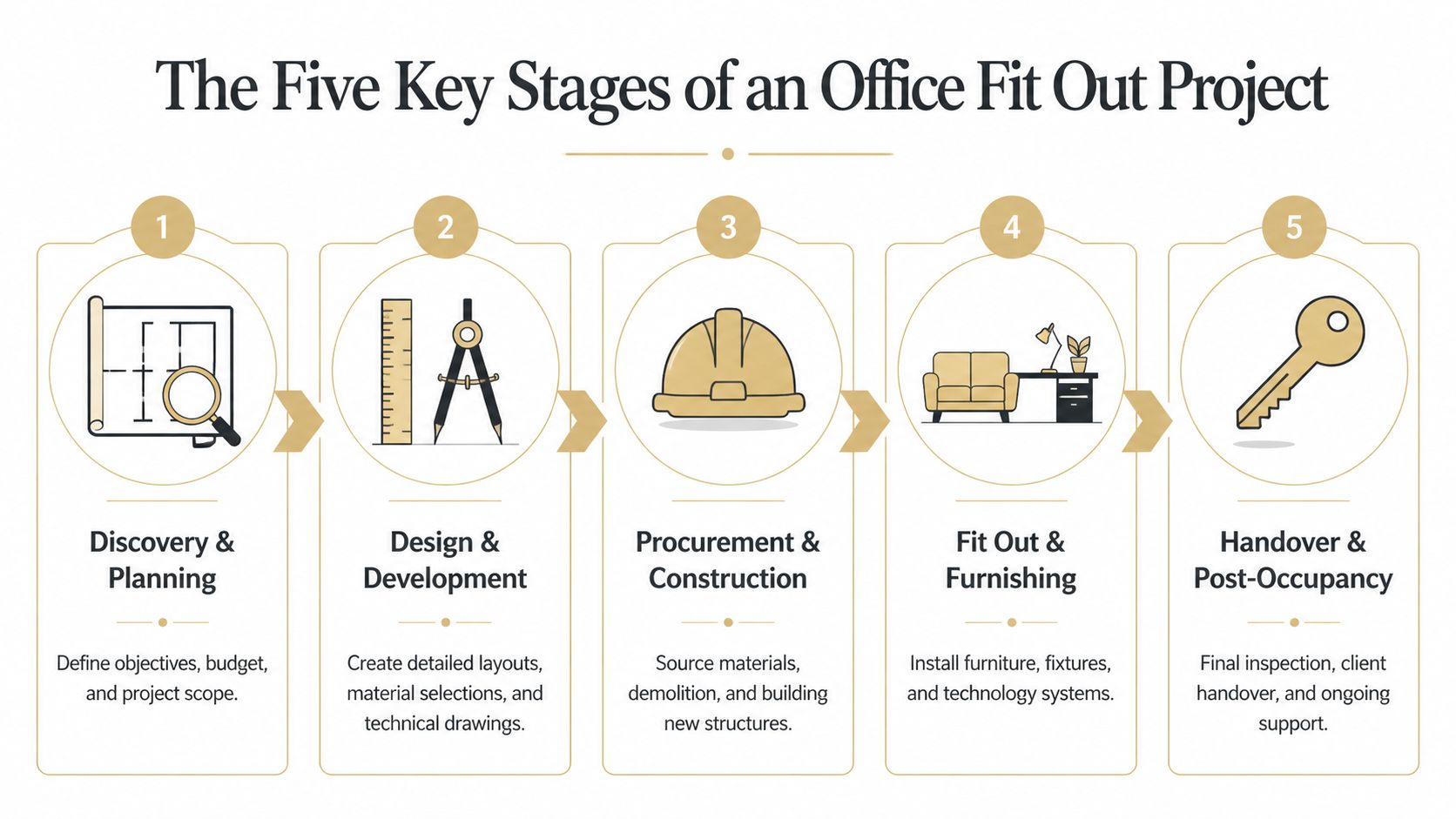
1 Discovery and planning
The first stage is about defining what the office needs to do. Not what looks good on a mood board. What the business needs.
This means reviewing headcount, departments, workflows, storage, privacy needs, and future plans. It also means understanding any constraints tied to the building, the lease, or live operations. A small mistake here can ripple through the entire programme.
Some clients arrive with a clear brief. Others know the problems but not the solution. Both are workable, as long as the early conversations are honest.
2 Design and space planning
Once the brief is clear, the design starts to take shape. This stage usually covers layout options, zoning, finishes, furniture direction, lighting intent, and technical coordination. The goal is to make the office work on paper before anything is ordered or built.
A strong design phase balances appearance with practicality. Glass partitions may improve flow and light. Pods may solve privacy issues without hard-building extra rooms. Architectural wrapping may refresh tired surfaces without full replacement.
Visual tools help clients make decisions faster. That can include plans, 3D views, finish boards, or simple material samples. It also helps to review how each area will be used over a normal working week.
Site reality check: If a design only works when every team behaves perfectly, it probably won’t work in practice.
3 Pre-construction and approvals
This is the stage many businesses underestimate. Procurement, approvals, lead times, landlord coordination, and building compliance all sit here. If this stage is thin, the build stage usually becomes messy.
Items often covered include:
- Technical drawings: Detailed information for partitions, electrics, lighting, and finishes
- Landlord approvals: Consent for works where leases require it
- Compliance review: Building Regulations, fire strategy, and access considerations
- Programme planning: Sequencing noisy or disruptive works around business needs
- Procurement: Ordering long-lead products before they delay the site team
A dedicated project lead matters at this point. There should be one person coordinating suppliers, trades, approvals, and communication. For businesses comparing delivery methods, this guide to office fit out project management is useful reading because it shows why single-point accountability makes such a difference.
4 Build and installation
People often expect drama. In reality, the cleanest fit out projects are calm because the decisions were made earlier.
The build phase can include strip-out, partitioning, flooring, decorating, M&E works, furniture install, pod placement, and final finishing. In live offices, the sequence matters as much as the workmanship. Noisy works may need to happen outside core hours. Dust control, access routes, and temporary working arrangements all need active management.
The best delivery teams don’t just build. They communicate. Clients should know what’s happening, what’s next, and where decisions are still needed.
5 Handover and post-care
Handover isn’t just a key exchange. It should include snagging, final checks, operating guidance, and a clean transition into occupation. If pods, glazing systems, or specialist finishes have been installed, the client team should know how to use and maintain them properly.
This stage is also where future value is protected. Records, warranties, product details, and as-built information help with maintenance, future changes, and end-of-lease planning.
A good fit out feels finished on day one. A great fit out still makes sense years later.
Budgeting and Timelines for Your 2026 Fit Out
A budget usually starts with one question. “What will this really cost us by the time we move in?” The honest answer is that the headline fit out figure is only part of the picture. Furniture, IT coordination, landlord approvals, temporary decant costs, and end-of-lease obligations can all change the true spend.
That matters even more in 2026, because many occupiers are balancing two costs at once. They are funding a new space while still carrying dilapidations exposure on the old one. A fit out plan that ignores that overlap can look affordable on paper and still put pressure on cash flow later.
What drives the cost
Regional pricing still sets the baseline. London generally commands a higher rate than Manchester, Birmingham, or regional business parks because labour, logistics, building rules, and supply chains are tougher to manage. The final figure then moves up or down based on what the building gives you to start with and how much change the business needs.
In practice, five items shape the budget fastest:
- Base building condition: Older offices often need more strip-out, testing, upgrades, and making-good than expected
- Mechanical and electrical changes: Lighting, small power, data, HVAC, and fire alarm alterations can absorb a large share of the spend
- Layout complexity: More cellular rooms, acoustic treatment, glazing details, and joinery usually mean more labour and coordination
- Furniture and specialist items: Meeting pods, banquette seating, tea points, lockers, and branded features add usability, but they also move the number quickly
- Delivery constraints: Phased works, weekend access, and live-office protection measures often make good operational sense, but they cost more than a clear, empty floor
I usually advise clients to separate budget lines into landlord works, tenant works, loose furniture, IT and AV, professional fees, and contingency. That gives a more honest approval figure and reduces surprises during procurement.
For businesses trying to sense-check early numbers, tools such as Exayard construction estimating software can help build a clearer pre-tender view before committing to a final scope.
Understanding Fit Out Categories
Category A and Category B are often discussed as if everyone defines them the same way. In reality, clients benefit from treating them as commercial decisions, not just property shorthand.
Category A usually covers the base office setup. Suspended ceilings, basic lighting, raised floors where applicable, core mechanical and electrical services, and neutral finishes. It gets the floor ready for occupation.
Category B is the operational layer. It includes the parts your team uses every day: meeting rooms, partitions, kitchens, furniture, branding, breakout areas, acoustic treatment, and workspace settings specific to headcount and work patterns.
| Feature | Category A (Landlord's Fit Out) | Category B (Tenant's Fit Out) |
|---|---|---|
| Core purpose | Makes the space ready for occupation | Tailors the space to how the tenant works |
| Typical scope | Basic finishes, ceilings, lighting, and services | Partitions, meeting rooms, furniture, branding, and workplace features |
| End result | Functional blank canvas | Fully usable office environment |
The trade-off is straightforward. Spending less up front on Cat B may protect capital now, but under-specifying the office can create poor acoustics, weak space utilisation, and expensive remedial works within the first year. Overspending has its own risk, especially if the lease term is short or the business expects headcount changes.
A good budget reflects the life of the space, not just the day practical completion is signed off.
What affects programme length
Programmes are usually won or lost before site work starts. The main causes of delay are late design decisions, slow landlord approvals, long-lead items, and unclear client sign-off routes.
A modest refurbishment can move quickly if the scope is settled early and the building is easy to access. A full Cat B fit out takes longer, particularly where the project includes new meeting rooms, glazed fronts, service alterations, bespoke joinery, or phased occupation.
Three timing checks are worth making early:
- Approval path: landlord consent, building management review, and statutory approvals
- Procurement risk: items such as pods, feature lighting, and specialist finishes may have longer lead times than standard materials
- Business readiness: internal stakeholders need to approve layouts, IT requirements, storage levels, and furniture choices on time
Clients often focus on the construction period and underestimate pre-construction. Design development, pricing, value engineering, approvals, and procurement can take as long as the build itself on some projects. A practical office refurbishment project plan template helps organise those decisions before they start affecting the site programme.
The best timeline is not the shortest one. It is the one that protects decision quality, controls cost movement, and gets your team into the space without last-minute compromise.
Bringing Your 2026 Vision to Life with Modern Solutions
Modern offices don’t need more features for the sake of it. They need the right solutions in the right places. The best spaces solve obvious daily frustrations without making the office feel overworked.
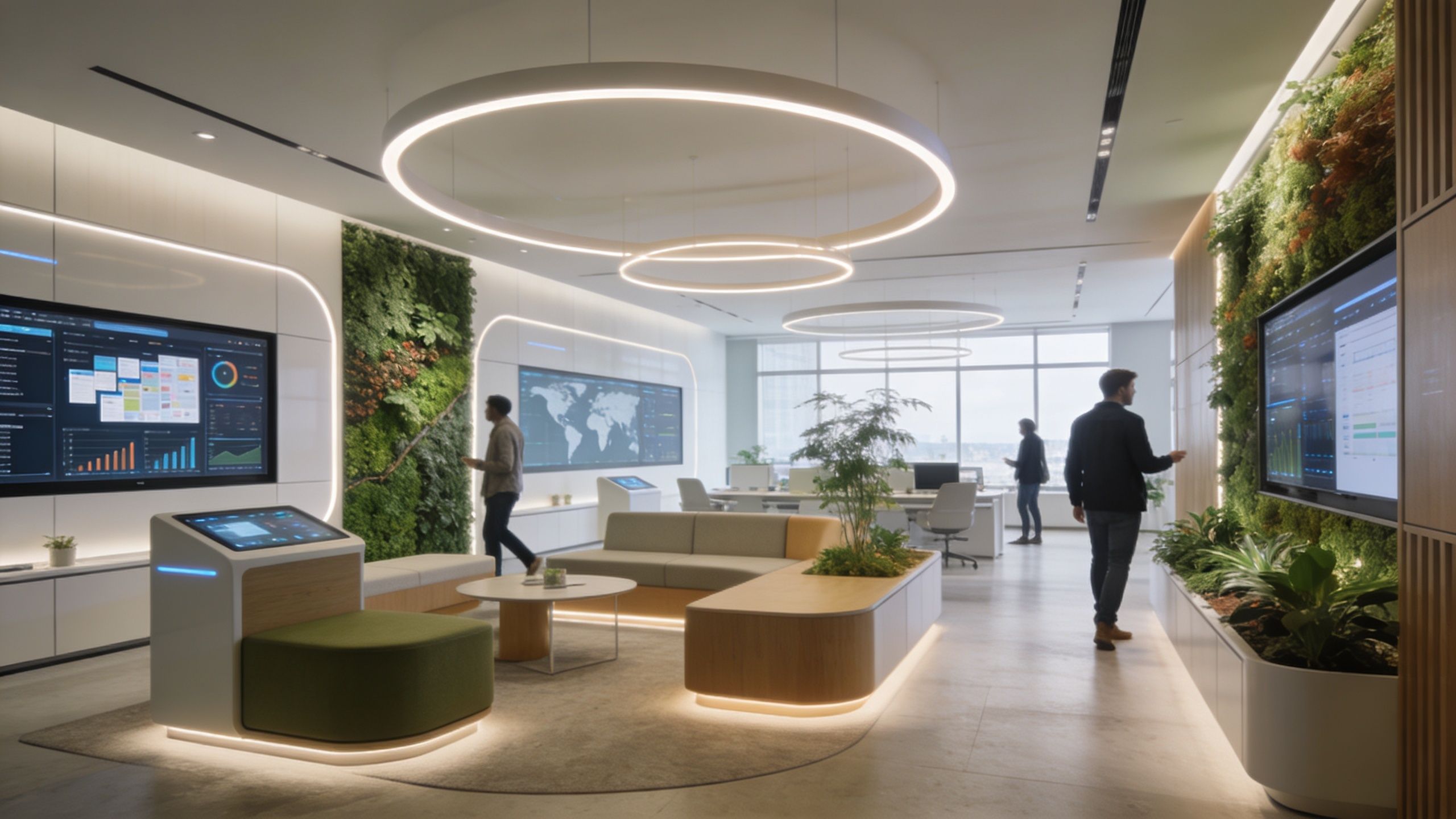
Glass partitions that keep light and improve zoning
Many offices need more enclosed space, but they can’t afford to lose natural light or openness. That’s where glazed partitioning earns its place. It creates meeting rooms, private offices, and touchdown zones without cutting the floorplate into dark boxes.
Used well, glass partitions make circulation clearer and improve the feel of the whole office. They also help businesses avoid one of the most common fit out mistakes, which is overbuilding too early. A space can stay open and still feel organised.
This works particularly well in offices that need flexibility. Teams can create defined zones without making the layout feel permanent or heavy. For businesses reviewing wider workplace direction, these commercial interior design trends are a helpful way to compare what’s current with what’s practical.
Meeting pods that solve noise without a full rebuild
Open-plan working is useful until noise starts stealing concentration. Calls spill into desk areas. Quick chats become a constant background layer. Formal rooms get booked for simple one-to-one conversations because there’s nowhere else to go.
That’s where modular pods make a real difference. In the verified data for this article, modern modular meeting pods achieve Rw 38-45 dB, outperform standard partitions, and help address the acoustic conditions linked to the 15-23% productivity drop noted in open-plan environments. In practical terms, that means they offer a reliable way to add privacy without taking on a full structural rebuild.
Well-known manufacturers include Vetrospace and Framery. BlockO is also commonly discussed in pod-led workplace planning, and the right choice usually comes down to acoustic performance, ventilation, visual style, and how easily the unit can be relocated later.
A short product overview can help clients picture how pods sit within a live office:
- Single-person pods: Best for calls, video meetings, and quiet focus
- Small meeting pods: Useful for two to four people and quick private conversations
- Larger enclosed pods: Good for hybrid meetings where sound control matters
- Relocatable systems: Often a better long-term choice when lease flexibility matters
A reception or arrival space should also be considered as part of the full experience. Lighting plays a large part in how that first space feels, and this guide to lighting for entrance foyers is a useful design reference for businesses thinking about tone, brightness, and welcome.
The video below gives a useful visual sense of how modern workplace features can support a more flexible environment.
Architectural wrapping for fast visual change
Not every office needs full replacement to feel new. Doors, counters, wall panels, storage units, and other visible surfaces can often be upgraded with architectural wrapping. This is one of the most practical ways to refresh a workplace quickly and neatly.
It works best when the underlying item is still sound but looks dated. Instead of stripping everything out, the finish is changed with less mess and far less operational disruption. That makes wrapping especially useful in live offices where access time is tight and downtime matters.
Sometimes the smartest fit out decision isn’t replacing more. It’s keeping what still works and upgrading what people actually see.
Navigating UK Compliance and Technical Details
Compliance doesn’t need to make a project feel heavy, but it does need to be taken seriously. The right technical approach protects the budget, the programme, and the finished workplace.
Part L matters long after handover
One of the most important technical areas in a refurbishment or fit out is Building Regulations Part L, which covers conservation of fuel and power. The verified data for this article states that Part L sets minimum thermal standards for refurbishments and that designs that fail to meet these standards can increase annual energy costs by up to 25%.
The same verified information notes that integrating insulated glass partitions can reduce HVAC loads by 15-20% and improve EPC ratings, with payback periods often under 3 years. That matters because compliance here isn’t just about passing checks. It affects the running cost of the office after completion.
Where glazing, façades, or internal thermal performance are part of the design, those details should be reviewed early. Leaving them until late often leads to redesign, delay, or unnecessary compromise.
Other rules that shape the project
Most office projects also need to consider planning permissions, landlord consent, fire safety, accessibility, and the Construction Design and Management Regulations 2015. The exact requirements depend on the building and the scope of work, but the principle is simple. These obligations should be built into the project, not treated as paperwork to catch up on later.
A sensible compliance review usually includes:
- Landlord requirements: Conditions attached to leases and permissions for alterations
- Access standards: Entrances, circulation, facilities, and inclusive use
- Health and safety duties: Clear roles, safe sequencing, and documented responsibilities
- Fire strategy alignment: Escape routes, compartmentation, and material suitability
This matters across the country, whether the project is in Cambridge or in Milton Keynes. Different buildings create different technical challenges, but clients should expect the same thing in every case. Clear advice, proper coordination, and no surprises at the end.
How to Choose Your Perfect Office Fit Out Partner
Choosing the right contractor has more effect on the outcome than any individual finish, furniture piece, or layout decision. A good partner keeps the job moving, solves issues early, and gives the client one clear line of communication.
What to look for before signing
A strong fit out partner should show relevant work, not just attractive photos. The key question is whether they’ve delivered projects with similar constraints, similar sectors, and similar operational demands. An occupied office, a healthcare admin building, and an airport workspace don’t run in the same way.
It also helps to choose a team that offers a full design-and-build route. When design, pricing, technical coordination, procurement, and delivery are joined up, clients usually get a smoother process and clearer accountability.
A practical checklist includes:
- Relevant portfolio: Similar project types, not just broad commercial work
- Transparent process: Clear stages, approvals, and decision points
- Insurance and safety standards: Up-to-date evidence, not vague assurances
- Supplier network: Reliable access to furniture, pods, glazing, and specialist trades
- Aftercare: A plan for snagging, support, and adjustments after handover
Questions worth asking early
Ask how the contractor handles live environments. Ask who manages subcontractors. Ask how cost changes are reported and approved. Ask what happens if products have long lead times.
Technology coordination is another area worth checking. Offices rely heavily on data, power, meeting room equipment, and wireless performance, so it helps to understand how the fit out team works alongside IT specialists. For businesses reviewing this side of a project, this overview of expert network cabling solutions gives a useful picture of what proper structured cabling support should cover.
Regional knowledge also matters. Businesses operating in Essex often value a team that understands local access, supply routes, and property types around places such as Braintree. That kind of familiarity doesn’t replace process, but it does help delivery run more smoothly.
The right fit out partner should reduce client workload, not add to it.
Frequently Asked Questions About Office Fit Outs
What’s the difference between a fit out and a refurbishment
A fit out usually means preparing a commercial interior for occupation or reshaping it in a more complete way. That can include partitions, services, finishes, furniture, and layout planning.
A refurbishment is often narrower. It usually means updating or refreshing an existing office rather than building out the whole internal environment from scratch. In practice, the terms do overlap, so the better question is what work is involved.
How can disruption be kept to a minimum
Disruption is reduced through planning, sequencing, and communication. Works can be phased, noisy activities can be timed around operations, and access routes can be separated from staff areas where possible.
Clients should also expect decisions to be made before site work starts. Late design changes are one of the fastest ways to create disruption because trades have to stop, revisit, or undo completed work.
How does a fit out affect end-of-lease obligations
This is one of the most overlooked parts of an interior office fit out. According to the verified data cited from Ark and Mason, UK commercial tenants face average dilapidation claims of £15-£25 per sq ft, and poor planning can inflate that cost. The same verified data states that reversible or modular systems can potentially cut liabilities by 15-20% compared with fixed, permanent constructions.
That’s why lease strategy should influence design choices at the start, not at the end. Demountable glass partitions, modular pods, and other reversible elements are often easier to remove, adapt, or reinstate. A heavily bespoke office may feel impressive in the short term, but it can create a more expensive exit later.
For tenants, the smart approach is simple:
- Review lease terms early: Understand reinstatement obligations before design is signed off
- Choose reversible systems where possible: They tend to be easier to remove and reconfigure
- Keep records: Product details and layout drawings help when planning exit works
- Think beyond occupation: The end of the lease should be considered during the first design meeting
Conclusion Let's Build Your Future Workspace
A successful interior office fit out does more than improve appearance. It supports the way a business works, helps teams perform better, and protects long-term value in the space. The strongest results come from clear planning, practical design choices, realistic budgets, and a delivery team that keeps everything joined up.
A workplace should feel right on day one and still make sense years later. That includes how it looks, how it performs, and how easily it can adapt.
Ready to transform your workspace? Speak to the GIBBSONN Interiors team today. Looking for bespoke pod solutions or interior support? We’re here to help. Contact Us