
UK businesses are spending heavily on commercial space, but the strongest projects are not the ones with the biggest budgets. The best results usually come from fit-outs that solve daily operational problems, support staff properly, and still make financial sense over five to ten years.
Commercial interior design ideas for 2026 need to earn their place. In practice, that means addressing noise in open-plan offices, underused meeting rooms, worn finishes, poor acoustics, weak brand expression, and layouts that no longer suit hybrid working. Better interiors are no longer a nice extra. They are part of how companies compete for staff, clients, and efficiency.
This investment reflects a fundamental shift. Businesses are not just refreshing finishes. They are using design to improve concentration, privacy, collaboration, retention, and the way a workplace performs day to day. In office projects across London and the wider UK, I see the same pattern repeatedly. Clients want spaces that look current, but they also want clearer ROI, lower disruption during works, and materials that will stand up to heavy use.
That is why broad trend lists often fall short. A healthcare fit-out, a hospitality venue, and a professional services office can all borrow from the same global ideas, but the specification should change by sector, compliance needs, and budget. A glazed meeting room may work well in one scheme, while acoustic pod meeting rooms for commercial workplaces make more sense in another because they reduce building work and get space back into use faster.
The ideas in this guide are framed through a UK fit-out lens. Each one looks at where it works best, what it tends to cost in £ terms, which materials are worth considering, including architectural wrapping where refurbishment beats replacement, and what return a business can reasonably expect from the investment. For companies planning a smarter workplace in London, that level of detail matters more than design jargon.
For added context on where workplace thinking is heading, this round-up of workplace design trends is worth a look before plans are finalised.
Table of Contents
- 1. Open-Plan Design with Modular Acoustic Pods
- 2. Glass Partitioning and Frameless Glazing Systems
- 3. Biophilic Design and Nature-Integrated Workspaces
- 4. Flexible and Agile Workspace Configurations
- 5. Acoustic Optimization and Sound Management
- 6. Brand-Aligned Interior Design and Corporate Identity Expression
- 7. Technology-Integrated and Smart Office Spaces
- 8. Ergonomic Design and Employee Wellbeing-Focused Spaces
- 9. Cost-Effective Refurbishment and Architectural Wrapping
- 10. Accessibility and Inclusive Design
- Commercial Interior Design: 10-Point Comparison
- Bringing Your Commercial Design Vision to Life
1. Open-Plan Design with Modular Acoustic Pods
Open-plan offices still work. They just need better support around them. That usually means adding enclosed spaces where people can take calls, join video meetings, or focus without leaving the floorplate.
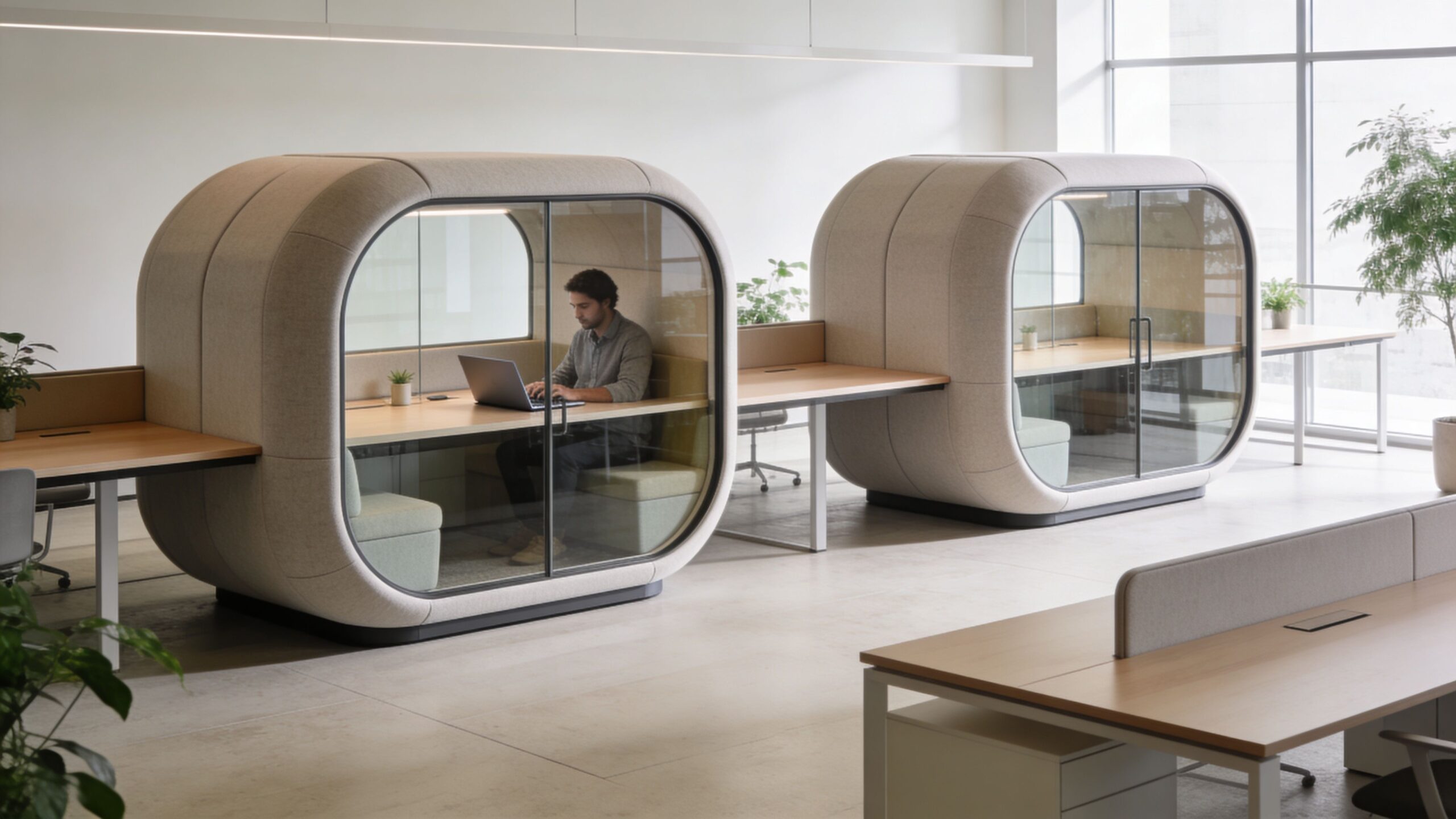
Modular pod systems from brands such as Vetrospace and BlockO give businesses a fast way to add privacy without building full new rooms. They’re especially useful in hybrid workplaces, where meeting patterns change through the week and teams need a mix of collaboration and quiet time.
The strongest case for pods in UK offices is practical. The Office for National Statistics data referenced in the verified brief states that 58% of UK workers are now hybrid, and the same brief notes a rise in flexible working that’s driving demand for adaptable space. In noisy open offices, the British Council for Offices 2025 Workplace Report, as cited in the verified brief, found that pods increased focus time by 40%.
Sector spotlight
Education settings often use pods as small tutorial rooms, quiet study points, or staff call spaces inside larger shared areas. In tech and creative offices, they’re often used as sprint rooms, private testing spaces, or quiet interview rooms.
Practical rule: Pods work best when they solve a clear problem. They don’t work when they’re dropped in as a trend piece with no thought to circulation, ventilation, or booking.
What works best
A pod layout needs to support movement across the office. If it blocks sightlines or creates dead corners, it will make the floor feel cramped, even in a large space.
A good scheme usually includes:
- Single-person booths for private calls and short video meetings
- Small team pods for quick huddles and sensitive conversations
- Glass-fronted models so the office keeps its open feel
- Nearby power and data access so people don’t avoid using them
For businesses comparing layouts and privacy options, GIBBSONN’s guide to pod meeting rooms gives a useful starting point.
A simple layout test before ordering pods usually saves more trouble than any late adjustment. Placement matters as much as the pod itself.
A short product walkthrough helps show how enclosed meeting spaces fit into a live office:
2. Glass Partitioning and Frameless Glazing Systems
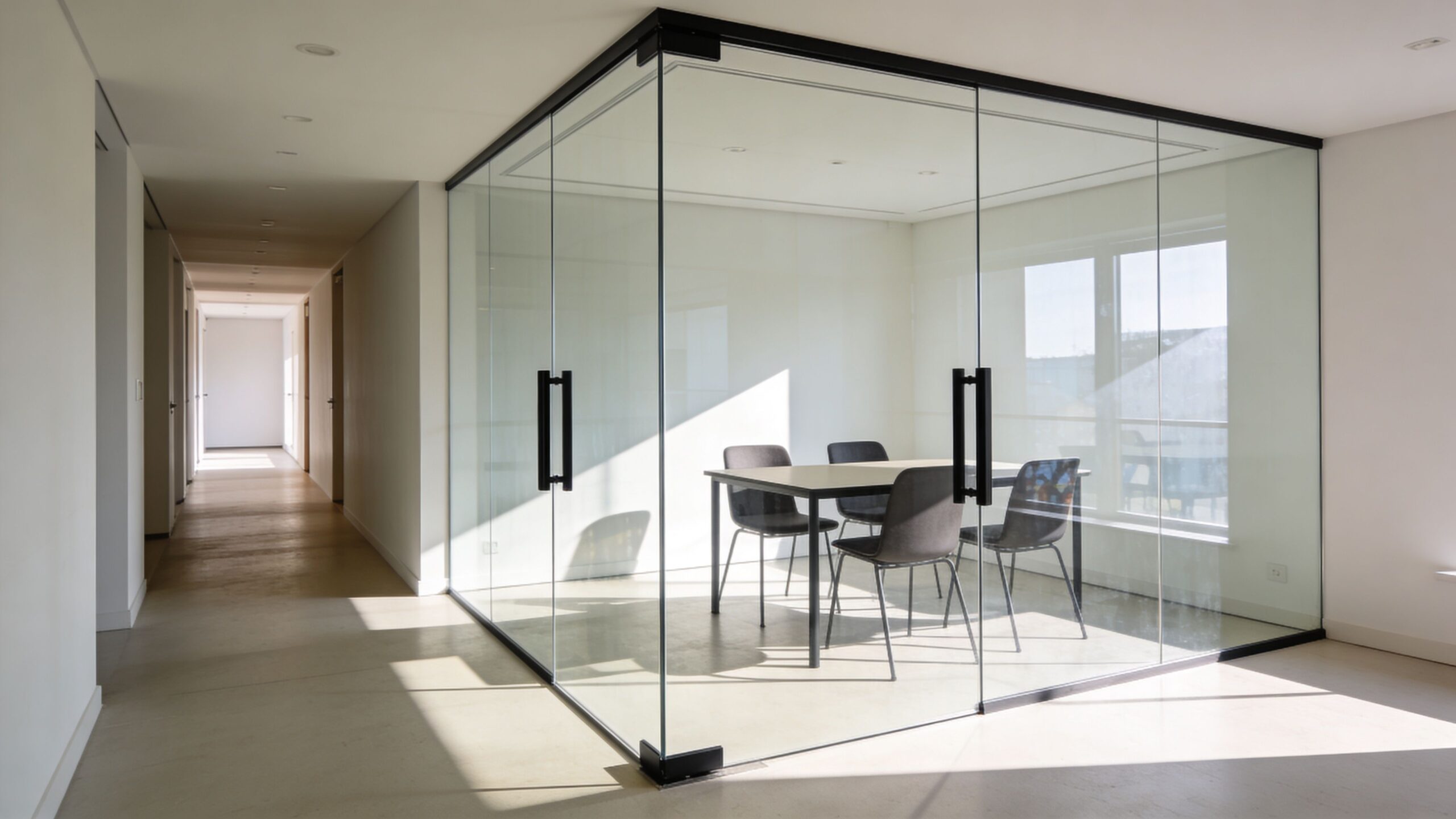
If a workplace feels dark or boxed in, glass partitions usually fix more than one issue at once. They define rooms clearly, hold onto daylight, and make a floor feel larger than it is.
This is one of the most reliable commercial interior design ideas because it improves function without making a workplace feel overbuilt. Meeting rooms, manager offices, consultation spaces, and touchdown rooms all benefit from visible boundaries and shared light.
In the UK, fire-safe partitioning became a sharper priority after Grenfell. The verified brief states that glass solutions featured in 52% of projects by 2022, citing RIBA reports through the supplied data. That helps explain why glazed systems now show up across offices, healthcare settings, and public buildings.
Where glass earns its keep
Glass is most effective where the business wants separation without visual isolation. Professional services firms use it to create client-facing rooms that feel polished and transparent. Healthcare settings often combine clear and frosted glazing to balance supervision, privacy, and light.
For teams planning a reconfiguration, GIBBSONN’s page on office partition systems covers the core system options.
Clear glass suits collaboration areas. Acoustic laminated glass or privacy film suits rooms where confidential calls happen every day.
The trade-off is simple. Standard glazing looks good and keeps costs down, but it won’t solve serious sound transfer on its own. For boardrooms, HR rooms, or legal and finance spaces, acoustic performance needs to be specified from the start.
In practice, the strongest glazed schemes combine:
- Frameless or minimal-frame fronts for clean sightlines
- Manifestation or frosting where privacy matters
- Acoustic doors and seals for rooms used for calls
- Consistent ironmongery and detailing so the finish feels deliberate
This approach is common in knowledge-led office hubs, including projects around Cambridge, where businesses often want meeting rooms to feel high quality without losing openness.
3. Biophilic Design and Nature-Integrated Workspaces
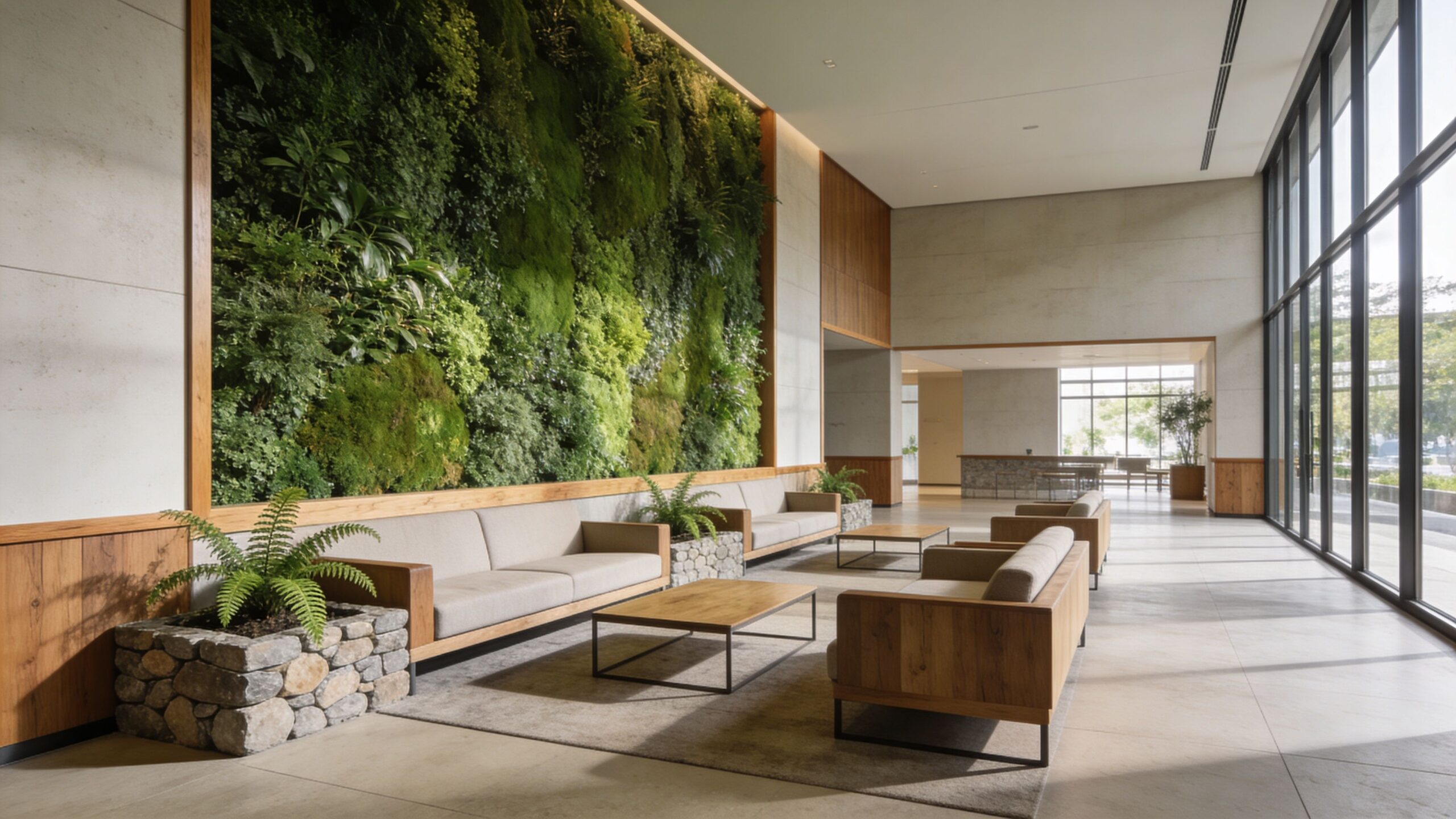
Biophilic design works when it’s built into the space, not sprinkled on at the end. A few plants in the corner won’t change how a workplace feels. Better daylight, natural finishes, planting with purpose, and quieter breakout areas will.
The verified brief states that by 2024, 67% of new office fit-outs incorporated biophilic elements such as natural lighting and plants, with productivity improvements of up to 15% cited from University of Exeter studies in BIID reports. That helps explain why this has moved from trend to standard practice in many schemes.
Why this keeps growing
Landlords and occupiers both want offices that feel healthier and more welcoming. The verified brief on South East projects notes that high-spec fit-outs increasingly use natural light, biophilic features, timber finishes, and indoor greenery to soften corporate environments and support wellbeing.
That doesn’t always mean expensive living walls. Often, the better result comes from a balanced mix of moves:
- Timber-effect or real timber finishes to reduce the hard, corporate feel
- Planting near work and breakout areas where it’s visible
- Better use of window lines so enclosed rooms don’t steal all the daylight
- Quiet wellness rooms that feel calm rather than clinical
Hospitality and healthcare tend to use biophilic design differently. Hotels and lounges often use it to shape atmosphere and first impressions. Healthcare settings tend to focus more on calm, natural light, and stress reduction.
The part that often fails is maintenance. A neglected planting scheme makes the whole office feel tired. If there isn’t a maintenance plan, lower-maintenance planting and durable nature-led materials are usually the safer choice.
4. Flexible and Agile Workspace Configurations
Rigid layouts date quickly. Teams grow, departments change, hybrid attendance shifts, and a fixed plan can start fighting the business within months.
Flexible workspace design solves that by creating zones rather than locking every activity into one setting. Focus work, project work, social use, and client use all need different conditions. When those conditions are planned properly, a workplace feels calmer and more useful.
The verified brief notes that modular furniture systems have been recognised since 2019 as a key way to enable rapid reconfiguration. It also states that UK-specific Cat B projects highlight sustainability as fully embedded in decision-making for reduced costs and stronger retention.
What flexible space should include
The most effective agile schemes tend to avoid one big open room with random furniture dropped into it. They use simple zoning with furniture, lighting, finishes, and partitioning to signal how each area should be used.
A balanced layout often includes:
- Touchdown areas for short stays and laptop work
- Team tables for project collaboration
- Quiet points away from main walkways
- Breakout space that can handle informal meetings
- Reservable enclosed rooms for conversations that need privacy
Good agile space doesn’t mean every seat is temporary. Teams still need anchors, storage, and spaces that feel dependable.
The biggest mistake is overcommitting to hot-desking without checking how people work. If staff need specialist screens, files, equipment, or quiet routine, they won’t use a fully nomadic setup well.
This approach is especially useful for growing firms in Braintree and for businesses working near major travel links through Stansted, where changing headcounts and mixed-use space are common design pressures.
5. Acoustic Optimization and Sound Management
Poor acoustics can ruin an otherwise strong fit-out. A workplace may look sharp on day one and still fail by week two if calls carry, chairs scrape, and every meeting leaks into the open office.
The challenge isn’t to make an office silent. It’s to control sound so people can work without strain. That usually means treating ceilings, walls, flooring, furniture, and room placement as one system rather than trying to fix noise with a few panels after handover.
The verified brief notes that UK offices are prioritising acoustic treatments as part of performance-driven design, particularly in open-plan environments. It also highlights acoustic consideration as part of modular meeting pod systems and flexible workplace planning.
Where projects usually go wrong
Most acoustic failures come from one of three issues. Too many hard finishes. Not enough enclosed rooms. Or noisy functions placed beside quiet ones.
A better acoustic strategy usually includes:
- Absorbent finishes such as acoustic baffles, fabric panels, and softer flooring
- Zoning that keeps collaboration areas away from heads-down work
- Pods or enclosed rooms for private calls and video meetings
- Furniture choices that break up sound reflection
For finance teams, legal departments, and compliance-heavy businesses, this matters even more. Privacy and concentration often go hand in hand.
In busy commercial settings near Bishop’s Stortford, acoustic control is often the difference between a workplace that looks modern and one that performs.
Noise problems are cheaper to prevent than to retrofit. Once teams are already complaining, the fix is usually more disruptive.
6. Brand-Aligned Interior Design and Corporate Identity Expression
A branded interior shouldn’t feel like a logo exercise. The strongest schemes express a company’s character through materials, layout, lighting, and tone of voice in the space itself.
That matters because office design shapes how staff and visitors read the business. A law firm, healthcare provider, airport operator, and creative agency won’t need the same atmosphere, even if they occupy a similar floorplate.
The verified brief notes that hospitality-led design is being used more often in high-spec fit-outs, with café-style breakout areas, feature reception spaces, statement lighting, soft seating, and strong finishes helping businesses reflect brand identity and improve property desirability.
Branding that feels built in
Good brand-led design usually shows up in a few smart moves:
- Reception design that sets the tone from the first step inside
- Material choices that match the company’s position and audience
- Colour used with restraint so the scheme doesn’t date too quickly
- Graphics and signage that support navigation as well as branding
What doesn’t work is forcing brand colours onto every wall, floor, and joinery face. That tends to look heavy-handed and quickly becomes tiring for the people using the space every day.
Professional services often lean into calm confidence with timber, glazing, and clean detailing. Tech and fast-growth firms may push harder on energy, colour contrast, and social space. Neither is right by default. The fit has to reflect the business, not a Pinterest board.
A branded interior also supports recruitment and culture. When the office clearly reflects the business, it becomes easier for staff to understand what the company values in practice.
7. Technology-Integrated and Smart Office Spaces
Tech works best when people barely notice it. If room booking is awkward, the screen share never connects, or nobody can find power, the workplace starts creating friction instead of removing it.
The best smart office design starts with basics. Reliable Wi-Fi, proper cable planning, good AV, visible power access, and simple controls matter more than flashy automation.
The verified brief points to a progression from smart IoT integration in 2024 toward AI-assisted adaptive reuse by 2026 to 2033, and frames technology as part of future-proofing commercial interiors. It also notes that improved ventilation and air quality systems remain a core part of post-2020 workplace standards.
Smart tech that actually helps
A practical smart-office package often includes:
- Room booking panels outside meeting spaces
- Integrated video conferencing in enclosed rooms and pods
- Wireless presentation tools for quicker meetings
- Occupancy and usage data to help teams refine layouts over time
For estates teams and office managers, usage data is often more useful than novelty tech. It shows which spaces stay full, which rooms sit empty, and whether the original layout still matches behaviour.
That’s especially useful in growth markets where companies want flexibility without repeated refits. Businesses planning future-ready workplaces in Luton and Colchester often benefit more from scalable infrastructure than from expensive one-off gadgets.
The common mistake is adding technology late. Once partitions, ceilings, and joinery are fixed, upgrades become slower and costlier. Good coordination between design, fit-out, and IT avoids that problem.
8. Ergonomic Design and Employee Wellbeing-Focused Spaces
Wellbeing starts with the basic working environment. If chairs are poor, lighting is harsh, and there’s nowhere quiet to reset, no amount of branding or planting will fix the daily experience.
The strongest ergonomic schemes combine furniture, lighting, air quality, and layout. That means adjustable chairs, sensible desk setups, screen positioning, balanced lighting, and spaces where staff can step away from noise for a short period.
The verified brief states that wellbeing-focused designs in UK SMEs boosted output by 21%, with 33% fewer sick days, citing a CIPD 2023 study. It also notes that ONS data showed 40% of UK firms refurbished spaces by 2023 for wellbeing, reducing staff turnover by 18%, as referenced in the supplied market summary.
Wellbeing needs space, not slogans
A useful wellbeing-led office usually includes:
- Ergonomic task seating with proper adjustability
- Sit-stand options where roles suit them
- Quiet or wellness rooms for calls, decompression, or private moments
- Good airflow and natural light wherever possible
For healthcare and education estates, ergonomic planning often needs to cover both public-facing and back-of-house areas. The verified brief also states that NHS estates reported 19% efficiency gains from ergonomic refits totalling £900 million in 2023.
For broader workplace thinking, GIBBSONN’s article on wellbeing in the workplace adds useful context. Readers weighing furniture choices may also want to compare ergonomic seating options.
A wellbeing room isn’t a luxury if the office asks a lot from people. It’s part of making the space usable for a wider range of staff, every day.
9. Cost-Effective Refurbishment and Architectural Wrapping
Not every tired office needs a full strip-out. In many cases, the smarter move is to upgrade what’s already there.
Architectural wrapping is one of the most practical commercial interior design ideas for businesses that need visual change without the time, cost, and mess of major replacement. Doors, counters, lift reveals, wall panels, storage fronts, and other worn surfaces can all be refreshed with the right specification and prep.
The verified brief states that architectural wrapping can renew surfaces 70% cheaper and 50% faster, citing the RICS Dilapidations Protocol 2024 update through the supplied data. It also notes annual UK dilapidation disputes valued at £1.2 billion and says wrapping can reduce claims in some contexts.
When wrapping is the better option
Wrapping works well when:
- The substrate is still sound and doesn’t need replacing
- The business needs minimal disruption during trading hours
- A landlord or tenant needs a fast visual reset
- End-of-lease works need control rather than overspend
This is particularly useful in dilapidations planning. The verified brief notes that 2025 Leasehold Reform Act amendments prioritise minimal disruption reinstatement, which fits the strengths of wrapping and targeted upgrades.
For landlords and occupiers in Chelmsford, this can be a strong middle route between doing too little and paying for a full refit that the next occupier may remove anyway.
What doesn’t work is using wrapping to hide poor surfaces, damaged joinery, or layout problems. It’s a finish solution, not a structural fix. Used properly, though, it can transform a space quickly and cleanly.
10. Accessibility and Inclusive Design
Inclusive design isn’t a bolt-on and it isn’t only about legal compliance. It’s part of making a workplace easier, safer, and more comfortable for everyone who uses it.
That means considering circulation, thresholds, visual contrast, lighting, room access, quiet space, and digital access from the start. Offices that get this right tend to feel clearer and calmer for all users, not just those with specific access needs.
Inclusive design improves everyday use
A practical inclusive design approach often covers:
- Wider, clearer circulation routes
- Accessible WCs and kitchen points
- Good colour contrast and readable signage
- Rooms that support different sensory needs
- Furniture and booking systems that suit a wide range of users
The verified brief on UK workspace compliance highlights the need to integrate acoustic privacy solutions such as pods with building regulations, including Part E acoustics under the Building Regulations 2010, updated in 2024. That is a reminder that inclusive design often overlaps with technical compliance, not just visual planning.
Public sector, healthcare, and large corporate environments usually need the highest level of coordination here. For businesses with workplaces in and around Dartford, planning this early avoids expensive retrofits later.
A space that only works well for one type of user isn’t well designed. It’s just narrowly designed.
Commercial Interior Design: 10-Point Comparison
| Solution | 🔄 Implementation Complexity | ⚡ Resource Requirements | 📊 Expected Outcomes | Ideal Use Cases | ⭐ Key Advantages & 💡 Tips |
|---|---|---|---|---|---|
| 1. Open-Plan Design with Modular Acoustic Pods | Moderate, requires space planning and specialist installation | Mid–High, modular pods, ventilation, power, occasional permits | Improves privacy and focus; +25–35% space utilisation | SMEs, tech, education, hybrid teams | Flexibility & reconfigurability; Tip: conduct a space audit and ensure pod ventilation |
| 2. Glass Partitioning and Frameless Glazing Systems | Moderate, specialist glazing and acoustic specification | Mid, toughened/acoustic glass, frames, doors, installation teams | Preserves light and sightlines; variable acoustic performance | Professional services, client-facing meeting rooms, healthcare admin | Sleek transparency and daylight; Tip: specify acoustic or smart glass for privacy |
| 3. Biophilic Design and Nature-Integrated Workspaces | Low–High, scale-dependent (plants to living walls) | Low–High, plants, irrigation, natural materials, maintenance | Boosts wellbeing and creativity; studies show ~15% productivity gain | Hospitality, healthcare, creative & tech firms | Improves wellbeing and brand image; Tip: start with low-maintenance plants if care is limited |
| 4. Flexible and Agile Workspace Configurations | Moderate, requires change management and zoning strategy | Mid, mobile furniture, partition systems, booking tech | Supports hybrid working; can reduce floorspace needs by 20–30% | Growing SMEs, startups, coworking, event spaces | High adaptability and cost savings; Tip: run usage analysis and invest in durable mobile furniture |
| 5. Acoustic Optimization and Sound Management | Moderate–High, may need acoustic consultancy | Mid, panels, baffles, masking systems, specialised materials | Better concentration and speech privacy; small measurable productivity uplift (~5%) | Open-plan offices, financial services, airports, creative studios | Improves focus and confidentiality; Tip: combine material treatments with spatial planning |
| 6. Brand-Aligned Interior Design & Corporate Identity | Moderate, needs strategic brand-to-space translation | Low–High, from graphics to bespoke joinery and installations | Stronger brand expression, improved candidate perception and retention | Corporate HQs, retail/showrooms, creative agencies | Reinforces culture and client impression; Tip: conduct a brand audit before design |
| 7. Technology-Integrated and Smart Office Spaces | High, complex systems integration and IT coordination | High, sensors, AV, IoT, network infrastructure, software | Data-driven optimisation; improves utilisation by 25–40% and energy efficiency | Tech firms, large campuses, hybrid-first organisations | Future-proofs operations and enables analytics; Tip: involve IT early and prioritise usability |
| 8. Ergonomic Design and Wellbeing-Focused Spaces | Low–Moderate, procurement and ergonomic assessments | Mid, adjustable desks/chairs, lighting, training | Reduces musculoskeletal issues; cuts absenteeism by ~10–15% | Call centres, healthcare admin, knowledge workers | Enhances health and retention; Tip: provide training and occupational assessments |
| 9. Cost-Effective Refurbishment and Architectural Wrapping | Low–Moderate, surface prep and specialist installers | Low–Mid, vinyl wraps, overlays, minimal structural work | Fast visual transformation; 30–50% cost savings vs full refurb | Landlords, retail, end-of-lease, rapid rebrand needs | Quick, low-disruption refresh; Tip: pre-assess surfaces and phase works to maintain operations |
| 10. Accessibility and Inclusive Design | Moderate, requires specialist input and integrated planning | Variable, ramps, toilets, signage, adjustable furniture, tech | Legal compliance, wider talent pool, improved retention and reputation | All organisations, public sector, large employers, healthcare, education | Ensures inclusion and reduces legal risk; Tip: engage disabled employees and accessibility consultants |
Bringing Your Commercial Design Vision to Life
A commercial fit-out affects far more than appearance. It influences staff concentration, customer confidence, daily workflow, maintenance costs and how long the space remains fit for purpose.
The strongest projects start with a clear brief and a realistic budget band. In the UK, that usually means making early decisions about what must be changed now, what can be phased later, and where spend will produce a measurable return. A legal office may put privacy, acoustics and meeting room quality first. A GP practice may need cleanable finishes, accessible circulation and compliant reception design. A restaurant or hotel may prioritise atmosphere, wear resistance and short installation windows, with architectural wrapping used to refresh tired surfaces without a full strip-out.
That is where good planning protects the budget.
Sustainability also needs to be assessed in practical terms. Clients are asking better questions about durability, recycled content, embodied impact, maintenance cycles and whether refurbishment can extend the life of existing elements. On live sites, those choices often come down to a simple trade-off. Lower upfront cost can mean earlier replacement, while better-specified materials can reduce disruption and maintenance over the life of the space.
When to Engage a Fit-Out Partner
Bring a fit-out partner in early if you are relocating, rethinking hybrid working, planning a Cat B fit-out or preparing for lease-end works. Early involvement gives tighter cost control, fewer programme surprises and better coordination between design, building services and site delivery.
A capable design-and-build team should cover:
- Space planning based on how staff, visitors and support teams use the building
- Specification aligned to budget, durability, compliance and brand requirements
- Technical coordination across fire safety, lighting, acoustics, access and M&E
- Phased delivery that keeps disruption under control in occupied premises
This joined-up approach matters. If layout, finishes, furniture, services and programme are decided separately, costs usually rise and compromises appear on site. If they are planned together, the result is easier to build, easier to maintain and more likely to produce a return through better utilisation, lower running costs, stronger staff retention or improved customer experience.
For occupiers and landlords across Essex, Hertfordshire and surrounding areas such as Milton Keynes, commercial interior design is now a business decision with operational consequences.
Ready to transform your workspace? Speak to the Gibbsonn Interiors team today.
GIBBSONN Interiors supports UK businesses with pod installations, glass partitioning, office refurbishment and end-of-lease dilapidations. The right scheme depends on your sector, timescale and budget, but the aim stays the same. Create a workplace that works harder for the business using practical design decisions that stand up over time.