
An office refurbishment usually starts the same way. The office still works, sort of, but the cracks are obvious. Meeting rooms are always full, the breakout space is underused, storage has taken over useful floor area, and the layout no longer matches how people work.
That’s where many projects go wrong. Teams rush into finishes, furniture, and builder quotes before they’ve pinned down the brief, the programme, and the major risks. A proper office refurbishment project plan template gives the project shape early. It helps decision-makers stay aligned, keeps costs visible, and reduces the chance of disruption spilling into day-to-day operations.
Table of Contents
- Why Your 2026 Office Refurbishment Needs a Bulletproof Plan
- Your Downloadable Office Refurbishment Template Explained
- Phase 1 Laying the Groundwork with a Watertight Strategy
- Phase 2 Navigating Design Procurement and UK Regulations
- Phase 3 Managing the Build for Minimal Business Disruption
- Phase 4 Successful Handover and Measuring Your Project ROI
- Start Your Transformation Journey Today
Why Your 2026 Office Refurbishment Needs a Bulletproof Plan
A refurbishment isn’t just a building exercise. It’s a business change project with contractors, consultants, staff, landlords, and suppliers all affecting the outcome. If the plan is loose, the project becomes reactive very quickly.
That matters more now because office demand has changed. In the UK, office refurbishment projects have seen a 27% increase in demand since 2021, driven by hybrid working models, and 65% of projects adhere to budget only when using Gantt-based templates. The same dataset notes that poorly planned refurbishments result in 22% average cost overruns, with procurement delays accounting for 40% of project slippage, according to UK office refurbishment planning data.
A good template does more than list tasks. It forces decisions early. It shows what has to happen first, what depends on landlord sign-off, which long-lead items need ordering, and who is responsible when a question comes up on site.
The cost of an ad hoc approach
An unplanned project usually looks fine in the first few weeks. Then small issues start to stack up.
- Briefs drift because different stakeholders want different things.
- Budgets blur when items sit outside the original scope.
- Programmes slip when approvals, lead times, or access arrangements weren’t fixed early.
- Staff frustration grows if communication is poor and noise or moves are badly managed.
Practical rule: if a project team can’t point to one agreed programme, one agreed budget tracker, and one live decision log, the refurbishment isn’t under control.
This is why the project plan template matters so much. It becomes the shared working document for the whole job. It gives facilities managers something practical to use with finance, operations, HR, design teams, and contractors.
What a solid plan actually protects
The best plans protect four things at once.
| Priority | What the plan controls | Why it matters |
|---|---|---|
| Budget | Scope, approvals, contingency, changes | Stops avoidable spend creeping in |
| Time | Sequencing, dependencies, procurement dates | Reduces delay risk |
| Operations | Phasing, staff moves, communication | Keeps the business running |
| Compliance | Landlord, CDM 2015, handover records | Avoids expensive surprises later |
For occupiers in places like Bishop’s Stortford, that control is often the difference between a smooth upgrade and a refurbishment that drags on, disrupts teams, and lands badly with leadership.
Your Downloadable Office Refurbishment Template Explained
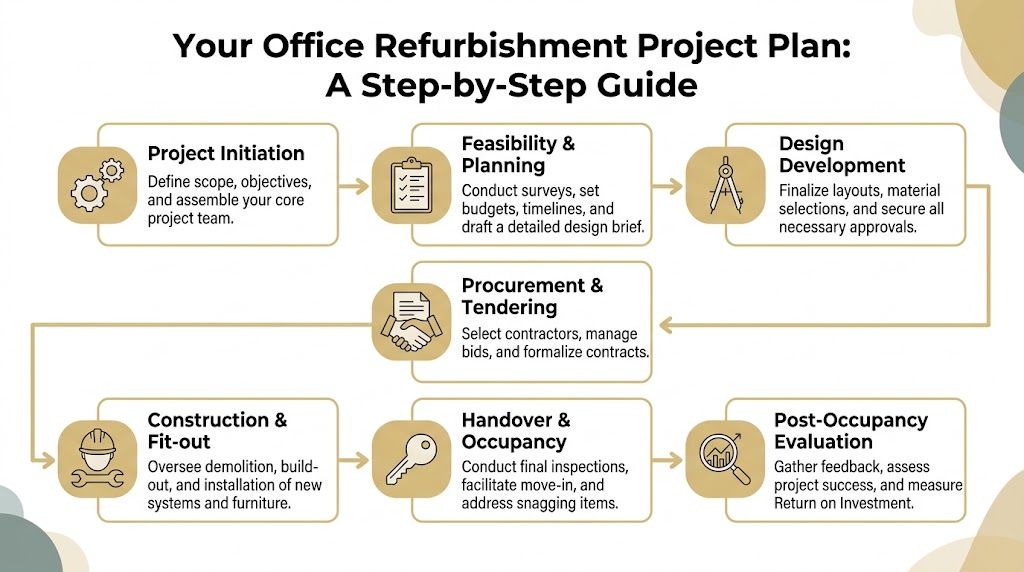
Most clients don’t need a complicated project platform to get started. They need a clear working template encompassing the full life of the job, from first brief to final handover. That’s what this format is for.
The most useful office refurbishment project plan template usually sits in Excel or Google Sheets because it’s easy to edit, share, and review in meetings. It should be simple enough for non-technical stakeholders to understand, but structured enough to manage a live build.
The core tabs worth including
A practical template needs a few essential tabs.
Project summary
This is the one-page view. It should cover project objectives, scope, target dates, budget headline, site constraints, decision-makers, and the status of landlord or statutory approvals.Budget tracker
This should split costs into sensible headings such as professional fees, strip-out, building works, M&E, furniture, pods, finishes, IT, signage, and contingency. It also needs columns for approved cost, forecast cost, committed spend, and change items.Programme or Gantt chart
This is the control centre. It shows phases, tasks, dependencies, approvals, procurement deadlines, site works, and handover activities in date order.Risk register
Every office project has risks. The point is to name them before they become expensive. Typical entries include access restrictions, noisy works, long-lead materials, landlord comments, live-office health and safety, and staff relocation issues.
The tabs that stop confusion
Projects rarely fail because nobody worked hard enough. They fail because responsibility was vague, decisions were late, and communication was inconsistent.
That’s why these tabs matter.
RACI chart
This sets out who is responsible, who signs off, who is consulted, and who just needs updates.Communication plan
This covers meeting rhythm, reporting format, escalation routes, and staff notices.Change log
Any design change, client instruction, or site variation should land here with date, cost effect, time effect, and approval status.
A template only works if the team uses it live. If it’s updated once at the start and forgotten, it becomes paperwork rather than project control.
How to fill it in properly
The right approach is to complete the template in layers, not in one sitting.
Start with the brief and business goals. Then build the programme around approvals, design development, and procurement. After that, add cost headings and identify the likely risks. Once the contractor and specialist suppliers are appointed, the template becomes more detailed and more useful.
A practical sequence looks like this:
- First pass with leadership, FM, and operations to set scope and key dates
- Second pass with design and technical teams to test feasibility
- Third pass with procurement and delivery partners to lock programme logic
- Weekly updates during pre-construction and live works
For teams that want a companion planning tool, this office refurbishment checklist for 2026 is a useful cross-reference alongside the main template.
What should never be left out
Three things are often missed in generic templates.
| Missing item | Why it matters | What to add |
|---|---|---|
| Landlord approvals | Delays can hold up works and licences | Approval dates, comments log, responsible party |
| Dilapidations planning | Early decisions affect end-of-lease cost | Record retained items, reinstatement issues, surveys |
| Staff move planning | Poor moves create operational disruption | Swing space, move dates, communications, IT checks |
That’s why a UK-specific office refurbishment project plan template is far more useful than a generic renovation sheet downloaded from a global project site. Office projects in Chelmsford or other live commercial settings need to reflect leases, approvals, compliance, and the need to keep teams productive while the work happens.
Phase 1 Laying the Groundwork with a Watertight Strategy
The strongest refurbishment projects are decided long before the site team arrives. This stage turns a vague ambition into a clear brief that can be priced, designed, and delivered without constant rework.

Start with the brief, not the finishes
Many teams start by talking about colours, furniture, and feature walls. That’s too early. The correct starting point is how the business works today and how it needs to work after the refurbishment.
A useful brief should answer practical questions:
- Who uses the office and when
- Which teams need focus space and which need collaboration space
- Whether client-facing areas need a stronger brand feel
- What can stay and what has to change
- How much disruption the business can tolerate
Stakeholder workshops earn their keep. FM, HR, leadership, IT, and team managers usually see different risks. Getting those views aligned early avoids expensive redesign later.
The brief should be specific enough that two different design teams would draw broadly the same workplace strategy from it.
Hybrid working changes the space brief
Hybrid work has changed what a good office looks like. UK data shows 58% of office workers are now hybrid, while many refurbishment plans still fail to address that shift. The same source notes that templates often lack KPIs for reallocating 30-40% of floorspace to collaboration zones, even though office utilisation has dropped to 52% and BCO guidance links that change to a 25% boost in wellbeing scores, according to UK hybrid workplace refurbishment data.
That changes the planning conversation. The question isn’t just how many desks fit on the floor. The question is what mix of spaces the business needs.
A sensible early test often includes:
- Desk demand by day rather than total headcount
- Meeting room pressure points across the week
- Need for quiet enclosed space for calls and focused work
- Use of informal touchdown areas and breakout settings
For many offices, that means less dead space and more purposeful zoning. Acoustic pods can help where enclosed rooms are limited. Products such as Framery acoustic pods are often considered when teams need privacy in otherwise open areas without committing to full built-room construction.
A short visual explainer can help internal teams understand the briefing stage before layouts are fixed.
Wellbeing and inclusion need to be designed in
The brief should also look past pure efficiency. A space can be full of desks and still fail its users. Noise, poor lighting balance, lack of retreat space, awkward circulation, and limited choice of work settings all reduce how well the office performs.
That’s why the early strategy needs to include:
- Acoustic control for focus and confidentiality
- Inclusive circulation and access that supports a wider range of users
- Settings for different work modes rather than one open-plan answer
- Storage and service points that don’t clog shared areas
- Practical wellness features such as better ergonomics and sensible breakout use
This is also the point where budget expectations need to be grounded. A project can’t carry every aspiration. The better approach is to rank needs into essentials, strong preferences, and optional upgrades. That keeps the office refurbishment project plan template honest from the start.
In London, this early strategy work often decides whether a project can be phased in occupation or whether temporary decant space is the wiser option.
Phase 2 Navigating Design Procurement and UK Regulations
Once the brief is agreed, the project moves from ambition to evidence. Every design decision now needs to stand up in drawings, specifications, approvals, and cost plans. Within these frameworks, disciplined teams save money, because problems solved on paper are far cheaper than problems solved on site.
Good design work solves site problems before site starts
Concept layouts are only the beginning. The design phase has to test what really fits, what services need altering, what approvals are required, and how the works will be sequenced in a live building.
A buildable package usually includes:
- Measured surveys and existing condition checks
- Space plans and room data
- Finishes and furniture schedules
- Lighting, power, and data requirements
- Partitioning and door details
- Programme assumptions linked to procurement
Without that level of detail, contractor pricing becomes uneven. One price may include core items another has left out. That’s when cheap tenders become expensive jobs.
Choose a contractor on delivery strength, not headline price
A low price isn’t always a good price. Refurbishment work in live offices depends on coordination, communication, and practical judgement. Contractors need to understand phasing, landlord processes, site protection, noise management, and short decision cycles.
Good procurement should test more than cost. It should look at programme logic, preliminaries, exclusions, relevant experience, insurances, proposed team, and approach to health and safety. A clear tender return makes comparisons much easier.
For teams reviewing routes to market, this guide to procurement in construction is a useful reference point.
A tender that looks light on cost but vague on scope usually creates change orders later.
A solid interview with shortlisted contractors often reveals more than the spreadsheet does. The strongest bidders are usually direct about risks, lead times, access limits, and what they still need clarified.
Landlord approval and compliance cannot be left until later
Office refurbishment in leased space brings another layer of control. Landlord consent, licence for alterations, building rules, access windows, and reinstatement obligations all need to be understood before works are committed.
This matters at both ends of the lease. Early design choices affect later dilapidations exposure. If a team strips out items without tracking what belonged to the base build, or installs changes without clear approval records, the end-of-lease position becomes harder to defend.
The office refurbishment project plan template should therefore include:
| Item | Why it matters | Owner |
|---|---|---|
| Landlord comments log | Tracks approvals and required amendments | Project manager |
| Building access rules | Controls working hours, deliveries, and noisy works | Contractor and FM |
| Dilapidations record | Helps protect end-of-lease position | Tenant and surveyor |
Compliance sits in the same conversation. CDM 2015 duties, fire safety considerations, contractor competence, and site welfare arrangements aren’t optional paperwork. They shape who is appointed, how the site runs, and what evidence is retained.
For occupiers around Hertfordshire and Essex, these early commercial and compliance checks often decide whether the programme is realistic at all. In specialist locations such as Cambridge, building management and landlord review can be particularly important where access, shared services, or technical spaces are involved.
Phase 3 Managing the Build for Minimal Business Disruption
Once the project reaches site, the pressure changes. The brief and drawings still matter, but daily control matters more. Staff are working nearby, deliveries are arriving, contractors need answers, and small delays can spill into business disruption very quickly.
The office refurbishment project plan template has to become a live tool, not a planning document sitting in a folder.
Phasing keeps the business moving
Phased execution is usually the safest route in occupied offices. According to UK office refit execution benchmarks, phased execution achieves 92% client satisfaction, but 35% of projects overrun their budgets without a benchmarked contingency of 10-15%. The same source notes that success rates dip without a swing space plan, and poorly managed moves can cause 2-3 times more disruption per employee.
That tells a clear story. Phasing works, but only when it is properly supported.
A workable live-site strategy usually includes:
- Zoned works so one area is refurbished while another remains in use
- Swing space planning for temporary staff moves
- Noisy works windows agreed around business activity
- Weekend or evening tasks for disruptive items where needed
- Daily site controls covering access, dust, safety, and housekeeping
Some teams try to save money by skipping temporary move planning. That often backfires. Without swing space, desks become unavailable, teams get moved twice, and managers lose confidence in the programme.
Use the template as a live control tool
During the build, four template tabs should be reviewed constantly.
First is the Gantt chart. It should be updated against actual progress, not hope. If partitioning slips because materials haven’t landed, the team needs to see immediately what else moves with it.
Second is the risk register. Live risks change fast. An occupied building may introduce access issues, unexpected noise sensitivity, or last-minute landlord restrictions. Those risks need action owners and review dates.
Third is the change log. Every client instruction needs to be costed and time-checked before it is waved through. The most common source of friction on refurbishments is a “small” change that nobody logged properly.
Fourth is the communication plan. Staff don’t need every technical detail, but they do need clear information on moves, outages, noisy periods, and what to expect next.
Site rule: if staff hear about a disruptive activity after it starts, the communication plan has already failed.
For project teams that want a broader delivery framework, this guide to office fit out project management complements the live-build controls above.
Example RACI Matrix for Key Refurbishment Tasks
A simple RACI view prevents confusion during busy weeks on site.
| Task / Decision | Project Manager (Accountable) | Stakeholders / Staff (Consulted / Informed) |
|---|---|---|
| Approve final phasing plan | Accountable | Consulted |
| Confirm staff move dates | Accountable | Informed |
| Sign off design change request | Accountable | Consulted |
| Issue disruption notices | Accountable | Informed |
| Review snagging items | Accountable | Consulted |
What works and what usually doesn’t
The jobs that run well tend to share the same habits. Meetings are short and regular. Decisions are written down. Site walks happen often. One person owns the client-side response. Staff updates are simple and timely.
The jobs that struggle usually show the opposite pattern. Too many decision-makers. Loose approval routes. A programme that isn’t updated. Assumptions about access that were never agreed with building management.
A practical weekly rhythm often looks like this:
- Site progress review with contractor and project lead
- Commercial check against budget, changes, and contingency
- Look-ahead review for the next fortnight
- Staff communication issue covering moves, noise, and service impact
That routine sounds basic, but it’s what keeps a refurbishment calm. Businesses in busy locations such as Stansted often need that discipline even more because access, security, and operational hours can tighten the margin for error.
Phase 4 Successful Handover and Measuring Your Project ROI
A refurbishment isn’t finished when the last contractor leaves site. The final stage decides whether the space feels complete, whether the defects are properly closed out, and whether the business can show clear value from the investment.

Handover is more than getting the keys back
The handover stage should be methodical. That means snagging, O&M information, warranties, training for any new systems, and a clear route for resolving remaining defects after occupation.
A proper handover pack should include:
- Snagging schedule with agreed close-out dates
- Test and commissioning records
- Warranties and product information
- Cleaning and maintenance guidance
- As-built records where relevant
- Final account and approved change summary
This stage also needs staff support. If the refurbishment introduced new room booking tools, acoustic pods, updated lighting controls, or different storage arrangements, the business should explain how the space is meant to be used. A good office can underperform if nobody knows how to use it properly.
The best handovers make the office feel settled from day one, not half-finished for the next two months.
Measure the result against the original brief
Return on investment should be measured against the goals agreed at the start. If the project aimed to reduce disruption, improve energy performance, make hybrid working easier, or create a better staff experience, those outcomes need to be checked after occupation.
According to UK office refurbishment sustainability and KPI data, 78% of UK office refurbishments in 2024 incorporated sustainable features, saving an average £15,000 per project on energy costs over 5 years. The same source states that projects with clear KPIs are 25% more likely to finish under budget and can achieve a 12% increase in property valuation.
That’s why post-occupancy review matters. It closes the loop between plan and result.
A sensible review usually looks at:
| Measure | What to review | Why it helps |
|---|---|---|
| Space performance | Room use, desk demand, collaboration areas | Tests whether the layout works |
| Staff response | Comfort, noise, usability, satisfaction | Checks everyday experience |
| Operational value | Energy use, maintenance issues, defects trend | Tests long-term performance |
For landlords, tenants, and FM teams, this stage often creates the strongest evidence for future decisions. It shows what the business should repeat, what needs tuning, and what the next workplace phase should avoid.
Start Your Transformation Journey Today
A refurbishment usually lands on the agenda at the same moment several pressures collide. The lease timeline is tightening, hybrid working has changed how space is used, and the office no longer supports the business properly. At that point, the job needs more than a sketch layout and a target finish date. It needs a plan that deals with cost, approvals, landlord obligations, compliance, and day-to-day disruption from the outset.
That is why a well-built office refurbishment project plan template matters. It gives clients a practical framework for setting the brief, tracking decisions, managing procurement risk, and phasing works around occupied space. In the UK, it also needs to cover points generic templates often miss, including landlord dilapidations, CDM 2015 duties, building management approvals, and the realities of delivering in a live office.
Well-run projects are planned early.
If you are weighing up a light refresh, a full fit-out, or a phased refurbishment across hybrid teams, start with the programme before lead times, budget pressure, and operational constraints start making the decisions for you.
GIBBSONN Interiors supports organisations through office refurbishment with clear communication, practical sequencing, and single-point accountability from strategy to handover. If you want to discuss your project, book a consultation through our contact page.