

Tuesday afternoon is when most open-plan offices show their cracks. A client call needs privacy. A manager needs a quiet one-to-one. Someone is trying to join a video meeting near the kitchen, while another team is talking through a deadline two desks away. Nothing is badly designed in isolation, but the whole space stops working.
That is why pod meeting rooms have moved from a nice extra to a practical workplace tool. They solve a basic problem fast. People need enclosed space, but most businesses don’t want the cost, delay, and lease risk of building more fixed rooms. For facilities managers, the appeal is simple. Pods can improve privacy, make better use of floor space, and avoid some of the headaches that come with permanent alterations.
Table of Contents
- Your Guide to Pod Meeting Rooms in 2026
- What Are Pod Meeting Rooms and Why Do You Need Them
- The Key Benefits for Your 2026 Workplace Strategy
- A Guide to Pod Types Sizes and Materials
- Technical Specs You Need to Understand for 2026
- Planning Your Pod Installation and End-of-Lease Strategy
- Pod Meeting Rooms Cost ROI and Compliance for 2026
- How Different Industries Are Using Pods
- The GIBBSONN Turnkey Solution Your Expert Pod Partner
- Frequently Asked Questions About Pod Meeting Rooms
- Are pod meeting rooms actually soundproof
- How long does installation take
- Should a business choose pods or build permanent meeting rooms
- What size pod is best for hybrid meetings
- Do pod meeting rooms need landlord approval
- Are they suitable for public sector or regulated settings
- What mistakes do buyers make most often
- Do pods work for smaller offices
- Ready to Transform Your Workspace for 2026
Your Guide to Pod Meeting Rooms in 2026
It is a familiar facilities problem. The office needs more private space, the team does not want weeks of building work, and the lease does not justify spending heavily on partitions you may need to remove in two or three years.
That is why pod meeting rooms have moved from a niche purchase to a serious workplace option. They give occupiers enclosed space without committing the floorplate to a permanent build, which matters more in 2026 as businesses keep reworking attendance patterns, team layouts, and real estate costs.
The part many guides miss is the lease-exit angle. In UK offices, end-of-lease dilapidations can turn a cheap fit-out decision into an expensive one. A freestanding pod will not remove every obligation, but it can reduce the amount of fixed construction a tenant installs, and that can simplify reinstatement discussions when the term ends.
Pod meeting rooms deliver the best return when they solve privacy and meeting demand now, while keeping future reinstatement costs under control.
In practice, pods sit in the middle ground between furniture and fit-out. They need proper planning, power, ventilation, and access, but they usually avoid the disruption, programme risk, and landlord consent issues that come with building permanent rooms. For facilities managers, that makes them useful for more than acoustics alone. They can support day-to-day operations and protect flexibility at lease end.
What Are Pod Meeting Rooms and Why Do You Need Them
A pod meeting room is a freestanding enclosed space placed inside an existing office. It is usually delivered in sections, assembled on site, connected to power, and ready to use without turning the office into a building site. That difference matters more than many buyers first realise.
A traditional meeting room becomes part of the building. It often needs construction work, coordination with multiple trades, and more commitment to one layout. A pod is closer to a movable workplace asset. It can be positioned where it is needed now, then relocated later if the office changes.
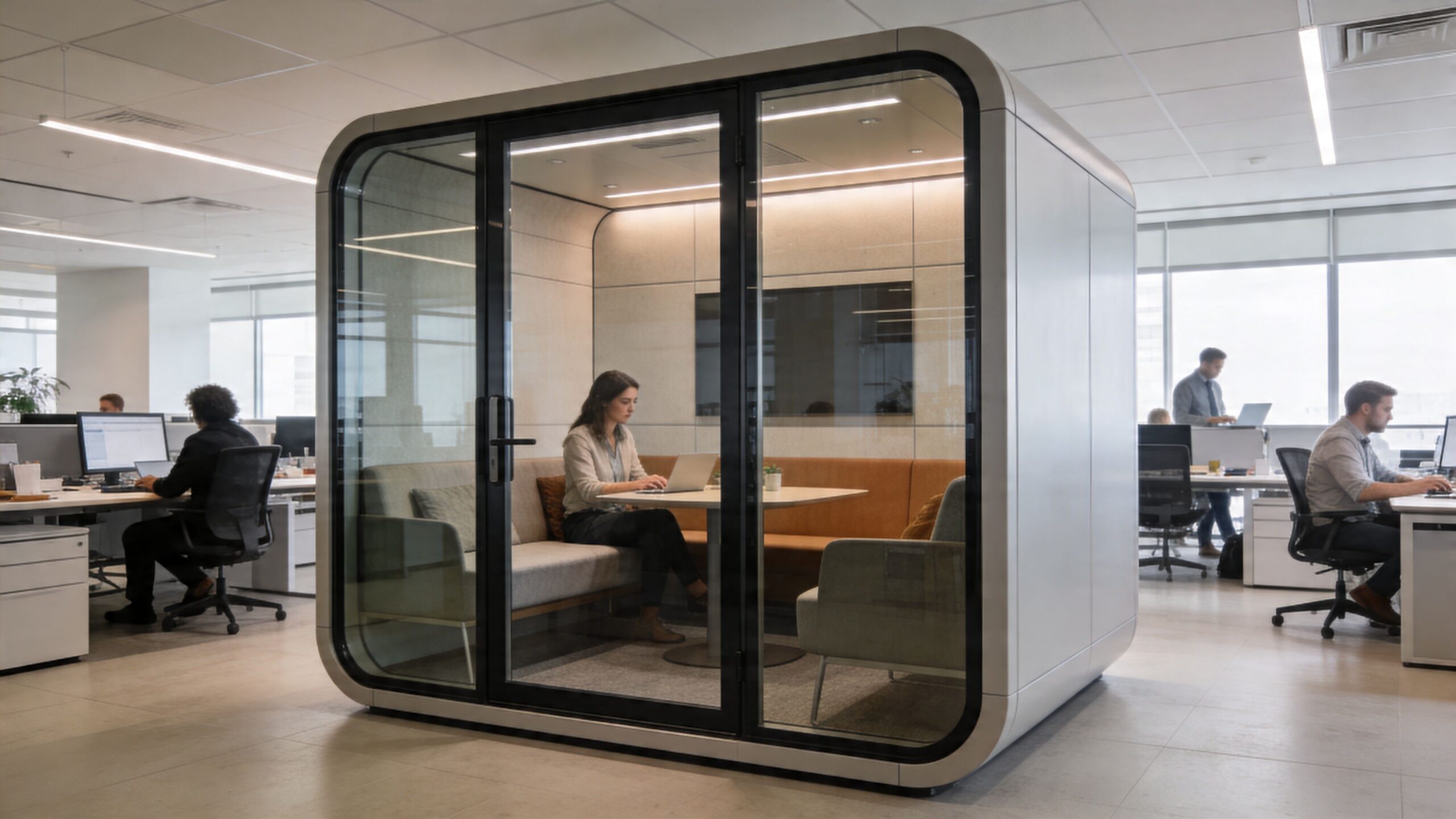
For space planning, the numbers are hard to ignore. Market Reports World’s office pods market analysis states that clusters of 4-person pods use floor space 40% more effectively than traditional conference rooms, and that a 4 square metre pod can replace a 10 square metre conference room. That is a strong argument for any facilities manager trying to protect usable area.
Why they matter in busy offices
Open-plan working gives teams visibility and flexibility, but it also removes the quiet edges of the workplace. Staff still need spaces for:
- Confidential calls where being overheard is a problem
- Hybrid meetings where background office noise affects audio quality
- Short focused work between meetings
- Manager conversations that should not happen at a desk bank
In London, that pressure is often sharper because floor space is expensive and every square metre has to work hard. In Hertfordshire and other commuter locations, the issue is often the same but expressed differently. Teams need quiet space without locking the office into a fixed layout for years.
What works and what does not
Pods work well when they are used to fill a clear gap in the workplace mix. They do not work well when a business expects one pod to solve every acoustic and meeting problem in the office. If the office has no etiquette, poor zoning, and no booking logic, a pod will still help, but it won’t fix the underlying workplace habits.
Practical rule: buy pods to support a layout strategy, not to rescue a weak one.
The Key Benefits for Your 2026 Workplace Strategy
A familiar office problem shows up around 10am. The meeting rooms are booked out, managers are taking sensitive calls at their desks, and hybrid meetings are fighting with general office noise. Pod meeting rooms solve that pressure quickly, but the value is broader than privacy alone. For many tenants, they also reduce the property risk that comes with fitting out fixed rooms in leased space.

Better privacy, faster delivery
Pods create enclosed space without the mess, noise, and downtime of building permanent partitions. That matters if the office needs to stay operational during a refresh, or if the business has to add private space quickly for HR meetings, client calls, or hybrid collaboration.
The day-to-day benefit is straightforward. Staff get somewhere to step into for a confidential conversation without broadcasting it across the floor. Managers stop using corridors and breakout areas for one-to-ones. Video calls sound clearer and feel more professional.
For offices with heavy call traffic, a mix of meeting pods and acoustic telephone booths for offices usually works better than relying on one room type to do everything.
Flexibility that helps now and at lease end
A built meeting room is fixed to one layout and often tied to landlord approvals, M&E changes, and reinstatement obligations. A pod is far easier to reposition, remove, or take to the next site. That gives facilities teams more control when headcount changes, departments move, or a floorplate needs to be reworked.
There is also a lease strategy benefit that many buyers miss. In the UK, end-of-lease dilapidations can turn internal alterations into a real cost line. If a tenant has added partitions, changed finishes, moved services, or altered the base build, reinstatement can become expensive and disruptive. Pods help avoid part of that problem because they can provide enclosed meeting space without hardwiring the layout into the fabric of the building.
That does not mean every pod is exempt from lease implications. Power feeds, data runs, fire strategy, and any changes to ceilings, sprinklers, or detection still need proper review. But compared with constructing fixed rooms, pods usually leave a lighter reinstatement burden. For occupiers with a break clause, an uncertain growth plan, or a short remaining term, that is a practical financial advantage.
This is one reason pods suit workplaces in places like Chelmsford and Essex where businesses may be balancing growth with cautious property decisions. A company can add enclosed space without committing to major structural change.
A better fit between space and task
The wrong pod creates frustration fast. The right one takes pressure off the rest of the office and improves how the whole layout works.
| Pod format | Best use | Common mistake |
|---|---|---|
| Solo booth | Calls and focused work | Using it for long two-person meetings |
| Small meeting pod | One-to-ones and video calls | Overcrowding it with too many people |
| Medium pod | Team huddles and hybrid meetings | Placing it in a noisy circulation route |
In practice, one pod rarely solves the whole problem. Solo booths absorb routine call demand. Small and medium meeting pods handle private conversations, quick decision-making, and hybrid touchpoints that do not justify a formal room booking. The result is better room availability, less disruption on the open floor, and a workplace that feels easier to use.
A short product overview helps show how these spaces are used in practice:
Wellbeing also improves when people have the right setting for the job in front of them. That is not a vague culture point. It affects concentration, meeting quality, and how often staff feel they have to leave the office floor just to find a quiet place to work.
A Guide to Pod Types Sizes and Materials
Choosing a pod starts with one basic question. What does the space need to do every day? Too many buyers begin with finish samples and brand names. The better route is to start with use, then capacity, then technical spec.
Start with use, not appearance
A solo booth suits private calls and short focused work. A two to four person pod is often the most useful all-round option for quick meetings and hybrid calls. Larger pods can work well, but they need more planning around circulation, sightlines, and power.
Some teams that first ask for large enclosed pods later realise they need a higher number of smaller enclosed settings. That is especially true when call demand is constant and formal meetings are less frequent. For teams weighing up smaller private spaces, GIBBSONN also covers telephone booths for offices, which can be a better fit than a meeting pod in high-call environments.
Meeting Pod Sizing Guide
The verified data states that 0.8 to 1.0 m² per person is the right planning allowance for ventilation and thermal comfort, according to the WeMember product specification sheet citing CIBSE Guide A. The same source says this helps prevent CO2 buildup above 1000 ppm, which can impair cognition by 15%, and notes that undersizing has been linked to a 20% productivity loss in BRE UK field trials.
| Pod Size | Typical Capacity | Best For |
|---|---|---|
| Small | 1 person | Calls, short focused tasks, private online meetings |
| Medium | 2 to 4 people | Team huddles, one-to-ones, video meetings |
| Large | 4 to 6 people | Project meetings, interviews, small workshop sessions |
If a pod feels crowded on the drawing, it will feel worse in use once chairs, screens, bags, and laptops are inside.
Materials and finishes that affect performance
Glass-heavy pods feel open and visually lighter. They help a space look less boxed in, which is useful in tighter offices. The trade-off is that the acoustic design has to be stronger elsewhere, through seals, panel build-up, and internal finishes.
Fabric-lined or felt-lined interiors tend to absorb sound better and reduce internal echo. That often improves speech clarity on calls. For facilities teams, the key point is simple. Material choice affects more than appearance. It changes how the pod sounds, feels, and ages in daily use.
Manufacturers such as Framery, Vetrospace, and BlockO each take slightly different approaches to glazing, ventilation, and finish quality. Product comparison is worth doing carefully, especially if the pod will be used heavily.
Technical Specs You Need to Understand for 2026
Technical sheets can look impressive while hiding weak performance. A facilities manager does not need every engineering detail, but a few specifications matter a great deal.
Acoustics first
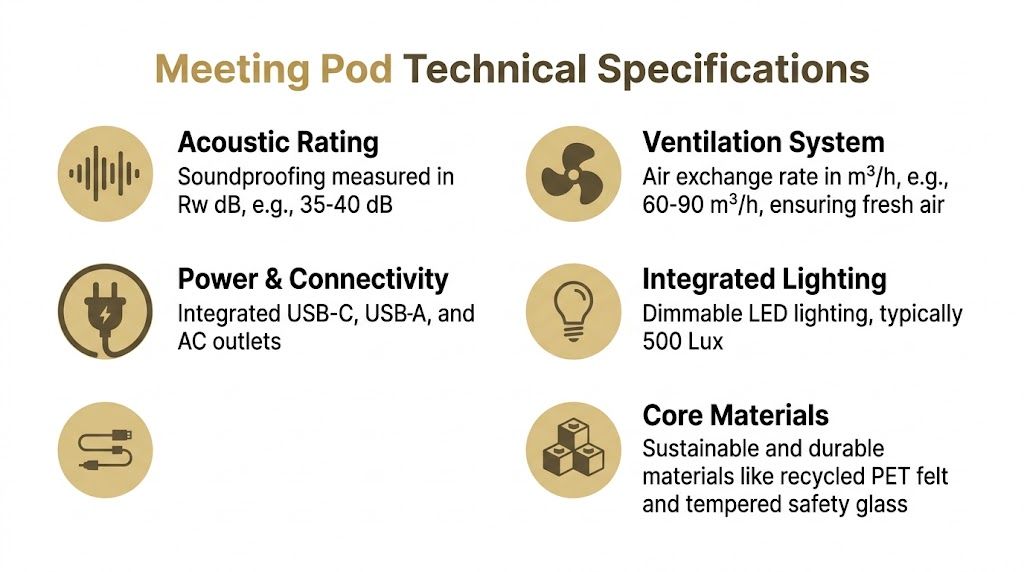
Acoustic performance is where many decisions should start. The verified data notes that pods with 30 to 35 dB sound reduction are critical in UK open-plan offices, and that this can bring external noise below the 45 dB threshold recommended by BS 8233:2014. The same Soundbox Store guide also cites a 2024 UK Framery case study in London financial firms where pods reduced perceived noise stress by 42% and boosted meeting efficiency by 28%.
For buyers, the practical lesson is this. A pod that looks smart but leaks speech is not doing the job. Teams dealing with wider workplace acoustic issues should also look at reduction of noise in office environments as part of the overall fit-out plan.
Ventilation and power
A meeting pod is still an enclosed room. If ventilation is poor, people will avoid using it for anything longer than a quick call. Fresh air movement, heat build-up, and noise from the fan system all matter in real use.
Power should be simple and reliable. At minimum, teams usually need easy laptop charging, support for video calls, and lighting that does not make the pod feel dim or clinical. A neat plug-and-play connection is valuable, but not if it comes at the expense of weak airflow or awkward maintenance access.
Why technical choices affect lease strategy
The less obvious point is that good technical choices also support property strategy. A well-designed pod can sit in the office as a self-contained element, with minimal intervention to the base build. That helps when occupiers want enclosed space without opening up bigger landlord approvals or more complex reinstatement work later.
Strong pod specifications are not only about comfort. They can reduce operational friction during installation, use, relocation, and lease exit.
Planning Your Pod Installation and End-of-Lease Strategy
Good pod projects usually feel easy because the planning was done early. Bad pod projects often fail on simple things such as access, circulation, nearby power, or putting the pod in the wrong acoustic zone.
What to check before delivery
Before a pod is ordered, the site team should check:
- Access routes: door widths, lifts, loading points, and any awkward turns
- Floor position: whether the pod sits in a quiet working area or in a busy path
- Power availability: not just proximity, but how the cable route will be handled cleanly
- Use pattern: whether the pod is for quick calls, booked meetings, or mixed use
Pods should not be dropped into dead space just because it looks spare. A leftover corner near a breakout area may be the worst possible location for a space intended for confidential calls.
Why tenants are looking at pods differently
The lease angle is often overlooked, but it is one of the strongest reasons to choose pod meeting rooms over fixed partitions. The verified data states that modular pods can help reduce dilapidation disputes by up to 30%, according to RICS data cited in My Office Pods’ meeting pod guidance. The same source says the British Council for Offices found that 42% of London office leases post-2024 incorporated flexible pods to avoid costly making-good clauses.
For tenants, that changes the conversation. Instead of adding built work that may need to be stripped out at lease end, a business can introduce enclosed space that can often be removed and relocated with far less disruption. That is especially relevant for firms around Bishop’s Stortford and wider Hertfordshire where lease flexibility matters just as much as day-to-day usability.
A practical rollout sequence
A sensible installation plan is usually straightforward:
- Map demand first: identify where calls, one-to-ones, or hybrid meetings are clashing with open-plan work.
- Test location options: check noise, circulation, and visibility before fixing the pod position.
- Review lease implications: if the office is nearing a break clause or renewal point, read this alongside a dilapidation survey guide.
- Plan user rules: decide whether pods are booked, first come first served, or split by use type.
That last point is often missed. A pod can be technically excellent and still fail if nobody knows how it is meant to be used.
Pod Meeting Rooms Cost ROI and Compliance for 2026
Cost is where pod meeting rooms tend to move from an interesting idea to a live project. The key is to judge them against the actual alternative, not against an unrealistic zero-cost option.
The financial case in real estate terms
The strongest market signal is broad. The UK meeting pod market was valued at USD 1.76 billion in 2024 and is projected to reach USD 4.75 billion by 2030, according to LeanSpace’s UK office pods market summary. For occupiers, the same source says that in London, constructing a traditional meeting room costs 33.5% more than deploying a moveable pod solution.
That does not mean every pod is cheap. It means the comparison should include build cost, programme disruption, and what happens at lease end. A fixed room can still be the right answer for some offices, especially where a permanent replan is already underway. But for many occupiers, pods give enclosed space without tying the spend to one building.
The practical ROI usually comes from a mix of factors rather than one headline saving:
- Faster deployment: less disruption to live operations
- Better space use: more enclosed settings in less floor area
- Asset flexibility: the pod can move if the office changes
- Lower lease risk: fewer reinstatement issues than built partitions
Where compliance still matters
Pods may be simpler than construction, but they are not outside normal workplace responsibility. Buyers still need to check fire strategy, electrical safety, ventilation performance, and whether the pod can be used comfortably by the people expected to use it.
Accessibility is especially important. A pod that technically fits into the plan but is awkward to enter or use will create problems quickly. Compliance should be treated as part of procurement, not as a late-stage check once the pod has already been chosen.
The cheapest pod on paper can become the most expensive one to live with if it causes maintenance, comfort, or compliance issues.
How Different Industries Are Using Pods
The best thing about pod meeting rooms is that they are not tied to one sector. The same core product can solve very different problems depending on where it is placed and how it is specified.
Offices and commercial workplaces
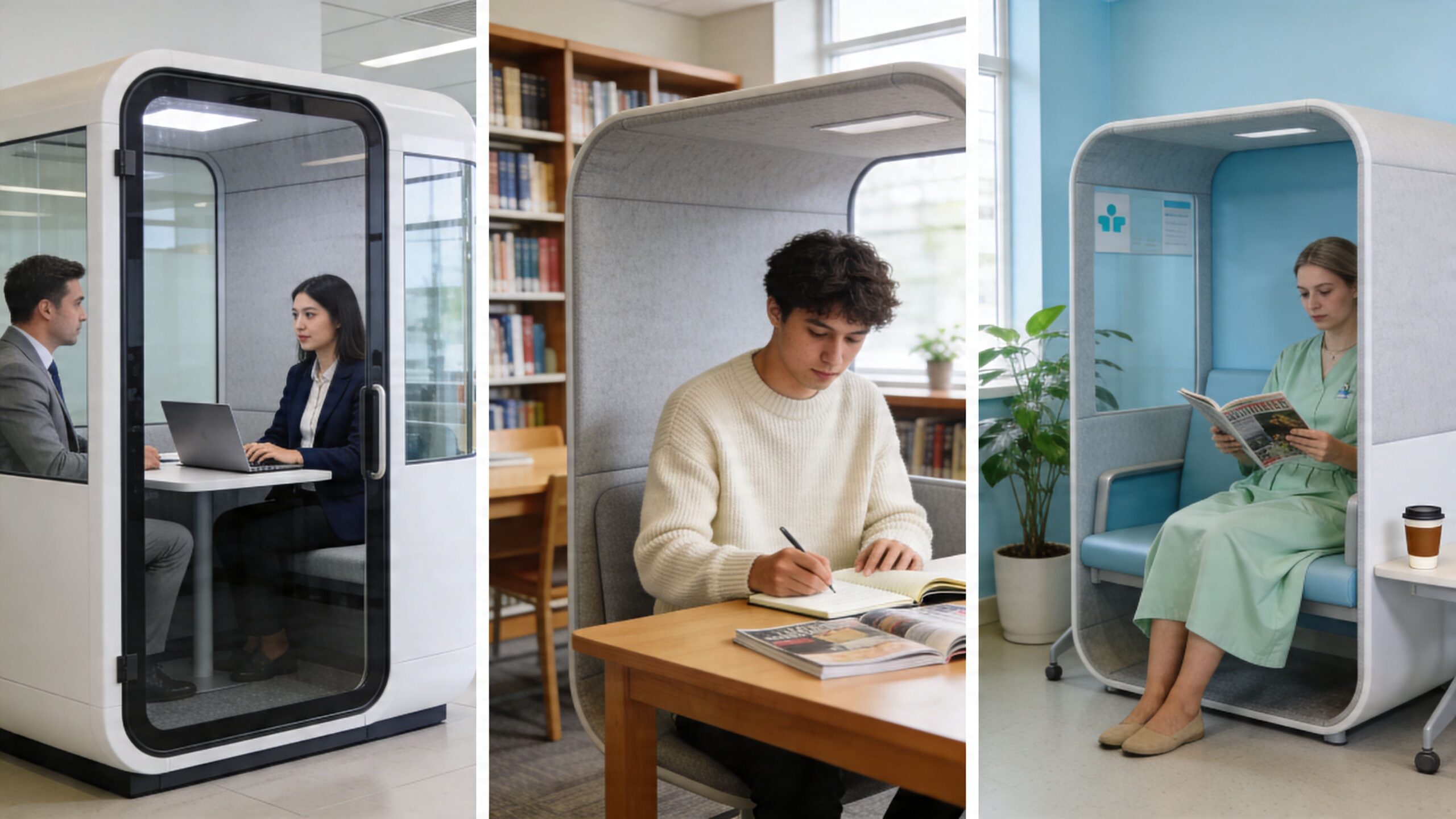
In standard offices, pods usually absorb the demand that formal meeting rooms cannot handle. That includes quick video calls, manager catch-ups, interviews, and project huddles. In Cambridge, tech and knowledge-based teams often need exactly that mix of quiet focus and fast collaboration.
Education healthcare and public settings
In education, pods can provide enclosed spaces for tutorials, online learning, or private study. In healthcare and public estates, the value is often confidentiality. Staff need rooms for sensitive conversations, but many buildings cannot easily take major internal alteration without disruption.
Spec discipline matters. Acoustic performance, ventilation, cleanable finishes, and ease of relocation all become more important than visual style alone.
Travel hospitality and mixed-use environments
Pods also work well in environments that are busy, shared, or transient. Around Stansted, enclosed work and call spaces can support staff, visitors, or travellers in settings where background noise is constant. In hospitality and mixed-use schemes, pods can create quiet business space without carving up the whole interior with fixed rooms.
The same logic applies in commercial hubs such as Braintree or government-related workplaces in Essex. A pod gives a site manager a way to add function quickly, while keeping future layout options open.
The GIBBSONN Turnkey Solution Your Expert Pod Partner
Choosing a pod is rarely just about choosing a product. The harder part is matching the right format, spec, and layout to the workplace itself.
A turnkey approach helps because the pod has to sit inside a wider office plan. That includes where it goes, how people move around it, how it connects to power, and how it fits with the rest of the interior. One supplier may provide the pod shell, but the fit-out partner still needs to think about practical use on the ground.
For clients who want one route through planning and delivery, GIBBSONN Interiors provides office fit-out, refurbishment, workplace reconfiguration, and modular meeting pod systems as part of a wider design-and-build service. In practical terms, that means pod decisions can be assessed alongside furniture layouts, acoustic conditions, circulation, and end-of-lease requirements rather than in isolation.
That kind of joined-up thinking reduces common mistakes. The wrong pod in the wrong place creates daily friction. The right pod, planned properly, becomes part of how the office works.
Frequently Asked Questions About Pod Meeting Rooms
Are pod meeting rooms actually soundproof
Most buyers use the word soundproof loosely. In practice, the right question is whether the pod provides enough speech privacy for the intended use. Pods with the right acoustic specification can significantly reduce external noise and make conversations much harder to overhear, but no pod should be treated as a recording studio unless the manufacturer proves that level of performance.
How long does installation take
Installation is usually far quicker than building a fixed room because pods are delivered as modular components. The verified data notes that entire meeting rooms can become operational within an afternoon in some cases, but the exact timeframe depends on access, site readiness, and whether power is already in the right place. The smoothest installations happen when delivery routes and floor positions are checked early.
Should a business choose pods or build permanent meeting rooms
That depends on lease length, layout certainty, and how often the space may need to change. If a business is staying put for a long period and already planning a full reconfiguration, fixed rooms may make sense. If flexibility, speed, or end-of-lease exposure is a concern, pods often make more sense.
What size pod is best for hybrid meetings
Many teams think they need a bigger pod than they really do. For most hybrid calls, a compact meeting pod works well if the table layout, camera line, screen position, and ventilation are right. Overly large pods take more floor area and can be harder to place well.
Do pod meeting rooms need landlord approval
That depends on the lease and the building, so this should always be checked. The attraction of pods is that they are non-permanent and usually involve far less structural intervention than built partitions. That often simplifies approvals, but it does not remove the need to review lease obligations properly.
Are they suitable for public sector or regulated settings
They can be, but specification matters more in these environments. Acoustic rating, ventilation, finishes, maintenance access, and practical compliance checks all need closer scrutiny. A pod that is acceptable in a standard office may not be right for education, healthcare, or government use without a more careful review.
What mistakes do buyers make most often
The most common mistakes are choosing by appearance alone, buying a pod that is too small for real use, underestimating ventilation, and placing it in the busiest part of the office. Another frequent mistake is forgetting how the pod will be managed after installation. If nobody knows who it is for, how long it should be used, or whether booking is required, frustration starts quickly.
Do pods work for smaller offices
Yes, often very well. Smaller offices usually feel the lack of private space more sharply because there are fewer enclosed rooms to begin with. The key is to avoid overfilling the floorplate. A smaller pod in the right place is usually better than a large pod that dominates the office.
Ready to Transform Your Workspace for 2026
Pod meeting rooms give businesses a practical way to add privacy, support hybrid work, and protect flexibility without committing to major construction. For facilities managers, they are not just a furniture choice. They are part of workplace strategy, lease planning, and staff wellbeing.
The best results come from getting the basics right. Choose the right size, insist on proper acoustic and ventilation performance, and plan installation around how the office works.
Ready to transform your workspace? Speak to the GIBBSONN Interiors team today. Looking for bespoke pod solutions or interior support? They’re here to help. Contact Us