
Most businesses start looking into office furniture fitted when the office no longer works. Desks don’t line up. Storage eats into walkways. Meeting rooms feel cramped, yet dead corners sit unused. The space may look fine on paper, but in day-to-day use it slows people down.
That’s where fitted furniture changes the conversation. It stops being a shopping exercise and becomes a workspace decision. Done well, it supports workflow, reflects the brand, helps with compliance, and makes future changes far easier to manage.
Table of Contents
- What Exactly Is Fitted Office Furniture?
- Exploring the Types of Fitted Office Furniture for 2026
- Unlocking the Benefits of a Bespoke Workspace
- Planning Your Project Cost and Timeline Drivers
- The GIBBSONN Process From Site Survey to Installation
- Essential Compliance for Your Fitted Office Furniture
- Smart Questions to Ask Your Supplier
- Your Checklist for a Perfect Fitted Office in 2026
What Exactly Is Fitted Office Furniture?
Fitted office furniture is made for the room, not dropped into it afterwards. That’s the simplest way to think about it. Instead of buying standard desks, cupboards, and screens in set sizes, the furniture is designed around the exact footprint, layout, and use of the office.
A good comparison is clothing. Off-the-shelf furniture can work, but it behaves like a suit bought in a hurry. It may fit well enough, yet it rarely makes the best use of every edge, wall, recess, or service point. Fitted furniture is custom-made. It follows the space properly and supports the people using it.
That changes more than appearance. It affects storage capacity, circulation, cable management, acoustic control, and how easy the office is to maintain.
More than built-in desks
Many people hear office furniture fitted and think of a desk run fixed to one wall. In practice, it covers a wider set of elements:
- Desking systems built to exact dimensions and team layouts
- Integrated storage that turns wasted wall space into useful capacity
- Reception features that combine branding, storage, and first impressions
- Breakout fittings such as banquette seating, tea points, and media units
- Room dividers and glazed systems that shape how the office works
The key point is integration. Freestanding furniture is selected piece by piece. Fitted furniture is planned as one joined-up solution.
Practical rule: If a room has awkward corners, shallow depths, uneven walls, or a need for hidden services, fitted furniture usually outperforms loose furniture.
Why businesses choose it
In commercial interiors, fitted solutions are rarely about luxury alone. They’re usually about control. Businesses want cleaner layouts, fewer compromises, and a workplace that feels considered rather than assembled over time.
That’s especially useful in offices where every square metre matters. A workspace in Bishop’s Stortford may need compact storage and multi-use areas, while a larger site in Essex may need a more structured mix of focused and collaborative settings.
Fitted furniture also tends to age better visually. Because lines are consistent and finishes are chosen together, the result feels part of the building rather than a collection of unrelated items.
Exploring the Types of Fitted Office Furniture for 2026
The fitted approach works because it isn’t one product. It’s a family of solutions that can be combined to shape how the office operates each day.
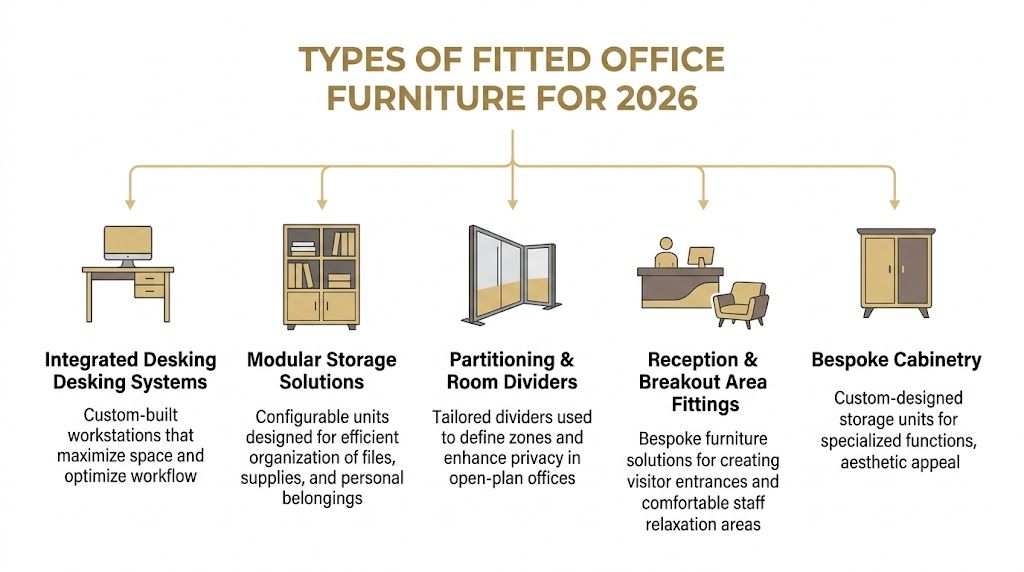
Some businesses need long desking runs with integrated cable trays. Others need a storage wall that doubles as zoning. Many now want privacy settings without committing to solid construction. That’s where pods, glazing, and demountable systems come in.
For a broader view of workplace planning trends, this guide on office furniture and design is a useful companion.
Built-in desking and benching
Built-in desking is the backbone of many fitted offices. It creates continuous work surfaces, consistent spacing, and a cleaner visual line across the floorplate. In practical terms, that means fewer awkward gaps and less wasted depth behind desks.
Benching systems work well for teams that need shared zones and straightforward power access. They can include integrated screens, under-desk storage, monitor arms, and cable routes. The main trade-off is flexibility. If a team structure changes often, the design needs to anticipate that from day one.
A fitted desk line works best when the space plan is stable and the business wants a polished, organised look.
Storage that works with the architecture
Storage is often the hidden reason fitted furniture pays off. Loose pedestals and mixed cupboards create clutter fast. A fitted storage wall can absorb files, lockers, printers, cleaning stock, and personal storage in one clean elevation.
This kind of joinery can also help define zones. A low run may separate touchdown space from a walkway. Full-height storage can screen support areas or create a backdrop in meeting rooms and reception spaces.
What doesn’t work is overbuilding storage for old habits. Many offices keep allocating room for paper-heavy systems they no longer need. Good fitted storage starts with an honest audit, not assumptions.
Partitions and pods with a fitted look
Modern office furniture fitted often includes demountable elements that look permanent without locking the business into a rigid layout. Glazed partitions are a strong example. They define rooms, preserve light, and can be reconfigured later.
Pods take that further. They provide enclosed privacy inside open-plan environments and can sit alongside fitted joinery without looking bolted on. Leading manufacturers in this space include Framery, Vetrospace, and BlockO.
These products are useful when the brief calls for acoustic privacy, phone space, or focused work settings but a full building alteration isn’t ideal.
| Furniture Type | Primary Function | Best For |
|---|---|---|
| Integrated desking systems | Continuous work surfaces with built-in cable and equipment planning | Open-plan teams and fixed workstations |
| Modular storage solutions | Organised storage that uses wall space efficiently | Offices needing cleaner layouts and less clutter |
| Partitioning and room dividers | Space zoning, privacy, and visual structure | Hybrid layouts and multi-use offices |
| Reception and breakout fittings | Brand presentation and social space support | Front-of-house areas and staff hubs |
| Bespoke cabinetry | Specialised storage or display built to exact needs | Equipment storage, tea points, and executive settings |
A fitted office works best when the pieces relate to each other. Mixing too many unrelated systems usually weakens the result.
A business in Chelmsford might prioritise integrated desking and storage, while a workspace in Hertfordshire may lean more heavily on pods and partitions to support hybrid use.
Unlocking the Benefits of a Bespoke Workspace
A team arrives on Monday to a newly fitted office. Desks sit tight to the room, storage is where people need it, cables are out of sight, and walkways stay clear even at busy times. That result does not come from buying better-looking furniture. It comes from planning the workspace around how the business operates.
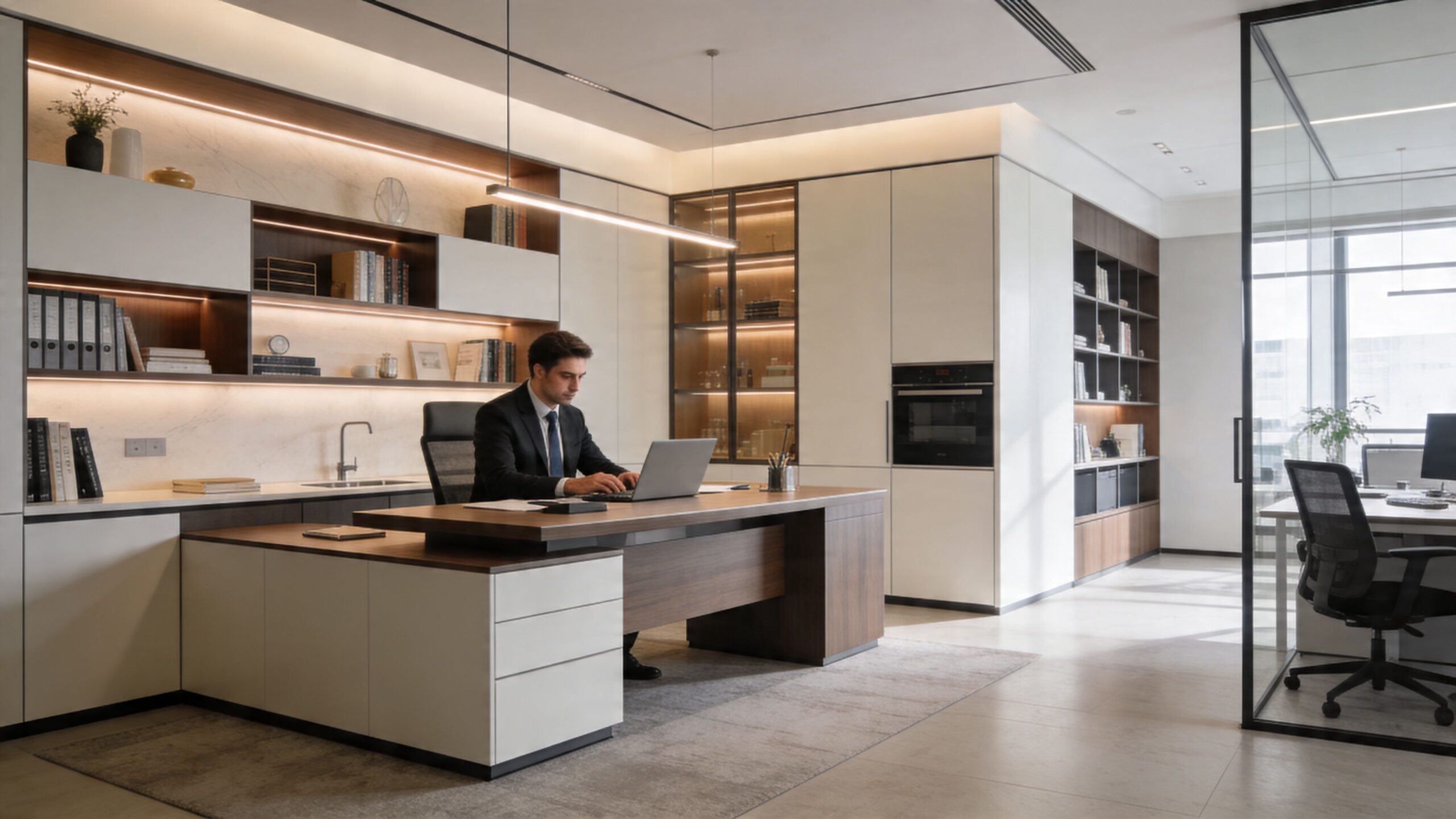
Fitted furniture earns its keep by reducing everyday friction. It uses awkward wall runs, corners, and service points properly. It also gives facilities teams more control over cable routes, equipment locations, storage capacity, and cleaning access. Businesses comparing off-the-shelf options with bespoke office furniture services usually find that the better answer depends on lifespan, headcount stability, and how hard the space needs to work.
Better use of space and better daily flow
The clearest gain is spatial efficiency. Standard desks and cabinets are made to suit average rooms. Real offices are rarely average. Alcoves, columns, glazing lines, radiators, floor boxes, and awkward corners all affect how usable the floorplate feels once a team moves in.
A fitted scheme deals with those constraints early, at survey stage, instead of forcing staff to work around them later.
That has a practical effect on the day-to-day running of the office. Printers can sit in sensible locations. Lockers and shared storage can be sized to the team rather than guessed. Meeting points and touchdown areas can be positioned without blocking circulation. In live UK workplaces, that matters as much as appearance because poor layout creates small delays all day long.
A well-designed fitted office is not just a visual upgrade. It becomes part of how the business works every day.
There is also a management benefit. When furniture is purpose-built, it is easier to keep the office consistent as teams grow or move around. Replacement pieces, add-on storage, and phased changes can follow an established specification instead of turning into a patchwork of mismatched products.
Brand, wellbeing and lease strategy
A bespoke workspace shapes how the business is read by staff, clients, and visitors. Reception joinery, meeting room storage, banquette seating, and built-in tea points all signal whether the office has been thought through properly. The strongest schemes are usually restrained. Good proportions, durable finishes, and tidy detailing tend to age better than design features chosen for short-term impact.
The wellbeing benefit is practical too. Fitted furniture allows working heights, monitor positions, reach zones, and circulation widths to be considered as part of the layout rather than left as an afterthought. In the UK, that matters because furniture choices sit alongside employer duties on workstation suitability, safe access, and day-to-day usability. Those compliance points are often addressed later in the project, but the best outcome comes from allowing for them during design.
Lease exit is another area where fitted schemes can either help or create cost. Some installations are straightforward to adapt, reuse, or remove. Others become expensive because they were never planned with reinstatement in mind. For tenants, that is a real trade-off. A feature partition, fixed cabinetry run, or heavily integrated service wall may suit the business now, but it should still be assessed against end-of-lease obligations, likely dilapidations exposure, and whether the landlord will require the space returned to shell or category A condition.
That is why the best fitted offices are not designed as isolated furniture packages. They are planned as working assets with a full life cycle in mind, from site survey and daily use through to reconfiguration, maintenance, and eventual removal.
Planning Your Project Cost and Timeline Drivers
The two questions that come up first are simple. What’s it going to cost, and how long will it take? The honest answer is that fitted furniture projects vary widely, but the drivers are usually predictable.
A straightforward desk and storage package in a clear rectangular office behaves very differently from a multi-room project with curved joinery, hidden services, phased installation, and live business operations. The detail matters.
For businesses trying to build a working budget, this guide to pricing per square foot helps frame the wider cost picture.
What pushes cost up or down
Three factors usually shape the budget most.
- Material choice: Laminates, MFC, veneers, glass, metal trims, acoustic finishes, and specialist worktops all sit at different price points. The right choice depends on wear, brand standard, and expected lifespan.
- Design complexity: Straight runs are easier to make and install than curved forms, floating details, feature lighting, or unusual junctions.
- Project scale: Larger schemes can improve consistency and buying efficiency, but they also involve more coordination, more site logistics, and more finishing detail.
A common mistake is pricing only the visible item. The desk itself is one part. Cable management, access panels, delivery constraints, installation sequencing, and making good all affect the total figure.
What affects the programme
Lead time is usually driven by design sign-off, manufacturing, and site readiness. Bespoke furniture can’t move into production until drawings, finishes, and practical details are approved.
Then there’s the building itself. Lift access, restricted delivery hours, floor levels, protection requirements, and whether the office remains occupied all influence the programme.
A sensible timeline usually includes these stages:
- Survey and brief review so the design is based on real site conditions
- Design development with layouts, finishes, and revisions
- Manufacturing period for approved bespoke items
- Installation window planned around the business and other trades
On-site reality: A fast programme on paper often slips because approvals were rushed or site conditions were never checked properly.
A site in Milton Keynes may have simpler access than a tighter city-centre building, while many offices across Essex face programme pressure because work has to continue around the installation team. That’s why early planning often saves more time than chasing a shorter lead time later.
The GIBBSONN Process From Site Survey to Installation
The strongest fitted furniture projects follow a calm sequence. Survey first. Design with purpose. Manufacture accurately. Install with as little disruption as possible.
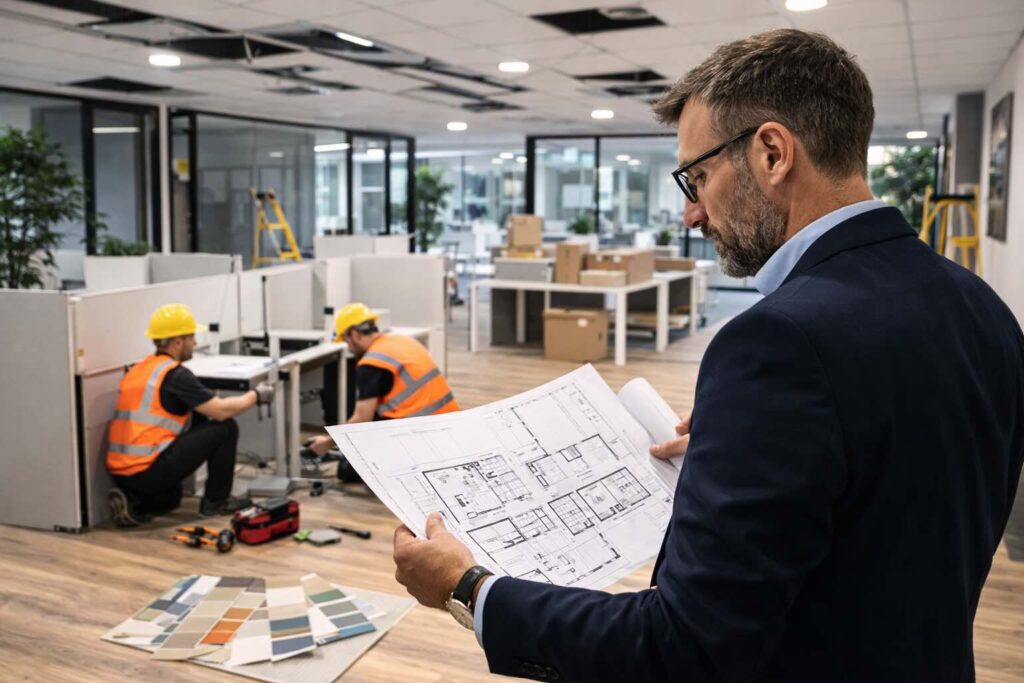
The order matters because every later decision depends on what happens during the first visit to site. When that stage is rushed, the project usually pays for it later in awkward junctions, delays, and avoidable rework.
Survey first, design second
A proper site survey does more than measure walls. It checks floor levels, bulkheads, radiators, sockets, data locations, door swings, sprinkler heads, access routes, and the condition of surfaces that new furniture will meet.
That information shapes the design. A storage wall may need service voids. A desk run may need access for floor boxes. A partition line may need to avoid lighting and air distribution.
The design stage then turns the brief into something buildable. That often includes:
- Layout testing to see how teams move and work
- Joinery detailing for doors, shelves, cable routes, and fixings
- Finish coordination so surfaces, glazing, and flooring relate properly
- Practical review to make sure cleaning, maintenance, and access still work
A project in London often brings tighter access constraints and stricter delivery planning, while offices across Hertfordshire may have more flexibility but still need detailed coordination around existing services.
Manufacture, install and handover
Once approved, the furniture moves into manufacture. That stage should be controlled, because small tolerances matter in fitted work. Consistent finishes, neat edging, hardware alignment, and pre-planned service access all make a visible difference at installation.
Installation itself should feel organised, not chaotic. Good teams sequence the work so protection, deliveries, assembly, and snagging happen in the right order. They also work around occupied offices where needed, often phasing noisy tasks or scheduling critical work outside core hours.
Good project management is quiet. The client knows what’s happening, who’s responsible, and what comes next.
Handover is the final test. Doors should align, cable access should work, pods and partitions should be clean and operational, and the office should be ready for use rather than nearly finished. That’s the point where fitted furniture proves whether it was designed for real life, not just for drawings.
Essential Compliance for Your Fitted Office Furniture
A team moves into a newly fitted office on Monday. By Wednesday, staff are propping fire doors open because circulation feels tight, cables are trailing where they should not, and two desks already need adjustment because the working heights are wrong. The furniture may look finished, but the job is not doing what the business needs.
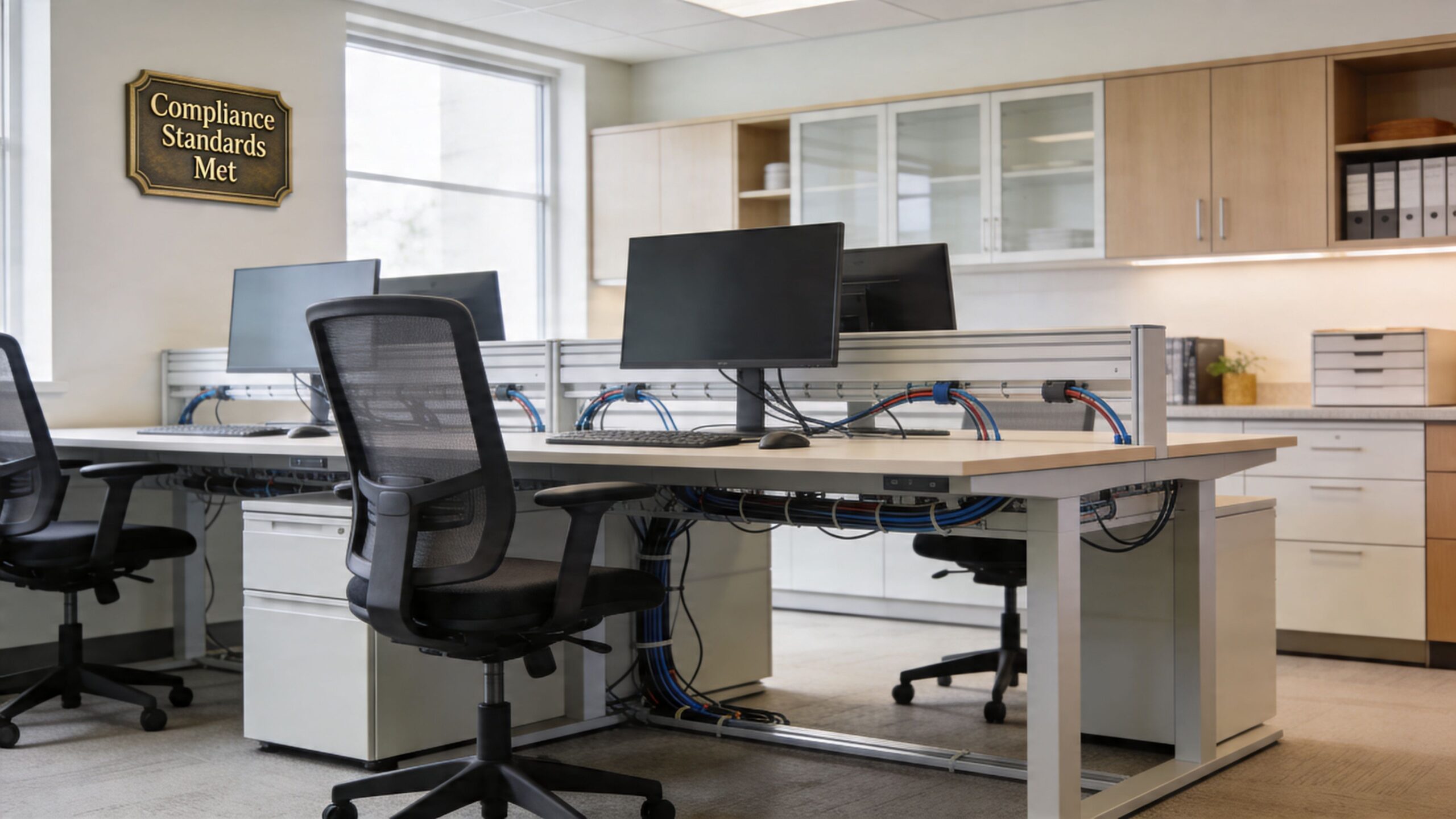
Compliance should be resolved during briefing, survey, and technical design, not checked after manufacture. In fitted work, that matters more because dimensions, fixings, access points, and clearances are built into the room. If the early decisions are wrong, the cost of correction rises quickly.
Ergonomics built into the furniture, not added later
For UK businesses, ergonomics starts with standards and then moves into practical use. Desk and seating specifications need to suit the people using them, the type of work being done, and the hours spent at each setting. A fitted bench that maximises headcount can still be the wrong answer if monitor depth is tight, seated posture is compromised, or cable trays block legroom.
British Standards such as BS EN 527 for office desks and BS EN 1335 for office seating are a sensible baseline. HSE guidance on musculoskeletal disorders reinforces the same point. Poor workstation setup creates avoidable strain, absence, and complaints.
The details are not decorative. They affect daily comfort.
Useful checks include:
- Desk height and adjustability for the user group, especially in shared workstations
- Screen depth and viewing distance so monitors are not pushed too close
- Keyboard and mouse position to support a more natural elbow and wrist posture
- Leg clearance under fitted desks, including cable management and support frames
- Chair compatibility so the furniture works with the seating already specified
I always treat ergonomics as a coordination issue, not a furniture-only issue. Joinery, task chairs, monitor arms, power access, and user behaviour all have to work together.
Safety and access need drawing-stage decisions
A fitted office also has to support safe movement through the space. That means keeping escape routes clear, protecting door swings, avoiding pinch points around storage, and making sure circulation still works when chairs are occupied and cupboards are open. These are basic checks, but they are often missed when layouts are approved from visuals instead of measured drawings.
Accessibility needs the same discipline. Route widths, turning space, reachable storage, and usable desk positions should be reviewed against the actual plan, not assumed. In practice, that often affects how many desks fit on paper versus how many should be installed on site.
| Compliance Area | What to check | Why it matters |
|---|---|---|
| Ergonomics | Desk dimensions, legroom, screen depth, chair compatibility | Reduces strain and supports sustained workstation use |
| Access | Route widths, turning space, reachable storage, usable desk positions | Helps staff and visitors use the office without barriers |
| Safety | Escape routes, door clearance, circulation, stable fixings | Lowers day-to-day risk and supports emergency egress |
Materials, air quality, and end-of-lease reality
Material choice has compliance implications as well. Low-VOC boards, laminates, adhesives, and finishes can support better indoor air quality, which matters in enclosed offices where people spend long hours. The right specification also helps with cleaning, durability, and maintenance.
There is a practical trade-off here. A finish that looks impressive in a sample pack may mark too easily in a busy office. A cheaper board may reduce upfront cost but perform poorly if furniture needs to be altered, removed, or made good at lease end. For many UK occupiers, end-of-lease obligations should be part of the conversation early. Fixed items, wall channels, and service penetrations can all affect reinstatement cost later.
A compliant fitted scheme usually feels straightforward to use. People can sit properly, move freely, find storage without obstruction, and leave the building quickly if they need to. That is the standard worth designing for.
A project in Cambridge may need to balance dense team layouts with accessible routes, while workplaces in Essex often need practical, durable material decisions that hold up to heavy daily use.
Smart Questions to Ask Your Supplier
A polished proposal can hide a weak process. The right questions expose whether a supplier can deliver fitted furniture properly, or whether they’re relying on generic products and optimistic promises.
Price matters, but it shouldn’t be the first filter. In fitted work, a cheap quote often means missing detail, limited design development, weak project management, or assumptions that turn into extras later.
Questions that reveal real capability
Ask direct questions and look for direct answers.
- Can they show similar commercial projects? Ask for examples that match your scale, building type, or level of complexity.
- Who handles the survey and who manages the job? If those roles are vague, coordination often suffers.
- How do they deal with revisions? Fitted projects nearly always involve refinement, so the process needs to be clear.
- What is manufactured bespoke and what is bought in? That reveals where quality control sits.
- How do they plan installation in a live office? The answer should cover sequencing, protection, access, and communication.
It also helps to ask what usually causes delay or cost movement. A reliable supplier won’t pretend nothing ever changes. They’ll explain where risk sits and how they control it.
Ask what happens when the site is not as drawn. The answer tells you a lot about how the supplier really works.
There are softer signals too. Do they talk about tolerances, services, finishes, and access in a grounded way? Or do they stay at moodboard level? Fitted furniture succeeds on detail, not just style.
A business in Stansted may need tighter programme control because of operational constraints, while companies in Hertfordshire often need a supplier who can coordinate cleanly with other fit-out trades. In both cases, the best partner is the one who can explain the process clearly before anything is ordered.
Your Checklist for a Perfect Fitted Office in 2026
A fitted office usually succeeds or fails before manufacture starts. The difference is rarely the finish sample or the moodboard. It is whether the brief, survey, compliance checks, programme, and lease position were handled properly from the outset.
Use this checklist to keep the project grounded in business reality:
- Set a brief that reflects how the office functions. Cover team adjacencies, storage pressures, privacy needs, IT requirements, and the impression the space should give to staff and visitors.
- Confirm the site conditions early. Accurate surveys, service locations, ceiling heights, access routes, and building constraints affect what can be fitted, how long installation takes, and what needs to be made off site.
- Plan for ergonomics and safety at design stage. Desk heights, reach ranges, circulation space, fire escape routes, and safe material choices are easier to resolve before anything is signed off.
- Build the budget around the full scope. Include design development, manufacture, delivery, installation, protection works, and making good. That is where cost movement usually shows up.
- Test the programme against operational reality. If the office stays live during the works, sequence matters. Deliveries, noise, dust control, and access windows need proper planning.
- Check what happens at lease end. Some fitted items can stay. Others may need removal or reinstatement. That decision affects fixings, materials, and long-term cost.
- Choose a supplier with clear project ownership. A good process includes one line of responsibility from survey through installation, with decisions tracked and changes managed properly.
Good fitted furniture should do more than fill a floorplate. It should support concentration, reduce daily friction, present the business well, and hold up under real use.
Ready to discuss your workspace? Contact Us