
Is your office really working for you? An outdated workspace isn’t just a matter of looks; it can quietly hold back productivity, dent team morale, and even misrepresent your brand to clients and new talent. Choosing the right partner from the sea of commercial interior design firms is one of the most important business decisions you’ll make.
This guide is your roadmap. It is not just about picking out new furniture. It’s about a strategic investment in your company’s future. We have seen countless businesses navigate this process, and we want to share that experience with you. We will walk you through how to define what you actually need, set a realistic plan, and ask the tough questions that reveal a firm’s true capabilities.
Think of this as a conversation with an expert, designed to help you avoid common pitfalls and select a partner with total confidence. Let’s get started on creating a workspace that not only looks incredible but also works hard for your business.
Your Workspace: The Heartbeat of Your Business
Your office is so much more than a collection of desks and chairs. It’s the physical version of your company culture, the place where your team collaborates and innovates, and a space that must adapt as your business grows.
When you invest in your commercial interior, you’re really investing in your people and your future. Getting it right pays you back in lots of ways:
- A Boost in Productivity: A thoughtfully designed space, with the right balance of collaborative hubs and quiet zones for deep work, helps everyone perform at their best.
- Happier, More Engaged Teams: An environment that puts employee wellbeing first sends a clear message: you are valued. This is a massive driver for morale and keeping your best people.
- A Powerful Brand Statement: Often, your office is the first real impression a client or potential hire has of your company. It should tell your story without saying a word.
Why a Professional Partner is a Must
The world of work is always changing, and your office needs to keep pace. The UK interior design industry reflects this. According to data from IBISWorld, the industry is projected to reach a market size of £1.8 billion by 2026, with over 6,400 businesses operating in the space. This growth highlights the rising demand for workplace transformations, especially for firms that can handle a project from start to finish. You can find more detail in the UK interior design industry data on IBISWorld.com.
A professional firm brings a level of expertise that goes far beyond just looking good. They are masters of building regulations, acoustics, lighting design, technology integration, and workflow. This knowledge is crucial, whether your business is based in a major hub like London or a growing community in Hertfordshire.
Understanding the Selection Process
With so many commercial interior design firms out there, the choice can feel overwhelming. The good news is that you can break it down into a straightforward, manageable process.
This infographic simplifies the journey into three core stages, helping you stay on track from start to finish.
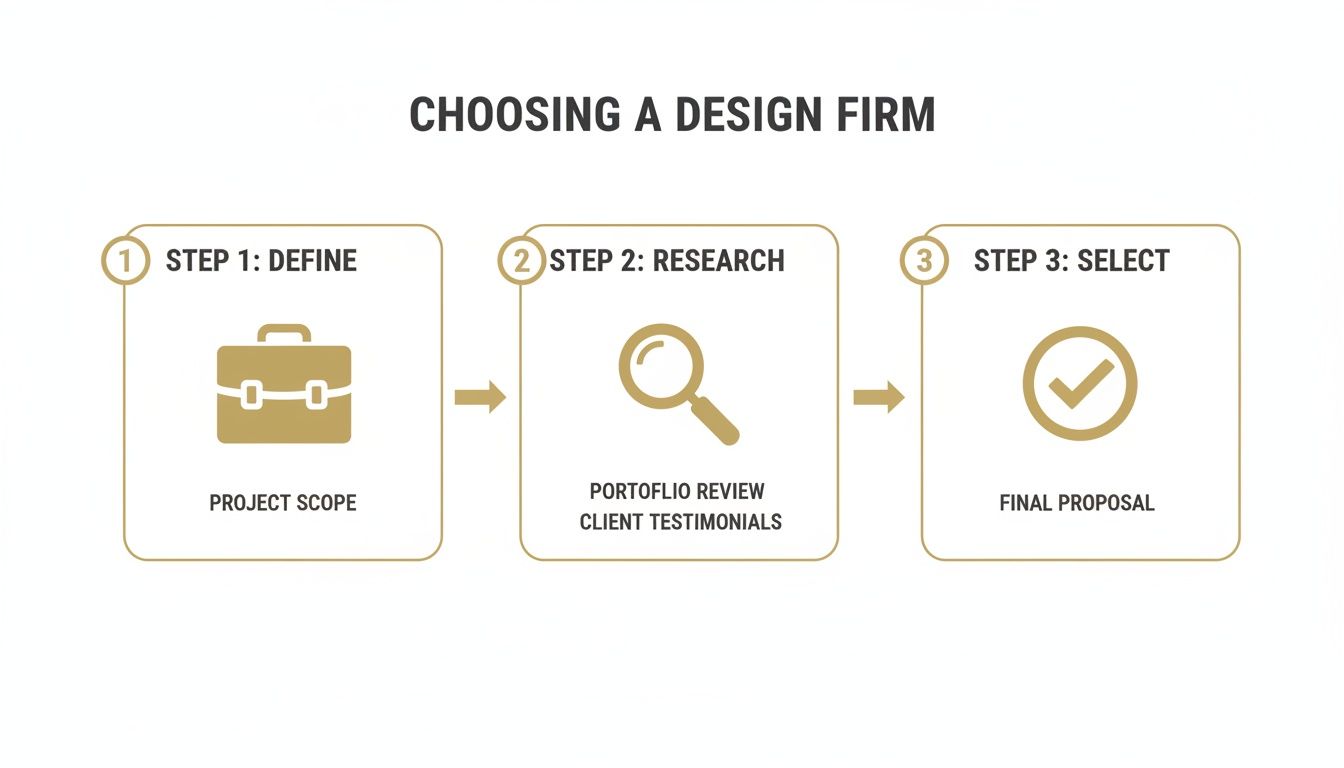
The real secret to success lies in the groundwork you do before you even start looking. When you have a crystal-clear vision of your goals, the research and selection phases become far more focused and effective.
The Rise of the Turnkey Design and Build Firm
More and more businesses are opting for a ‘design and build’ partner. In this model, a single company manages everything, from the first design sketches all the way through to construction, fit-out, and the final handover.
Here’s why this all-in-one approach has become so popular:
- One Point of Contact: You have a single, dedicated team to communicate with. This simplifies everything and gets rid of the blame game between separate designers and contractors.
- Budget Clarity: With one team managing the entire budget from day one, you get far greater cost certainty and fewer unexpected bills.
- Faster Project Delivery: The design and construction phases can overlap, which often shaves weeks or even months off the total project timeline.
This model removes the headache of juggling multiple contractors and designers yourself. It lets you focus on running your business while the experts bring your vision to life.
Ready to see how we can transform your workspace? The GIBBSONN Interiors team is here to help.
Building Your Project Brief and Core Objectives for 2026
Before you even think about picking up the phone to an interior design firm, the most crucial work begins right where you are. A well-defined project brief is, without a doubt, the single most powerful tool you have. It acts as the instruction manual for your new workspace and ensures every potential partner is quoting on a level playing field, understanding exactly what you want to achieve.
Think of it this way: you would not start building a house without a set of blueprints. Your project brief serves the exact same purpose. It’s what turns those vague, “it would be nice to have…” ideas into a clear, actionable plan that will guide every single decision, from the overall layout right down to the final finishes.
A good brief does not need to be a literary masterpiece, but it does need to be thorough. This is your opportunity to think deeply about the future of your business and how your physical environment can help get you there. A clear plan helps firms understand your specific needs from day one, whether your project is in a dynamic area like Essex or a growing business hub.
Define Your Business Goals
First, take a step back and ask the big question: why are we actually doing this? The answer needs to go deeper than simply wanting a “nicer office.” What are the concrete business goals driving this major investment?
- Improving Productivity: Are you trying to spark more collaboration with open-plan, shared spaces? Or, do your teams desperately need more dedicated quiet zones, like acoustic pods, for deep, focused work?
- Attracting and Retaining Talent: Is your current office letting you down in a competitive hiring market? A modern, well-designed, flexible workspace is a massive draw for top candidates.
- Supporting a Rebrand: Does your physical space need to finally reflect a new brand identity, a refreshed company mission, or a new set of corporate values?
- Boosting Employee Wellbeing: Are you looking to create a healthier environment that actively supports mental and physical wellness through better lighting, plants, or ergonomic furniture?
Answering these questions gives your project a real purpose and, just as importantly, a way to measure its success down the line.
Must-Haves vs Nice-to-Haves for 2026
Now it is time to get specific. Sit down with your key stakeholders and make two distinct lists: one for the absolute, non-negotiable essentials, and another for the things you would love to have if the budget and space allow. This is a critical step for managing your budget and making smart compromises later in the process.
| Category | Must-Haves | Nice-to-Haves |
|---|---|---|
| Workspace | 20 individual desks, 2 quiet pods | Sit-stand desks for everyone |
| Meeting | One 8-person boardroom | A casual breakout meeting zone |
| Social | Kitchen with coffee machine, fridge | A fully catered café space |
This simple exercise provides instant clarity. It forces you to prioritise what truly matters for your team’s day-to-day effectiveness and gives potential design firms a clear framework to work within. This prevents them from pitching concepts that are either too basic or far too extravagant for your actual needs.
Involve Your Team
Whatever you do, do not create your brief in an executive vacuum. Your employees are the ones who will live and breathe in this space every day, and their insights are absolutely invaluable. You do not need to get everyone’s opinion on paint colours, but you can gather incredibly useful feedback.
Send out a simple survey asking questions like:
- What is the single biggest frustration with our current office?
- What part of the office helps you do your best work, and why?
- If you could add one thing to our new office, what would it be?
This approach does more than just uncover practical issues you might have completely missed (like the chronic lack of private call spaces). It also fosters genuine buy-in from your team. When people feel heard, they become champions for the project, which makes the eventual transition into the new space infinitely smoother. This is just as important for a team in a bustling town like Bishop’s Stortford as it is anywhere else.
Ready to transform your workspace? Speak to the Gibbsonn Interiors team today.
How to Set a Realistic 2026 Budget and Timeline
Let’s get straight to the two elements that will define your project’s success: money and time. It’s all too easy to underestimate both when you’re excited about a new commercial fit-out. Getting these nailed down from the very beginning is the secret to a smooth project and a final result that actually lives up to your vision.
This is not about just picking a number that feels right. It’s about building a proper financial plan that anticipates every cost, so there are no nasty surprises waiting for you down the line. A solid budget and a clear timeline give you the power to have confident, informed conversations with potential design partners.

Speaking of confidence, the industry feels it too. The 2026 Houzz UK State of the Industry report found that 54% of UK interior designers have a good or very good business outlook for 2026. This stability points to a healthy market, giving businesses like yours the assurance to invest in their workspaces.
Breaking Down Your Commercial Fit Out Budget for 2026
So, where does the money actually go? A fit-out budget is far more complex than just the price of desks and paint. To get a true picture, you need to account for several distinct cost categories.
Here’s a quick look at the main categories you’ll be dealing with:
- Professional Fees: This covers your design firm’s costs, but do not forget other consultants. You might need structural engineers or M&E (mechanical and electrical) specialists, and their fees add up.
- Construction Costs: This is the big one. It includes all the building work, from putting up partitions and installing ceilings to all the plumbing and electrical wiring.
- Furniture, Fixtures, and Equipment (FF&E): Another major slice of the budget. This is everything from your workstations, chairs, and storage units to specialist kit and even decorative lighting.
- Technology: Think data cabling, the AV setup for your meeting rooms, and any other tech infrastructure your new space will rely on.
One of the smartest moves you can make is to set aside a contingency fund. We always recommend earmarking around 10% of the total project cost. This is not a sign of bad planning, it is a professional safety net for the unexpected, like discovering structural issues once the demolition starts.
For a more granular breakdown, check out our guide on how to calculate your 2026 office fit-out costs.
Mapping Out a Realistic Project Timeline
Just as critical as your budget is your timeline. Understanding the typical project phases helps you manage expectations internally and plan for any potential disruption. Keep in mind that a project in a competitive hub like London might have unique logistical challenges that an experienced firm should already be factoring into your schedule.
Generally, a project unfolds across four key stages.
| Project Phase | Typical Duration | Key Activities |
|---|---|---|
| 1. Strategy & Design | 4–8 weeks | Briefing, site surveys, concept design, detailed drawings. |
| 2. Procurement | 2–4 weeks | Tendering, appointing contractors, ordering long-lead items. |
| 3. Construction | 4–12+ weeks | On-site build, installation of M&E, fit-out, and finishing. |
| 4. Handover & Move-In | 1–2 weeks | Snagging, final cleans, furniture installation, client move-in. |
Of course, this is just a guide. A simple office refresh might only take a few weeks on-site. A complex, multi-floor reconfiguration, on the other hand, could easily take several months. Your chosen commercial interior design firm should be able to give you a detailed programme of works right from the start.
Ready to transform your workspace? Speak to the Gibbsonn Interiors team today.
Evaluating and Shortlisting Potential Design Firms for 2026
You’ve done the hard work of defining your vision, scope, and budget. Now comes the exciting part: finding the right design partner to bring it all to life. The UK’s commercial interior design sector was worth around £3.8 billion in 2023, which means you have a vast pool of talent to choose from. Your mission is to find the one that truly clicks with your project.
Finding commercial interior design firms can feel like searching for a needle in a haystack, but a methodical approach makes all the difference. It’s time to look past the glossy portfolios and start asking the questions that reveal a firm’s true capabilities.
Looking Beyond the Pretty Pictures
A stunning portfolio is table stakes, every decent firm has one. But a beautiful photo tells you very little about the journey. Was the project delivered on time? Did it stay on budget? What was the client relationship actually like?
To build a shortlist of genuine contenders, you need to filter for proven, relevant experience. Do not be shy about getting specific. If you’re a healthcare provider, you need a firm that understands clinical workflows, not just one that has designed a few nice waiting rooms. If you’re fitting out a new corporate HQ, you want to see a track record of large-scale projects, not just small office refreshes.
Sector Experience and Case Studies
A design firm with deep experience in your sector is worth its weight in gold. They’ll already be familiar with the unique operational challenges you face, whether that’s the acoustic engineering needed in a bustling open-plan office, the stringent security protocols in an airport, or the heavy-duty durability required in an educational setting.
When you start talking to firms, ask for detailed case studies on projects that mirror yours in a few key areas:
- Size: Have they managed a fit-out of a similar square footage?
- Budget: Can they show you successful projects within your approximate cost range?
- Scope: Look for examples with similar complexity, like major structural work or intricate tech integrations.
Comparing Service Models
You’ll quickly discover that firms work in very different ways. Understanding their delivery model is crucial for finding a partner that aligns with your internal resources and management style.
Broadly, you’ll encounter two main approaches:
-
The Traditional Model: You hire a designer or architect to create the plans and specifications. Then, you go out to tender and hire a separate contractor to do the building work. This puts you in the driver’s seat, but it also means you’re managing multiple contracts and are responsible for all the coordination between the different parties.
-
The Design-and-Build Model: You engage a single firm, like GIBBSONN Interiors, to handle the entire project from concept to completion. One team, one contract, one point of contact. This integrated approach simplifies communication, streamlines the process, and provides a single point of accountability for budget and timeline.
For businesses without a dedicated internal projects team, the design-and-build model offers far greater certainty and a much smoother experience. To understand how these models fit into the bigger picture, check out our guide on procurement in construction.
Technical Skills and Local Knowledge
A modern workspace is a highly complex environment. You need a partner with proven technical expertise in areas like acoustics, biophilic design, and smart building technology. Do they use the latest space-planning software to create immersive 3D visualisations? Do they have strong relationships with leading manufacturers of workplace tech and furniture, like Vetrospace or BlockO acoustic pods?
Finally, never underestimate the power of local knowledge. A firm with a strong presence in your area, like our work in a city like Cambridge, will have established relationships with local suppliers and a deep understanding of regional planning regulations and logistics. This insider knowledge can be invaluable in avoiding unexpected delays and costs.
As you start making calls, use this simple checklist to keep your evaluations consistent.
Key Questions to Ask Potential Design Firms
Use this checklist during your initial calls or meetings to consistently evaluate each firm.
| Evaluation Area | Key Question | What to Look For in Their Answer |
|---|---|---|
| Relevant Experience | “Can you show me 2-3 projects you’ve completed for a business like mine?” | They should confidently provide specific, relevant examples, not just generic portfolio shots. |
| Client Satisfaction | “Could you provide references from a recent project of a similar scale?” | A willingness to connect you with past clients is a huge green flag. Hesitation is a warning sign. |
| Team Structure | “Who would be my main point of contact and who is on the project team?” | Look for a clear structure and a dedicated project manager who will be your single point of contact. |
From Contract to Handover: What to Expect
You’ve done the hard work of vetting firms and have finally picked your design partner. Now, the real excitement begins. This is where all the plans, mood boards, and budgets start taking physical shape.
But what actually happens between signing the contract and getting the keys to your brand-new space? Knowing the road ahead makes the entire journey feel less like a mystery and more like a well-guided process. This final phase is where your vision truly comes to life.
Signing on the Dotted Line: The Contract Essentials
Before any work kicks off, you’ll sign a contract. This is not just a formality; it’s your project’s rulebook. Think of it as the ultimate source of truth that protects both you and your design firm. It’s crucial to read this document carefully, do not just skim it.
A professional, transparent contract will lay everything out in plain English. From our experience, these are the non-negotiable elements it absolutely must contain:
- A Detailed Scope of Work: This should list every single task and deliverable. We’re talking specifics, from the construction work involved right down to the exact model numbers of the furniture being installed.
- Clear Payment Schedules: The contract has to spell out how much is due and when. This is typically tied to key project milestones, like the initial deposit, the start of construction, and practical completion.
- Agreed Timelines: A reputable firm will give you a clear programme of works. This schedule should outline start and finish dates for every major phase of the project, so you always know what’s happening and when.
- Clauses for Changes: Projects sometimes evolve. Your contract needs a straightforward process for how changes are requested, costed, and approved. This is often called a ‘change order’ process and prevents any surprise costs.
- Warranties and Insurance: The document must detail all warranties for workmanship and products. It also needs to confirm the firm holds the right insurance, like public liability and professional indemnity.
Managing the Project: Communication is Everything
Once the project is underway, solid project management is what holds everything together. This is where having a single point of contact becomes invaluable. You should never find yourself chasing different tradespeople or suppliers for an update.
A dedicated project manager is your guide. They’re responsible for keeping the project on track, on budget, and for being your go-to person for anything you need.
You should expect, and ask for, a clear plan for communication. This usually looks something like this:
- Regular Progress Updates: A weekly email, a quick call, or a formal report. You should always be kept in the loop on what’s been done, what’s coming up, and any challenges that have been tackled.
- Scheduled Site Meetings: There’s nothing like seeing the progress for yourself. Regular site walk-throughs with your project manager let you see the vision taking shape and address any points on the spot.
- A Single Point of Contact: Having one person to liaise with is a game-changer. It cuts out confusion and ensures someone is always accountable.
For a business in a busy location like Hertfordshire, a project manager who understands the local logistics, from delivery access to council regulations, is a massive plus. They’re the ones solving problems before you even know they exist. For a deeper look into this crucial role, you might be interested in our guide on 2026 office fit-out project management.
The Final Lap: Your Handover Checklist
As the dust settles and the project nears completion, the “handover” process begins. This is more than just someone handing you a set of keys. It’s a formal procedure to ensure every detail has been completed to the standard you agreed upon before the final payment is made.
Your project manager will walk you through the space to put together a “snagging list.” This is simply a list of any minor defects or unfinished touches that need to be put right.
Use this checklist to make sure your handover is thorough:
| Checklist Area | What to Check |
|---|---|
| Finishes | Inspect all paintwork, flooring, and wall surfaces for a quality finish. |
| Systems | Test all lighting, power sockets, heating, and air conditioning to ensure they work. |
| Fixtures | Check that all doors, windows, and hardware operate smoothly and correctly. |
This is also the point where you’ll be given all the necessary paperwork for specialist products. For example, if you’ve had meeting pods installed, you’ll get the operational guides from manufacturers like Vetrospace or BlockO.
Only when you are completely happy and all snags have been resolved should you sign off on the project and release the final payment. This last, careful check ensures your new workspace is perfect from day one.
Your 2026 Commercial Interior Design Questions Answered
Embarking on a new workplace project is a huge undertaking, and it’s completely normal to have a long list of questions. It’s a significant investment, after all, and you want to get it right from day one. We get asked these all the time, so we’ve put together some straight-talking answers to the queries we hear most often.

What Is the Difference Between a Designer and a Design and Build Firm?
This is an excellent question because the answer gets right to the heart of how your project is managed and delivered.
A traditional interior designer will focus solely on the creative side, the concepts, floor plans, and technical specifications. Once that’s done, it’s up to you to hire a separate contractor to do the building work. This means you’re managing two different companies, two contracts, and all the communication in between.
A design and build firm, like us, offers a ‘turnkey’ solution. We handle everything for you under one roof. From initial workplace consultancy and design, right through to project management, construction, and the final fit-out, it’s all managed by a single, cohesive team.
The biggest win for you? Simplicity and total accountability. You have one point of contact from start to finish. This not only streamlines communication but also gives you far greater certainty on the final cost and project timeline, a massive advantage for any busy organisation.
How Much Does a Commercial Interior Fit Out Cost?
This is always the million-pound question, and the honest answer is: it varies dramatically. The final cost hinges on the size and location of your space, plus the level of specification you’re aiming for. A high-end fit-out in a prime city location will naturally have a different budget to a refresh in a town like Braintree.
To give you a ballpark figure, here are some typical industry ranges:
- Light Refurbishment (£30 to £50 per sq ft): This usually covers cosmetic updates like new carpets, a fresh coat of paint, and some new loose furniture. It’s a fantastic way to breathe new life into a space without a massive outlay.
- Full Fit-Out (£70 to £150+ per sq ft): This is a complete transformation. Think new partitions, ceilings, updated mechanical and electrical systems, and high-specification furniture and finishes.
A good partner will work with you to establish a realistic budget from the very beginning. They can then value-engineer the design, finding smart ways to bring your vision to life without ever compromising on the quality or durability of the final space.
How Long Does a Typical Office Refurbishment Take?
Just like the cost, the timeline is tied directly to the scale and complexity of your project. It’s vital to have a realistic grasp of the schedule so you can plan effectively and minimise any disruption to your day-to-day operations.
Here’s a general guide to what you can expect:
- Small Office Refresh: For a smaller space needing mostly cosmetic work, the on-site phase could be as quick as 2 to 4 weeks.
- Medium-Sized Refurbishment: For a standard 5,000 to 10,000 sq ft office, you should realistically plan for around 8 to 12 weeks of construction. This always follows a crucial period of detailed design and planning beforehand.
This is where the design and build model really shines. Because a single team manages both design and procurement, we can overlap key activities. For example, we can order long-lead items while final drawings are still being tweaked, something that’s impossible with the traditional approach. This can shave a significant amount of time off the overall project.
What Are the Biggest Office Design Trends for 2026?
Looking ahead to 2026, the best commercial interior design firms are doubling down on three core principles: flexibility, wellbeing, and technology. The office is no longer just a place to tick off tasks; it’s a destination that fosters culture, connection, and collaboration.
We’re seeing a huge shift towards ‘neighbourhood-based’ layouts. This involves creating distinct zones for different types of work, think bustling collaborative hubs, quiet libraries for deep focus, and relaxed social spaces for informal catch-ups.
In these open environments, acoustic comfort is now non-negotiable. That’s why modular meeting pods from pioneering manufacturers like Framery have become so essential. They offer instant, soundproofed rooms for private calls or small meetings without the dust and disruption of construction.
Finally, sustainability has moved from a ‘nice-to-have’ to a core requirement. Clients are rightly demanding designs that feature recycled or sustainable materials, energy-efficient systems, and a lower overall carbon footprint. A modern office must also be a healthy and responsible one.
Looking for bespoke pod solutions or interior support? The GIBBSONN Interiors team is here to help.