
Is your office just a place where work happens, or is it a powerhouse for your company’s culture and success? An office should be more than just desks and chairs; it’s the heart of your business, a magnet for top talent, and the physical shape of your brand. This is where commercial office fit out companies come in, the experts who turn an ordinary space into an extraordinary one.
Table of Contents
- Your Guide to Choosing the Right Office Fit Out Partner for 2026
- What a Commercial Office Fit Out Company Really Does
- How Much Does an Office Fit Out Cost in the UK?
- Key Office Design Trends to Watch in 2026
- How to Choose the Right Fit Out Partner for Your Project
- Your Top Questions About Commercial Office Fit Outs, Answered
Your Guide to Choosing the Right Office Fit Out Partner for 2026
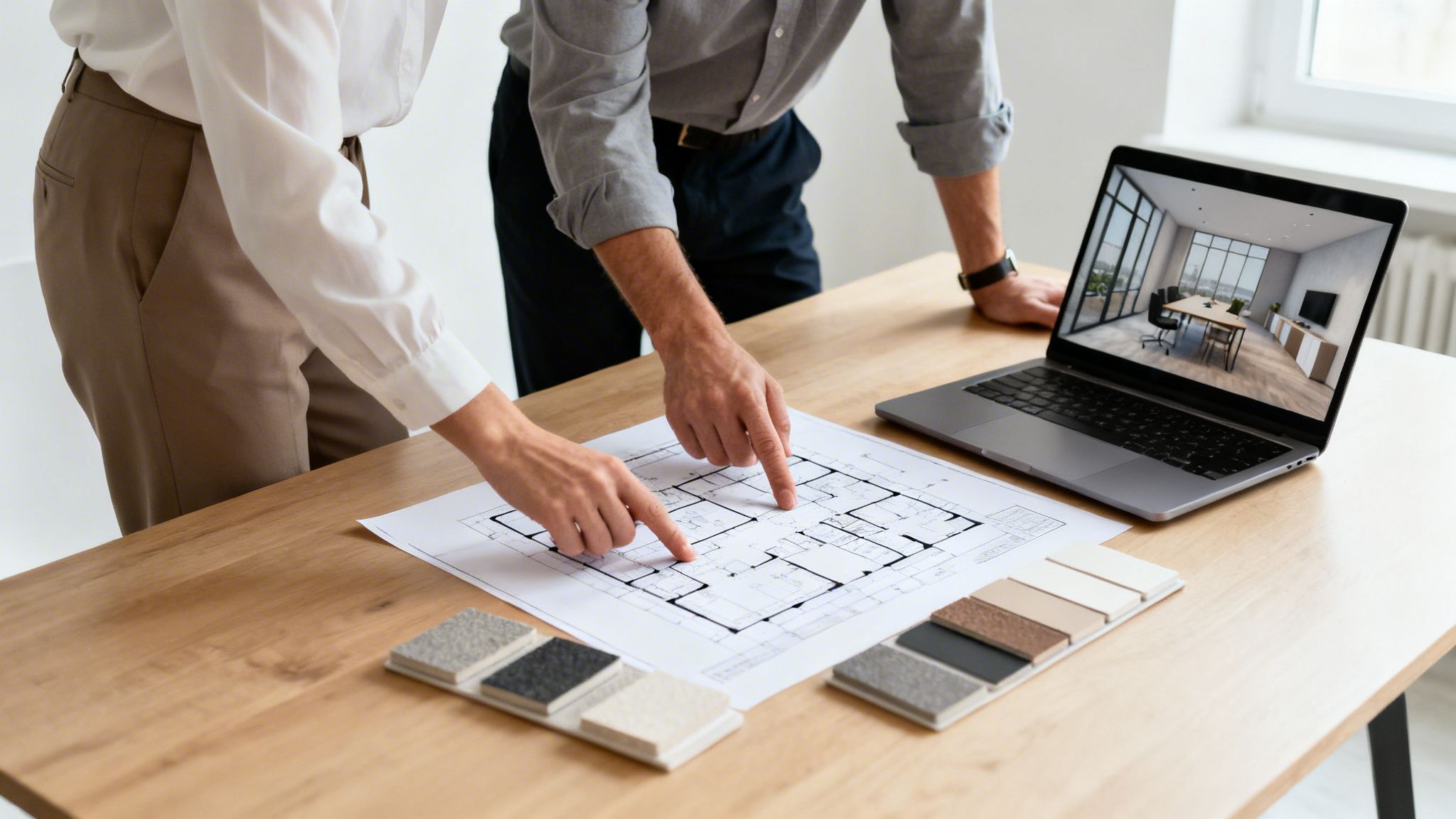
Turning a tired office or an empty shell into a dynamic space that energises your team and impresses clients is a huge job. The process involves countless moving parts, from initial design ideas and detailed plans to construction, legal checks, and the final touches.
Why Partnering with a Specialist Matters
Think of a fit out partner as the expert conductor of an orchestra. They take all the complex, individual elements of your project and bring them together in perfect harmony. This lets you focus on what you do best: running your business.
A great partner will:
- Manage the entire project: From the first sketch to the final coat of paint, they provide a single, accountable point of contact.
- Ensure compliance: They expertly handle the maze of building control and health and safety rules to keep your project legal and on track.
- Bring your vision to life: They mix creative flair with practical know-how to build a space that not only looks incredible but works flawlessly.
The commercial fit out market is a major part of the UK construction industry. A report from AMA Research valued the UK office fit out market at around £4.5 billion in 2022. This number is set to grow, driven by the increasing demand for flexible, high-quality workspaces that support modern ways of working.
Planning Your 2026 Project
As you look towards a 2026 project, this guide is here to explain the whole process. We will break down the stages, the likely costs, and the key questions you need to ask to find the perfect fit out partner. We’ve got you covered, from major projects in bustling hubs like London to emerging business centres in Hertfordshire.
Whether you’re planning a complete overhaul or a simple refresh, understanding the role of a commercial office fit out company is the first vital step. It’s about creating an environment that not only meets your needs today but actively supports your success for years to come.
What a Commercial Office Fit Out Company Really Does
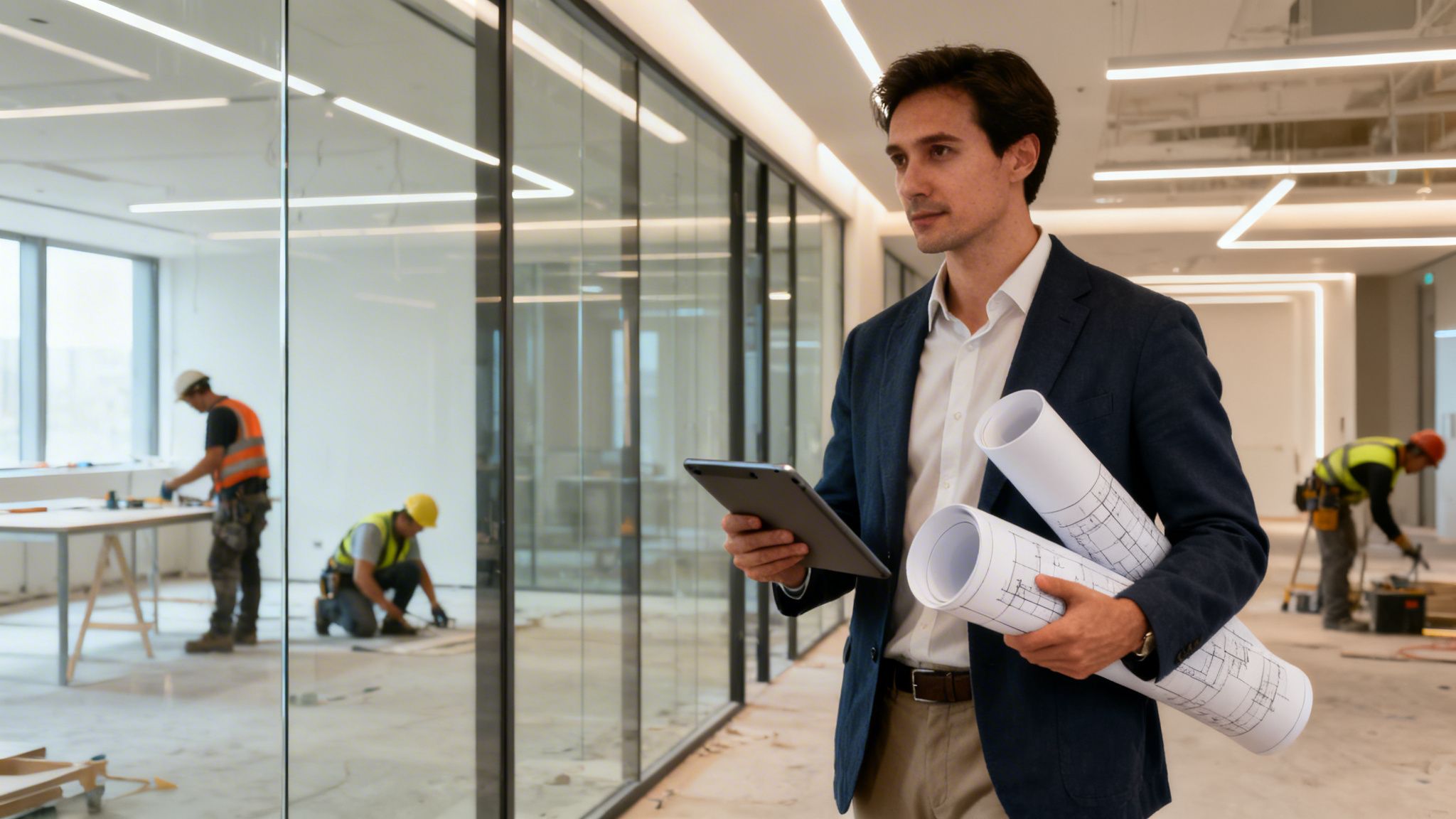
Ever wondered what goes on behind the scenes of a stunning new office? A specialist fit out company does far more than just put up a few walls and install some lights. You can think of them as a master conductor, bringing together designers, builders, suppliers, and technicians to create a perfectly tuned workspace.
The best commercial office fit out companies deliver what we call a ‘turnkey’ service. This simply means they manage the whole project for you, from the first spark of an idea to the moment your team moves in. It gives you one person to talk to and saves you the huge headache of trying to coordinate dozens of different tradespeople yourself.
At its heart, the process is about turning an empty shell into a strategic business asset. It is a journey that marries creative vision with exact technical skill.
From Vision to Reality: The Turnkey Process
A truly professional fit out journey begins long before a single hammer is swung. It all starts with workplace consultancy. This is where the company gets under the skin of your business. They take a deep dive into how your teams work together, what your daily workflows look like, and what makes your company culture special.
This detailed insight is the foundation for everything that follows:
- Space Planning: This is not just about drawing lines on a floor plan. It is about creating an efficient layout that makes the most of every square foot, ensuring your office genuinely supports how your people need to work.
- 3D Design and Visualisation: Using advanced software, we build a virtual model of your new office. This lets you “walk through” the space and ask for changes before any physical work begins, making sure the final result is exactly what you imagined.
- Full Construction Management: We then oversee every single part of the build, from installing partitions and flooring to managing all the crucial electrical, plumbing, and data cabling work.
Whether you’re setting up a new headquarters in Cambridge or refreshing an existing office in Essex, your fit out partner handles all the complex compliance checks. This is a critical step that ensures your new workspace meets all current building regulations and health and safety standards.
Essentially, they are responsible for delivering a finished environment that is ready for your team to walk into and start working from day one. You can learn more about the specific elements involved in our guide to office fit out services for 2026.
The right partner turns what could be a stressful and complicated project into a smooth and genuinely exciting experience.
When you start looking into commercial office fit outs, you will quickly hear industry terms like ‘Cat A’ and ‘Cat B’. It might sound technical, but it is actually quite simple once you know what it means.
Think of it this way: you would not buy a custom suit without knowing your measurements. These categories are the ‘measurements’ for your office project. They provide a common language that helps define the scope, budget, and final look of your new workspace from day one.
What Is a Category A Fit Out?
A Category A fit out, or ‘Cat A’ as we call it, is the basic shell that a landlord prepares for a new tenant. Imagine stepping into a space that is clean, functional, and ready to go, but completely neutral. It is a blank canvas.
It is liveable, but it is waiting for a business to put its own stamp on it. A standard Cat A project usually delivers:
- Raised access flooring and suspended ceilings.
- Basic mechanical and electrical services, like heating, lighting, and air conditioning.
- Finished internal walls and basic fire detection systems.
- Shared spaces like toilets and lift lobbies are also usually finished to this standard.
In short, a landlord invests in a Cat A fit out to offer a safe, functional, and appealing space to the market. It is the essential groundwork you see in new commercial buildings, whether in a busy city centre or a business park in Braintree.
What Is a Category B Fit Out?
This is where your vision truly comes to life. A Category B or ‘Cat B’ fit out is the process of taking that blank Cat A canvas and turning it into a workspace that is unmistakably yours. This stage is all about creativity, brand expression, and practical function.
This is where we install all the elements that make an office work for your people and your culture. A Cat B project is bespoke and can include everything from:
- Creating the Layout: Installing partitions, sleek glass walls, and doors to build individual offices, boardrooms, and quiet zones.
- Designing Specialist Areas: Crafting the perfect breakout zones, staff kitchens, a welcoming reception area, and dynamic collaboration hubs.
- Finishing Touches: All the decorating, flooring choices, and branded graphics that turn a shell into a home for your business.
- IT and Furniture: Installing the complete data cabling and IT infrastructure, along with picking and placing every desk, chair, and storage unit.
Cat A vs. Cat B Fit Out at a Glance
To bring it all together, here’s a quick comparison table. Think of this as a simple cheat sheet to tell the difference between what the landlord usually provides and what your fit out partner will create just for you.
| Feature | Category A (Landlord’s Fit Out) | Category B (Tenant’s Fit Out) |
|---|---|---|
| Main Goal | Create a functional, lettable space. | Create a branded, bespoke workspace. |
| Key Elements | Ceilings, floors, basic electrics, HVAC. | Partitions, meeting rooms, kitchen, branding. |
| Aesthetics | Neutral and unbranded. | Fully branded with company colours and logos. |
Having a solid grasp of these differences is key. It ensures you’re speaking the same language as your design and build partner, setting your 2026 project on the right track from the very first conversation.
How Much Does an Office Fit Out Cost in the UK?
One of the first questions on everyone’s mind is, “What’s the budget going to look like?” It is a vital step, but trying to find one magic number for an office fit out is nearly impossible. The final cost can change a lot based on where you are in the UK, the size of your space, and, of course, the quality of the finishes you want.
This is exactly why bringing in professional commercial office fit out companies from the start is so important. A high-spec project in a prime spot like Bishop’s Stortford, for instance, will have a completely different price tag than a more modest refurbishment in a smaller town. To help you get your head around the numbers and plan effectively for 2026, let’s break down the typical cost brackets you can expect.
Factors That Influence Your Fit Out Budget
A few key things will ultimately decide your final costs. Getting a handle on these early on helps you make smarter decisions and budget with a lot more confidence.
The main cost drivers really boil down to:
- Specification Level: Are you after basic, functional finishes, or are we talking high-end, bespoke materials? This is easily the single biggest factor in your budget.
- Location: It is no surprise that labour and material costs can vary quite a bit from one region to another.
- Size and Condition of the Space: A large floor plan or an older space that needs a lot of prep work will naturally increase the cost.
- Technology and M&E: The complexity of your IT, audiovisual systems, and the mechanical and electrical setup plays a massive part.
- Furniture: The quality and sheer amount of desks, chairs, storage, and breakout furniture will be a major line item on your invoice.
It is vital to think of this as a strategic investment, not just a line on a spreadsheet. A thoughtfully designed workspace has a direct, measurable impact on your team’s productivity, your company culture, and your power to attract and keep the very best talent.
Typical Cost Estimates for 2026
To give you a realistic starting point, costs are often broken down by the level of specification. While every single project is unique, these figures are a brilliant guide.
The Cushman & Wakefield UK Office Fit Out Cost Guide 2025 shows that average costs per square metre shift quite a bit depending on the city and spec. In London, the heart of UK commercial activity, a low-spec fit out starts around £1,356/m² (£126/sq ft), a medium-spec build is about £2,228/m² (£207/sq ft), and a high-spec design can hit £3,315/m² (£308/sq ft). Manchester is not far behind, with £1,173/m² (£109/sq ft) for low-spec, £1,927/m² (£179/sq ft) for medium, and £2,874/m² (£267/sq ft) for high-spec projects.
These figures show a clear year-on-year increase, something we are seeing driven by a growing demand for features like ergonomic designs, sleek glass partitions, and modular pods that boost staff wellbeing and focus.
This visual below does a great job of showing the difference between a ‘Cat A’ fit out (the basic shell provided by a landlord) and a ‘Cat B’ fit out, which covers all the bespoke finishes that make a space your own.
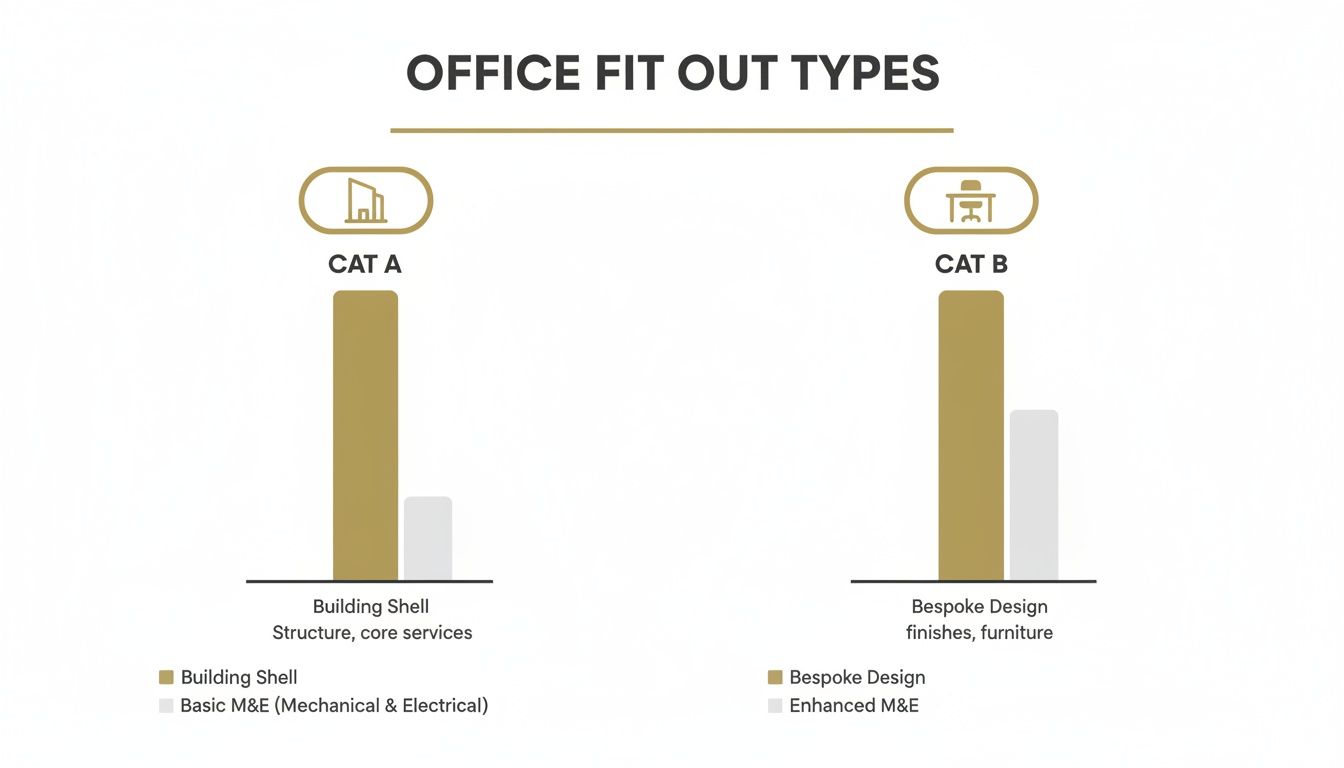
As you can see, a Cat B project builds directly onto the landlord’s Cat A foundation. It’s where we add all the specific elements like the branding, the meeting rooms, and the kitchen that make the space truly functional for your business. For a much deeper dive into the numbers, you can read our dedicated article on understanding your office fit out cost for 2026.
Key Office Design Trends to Watch in 2026
It’s no secret that how we work has completely changed, and our offices are now playing catch-up. With hybrid working becoming the norm, the very purpose of the office is changing. It is moving from a place for heads-down typing into a vibrant hub for collaboration, human connection, and bringing your company culture to life. The biggest shift we’re seeing for 2026 is the definite move towards truly flexible and agile environments.
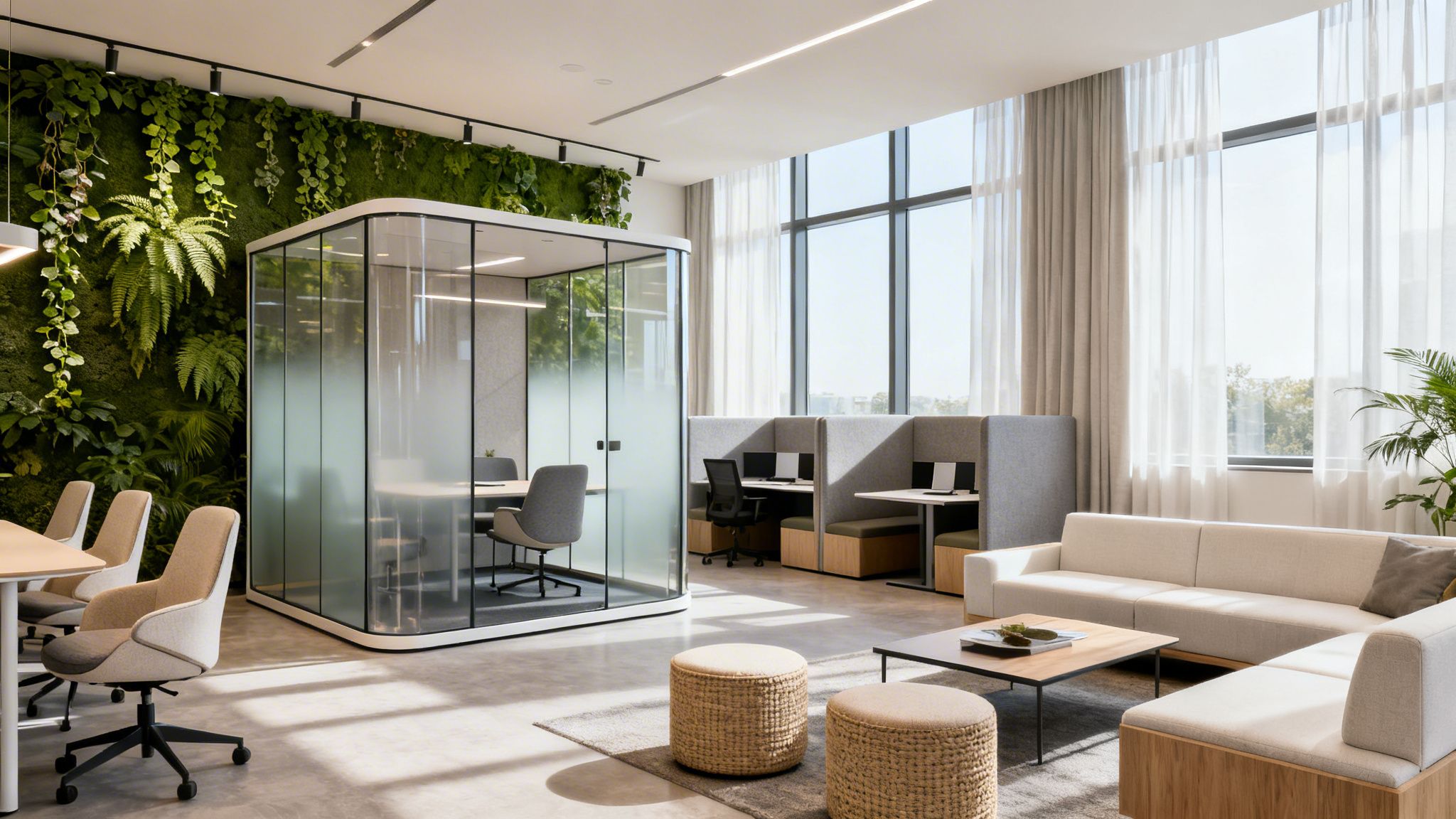
This means we’re designing spaces with far fewer assigned desks and a much richer variety of work settings. Think dedicated collaborative zones, quiet nooks for deep focus, and relaxed, informal lounges. As commercial office fit out companies, we’re at the forefront of this change, helping businesses create workspaces that not only meet these new demands but actively encourage them.
The Rise of Flexible and Agile Workspaces
Flexibility is without a doubt the key word for 2026. The UK’s flexible office sector isn’t just growing; it’s booming. It now accounts for roughly 10% of London’s entire office stock, a huge leap from just 6% back in 2019. And with average occupancy in these flexible workspaces hitting a strong 80%, it’s clear that businesses are fully embracing this adaptable model.
This is a direct response to the new rhythm of work, with about 25% of UK workers now splitting their time between home and the office. Naturally, this shift is creating a massive demand for modular and adaptable solutions within the workplace itself.
The Essential Role of Modular Pods
Modular meeting pods, from pioneers like Vetrospace and BlockO, are quickly becoming a must-have feature in any forward-thinking office. They’re a brilliant way to add private, soundproofed rooms to an open-plan layout without the expense, mess, and downtime of traditional building work.
Whether you need a single-person phone booth for quiet calls or a larger meeting pod for a team of four, these units offer incredible versatility. They can be moved and rearranged as your team’s needs change, making them a smart, future-proof investment. We’re seeing this trend take hold in our projects everywhere, from bustling business centres in Hertfordshire and beyond.
Sustainability and Wellbeing at the Forefront
Beyond flexibility, two other powerful trends are shaping the future of office design as we head into 2026.
- Sustainability: This has moved from a ‘nice-to-have’ to a core business need. Companies are now actively looking for recycled materials, energy-efficient systems, and sustainable building practices. A green office isn’t just good for the planet; it’s a powerful statement about your brand’s values.
- Employee Wellbeing: Creating a genuinely healthy environment is now top priority. This means designing spaces that support both mental and physical health. A key part of this is biophilic design, which means bringing natural elements like living walls and plants into the workspace, maximising natural light, and providing quality ergonomic furniture. It is a people-first approach, plain and simple.
These trends are all aimed at one thing: creating inspiring, thoughtful spaces where people genuinely want to be. For more ideas on bringing these elements to life in your own office, you’ll find our guide on modern office design trends for 2026 a great resource. From our work in dynamic hubs like Milton Keynes to corporate HQs across the country, we see first-hand how businesses are getting the rewards of investing in these forward-thinking designs.
How to Choose the Right Fit Out Partner for Your Project
Picking your fit out partner is probably the most important decision you will make for your whole office transformation. Get it right, and the project flows smoothly, hitting its deadlines and budget targets. But with so many commercial office fit out companies out there, what really sets a great partner apart from the rest?
Your first step should always be to look closely at their portfolio. You need to see a proven track record of delivering projects that are similar to yours in size, ambition, and complexity. A strong body of past work is the clearest sign that they have the experience to bring your vision to life.
Look for Turnkey Expertise
A company offering a complete ‘design and build’ or ‘turnkey’ service is a game-changer. It saves you a huge amount of time, coordination, and stress. This integrated approach means one team manages every single element under one roof, from the first architectural sketches and space plans to the final coat of paint and handover.
Instead of you juggling architects, builders, data cable installers, and furniture suppliers, you get one dedicated project manager as your single point of contact. It is a far simpler and more efficient way to work, making communication and accountability clear from day one.
Verify Their Experience and Reputation
Do not just rely on a polished pitch. Dig deeper and check their experience in your specific industry, whether it is the fast-paced tech world, a regulated healthcare environment, or a corporate headquarters. Every sector has its own unique needs, and you want a partner who already speaks your language.
Any reputable firm will be proud to share client testimonials and connect you with references. But if you can, take it a step further. Ask to visit a recently completed project. There is simply no substitute for seeing the quality of their work and their attention to detail up close.
A Checklist for Choosing Your Partner
As you begin talking with potential partners, having a structured checklist helps you cut through the noise. This ensures you cover every vital point and can make a fair comparison.
- Communication Style: Do they listen carefully before they speak? A true partner works with you, making a real effort to understand your business goals and operational challenges before they even think about offering solutions.
- Creative Solutions: Look for a team that brings fresh, innovative ideas to the table. They should be able to present creative yet practical ways to achieve your goals, all while respecting your budget.
- Transparency: Be direct. Ask about their process for managing budgets, tracking timelines, and handling changes. Crystal-clear, open communication is the foundation of a successful project and prevents nasty surprises down the line.
- Local Knowledge: Make sure they have clear experience in your area. Whether you need a full refit in Stansted or are navigating complex dilapidations in Chelmsford, local expertise is invaluable.
Ultimately, choosing the right fit out company is about finding a team you connect with and can trust. They should feel like an extension of your own business, a partner fully invested in creating a workspace that will empower your success for years to come.
Ready to transform your workspace? Speak to the Gibbsonn Interiors team today.
Your Top Questions About Commercial Office Fit Outs, Answered
When you are thinking about a new office project, a lot of questions come to mind. It’s completely normal. Based on our years of experience, we have pulled together the answers to some of the most common questions we get about office fit outs and refurbishments.
How Long Will My Office Fit Out Take?
Honestly, it all comes down to the size and detail of your vision. A simple, straightforward refresh of a smaller office might be finished in as little as 4 to 6 weeks. It is quick, efficient, and makes an immediate impact.
On the other hand, if you are looking at a full Cat B fit out from a basic ‘shell and core’ space, you need to think in months, not weeks. A larger, more complex project like this usually takes anywhere from 12 to 24 weeks. A reliable fit out partner will always provide a detailed project schedule right from the start, so you have total clarity on every milestone. This is absolutely critical, especially when you have a hard deadline like a 2026 launch.
What’s the Real Difference Between a Fit Out and a Refurbishment?
This is a great question, and we hear it a lot because the terms are often used in the same way. Think of it like this: a fit out is about creating a brand-new, functioning office from an empty space. This is what we call a ‘Cat A’ or ‘shell’ space provided by a landlord. You are building it from scratch.
A refurbishment, however, is all about breathing new life into an existing office. It is an upgrade. This could be as simple as fresh paint and new furniture, or it might involve a complete rethink of the layout, mechanical and electrical services, and tech to match how your team works today.
Can We Keep Working in Our Office During a Refurbishment?
Yes, in most cases, you absolutely can. This is where the expertise of experienced commercial office fit out companies really shines. We are masters of what is called ‘phased working’.
It is all about careful planning. We break the project down into logical stages to keep disruption to a minimum for your team. This often means scheduling the noisy or dusty work for evenings or weekends. Smooth progress relies on crystal-clear communication and a tightly managed schedule, whether your team is based in Dartford or anywhere else in the UK.
What Exactly are Dilapidations?
‘Dilapidations’ is the legal term for your duty to return a leased office to its original condition when your tenancy ends. Your lease agreement will spell out the exact requirements.
Essentially, it means taking out all the custom changes you made during your Cat B fit out. This includes removing things like partitioning, bespoke flooring, company branding, and kitchenettes. A professional partner can handle this entire process for you, ensuring you meet your landlord’s requirements and avoid any surprise financial penalties.
Ready to transform your workspace? Speak to the Gibbsonn Interiors team today.