
Let’s be honest, dealing with old office furniture during a refurb can feel like a massive headache. But what if it’s actually a huge opportunity? At its heart, office furniture recycling is all about finding a responsible home for those unwanted desks, chairs, and cabinets, making sure they never see a landfill. It’s a smart approach that doesn’t just help the planet, it can save your business a surprising amount of money.
Why Office Furniture Recycling Is a Smart Business Move in 2026

When you’re knee-deep in planning an office refurbishment in Hertfordshire, the last thing on your mind is probably what to do with the old stuff. But the sheer volume of commercial waste makes this an issue no business can afford to ignore anymore.
Every year in the UK, businesses throw away an incredible amount of perfectly good furniture. We’re talking about thousands of tonnes of desks, chairs, and storage units being sent straight to the tip. It’s not just wasteful; it’s a completely missed opportunity. This is where the idea of a ‘circular economy’ really comes into its own.
What Is a Circular Economy?
Think of it this way: instead of a straight line where we make something, use it, and then bin it, a circular economy creates a loop. We keep old items in use for as long as possible by repairing, refurbishing, or breaking them down into materials to create something totally new.
For your business, that old desk doesn’t have to become rubbish. It could be:
- Reused in another part of your business or a different site.
- Donated to a local charity, school, or community start-up.
- Refurbished to look brand new for a fraction of the cost of buying new.
- Recycled properly, with its wood, metal, and plastic components given a new life.
Suddenly, a logistical problem is transformed into a genuine business advantage. You’re not just clearing out a space; you’re making a strategic decision that benefits your finances and your brand’s reputation.
“Adopting a circular approach to office furniture is one of the most effective ways to reduce waste and demonstrate a real commitment to sustainability. It shows clients and employees that you’re a forward-thinking organisation.”
Beyond the Green Buzzwords for 2026
This is about much more than just “being green.” The benefits are tangible and hit your bottom line directly.
For a start, landfill taxes are constantly on the rise. Every single skip of waste sent to the dump costs your business money, and for a large clear-out, this can easily run into thousands of pounds.
Secondly, a strong environmental policy is a powerful magnet for attracting and retaining top talent. People want to work for companies that genuinely care about their impact. When you can proudly say your recent office fit-out in Bishop’s Stortford involved recycling 95% of the old furniture, it sends a powerful message.
Finally, it gives your brand image a serious boost. Customers are increasingly choosing businesses that align with their own values. Proving your commitment to sustainability can be a key differentiator in a crowded market. If you want to dive deeper, check out our guide on creating a more sustainable office space. It’s all part of building a modern, responsible, and successful business.
Understanding Your Legal Duties and the Cost of Landfill
When it comes to disposing of old office furniture, it’s about much more than just doing the right thing for the planet. As a UK business, you have legal responsibilities you simply can’t afford to ignore. Getting this wrong can lead to some eye-watering fines, so it’s something every facilities manager and business owner needs to have on their radar.
At the heart of it all is the ‘Duty of Care’. In short, this means your business is legally responsible for its waste from the moment it’s created until it’s properly and legally disposed of. You can’t just hand it off to any “man with a van” and wash your hands of it.
This means you have to ensure that whoever handles your waste, including those old desks and chairs, is a licensed waste carrier. You also need a paper trail. A document called a Waste Transfer Note must be filled out and signed by both you and the contractor. Think of it as your proof that you handed everything over to an authorised person and properly declared what the waste was.
The Ever-Rising Cost of Landfill
Beyond the legal obligations, there’s a powerful financial reason to avoid just chucking everything in a skip: landfill tax. This is a tax the government levies for every tonne of waste sent to landfill, and it climbs upwards pretty much every year.
Put simply, throwing things away is getting more and more expensive. What might seem like the “easy” option can quickly become a massive, unexpected dent in your refurbishment project budget. This is especially true for large-scale clearances, like those you might see during a major office move in Essex.
“For any business undertaking an office fit out or clearance, understanding the true cost of waste is critical. The financial case for office furniture recycling has never been stronger, turning a potential expense into a cost-saving opportunity.”
These rising costs are a clear signal from the government, nudging businesses to find better, more sustainable alternatives. It’s what makes office furniture recycling not just an environmental choice, but a genuinely savvy financial one.
Let’s just look at how quickly these taxes are adding up. The government is making it increasingly clear that landfill is the last resort, and the cost reflects that.
The Rising Cost of UK Landfill Tax
| Tax Year | Standard Rate Per Tonne |
|---|---|
| 2023-2024 | £102.10 |
| 2024-2025 | £103.70 |
| 2025-2026 | £126.15 (Projected) |
As you can see, the trend is only going in one direction. That projected leap for 2025-2026 is a significant jump that will catch unprepared budgets out.
Protecting Your Business and Your Budget for 2026
If your waste gets fly-tipped and traced back to you, failing to comply with your Duty of Care can result in unlimited fines. The Environment Agency takes this very seriously. They expect you to do your homework and only partner with reputable, licensed waste management professionals.
For projects in busy areas like London, the logistics are complex enough without adding the risk of legal hot water. By planning for furniture recycling right from the start, you shield your business from potential fines and keep your project on budget.
This proactive approach is all about being responsible, compliant, and financially smart, a core part of any successful modern business strategy.
Exploring Your Options from Reuse to Full Recycling
So, you’ve made the excellent decision to keep your old furniture out of landfill. What now? When you start looking into office furniture recycling, you’ll find several routes you can take, each with its own pros and cons. The real goal is to find the right home for every single item, whether that means giving it a second chance elsewhere or breaking it down responsibly.
This isn’t an all-or-nothing game. A typical office clearance project might actually use a mix of all these methods. It’s all about looking at your inventory with a critical eye and deciding which path makes the most sense for each piece.
First Stop: Give It a New Purpose Through Reuse
Honestly, the most sustainable option is almost always the simplest: just reuse it. Before you even think about getting rid of anything, take a look around. Could that spare meeting table work in a new breakout area? Can those extra chairs go to a new starter or a different department?
If there’s no room left in your own business, think wider. Local charities, schools, and community start-ups are often crying out for good quality office furniture. A simple donation can make a massive difference to them, and it’s a brilliant way to solve your disposal problem while giving back to the community.
Second Option: Sell It and Recoup Some Costs
If your furniture is still in good nick, you might be able to sell it. There’s a surprisingly robust market for second-hand office furniture, especially for high-quality, branded items like ergonomic chairs or solid desks that were built to last.
You’ve got a few avenues here:
- Second-hand Dealers: Specialist companies will often buy used office furniture in bulk. This is a quick and easy solution if you’re managing a large-scale clear-out.
- Online Marketplaces: Platforms like eBay or Gumtree can work well for smaller quantities, though it does mean a bit more legwork managing listings and dealing with buyers.
- Auction Houses: If you have some unique or high-value designer pieces, an auction could be the best way to get a fair price.
Selling not only puts some money back into your project budget but also guarantees the items continue their useful life in another business.
Third Choice: Refresh and Refurbish for 2026
What about the items that look a bit tired but are still structurally sound? This is where refurbishment comes into its own. It’s amazing what a little TLC can do to transform an old piece of furniture. A scuffed desk doesn’t have to be chucked; it can be given a completely new lease of life.
This is where services like architectural wrapping are real game-changers. We can take a dated, scratched tabletop and wrap it in a durable, modern finish. Suddenly, it looks brand new for a fraction of the cost and with a much smaller environmental footprint. Chairs can be reupholstered, metal frames can be repainted, the possibilities are endless, and refurbishing emits far less CO2 than producing new items.
Final Resort: Responsible Recycling
For furniture that is truly beyond repair or reuse, the final stop is responsible recycling. This isn’t just about tossing things in a skip. It’s a meticulous process where items are carefully dismantled into their core components, wood, metal, plastic, and fabric are all separated. From there, they’re sent to the correct facilities to be processed and turned back into raw materials.
The scale of this is staggering; UK businesses throw away up to 200,000 tonnes of office furniture every single year, and a huge portion of it is perfectly reusable or recyclable. You can discover more about the state of UK furniture waste to see just how big the problem is. Choosing the right partners makes a massive difference.
To help you weigh it all up, here’s a straightforward comparison to help you decide the best path for your unwanted furniture.
Comparing Office Furniture Disposal Options
| Option | Typical Cost | Environmental Impact |
|---|---|---|
| Donation/Reuse | Low (transport) | Very Positive |
| Resale | Potential Profit | Positive |
| Refurbishment | Medium | Very Positive |
| Recycling | Medium | Positive |
| Landfill | High and Rising | Very Negative |
As you can see, landfill is not only the worst choice for the planet but also an increasingly expensive one. Every other route offers clear environmental and financial benefits.
This kind of thinking is where adaptable solutions like modular office furniture really shine. They’re designed from the outset to be reconfigured and reused, cutting down on waste before it’s even created.
Ultimately, choosing the right path depends on the condition of your items, your timeline, and your budget. For most businesses, a smart combination of these approaches will deliver the best results, saving money while seriously boosting your company’s green credentials.
How to Plan Your Office Furniture Audit and Clearance
A successful office furniture recycling project begins long before a single item leaves the building. It’s the planning that separates a smooth, stress-free clearance from a chaotic and costly one. Getting organised from the very start is the best way to make the whole process feel manageable, not overwhelming.
This is especially true for projects in busy commercial centres, where keeping disruption to a minimum is always a top priority. A well-executed audit is your roadmap, giving you a crystal-clear picture of what you have, and what condition it’s in.
Creating Your Furniture Inventory
First things first: you need a simple inventory of everything you plan to remove. You don’t need a complicated system for this; a basic spreadsheet will do the trick perfectly.
Your inventory should list every single item, from desks and chairs to filing cabinets and meeting tables. For each piece, you’ll want to note a few key details.
| Item Description | Quantity | Condition |
|---|---|---|
| Ergonomic Operator Chair | 45 | Good (minor wear) |
| 1400mm Wave Desk | 30 | Fair (some scratches) |
| 3-Drawer Pedestal | 30 | Excellent |
| Large Boardroom Table | 1 | Poor (damaged leg) |
This simple table gives you a clear, at-a-glance overview of your assets. Believe me, it forms the foundation for all the decisions you’ll make next.
Assessing the Condition of Each Piece
Once your inventory is complete, it’s time to get brutally honest and grade the condition of each item. A quick walk-through is usually all it takes to categorise everything into a few simple groups:
- Excellent: As good as new. These items are ready for immediate reuse.
- Good: Shows minor signs of wear but is fully functional and presentable.
- Fair: Structurally sound but has visible scratches, stains, or general wear and tear. A great candidate for refurbishment.
- Poor: Damaged, broken, or unsafe. This is destined for responsible recycling.
This grading process is absolutely crucial. It helps you decide which items can be sold or donated, which could be given a new lease of life with a bit of work, and which need to be dismantled for their raw materials. It’s also a chance to get creative, think about updating tired surfaces with new finishes, a popular choice in modern office refurbishments. You can learn more about the potential of bespoke office furniture and how refurbishment plays a key role.
The journey of your unwanted furniture, from deciding its fate to its final destination, should look something like this.

This visual guide is a great reminder that landfill should always be the absolute last resort, with several sustainable options to explore first.
Coordinating with Your Clearance Partner
With your audit done and dusted, you can now approach potential clearance partners with a clear, detailed brief. A professional company will help you manage all the logistics, from providing the right transport to handling the mountain of necessary paperwork.
“A detailed audit is the single most important tool for an effective office clearance. It allows us to plan precisely, minimise disruption, and maximise the value recovered from your old assets.”
One of the most important documents you’ll need is a Waste Transfer Note. This isn’t just a piece of paper; it’s your legal proof that you have passed your commercial waste to a licensed carrier, fulfilling your legal Duty of Care obligations. Any reputable partner will provide this as standard.
Sadly, far too many organisations still haven’t adopted this planned approach. A startling 50% of UK firms dispose of office furniture as general waste, sending around 300 tonnes to landfill every single working day. That figure includes up to 1.2 million desks and 1.8 million chairs annually. As you can imagine, this creates a staggering amount of unnecessary waste and expense for businesses.
By taking the time to plan your audit and clearance properly, you can avoid becoming part of that statistic. You’ll ensure your project runs smoothly, complies with the law, and achieves the best possible outcome for your budget and the environment.
Measuring the Real Impact of Your Recycling Efforts
After all the hard work of auditing, planning, and clearing out your old office furniture, you finally get to the best part: seeing the positive impact of your efforts. This is the moment your project transforms from a simple clearance job into a powerful story about your company’s commitment to sustainability.
Measuring this impact isn’t about guesswork. It’s about tangible data that proves the difference you’ve made.
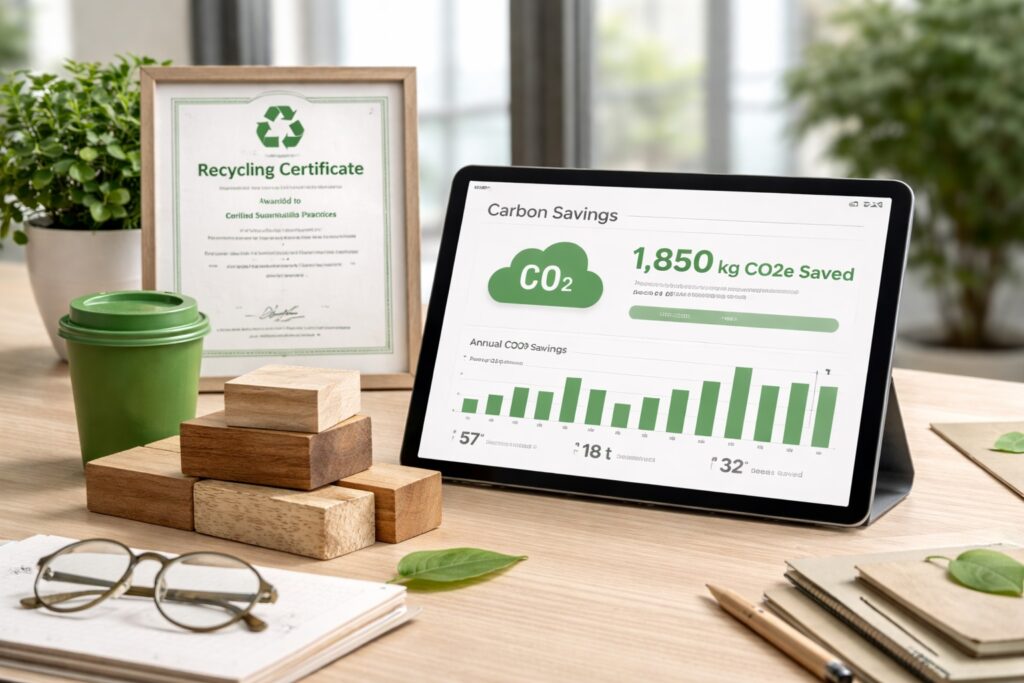
Any professional office furniture recycling partner worth their salt will provide detailed reports and certificates once the project is finished. These documents are more than just a tick-box exercise; they are compelling tools you can use to shout about your achievements. They break down exactly how much waste you’ve diverted from landfill, and that’s a figure worth celebrating.
Quantifying Your Success for 2026 and Beyond
The reports you receive should present clear, simple metrics that everyone in the business can understand. You’ll be able to see exactly what you’ve achieved.
This typically includes key stats like:
- The total weight of furniture collected, often measured in tonnes.
- The percentage of items successfully reused, refurbished, or recycled.
- A solid estimate of the carbon savings achieved by avoiding landfill.
These numbers give you a concrete way to measure success. They turn an abstract idea like “being green” into specific, impressive outcomes you can share with your team, customers, and stakeholders. For a business in a competitive market like Cambridge, this kind of data is gold.
“The sustainability certificates and reports you receive are more than just paperwork. They are proof of your commitment and a valuable asset for your company’s environmental reporting and brand storytelling.”
The real-world impact is genuinely significant. To give you an idea, in the first half of 2025, one UK specialist rehomed or recycled 4,121 pieces of furniture, weighing a hefty 93,000 kg. This single effort resulted in carbon savings of 111,875 kg CO2e, proving the massive environmental benefits of keeping furniture out of landfill. You can discover more insights about these impressive CO2 savings and see just how scalable these circular practices are.
Leveraging Your Achievements for Business Growth
Once you have this data, don’t keep it to yourself. It’s a fantastic story to tell, and one that can bring real business benefits. These reports are essential for your company’s Environmental, Social, and Governance (ESG) reporting, a factor that’s becoming increasingly important to investors and corporate partners.
Think about how you can use this information:
- Internal Communications: Share the results with staff to boost morale and foster a sense of pride in the company’s values.
- Marketing Materials: Include your recycling statistics on your website, in brochures, and on social media to attract environmentally-conscious customers.
- Tender Applications: Use your environmental performance as a key differentiator when bidding for new contracts, especially in the public sector.
Demonstrating your commitment in this way shows customers and staff that you are a business that genuinely cares. It builds trust and strengthens your brand reputation, turning a simple clearance project into a long-term asset for your business.
Common Questions About Office Furniture Recycling
Even with a detailed plan in place, a few last-minute questions always seem to pop up. It’s understandable, the finer details really do matter. We’ve pulled together some of the most common queries we get from office and facilities managers to help clear things up.
Think of this as your final checklist before you get started. From tricky IT gear attached to desks to finding a recycling partner you can actually trust, these answers should give you the confidence to move ahead.
What Should I Do with IT Equipment Attached to Desks?
This is a classic query, and it’s particularly relevant in today’s tech-heavy offices. Many desks come fitted with monitor arms, power modules, and data cabling. It is absolutely crucial that any IT equipment containing data is managed securely under the UK’s WEEE (Waste Electrical and Electronic Equipment) regulations.
Your furniture clearance partner should have a clear process for this. In most cases, they’ll work alongside a specialist WEEE-certified recycler who can safely remove, data-wipe, and dispose of all electronic components. Whatever you do, don’t let these items get tossed into a general waste skip, the data security risks are huge, and the environmental rules are incredibly strict.
Before the clearance team arrives on-site:
- Get your IT department to disconnect all computers, servers, and peripherals.
- Clearly label any hardware that requires secure data destruction.
- Confirm with your clearance partner upfront how they handle WEEE waste.
By tackling it from both an IT and a logistics angle, you ensure your furniture is recycled properly while keeping your sensitive company data locked down.
How Do I Find a Trustworthy Recycling Partner in 2026?
Choosing the right partner is probably the single most important decision you’ll make in this entire project. A great partner makes the whole process feel effortless, but the wrong one can land you in a mess of legal issues and logistical chaos. The key is to do your homework before signing on the dotted line.
A legitimate, trustworthy partner will never hesitate to provide their Waste Carrier Licence number. You can and should verify this on the Environment Agency’s public register. They must also issue a full Waste Transfer Note for every single collection, which serves as your legal proof that everything was disposed of responsibly.
“Never just go for the cheapest quote you find online. Ask for references, check their credentials, and make sure they can provide clear data and reporting on where your old furniture actually ends up. Transparency is everything.”
Look for companies with a solid track record, especially those with experience in your local area, whether it’s a complex project in Braintree or a straightforward office clearance. A good reputation is built on reliability and trust, so it’s worth digging into.
Can I Recycle Office Chairs with Fabric and Foam?
Yes, you certainly can. This is where a specialist office furniture recycler really proves their worth. A typical office chair is a complex bundle of different materials: metal, various plastics, foam padding, and fabric upholstery. Just sending it to a standard recycling facility simply won’t work.
A specialist, however, will dismantle the chair entirely. Every single component is carefully separated and directed into the correct recycling stream.
Here’s a rough breakdown of the process:
- Metal: The frame and mechanical parts are melted down to be reborn as new metal products.
- Plastic: Components like the arms and base are shredded and repurposed into new plastic goods.
- Fabric and Foam: These are usually the most challenging materials. Some advanced facilities can shred them for use in insulation or carpet underlay. Others send them to a ‘waste-to-energy’ plant, where they are incinerated to generate electricity, a far better outcome than landfill.
It’s this meticulous separation process that ensures an incredibly high proportion of the chair, often over 95%, is successfully diverted from landfill. It’s a detailed job, but one that makes a massive difference for the environment.
Ready to transform your workspace? Speak to the Gibbsonn Interiors team today.