
A well-designed office is more than just a place to work; it is the engine room of your business. It shapes company culture, boosts productivity and leaves a lasting impression on clients and employees alike. But transforming a vision into a functional, inspiring reality requires careful thought and meticulous planning. From understanding your team’s needs in a bustling London hub to navigating complex lease requirements in Bishop’s Stortford, every detail is critical to success.
This definitive office space planning checklist is your step-by-step guide to creating a workspace that not only looks brilliant but actively supports your business goals for 2026 and beyond. A successful office project is not about simply choosing desks and paint colours. It is a strategic process that balances budget, brand, compliance and human-centric design to deliver tangible returns on your investment. Ignoring this crucial phase can lead to costly mistakes, operational disruption and a workspace that fails to meet the needs of your people.
Whether you are planning a full-scale refurbishment in Essex, reconfiguring a floorplate in Cambridge, or preparing for an end-of-lease move in Hertfordshire, this comprehensive checklist covers every stage. We will walk you through everything from the initial discovery and space analysis to M&E requirements, acoustics and post-occupancy evaluation. Use this guide to ensure nothing is overlooked, empowering you to create a workspace that is efficient, compliant and perfectly aligned with your organisation’s future.
1. Define Project Scope and Business Objectives
The first and most critical step in any successful office space planning checklist is to establish a rock-solid foundation. This means clearly defining the project’s scope, timeline and budget while ensuring every decision aligns with your organisation’s strategic goals. Without this clarity, projects risk scope creep, budget overruns and a final result that fails to meet business needs.
This foundational stage involves answering key questions: Is this a complete refurbishment, a targeted upgrade to specific zones, or an end-of-lease dilapidation project? Are you transforming the workplace to support a new hybrid working model or simply expanding to accommodate team growth? Documenting these parameters provides a clear brief for your internal team and any external partners.
Aligning Space with Strategy
Your office is more than just a place to work; it is a strategic asset. Aligning its design with business objectives ensures your investment delivers tangible returns.
- Example 1: Tech SME Expansion: A fast-growing London tech firm needed to expand its office for 50 new hires within a tight three-month deadline. Their primary objective was to foster innovation. The project scope therefore prioritised creating collaborative zones, flexible project spaces and tech-enabled meeting rooms over traditional cellular offices.
- Example 2: Corporate ESG Commitments: A large financial services company planned a full office refit. A core business objective was to improve their Environmental, Social and Governance (ESG) credentials. This translated into a project scope that mandated the use of sustainable materials, energy-efficient M&E systems and wellbeing-focused amenities.
Actionable Tips for Success
To ensure your objectives are clear and achievable from the start:
- Engage Stakeholders Early: Involve department heads, HR, IT and a cross-section of employees to gather diverse perspectives on needs and pain points.
- Document Everything: Create a formal project brief that outlines objectives, budget, timeline and key deliverables. This document becomes the single source of truth.
- Build in Contingency: For any fit-out project it is wise to allocate a contingency fund, typically 10-15% of the total budget, to cover unforeseen costs. For a comprehensive breakdown, explore this guide on the cost of an office fit-out.
- Define Success Metrics: Before a single layout is drawn, decide how you will measure success. Will it be improved employee satisfaction scores, a lower cost per square foot or increased space utilisation?
2. Conduct Space Audit and Occupancy Analysis
Before drawing a single line on a floor plan, it is vital to understand how your current space is performing. A thorough space audit and occupancy analysis provides the data-driven foundation for your entire project. This process moves beyond assumptions, using hard evidence to identify underutilised areas, workflow bottlenecks and opportunities for efficiency. Without this analysis you risk replicating old problems in a new design.
This stage involves a detailed assessment of how your teams actually work. It examines traffic flow, identifies peak usage times for shared amenities and measures the utilisation rates of desks, meeting rooms and breakout zones. This intelligence is a cornerstone of any effective office space planning checklist, ensuring every square metre of your workspace adds tangible value and supports productivity.
Aligning Space with Actual Usage
A workspace designed around real-world data is one that inherently works better for its people. This analysis ensures your investment is targeted where it will have the most impact.
- Example 1: Healthcare Facility Reconfiguration: An audit of a healthcare administration building in Cambridge revealed that 40% of their large, formal meeting rooms were unused for over 80% of the week. This data prompted a shift away from traditional rooms towards installing flexible, modular meeting pods, freeing up valuable floor space for collaborative team zones.
- Example 2: SME Collaborative Space Redesign: A growing SME in Chelmsford discovered through occupancy tracking that their designated collaborative zones were consistently overcrowded, while rows of desks sat empty. This insight led to a redesign focused on a larger open-plan area with improved acoustic separation, better supporting their team-based project work.
Actionable Tips for Success
To gather accurate and meaningful data for your project:
- Utilise Technology: Employ space management software or non-invasive sensor technology to track real-time usage patterns. This provides objective data on which areas are most and least popular.
- Conduct Employee Surveys: Quantitative data tells you what is happening but qualitative feedback from staff surveys tells you why. Ask about satisfaction with the current layout, noise levels and access to necessary resources.
- Plan for Growth: A successful design must accommodate the future. A common best practice is to design for 110% of your projected headcount to allow for organic team growth without needing an immediate reconfiguration.
- Document Peak Times: Analyse and document peak usage times for high-traffic areas like kitchens, breakout spaces and meeting rooms. This data will inform the required number and size of these critical shared facilities.
3. Assess Regulatory Compliance and Lease Requirements
Navigating the complex landscape of regulations and lease obligations is a non-negotiable step in any office space planning checklist. Overlooking this critical phase can lead to significant legal liabilities, costly remediation work and disruptive project delays. It is essential to ensure that your planned fit-out adheres to all building codes, fire safety standards, accessibility laws and specific lease clauses from the outset.
This stage involves a thorough review of legal and contractual duties. Key considerations include the Equality Act 2010, which mandates accessibility for all, and health and safety regulations that protect your employees. Furthermore, your tenancy agreement will contain specific covenants dictating what modifications are permitted and, crucially, your reinstatement obligations (dilapidations) when the lease ends.
Aligning Design with Legal Duties
Integrating compliance into the design phase is not a constraint but a framework for creating a safe, inclusive and legally sound workplace. This proactive approach prevents expensive redesigns and ensures the project proceeds smoothly.
- Example 1: Public Sector Secure Facility: A government agency in London required an office fit-out that met Ministry of Defence security standards for handling sensitive information. The project scope included specific acoustic ratings for partitions, access control systems and secure IT infrastructure, all of which were designed in from day one to ensure full compliance.
- Example 2: Healthcare Clinic Refurbishment: A private healthcare provider in Hertfordshire was redesigning its clinical spaces. The project had to adhere to strict government design guidance, focusing on infection control with non-porous surfaces, optimised staff and patient circulation routes and specific ventilation requirements to meet healthcare standards.
Actionable Tips for Success
To ensure your project is compliant and avoids future lease-end disputes:
- Engage a Compliance Expert Early: Involve an architect or a specialist compliance consultant at the initial planning stage. Their expertise is invaluable for interpreting building regulations and sector-specific requirements.
- Request a Dilapidations Schedule: Before finalising any design, ask the landlord or their agent for a detailed schedule of dilapidations. This clarifies your reinstatement responsibilities and helps you design in a way that minimises future costs.
- Choose a Certified Partner: Ensure your chosen fit-out partner has demonstrable experience in your sector and holds relevant certifications. This provides assurance that they understand the specific compliance challenges you face.
- Document All Decisions: Maintain a clear record of all compliance-related decisions, inspections and certifications. This documentation is vital for demonstrating due diligence and for a smooth project handover.
4. Evaluate Layout Options and Traffic Flow Patterns
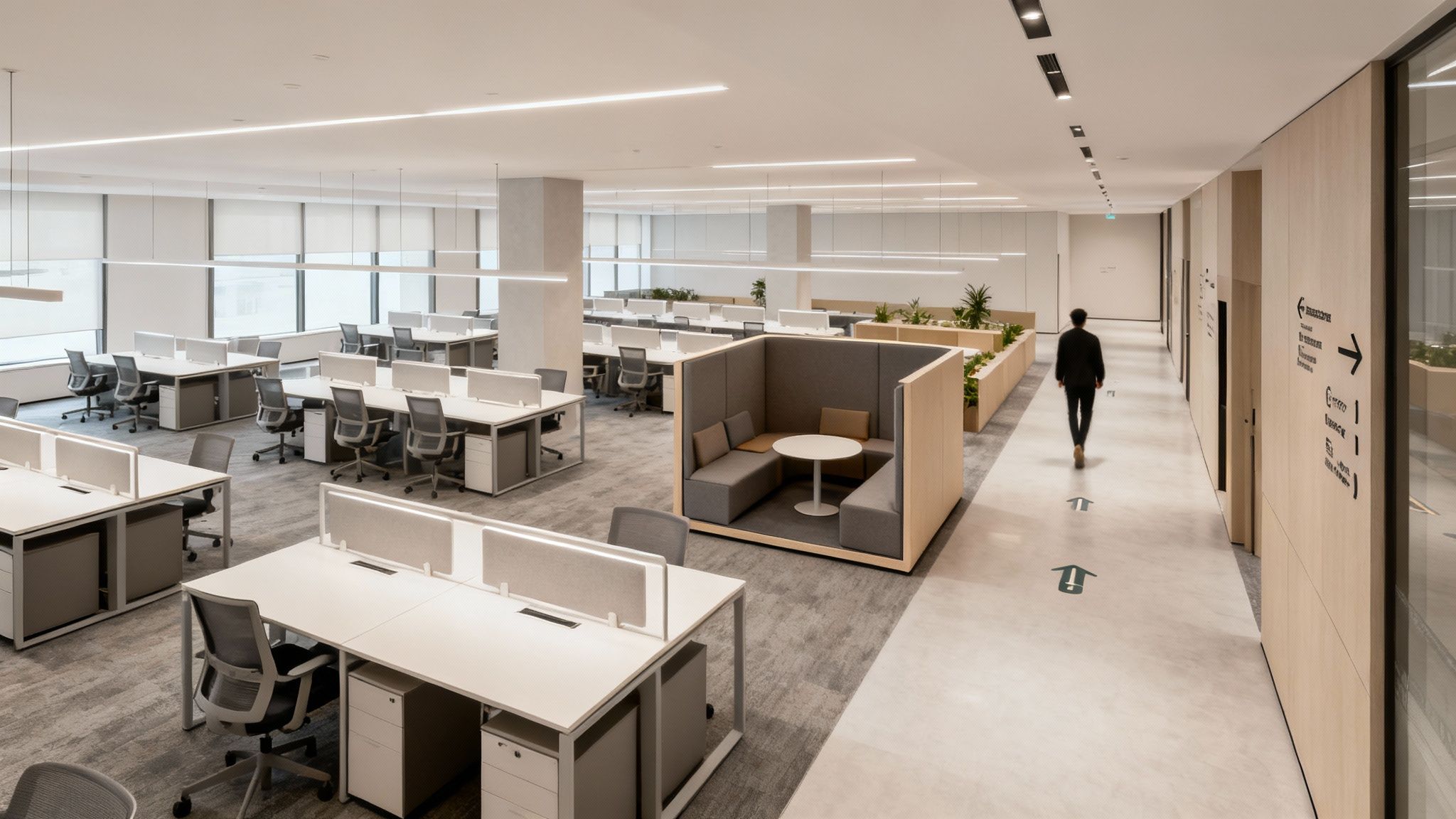
Once you understand your occupancy needs, the next logical step in your office space planning checklist is to evaluate how your team will move and interact within the space. Choosing the right layout is about more than aesthetics; it is about engineering a physical environment that actively supports your workflows, enhances productivity and minimises daily friction. This involves analysing different configurations and mapping traffic flow to ensure a seamless experience.
A well-designed layout strikes a crucial balance between collaborative energy and individual focus. It considers how people naturally move between tasks, desks, meeting rooms and amenities. By mapping these journeys, you can identify potential bottlenecks, reduce disruptive foot traffic through quiet zones and create an office that feels intuitive and efficient for everyone, whether they are concentrating on a report or brainstorming with colleagues.
Aligning Space with Strategy
The optimal layout directly reflects your company culture and operational model. A layout that works for a creative agency in London may be entirely unsuitable for a legal firm in Hertfordshire.
- Example 1: Corporate Transition to ABW: A large corporate client was moving to an activity-based working (ABW) model to empower employee choice. The layout was designed with distinct neighbourhoods for different tasks: a library for silent work, open-plan benches for collaboration, high-backed sofas for informal chats and bookable meeting pods for private calls. Circulation paths were designed to guide staff to the right zone without disturbing others.
- Example 2: Creative Agency Open-Plan: A fast-growing SME in Cambridge adopted a largely open-plan layout to promote spontaneous collaboration. To counteract the acoustic challenges, the design integrated strategically placed modular meeting pods and sound-absorbing panels. This hybrid approach provided the necessary balance, offering privacy on demand without sacrificing the open, dynamic atmosphere.
Actionable Tips for Success
To ensure your chosen layout and flow patterns are effective:
- Use 3D Modelling: Before committing to a build, use 3D visualisations or virtual reality walkthroughs to test different layouts. This helps stakeholders experience the space and identify potential issues with flow or functionality.
- Design for Flexibility: Prioritise modular systems, moveable partitions and versatile furniture over fixed, permanent walls. This allows you to reconfigure the space easily as your team’s needs evolve.
- Plan Generous Circulation: Ensure main walkways and corridors are wide enough to accommodate peak traffic, such as during morning arrival or lunchtime, to prevent congestion and frustration.
- Separate Work Zones Acoustically: In open-plan or ABW environments, use acoustic baffles, high-performance flooring and sound-absorbing materials to prevent noise from collaborative areas bleeding into focus zones.
5. Plan for Ergonomics, Health, and Wellbeing Integration
A crucial element of any modern office space planning checklist is the proactive integration of ergonomics, health and wellbeing. Moving beyond basic compliance, this step focuses on creating an environment that actively supports the physical and mental health of your employees. A workspace that prioritises wellbeing is no longer a luxury but a strategic tool that directly reduces absenteeism, boosts productivity and improves staff retention.

This involves a holistic approach, considering everything from the adjustability of a chair to the quality of the air. It means designing workstations to prevent musculoskeletal disorders and providing amenities that allow staff to rest, recharge and find focus. By embedding wellbeing into the fabric of your office design, you create a space where your team can perform at their best.
Aligning Space with Strategy
A people-centric design philosophy delivers clear business advantages, transforming your office from a cost centre into a valuable asset for talent attraction and organisational performance.
- Example 1: Financial Services Wellbeing Initiative: A London-based financial services firm aimed to reduce workplace stress and improve employee focus. Their fit-out integrated sit-stand desks as standard, installed biophilic green walls to improve air quality and incorporated quiet focus pods. This directly addressed staff feedback and supported a high-performance culture.
- Example 2: Healthcare Staff Support: An NHS hospital trust in Essex sought to improve break facilities for staff facing demanding shifts. The refurbishment project created a dedicated staff retreat with abundant natural light, comfortable soft seating and calming biophilic design elements, directly supporting the wellbeing of frontline workers.
Actionable Tips for Success
To successfully integrate health and wellbeing into your workplace design:
- Audit and Survey: Conduct employee surveys to understand their wellbeing priorities. Do they need more quiet zones for focused work, better break facilities or more natural light?
- Prioritise Ergonomics: Integrate sit-stand desks, fully adjustable ergonomic chairs and monitor arms as a standard provision, not an afterthought. This is a direct investment in your team’s long-term health.
- Adhere to Regulations: Ensure your design meets or exceeds the guidance in the HSE’s Workplace (Health, Safety and Welfare) Regulations 1992, which cover essentials like lighting, temperature and ventilation.
- Consider Certification: Explore wellbeing certifications like the WELL Building Standard or BREEAM to provide a structured framework for your health-focused design initiatives and demonstrate your commitment to employees.
6. Establish Acoustic and Privacy Solutions
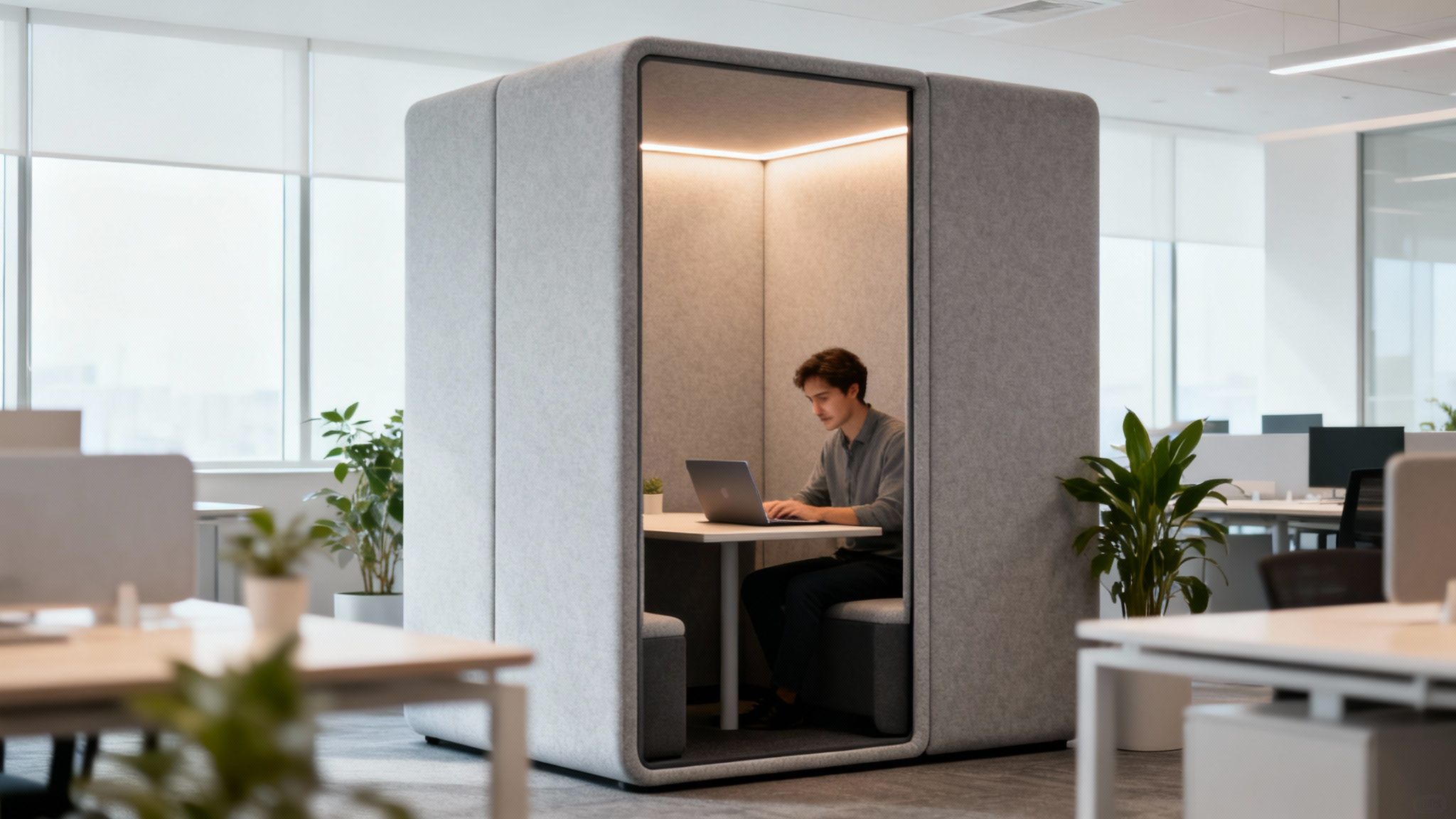
A crucial, yet often underestimated, element of any office space planning checklist is the strategic management of sound. In modern open-plan and hybrid environments, uncontrolled noise is a primary source of distraction, stress and reduced productivity. Establishing effective acoustic and privacy solutions means proactively planning how to absorb, block and mask sound to create an environment where both focused work and confidential conversations can coexist comfortably.
This involves moving beyond basic material choices and implementing a layered acoustic strategy. It requires analysing how different teams work and creating designated zones with appropriate soundscapes. From bustling collaborative hubs to quiet libraries, a well-designed acoustic plan ensures that the sound of the office supports its function, rather than detracts from it. This is not merely an afterthought; it is fundamental to employee wellbeing and operational effectiveness.
Aligning Space with Strategy
A successful acoustic strategy aligns directly with how your business operates, protecting both concentration and confidentiality where it matters most.
- Example 1: Call Centre Focus: A busy call centre in Essex needed to reduce ambient noise that was impacting call quality and causing staff stress. The redesign project incorporated high-performance acoustic ceiling baffles and freestanding desk dividers with high NRC ratings. Crucially, modular pods were installed for one-to-one training sessions and private staff calls, isolating noise at the source.
- Example 2: Healthcare Confidentiality: A healthcare provider in Hertfordshire planned a clinic refurbishment with a primary objective to improve patient confidentiality. The scope included specifying acoustic-lined phone booths for administrative staff to discuss sensitive patient information, ensuring conversations were not overheard in the open reception area.
- Example 3: Agency Collaboration: A creative agency in Braintree wanted to maintain a vibrant, collaborative atmosphere without constant interruptions. Their fit-out used soft partitions, biophilic elements like moss walls for sound absorption and designated quiet zones, striking a balance between energetic brainstorming and deep focus.
Actionable Tips for Success
To integrate effective acoustic control into your project from the outset:
- Engage an Acoustician: For complex spaces, consult a professional to conduct a sound survey. They can provide technical specifications and recommend solutions based on scientific data.
- Invest in Modular Pods: These are a versatile and highly effective solution. They provide instant privacy for meetings, phone calls and focused work without the need for structural changes. Explore some of the reasons for revolutionising workspace dynamics with freestanding booths and pods.
- Layer Your Solutions: Combine multiple strategies for the best results. Use sound-absorbing materials (carpets, soft furnishings), sound-blocking elements (partitions, pods) and sound-masking technology (white noise systems) to create a comprehensive acoustic plan.
- Specify Performance Metrics: Use industry-standard ratings to define your requirements. Look for Noise Reduction Coefficient (NRC) for absorptive materials and Sound Transmission Class (STC) for blocking materials to ensure they meet your needs.
7. Design Flexible and Future-Ready Infrastructure
One of the most strategic elements in any office space planning checklist is designing infrastructure that is not only fit for today but also adaptable for tomorrow. This involves planning electrical, data and mechanical systems that can support future growth, technological shifts and new ways of working without requiring disruptive and expensive overhauls. A future-ready design extends the life of your fit-out and maximises your initial investment.
This forward-thinking approach means moving beyond immediate requirements. It anticipates changes in headcount, technology and team structures, building in the capacity to adapt seamlessly. By prioritising flexible infrastructure, you create an agile physical environment that can evolve alongside your organisation, reducing long-term operational costs and disruption.
Aligning Space with Strategy
A flexible infrastructure is the unseen backbone of a resilient and high-performing workspace. It directly supports long-term business agility and operational efficiency.
- Example 1: Tech SME Scalability: A fast-growing tech firm in Cambridge needed a new office that wouldn’t become obsolete within two years. They installed a grid-based system of floor boxes with both power and data at regular intervals. This allows them to reconfigure hot-desking zones, project team areas and individual workstations over a weekend without needing electricians or data engineers.
- Example 2: Corporate Reorganisation: A financial services company in London knew departmental changes were common. Instead of building fixed plasterboard walls, they used high-performance modular partition systems. When a new project team was formed, they were able to reconfigure a large open-plan area into a suite of offices and a meeting room in days, not weeks.
Actionable Tips for Success
To embed flexibility and future-readiness into your office infrastructure:
- Specify Excess Capacity: Plan for electrical and data systems that exceed your current needs by at least 25-30%. The upfront cost of adding extra capacity to a circuit is minimal compared to the cost of retrofitting it later.
- Prioritise Accessible Cabling: Use solutions like raised access flooring or accessible ceiling voids to make running new cables simple. Avoid burying services in screed or plaster, as this makes future upgrades significantly more difficult and costly.
- Opt for Modular Systems: Favour modular furniture, relocatable partitions and mobile power solutions over fixed, built-in installations. This ensures you can easily adapt your layout to support changing team dynamics and work patterns.
- Document Everything: Create a comprehensive set of “as-built” drawings that map out all power, data, HVAC and structural elements. This documentation is invaluable for future maintenance, troubleshooting and planning further changes.
8. Incorporate Brand Identity and Company Culture Alignment
A truly effective office space does more than just facilitate work; it tells a story. This part of your office space planning checklist focuses on embedding your organisation’s identity, values and culture into the physical environment. Using design elements like colour palettes, materials, brand graphics and even the spatial layout itself, you can create a powerful and authentic brand experience.
This strategic approach transforms your workplace from a generic container into a vibrant hub that communicates your brand promise to clients and visitors. More importantly, it strengthens employees’ connection to the company’s mission and values. A well-branded environment supports recruitment and retention by showing potential and current staff what the organisation stands for, creating a cohesive and purposeful atmosphere.
Aligning Space with Strategy
Your office is a three-dimensional representation of your company culture. Ensuring its design reflects your core values is crucial for authenticity and employee engagement.
- Example 1: Sustainability Consultancy: A London-based consultancy with a core mission of environmental responsibility designed its new office using reclaimed timber, biophilic elements like living walls and energy-efficient lighting. This not only reduced their carbon footprint but also served as a constant, tangible reminder of their purpose for both staff and visiting clients.
- Example 2: Creative Agency: To foster a culture of innovation and collaboration, a creative agency in Bishop’s Stortford used vibrant colours, flexible project walls to display ongoing work and dynamic, reconfigurable furniture. The space itself became a tool for creativity, reinforcing the agency’s brand as forward-thinking and dynamic.
Actionable Tips for Success
To integrate your brand and culture into the workspace without it feeling forced:
- Engage Brand and Marketing Teams: Involve your brand and marketing departments from the very beginning of the design process to ensure consistency and authenticity.
- Prioritise Subtle Integration: Instead of plastering logos everywhere, use brand colours in accents, choose materials that reflect your values (e.g. natural wood for a wellness-focused brand) and name meeting rooms after company milestones or heroes.
- Create Brand Focal Points: Use high-traffic areas like the reception, breakout zones or main collaboration hubs to make a strong brand statement, while keeping individual workspaces more neutral and functional.
- Ensure Functionality Comes First: Brand expression should never compromise the functionality or wellbeing of the space. The design must support how people work, first and foremost.
9. Plan Sustainable Materials and Environmental Impact
A fundamental part of any modern office space planning checklist is a commitment to sustainability. This means consciously selecting environmentally responsible materials, specifying energy-efficient systems and embedding waste reduction strategies throughout the design and construction process. Moving beyond a tick-box exercise, sustainable office design significantly reduces your environmental footprint and enhances your corporate social responsibility credentials.
This forward-thinking approach demonstrates a commitment that attracts top talent and clients who value environmental stewardship. Furthermore, specifying sustainable solutions often leads to lower long-term operational costs through reduced energy consumption and increased material longevity. It involves a holistic view, from sourcing low-VOC paints and recyclable components to planning for effective waste management during the fit-out itself.
Aligning Space with Strategy
Your office’s environmental performance is a direct reflection of your organisation’s values. Integrating sustainability into the project brief ensures your physical space authentically represents your brand.
- Example 1: Corporate BREEAM Goal: A London-based law firm aiming for a BREEAM ‘Excellent’ rating mandated the use of recycled partition systems, FSC-certified timber and a full LED lighting upgrade with daylight harvesting controls. This aligned their physical office with their publicly stated ESG targets.
- Example 2: Tech Start-up Brand Identity: A Cambridge tech company built its brand around innovation and responsible growth. Their office fit-out used reclaimed timber features, low-VOC finishes and highly durable, adaptable modular furniture to minimise future replacement cycles, directly supporting their sustainability-focused brand narrative.
Actionable Tips for Success
To effectively integrate sustainability into your project:
- Prioritise High-Impact Areas: Focus initial efforts where they will make the most difference. This includes lighting (for energy efficiency), indoor air quality (specifying low-VOC materials) and finishes (choosing durable, recyclable options).
- Request Certifications: Ask suppliers for Environmental Product Declarations (EPDs) and look for recognised certifications like FSC for timber or Cradle to Cradle for circular products.
- Design for Durability and Adaptability: A key principle of sustainability is longevity. Choose robust materials and create flexible layouts that can evolve with your business, reducing the need for future refurbishments.
- Plan Your Site Waste: Before work begins, create a comprehensive site waste management plan. Allocate budget and logistical support for segregating materials for recycling and reuse.
10. Develop Detailed Design Specifications and Project Timeline
This is the crucial stage where abstract plans transform into a concrete, executable project. Developing detailed design specifications and a realistic timeline is the bridge between your strategic vision and the physical build. This step involves creating comprehensive technical drawings, material specifications and installation sequencing to prevent misunderstandings, ensure quality control and facilitate a smooth, predictable installation.
A well-defined timeline that accounts for procurement, lead times, site preparation, phased installation and testing is equally vital. It minimises disruption to your day-to-day business operations and manages expectations for all stakeholders. Without this detailed documentation, a project is vulnerable to ambiguity, delays and budget creep, turning a planned transformation into a source of significant business friction.
Aligning Space with Strategy
Detailed specifications translate your strategic goals into tangible, measurable outcomes. They ensure every finish, fixture and system specified contributes directly to the project’s objectives.
- Example 1: Corporate Phased Refurbishment: A London-based law firm needed to refurbish its three-floor office without closing. A detailed 12-week timeline was created, phasing the work floor by floor. Weeks 1-4 focused on floor one, weeks 5-8 on floor two and weeks 9-12 on floor three. This sequencing allowed business continuity, a primary strategic objective.
- Example 2: End-of-Lease Dilapidations: A tenant vacating a commercial property in Essex was served a dilapidations schedule. Detailed specifications were developed to match the lease obligations precisely, specifying exact paint colours, flooring types and M&E remediation standards. This prevented disputes with the landlord and ensured a timely, cost-effective exit.
Actionable Tips for Success
To ensure your specifications and timeline are robust and realistic:
- Confirm Supplier Lead Times Early: Certain items, like bespoke joinery or specialised acoustic panels, can have long lead times. Confirming these early is essential for building an accurate project timeline.
- Build Phasing Around Operations: For live environments, sequence the fit-out to minimise impact. This could mean scheduling noisy work out of hours or completing one department’s area at a time.
- Document Change Management: Establish a formal process for any changes to the specification. This should outline how changes are requested, approved and costed to prevent uncontrolled scope creep.
- Allocate Time for Snagging: Build a dedicated period into the end of the timeline for testing, commissioning and rectifying any minor defects (snagging) before the final handover and your team moves in. Learn more about the critical steps in a successful interior fit-out.
Ready to Bring Your Vision to Life?
Navigating the complexities of an office move or refurbishment can feel overwhelming. This comprehensive office space planning checklist serves as your strategic roadmap, breaking down the process into manageable, actionable stages. From defining your ‘why’ to the granular details of infrastructure and post-occupancy evaluation, each step is critical for creating a workspace that truly performs.
We have covered the essential pillars of modern workspace design: defining clear business objectives, analysing occupancy for a data-driven layout and integrating crucial elements like acoustics, ergonomics and brand expression. The goal is no longer just to house employees but to create an environment that actively enhances productivity, fosters collaboration and champions employee wellbeing. Mastering this process means transforming your physical space into a strategic asset that attracts and retains top talent, reinforces company culture and adapts to future business needs.
The value of this office space planning checklist lies in its application. It prevents costly oversights, aligns stakeholder expectations and ensures that every decision is made with purpose and foresight. By systematically addressing each point, you move from a reactive position to a proactive one, steering your project with confidence and clarity.
A well-executed office design is an investment in your people and your future. It’s about creating a destination where your team wants to be, a place that empowers them to do their best work. By following this structured checklist, you are not just ticking boxes; you are laying the foundation for a dynamic, resilient and inspiring workplace that will serve your organisation for years to come.
Ready to transform your workspace in Essex, Hertfordshire or Cambridgeshire?