
The office no longer fits the way the business works. Teams need focus rooms, better meeting space, stronger acoustic control, cleaner branding, and fewer daily frustrations. At the same time, moving into brand-new premium space isn't always realistic.
That matters more now than it did a year ago. In the first quarter of 2026, Manchester's office market recorded a take-up of 286,000 square feet, and with no new-build Grade A developments scheduled for delivery in 2026, prime headline office rents are projected to increase by 15% to 20%, pushing costs towards the mid-£50s per square foot, according to CRE Insider's report on Manchester's Grade A shortage. For many occupiers, that changes the decision. Instead of waiting for ideal stock, they improve what they already have.
A smart office fit out manchester project isn't just about finishes. It's about making the space work harder, avoiding wasted spend, and getting the programme right from the first briefing call to final handover. It also means thinking about digital experience early on. For businesses reviewing guest Wi-Fi, hybrid meeting support, and connected workplace services, Purple's office networking solutions are a useful example of the kind of infrastructure thinking that should happen before drawings are fixed.
Table of Contents
- Introduction: Your Manchester Workspace Transformation Starts Here
- Your 2026 Fit Out Blueprint Briefing and Budgeting
- From Floorplan to Flow Workplace Strategy
- Creating Your Signature Look Design and Materials
- The Paperwork Path Planning and Compliance in Manchester
- Delivering the Project with Minimal Disruption
- Handover, Dilapidations, and Future-Proofing
Introduction: Your Manchester Workspace Transformation Starts Here
It usually starts on an ordinary Tuesday. A client meeting needs a room, every decent space is booked, someone takes a call in the breakout area, and the office that looked acceptable two years ago now feels cramped, tired, and harder to work in. That is the point where many Manchester businesses stop asking whether they need to change the space and start asking how to do it without wasting money.
In Manchester, that question matters more than ever. Good offices are expensive to replace, and for many occupiers the smarter move is to improve what they already have. A well-planned fit out can fix layout problems, sharpen client-facing areas, support hybrid working, and extend the life of an existing workplace without the cost and disruption of a full relocation.
It also needs to be judged properly. A project is not successful because the finishes look smart on day one. It works when the meeting rooms are sized correctly, the acoustics improve, storage stops creeping into circulation space, and the floorplate earns its keep.
That is why I advise clients to treat fit out as a business case first and a design exercise second. Early decisions on scope, retained elements, and phasing affect cost far more than people expect. Manchester occupiers who want a clearer view of likely spend should review current office fit out cost guidance for Manchester projects before the brief hardens into drawings.
Sustainability belongs in that conversation from the start. Full strip-out is not always the best answer. In many refurbishments, architectural wrapping, surface refinishing, and selective upgrades can refresh the space, reduce waste, and help meet landlord or ESG expectations without paying for wholesale replacement. Done properly, that approach improves the look and performance of the office while keeping more of the original fit out in use.
Digital infrastructure also needs attention early. Guest Wi-Fi, hybrid meeting support, access control, and connected workplace services should be considered before layouts are fixed. For businesses reviewing those requirements, Purple's office networking solutions are a useful example of the kind of infrastructure thinking that should happen before drawings are fixed.
At this stage, the useful questions are practical:
- What is the office failing at today: focus space, meeting capacity, client impression, storage, circulation, or acoustics.
- What is still worth keeping: furniture, ceilings, lighting, partitioning, finishes, or back-of-house areas with life left in them.
- What could disrupt the business if handled badly: live working, IT downtime, landlord approvals, delivery access, or programme pressure.
- What needs to stay flexible: headcount changes, team reshuffles, lease events, and future reconfiguration.
- What sits below the visible finish line: MEP alterations, compliance works, furniture lead times, and contingency.
A strong office fit out manchester project starts with honest answers to those points. Get them right early, and the rest of the journey becomes more controlled, more cost-aware, and far less painful.
Your 2026 Fit Out Blueprint Briefing and Budgeting
A Manchester office fit out usually goes off course long before the first partition moves. The warning signs show up in week one. A brief that says “modern, flexible, sustainable” but does not define how teams work. A budget that covers finishes but ignores power upgrades, acoustics, landlord requirements, and the parts of the existing fit out worth keeping.
Start by tying the brief to business decisions, not design language. Headcount matters, but it is only one line in the brief. The stronger questions are commercial. Are you using the office to bring people back in more often, improve client presentation, support hybrid working properly, or make a tired space work harder for the rest of the lease term? Those choices affect spend, programme, and where value sits.
Build a brief the project team can price and deliver
A good brief gives the design team enough direction to test options without forcing expensive rework later. It should explain what the office must do day to day, what can stay, and what will cause problems if ignored.
Useful briefing points include:
- Occupancy patterns: daily attendance, peak days, team adjacencies, and whether assigned desks still make sense.
- Business priorities: client-facing areas, meeting demand, recruitment appeal, confidentiality, and staff wellbeing.
- Operational constraints: live working, access windows, delivery restrictions, decant needs, and IT dependencies.
- Existing asset value: furniture, glazing, ceilings, lighting, tea points, and partitions that can be reused or wrapped rather than replaced.
- Compliance triggers: fire strategy changes, accessibility upgrades, mechanical limits, and landlord approval points.
- Budget boundaries: where to spend for impact and where a practical finish is enough.
That last point matters. Plenty of occupiers overspend on visible features and under-allow for infrastructure. Then the value engineering starts in the wrong place.
Set the budget early, then test it against Manchester rates
Manchester pricing is still more competitive than London, but that does not make budgeting simple. Specification level, existing condition, building services capacity, and programme pressure can move the numbers quickly.
According to BCIS Q1 2026 data referenced by Blok Projects, average Category B fit-out costs in Manchester range from £1,250 to £1,800 per square metre for mid-range offices. That is a useful planning range, not a promise. A floor with strong existing services and reusable elements may land below a full replacement scheme. A space with heavy acoustic upgrades, new meeting room infrastructure, and higher-end joinery can push upward fast.
For a clearer breakdown of what tends to drive those figures, this guide to office fit out costs in 2026 is a sensible starting point.
| Fit Out Level | Average Cost per m² | Typical Inclusions |
|---|---|---|
| Basic | Qualitatively lower than a mid-range Category B scheme | Light redecoration, selected furniture reuse, minor partition changes, simple upgrades |
| Mid-range | £1,250 to £1,800 | Category B fit out, meeting rooms, tea point updates, finishes, lighting changes, standard workplace upgrades |
| High-end | Qualitatively above the mid-range bracket | Premium finishes, higher-spec joinery, extensive bespoke features, advanced AV, stronger hospitality feel |
The right answer is not always a full strip-out. In many Manchester projects, the better commercial move is selective intervention. Keep what still performs. Upgrade what people touch and see every day. Correct the hidden issues that will cause trouble later.
Use sustainability to control cost, not just satisfy policy
Sustainability targets should be part of the budget discussion from the start, because they affect specification choices. One of the most cost-effective options is architectural wrapping. If existing doors, glazed fronts, joinery, or other sound surfaces are structurally fine but dated, wrapping can refresh the look without paying for wholesale replacement. That reduces waste, shortens programme, and often protects budget for the areas that genuinely need new work.
This is usually the point where clients save money or lose it.
A project that strips out usable elements for cosmetic reasons often spends more and gains less. A project that audits what can stay, what can be wrapped, and what needs replacement tends to get a better result for the same budget.
Price the hidden items before they become variations
Budget pressure rarely comes from one dramatic surprise. It usually builds through smaller misses that should have been identified during briefing and early surveys.
Watch these closely:
- Power and data changes around new desk layouts and meeting rooms
- Acoustic treatment for calls, hybrid meetings, and private work
- Mechanical adjustments if occupancy density or room layouts change
- Furniture integration including storage, lockers, and cable management
- Approval-related costs tied to landlord comments, building management rules, or compliance updates
- Contingency for opening up existing fabric and finding undocumented conditions
Clients with multiple offices also need to decide whether consistency or local optimisation matters more. Businesses familiar with project costs in London often arrive with a benchmark that does not quite fit Manchester. The smarter approach is to keep workplace standards consistent where users notice them, then adjust specification and delivery method to suit the building, the market, and the lease position.
From Floorplan to Flow Workplace Strategy
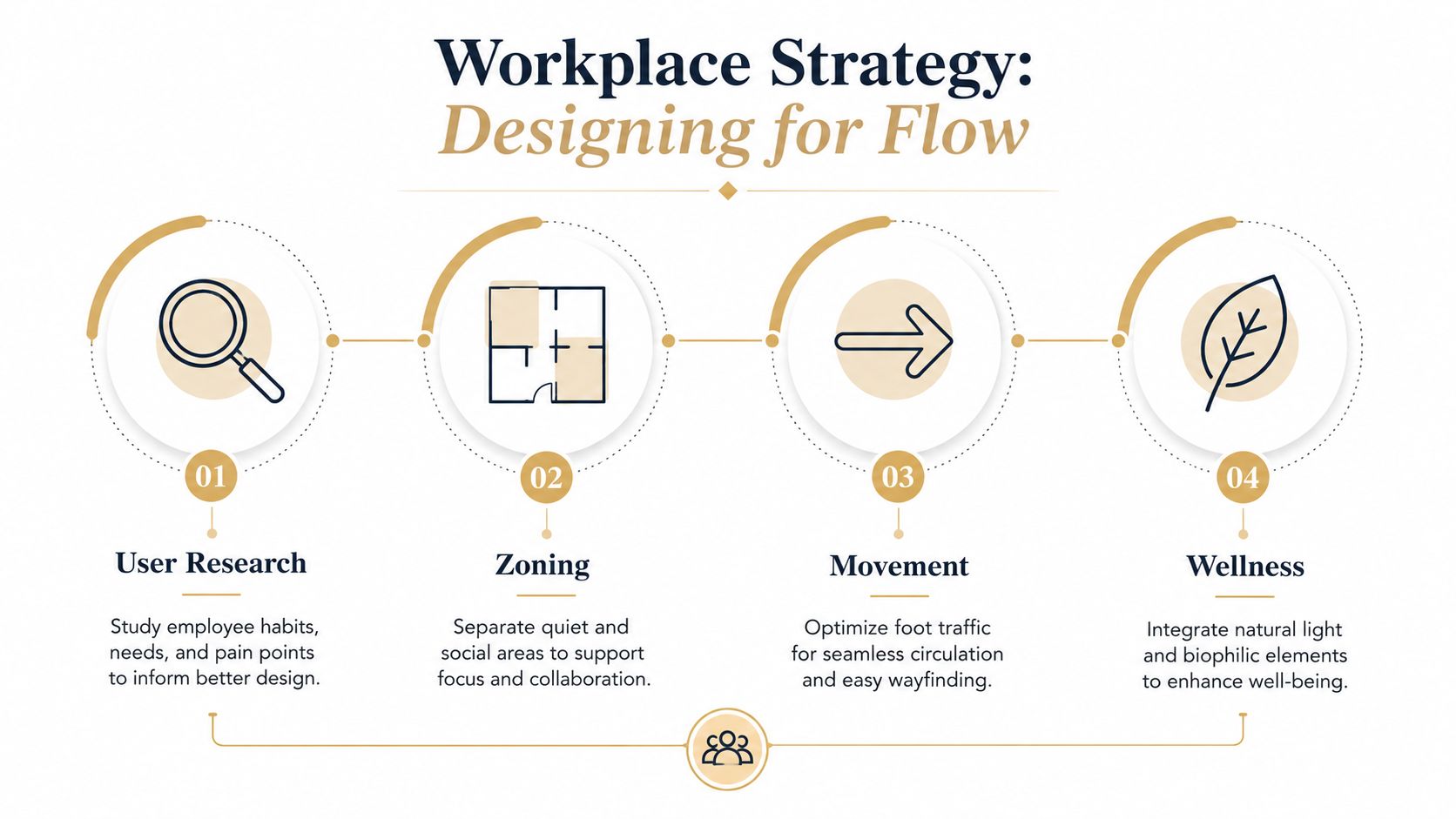
Space planning isn't a desk-counting exercise anymore. A good layout supports concentration, conversation, private calls, informal catch-ups, and video meetings without forcing all of that into one open-plan room.
Plan around behaviour, not headcount alone
The first layout question isn't “How many desks fit?” It's “How does the team use the day?” Some businesses need benching and touchdown points. Others need quiet rooms, enclosed project rooms, or more small meeting spaces because the old office over-relied on one large boardroom.
A better floorplan usually combines several settings:
- Focus areas for heads-down work and low interruption.
- Collaboration zones for team sessions and informal review points.
- Private spaces for calls, HR conversations, and concentrated tasks.
- Shared support areas such as lockers, print points, and breakout spots placed where they don't interrupt workflow.
Movement matters too. If people cross the whole floor to reach meeting rooms or tea points, noise and interruption spread with them. If circulation runs through quiet areas, the layout will look neat on plan but feel wrong in use.
Technology decisions belong at concept stage
Technology planning needs to sit inside the design process, not after it. According to Mastt's office fit out guidance, integrating technology planning during design conception can prevent 15% to 25% cost overruns typical in retrofitted projects. The same guidance notes that coordinating data cabling and power outlet positioning with furniture and partition design from the start improves cost efficiency and avoids disruptive remedial works after handover.
That changes how layout should be tested. Desk positions affect floor box locations. Meeting room furniture affects screen placement and cable routes. Glass partitions need careful detailing if cable trays, conduit routes, or power feeds must pass nearby without spoiling the finish.
For occupiers reviewing zoning and test fits, this guide to office space planning in the UK gives a practical view of how early planning choices shape the whole job.
If AV, data, and power are left until after the design sign-off, the project usually pays twice. Once for the original work, and again for the correction.
A workplace strategy should also leave room for change. Departments grow, reporting lines shift, and one quiet booth can become six if hybrid work patterns evolve. Flexible planning isn't about empty space. It's about making sensible moves easier later on.
Creating Your Signature Look Design and Materials
Design choices have to do two jobs. They need to shape the look of the workplace, and they need to hold up under daily use. If a fit out only looks good on day one, it hasn't done its job properly.
Good design has to earn its keep
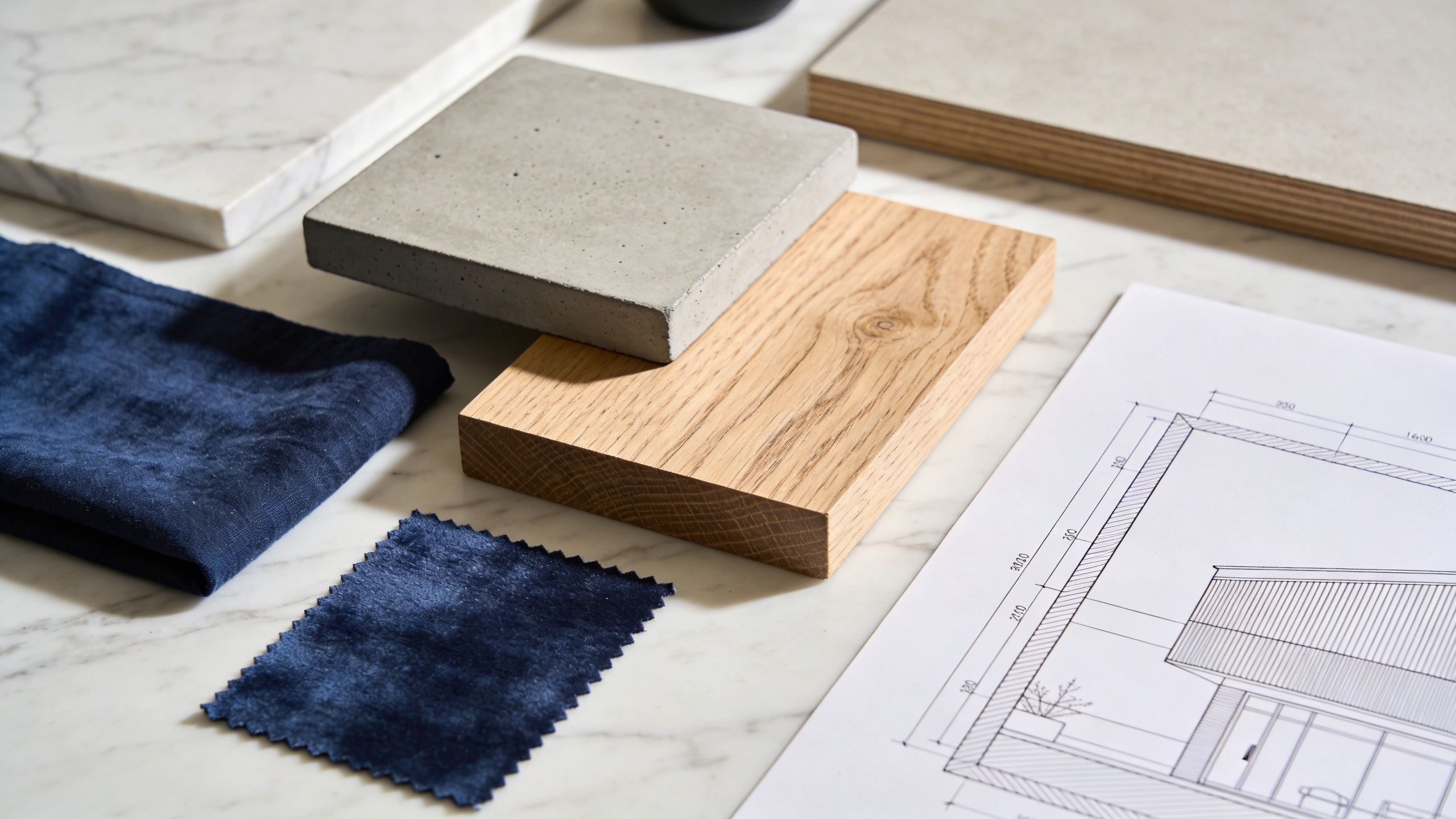
The strongest schemes usually rely on a disciplined material palette. That means choosing finishes that support brand character without turning the office into a showroom. Timber textures can warm up hard commercial shells. Powder-coated metal can sharpen a contemporary look. Upholstery and acoustic panels can soften spaces that would otherwise sound harsh.
Glazed partitioning is often one of the smartest tools in the kit. It keeps sightlines open, shares light through the floorplate, and creates enclosed rooms without making the office feel boxed in. That's especially useful when a team wants more privacy but doesn't want to lose the sense of openness that open-plan space can bring.
Modular pod systems can solve a different problem. Instead of building every new room from scratch, products such as Vetrospace, BlockO, and Framery can add focused privacy where it's needed most. They work well for calls, short meetings, quiet tasks, and overflow demand where the floor needs flexibility.
Material choice should also reflect how the business presents itself. A client-facing consultancy may need a sharper front-of-house finish than a back-office operational space. An education or healthcare team may need surfaces that are durable, simple to maintain, and easy to refresh without major downtime.
Materials that refresh without waste
One of the most useful approaches in refurbishment is keeping sound surfaces and upgrading them rather than stripping them out. According to tp bennett's Windmill Green project page, architectural wrapping can cut refurbishment costs by up to 35% compared to full surface replacement. The same source notes that this matters in sustainability terms too, especially when 41% of Manchester commercial retrofits failed to achieve EPC B in 2025.
That makes wrapping more than a cosmetic trick. It can refresh receptions, joinery, doors, and other visible elements with less mess and less waste than full replacement. In the right project, it helps a space look newer and perform better without forcing a deeper strip-out than necessary.
Design check: Replace only what's failing. Refresh what's still sound. That's often the best route for programme, budget, and sustainability.
Presentation technology needs similar thought. Boardrooms, town hall areas, and client event spaces often need screens, audio, and connectivity that match the new interior standard. For teams weighing up what equipment matters most, these event production equipment tips are a helpful reference point when shaping AV expectations inside a fit out.
This design logic applies well beyond one city. Similar choices often suit clients in Cambridge and across Hertfordshire, where businesses want polished interiors that still feel practical and easy to maintain.
A useful visual example sits below.
The Paperwork Path Planning and Compliance in Manchester
The design may be exciting, but paperwork decides whether the project runs smoothly. Most internal fit outs don't get stuck because the ideas are poor. They get stuck because approvals, landlord processes, and compliance steps weren't lined up early enough.
Know which approvals actually matter
Internal office work often doesn't need formal planning permission, but that doesn't mean the project is approval-free. Building regulations are usually the bigger issue, especially when layouts change, partitions affect fire strategy, or MEP works alter how the floor operates.
Common areas that need proper review include:
- Fire safety: escape routes, compartmentation, alarm interfaces, and door performance.
- Accessibility: routes, door widths, facilities, and practical day-to-day use.
- Building services: ventilation, lighting, emergency systems, and electrical changes.
- Landlord requirements: licences to alter, fit out guides, and building management sign-off.
For clients looking at a single-point delivery route, this overview of procurement and design-and-build is useful because it shows how design responsibility and delivery coordination can sit together.
Compliance works best when it starts early
A strong compliance process is quiet and organised. It starts during design, not after tender. That means checking the base building information, understanding what the lease allows, and making sure specialist input lands at the right stage.
CDM duties matter as well. Someone needs to coordinate health and safety, construction information, and practical site risks. On live office floors, that includes access routes, noisy works, welfare planning, deliveries, and separation between occupied areas and work zones.
The process is similar whether the site is in a city office building or a more controlled setting. The same discipline that supports projects near Stansted also matters on business park schemes in Milton Keynes. Different environments bring different constraints, but poor coordination causes the same kind of delay in both.
Paperwork shouldn't be visible to staff. If it is, it usually means something has gone wrong upstream.
Delivering the Project with Minimal Disruption
Delivery is where the planning gets tested. Staff still need to work, clients still visit, and building rules still apply. A fit out team that can't control disruption will turn even a good design into a difficult experience.
Phasing keeps the business moving
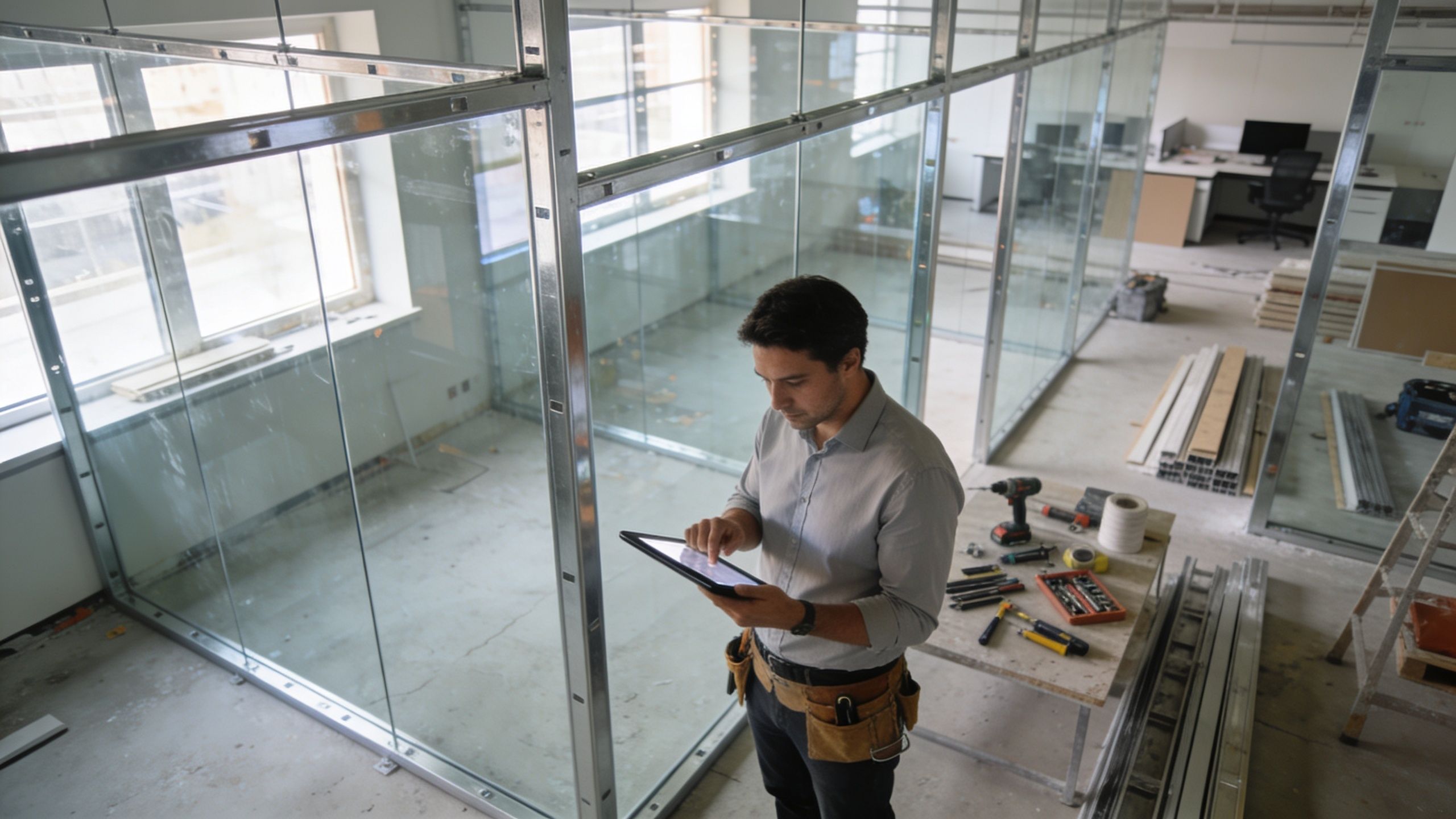
For live workplaces, phased delivery is often the safest route. According to Jennor's step-by-step fit out guide, a phased construction approach is a best practice for minimising operational disruption because the work is divided into sequential stages and parts of the office can remain operational. That reduces staff displacement and helps avoid the hidden cost of lost productivity.
A phased plan usually works best when the team agrees three things early:
Which spaces must stay live
That might be reception, leadership offices, helpdesk zones, or a core bank of meeting rooms.Which works are most disruptive
Demolition, drilling, service shut-downs, and noisy joinery installation need careful timing.How temporary moves will work
Staff may rotate between neighbourhoods, remote work, or short-term swing space.
What a controlled live project looks like
A well-run live project feels ordered. The site team secures the work area, manages deliveries around building rules, protects common parts, and keeps daily communication tight. Staff know what's happening, what routes have changed, and when noisy works are planned.
Typical live-site priorities include:
- Clean separation: occupied areas and construction zones need clear boundaries.
- Service continuity: power, data, and HVAC changes should be staged so critical teams aren't knocked offline.
- Short decision loops: if a site issue appears, the client needs clear options fast, not a long chain of vague updates.
- Snag control as work progresses: leaving every defect to the end creates avoidable pressure at handover.
This approach matters in dense office locations, but it also matters in busy commuter markets where clients can't afford long disruption. The same delivery discipline helps on schemes in Bishop's Stortford and Chelmsford, where teams still need to keep trading while the environment changes around them.
A fit out programme should protect the client's business first. Build speed matters, but usable continuity matters more.
Handover, Dilapidations, and Future-Proofing
A project doesn't finish when the last contractor leaves site. The final value comes from a clean handover, a practical close-out, and a workspace that won't become awkward to manage six months later.
A proper handover protects the investment
Handover should be organised, not rushed. That means snagging is recorded and closed properly, O&M information is ready, and the client understands how the space is meant to operate. Lighting controls, booking systems, AV, ventilation settings, and specialist furniture all need a proper explanation.
A good handover usually includes:
- A snagging review with owners and target close-out dates.
- Operating manuals for services, finishes, and installed products.
- Training sessions for facilities or office managers where needed.
- Warranty records stored clearly for future maintenance.
This stage is also where post-occupancy thinking starts. If one room type is already overbooked in the first weeks, that's useful evidence. If lockers are underused or a touchdown zone becomes the most popular part of the floor, those signals help shape later adjustments.
Think about lease exit before day one
Dilapidations often arrive as a nasty surprise because they weren't considered at fit out stage. Yet lease-end obligations can influence what should be kept, what should be altered lightly, and what should remain easy to reverse.
That matters most when a tenant is making substantial changes to landlord space. Some occupiers benefit from a more reversible approach, especially where future reinstatement could become costly. Modular elements, carefully planned partitions, and selective upgrades can make later change less painful than hard-built interventions everywhere.
Useful questions to ask early include:
- What does the lease say about reinstatement
- Which alterations need landlord consent
- What base-build items should be retained or documented
- Which new elements are easy to remove or repurpose later
Future-proofing isn't only about lease exit. It's also about making the office adaptable. Teams change size, departments merge, and workplace patterns shift. Layouts that depend on fixed assumptions age badly. Layouts that allow selective reconfiguration tend to stay useful for longer.
That flexibility is often what clients need across mixed property portfolios. A business may need a polished office in Braintree, a practical workplace reset in Luton, lease-related support in Dartford, or a refurbishment strategy in Colchester. The common thread is the same. Good projects stay useful because they were planned for change from the start.
Ready to transform your workspace? Speak to the GIBBSONN Interiors team today. Whether the project involves a full office fit out, a refurbishment, architectural wrapping, or support with dilapidations, practical advice starts with the right conversation. Contact Us to book a consultation.