
An office fit out is the entire process of taking an interior commercial space and making it perfectly suitable for a business to move into. It’s about transforming an empty shell into a fully functioning, ready-to-use workplace, complete with everything from walls and flooring to furniture and branding.
The Foundations of a Workspace Transformation
Think of an empty commercial property as a blank canvas. An office fit out is both the art and the science of turning that empty space into a vibrant, productive and inspiring environment for your team. This is a comprehensive project that goes far beyond just decorating or buying a few new desks.
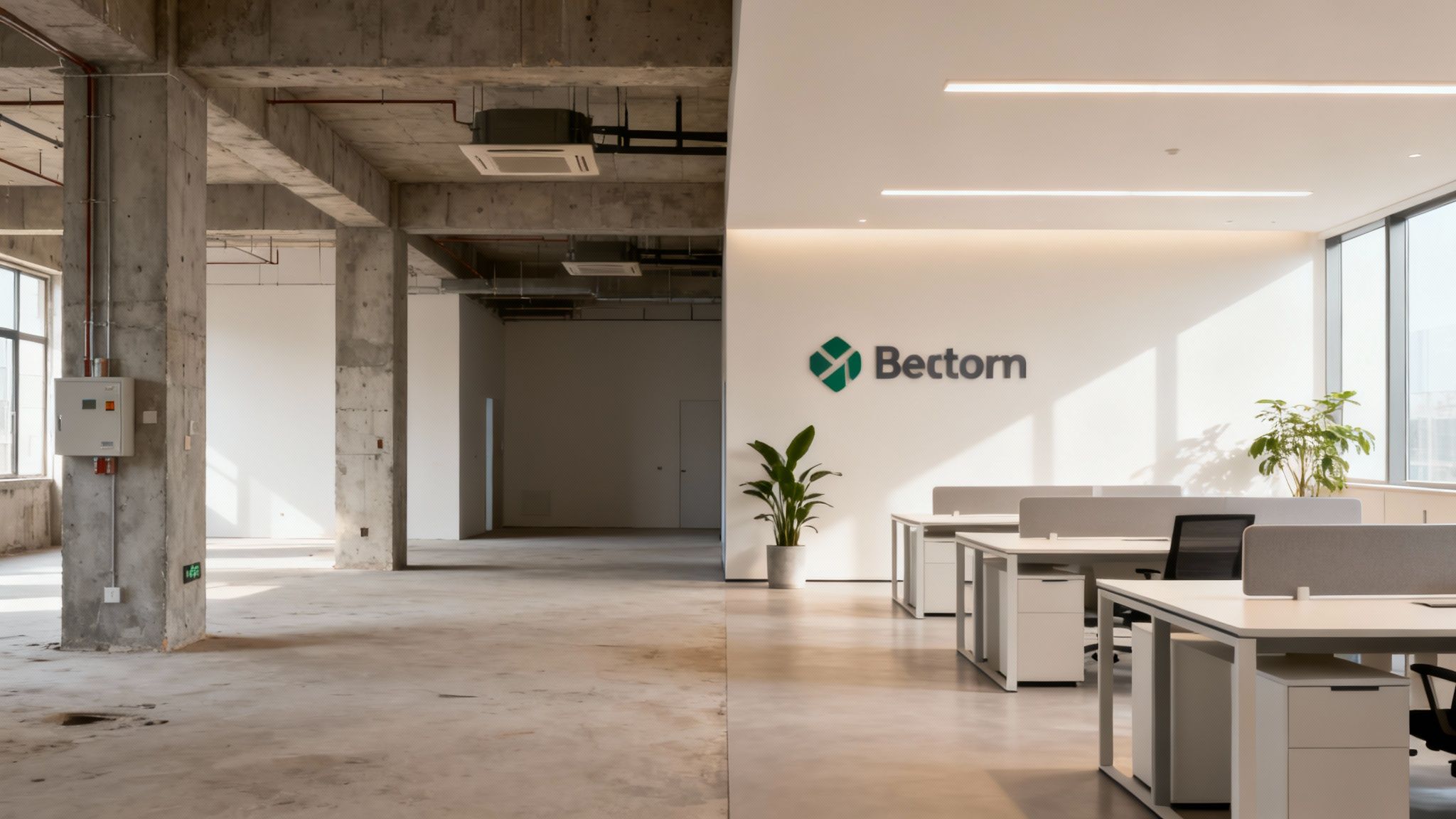
It’s a common mix-up but ‘fit out’ and ‘refurbishment’ are fundamentally different things. A fit out always starts with a bare space, often just a concrete shell, whereas a refurbishment involves upgrading an existing office.
Understanding the Key Terms
To get started it helps to get your head around the industry language. In the UK fit outs are typically classified into different categories that define the state of the building when a new tenant takes over. Grasping these concepts is the first step for any business leader in Bishop’s Stortford or London looking to nail down their project scope.
- Shell and Core: This is the most basic state you can get. It includes the main structure of the building, the frame, walls, roof and cladding, but absolutely nothing inside. It’s a bare-bones shell just waiting for services and finishes.
- Category A (Cat A): This is the landlord’s fit out. They’ll typically install all the essential services to create a habitable blank canvas for a future tenant. This usually includes things like raised floors, suspended ceilings, basic mechanical and electrical services and finished common areas like lobbies and toilets.
- Category B (Cat B): This is where you, the tenant, come in. The Cat B fit out is where your unique vision for your workspace truly comes to life. It includes everything needed to make the space your own from creating meeting rooms and installing branded features to choosing furniture and applying the final finishes.
A great fit out is less about just aesthetics and more about boosting productivity, enhancing employee wellbeing and bringing your company’s brand to life in a physical space. It’s an investment in your people and your business’s future.
Choosing the right partner for this is critical. With over 30 years of experience in large commercial fit outs across Essex and Hertfordshire you’re not just hiring a contractor you’re getting the full package. We plan with the end in mind ensuring your project runs smoothly from concept to completion and helping to reduce costly future dilapidations wherever possible.
Decoding the Different Types of Office Fit Out
Navigating the world of commercial property and lease agreements can often feel like learning a new language. You’ll hear terms like ‘Shell and Core’, ‘Cat A’ and ‘Cat B’ thrown around and they’re not always clearly explained. Getting to grips with what they mean is the first step in any successful office fit out as it sets the scene for your project and makes it crystal clear who is responsible for what.
Each term simply represents a different stage of completion for a commercial space. Think of it like building a house: you start with the basic structure then add the essential utilities and finally you bring in the furniture and decor that make it a home.
The Basic Structure: Shell and Core
A Shell and Core space is a building at its most basic. We’re talking about the concrete and steel skeleton, a weatherproof structure that’s completely empty on the inside.
This stage typically gives you:
- The fundamental framework, cladding and external works.
- The main reception, lift shafts and common areas like stairwells.
- Loading bays, basement spaces and car parks.
If you take on a Shell and Core lease you’re responsible for everything from the ground up including the installation of all mechanical and electrical systems. It’s not the most common route for a standard office lease but for a large corporation wanting total control over their environment it can be the perfect starting point.
The Landlord’s Canvas: Category A Fit Out
A Category A or Cat A fit out is what most people think of as a ‘blank canvas’. It’s the standard finish a landlord provides to make a space lettable. The goal is to create a functional but plain interior that a new tenant can easily adapt to their own needs. It’s a habitable space but it’s waiting for you to give it a personality.
A Cat A space is like a primed canvas waiting for an artist. All the necessary basics are in place but the final design, branding and functional layout are yet to be created.
So what can you expect from a Cat A fit out? It usually covers:
- Raised floors and suspended ceilings.
- Basic mechanical and electrical services including heating, ventilation and air conditioning (HVAC).
- Standard lighting and fire detection systems.
- Finished common areas including toilets and lift lobbies.
For businesses moving into new premises in places like Cambridge or Chelmsford this is the most common starting point. The landlord takes care of the essential infrastructure and you take it from there.
Your Bespoke Workspace: Category B Fit Out
This is where your vision for your office really comes to life. A Category B or Cat B fit out is the process of transforming that landlord’s Cat A shell into a fully realised workspace designed specifically for your business. It covers every single element that makes the office uniquely yours, from the layout and branding to the final finishes and furniture.
This is the stage where Gibbsonn Interiors truly shines. With over 30 years of experience in large-scale commercial fit outs we seamlessly manage the journey from a basic Cat A space to a ready-to-use Cat B solution that reflects your company culture and empowers your team.
Cat A vs Cat B Fit Out at a Glance
To make the distinction even clearer it’s helpful to see the two side-by-side. The table below breaks down what falls under the landlord’s remit (Cat A) and what becomes part of your bespoke fit out project (Cat B).
| Feature | Category A (Landlord’s Fit Out) | Category B (Tenant’s Fit Out) |
|---|---|---|
| Purpose | To create a functional, lettable blank space. | To create a bespoke, branded and fully operational workspace. |
| Flooring | Basic raised access flooring is typically installed. | Final floor finishes like carpet, vinyl or wood are added. |
| Walls | Open-plan space with plastered perimeter walls. | Installation of partitions, meeting rooms and private offices. |
| Electrical | Basic power distribution to the floor. | Full installation of workstations, specialist power and data cabling. |
| Lighting | Standard, uniform lighting grid installed. | Specialist and feature lighting to suit the design and layout. |
| Finishes | Neutral, basic finishes. | Branded elements, bespoke joinery, feature walls and decoration. |
| Furniture | None provided. | All office furniture from desks and chairs to breakout seating. |
| IT & AV | None provided. | Installation of IT infrastructure and audio-visual equipment. |
For facilities managers and business leaders in London or across Hertfordshire understanding this split is essential for accurate budgeting and project planning. It tells you exactly where your responsibilities begin and end helping you choose the right partner to deliver a Cat B office fit out that meets your precise operational needs.
Mapping Your Office Fit Out Journey Step by Step
Embarking on an office fit out can feel like a mammoth task but in reality it follows a clear, logical path. When you understand this journey from start to finish the uncertainty melts away giving you the confidence to start your workspace transformation. Every successful project we deliver whether in Essex, Hertfordshire or Cambridge is built on a structured, six-stage process that ensures nothing is overlooked.
This roadmap breaks down the entire project into manageable steps. For each stage we’ll outline what’s involved and what a successful outcome looks like. It’s the perfect illustration of why having a single, accountable partner to guide you from the first flicker of an idea to the final handover is so invaluable.
The process flows from a basic structure to a fully bespoke business environment.
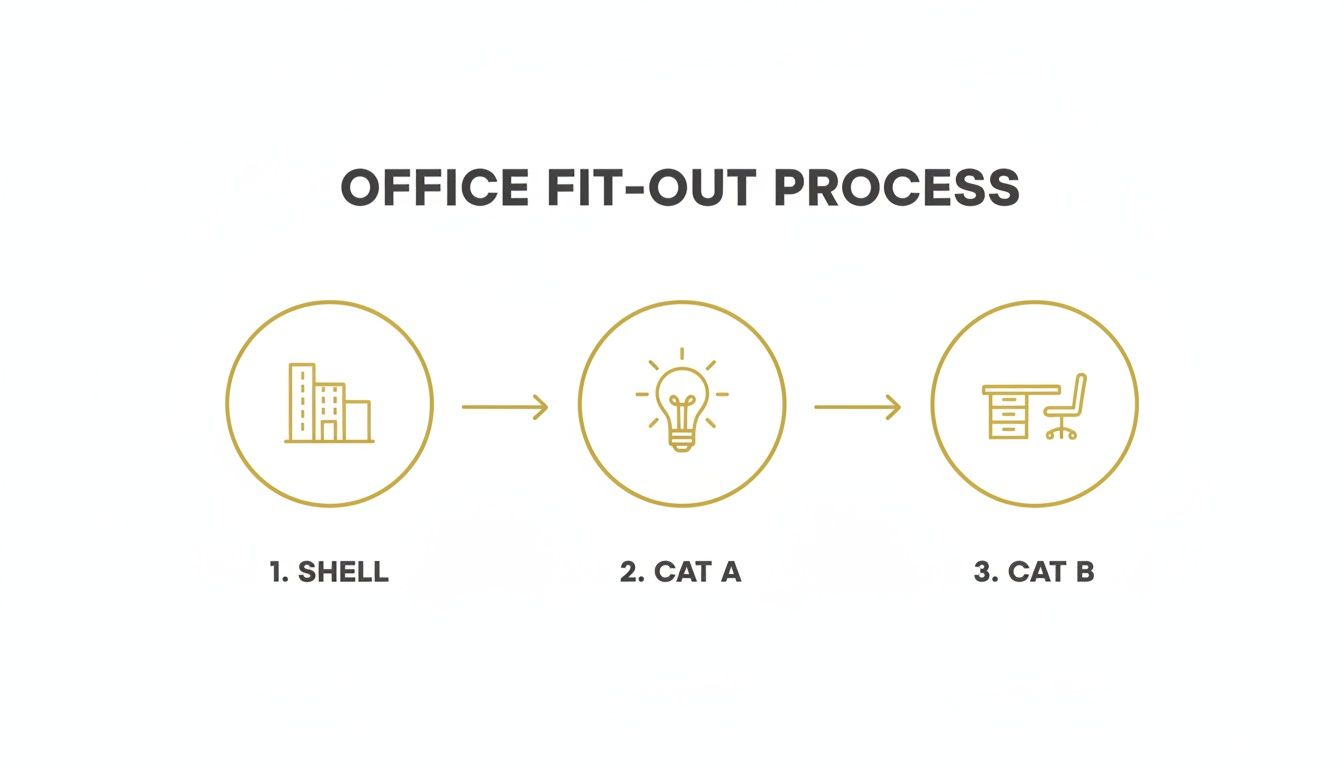
As you can see the project progresses from the basic ‘Shell’ to the landlord’s functional base ‘Cat A’ and finally into ‘Cat B’—the space that is uniquely yours.
Stage 1: Workplace Consultancy and Briefing
Everything starts with discovery. This is easily the most important stage because before a single line is drawn we need to get under the skin of your business. We kick things off with in-depth discussions to pin down your objectives, your current challenges and what you dream of for your new space.
We’ll dig into your company culture, daily workflows and future growth plans. We’ll ask how your teams collaborate, what tech they rely on and what kind of environment will genuinely help them thrive. This detailed brief becomes the north star for the entire office fit out.
Stage 2: Concept Design and Space Planning
With a solid brief in hand our design team starts bringing your vision to life. This is the stage where we translate all those needs and ideas into something tangible. We’ll create initial concept designs, mood boards and 2D layouts that start to show you how the space could really work.
This is where you start to see the possibilities emerge. Great office design and space planning is about so much more than just placing desks; it’s about creating an ecosystem of zones for different activities—collaboration, quiet focus and social connection. We use our expertise to craft a layout that makes work flow, boosts productivity and puts your brand identity front and centre.
Stage 3: Detailed Design and Costing
Once you’re excited about the initial concept we dive into the nitty-gritty. This stage involves fleshing out the design, creating rich 3D visuals and specifying every last material, finish and piece of furniture. From the carpet tiles underfoot to the light fittings overhead every single element is chosen with purpose.
At the same time we provide a completely transparent, detailed breakdown of all the costs. Our open-book approach means you’ll never face any nasty surprises down the line. With over 30 years of experience our deep-rooted supplier relationships allow us to source high-quality materials and furniture at competitive prices guaranteeing you exceptional value.
Stage 4: Technical Design and Approvals
Now we get technical. This phase is all about finalising the construction drawings and ensuring every aspect of the design complies with all relevant regulations. This covers everything from Building Regulations and health and safety standards to securing planning permissions if they’re needed.
A single, experienced partner like Gibbsonn manages this entire process for you. We handle all the paperwork and liaise with authorities taking the complexity off your shoulders so you can focus on your business.
This meticulous groundwork is absolutely crucial for a smooth construction phase and is key to preventing any costly, frustrating delays. It’s especially vital for projects in busy commercial hubs like London or Stansted where navigating approvals efficiently is half the battle.
Stage 5: Construction and Installation
With all approvals signed off and the plans locked in the build begins. Your dedicated project manager takes the helm overseeing every single aspect of the on-site work. They’ll coordinate all our trusted tradespeople, from electricians and partitioners to decorators and flooring specialists.
We ensure your project runs like clockwork, on schedule and to the highest possible standards of quality. Through regular communication you’ll be kept in the loop every step of the way and we’ll work tirelessly to minimise any disruption to your day-to-day business operations.
Stage 6: Handover and Aftercare
The final stage is the big reveal. We’ll walk through the new space with you conducting a thorough inspection to make sure every last detail is absolutely perfect. Once you are completely happy we officially hand over the keys to your incredible new workplace.
But our partnership doesn’t just stop there. We provide comprehensive aftercare to help you and your team settle in and make the most of the new environment. After all a truly successful office fit out is one that continues to support and elevate your business long after the project is complete.
Budgeting for Office Fit Out Costs and Timelines
Once you have a vision for your new workspace two questions inevitably follow: how much is it all going to cost and how long is it going to take? Getting clear answers to these early on is the secret to a successful office fit out giving you the clarity to plan with confidence and avoid any unwelcome surprises down the road.
Think of a clear budget and timeline as the foundation upon which a smooth, stress-free transformation is built. They allow you to set realistic expectations from the outset and make sure the project aligns perfectly with your wider business goals.
Typical Office Fit Out Costs
The final bill for an office fit out can swing dramatically based on a few key things. The spec of the materials you choose, the complexity of the design and even your postcode all play a big part. A project in central London will naturally have a different cost profile to one in Chelmsford or Bishop’s Stortford.
To give you a clearer picture costs are usually broken down by the level of finish:
- Low Specification: This is your basic, functional fit out. It focuses on essential finishes and standard furniture making it a great choice for businesses needing a practical workspace without breaking the bank.
- Medium Specification: Here you find a sweet spot between quality and cost. This level brings in better materials, more bespoke design features and smarter tech integration.
- High Specification: This is the premium option. We’re talking high-end materials, custom-built joinery, advanced audio-visual systems and a design that truly embodies your brand and puts employee wellbeing first.
A well-planned budget isn’t just about putting a cap on spending. It’s about strategically investing in the areas that will deliver the biggest return for your business whether that’s through boosting productivity or improving staff retention.
Research from industry experts like JLL highlights why strategic planning is so vital especially for businesses creating wellbeing-focused, hybrid-ready offices in 2026.
Estimated Timelines for Your Project
Just like the budget the project timeline is shaped by the size and complexity of your office fit out. A small, straightforward job can be turned around pretty quickly. But a large, multi-floor transformation will naturally need more time for every phase from initial design concepts to the final build.
Having a realistic timeframe helps you manage expectations internally and plan your day-to-day operations around the move. A seasoned partner will give you a detailed project schedule mapping out key milestones to ensure everything stays on track from start to finish.
Here’s a general guide to what you can expect:
| Project Size | Typical Timeline (Design to Handover) | Best For |
|---|---|---|
| Small (Up to 5,000 sq ft) | 8–12 Weeks | Start-ups, small teams or satellite offices needing a quick turnaround. |
| Medium (5k–15k sq ft) | 12–16 Weeks | Growing businesses and established SMEs that need a more comprehensive space. |
| Large (Over 15k sq ft) | 16+ Weeks | Corporate headquarters or complex, multi-floor projects. |
The Value of an Experienced Partner
This is where having an experienced partner like Gibbsonn Interiors makes all the difference. With over 30 years of experience in large commercial fit outs we know exactly how to juggle costs and timelines to deliver exceptional quality without compromise.
Our team is with you from day one to help you budget effectively. We always plan with the end in mind recommending smart, flexible solutions like office pods that are easy to relocate and can even reduce future dilapidation costs. By managing the entire process for you we make sure your office fit out is delivered on time, on budget and to the highest possible standard.
Future-Proofing Your Workspace with Smart Design
A truly modern office isn’t just about what looks good today; it’s about building a space that’s ready for the challenges of tomorrow. When we talk about creating a high-performance work environment we’re moving beyond fleeting trends to focus on what genuinely matters: seamless hybrid work, authentic employee wellbeing and sustainable practices that are good for business.
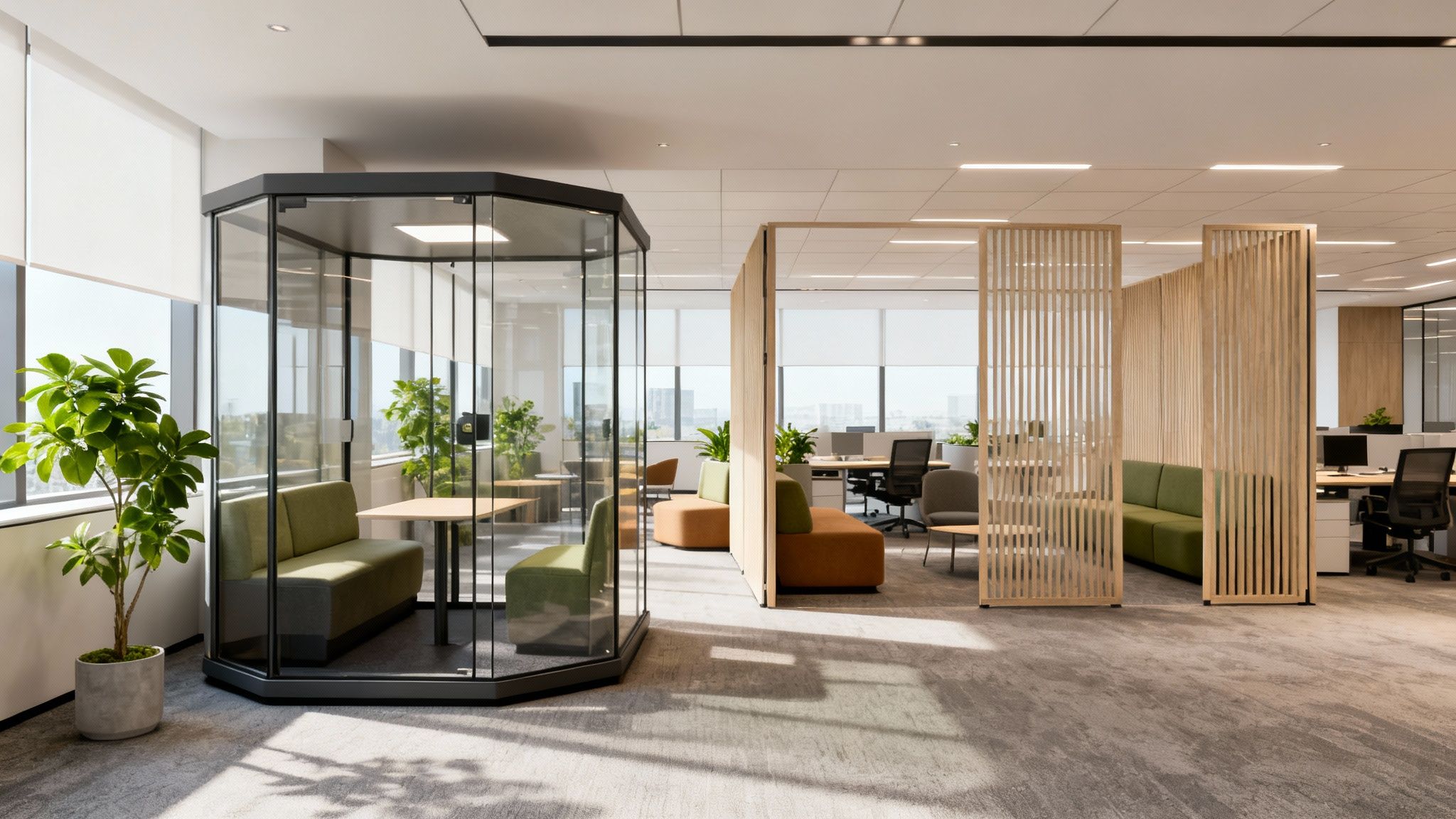
This forward-thinking approach to an office fit out is more than an aesthetic upgrade. It’s an investment in agility, crafting a resilient, dynamic and inspiring workplace that will attract and keep top talent for years to come.
Embracing Flexibility for the Modern Workforce
Let’s be honest the way we work has fundamentally changed. Hybrid models are here to stay and our offices must catch up to support this blend of in-person collaboration and remote focus. A future-proofed workspace is one that can effortlessly adapt to shifting team sizes, new projects and evolving work patterns without needing a costly, disruptive overhaul every few years.
This is where traditional, fixed-wall construction simply can’t keep up. Building permanent meeting rooms is not only expensive and time-consuming but also locks you into a rigid layout that might not serve your needs a year from now. Smart design looks for adaptable solutions that can be reconfigured as your business grows.
The Rise of Modular and Adaptable Solutions
So how do you build this kind of flexibility into your office fit out? The answer lies in modular solutions. Freestanding office pods and booths like those from innovative manufacturers such as Vetrospace and BlockO offer a brilliant alternative to conventional meeting rooms.
These self-contained units provide acoustically private spaces for everything from heads-down work and video calls to small team huddles. And because they are technically considered furniture not fixtures they come with some major advantages:
- Mobility: They can be easily moved and repositioned within your office whenever your needs change. No builders, no dust, no drama.
- Reduced Waste: Moving premises? You can take them with you. This completely eliminates the waste and cost of demolishing fixed walls.
- Cost Efficiency: They dramatically cut down future dilapidation costs by minimising the permanent alterations made to the building’s structure.
Our Take at Gibbsonn: We always plan with the end in mind. With over 30 years of experience in large commercial fit outs and partitioning we’ve learned that recommending flexible solutions like office pods isn’t just a trend, it’s a smart financial and environmental decision that saves our clients a significant amount of money in the long run.
Designing for Wellbeing and Productivity
Future-proofing is also about putting your people first. In today’s competitive market a workspace that genuinely supports employee wellbeing is non-negotiable for attracting and retaining the best talent. This goes far beyond just providing ergonomic chairs and good lighting.
A truly supportive environment considers the full spectrum of what your team needs to thrive:
- Acoustic Comfort: Open-plan offices are notorious for noise and distractions. Integrating acoustic panels, designated quiet zones and private pods is essential for focus.
- Varied Work Settings: Give people choice. A mix of spaces, from buzzing collaborative hubs and social breakout areas to quiet libraries and focus booths, allows employees to pick the right spot for the task at hand.
- Biophilic Design: We’re hardwired to connect with nature. Bringing in natural elements like plants, wood and maximising natural light has been proven to lower stress and boost creativity. As highlighted by architectural sources like ArchDaily, this is a key component of modern workspace design.
By embedding these principles into your office fit out you create a workplace where people feel valued, supported and empowered to do their best work. It’s a foundational step in building a resilient and productive company culture. For more ideas you might find our guide on revolutionising shared spaces with freestanding booths useful.
Navigating End-of-Lease Dilapidations Smartly
The word dilapidations can sound a bit daunting but the idea behind it is simple. It’s the legal duty a tenant has to hand a commercial property back to the landlord in its original condition once the lease is up. It’s one of those crucial details that if forgotten until the last minute often becomes one of the most costly mistakes a business can make.
This process means reversing every change you made during your office fit out. That means partition walls you built have to come down, bespoke flooring gets ripped up and any alterations to the building’s core services must be undone. For any business but especially those in busy hubs like Stansted or Braintree this can land you with a hefty, unexpected bill right when you should be focused on your next move.
Planning with the End in Mind
The smartest way to deal with dilapidations is to think about them from day one. By planning your exit strategy right at the start of your office fit out you can make decisions that will dramatically slash those future costs. This is where having an experienced partner really makes a difference.
With over 30 years of experience in large-scale commercial fit outs our team recommends the best solutions for your space. Our entire approach is built on creating a fantastic workspace for you today while shielding you from unnecessary pain and expense tomorrow.
A proactive approach to dilapidations isn’t about cutting corners on your fit out; it’s about making smarter, more flexible choices that give you a better long-term return on your investment. It’s about foresight over hindsight.
By considering the end-of-lease terms from the beginning we can steer you towards solutions that are as financially sensible as they are functional.
Minimising Costs with Flexible Solutions
The secret to cutting your dilapidations bill is to minimise permanent, structural changes to the building itself. Instead of putting up fixed meeting rooms with traditional stud walls and plasterboard we often guide our clients toward more adaptable, non-permanent options.
This is where modular systems like office pods truly come into their own. Because they are flexible by design, easy to relocate and help cut down on waste you save money and reduce environmental impact at the same time.
Consider these clever, flexible alternatives:
- Office Pods: These are essentially freestanding, acoustically sealed rooms that are technically classed as furniture. They can be installed without touching the building’s structure and when it’s time to move you can just dismantle them and take them with you.
- Modular Partitioning: Modern partitioning systems can be put up, taken down and reconfigured with very little impact on the building’s fabric. They offer brilliant acoustic privacy without the permanence (and cost) of fixed walls.
- Freestanding Breakout Furniture: Rather than building in fixed banquette seating using modular furniture can create well-defined zones that are incredibly easy to remove when you leave.
Adopting this mindset transforms your office fit out from a sunk cost into an asset that can move and adapt with your business. It ensures your exit is smooth, predictable and far less costly when your lease ends letting you invest your capital in your future not in undoing the past.
Your Office Fit Out Questions Answered
To wrap things up let’s tackle some of the most common questions we hear from clients about the office fit out process. Think of this as a quick-start guide pulling together insights from our 30 years of hands-on experience transforming commercial spaces.
How Long Does a Typical Office Fit Out Take?
There’s no single answer but we can give you a good ballpark. A smaller office fit out say under 5,000 sq ft will generally take around 8-12 weeks from the initial design concepts to handing you the keys.
For a medium-sized project of 5,000-15,000 sq ft you’re probably looking at 12-16 weeks. Anything larger or more intricate can easily go beyond 16 weeks. The final timeline really depends on the complexity of the design, lead times for specialist materials and furniture and any council approvals needed along the way.
What Is the Biggest Hidden Cost in an Office Fit Out?
One of the sneakiest costs that often catches people by surprise is dilapidations – the work required to return your old office to its original state when your lease ends. It’s easy to overlook when you’re focused on the new space.
Other potential budget-busters can include discovering unforeseen structural problems, needing major IT and data cabling upgrades or professional fees that aren’t bundled into a turnkey service. A bit of proactive planning is your best defence against these surprises.
Can My Business Operate During the Fit Out Process?
Absolutely. It’s entirely possible to keep the doors open with a carefully phased construction schedule. A good fit out partner will map out a plan that minimises disruption often by working section by section or scheduling noisy works outside of your core business hours.
The key to making this work smoothly is crystal-clear communication and meticulous project management. It ensures your day-to-day operations can continue with as little interruption as possible.
A successful fit out is built on transparent communication and meticulous planning. Understanding the key stages and potential challenges from the start ensures a smoother journey and a better outcome for everyone involved.
Got more questions? We’ve got more answers. For a deeper dive feel free to explore our complete office fit out FAQs page.
Ready to transform your workspace? Speak to the Gibbsonn Interiors team today.