

The lease end date is getting closer, the team is asking what the new office will look like, and somebody has already asked for a moving quote. That's usually the point where office moving costs get reduced to one line item. Van, labour, boxes, done.
That's almost never how it plays out.
For most UK businesses, the removal quote is only one part of the spend. Total budget requirements sit across logistics, IT, furniture changes, landlord obligations, new-space works, waste disposal, and the downtime that creeps in when the move plan is too thin. A straightforward move can stay controlled. A poorly scoped one can become expensive very quickly.
Table of Contents
- So Your Lease Is Ending A Guide to Your 2026 Office Move
- Breaking Down the Main Office Moving Costs
- The Hidden Costs That Can Derail Your 2026 Budget
- Key Factors That Influence Your Final Bill
- Example Scenarios From SME to Corporate
- How a Turnkey Service Delivers More Value
- Start Your 2026 Office Move with Confidence
So Your Lease Is Ending A Guide to Your 2026 Office Move
A typical move starts with a sensible business reason. The lease is up. The space no longer fits. Hybrid working has changed how many desks are needed. The team wants better meeting space, cleaner storage, and less wasted floor area.
Then the practical questions land all at once. What stays. What goes. What must be stripped out. What has to be ready on day one in the new office.

For a facilities manager, the risk isn't only the moving day. It's the overlap between the old lease, the new space, contractor lead times, staff disruption, and the landlord's schedule for inspecting the premises. That's why a move budget needs to cover more than transport.
A sensible early check is your lease paperwork and the likely reinstatement burden. If the current office has been altered, added to, or branded heavily, a proper review of what a dilapidation survey covers can stop the old site from becoming the most expensive part of the whole project.
Practical rule: Start pricing the move from both ends. What it takes to leave well, and what it takes to open well.
Cleaning also gets left too late. Before handover, many teams need a clear list covering carpets, kitchens, washrooms, glass, waste, and final presentation. A useful reference point is this London House Cleaners end of tenancy checklist, especially for teams trying to line up practical close-out tasks in a commercial space.
Businesses moving in places such as Bishop's Stortford often assume the smaller scale makes the move simple. Sometimes it does. But even compact offices can become costly when the old site needs reinstatement and the new one needs immediate adaptation.
Breaking Down the Main Office Moving Costs
A workable move budget starts by separating the obvious transport spend from the costs that make the new office usable on day one. Facilities managers usually get the removal quote first because it is easy to request. It is rarely the full number that matters.
The core cost buckets
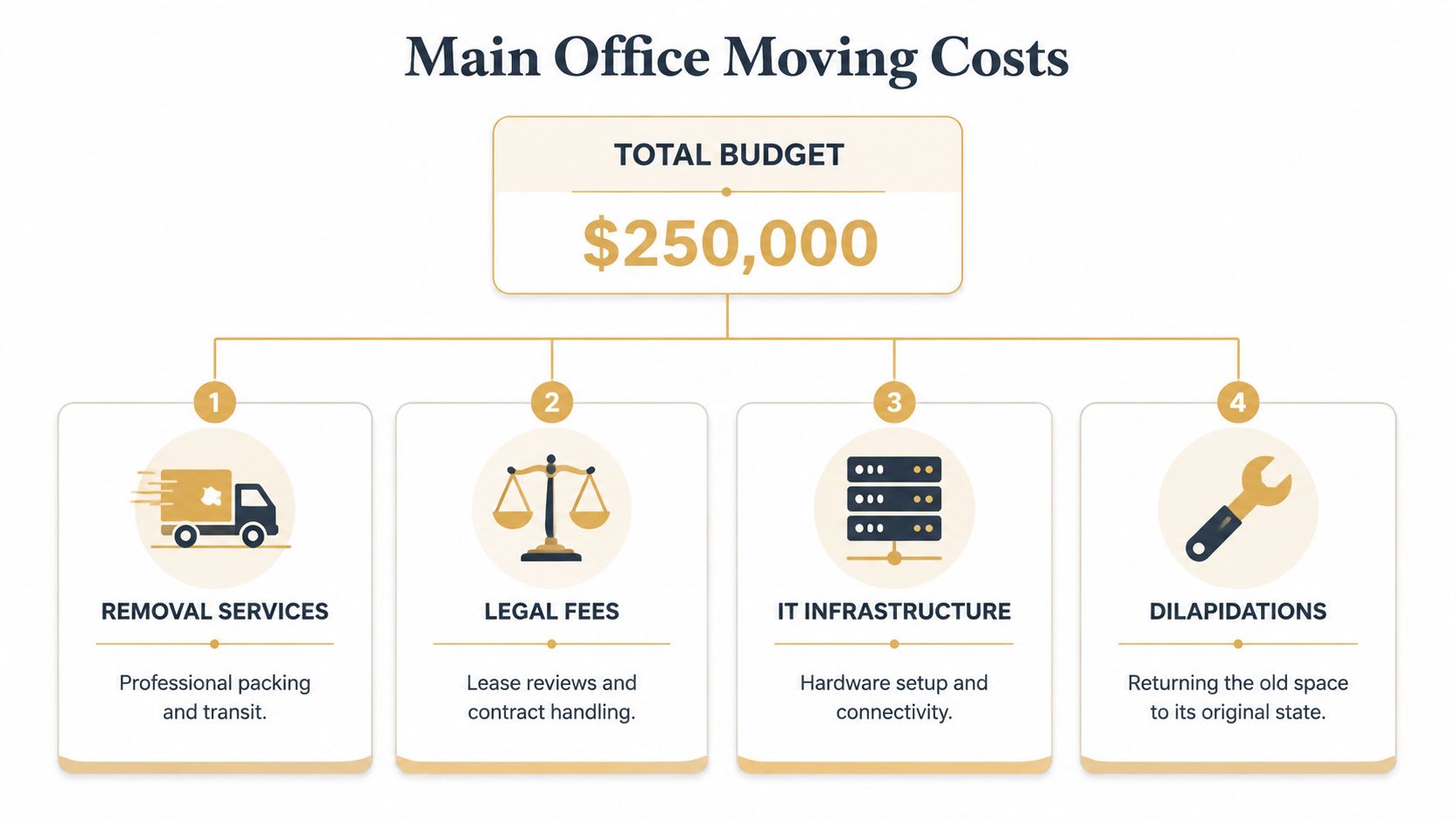
Physical removals are the visible part of the move. This covers labour, vehicles, protection materials, crate hire, loading, unloading, and placing furniture in the new space. Dismantling and rebuilding desks, booths, and meeting tables may be included, or priced as separate joinery and furniture handling.
IT migration sits in its own category because the risk is different. A removals crew can move screens and boxes. They should not be making decisions about server shutdowns, patching, comms room sequencing, network testing, or user reconnection. In practice, the cost is shaped less by how far you move and more by how much downtime the business can tolerate.
Furniture and asset decisions often decide whether the move stays efficient or becomes expensive. Some items are worth relocating. Some should be sold, recycled, or replaced because the labour to dismantle, transport, store, and adapt them exceeds their value. That judgment matters even more in 2026, as more businesses choose flexible layouts and need furniture that can support reconfiguration rather than filling the same footprint again.
If parts of the office are being stripped out before handover or refreshed on arrival, treat that as a project cost, not an afterthought. The economics often become clearer once you compare move spend with the likely office fit out cost for a new workplace. Many teams find it makes more sense to relocate selected assets and invest the balance in furniture and finishes that suit the new brief.
If desks, storage, partitions, or old kitchen units are being removed, disposal also needs its own line in the budget. Pricing varies by material, volume, access, and separation requirements, so early benchmarking helps. This guide to UK commercial waste collection prices is useful for setting expectations before contractor quotes are finalised.
What basic moving rates do and do not cover
Benchmarks can help, but they need careful reading. US office relocation statistics suggest basic office moving costs can range from £0.60 to £2.00 per square foot, and the key word is basic. Those figures usually reflect labour and transport. They do not capture the wider spend that UK occupiers face around access restrictions, fit-out changes, IT cutover, landlord requirements, and workplace readiness.
That is where budgets drift.
A business relocating in London may receive a competitive quote, then discover that crate rental, evening working, lift marshal requirements, cable relabelling, floor protection, and furniture reassembly sit outside scope. None of those items are unusual. They are standard pressure points in managed buildings, and they can change the final bill quickly.
A better way to test any quote is to read it against three questions:
- What is covered on moving day? Labour, vehicles, crates, packing, protection, furniture dismantling, reassembly, and crate collection.
- What still has to be bought elsewhere? IT cutover support, storage, waste disposal, specialist handling, cleaning, and post-move fixes.
- What depends on the building and programme? Lift bookings, loading windows, parking suspensions, security clearance, and out-of-hours access.
Inexpensive quotes are frequently incomplete. The core task is pricing the move that must happen, rather than the limited version that fits easily into a transport schedule.
The Hidden Costs That Can Derail Your 2026 Budget
The part that catches most businesses isn't the move itself. It's everything attached to leaving the old office and making the new one work fast enough for the team.

Dilapidations catch more teams than the move itself
In the UK, end-of-lease dilapidations are a major hidden cost. According to a British Chambers of Commerce survey, 68% of SMEs reported surprise dilapidation bills over £50,000 during a move, often exceeding the cost of the physical relocation itself.
Budgets often go off course during this stage. A company may have spent years adapting the space with glass partitions, branding, flooring changes, tea points, power upgrades, or meeting rooms. At lease end, the landlord may expect part or all of that to be removed or reinstated. The move quote won't usually cover any of it.
A good way to sense the likely scale is to compare the departure works with the cost of creating the next space. This breakdown of the cost of office fit out helps show why old-space obligations and new-space preparation need to be budgeted together, not as separate afterthoughts.
Key point: A low removal quote does nothing to protect the budget if the old office still needs stripping back to lease condition.
The costs that appear late
Other hidden costs tend to arrive in the final weeks, when there's least room to negotiate.
Some are contractual. Legal review of the new lease, licences for alterations, building deposits, and compliance documents can all create spend outside the move contractor's scope.
Some are operational. Staff packing time, delayed internet activation, temporary storage, split deliveries, and phased occupation all add friction. They may not show as one dramatic invoice, but they still count.
The video below gives a useful overview of why commercial moves often cost more than the headline quote suggests.
Regional context matters too. In parts of Essex and Hertfordshire, the issue may be less about headline labour rates and more about scheduling constraints, access windows, and landlord expectations. Two offices of a similar size can produce very different final bills because one has a clean exit path and the other does not.
Key Factors That Influence Your Final Bill
A move can start with a sensible removal quote and still finish over budget because the expensive parts sit in the conditions around the move, not just the vans and labour. In practice, final cost is shaped by how your buildings operate, how much downtime the business can tolerate, and how much adaptation the new space needs before people can work.
Building constraints, programme pressure and move strategy
Square footage only tells part of the story. A compact office with dense filing, legacy furniture, and poor circulation can cost more to clear than a larger floor with standard desking and good loading access.
Access rules often have more impact than mileage. A short relocation within Chelmsford may need weekend labour, multiple lift reservations, traffic management, porter supervision, or out-of-hours security cover. Each one is manageable. Together, they change the bill.
The move strategy matters too. A single weekend cutover is usually easier to control. A phased move across teams or floors reduces disruption for some businesses, but it tends to add repeat labour, extra coordination, temporary storage, and a longer period of dual-site complexity.
Three questions usually expose cost risk early:
- How restricted are the buildings? Lift times, loading windows, contractor paperwork, protection works, and induction processes all affect labour time.
- What does downtime cost? Evening or weekend work often raises the supplier fee, but it may protect trading hours and staff productivity.
- Is the business moving once or operating in transition? Decant moves, phased occupation, and swing space arrangements add handling and management time.
Technical scope, reinstatement choices and how much change is happening at once
The biggest cost swings usually come from specialist work. If the business depends on live connectivity from day one, IT planning cannot be treated as a removal add-on. Internet handover, comms room setup, printer mapping, AV recommissioning, access control, and user testing all need clear ownership. Firms without in-house support often benefit from lining up reliable IT services for SMEs before the move plan is fixed, not after.
There is also a property decision that catches many occupiers out. Some landlords want full reinstatement at the old office. Others will accept a negotiated settlement if the space can be re-let with elements left in place. That choice affects contractor scope, programme length, and cash flow. A cheap approach on day one can become expensive if it leaves too much unresolved at lease end.
At GIBBSONN, we often see budgets tighten when businesses try to combine relocation, IT change, and workplace redesign without deciding which outcome matters most. If the priority is speed, the specification may need simplifying. If the priority is improving the workplace for hybrid working, expect more spend on reconfiguration, furniture adaptation, acoustic upgrades, and commissioning. Significant saving comes from sequencing those decisions properly, not from forcing every cost line down at once.
The final bill rises fastest when a move is treated as transport, even though the business is really paying for continuity, compliance, and a workable office on Monday morning.
Example Scenarios From SME to Corporate
The best way to read office moving costs is through realistic scenarios. Not because every project follows a template, but because most businesses recognise their own move in one of these patterns.
A practical cost view for a 20 person move
The table below gives a simple planning view for a 20-person SME office move. It is not a market rate card. It is a budgeting tool that shows where costs commonly sit and where uncertainty tends to live.
| Cost Item | Estimated Cost Range (£) | Key Considerations |
|---|---|---|
| Physical move labour and transport | Qualitative only | Scope, packing level, furniture volume, access, timing |
| IT relocation | £4,000 to £8,000 or more | More likely where decommissioning and recommissioning are needed for a comparable 30-person setup |
| Modular meeting pod | £10,000 to £25,000 | Relevant if the new office is being redesigned for hybrid work |
| Dilapidations | Over £50,000 can occur | Survey findings, lease terms, reinstatement standard |
For firms that don't have in-house technical capacity, outside support is often worth lining up early. This guide to reliable IT services for SMEs is a useful starting point for thinking through continuity, support cover, and what needs to be live from day one.
Three common relocation stories
A small creative business moving from an older office into a more efficient space often tries to keep cash focused on the essentials. The temptation is to move everything. In practice, that rarely works well. The better approach is usually to move only the furniture and equipment that still earns its place, then put budget into layout, acoustic control, and power where the team works.
A mid-sized hybrid business has a different brief. According to this relocation cost guide, 45% of UK firms are downsizing offices due to hybrid work, and flexible elements such as modular meeting pods can cost £10,000 to £25,000 and have been linked to 25% higher staff retention. That's why many 2026 moves aren't really about moving more desks. They're about creating better settings for calls, focus work, and small team meetings. Products from Vetrospace and Framery often come into that conversation when the open-plan floor needs privacy without a full rebuild.
A larger corporate move usually becomes a workplace change project rather than a simple relocation. There may be a formal decant, phased department moves, storage, landlord approvals, and a new fit-out running alongside live operations. In that type of job, a design-and-build provider such as GIBBSONN Interiors may be brought in to coordinate space planning, workplace changes, and installation as part of one programme.
The most cost-effective move is not always the one with the lowest transport bill. It is the one that opens the new office in the right shape, with the least rework.
For businesses moving near Braintree or planning a larger relocation into Milton Keynes, the same principle holds. Spend should follow the business need, not habit. If the team now needs fewer desks and better enclosed spaces, the budget should reflect that.
How a Turnkey Service Delivers More Value
Office moves go wrong when too many separate suppliers each control one small part of the outcome. The mover blames the IT team. The furniture installer blames the building access slot. The dilapidations contractor finishes late. Nobody owns the whole sequence.
Where fragmented delivery goes wrong
A fragmented model can work on a very simple relocation. Once the move includes landlord obligations, design changes, furniture reconfiguration, glass partitioning, and technology setup, the gaps between suppliers become the risk.
Those gaps usually show up in familiar ways:
- Scope gaps: One contractor assumes another is handling removals, disposal, or making good.
- Timing gaps: The space is technically handed over, but not ready for staff because critical tasks are still incomplete.
- Cost gaps: Variations appear late because there was no joined-up plan at the start.
A single managed route won't remove every cost, but it usually makes the cost visible earlier. That is often where the most significant value sits. This overview of what a turnkey project involves is useful for teams weighing whether to coordinate multiple packages or place the project under one lead partner.
Turnkey vs fragmented approach
| quote | quote | quote |
|---|---|---|
| Turnkey approach | One lead team coordinates move, fit-out, reinstatement, and handover | Better visibility of dependencies and fewer handoff issues |
| Fragmented approach | Separate suppliers manage isolated work packages | More client-side coordination and greater risk of scope overlap or omission |
There is also a softer advantage. Facilities managers spend less time chasing updates across trades and more time making actual business decisions. That matters when the office move is happening alongside normal operations in Hertfordshire or a live project elsewhere.
Start Your 2026 Office Move with Confidence
Office moving costs are rarely difficult because the numbers are mysterious. They are difficult because the budget is often split across too many decisions, too many suppliers, and too many late discoveries.
The businesses that handle moves well tend to do three things early. They check the lease. They define what the new office needs to do. They build one joined-up budget that covers departure, relocation, and arrival.
That approach helps whether the brief is a light-touch move, a hybrid redesign, or a more involved relocation near Stansted. The point is not just to move out. It is to leave cleanly, open properly, and avoid paying twice for rushed decisions.
| cta_text | cta_button_text | cta_link |
|---|---|---|
| Ready to plan your office move with clearer costs, fewer surprises, and a workspace that fits how your team works now | Contact Us | https://gibbsonninteriors.com/contact/ |
Ready to transform your workspace? Speak to the GIBBSONN Interiors team today. If you're planning an office move, reviewing lease-end obligations, or exploring a better fit-out strategy for your next space, Contact Us.