

An office usually looks fine right up to the moment it doesn't. A meeting room booking clashes with a client visit. Deliveries arrive with nowhere to go. The air conditioning fails on the busiest day of the month. Someone new starts, but their desk, pass, and screen aren't ready. None of these problems looks strategic on its own. Together, they drain time, frustrate staff, and steadily push up costs.
That's why office manager responsibilities matter far more than many business owners realise. The role has moved well beyond diary support and stationery orders. In a modern UK workplace, the office manager often sits at the point where operations, people, budgets, suppliers, compliance, and the physical workspace all meet.
For firms planning growth, managing hybrid working, or preparing for a fit out, this role often decides whether change runs smoothly or turns into disruption.
Table of Contents
- The Evolution of the Office Manager for 2026
- The Four Pillars of Office Manager Responsibilities
- How Responsibilities Change with Company Size
- The Office Manager's Role in Office Fit Outs and Refurbishments
- Measuring Success KPIs for Office Managers in 2026
- Delegation and Technology for the Modern Office
- Free Templates Job Description and Handover Checklist
The Evolution of the Office Manager for 2026
The old view of the office manager is badly out of date. Businesses that still treat the role as basic admin usually feel the cost somewhere else. It shows up in missed maintenance, poor supplier control, weak onboarding, unclear ownership, and workplace decisions made too late.
A modern office manager is closer to an operational hub. They keep daily work moving, but they also protect the business from small failures turning into bigger ones. In many firms, they're the person who spots when a layout no longer works, when a service contract needs review, or when staff frustration is really a workspace problem in disguise.
That shift matters because the profession is experienced. In the United States, office managers have an average age of 47, and the role is 86.5% female, with women earning approximately 91 cents for every dollar earned by men in equivalent roles, according to office manager demographics data from Zippia. For employers, that points to a mature talent pool with practical judgement, not just task-handling capacity.
More than admin support
Business owners often notice the role properly during periods of change. A move, refurbishment, lease event, policy shift, or return-to-office plan exposes how many moving parts sit under office manager responsibilities.
The strongest office managers usually sit across several lanes at once:
- Operations control through scheduling, issue handling, and supplier coordination
- Workplace oversight through maintenance, layout feedback, and service standards
- People support through onboarding, communication, and day-to-day environment management
- Commercial awareness through budget tracking, purchasing decisions, and contract discipline
A business owner may think they’re paying for administration. In practice, they’re often paying for continuity, speed of response, and fewer avoidable problems.
Why the role now carries more risk and value
Hybrid working, legal duties, and higher expectations around staff wellbeing have widened the role. Office managers are often expected to apply policy in practical environments. That means desk allocation, visitor flow, room use, cleaning standards, accessibility, and communication all land on one desk.
Managers also need a clear grip on people issues. For teams reviewing absence, wellbeing, and manager obligations, practical guidance on UK compliance for managers can help frame what good oversight looks like in everyday operations.
In places such as Bishop's Stortford, where firms often balance growth with limited internal headcount, that blend of practical control and strategic awareness is especially valuable. The office manager is no longer just keeping the lights on. They're helping the business decide how the workplace should function.
The Four Pillars of Office Manager Responsibilities
The simplest way to understand office manager responsibilities is to split them into four pillars. That gives business owners a clearer view of what the role should own, what it should influence, and what should sit elsewhere.
The structure also fits the classic management model. The seven major functions of office management are planning, organising, staffing, directing, coordinating, reporting, and budgeting, as outlined by Excelsior's office management overview. A good office manager applies all seven, even if the job title sounds narrower.
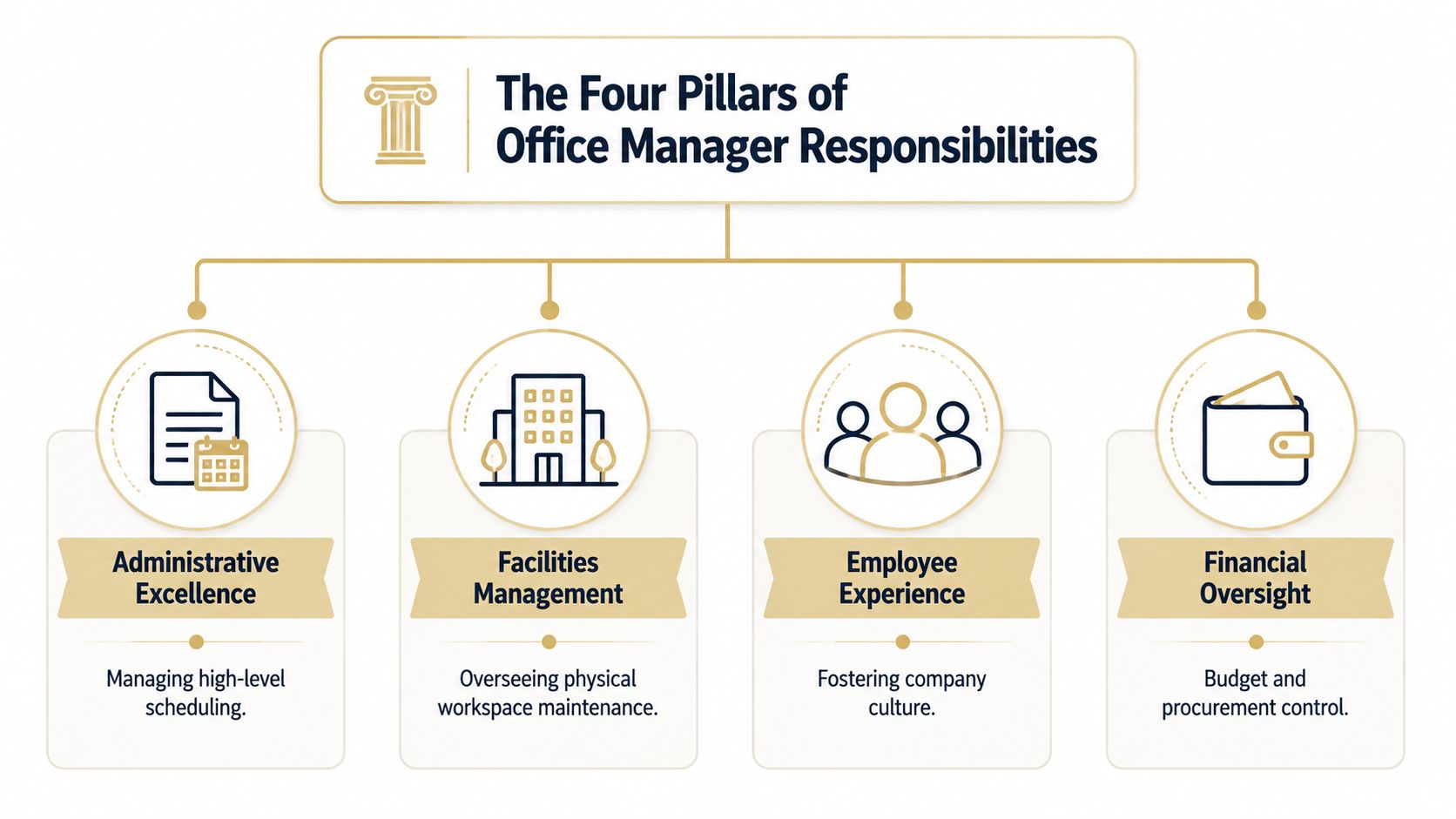
Administrative excellence
Administrative work still matters. It just shouldn't be mistaken for the whole role.
This pillar covers the systems that stop the office from becoming messy and reactive. That includes diary coordination, meeting support, document flow, visitor handling, mail, reception standards, supply control, and internal communications. The office manager often becomes the person who keeps the business from wasting time on preventable friction.
What works is simple and repeatable:
- Clear ownership: someone knows who books rooms, who signs for deliveries, and who escalates issues
- Documented routines: induction steps, supplier contacts, and recurring tasks are written down
- Visible priorities: urgent items aren't buried under low-value admin
For teams trying to tighten process, guides on automating admin training and operations can be useful for mapping repeatable tasks and deciding what can be systemised.
Facilities and workplace management
The role becomes directly tied to the physical office at this stage.
Facilities work includes maintenance requests, contractor visits, cleaning standards, furniture issues, health and safety coordination, and making sure the workplace supports the work being done. It also includes practical judgement. If a team has outgrown its layout, the office manager usually sees it before leadership does.
A capable office manager doesn't just report faults. They manage the environment.
Practical rule: If staff keep creating workarounds for noise, storage, meeting space, or temperature, the office has a design problem, not a people problem.
People and culture support
This pillar sits between operations and HR. It covers the everyday experience of working in the office.
A strong office manager helps onboard starters, coordinates desk readiness, supports internal events, and keeps shared areas usable and welcoming. They also play a quiet role in culture. People notice whether the office feels organised, fair, safe, and respectful.
That includes things such as:
- Onboarding readiness: desks, passes, IT setup, and welcome plans are in place
- Basic consistency: shared rules around rooms, kitchens, storage, and visitor handling are followed
- Environment signals: the space reflects how the business wants people to work and behave
For many firms in London, this part of the role now affects retention as much as administration.
Financial oversight
The office manager doesn't need to be a finance director, but they do need sound commercial discipline.
This pillar covers purchasing, invoice checks, budget tracking, supplier comparisons, small project spend, and spotting poor value before it becomes accepted practice. The difference between a reactive office manager and a strong one is usually visible here. One orders what's needed. The other challenges waste, reviews suppliers, and plans ahead.
A practical way to define this pillar is to ask three questions:
- Who approves everyday spend?
- Who checks whether suppliers still deliver value?
- Who notices when workplace costs are rising without a clear reason?
If the answer is unclear, the business doesn't have proper control of workplace spending.
How Responsibilities Change with Company Size
Office manager responsibilities don't stay still as a business grows. The role broadens at the start, tightens in the middle, and becomes more strategic in larger organisations.
A ten-person business often needs one person to do a bit of everything. A larger firm needs process, reporting, and sharper ownership. Problems start when businesses keep the same job design long after the company has changed.
Small business and startup
At this stage, the office manager is often the person who catches whatever falls through the gap. They may handle suppliers in the morning, organise onboarding at lunch, and sort a facilities issue in the afternoon.
That setup can work well because decisions are quick. It can also create risk if too much operational knowledge sits with one person and nowhere else.
Growing SME
In an SME, the role usually becomes more structured. HR, finance, and IT may each own more of their specialist work, while the office manager focuses on coordination, standards, and the day-to-day workplace.
This is the point where systems matter. Informal habits stop scaling once more people, more suppliers, and more space are involved.
| Company Size | Primary Focus | Example Responsibilities |
|---|---|---|
| Startup or small business | Keeping everything moving | Supplies, visitor handling, basic supplier contact, onboarding setup, room bookings, issue escalation |
| Growing SME | Building repeatable systems | Service contracts, maintenance coordination, workplace policy support, budget tracking, process ownership |
| Large organisation | Strategic workplace control | Managing teams or vendors, reporting, governance, project input, service standards across departments |
Large organisation
In a larger business, office manager responsibilities become less about doing every task personally and more about directing work well. There may be reception teams, facilities support, procurement processes, and external contractors already in place.
That changes the job in two ways:
- Coordination becomes more important than task completion
- Influence matters as much as authority
Good office managers at scale don't try to control every detail themselves. They create clarity, set standards, and make sure nothing important gets lost between teams.
Businesses across Essex and Hertfordshire often need to rethink the role at this stage. If a company has grown but still expects one person to run the office through memory and goodwill, service quality usually drops first, then staff confidence follows.
The Office Manager's Role in Office Fit Outs and Refurbishments
Fit outs fail when no one bridges business needs and project delivery. Designers may understand space. Contractors may understand build. Leadership may understand budget. The office manager is often the person who understands how the office works day to day.
That's why office manager responsibilities become far more visible during a refurbishment. They're usually the person translating real operational needs into decisions about layout, storage, privacy, meeting rooms, access, sequencing, and disruption control.

Before work starts
The planning stage is where many avoidable mistakes either get prevented or locked in.
The office manager should be involved early in decisions such as:
- Headcount reality: how many people use the office, on which days, and for what kind of work
- Space behaviour: where noise builds up, where teams gather, and which rooms are always overbooked
- Operational needs: storage, printing, deliveries, visitor routes, kitchen pressure points, and welfare facilities
- Move sequencing: what can be relocated, what must stay live, and what downtime is acceptable
Hard and soft services both matter here. Hard services include items like building maintenance, security, technical infrastructure, and safety. Soft services include furnishings, catering, events, and workplace experience. According to Spendesk's office manager skills guide, poor coordination between these service categories can lead to 23-27% productivity loss, while unified oversight improves operational efficiency by 31-40%.
That's one reason many businesses prefer a single delivery route for design and build, such as an interior office fit out service, rather than leaving the office manager to juggle multiple disconnected contractors.
During the project
Once work begins, the office manager often becomes the operational anchor.
Their job isn't to run the build itself. It is to keep the organisation working around the build. That means coordinating access, managing internal updates, keeping staff informed, dealing with temporary relocations, and making sure live business needs aren't ignored in favour of the programme.
What works during this phase is disciplined communication:
- One decision route: staff know where to raise practical concerns
- Short updates: teams get relevant changes, not long vague emails
- Fast issue logging: snags, access problems, and service gaps are recorded early
A refurbishment becomes disruptive when nobody owns the small details. Those details usually sit with the office manager.
For workplaces in Cambridge or Chelmsford, this matters even more where office space is expected to do more with less room.
After handover
Completion isn't the finish line. It's the point where the office starts proving whether the design decisions were right.
The office manager usually owns or influences:
- Snagging follow-up
- Furniture and storage allocation
- Room booking rules
- New workspace etiquette
- Supplier call-backs
- Staff adjustment support
The strongest post-project handovers include a real bedding-in period. Teams need time to test room use, acoustics, storage, circulation, and new equipment. If that stage is rushed, the business can end up blaming the design when the actual problem is poor operational setup.
Measuring Success KPIs for Office Managers in 2026
A lot of office manager responsibilities are easy to feel but hard to measure. Staff notice when the office runs well, but business owners still need a practical way to judge performance.
The answer isn't to measure busyness. It's to track outcomes. Good KPIs show whether the office manager is controlling cost, reducing friction, supporting staff, and keeping the workplace reliable.

Operational KPIs
Operational measures should focus on service quality, not theatre.
Useful examples include:
- Response times: how quickly issues are acknowledged and routed
- Resolution speed: how long common facilities problems remain open
- Recurring faults: whether the same maintenance or service issues keep returning
- Workspace readiness: whether rooms, desks, and visitor areas are consistently usable
These measures are especially useful after any office change programme. They show whether the environment is stable or still creating unnecessary work.
Financial and supplier KPIs
This is one of the clearest ways to show business value. Office managers who use structured supplier vetting and contract management software achieve 12-18% cost savings, and in fit-out settings, rigorous contractor evaluation can reduce cost overruns by 22-31%, according to Go Construct's office manager career guide.
That doesn't mean every office manager should chase the lowest price. A better KPI set includes:
- Budget variance: was spend controlled against plan
- Supplier performance: did contractors deliver on time and to standard
- Avoided repeat spend: were poor purchases or repeat call-outs reduced
- Procurement quality: were comparisons and approvals documented
For businesses reviewing broader operational returns, this sits well alongside thinking about how to improve workplace productivity.
Workplace and people KPIs
Not every result belongs in a spreadsheet, but some people-related measures are still worth tracking.
A sensible dashboard might include:
| KPI Area | What to Watch | Why It Matters |
|---|---|---|
| Staff feedback | Repeated complaints about noise, space, temperature, or booking systems | Shows whether the workplace supports daily work |
| Onboarding readiness | Whether new starters arrive to a working setup | Reflects organisation and cross-team coordination |
| Small project delivery | Completion of office changes on time and with low disruption | Shows control, planning, and follow-through |
If staff keep complaining about the same workspace issue, the KPI isn't “communication sent”. The KPI is whether the issue was fixed.
Delegation and Technology for the Modern Office
Monday morning is usually when weak office systems show themselves. A delivery arrives with nowhere to go, three people cannot find a meeting space, a contractor needs access approval, and a new starter is still waiting for a working desk setup. In that moment, the office manager is not doing admin. They are protecting time, controlling disruption, and keeping the workplace usable.
That is why delegation and technology matter. The modern office manager should not be the person manually holding every process together. They should set the standard, decide what needs judgement, and build a system that keeps the office running even when priorities change.
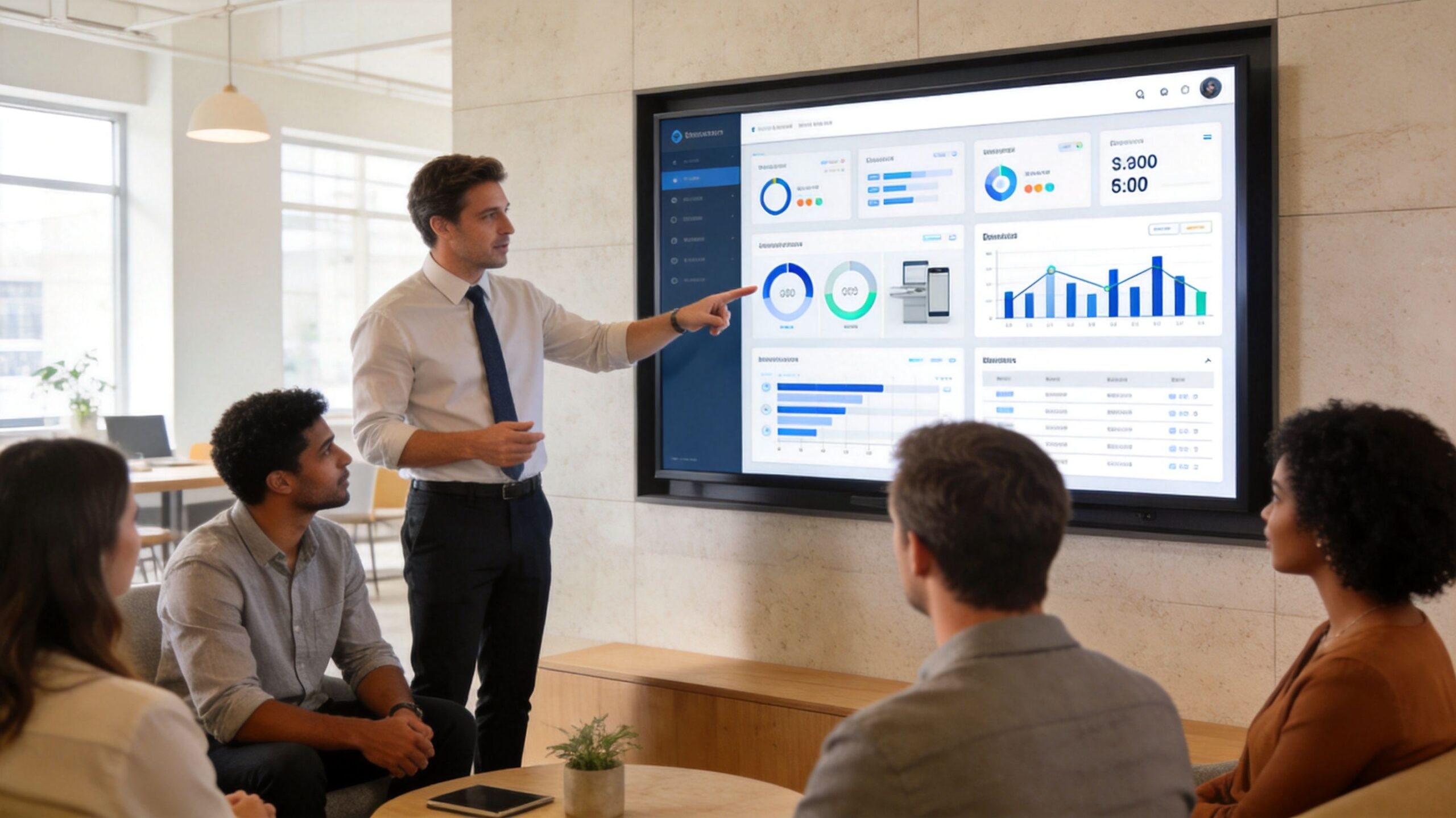
CareerExplorer's summary of office manager responsibilities points to the shift toward space optimisation and technology integration in hybrid offices. The practical implication is clear. Office managers now oversee a workplace that changes day by day, with fluctuating attendance, shared desks, visitor movement, and ongoing adjustments to layout and usage.
What to keep and what to delegate
Strong office managers keep the work that affects standards, cost, and business risk. They hand off repeatable tasks that do not need their direct involvement every time.
A practical split looks like this:
- Keep in role: supplier decisions, workplace standards, exception handling, project coordination, budget oversight
- Delegate internally: room resets, simple stock checks, routine staff requests, event support, basic facilities follow-up
- Automate where possible: desk booking, visitor sign-in, recurring supply orders, maintenance tickets, approval routing
The trade-off is straightforward. If the office manager keeps too much, they become a bottleneck. If they delegate too loosely, standards slip and problems get missed until they become expensive.
This matters during office change projects. Fit-outs, refurbishments, and reconfigurations create extra decisions, extra supplier contact, and extra pressure from staff. An office manager who has already delegated routine admin has the capacity to coordinate moves, check readiness, and spot operational problems before they affect the wider business.
Technology that reduces friction
Software should remove low-value admin and improve control of the physical workplace.
Useful tools often include:
- Desk and room booking platforms to manage hybrid attendance and meeting demand
- Visitor management systems to control access, front-of-house flow, and compliance records
- Procurement and contract tools to track approvals, supplier terms, and renewal dates
- Issue logging platforms to record maintenance problems and monitor response times
Poor implementation creates its own mess. I often see businesses buy a booking tool or helpdesk platform without defining ownership, escalation rules, or service standards. The result is predictable. Staff stop trusting the system, and the office manager ends up chasing requests manually anyway.
Physical products matter as well. In open-plan offices, acoustic booths and meeting pods from Vetrospace, BlockO, and Framery can reduce noise spill, add private meeting space, and relieve pressure on fixed meeting rooms.
The best results come from planning operations, technology, and space together. A clear workplace transformation strategy helps align layout decisions with booking data, staff behaviour, and day-to-day management. GIBBSONN Interiors provides fit out, refurbishment, and workspace reconfiguration services for UK organisations, which is relevant when an office manager needs workplace changes to support operational goals rather than just refresh the look of the space.
Businesses also need to define where office administration ends and workplace management begins. This office admin work description is a useful comparison point because it shows why modern office managers need a broader remit than diary support and general admin.
A short walkthrough can help explain how modern workplace tools and settings are coming together:
Near hubs such as Stansted Airport, where team movements, visitor volumes, and schedules can change quickly, the gap between manual coordination and a properly structured workplace operation becomes obvious fast.
Free Templates Job Description and Handover Checklist
A lot of businesses know they need help with office manager responsibilities but still write weak job descriptions. The result is predictable. They hire for admin support when they need workplace coordination, supplier control, and project input.
For comparison with broader support roles, this guide to an office admin work description is useful because it shows where pure admin ends and a modern office manager role starts.
Sample office manager job description
Job title
Office Manager
Role summary
The Office Manager oversees the smooth operation of the workplace, supports staff day to day, coordinates suppliers and facilities services, and helps control office-related spending and projects.
Core responsibilities
- Administrative control: manage office procedures, meeting support, visitor handling, supplies, shared documentation, and internal communications
- Workplace operations: coordinate maintenance, cleaning, contractor attendance, health and safety actions, and space readiness
- People support: assist onboarding, desk setup, office events, and day-to-day employee experience within the physical workplace
- Financial oversight: track office spend, process purchasing requests, review supplier performance, and support budget discipline
- Project support: contribute to office changes, refurbishments, room reconfigurations, and move planning
Key skills
- Strong organisation and follow-through
- Clear written and verbal communication
- Confidence dealing with suppliers and internal stakeholders
- Good judgement under pressure
- Commercial awareness
- Comfort working with digital systems and booking tools
What good looks like
- The office is reliable and well run
- Staff know how to get support
- Suppliers are controlled rather than chased
- Small issues are solved before they become bigger ones
- Workplace changes happen with minimal disruption
Estate and lease handover checklist
Office moves and lease exits often become expensive because no one starts early enough. A handover checklist keeps the work visible.
Property and compliance
- Review lease obligations: check repair, reinstatement, decoration, and notice terms
- Confirm landlord requirements: gather written expectations for handover condition
- Check certificates and records: keep servicing, maintenance, and compliance documents in one file
Physical space
- Inspect alterations: identify partitions, flooring changes, signage, furniture, and cabling that may need removal or agreement
- Log defects early: note damage, wear, missing items, and repair responsibilities
- Plan reinstatement works: decide what must be restored before final inspection
Services and suppliers
- Notify providers: cleaning, waste, internet, utilities, security, plants, and other contracts
- Collect final readings: record utilities and service cut-off details
- Secure asset lists: identify what is moving, staying, being sold, or being disposed of
Operational handover
- Schedule final walk-through: include landlord or managing agent where needed
- Gather keys and passes: confirm return of access devices and security items
- Close open issues: make sure snagging, contractor invoices, and records are complete
Internal transition
- Assign task owners: every item needs a named person and due date
- Protect business continuity: avoid leaving move-week decisions to chance
- Keep one master tracker: version control matters more than long email chains
A checklist like this won't remove every risk, but it does stop important details from being buried until the last week.
Ready to transform your workspace? Speak to the GIBBSONN Interiors team today. If your business is planning a refurbishment, reconfiguration, or move, Contact Us to discuss a practical workplace solution that supports your staff and your bottom line.