

A lot of workplace refurbishments stall for the same reason. The toilets are clearly tired, complaints keep coming in, cleaning takes too long, fixtures keep failing, but nobody wants to approve a project that feels cosmetic. That is usually the first mistake.
A commercial toilet refurbishment is rarely just about appearance. It affects compliance, cleaning time, water use, staff perception, visitor experience, and the way a building holds up under daily use. If the washrooms feel neglected, people notice. They often notice more than they do the reception desk.
The wider market backs that up. The global commercial bathroom renovations service market was valued at USD 12.65 billion in 2023 and is projected to reach USD 28.78 billion by 2033, with the European market standing at USD 3.25 billion, according to Data Horizzon Research on the commercial bathroom renovations service market. That demand is being driven by improved aesthetics, functionality, and energy efficiency. In simple terms, better washrooms have become a business priority.
For facilities managers, that creates a familiar challenge. The project has to satisfy finance, meet regulations, work around live operations, and still deliver something durable. That is where good planning matters most.
Table of Contents
- Your 2026 Commercial Toilet Refurbishment Starting Point
- Navigating UK Regulations and Water Efficiency
- Design Choices That Define the User Experience
- Selecting the Right Fixtures and Fittings for 2026
- The Hidden Essentials Plumbing and Ventilation
- Managing Costs Timelines and Finding Your Partner
- Your Commercial Toilet Refurbishment Checklist
- Ready to Transform Your Commercial Washrooms?
Your 2026 Commercial Toilet Refurbishment Starting Point
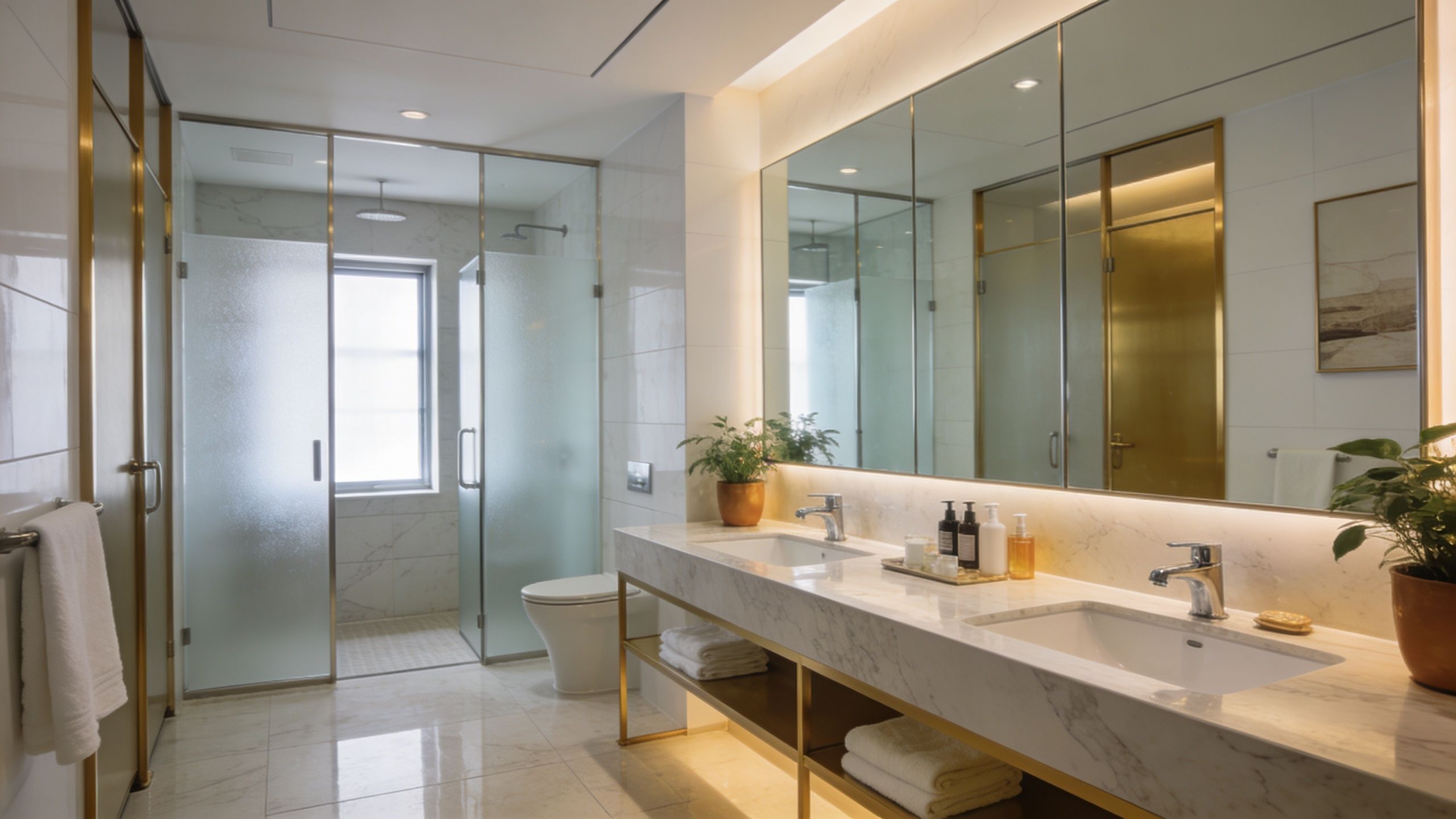
A poor washroom does more damage than many teams expect. Staff see it every day. Visitors use it without warning. If the cubicles are swollen, the flooring feels tired, or the fittings look patched together, that affects how the whole workplace feels.
Start with the real problem
Most facilities teams are not dealing with one issue. They are dealing with several at once.
- Repeated maintenance callouts: Small failures become normal. Loose ironmongery, poor flushing, tired sealant, stained sanitaryware and damaged cubicles all add up.
- Cleaning inefficiency: If partitions are too tight, corners are awkward, and finishes hold dirt, the room takes longer to clean and still looks poor.
- Perception issues: Staff usually judge washrooms quickly. If they feel old or unhygienic, the wider office can feel under-managed.
- End-of-lease pressure: When a tenant has dilapidations on the horizon, visible wear in washrooms becomes hard to defend.
Practical rule: If the same toilet block causes complaints from users, cleaners, and maintenance at the same time, refurbishment is usually the right conversation.
This is also why the business case should not be framed as "we need nicer toilets". It should be framed as a building performance issue. In live office environments across Essex, that distinction often decides whether a project gets approved.
Build the brief before the design
A strong brief saves money because it stops the wrong discussions early. Before anyone starts choosing taps, there should be clear answers to a few practical questions:
- Is the main driver compliance, appearance, operational failure, or end-of-lease condition?
- Will the area stay live during works, or can it be taken out of use fully?
- Are the current layouts worth keeping, or do circulation and maintenance access need reworking?
- Which finishes can withstand the traffic level?
- Who signs off the specification, budget, and handover standard?
The best projects treat the washroom as part of the workplace standard, not as a side room. That matters just as much in a head office as it does in a satellite site. Businesses in Hertfordshire often face the same issue. Their front-of-house may be well presented, while the washrooms still reflect an older fit-out cycle.
A good commercial toilet refurbishment should do four things at once. It should meet current standards, make cleaning easier, improve user confidence, and reduce the amount of reactive work that follows. If one of those is missed, the job will look finished but still feel unresolved.
Navigating UK Regulations and Water Efficiency
A washroom project can look tidy on paper and still fail where it matters. The main risk is not the visible finish. It is non-compliance built into the specification.
Compliance has to shape the specification
One verified warning stands out. A 2023 CIBSE report noted that 42% of UK commercial buildings fail water efficiency audits during refurbishments, risking fines up to £5,000 per non-compliant fixture under the Water Supply Regulations 1999, as cited by Newton Distributing in its commercial bathroom renovation guidance. That is not a snagging issue. It is a project failure.
For a UK commercial toilet refurbishment, facilities teams need to think about compliance before finishes, brands, or touchless add-ons. The wrong pan, the wrong flush control, or the wrong urinal setup can leave the scheme exposed after completion.
Three regulatory points usually drive the early specification:
- Part G requirements: Water use has to be controlled properly in new builds and major refurbishments.
- Water Supply Regulations: Fittings must be compliant, suitable for commercial use, and installed correctly.
- Practical maintainability: A compliant product that is awkward to maintain still creates a bad asset.
Get the flush strategy right first. Most other fixture decisions follow from that.
There is also a sustainability angle. Many workplace teams are under pressure to improve environmental performance without driving up maintenance headaches. That is why the specification should be coordinated with wider building goals from the outset. For teams reviewing broader workplace standards, sustainable office spaces for 2026 is a useful companion read.
What facilities managers should check early
The easiest way to lose time is to discover a compliance problem after the design has been priced. A practical pre-start review should cover:
- Existing toilet and urinal types: Some older fixtures may not justify retention.
- Flush performance and water use: The fixture may still operate, but that does not mean it is suitable for a refurbishment scheme.
- Sensor suitability: Touchless controls can improve hygiene and water control, but they need reliable installation and access for maintenance.
- Access for cleaning and repair: A compliant room still fails operationally if valves, traps, and service voids are difficult to reach.
A smart brief also separates what is mandatory from what is optional. Water efficiency and legal compliance are not value-engineering targets. Decorative upgrades are.
For many projects, the strongest approach is simple. Lock the compliant core first. Then build the visible design around it. That avoids the common mistake of approving a polished concept only to unpick it later when technical review catches up.
Design Choices That Define the User Experience
The best washrooms feel obvious to use. People move through them easily, finishes feel durable, and nothing looks like an afterthought. Good design in a commercial toilet refurbishment is not about adding visual tricks. It is about making the room work under pressure.
Layout does more than make the room look better
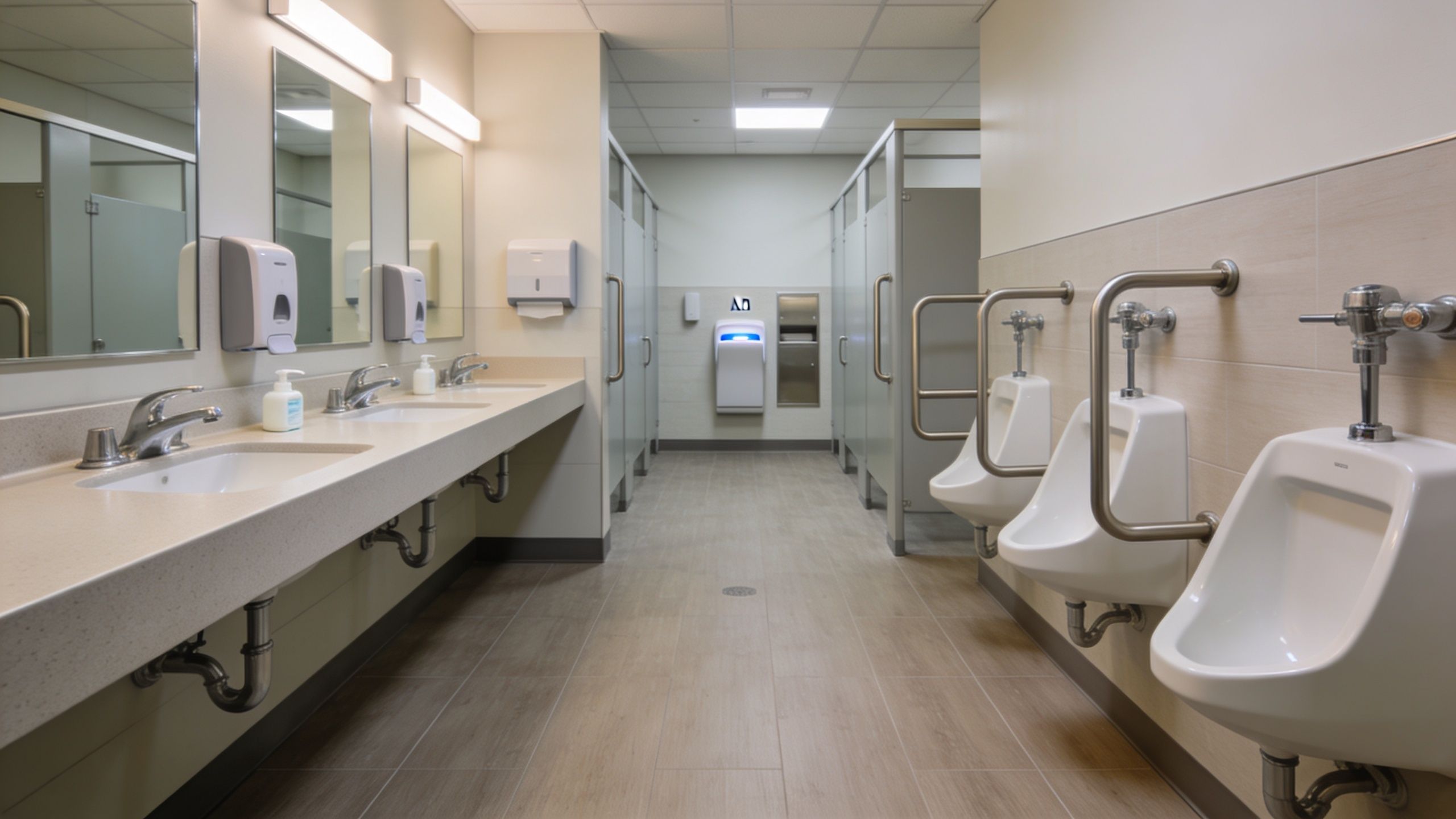
Poor layout shows up quickly in busy buildings. Doors clash, vanity areas get blocked, cleaners cannot reach corners properly, and users queue where they should be moving through. This is especially common in high-demand office environments such as London workplace refurbishment projects, where every part of the floorplate is under pressure.
A better layout usually comes from basic discipline:
- Keep circulation clean: Don’t force people to turn sharply around vanity runs or queue across access routes.
- Protect maintenance access: If cubicles, IPS panels, or partitions are packed too tightly, cleaning and repairs become harder.
- Use finishes that suit the site: An office toilet block does not need the same spec as a leisure centre or transport hub.
- Make lighting honest: Good lighting helps the room feel cleaner and makes defects easier to spot before they become bigger issues.
The visual finish still matters. Colour, mirrors, and signage all affect the experience. But durability carries more weight over time than style alone.
Choosing Your Washroom Cubicle Material
One of the most important material decisions is cubicle specification. High Pressure Laminate is a durable standard for offices, but for very high-traffic or wet areas, Solid Grade Laminate offers stronger water and impact resistance, reducing replacement cycles by 40-50% compared to budget options, according to Excelsior Cubicles on commercial toilet refurbishment materials.
| Material | Best For | Key Properties |
|---|---|---|
| HPL | Offices and standard commercial settings | Durable, scratch resistant, suitable for moderate use |
| SGL | High-traffic or wetter environments | Strong water resistance, better impact resistance, longer life |
| Budget board systems | Short-term or low-demand areas | Lower upfront cost, but weaker durability and poorer long-term value |
That trade-off matters. HPL can be the right answer in many office settings. SGL earns its keep where moisture, heavier use, or rough treatment are part of daily life.
Better materials do not always mean luxury. Often they just mean fewer closures, fewer replacements, and less patching.
Flooring should be judged in the same way. Non-slip vinyl is often a sensible commercial choice because it is safer, easier to clean, and more forgiving in daily use than finishes that look smart in a sample board but fail in service. Stainless steel and solid-surface sanitaryware can also outperform ceramic options in harder-use settings where stains, chips, or vandalism are more likely.
The right design decisions are the ones that still look sensible after years of cleaning, repairs, and user traffic. That is the test that matters.
Selecting the Right Fixtures and Fittings for 2026
Fixtures do the heavy lifting in a commercial toilet refurbishment. They are used constantly, judged instantly, and blamed first when the room feels poor. That is why the right choice is usually the one that performs well every day, not the one that looks best in a catalogue.
Choose fixtures for use patterns, not showroom appeal
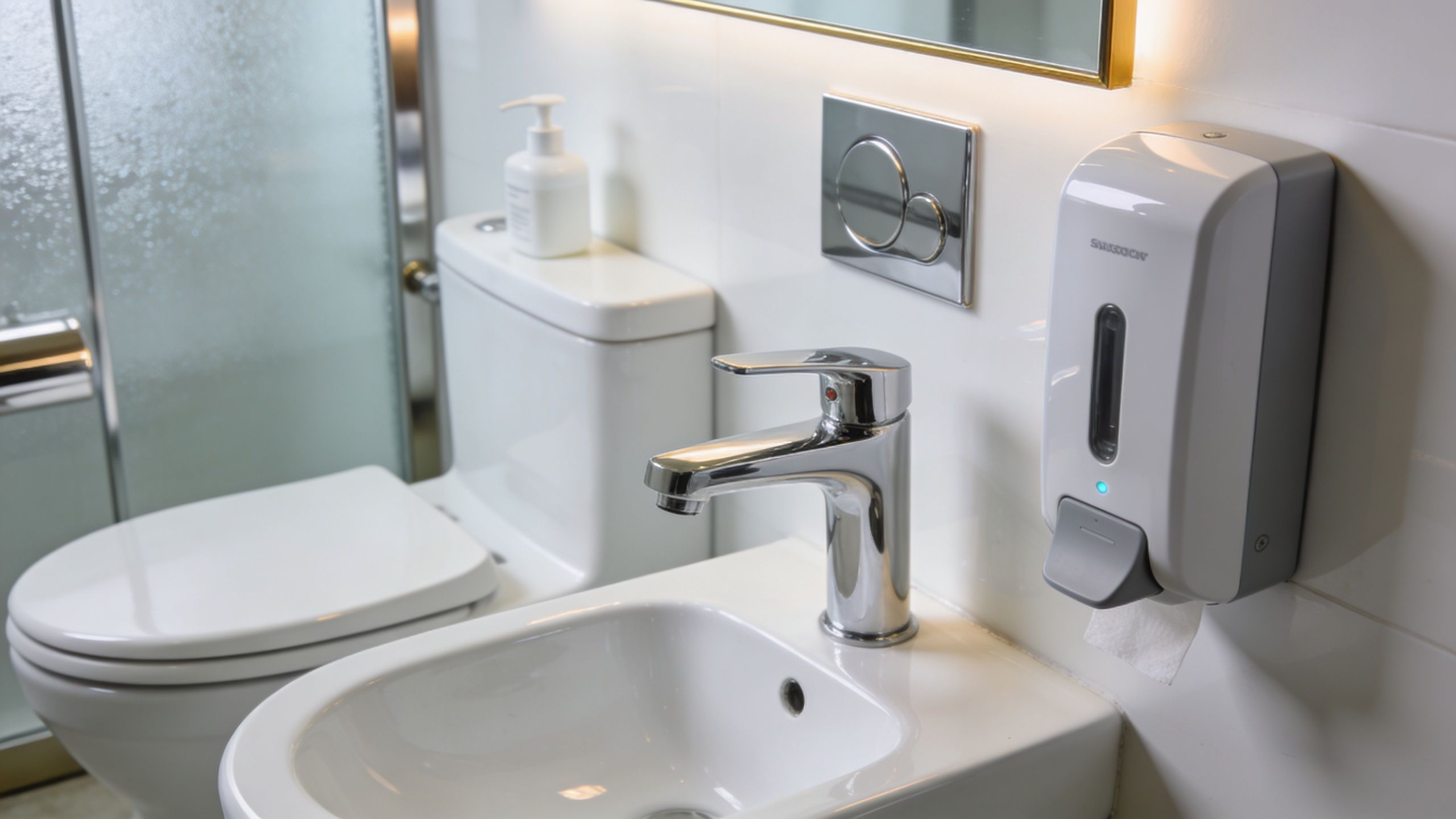
In commercial settings, old tank-style thinking often causes problems. Refill times, maintenance access, and peak-period performance matter more than domestic familiarity. The fixture has to suit the load placed on it.
Verified guidance on modern specification is clear. Modern UK dual-flush toilets must deliver 1.6/1.0-1.1 gallons per flush, giving a 60-70% water reduction from older models. Sensor-activated flushometers also improve hygiene and can reduce vandalism risk, according to FacilitiesNet on toilet specification for plumbing upgrades.
That makes flushometer and sensor-led systems attractive in many office and public-facing environments. They support consistent flushing, cleaner touchpoints, and tighter water control. They also fit the direction many facilities teams are already moving in.
What tends to work best
A practical fixture schedule usually focuses on a few key choices:
- Toilets and flushing systems: Tankless or flushometer-led commercial systems often make more sense in higher-use areas than domestic-style setups.
- Taps and soap dispensers: Sensor fittings help reduce touchpoints, but only if they are responsive and easy to service.
- Hand drying strategy: High-speed dryers can reduce consumables, while paper systems may still suit buildings with specific hygiene or user-expectation requirements.
- Basins and vanity tops: Integrated, easy-clean surfaces usually outperform fussy designs with too many joints and dirt traps.
For teams reviewing finish ideas alongside fixture planning, Performance cement tiles for commercial projects offers useful visual examples of hard-wearing tile approaches that can suit washroom environments when the specification is handled carefully.
A short technical overview can also help frame the discussion with stakeholders:
Another useful market signal is where spend is concentrated. In the commercial bathroom market, toilets and urinals lead with 38.16% of revenue share, reflecting their central role and the replacement demand created by hygiene expectations and sensor adoption, according to Mordor Intelligence on the United States commercial bathroom products market. The geography is different, but the practical lesson holds. These are the fixtures that deserve the most care in the specification.
The best fitting-out decisions are rarely flashy. They are reliable, simple to maintain, and properly suited to the building.
The Hidden Essentials Plumbing and Ventilation
A washroom can look excellent at handover and still become a problem fast if the hidden systems have been ignored. Most expensive callbacks come from what sits behind panels, below floors, or above ceilings.
Check the hidden condition before the strip-out
Before committing to a final specification, the existing services need a proper review. That means checking drainage routes, water feeds, isolation points, service voids, and any obvious signs of past leaks or poor repairs.
A few practical checks can prevent a lot of trouble later:
- Confirm what can stay and what should go. Keeping old pipework to save time sometimes creates bigger costs after the room is rebuilt.
- Check access panels and service zones. If maintenance teams cannot reach the working parts easily, simple faults become disruptive faults.
- Review waste runs properly. Pipe sizing and routing matter more than many clients realise. For teams wanting a simple technical refresher, UK 32mm waste pipe regulations is a helpful background guide.
- Flag hidden damage early. Stained subfloors, rotten grounds, failed seals, and poor previous alterations should be treated as design information, not site surprises.
A neat fit-out cannot compensate for poor drainage falls or inaccessible services.
Many projects frequently go awry. Too much attention goes on visible finishes, while the enabling work gets compressed. If the waste strategy, fixings, or service access are weak, the room will not stay good for long.
Ventilation is part of the user experience
Ventilation tends to get discussed late, even though users notice it immediately. If odours linger, mirrors stay fogged, or moisture sits in the room, people assume the washroom is dirty even when it has just been cleaned.
Good extraction protects more than comfort. It helps limit damp, reduces strain on finishes, and supports a more consistent internal environment. That matters for cubicle longevity, sealants, ceiling finishes, and general hygiene perception.
Facilities managers should make sure the ventilation design matches real use, not just the drawing set. Busy washrooms need extraction that can cope with occupancy peaks. They also need controls and access that make ongoing maintenance straightforward.
Plumbing and ventilation are not glamorous parts of a commercial toilet refurbishment. They are often the difference between a project that lasts and one that starts failing as soon as normal use returns.
Managing Costs Timelines and Finding Your Partner
Budgets usually fail for one of two reasons. Either the early scope was too vague, or the contractor was chosen on price before the risk was understood. A commercial toilet refurbishment needs tighter control than many people expect because so much of the work is hidden until strip-out starts.
Budget for decisions, not just products
A realistic budget should cover more than visible finishes and labour. It should reflect the actual sequence of work, the condition of the existing area, and the level of disruption the building can tolerate.
Strong cost planning usually includes:
- Pre-construction checks: Surveys, opening-up where needed, and enough technical review to avoid blind pricing.
- Core compliance items: Toilets, urinals, valves, water-saving controls, and associated enabling works should not be treated as optional.
- Access and phasing: Out-of-hours work, temporary facilities, or restricted building access can change the programme and cost.
- Contingency: Older washrooms often reveal hidden defects once finishes are removed.
For many teams, the easiest way to keep control is to set decision gates. Approve the brief. Approve the technical design. Approve the fixed scope. Then release the build. That is slower at the front end, but safer overall.
A planning framework helps. This office refurbishment project plan template is useful for shaping responsibilities, sequencing, and approvals before site work starts.
The right contractor reduces risk
Choosing a refurbishment partner is not just about workmanship. It is about communication, sequencing, and commercial discipline. The contractor needs to understand live environments, compliance pressure, long-lead items, and final handover standards.
Questions worth asking include:
- Who manages the programme day to day?
- How are compliance items checked before ordering?
- What happens if strip-out reveals hidden service issues?
- How will disruption to staff or visitors be controlled?
- What does handover include beyond practical completion?
Projects in Cambridge commercial interiors settings often highlight this well. Buildings can have access constraints, mixed occupancy patterns, or legacy services that require close coordination. The same is true in many other UK office locations.
A good partner will also challenge weak assumptions. If a client wants to keep failing infrastructure to trim cost, the contractor should say so. If the layout creates cleaning problems, that should be raised before manufacture. If the programme is unrealistic, it should be reset early.
The cheapest quote can become the most expensive project if the scope is unclear and the management is weak.
Time pressure is real, but rushed procurement usually costs more. The best refurbishment teams are methodical. They price what can be delivered, flag what is uncertain, and keep the project controlled from approval to sign-off.
Your Commercial Toilet Refurbishment Checklist
Use this checklist to keep the project practical from the first survey to final handover. It is not meant to replace technical design. It is there to stop obvious gaps.
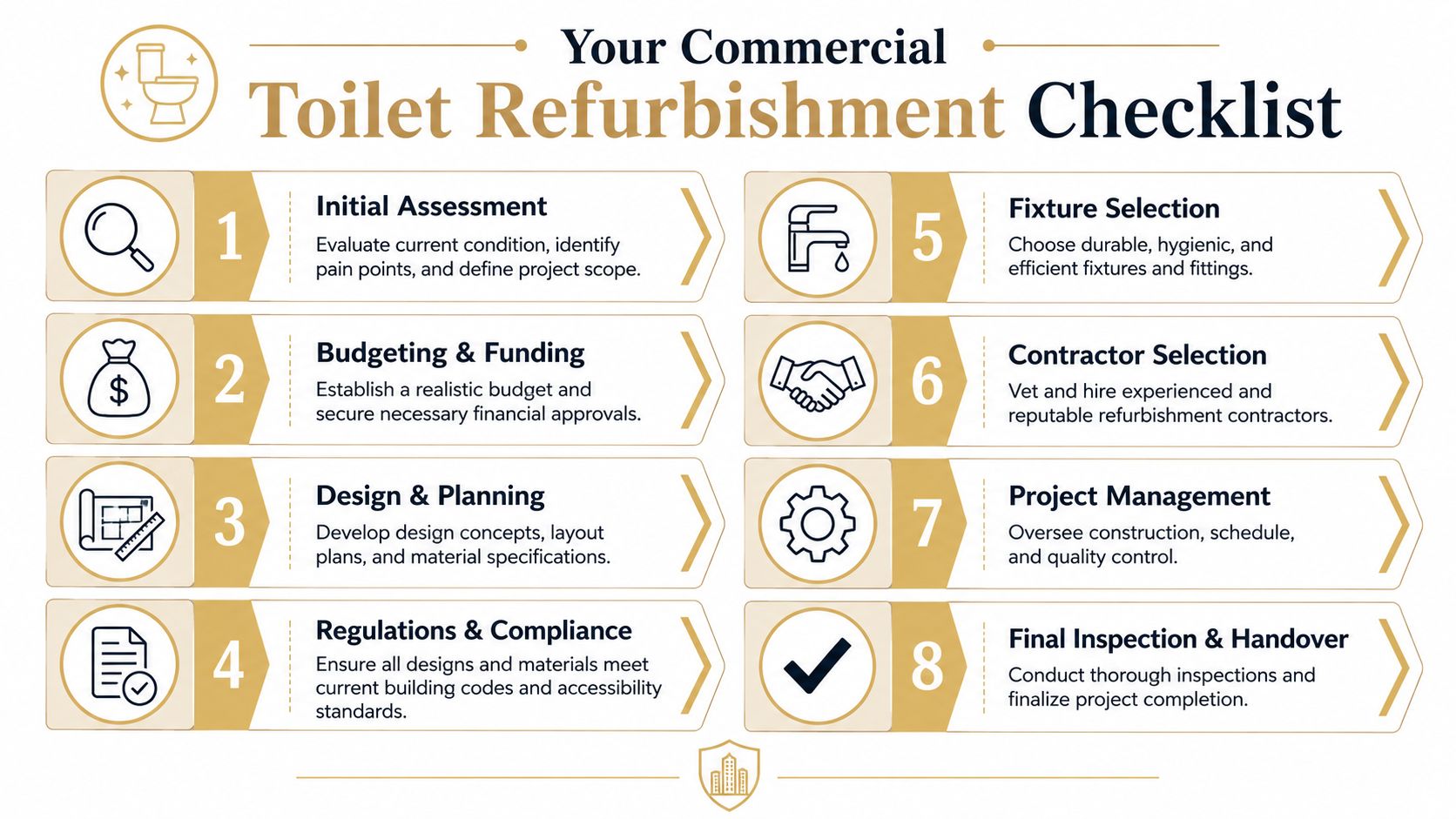
- Assess the current condition: Record defects, user complaints, cleaning issues, and service failures.
- Set the project driver: Decide whether the priority is compliance, durability, user experience, end-of-lease condition, or a mix.
- Review regulations early: Check water efficiency, fitting suitability, and any building-specific constraints.
- Test the layout: Make sure circulation, access, and maintenance space all work properly.
- Choose durable materials: Match cubicles, flooring, and sanitaryware to the actual traffic and cleaning regime.
- Specify commercial-grade fixtures: Prioritise serviceable, efficient products over domestic-style alternatives.
- Plan programme and disruption: Agree access windows, shutdowns, temporary arrangements, and handover expectations.
- Close out properly: Snag thoroughly, collect manuals, confirm compliance records, and make sure the team has what it needs to maintain the space.
For a broader planning tool that sits alongside this washroom-specific list, see the 2026 office refurbishment checklist.
Ready to Transform Your Commercial Washrooms?
A successful commercial toilet refurbishment does not come from picking smarter finishes at the end. It starts with a sharper brief, clear compliance thinking, and honest decisions about how the space is used.
The projects that perform best usually follow the same pattern. They solve the hidden service issues, choose materials that match the traffic, and avoid false savings on fixtures that will fail early or cost more to maintain. They also recognise that staff and visitors judge washrooms quickly. If the room feels neglected, that perception spreads to the rest of the workplace.
Refurbishment done properly gives facilities teams something valuable. Fewer recurring faults, simpler cleaning, stronger compliance, and a workplace standard that feels deliberate rather than patched together.
Ready to transform your workspace? Speak to the Gibbsonn Interiors team today.
Looking for a bespoke refurbishment or interior support? We’re here to help.
If your washrooms are overdue for an upgrade, GIBBSONN Interiors can help plan and deliver a refurbishment that is practical, compliant, and built to last. Ready to transform your workspace? Speak to the team today.