

Most office refurbishment projects start at the same point. The space no longer fits the business. Staff are distracted by noise, meeting rooms are always full, storage has crept into walkways, and the office looks tired when clients visit.
That usually creates two worries at once. The first is cost. The second is disruption. Good office refurbishment services deal with both by putting structure around the job early, then delivering the work in a way that keeps the business moving.
Table of Contents
- Your 2026 Starting Point Defining Your Refurbishment Goals
- Budgeting Your Project and Measuring the Return
- How to Choose Your Office Refurbishment Partner
- Managing Timelines and Minimising Disruption
- Compliance Sustainability and Future Proofing Your Space
- The Final Step Handover and Enjoying Your New Office
Your 2026 Starting Point Defining Your Refurbishment Goals
An office refurbishment can go wrong before a single wall is moved. That happens when a business jumps straight into finishes, furniture, and layout ideas without being clear on the problem it is trying to solve.

A better starting point is a short, disciplined review of how the office works now. That means looking at space use, daily friction, team habits, storage, privacy, meeting demand, and any compliance gaps. Businesses planning moves or upgrades in Cambridge and Braintree often find that the biggest issue is not lack of space. It is poor use of the space they already have.
Start with what is not working
A useful first pass is simple. Walk the office and write down what staff keep working around.
- Noise issues: People take calls in corridors or book meeting rooms for solo work.
- Layout problems: Teams that need to collaborate sit too far apart, while quiet work happens in busy areas.
- Storage creep: Filing, deliveries, and shared equipment end up in spaces meant for people.
- Brand mismatch: The office no longer reflects the business clients expect to see.
- Hybrid strain: Desks sit empty some days, while collaboration spaces feel overloaded on others.
Practical rule: If a problem affects staff every day, it belongs in the brief before it appears in the design.
The strongest briefs are measurable. Instead of saying the office needs to feel better, define the outcome. That might mean more enclosed space for focused work, better meeting capacity, improved accessibility, or a clearer reception and client journey.
Turn complaints into a proper brief
A structured needs assessment is not admin for the sake of it. According to UK guidance on refurbishment planning, projects that begin with a structured needs assessment and clear objective setting are successful in 60 to 70% of cases, with unplanned changes falling by around 30 to 40%.
That matters because late changes are what usually stretch budgets and extend programmes.
A practical brief normally includes these points:
Business need
Why the refurbishment is happening now. Growth, lease renewal, staff complaints, brand change, or a new way of working.Operational priorities
Which teams must stay live, what can't be interrupted, and when the busiest periods hit.Space priorities
Desk mix, meeting rooms, quiet booths, breakout space, storage, reception, and welfare areas.Technical constraints
Building services, access restrictions, landlord approvals, and any known issues with power, lighting, or ventilation.Success measures
What completion should achieve.
For businesses that need help shaping that early brief, a workplace strategy consultant can turn general frustrations into a usable project plan.
Budgeting Your Project and Measuring the Return
Budget conversations tend to get stuck on one question. What will it cost per square foot? That sounds sensible, but it rarely gives the full answer. Office refurbishment services are built from several moving parts, and each one affects the final number.
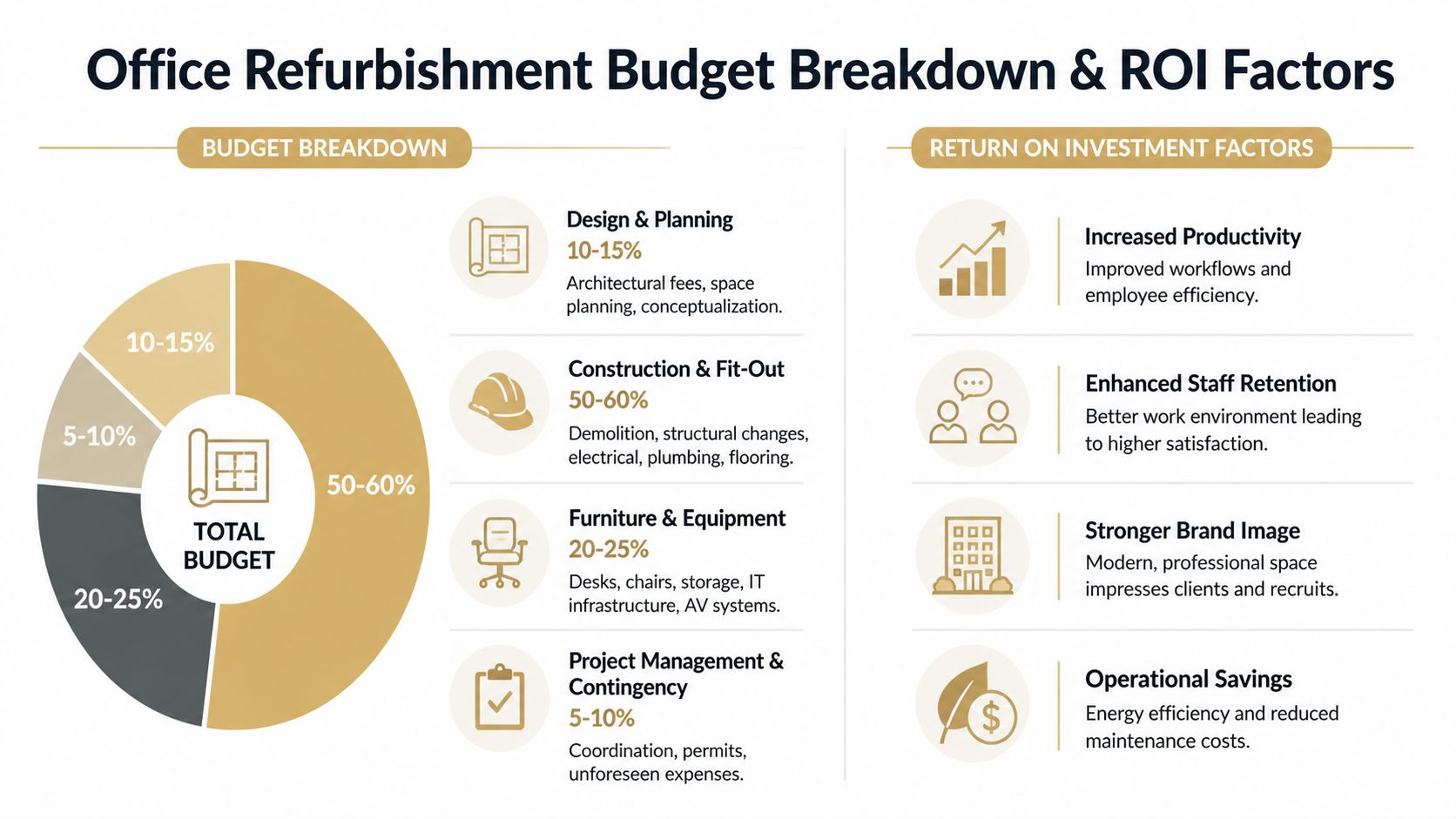
The more useful question is this. What is the business buying, and what level of change is needed?
What sits inside the budget
A light refresh and a full refurbishment are very different jobs. One may focus on finishes, furniture updates, and layout adjustments. The other may involve partitions, M&E coordination, compliance upgrades, and deeper reconfiguration.
Typical budget headings include:
- Design and planning: Surveys, space planning, concept layouts, technical drawings, and approvals.
- Construction and fit-out: Strip-out, partitions, flooring, ceilings, decorations, lighting changes, and builder's works.
- Furniture and equipment: Desks, seating, storage, collaboration furniture, meeting pods, AV, and IT support items.
- Project management and contingency: Coordination, sequencing, problem solving on site, and cover for surprises.
A contingency is not optional. It protects the project from known unknowns such as hidden service routes, uneven existing finishes, or changes triggered by landlord and building requirements.
How SMEs can think about return
For many SMEs, the hardest part isn't the wish list. It is proving the spend. The challenge is especially sharp in higher-cost locations such as Bishop’s Stortford and across Hertfordshire, where every capital decision is examined closely.
According to guidance on ROI barriers for refurbishment decisions, there is no single formula for refurbishment return. UK SMEs are advised to assess costs against likely gains in productivity, staff retention, and brand identity when making the case for investment.
That is a sensible way to frame it because the return is usually spread across several outcomes, not one headline figure.
A good refurbishment budget is not a shopping list. It is a decision about where the business needs better performance.
A simple ROI discussion usually works best when it asks:
| Cost area | Business effect | What to review |
|---|---|---|
| Workspace layout | How teams work day to day | Delays, crowding, meeting pressure |
| Acoustic and privacy upgrades | Focus and comfort | Noise complaints, poor call quality |
| Visual refresh | Recruitment and client impression | Brand fit, staff pride, visitor experience |
Businesses that need a clearer budgeting framework can review these common cost drivers in this guide to office refurbishment costs.
How to Choose Your Office Refurbishment Partner
The wrong partner usually looks fine at tender stage. The quote arrives quickly, the price is sharp, and the promises sound familiar. The problems show up later when decisions slow down, trades clash, questions go unanswered, or site works start affecting staff more than expected.
That is why buying on price alone is risky. An office refurbishment is not just a build package. It is planning, sequencing, communication, risk control, and accountability.
Why the cheapest quote often costs more
A low headline figure can hide gaps. Furniture coordination may sit outside the price. Building services checks may be light. Programme assumptions may depend on unrestricted site access that the client cannot provide.
Experienced design-and-build teams tend to stand out. They ask awkward questions early. They test assumptions before the contract is signed. They flag where a layout idea will create service issues, compliance issues, or delays later.
The partner worth choosing is the one that spots problems before the site team finds them.
A reliable shortlist should include firms that can show relevant refurbishment work, not just attractive images. A smart reception project is not the same as a live office refurbishment with phased occupation, landlord constraints, and tight handover dates.
Contractor selection criteria
| Criterion | What to look for | Why it matters |
|---|---|---|
| Relevant project experience | Similar office refurbishment services, live-site work, sector knowledge | Reduces avoidable surprises |
| Communication style | Clear reporting, named contact, quick decisions | Keeps client teams informed and calm |
| Technical depth | Strong detail on M&E, compliance, and coordination | Prevents design-site disconnect |
| Programme approach | Realistic phasing, access planning, staff protection | Cuts business disruption |
| Aftercare | Snagging response and handover support | Finishes the job properly |
For local projects, it also helps to choose a team familiar with the working patterns and property constraints common in Chelmsford and Colchester.
One practical option in the market is GIBBSONN Interiors, which offers workplace consultancy, space planning, refurbishment delivery, partitioning, meeting pods, and dilapidation support through a single design-and-build route. That kind of joined-up service can suit clients who want one point of contact from brief to handover.
Managing Timelines and Minimising Disruption
Most clients can cope with dust, noise, and temporary inconvenience. What they cannot accept is losing the ability to trade, serve staff, or keep core operations running. That is where programme planning becomes as important as the physical build.

The biggest challenge during refurbishment is maintaining operations. As noted in guidance on seamless office renovation, the answer is a reliable team that can run a phased schedule so one part of the business stays live while work happens elsewhere.
Phased works keep the business operating
Phasing works because it breaks a large disruption into smaller, planned ones. Instead of trying to overhaul the whole office at once, the project team moves through zones in a set order.
That may involve:
- Decanting one team at a time: Temporary moves into spare desks, meeting rooms, or swing space.
- Running noisy works out of hours: Best for demolition, drilling, service isolations, and delivery of bulky items.
- Protecting live routes: Clear hoardings, safe access, separate contractor routes, and tidy delivery windows.
- Sequencing support spaces first: Finishing storage, breakout, or touchdown areas early can make later moves easier.
For operational sites near Stansted or Luton, that phased approach is often the difference between a manageable project and a major operational problem.
A detailed planning checklist also helps. This office refurbishment project plan template is a useful starting point for mapping scope, sequencing, and responsibilities before site mobilisation.
Communication matters as much as construction
Most disruption gets worse when staff don't know what is happening. Even a well-run site feels chaotic if people arrive to find their route blocked, their meeting room closed, or their team moved without warning.
Useful communication usually includes:
- A short weekly update with upcoming works and any access changes
- Floor plans for each phase so staff know where they are moving
- Named contacts for building issues, IT issues, and health and safety queries
- Simple rules for live areas such as delivery times, quiet times, and fire routes
This short video gives a useful visual sense of how live working and renovation can overlap when sequencing is handled carefully.
Compliance Sustainability and Future Proofing Your Space
A refurbishment that looks good but fails on compliance or flexibility is not finished properly. It just stores up cost for later. The strongest office refurbishment services deal with legal requirements, building performance, and future use at the same time.
Get technical issues resolved before work starts
A common mistake is treating building services as a detail to sort out during construction. That usually leads to clashes between ceilings, lighting, air distribution, partitions, and furniture layouts. Another regular problem is leaving lease-end obligations too late, then trying to fit refurbishment work around dilapidation pressure.
According to UK refurbishment guidance covering risk and compliance, common pitfalls include underestimating building service integration and failing to align works with lease-end dilapidation deadlines. The same guidance recommends a 10 to 15% contingency and resolving compliance with Part L, Part M, and Part B before design finalisation.
That is why technical coordination needs to happen before finishes are chosen and orders are placed.
Key checkpoint: If power, lighting, HVAC, fire strategy, and accessibility are still open questions, the design is not ready to lock.
Indoor environmental quality also deserves more attention than it usually gets. Air quality, thermal comfort, acoustics, and cleanliness all shape how the office feels once people return. Teams reviewing post-refurbishment performance may find this guide to understanding IEQ standards helpful when discussing ventilation, comfort, and occupant wellbeing.
Build flexibility into the finished office
Future-proofing is less about trend chasing and more about avoiding hard-to-change decisions.
A practical office should cope with headcount shifts, hybrid patterns, new technology, and different styles of work without needing another major project too soon. That usually points towards movable furniture, adaptable zones, and enclosed spaces that can be added without major structural work.
Examples include:
- Glass partitions: Useful where visual openness matters but acoustic control still needs improvement.
- Architectural wrapping: A fast way to update tired surfaces with less disruption than full replacement.
- Acoustic pods: Products from Framery, Vetrospace, or BlockO can create bookable focus and call spaces inside open-plan offices.
- Flexible layouts: Areas that support touchdown work today and team project use later tend to last better.
That matters for growing occupiers in places such as Milton Keynes and Dartford, where office needs can shift quickly over the life of a lease.
The Final Step Handover and Enjoying Your New Office
Handover is where a project proves whether it has really been managed well. If the site looks finished but the documents are missing, small defects remain open, and nobody knows how systems work, the client is left carrying the final stretch alone.
A proper handover closes that gap. It turns practical completion into an office that staff can use with confidence from day one.
What a proper handover should include
The walk-through matters. During this stage, the client team checks finishes, doors, ironmongery, partitions, flooring transitions, lighting operation, furniture placement, and any final decorating touch-ups. Small defects are normal. What matters is that they are recorded clearly and closed quickly.
A solid handover pack usually includes:
- Warranties and guarantees: For products, installed elements, and specialist systems
- Operating information: Lighting controls, heating and cooling controls, access systems, and any booking tools
- Finish schedules: Useful for maintenance, cleaning, and future repairs
- Compliance records: Relevant certificates and sign-off documents
- Snagging list: What is open, who owns it, and when it will be resolved
A tidy handover saves weeks of frustration later. Teams should know who to call, what has been installed, and how the space is meant to operate.
Settling in without loose ends
The first days after occupation often expose minor issues that were not obvious during site inspections. Glare at one desk bank, a door closer that needs adjusting, a meeting room booking panel that needs resetting, or storage that needs relabelling. These are normal post-move points, and they should be handled through an agreed aftercare process.
Cleaning is also part of that final impression. Before staff return fully, many clients arrange a specialist reset so the office feels fresh rather than newly built. For that stage, these commercial deep cleaning solutions are a useful reference when planning a proper post-works clean.
A successful finish does more than remove defects. It helps staff settle quickly into new habits. Meeting pods get booked properly, quiet areas are respected, storage works as intended, and the office starts doing the job it was refurbished to do.
The result should feel calm, organised, and ready for work.
Ready to transform your workspace? Speak to GIBBSONN Interiors today. For practical office refurbishment services, phased delivery support, and a clear route from brief to handover, Contact Us.