
A lot of office teams are in the same spot right now. Staff want a workplace that feels better to use. Leadership wants proof that investment in the office still matters. Facilities teams need upgrades that won't create headaches at lease end. That mix of pressure is exactly why the well building standard has moved from a niche topic into a serious workplace discussion.
The standard gives businesses a clear way to shape offices around people, not just floor plans. It looks at the things occupants notice every day, such as air, light, sound, comfort, movement and mental wellbeing. For employers trying to improve attendance, support focus and make the office worth the commute, that matters.
It also isn't a fringe idea anymore. The WELL Building Standard has reached more than 5 billion square feet across 130 countries, supports an estimated 25 million occupants, and is being implemented by over 2,000 companies, including 96 of the Fortune 500, according to the WELL Building Standard overview. For businesses competing for talent in places like Cambridge, that level of adoption sends a clear signal. Occupant wellbeing is becoming part of what good offices are expected to deliver.
Table of Contents
- Introduction The Future of the Office is Human-Centred
- The 10 Core Concepts of the WELL Building Standard
- Decoding WELL Certification Levels for Your 2026 Goals
- The Business Case The Real-World Benefits of a WELL Office
- A Practical Checklist for Integrating WELL into Your Office Fit-Out
- How Gibbsonn Interiors Delivers WELL-Ready Workspaces
- Your WELL Building Standard Questions Answered
Introduction The Future of the Office is Human-Centred
A leadership team signs off a new office because the space looks sharp, the density works on paper, and the rent fits the budget. Six months later, staff are still avoiding the office, complaints about noise and glare keep coming in, and the fit-out no longer feels like money well spent.
That is the gap human-centred workplace design is trying to close.
The office is still judged on efficiency, headcount and finish quality. UK businesses now need more than that. They need a workplace that helps people concentrate, collaborate, recover from screen fatigue, and stay comfortable through a full working day. They also need choices that stand up to lease constraints, hybrid working patterns, and board-level scrutiny on value.
That is why the well building standard matters. It gives occupiers, landlords and project teams a practical way to turn wellbeing into design decisions, delivery actions and measurable project goals. For businesses planning a fit-out or refurbishment, it helps separate useful investment from decorative spend.

A workplace standard with real project relevance
WELL is now part of serious workplace conversations, not a niche add-on for prestige HQs. We see it come up early in projects where clients want to improve attendance, support staff wellbeing, meet ESG expectations, or make a stronger case for relocation and refurbishment.
That shift matters because office performance is rarely caused by one bad choice. Problems usually sit across ventilation, lighting, acoustics, layout, amenities and management policies at the same time. WELL gives teams a common framework for addressing those issues in a joined-up way.
Practical rule: A healthy office comes from coordinated decisions across the whole fit-out, not one headline feature.
Why UK occupiers are paying closer attention
In live projects, certification is often not the first question. The first question is usually more direct. Why are people avoiding the office, and what will improve that?
For some businesses, the answer starts with poor acoustics in open-plan areas. For others, it is weak daylight, inconsistent temperatures, limited quiet space, or a layout that forces every task into the same setting. WELL helps project teams assess those conditions properly and respond with design choices that support employee wellbeing and day-to-day productivity.
It also brings discipline to the brief. That matters in the UK, where CAT A limitations, landlord approvals, MEP constraints and programme pressure can quickly push wellbeing goals off the table unless they are built into the project from the start. Our approach at GIBBSONN is to address those trade-offs early, so the finished office is practical to deliver and better to use.
Businesses that want a clearer picture of what good workplace wellbeing looks like in practice can start with our guide to wellbeing in the workplace.
The 10 Core Concepts of the WELL Building Standard
At a practical level, the well building standard works like a health checklist for the office. It doesn't just ask whether the space looks good. It asks whether the environment supports the people inside it.
A simple way to read the framework
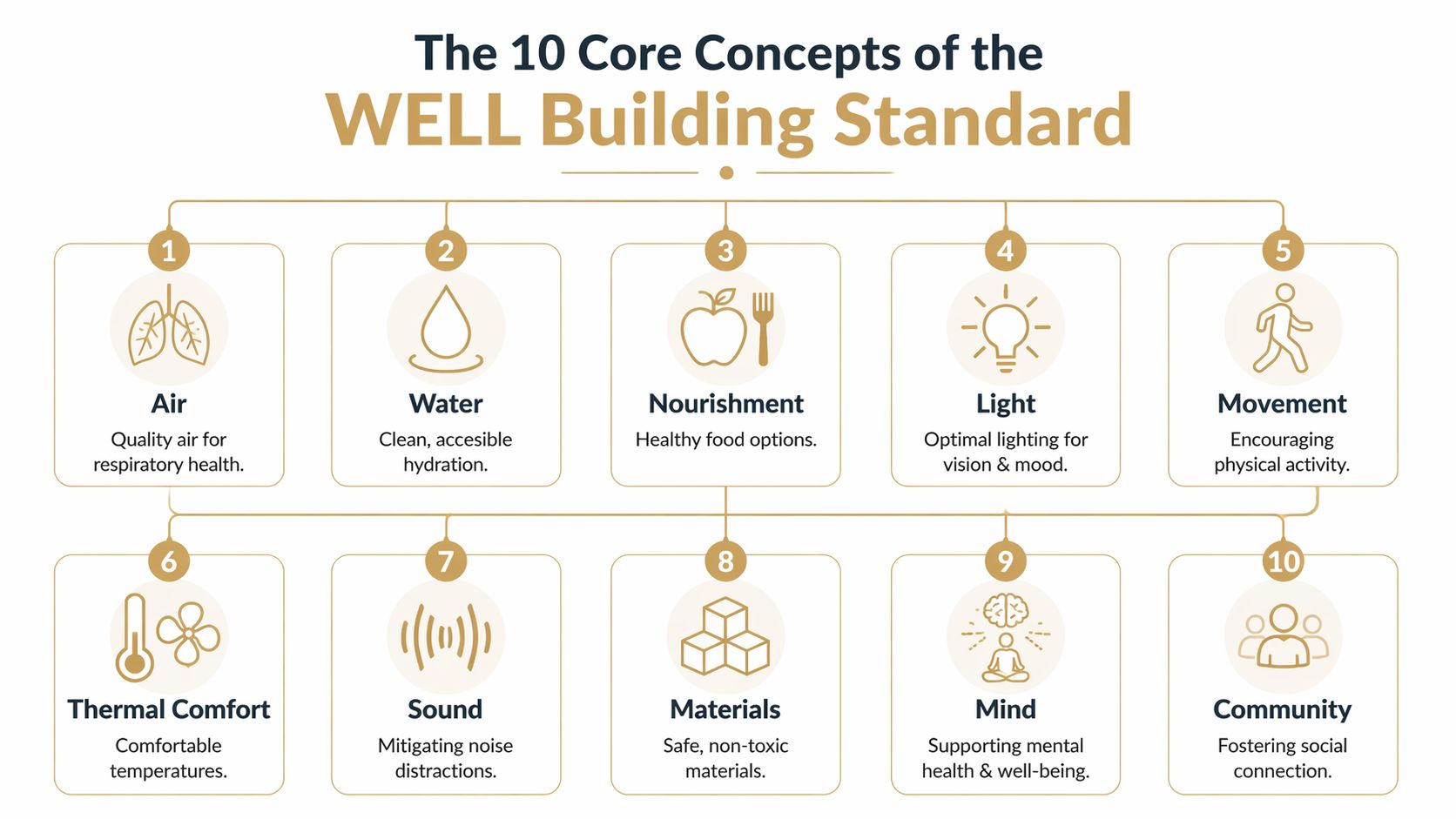
The easiest way to think about WELL is as a nutrition label for your workplace. Each concept covers one part of the occupant experience. On its own, each one seems straightforward. Together, they shape how the office feels across a full working day.
The ten concepts are:
| Concept | Focus Area | Example Office Application |
|---|---|---|
| Air | Indoor air quality and ventilation | Better filtration and fresh air strategies |
| Water | Safe, accessible drinking water | Easy access to quality drinking points |
| Nourishment | Healthier food choices | Breakout areas that support better options |
| Light | Visual comfort and circadian support | Daylight-led layouts and glare control |
| Movement | Reducing sedentary habits | Walk routes, varied settings and sit-stand use |
| Thermal Comfort | Temperature and comfort balance | Zoned control and fewer hot or cold spots |
| Sound | Acoustic comfort and privacy | Pods, acoustic treatments and quiet zones |
| Materials | Low-toxicity, healthier finishes | Careful material and product selection |
| Mind | Mental wellbeing and focus | Restorative areas and lower-stress design |
| Community | Inclusion, connection and support | Shared spaces that encourage belonging |
A good office doesn't treat these as separate boxes. The strongest projects combine them. Glass partitioning can help light move deeper into a floorplate, for example, but the acoustic plan then needs to work harder so openness doesn't turn into noise spill.
What the concepts look like in practice
Some concepts affect building systems. Others sit in the fit-out itself. Most live somewhere in the middle. That's why design teams need to understand the interaction between layout, products and user behaviour.
A few examples make that clearer:
- Air and materials: Strong finishes can look impressive on handover but create problems if material choices and ventilation aren't thought through together.
- Light and mind: A bright office isn't always a comfortable office. Poor glare control can make a workspace feel harder to use, not better.
- Movement and community: Breakout zones only support movement and connection if they're placed where people will use them.
- Sound and focus: Open-plan layouts need spaces for quiet calls, private meetings and deep work, otherwise the office creates friction all day long.
Acoustic pods and enclosed booths often do more than solve noise. They support focus, privacy, wellbeing and meeting choice in one move.
For many occupiers, the standard begins to feel useful rather than theoretical. It turns broad wellbeing aims into decisions about partitions, finishes, ventilation coordination, lighting, furniture settings and room types.
Businesses looking at wellbeing in the workplace usually find that the biggest gains come from these joined-up decisions, not from isolated add-ons.
Decoding WELL Certification Levels for Your 2026 Goals
Certification can sound more complicated than it is. In simple terms, WELL has a baseline of things every project must achieve, then a wider set of optional improvements that help a project reach a higher level.
Preconditions and optimisations
The baseline items are called preconditions. These are the must-haves. They set the minimum standard for a healthy environment.
The optional items are called optimisations. These are the extra measures that earn points and push a project towards a stronger certification outcome. That structure is useful because it gives businesses room to prioritise. Not every office needs to chase the highest possible level. Many need a realistic target that fits the building, budget and programme.
A sensible project team usually starts with two questions:
- What must the office do better for occupants?
- Which improvements are achievable without creating avoidable cost or complexity?
Choosing the right level
In broad terms, the different levels reflect ambition.
- Bronze suits organisations that want a clear wellbeing foundation without turning the project into a major certification exercise.
- Silver often appeals to businesses that want a more rounded commitment across the whole workplace.
- Gold tends to suit occupiers using the office as a stronger talent, brand or ESG statement.
- Platinum is for projects with very high ambitions, close coordination and strong operational follow-through.
The wrong approach is choosing a level because it sounds impressive. The right approach is matching the target to the building and the business. A tenant in an older building may need to be more selective. A business with strong HR and ESG goals may decide the extra effort is worthwhile because the office is part of a wider people strategy.
Decision point: The best certification target is the one the project can genuinely deliver and maintain after handover.
A practical 2026 brief usually aims for changes that employees can tangibly feel. Better acoustic control, improved lighting, healthier material choices, flexible meeting settings and stronger comfort conditions often matter more than chasing features that are hard to operate in day-to-day use.
The Business Case The Real-World Benefits of a WELL Office
Most office investments fail when they're sold as style upgrades. The better argument is simpler. A people-focused office helps staff work with less friction.
Why people-first design affects performance
When a workplace gets the basics wrong, people feel it quickly. Rooms are too noisy for focus. Meeting spaces are always full. Lighting creates glare on screens. Temperature varies across the floor. Staff spend time adjusting to the building instead of getting on with work.
That is why the well building standard matters commercially. It gives businesses a way to reduce these daily irritations through design choices that support better working conditions.
A few examples are easy to see in real projects:
- Sound control improves concentration: Acoustic booths, enclosed meeting pods and better zoning help open-plan offices support both collaboration and quiet work.
- Light quality affects comfort: Access to daylight, balanced artificial lighting and glare control make desk settings easier to use for longer periods.
- Movement supports energy: A layout with varied work points and natural movement routes helps people avoid being stuck in one position all day.
- Comfort reduces complaints: Better thermal planning and smarter space allocation cut down the constant background friction that drains workplace satisfaction.
Organisations exploring ways to improve workplace productivity often find that environment is part of the answer. Not the whole answer, but a meaningful part of it.
Where businesses usually see value
The value of a WELL-led office isn't limited to one department. HR sees a better employee experience. Operations gets a space that works more smoothly. Leadership gets an office that supports culture and brand. Property teams get a clearer brief for fit-out decisions.
There is also a reputational benefit. A workplace designed around occupant wellbeing tells clients, recruits and existing staff that the business takes the user experience seriously. That can be especially important in competitive markets where office quality helps shape perception.
For landlords and tenants, WELL thinking can also improve letting conversations. Healthier, more adaptable spaces are easier to explain and easier to position in a market where occupiers are more selective about what the office must do.
A strong office isn't just attractive on day one. It continues to support people after the novelty of the fit-out has worn off.
The key point is that wellbeing features shouldn't sit outside the business case. They should be part of it. If the office is still a major business asset, then making it healthier, easier to use and more flexible is a practical investment, not a cosmetic one.
A Practical Checklist for Integrating WELL into Your Office Fit-Out
Most WELL projects don't fall short because the standard is too hard. They fall short because the team starts too late, designs in isolation, or forgets the lease.
Start with the lease before the layout
This matters a lot for UK tenants. Office teams often focus on the fit-out brief and leave lease risk until much later. That can be expensive.
UK commercial leases often require the space to be returned to its original condition, and dilapidations claims average £1.2 million per office property, while 68% of UK SMEs delay fit-outs because they fear lease-end costs, according to the cited industry summary in this UK office fit-out and lease-cost reference. That is a strong reason to favour reversible, low-damage upgrades wherever possible.
A WELL-led office doesn't have to mean heavy structural intervention. In fact, some of the smartest solutions are the least disruptive.
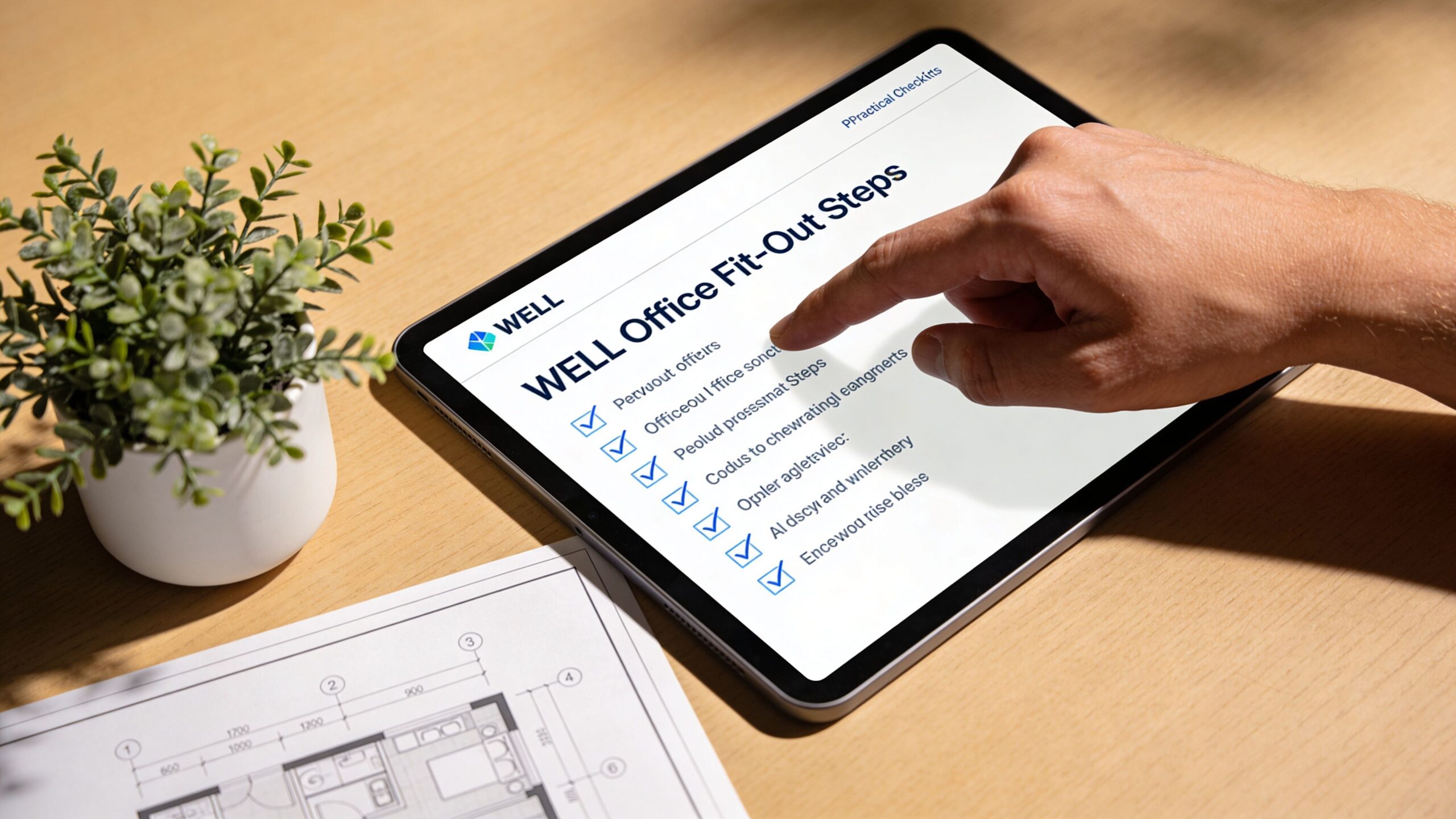
A fit-out checklist that works in the real world
A practical project usually follows this order:
- Review the lease early: Check reinstatement clauses, landlord approvals and any restrictions on mechanical, electrical or structural changes.
- Set a realistic WELL target: Decide whether the project is aiming for a formal certification path or using WELL principles as a design guide.
- Audit the current office: Look at light, acoustics, temperature, air movement, privacy, amenities and layout problems before choosing products.
- Prioritise reversible interventions: Freestanding or modular solutions often protect both programme and lease position.
- Coordinate consultants early: WELL-related decisions can affect M&E design, furniture planning, finishes and workplace policies.
- Document everything: Keep a clear record of what was installed, where, and how it can be removed or reconfigured later.
A checklist like this keeps the project grounded. It also helps occupiers avoid spending money on changes that look positive on a concept board but create practical issues later.
Here are the fit-out choices that often work well:
- Glass partitions: They can improve light flow while creating enclosed rooms without making the office feel boxed in.
- Modular meeting pods: Products from Vetrospace, BlockO and Framery can add privacy, acoustic control and flexible meeting capacity without major structural works.
- Surface renewal strategies: Refurbishing what can be retained is often cleaner and more practical than defaulting to full replacement.
- Flexible zoning: Quiet areas, collaboration settings and touchdown spaces need to support different work modes across the same floorplate.
Lease-safe approach: If a feature supports wellbeing but can also be removed cleanly, it usually deserves serious consideration.
In dense occupier markets such as London, that balance between occupant wellbeing and lease protection is often where the best fit-out strategies are won or lost.
A more detailed office fit-out checklist can help teams structure that process before design decisions start to harden.
How Gibbsonn Interiors Delivers WELL-Ready Workspaces
Understanding WELL on paper is one thing. Delivering a workplace that feels healthier, calmer and more usable is something else entirely. That takes coordination between consultancy, design, product selection and installation.
Design choices that support WELL goals
A WELL-ready workspace is usually built from practical decisions rather than dramatic gestures. Natural light needs to move through the plan. Acoustic privacy needs to exist where people need it most. Materials need to be selected with care. Meeting spaces need variety, not just quantity.
That is where turnkey delivery matters. When workplace strategy, space planning and fit-out execution are handled together, the project has a better chance of keeping its original wellbeing goals intact. If those decisions are split across too many parties, important details can get watered down.
Typical elements that support WELL-focused outcomes include:
- Glass partitioning to share light while still creating enclosed rooms
- Modular pods and booths to support sound control, privacy and flexible meeting use
- Ergonomic furniture planning to support movement and comfort
- Thoughtful finishes and layouts that reduce visual stress and support easier wayfinding
Why delivery matters as much as design
A good-looking scheme can still fail if installation is rushed or sequencing is poor. Staff notice the actual outcome, not the drawing pack. If privacy doesn't work, lighting feels harsh, or circulation is awkward, the office won't deliver the experience it promised.
That is why fit-out delivery has to stay connected to workplace intent from start to finish. Reconfiguration, refurbishment and reinstatement planning all matter, especially for tenants that need flexibility over time.
For organisations upgrading offices in Bishop’s Stortford or elsewhere across Essex and Hertfordshire, the strongest projects are usually the ones that balance wellbeing goals with practical realities such as programme, landlord approvals and future change.
The best workspace solutions don't just look aligned to WELL principles. They continue to work when the office is busy, noisy and fully occupied.
Your WELL Building Standard Questions Answered
Decision-makers usually ask the same few questions once WELL moves from idea to project brief. Most of them come down to practicality.
Is WELL only for new buildings
No. WELL can be highly relevant for existing offices, refurbishments and interior fit-outs.
In fact, many of the most useful WELL-led changes happen inside the occupied space rather than in the shell of the building. Layout improvements, acoustic pods, lighting upgrades, healthier material choices, better zoning and stronger amenity planning can all support a more people-focused workplace in an existing office.
That makes the standard especially useful for tenants who want better workplace performance without moving.
How is WELL different from BREEAM
They are related, but they aren't the same.
A simple distinction helps. BREEAM is usually more focused on the environmental performance of the building. WELL is more focused on the experience and wellbeing of the people using it.
That means the two can complement each other. A workplace can be environmentally responsible and still fail occupants on noise, privacy or comfort. WELL pushes project teams to look directly at those human factors.
Is it realistic for SMEs
Yes, if the brief is realistic.
Small and medium-sized businesses don't need to treat WELL as an all-or-nothing exercise. A smaller occupier can still apply WELL principles to create a much better office. The key is to focus on the changes with the clearest everyday effect.
That usually means priorities such as:
- Better acoustics: Quiet rooms, phone booths or modular pods can transform open-plan usability.
- Smarter lighting: Reduce glare, improve consistency and make key work areas more comfortable.
- Healthier layouts: Give staff a choice of settings instead of forcing every task into the same type of desk space.
- Reversible upgrades: Select products and interventions that protect the lease as well as the employee experience.
What affects cost and timescale
There isn't one fixed answer, because projects vary too much.
Cost and timescale depend on the size of the office, the condition of the existing space, the target certification level, the building services already in place, landlord approvals and whether the project needs formal certification or is using WELL as a guide.
What can be said with confidence is this:
| Factor | Usually makes it easier | Usually makes it harder |
|---|---|---|
| Building condition | Modern services and flexible layout | Older services and fixed constraints |
| Scope | Interior-led upgrades | Major building systems intervention |
| Lease position | Clear approvals and reversible changes | Tight lease clauses and late approvals |
The practical way to budget is to start with outcomes, not labels. Decide what needs to improve for staff, what the lease allows, and which changes are worth doing properly.
For occupiers in places such as Chelmsford or Stansted, that often leads to a phased approach. Improve the workplace where the impact is clearest first, then build from there if needed.
The well building standard works best when it is treated as a decision-making tool, not just a badge. If the project creates a workplace with better air, light, comfort, focus and flexibility, then it is already moving in the right direction.
Ready to transform your workspace? Speak to the GIBBSONN Interiors team today. Whether a business needs a full fit-out, reversible pod solutions, smarter partitioning or support with lease-end planning, the team can help shape a healthier, more practical office. Contact Us to book a consultation.