
An office that felt right in 2019 can feel badly out of step in 2026. Desks sit empty for half the week. Meeting rooms are booked solid, yet the open plan floor still sounds noisy and distracting. Staff come in for teamwork, quiet focus, client meetings, and social time, but the space was built for rows of fixed desks.
That gap is why commercial interior design trends matter now. The strongest trends are not about fashionable finishes. They are about making better use of space, giving people more choice in how they work, reducing waste, and creating workplaces that people want to use.
For office managers, facilities teams, and business owners, the challenge is practical. Which changes improve day-to-day working? Which upgrades reduce disruption? Which choices are worth the money when a lease, refurbishment, or dilapidations decision is already on the table?
Businesses reviewing workplaces in London and Bishop’s Stortford are asking the same core questions. The answer usually isn't one dramatic redesign. It's a series of smart decisions about layout, acoustics, finishes, and delivery.
Table of Contents
- The Big Picture Why Commercial Interiors are Changing in 2026
- Trend 1 Human-Centric Spaces with Biophilic and Neurodiverse Design
- Trend 2 The Agile Office Flexible and Multi-Functional Layouts for 2026
- A Practical Guide to Office Acoustic Solutions
- Trend 3 Sustainable Design and The Circular Office Economy in 2026
- Bringing it all Together Fit-Out Project Delivery in Action
- Frequently Asked Questions about Commercial Fit-Outs
- How early should a business start planning a refurbishment or fit-out
- Are meeting pods better than building new rooms
- Is hot desking right for every office
- What causes the biggest problems during delivery
- Can a tired office be improved without a full strip-out
- How should businesses think about budget when ROI data is unclear
- Conclusion Transform Your Workspace for 2026 and Beyond
The Big Picture Why Commercial Interiors are Changing in 2026
The biggest change is simple. Offices are being used differently, so they need to be designed differently.
According to the NeoCon 2025 workplace summary, citing a 2025 JLL UK Workplace Survey, 62% of office spaces were redesigned for agility in 2024, with a 35% increase in modular installations since 2021. The same source says only 40% of UK office desks are occupied daily, down from 85% before 2020.
That shift has major design consequences. A fixed desk layout becomes hard to justify when daily attendance is uneven. Businesses don't just want fewer desks. They want better use of the floorplate. That means spaces that can handle teamwork one day, focused work the next, and client meetings without constant friction.
Hybrid working changed the brief
The old brief was straightforward. Fit as many people in as possible, give senior staff enclosed rooms, and place a meeting room where it fits.
The new brief is more demanding. Teams need spaces for video calls, project work, private conversations, focused work, and informal catch-ups. Staff also expect more comfort, better lighting, stronger acoustic control, and a workplace that feels worth the commute.
Practical rule: If the office only supports one mode of work, it will feel wrong for most of the week.
This is why so many current commercial interior design trends overlap. Flexibility supports hybrid working. Better acoustics support concentration. Softer finishes and natural materials support wellbeing. Smarter controls help reduce wasted energy.
Cost pressure is part of the story
A poorly planned office costs money in quiet ways. Space goes underused. Small changes turn into disruptive building work. Teams complain about noise, meeting room shortages, and poor storage. Then the business starts paying twice, once for the original layout and again for the corrections.
Across Essex, workplace decisions are now being tested against operational reality. Facilities teams aren't only asking what looks good. They're asking whether the layout can adapt without another full strip-out in a short period.
A useful way to assess any 2026 trend is to ask three questions:
- Will it improve daily use: Better circulation, clearer zoning, and more suitable work settings usually matter more than a dramatic feature wall.
- Will it stay flexible: Demountable systems, modular furniture, and adaptable power layouts tend to age better than fixed joinery everywhere.
- Will it reduce friction: The best offices make booking rooms easier, noise easier to manage, and changes easier to deliver.
Trend 1 Human-Centric Spaces with Biophilic and Neurodiverse Design
A team arrives after a recent refurb. The office looks sharp, but by week two the complaints start. Screens catch glare all afternoon, calls spill across the open floor, one meeting room is always booked, and the breakout area sits empty because it is too close to the noisiest desks.
That is usually the gap between a fashionable scheme and a workplace that works.
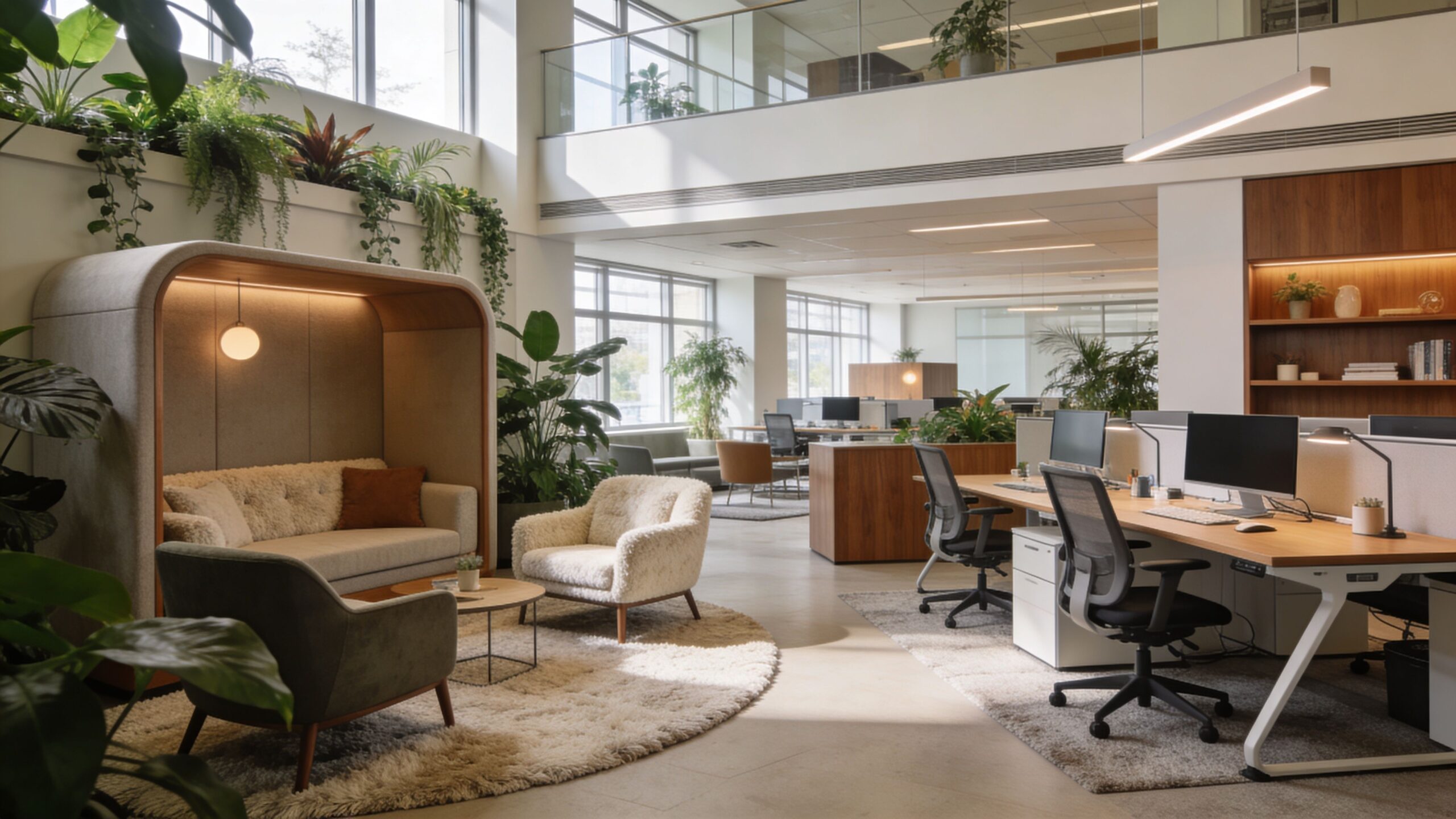
Human-centric design matters because people feel the layout long before they comment on the finishes. Biophilic and neurodiverse design help shape that experience in practical ways. Used properly, they improve concentration, reduce friction across the day, and give staff more control over how they work.
The delivery point is important. A planting scheme that blocks access to floor boxes, a timber feature that pushes up fire compliance costs, or a soft-seating hub placed beside focused workstations will create problems just as fast as poor aesthetics. Good intent still needs disciplined planning.
What biophilic design looks like in practice
Biophilic design works best when it supports the way the office is used. In fit-out terms, that usually means better daylight distribution, materials with less visual harshness, planting that helps define areas, and finishes that make the space feel calmer without increasing maintenance headaches.
Simple choices often give the best return:
- Natural finishes: Timber veneers, low-sheen laminates, woven panels, and stone-effect surfaces can soften the feel of a commercial floorplate without the cost or upkeep of more delicate materials.
- Planting with a job to do: Large planters can help break up open areas, support wayfinding, and add a degree of screening. Living walls can work, but they bring irrigation, lighting, and maintenance requirements that need to be budgeted from the start.
- Better use of daylight: Keeping windows clear, lowering the height of storage near the perimeter, and controlling glare properly will usually do more for comfort than adding decorative fittings later.
I often advise clients to test every wellbeing feature against operations. Who maintains it. Does it block circulation. Will it date badly. Can it survive heavy daily use. Those questions save money.
A breakout area with softer finishes, planting, and warmer lighting can work very well, but only if it sits in the right part of the floor. Place it beside concentration desks and the same feature becomes a noise source.
Readers looking at staff comfort in more detail can also explore wellbeing in the workplace.
Designing for different ways people process space
Neurodiverse design gets reduced to colour palettes far too often. In practice, it is about giving people a choice of settings and removing avoidable sources of stress.
Some staff need low-stimulation areas to focus for long periods. Others work well in more social settings and only need quiet space for specific tasks. A single acoustic and visual condition across the whole office rarely serves either group well.
A workplace performs better when people can choose the setting that matches the task.
Practical neurodiverse design usually includes:
- Quiet zones: Lower footfall, muted finishes, reduced visual clutter, and stronger acoustic separation.
- Collaborative zones: Areas where conversation is expected, supported by durable finishes and furniture that can handle high use.
- Clear navigation: Obvious routes, consistent signage, and rooms that do what their label suggests.
- Sensory balance: Controlled lighting, fewer reflective surfaces, and patterns that do not create visual fatigue.
Acoustics are often the deciding factor. A client may invest heavily in furniture and finishes, then still get poor feedback because the office sounds wrong. That is why enclosed booths, acoustic pods, high-back seating, glazed partitions with the right specification, and absorptive ceiling or wall treatments matter in human-centric schemes. They give people places to reset, focus, or take a call without forcing a full rebuild of the floorplate.
The trade-off is cost and space. Pods and enclosed rooms take up valuable area, and higher-performing partitions cost more than standard screens. In many projects, though, that spend is easier to justify than the ongoing loss of productivity caused by constant distraction. The right answer usually sits in the middle. Not silence everywhere, but enough variety and acoustic control to support different types of work.
The following clip shows how this workplace thinking is shaping current office design:
In busy office markets such as Cambridge and Chelmsford, this approach is tied to retention as much as design quality. Staff notice very quickly whether a space helps them focus, recover from noise, and get through the day with less effort.
Token gestures do not fix underlying planning problems. One planted corner will not solve poor acoustics. A wellness room will not compensate for an overstimulating open office. Human-centric design works when layout, lighting, materials, acoustic control, and project delivery are pulling in the same direction.
Trend 2 The Agile Office Flexible and Multi-Functional Layouts for 2026
The most useful office in 2026 is one that can change without becoming a building site every time the business shifts.
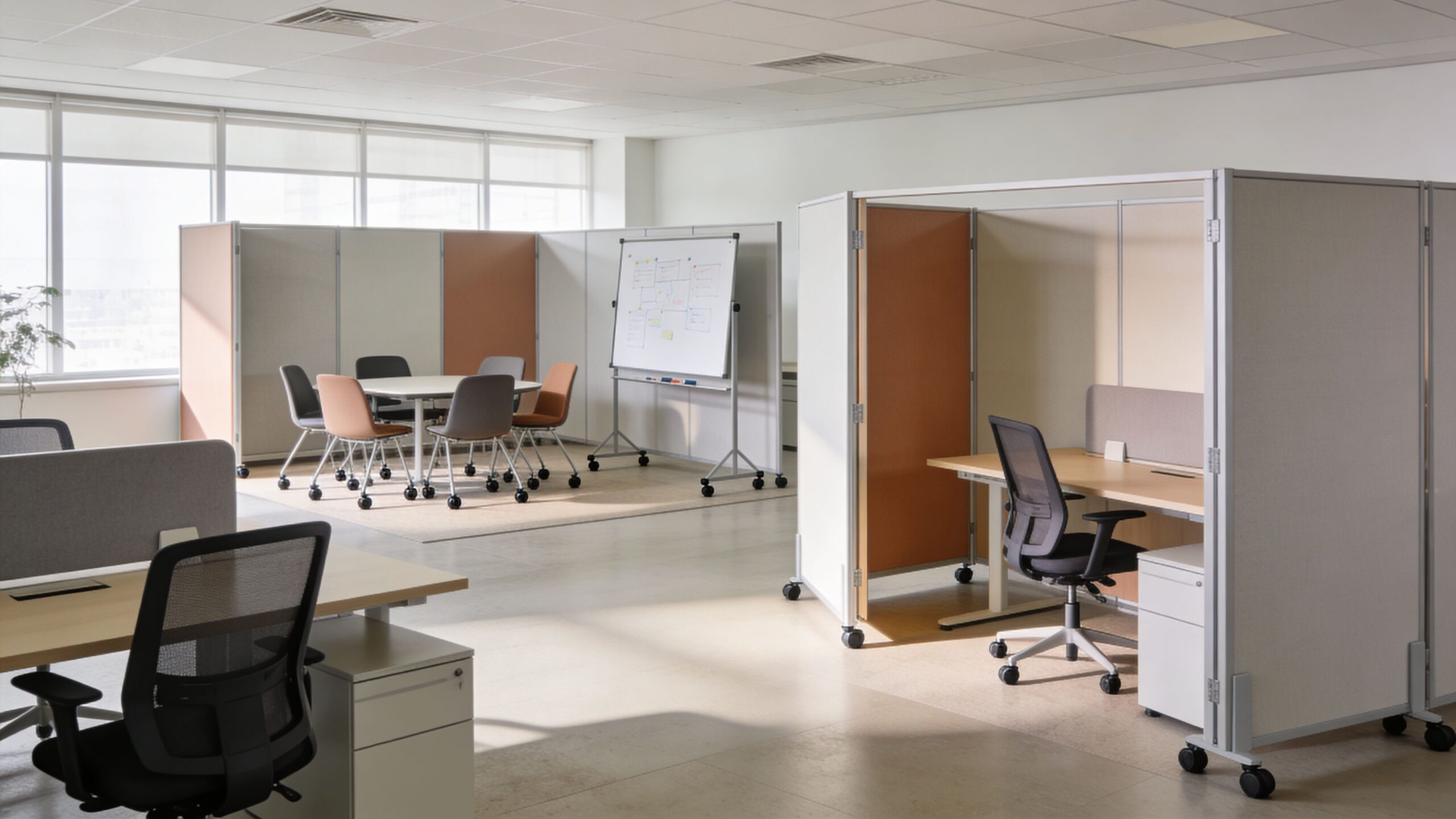
An agile office is not a vague idea. It is a layout built around movement, shared use, and quick reconfiguration. Instead of assigning every square metre to one fixed function, it creates a mix of spaces that can flex as team patterns change.
The Presence overview of 2026 commercial interior trends notes that in UK Cat B fit-out projects, flexible layouts use demountable partitions with 50 to 75mm thickness and acoustic ratings of Rw 32 to 40 dB, and can enable reconfiguration in under 4 hours. The same source states that this approach can lead to a 15 to 20% reduction in required space per employee, while integrated IoT sensors can cut energy costs by 25 to 30%.
What an agile office includes
Agile planning works best when each area has a clear purpose. Trying to make every space do everything usually creates confusion.
Common zones include:
- Shared touchdown areas: Best for short stays, laptop work, and quick visits to the office.
- Collaboration zones: Whiteboards, screens, and movable furniture support project work and team sessions.
- Quiet libraries or focus rooms: These are for concentrated work, not private calls.
- Social hubs: Spaces that feel more like hospitality settings can support informal meetings and give the office more pull.
- Bookable enclosed rooms: Small rooms and pods help when privacy or calls are essential.
Agile working also depends on supporting details. Lockers replace pedestal storage. Power and data need to be accessible where people work. Furniture has to move easily without feeling flimsy. If the office is meant to flex, the infrastructure has to flex too.
A useful companion read is what agile working means in practice.
Where flexible layouts work well and where they do not
Agility is not a licence to strip out every fixed element. Some businesses still need stable settings for specialist teams, confidential work, or client use.
Site reality: The best flexible offices are usually a blend of fixed and movable elements, not a room full of furniture on wheels.
Project planning is essential. Demountable glass partitions can divide space cleanly while preserving light. Moveable furniture can support workshops and social events. Acoustic pods can add phone and meeting space without major construction. But some functions still need permanence, especially reception, storage, comms areas, and certain meeting rooms.
A strong agile office usually avoids three mistakes:
Too little storage
Hot desking fails quickly if personal items have nowhere to go.Weak booking behaviour
Smart systems help, but room etiquette and clear rules still matter.No acoustic strategy
A flexible layout without noise control can feel chaotic within days.
This approach is proving useful in business centres such as Milton Keynes and Luton, where teams often need a workplace that can support growth without constant refit costs.
A Practical Guide to Office Acoustic Solutions
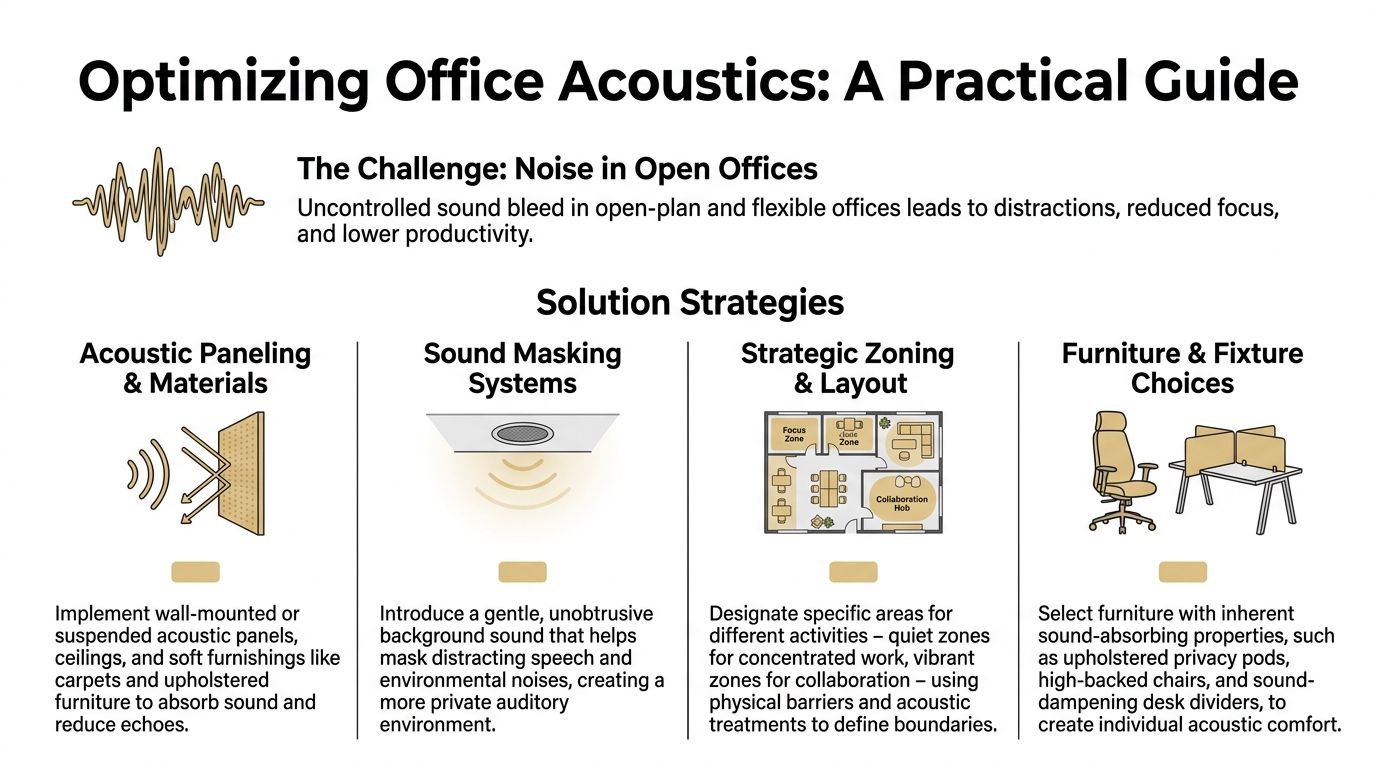
Open plan offices often fail for one reason before any other. Noise travels too easily.
An agile layout, a stylish café space, and a bank of meeting tables won't deliver much value if private calls spill across the floor and focused work becomes difficult. Acoustic planning is often treated as a finishing touch, but it needs to be built into the design from the start.
Why acoustics go wrong in refurbished offices
Most noise problems come from a combination of hard surfaces, poor zoning, and too few enclosed spaces. A refurbishment may add glass, polished finishes, and open circulation routes, all of which can make speech carry further if nothing balances them.
The first step is to identify what kind of sound needs controlling:
- Speech privacy: Important for HR, finance, management, and client calls.
- General distraction: The constant background interruption that makes concentration harder.
- Reverberation: Echo and sound bounce from hard surfaces.
- Activity clash: Social areas placed too close to quiet work settings.
A practical acoustic plan often mixes built solutions with softer interventions. The right answer depends on lease length, budget, programme, and whether the business needs permanent rooms or more flexible options.
For a deeper look at common fixes, this guide on reducing noise in an open-plan office is a useful reference.
Comparing office acoustic solutions
Glass partitions remain one of the strongest options when teams want separation without losing daylight and visual openness. Double-glazed systems and acoustic laminates can perform well, but detailing matters. Poor door seals, weak head details, and service penetrations can undo the benefit.
Meeting pods offer a different route. Products from Vetrospace, BlockO, and Framery can introduce enclosed space quickly, often with integrated lighting, ventilation, and power. They are especially useful where building work needs to stay light or phased.
Soft acoustic measures also matter. Ceiling baffles, wall panels, rugs, upholstered seating, and high-backed booths reduce reflected sound and help define zones. These won't replace a private room, but they can make the whole office calmer.
| Solution | Key Features & Best Use | Cost & Disruption Guide |
|---|---|---|
| Glass partitions | Best for meeting rooms, management offices, and spaces that need light plus privacy. Works well with acoustic glazing and well-detailed doors. | Usually more disruptive than furniture-based fixes, but strong long-term value where enclosed rooms are needed. |
| Meeting pods | Good for phone calls, one-to-ones, short video meetings, and extra privacy without full construction. | Faster to install and easier to relocate, but floor space and unit cost need careful planning. |
| Soft acoustic treatments | Useful across open plan areas to reduce echo and improve comfort. Includes panels, baffles, booths, and upholstered elements. | Usually the least disruptive option. Best as part of a wider strategy, not as the only fix where privacy is essential. |
If a team needs confidentiality, soft finishes alone won't solve it. They improve comfort, but they do not create true speech privacy.
What works best is usually a layered approach. Use partitions or pods for privacy, then support them with sound-absorbing finishes and smarter zoning across the wider floor.
Trend 3 Sustainable Design and The Circular Office Economy in 2026
A client signs a new lease, approves a stylish scheme, and then gets hit twice. First on fit-out cost. Then again at lease end, when perfectly usable partitions, joinery, and furniture go into a skip because nothing was selected with reuse in mind.
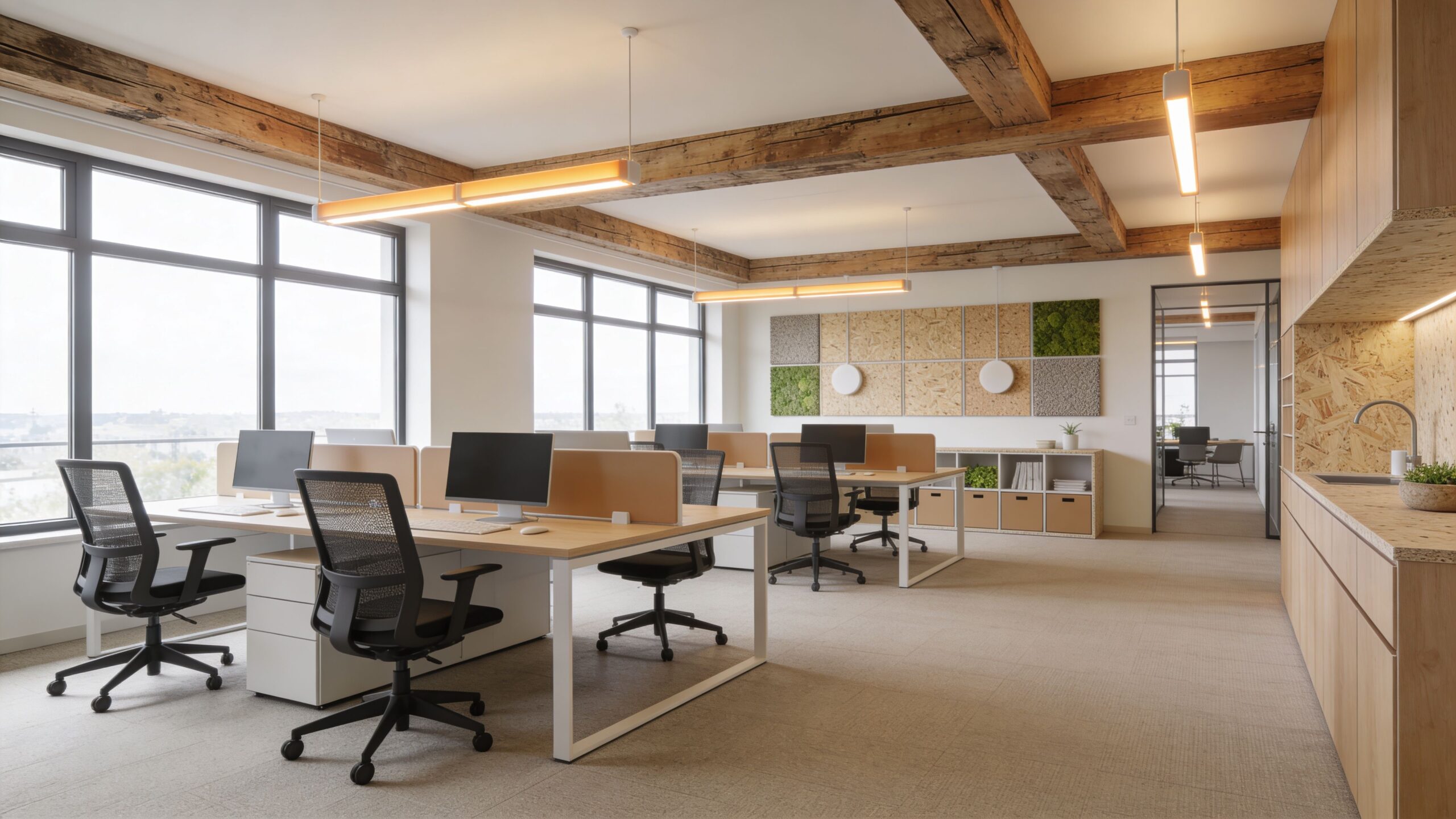
That is the practical case for sustainable design in 2026. It is no longer a side note for planning documents or a branding exercise for reception areas. It affects procurement, lead times, strip-out scope, waste charges, landlord approvals, and how much of the current office can stay in service.
As noted earlier, businesses are putting more weight on lower-waste fit-outs and better material choices. On site, that usually means asking a harder question at the start. What can stay, what should be upgraded, and what will cost more to keep than to replace?
The strongest sustainable schemes are rarely the ones with the most obvious eco signals. They are the ones that reduce unnecessary work and still perform properly for the people using the space every day.
What sustainable fit-out means in practice
A sustainable office often comes from disciplined early decisions rather than expensive specialist products.
On live projects, the main options tend to be:
- Retain sound existing elements: Glazed partitions, doors, ceilings, tea points, and storage can often stay if they are in good condition and still suit the new layout.
- Refinish instead of replace: Architectural wrapping and surface upgrades can extend the life of joinery, doors, and counters with less waste and less site disruption.
- Specify products with a second life: Demountable partitions, modular flooring, and relocatable furniture are easier to reuse, adapt, or move to another floor or site.
- Choose materials that work hard: Recycled-content finishes are useful, but they still need to meet durability, cleaning, acoustic, and fire performance requirements.
This is also where circular design becomes commercially useful. The office is planned as a set of parts that can be moved, repaired, re-skinned, or reconfigured, rather than a fixed scheme that only works once.
Where circular design saves money and where it can go wrong
Reuse can reduce purchase costs and waste volumes, but only when the survey work is honest. I have seen teams try to preserve old partition runs to save money, then spend the saving on alterations because the door positions, power layout, and acoustic performance no longer suit the brief.
Sustainable choices, therefore, should be judged on performance as well as principle.
The trade-offs are usually straightforward:
- Keep high-value items where they still perform: Good glazed screens, solid doors, and well-built joinery often justify retention.
- Replace elements that weaken the whole office: Poor lighting, damaged finishes, and furniture that does not support hybrid work usually cost more in complaints and lost usability than they save upfront.
- Check compliance before promising reuse: Existing materials may fail current fire, accessibility, or acoustic expectations, especially in older spaces.
- Plan dilapidations early: End-of-lease obligations can wipe out savings if the exit strategy is left until the final months.
- Avoid token gestures: A few planters and recycled accessories do not offset a full strip-out of serviceable materials.
Acoustics matter here as well. Reused space should still support concentration and private conversation. If an old open-plan layout creates noise problems, the better answer may be to retain what works, then add targeted upgrades such as acoustic partitions, pods, or sound-absorbing finishes instead of rebuilding everything.
Sustainable fit-out works best when it reduces waste, extends product life, and avoids unnecessary strip-out.
That balance matters for occupiers around Stansted and Braintree, where budget control, programme risk, and day-to-day usability usually matter just as much as environmental intent.
Bringing it all Together Fit-Out Project Delivery in Action
Good workplace design only proves itself when it survives programme pressure, budget checks, live-site constraints, and day-to-day use.
One of the hardest parts for smaller businesses is working out what level of investment is justified. The Mount-It overview of commercial interior design trends highlights a real gap in UK-specific ROI data for SMEs, especially around payback periods and cost justification for flexible versus traditional fit-outs. It also notes that adaptive reuse can create financial pressure for organisations unfamiliar with modular design costs.
Scenario one a growing team that needs flexibility
A growing tech business in Colchester takes space that was previously laid out with fixed desks, oversized private offices, and limited meeting capacity. The team now works in a hybrid pattern and wants a space that feels active when people are in, not half-empty.
The right answer is unlikely to be a total strip-out of every element. A more controlled plan would keep usable infrastructure, open up the centre of the floor for shared work settings, add enclosed call and meeting spaces, and improve social space so the office has a stronger reason to visit.
The delivery challenge is timing. If the business is already occupying the space, work needs phasing. Noisy works should be grouped. Critical IT moves need clear cutover plans. Furniture procurement should be locked early, because moveable elements only help if they arrive on programme.
Scenario two a client-facing office that needs privacy
A professional services firm in Dartford has a different problem. Staff need collaborative areas internally, but client meetings require privacy and a more polished front-of-house feel.
Here, acoustic glass partitioning makes more sense than pushing everything into open plan. Private rooms can sit near reception and meeting areas, while shared team zones can remain more flexible behind them. A few pods may still help for overflow calls, but they would support the layout rather than define it.
The cheapest route on paper often becomes expensive when it creates a second wave of corrective work.
Project management demonstrates its worth. A good fit-out plan should test what can be reused, what must be upgraded, and what is likely to cause disruption later if it is ignored now. That is often more valuable than chasing a trend for its own sake.
Frequently Asked Questions about Commercial Fit-Outs
How early should a business start planning a refurbishment or fit-out
Earlier than most expect. Decisions about lease events, dilapidations, procurement, furniture, and phasing all affect one another. Starting early gives more room to compare options properly and avoid rushed choices.
Are meeting pods better than building new rooms
Sometimes, yes. Pods are useful when a business needs quick acoustic privacy with less site disruption. Built rooms are usually better where larger groups, stronger privacy, or long-term permanence matter more.
Is hot desking right for every office
No. It suits some teams well, especially where attendance patterns vary. It works less well where people need specialist equipment, lots of paper storage, or a consistent personal base.
What causes the biggest problems during delivery
Late decisions are a common issue. So are underestimating IT moves, access restrictions, and the effect of noisy works in occupied space. Clear phasing and realistic programmes matter as much as the design itself.
Can a tired office be improved without a full strip-out
Often, yes. Surface renewal, selective partition changes, better zoning, acoustic upgrades, and furniture replacement can make a major difference. The right route depends on condition, goals, and how long the business expects to stay in the space.
How should businesses think about budget when ROI data is unclear
The sensible approach is to link spending to operational outcomes. Better privacy, easier reconfiguration, stronger staff experience, and reduced waste all have value, even where UK-specific SME ROI data is limited. The key is to test each upgrade against actual use rather than broad assumptions.
Conclusion Transform Your Workspace for 2026 and Beyond
The most important commercial interior design trends for 2026 are grounded in real workplace needs. Flexible layouts help offices adapt. Human-centric design helps people work better. Strong acoustic planning fixes one of the biggest failures in open environments. Sustainable choices reduce waste and support longer-term value.
Trends only matter when they work on site, on budget, and in daily use. The right fit-out should make the office easier to use now and easier to adapt later.
Ready to transform your workspace? Speak to the GIBBSONN Interiors team today. Whether the need is a full fit-out, smarter partitioning, pod solutions, or support with refurbishment planning, practical advice starts with the right conversation. Contact Us.