

If the office feels noisy, looks tired, and hides a mess of cables, ducts, and patch repairs above eye level, the ceiling is often the problem. Many workplaces keep treating it as a finishing item, when in practice a suspended panel ceiling affects acoustics, maintenance access, fire performance, lighting coordination, and even what happens at lease end.
That matters in 2026. A ceiling choice made for speed or lowest upfront cost can create years of awkward maintenance, poor sound control, and expensive remedial work later. The better approach is to treat the ceiling as part of the whole office system, not a decorative extra.
The idea itself isn’t new. The Blackfriars Theatre in London, constructed in 1596, is one of the earliest documented UK uses of a suspended panel ceiling, installed to improve acoustics. That early use still says a lot about why the system works today in modern fit-outs, as noted in this history of suspended ceilings.
Table of Contents
- Transforming Your Office from the Top Down for 2026
- What Is a Suspended Panel Ceiling Explained
- Choosing Your System Materials and Performance
- UK Compliance and Building Regulations Your 2026 Checklist
- The Installation Process From Plan to Handover
- Lifecycle Costs Maintenance and Modern Integration
- Your Next Step to a Better Workspace
Transforming Your Office from the Top Down for 2026
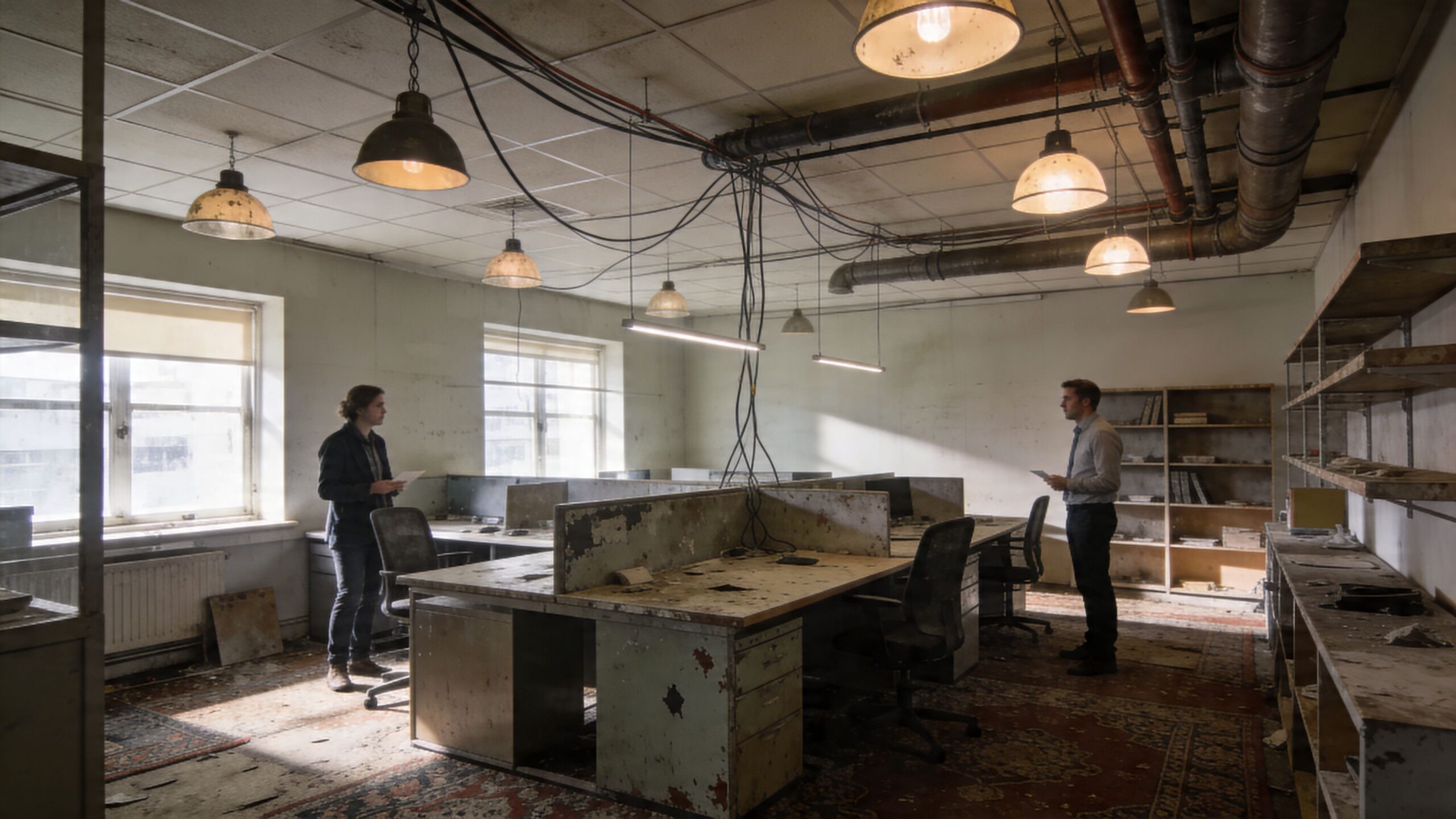
A lot of offices show the same warning signs. Too much echo, visible service runs, stained tiles from old leaks, and a patchwork of light fittings from different eras. Staff notice it even if they never say it directly. Clients notice it even faster.
A good suspended panel ceiling changes that in one move. It creates a clean visual line across the office, hides the service clutter, and gives the project team a controlled way to bring lighting, air distribution, alarms, and sprinklers together. It’s one of the few fit-out elements that improves both appearance and building function at the same time.
Why clients usually start looking at the ceiling
The trigger is rarely just appearance. It’s normally one of these:
- Noise complaints: Teams struggle to focus because conversations travel too easily.
- Service access issues: Every minor electrical or HVAC job becomes disruptive.
- Dilapidation pressure: A landlord expects a clean, compliant finish at the end of the term.
- Refurbishment mismatch: New desks, flooring, and partitions make an old ceiling look worse.
In London, that often shows up in older office stock where services have been adapted over time but the ceiling layout never really caught up.
Practical rule: If the office ceiling looks like it’s been altered in stages, it usually has been. That’s when a full ceiling strategy makes more sense than another local patch repair.
What works and what doesn’t
What works is a ceiling designed around the room’s actual use. Open-plan areas need stronger acoustic thinking. Meeting rooms need clean perimeter details. Reception areas often need a better visual finish than the back office.
What doesn’t work is choosing a generic tile and grid because it’s available quickly. That approach can leave weak acoustic control, awkward service positions, and trims that never align properly with partitions or bulkheads.
In places such as Chelmsford, where businesses often want a smart upgrade without a full structural overhaul, the suspended panel ceiling is usually the practical middle ground. It gives a fresh, organised finish without turning the whole refurbishment into a heavy building project.
What Is a Suspended Panel Ceiling Explained
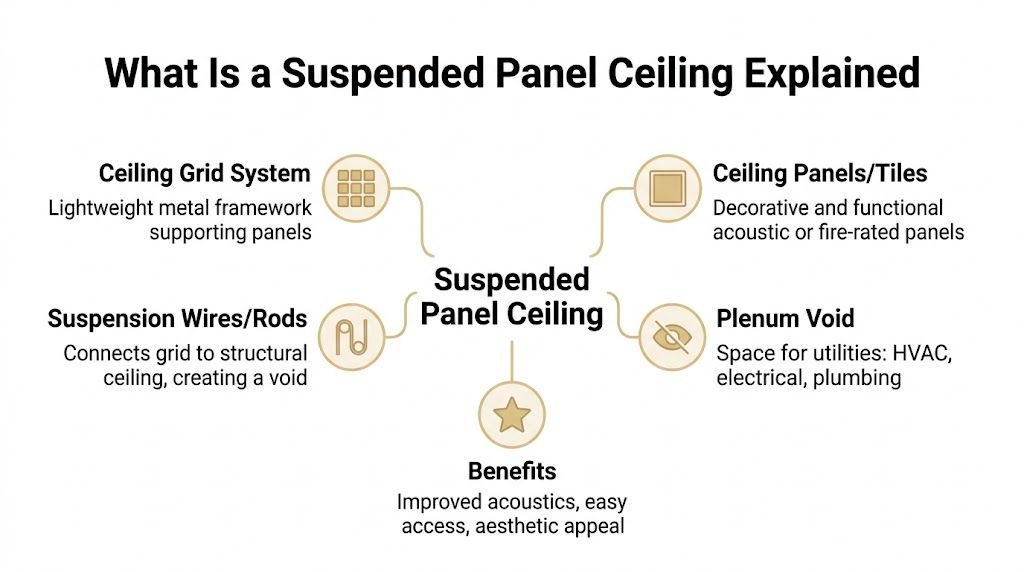
A suspended panel ceiling gives an office a usable service zone above head height without leaving the soffit exposed. It sits below the structural ceiling on a metal grid, with removable panels forming the visible finish. For most office refurbishments, that matters less for appearance alone and more for what it lets the building do over the next lease term.
The space above the panels is the plenum. That is where contractors route ductwork, cable trays, pipework, lighting gear, sensors, sprinklers, and other services in an organised way instead of layering fixes onto the underside of the slab. In practical terms, it makes later changes faster, cleaner, and cheaper.
The core parts of the system
Most suspended panel ceilings use the same working parts:
- Main runners: The primary metal members that carry the grid.
- Cross tees: The sections that lock between runners and create the panel modules.
- Suspension wires or rods: The hangers that support the grid from the structural soffit.
- Perimeter trim: The edge detail that finishes the ceiling neatly at walls, glazing lines, and partitions.
- Panels or tiles: The visible ceiling face, selected for acoustic control, fire performance, moisture resistance, cleanability, or appearance.
In UK office fit-out work, panel sizes commonly follow modular formats such as 600 x 600mm and 1200 x 600mm. Those module sizes align with standard grid systems and simplify replacement, lighting coordination, and future alterations, as set out in the British Standard for suspended ceilings, BS EN 13964.
That modular logic also supports practical specification choices such as recycled-content tiles and lower-impact finishes. It is worth tying ceiling selection into wider environment-friendly material choices for office fit-outs rather than treating the ceiling as a standalone package.
Why the plenum matters over the life of the office
The plenum is where a suspended panel ceiling earns its keep. A fixed plasterboard ceiling can give a clean look, but every service change usually means opening the ceiling, making good, repainting, and working around occupied desks.
With a panel system, a contractor can lift a tile, reach the service, complete the work, and close it back up with far less disruption. That is a straightforward advantage in offices where lighting layouts change, extra data drops get added, air distribution is rebalanced, or sensors are upgraded to meet newer building management expectations.
This has a direct cost effect. Day-one supply rates are only part of the decision. Access for maintenance, speed of minor works, damage during service visits, and the ability to replace single panels instead of whole areas all affect what the ceiling costs over seven to ten years and what condition it is in at lease end.
A ceiling that allows regular access usually performs better commercially than one that only looks good on handover day.
How it differs from a fixed ceiling
The main difference is adaptability. A suspended panel ceiling is built as a modular system, so services, lights, diffusers, and access points can be changed without rebuilding the whole surface.
A fixed ceiling still has a place. It can suit feature spaces where the brief is driven by a continuous visual finish and service access is limited to selected hatches. In mainstream office areas, though, modular systems usually make more sense because workplaces rarely stay static for long.
For many businesses in Braintree, that flexibility is what justifies the specification. Teams expand, meeting rooms get reconfigured, occupancy patterns change, and landlords still expect the space to be returned in good order. A suspended panel ceiling handles that cycle better than a sealed ceiling that becomes expensive every time the office evolves.
Choosing Your System Materials and Performance
Choose the wrong ceiling tile at specification stage and the problem rarely shows up on day one. It shows up six months later when staff complain about noise, the FM team keeps replacing chipped panels, or a landlord queries the reinstatement standard at lease end. Material choice affects all of that, so it needs to be tied to how the office will operate.
Clients often ask for a standard suspended ceiling. In practice, there are several routes, and each one shifts cost and performance in different ways. The right question is not which tile looks best in the sample box. It is which system suits the space, the services above it, and the length of the occupation.
The three choices most clients compare
| Material | Key Benefits | Best For |
|---|---|---|
| Mineral fibre | Good all-round acoustic performance, broad specification range, practical replacement options | General offices, meeting rooms, education and admin spaces |
| Metal panels | Durable finish, crisp appearance, better resistance in harder-wearing environments | Reception areas, transport settings, high-traffic commercial spaces |
| Wood or wood-effect panels | Warmer appearance, design-led finish, strong visual character | Boardrooms, client-facing spaces, feature zones |
Mineral fibre remains the usual choice for mainstream office fit-outs because it balances three things that matter commercially. It helps with sound control, it keeps upfront cost sensible, and damaged tiles can usually be swapped out without disturbing a whole area. That combination matters more than appearance alone in most open-plan workplaces.
Metal panels suit spaces where durability, washability, or a sharper visual finish matter more. Reception areas and amenity spaces often justify that upgrade. The trade-off is acoustic performance. Unless the panel is perforated and backed correctly, a metal ceiling can leave a space harder and noisier than clients expect.
Wood and wood-effect systems sit in a different category. They are usually selected for visual impact rather than pure value engineering. They can work well in boardrooms or client-facing areas, but they demand tighter coordination around lighting, sprinkler heads, access panels, and future maintenance. They also tend to be less forgiving if the tenancy changes hands and the new occupier wants a simpler layout.
Material choice now also carries a procurement and compliance angle. Recycled content, VOC performance, and end-of-life handling are being asked about earlier in projects, especially where occupiers are reporting against ESG targets or reviewing embodied carbon. If that is part of the brief, this guide to environment-friendly material choices is a useful reference alongside the ceiling specification.
What acoustic performance means day to day
Office acoustics are usually discussed in product data terms, but clients feel the result in much simpler ways. Can people focus. Can they hold a meeting without spill from the next area. Does the office sound busy all the time, even when occupancy is moderate.
A suspended ceiling helps by absorbing sound within the room. In open-plan offices, that reduces reverberation and cuts the sense of constant background chatter. In meeting rooms and cellular offices, the ceiling still matters, but it works alongside partitions, doors, glazing, and service penetrations. A good tile improves the result. It does not fix weak room construction.
The UK Acoustics Network explains the workplace effect clearly in its guidance on room acoustics and office noise. The practical lesson for specification is straightforward. Match the ceiling to the room use instead of applying one tile across the whole floor because it is easy to price.
A simple way to judge the acoustic need
- Open-plan workspace: Prioritise high sound absorption to control general reverberation and reduce distraction.
- Meeting rooms: Check the full room build-up, especially glazed fronts and partition heads, not just the tile.
- Reception and breakout spaces: Balance finish, durability, and enough absorption to stop the area becoming harsh.
- Cellular offices: A standard commercial tile may be suitable if the partitions and doors are doing the heavier acoustic work.
A common mistake is over-specifying feature areas and under-specifying work areas. Clients notice the opposite of what they intended. The reception looks polished, but the office where people spend eight hours a day feels tiring to work in.
Site reality: A good-looking tile will not deliver speech privacy if sound is escaping through partition heads, recessed light fittings, or poorly sealed service penetrations.
Fire rating and durability need plain speaking
Fire performance needs to be assessed as part of the full ceiling and partition build-up. If the brief calls for a fire-resisting assembly, the tile, grid, support detail, and perimeter treatment all need to align with the tested system. Substituting one component late to save cost can change the performance of the whole arrangement.
Durability should be specified with the maintenance regime in mind. A panel that looks clean on handover may mark easily after repeated access by M&E contractors. In offices with frequent churn, sensor upgrades, or air-conditioning adjustments, that becomes a real operating cost. Cheap tiles often stop looking cheap once replacements, call-backs, and patchy ceiling areas start appearing.
For office occupiers in Cambridge, Hertfordshire, and similar landlord-led markets, three questions usually narrow the selection quickly:
- How often will the services above the ceiling need access?
- How much acoustic control does the workspace need to support concentration and privacy?
- How simple will it be to repair, match, or replace this system during dilapidations?
Those answers usually lead to a better decision than a product brochure alone, because they cover the full life of the ceiling rather than just the handover finish.
UK Compliance and Building Regulations Your 2026 Checklist
Ceiling compliance gets overlooked because much of it is hidden once the job is finished. That’s exactly why it matters. If the support, fire detail, or perimeter treatment is wrong, the office may still look complete while carrying risk underneath.
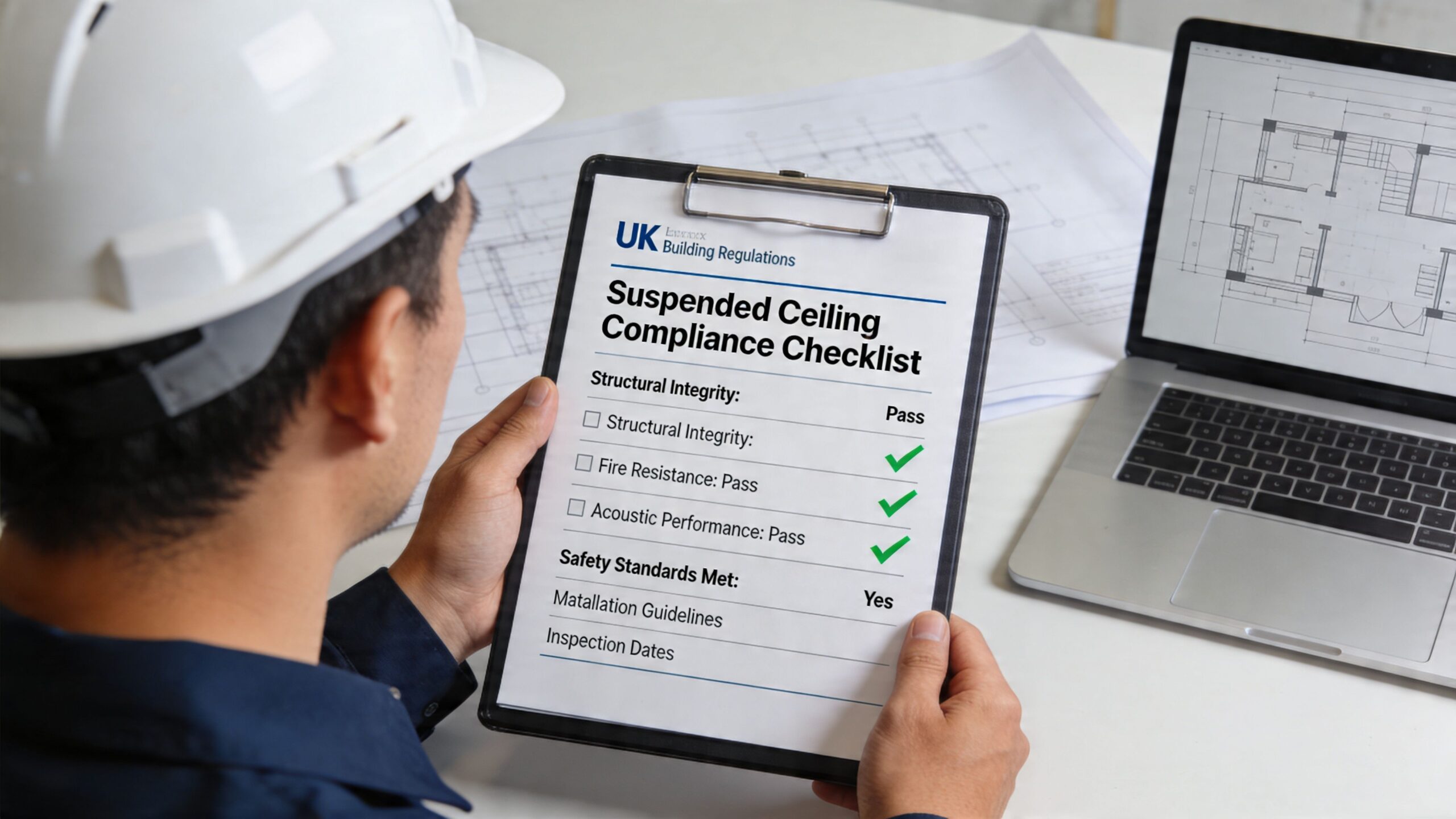
The baseline standard for suspended ceiling systems in office fit-outs is BS EN 13964:2014, which covers system performance and testing. On site, that translates into very practical things such as how the grid is set out, how the hangers are installed, and whether the ceiling can safely carry the intended load.
What BS EN 13964:2014 means on site
The technical side matters because poor support leads to sagging, failure at perimeter points, and compromised performance around fire and acoustics. The specification data cited in TSIB suspended ceiling design data includes these reference points:
- Main runner tees are typically 24mm or 38mm wide
- They are spaced at 1200mm on centre
- Hanger wires should be a minimum 12-gauge (2.7mm diameter)
- Hangers are installed on a 1200mm x 1200mm grid
- Deflection should remain below L/360
Those aren’t abstract design numbers. They’re what help stop sagging and loss of integrity in use.
The same TSIB data also notes tested Rockfon systems showing NRC 0.70-0.90 with 50mm stone wool panels, which is why ceiling choice often feeds directly into wider room performance rather than just visual finish.
The fire safety point that gets missed on sloped ceilings
A tricky area for 2026 projects is the sloped or angled suspended panel ceiling. Many product guides discuss slope in general terms, but UK commercial projects still need to satisfy fire safety expectations under Approved Document B Volume 2 and related test routes such as BS 476 or EN 13501-2 for 30-60 minutes fire resistance where the design requires it.
That’s where details often go wrong. The ceiling plane may be specified, but the wall angle, perimeter closure, and seal treatment are left vague. On sloped work, those edge details become more important, not less.
An often-missed concern in current guidance is the lack of clear UK-specific advice for intumescent seals and wall angles in sloped office installations. Landlords and facilities teams dealing with refits in Milton Keynes need that checked early, especially where open-plan areas, meeting rooms, and hybrid-use layouts meet at different ceiling heights.
Don’t assume a fire-rated tile automatically gives a fire-rated ceiling. The full build-up, support method, perimeter detail, and penetrations all have to work together.
A useful project planning companion at this stage is this office refurbishment checklist, especially where ceiling works sit alongside broader compliance items.
A practical compliance checklist
The easiest way to avoid trouble is to review the suspended panel ceiling against the full room build-up before ordering materials.
- Check the ceiling type against room use: General office, meeting room, circulation space, and plant-adjacent areas may all need different performance.
- Confirm support spacing and hanger specification: The grid design should follow the tested system, not a rough site guess.
- Review fire performance as a full assembly: Tiles, grid, hangers, penetrations, and perimeter trim all count.
- Coordinate with ventilation: Panels in commercial refits can be specified for air permeability below 0.1m³/m²hPa under BS EN 13180 to support ventilation compliance, as described in the Rockfon technical guidance already referenced earlier.
- Inspect interfaces with partitions and glazing: The ceiling edge is often where acoustic and fire performance is lost.
- Document the installed system: Product data, drawings, and maintenance details should be retained for handover and future dilapidations.
In Bishop’s Stortford, that documentation can become just as important as the installation itself when occupiers need to prove what was fitted and how it was built.
The Installation Process From Plan to Handover
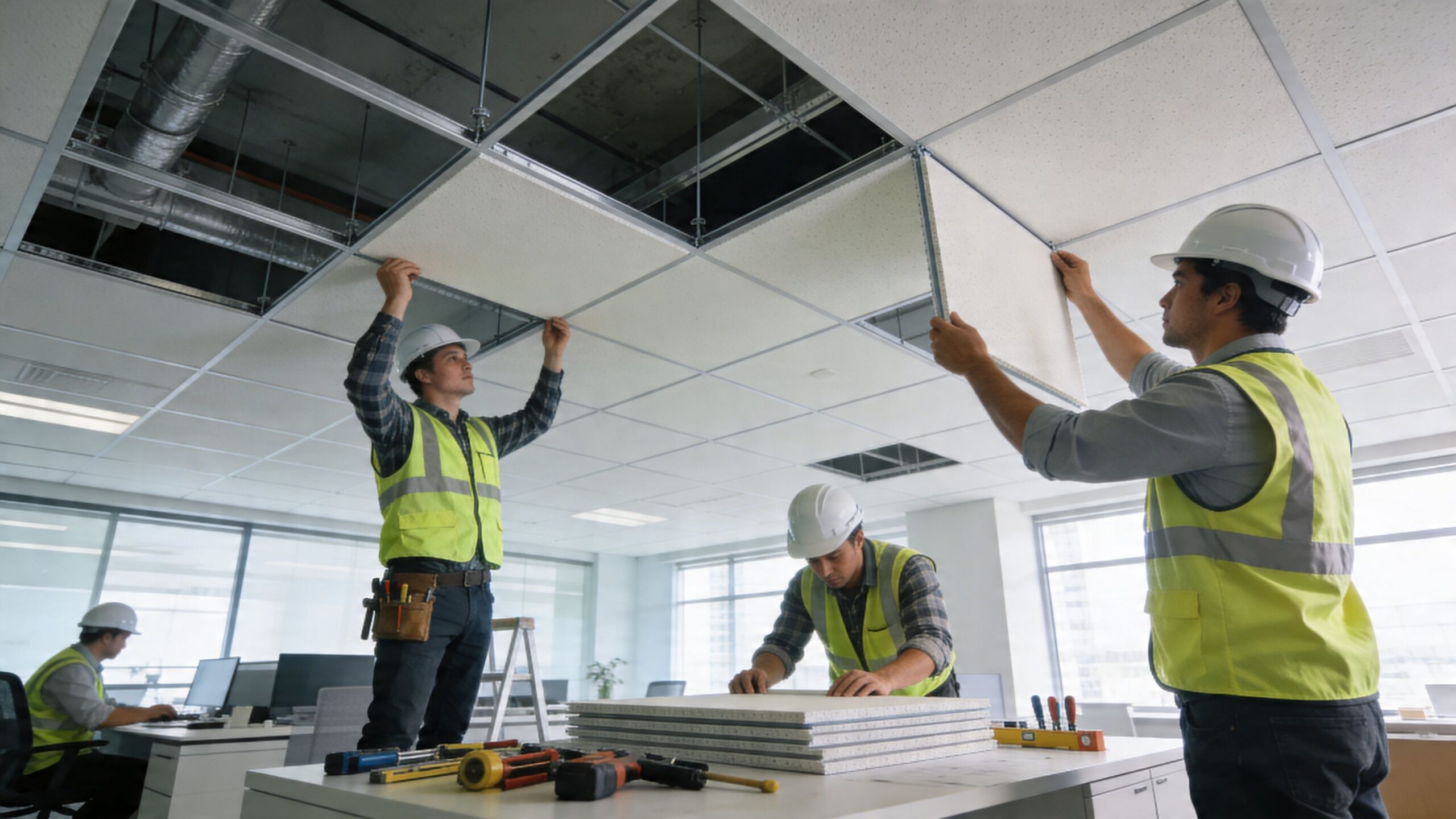
The best ceiling installations look simple when finished. They never are. Good results come from coordination before the first runner is fixed, not from trying to solve everything while standing on a tower.
The sequence matters because the ceiling sits in the middle of several trades. Lighting, HVAC, sprinklers, alarms, partition heads, and decorations all touch it somewhere.
Before the first tile goes in
A clean install starts with survey work. The team needs to confirm ceiling height, existing soffit condition, service clashes, lighting layout, sprinkler positions, and partition lines before final setting out.
That first stage is also where awkward truths come out. Uneven soffits, old redundant services, missing drawings, and legacy cable routes can all affect programme and finish quality. It’s far cheaper to identify those early than after materials arrive.
A typical pre-start review should include:
- Setting out: So perimeter cuts don’t end up tiny and uneven.
- Service coordination: So vents, detectors, and lights don’t fight for the same tile.
- Access strategy: So maintenance panels and regular entry points are planned properly.
How the site sequence usually runs
Once the room is ready, the perimeter trim goes in first, then the suspension points, then the main grid, then cross tees, then service integration, and finally the tiles. On paper that looks linear. On a live office project it often overlaps with other trades.
The cited TSIB design data notes installation rates of 1-2 days per 100m² for the specified system context, which is a useful reference point when clients are planning occupation and contractor access in Dartford or similar live environments. Actual programme still depends on ceiling complexity, service density, and whether the office stays occupied during the works.
This installation video gives a useful visual of the process in action:
On-site priority: The fastest ceiling jobs are usually the ones with the best coordination drawings, not the biggest labour teams.
What a good handover looks like
Handover shouldn’t stop at “ceiling installed”. The better standard is a room that’s level, clean, accessible, and documented.
That means checking tile alignment, confirming service access points, making sure all cut edges are neat, and logging the installed system for future maintenance. If panels need to be removed later, the facilities team should know which tile type was used and how replacements can be sourced.
What doesn’t work is leaving a client with a ceiling that looks fine but has no clear record of fire performance, access points, or spare tile stock. That tends to create avoidable cost later.
Lifecycle Costs Maintenance and Modern Integration
Upfront cost gets most of the attention, but the longer-term value of a suspended panel ceiling usually comes from what happens after practical completion. Offices change. Teams move. Cabling grows. Air systems are adjusted. Meeting spaces get reworked. A ceiling that accepts those changes calmly will nearly always age better than one that fights them.
That’s where suspended systems earn their keep. They’re easier to open, easier to alter, and easier to coordinate with future workplace changes.
Why access matters more than people expect
Every facilities manager knows the pattern. A sensor fails, a data point moves, a leaking valve needs attention, or a duct route needs adjusting. If the ceiling is fixed, the repair often spreads into redecorating and reinstatement. If the ceiling is modular, the task stays contained.
This matters at lease end too. A workplace that has seen years of churn often needs selective replacement and tidy reinstatement. A suspended panel ceiling gives a cleaner route for that work because damaged tiles can be swapped and access above remains simple.
There’s also a maintenance speed benefit in modular systems. Benchmark notes in the verified guidance state that Armstrong and Rockfon UK installations report 50% faster access to MEP services, with maintenance downtime cut by 30% compared with fixed ceilings, in the referenced system context from the Rockfon article already cited earlier in the article.
Ceilings and partitions need to work together
Many projects fall short in this regard. The ceiling is specified by one party, the partitions by another, and the final junction between them is left to chance.
That weak point now matters more because many offices rely on glazed meeting rooms, phone booths, and hybrid layouts. A 2025 BRE report noted that 55% of London offices fail WELL v2 preconditions due to poor ceiling-perimeter seals in hybrid layouts, as cited in this technical guide reference. The problem isn’t always the tile. It’s often the edge condition where ceiling, partition, and service penetrations meet.
That’s why suspended ceilings need to be integrated carefully with acoustic glass partitions and pods, not trimmed up after the fact. For anyone reviewing workplace sound control more broadly, this article on reduction of noise in offices gives useful context.
A quiet room is usually built at the edges. If the perimeter is weak, the centre of the ceiling can perform perfectly and the room will still disappoint.
Where suspended ceilings fit in a future-ready office
Modern office layouts are more layered than they used to be. There may be open collaboration areas, enclosed call spaces, glazed meeting rooms, and independent pods from brands such as Vetrospace, BlockO, and Framery. The ceiling has to support all of that without becoming the weak link.
In Stansted, for example, high-footfall environments often need durable ceiling finishes that still allow service access and straightforward maintenance. In Luton, fast-moving office layouts can benefit from the same modular logic for a different reason. The workspace may need to adapt more often.
What tends not to work is mixing modular room elements with a rigid ceiling strategy. If the office is meant to change, the ceiling should be ready for change as well.
Your Next Step to a Better Workspace
A suspended panel ceiling isn’t just there to cover the soffit. It shapes how the office sounds, how it looks, how easy it is to maintain, and how smoothly future changes can happen. Done properly, it supports daily performance as much as it improves finish quality.
The right answer depends on the space. Some offices need a practical mineral fibre system with dependable acoustic control. Others need a tougher metal solution, better perimeter detailing, or a ceiling layout that works with glazing and meeting pods. The point is to specify the system around the building’s real use, not around a generic standard detail.
For landlords and occupiers, the long-term view matters just as much. Compliance, service access, replacement strategy, and end-of-lease reinstatement all sit behind the visible finish. That’s why ceiling decisions made early in a fit-out tend to have an outsized effect later.
A well-planned suspended panel ceiling gives a workplace a better platform to operate from. It keeps the office cleaner, quieter, easier to manage, and easier to adapt.
Ready to transform your workspace? Speak to the GIBBSONN Interiors team today. Whether the project involves a full office refit, a ceiling replacement, or support with dilapidations and acoustic upgrades, the team can help. Contact Us.