
Table of Contents
- What an Office Relocation Really Costs in 2026
- Breaking Down Your Core Relocation Expenses
- Uncovering the Hidden Costs of Moving Office
- How Your New Office Fit Out Shapes the Final Cost
- Smart Strategies to Control Your Relocation Budget
- Why Your Location Choice Matters for Long Term Costs
- Common Questions About Office Relocation Costs
Thinking about moving your office? It’s easy to focus on the price of a removal van for the day, but that’s just the tip of the iceberg. The real office relocation cost is a complex mix of upfront expenses and bigger, less obvious investments, from a brand-new office fit out and IT migration to the costs of getting out of your old lease.
When you get it right, a move isn’t just a change of address; it’s a major upgrade for your entire business.
What an Office Relocation Really Costs in 2026
Planning for a move in 2026 means looking at it not as one big bill, but as a strategic project with many different parts. Each of those parts has its own price tag, and understanding them is the key to building a realistic budget. It’s how you turn a potentially difficult task into a smart investment in your company’s future.
The final figure is shaped by a handful of factors unique to your business. Getting to grips with these from the start is the first step towards a smooth, financially sound move, whether you’re relocating across Hertfordshire or setting up in a completely new commercial hub.
Key Factors Driving Your Budget
Every office move is different, so there’s no single price tag that fits all. But your costs will almost always hinge on a few core variables. Nail these down, and you’ll be in a much better position to estimate what you’ll need to spend.
-
Office Size and Layout: It’s simple, really. The bigger your office and the more staff you have, the more stuff there is to move. This has a direct knock-on effect on your removalist fees, how much new furniture you’ll need, and the sheer scale of any fit out work.
-
Location, Location, Location: Moving into a prime spot like London comes with a different set of costs compared to a business park out in Essex. You need to think about everything from rent and business rates to what local suppliers charge for their services.
-
Your Vision for the New Space: Are you after a simple, functional setup, or are you dreaming of a high-spec, bespoke interior that screams your brand’s identity from the walls? The level of finish you choose for your fit out is one of the single biggest drivers of the final cost.
Figuring these out early on will save you a world of headaches and unexpected bills down the line.
“A well-planned office move is a powerful investment in your company’s future, boosting productivity, improving team morale, and strengthening your brand identity. It’s not just a logistical headache.”
Ultimately, a successful office relocation is all about creating an environment where your team can do their best work. With careful planning, the expense becomes an opportunity to build a better, more efficient, and more inspiring workplace for the years ahead. It’s a chance to invest directly in your people and your company’s long-term success.
Breaking Down Your Core Relocation Expenses
When you start to map out your office move, it helps to think of the budget as a handful of core services, each with its own price tag. Nailing down these main expenses gives you a solid foundation for your total office relocation cost. Let’s unpack the big-ticket items you’ll need to account for.
First and foremost, you have your professional removalists. This isn’t just about a couple of people and a lorry; it’s a specialist service that ensures your expensive equipment, confidential documents, and office furniture arrive in one piece. The final bill will hinge on the sheer volume of stuff you have, how far you’re going, and the access at both buildings.
Moving a business within a busy hub like Bishop’s Stortford, for example, might even require securing local parking permits for the removal vehicles. It’s these small but crucial details that a professional moving partner will have on their radar from the start.
The Price of the Physical Move
The cost for the physical removal itself can swing wildly. Recent analysis shows that moving an office in 2026 could set you back anywhere from £50 to £150 per square foot for the removal service alone. That figure can climb sharply if you’re in a high-rise without a dedicated goods lift; the extra manual labour can inflate costs by as much as 40%.
This diagram gives a great overview of the main cost categories, showing how the budget is typically split between the new property, IT migration, and the physical move itself.
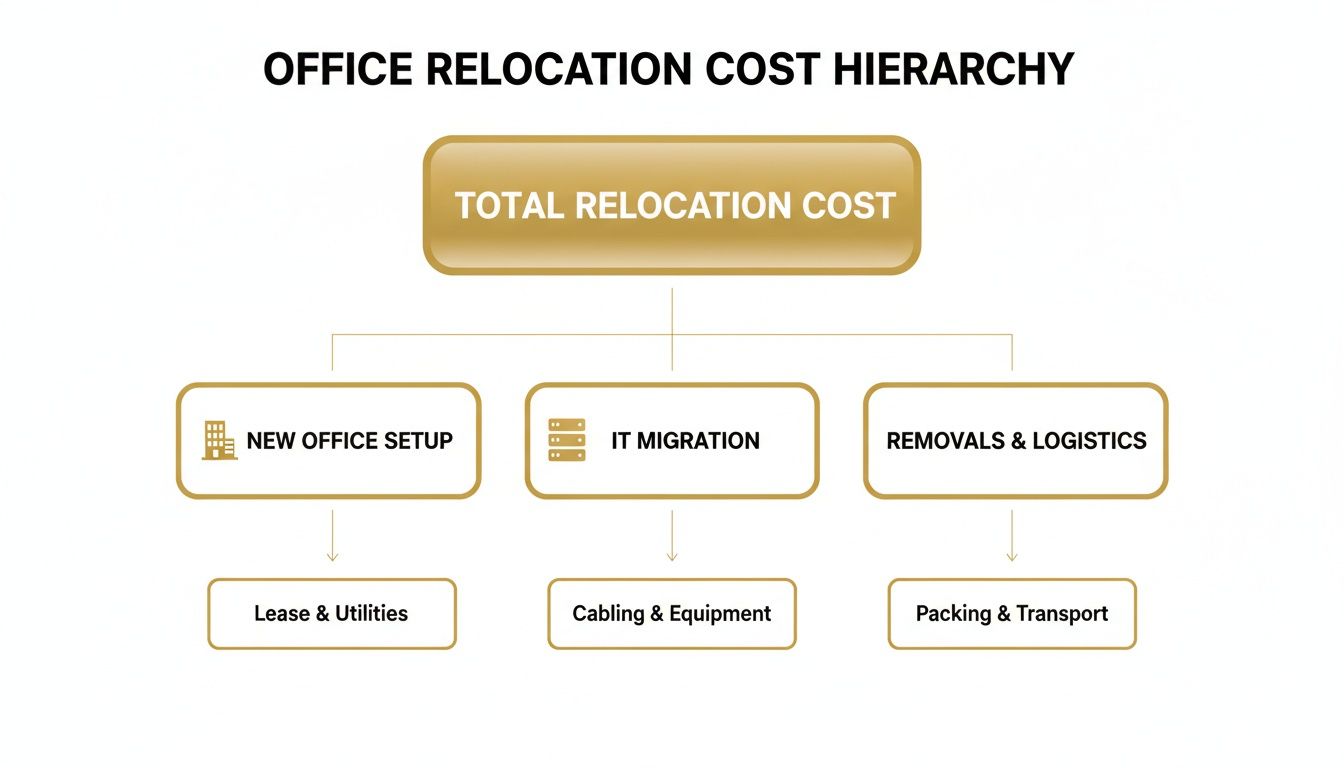
As you can see, the new office space often takes the biggest slice of the pie. This really underlines just how important lease negotiations and fit-out planning are to the overall project.
IT and Tech Migration
Next on the list, and arguably just as critical, is migrating your technology. You can’t just unplug servers, throw them in a van, and hope for the best. This part of the move demands a specialist team to safely decommission, transport, and then recommission all your critical IT infrastructure.
Getting this process right is all about minimising downtime. A poorly handled IT move can cost you far more in lost productivity and sales than the migration service itself. Budgeting for experts here isn’t a luxury; it’s essential for a smooth transition.
“Think of your IT migration as a delicate operation. You need surgeons, not just movers, to ensure the digital heart of your business keeps beating without interruption.”
Furniture, Fixtures, and Finishing Touches
What you decide to do with your furniture also has a huge bearing on the budget. You really have three paths you can go down:
- Move existing furniture: This is often the cheapest route upfront, but old furniture might not work with the layout or aesthetic of your new space.
- Buy new furniture: This gives you a completely fresh start and a chance to build a more modern, productive environment, but it’s a significant capital outlay.
- A mix of both: Many businesses find a happy medium, reusing key pieces while investing in new items for high-impact zones like the reception or breakout areas.
Finally, don’t overlook the cleaning fees. Your old lease will almost certainly require you to leave the premises in a clean state, and you’ll definitely want your new space to be spotless before your team arrives. Professional cleaning for two separate commercial properties should always be factored into your sums. To get a better handle on all the moving parts, take a look at our comprehensive 2026 office fit out checklist.
It’s easy enough to budget for the obvious things; the removal company, the new desks, maybe even a fresh coat of paint. But the true test of any office move budget isn’t how it handles the knowns, but how it weathers the surprises. The total office relocation cost is often quietly inflated by a whole host of hidden expenses that can catch even the most meticulous planner off guard.
When you sign a commercial lease, you’re not just agreeing to the monthly rent. You’re also committing to hand the space back exactly as you found it. This brings us to one of the most frequently forgotten costs: dilapidations. It’s your legal obligation to strip out any changes you made, from taking down partition walls and ripping up carpets to filling in every last screw hole.
Depending on how extensively you customised the space, these restoration works can be a hefty bill. Forgetting to account for dilapidations is one of the single most common, and costly, mistakes a business can make when moving.

Lease Overlaps and Professional Fees
In a perfect world, your old lease would end the day before your new one begins. But reality is rarely that tidy. It’s almost inevitable you’ll have a lease overlap, a period where you’re paying rent on two properties at once to allow time for the new fit out and the physical move.
Even if it’s just for a few weeks, this period of double rent needs to be pencilled into your cash flow right from the start. Think of it as an essential buffer that gives your project the breathing room it needs during the most critical phase.
Beyond the rent, a whole raft of professional fees come with securing a new commercial property. These can add up faster than you think and need to be in your calculations.
- Legal Fees: You’ll need a solicitor to scrutinise and negotiate the terms of your new lease. This is money well spent, protecting you from unfavourable clauses and future headaches.
- Stamp Duty Land Tax (SDLT): If the total rent over the lifetime of the lease exceeds a certain threshold, you’ll be liable for SDLT. It’s a significant, non-negotiable government tax that often comes as a nasty surprise.
- Agent Fees: If you enlisted a commercial property agent to help find your perfect new home, their commission will need to be settled.
These professional costs are especially important to manage when you’re looking at prime commercial hubs across Hertfordshire, where expert services are always in high demand.
Productivity Dips and Marketing Spend
Let’s be honest: an office move is a massive distraction. For everyone. From the senior leadership team coordinating the logistics to staff packing up their desks and figuring out a new commute, focus will inevitably shift away from day-to-day work.
“The temporary loss of productivity during an office move is a very real, though indirect, cost. Planning for this dip helps set realistic performance expectations and reduces stress on the team during the transition.”
This temporary drop in output is a genuine, albeit invisible, cost that hits your bottom line. While it’s tricky to put an exact figure on it, it’s wise to accept that business-as-usual will be disrupted. A well-planned move is all about keeping that disruption to an absolute minimum.
Finally, you can’t move without telling people! You need to set aside a budget to communicate your new address to the world. This is more than a quick email; it means updating a whole range of business materials.
| Communication Task | Examples of Costs Involved | Purpose |
|---|---|---|
| Digital Updates | Website developer time, digital designer fees | Updating your address on your website, Google Business Profile, and all social media channels. |
| Printed Materials | Printing and design costs for new stationery | Ordering new business cards, letterheads, and compliment slips with the updated address. |
| Client Outreach | Email marketing platform costs, postage for letters | Formally announcing your new location to all existing clients, suppliers, and partners. |
By getting ahead of these hidden costs, you can build a budget that’s robust, realistic, and ready for anything. This foresight is what turns a potentially stressful project into a smoothly controlled transition, setting your move up for financial success from day one.
How Your New Office Fit Out Shapes the Final Cost for 2026
Moving into a new office is the perfect excuse to finally create a workspace that actually supports the way your team works. But let’s be realistic: this is where a huge chunk of your office relocation cost sits. The “fit out,” which is just the industry term for turning an empty shell into a functioning, ready-to-use office, is a major investment. Its price tag can swing wildly.
The final bill comes down to the level of finish you’re after. Are you thinking of a simple refresh with a new coat of paint and some carpet tiles? Or are you picturing a completely bespoke design with high-end finishes and custom joinery? Every single choice has a knock-on effect on the budget.
Understanding Different Specification Levels
To get a handle on fit out pricing, we tend to break it down into three main categories: low, medium, and high specification. Think of it like buying a car. You can have the basic model that gets you from A to B, a mid-range version with a few extra comforts, or the top-of-the-line model with all the bells and whistles.
- Low Specification: This is your clean, simple, and functional option. It covers the essentials like standard carpet tiles, basic lighting, a straightforward paint job, and a practical tea point. It’s ideal for businesses on a tight budget who need a professional but no-frills workspace.
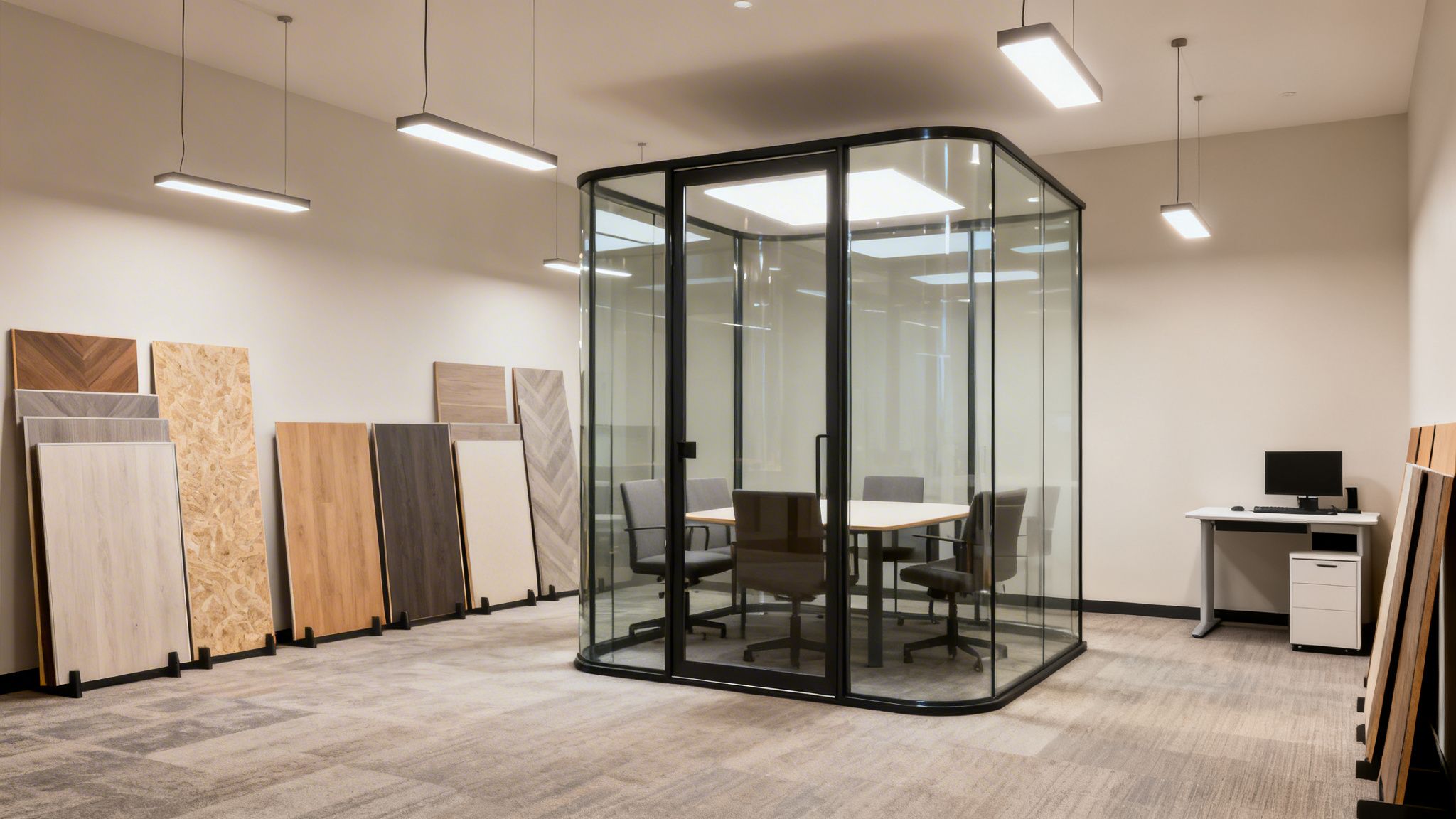
- Medium Specification: This is the sweet spot for most businesses. It includes better quality flooring, more feature lighting, some glass partitioning for meeting rooms, and a more thoughtfully designed breakout area. It strikes that perfect balance between cost and creating a genuinely appealing work environment.
- High Specification: Here, you’re aiming for a premium, statement-making finish. Think bespoke joinery, stone worktops, high-end acoustic solutions, advanced smart technology, and a reception that delivers a real “wow factor.” This is an investment in your brand image, designed to impress clients and attract the very best talent.
The costs for these specs can vary significantly depending on where your new office is located. Recent analysis shows that in 2026, fit out costs in major UK cities have jumped, which will directly impact your relocation budget. For example, a low-spec fit out in a major city might start around £126 per square foot, while a high-spec project could easily reach £308 per square foot.
To give you a clearer picture, here’s a rough guide to how costs can differ across the country.
Sample Fit Out Cost Guide Per Square Foot for 2026
This table illustrates the typical cost ranges for different levels of office fit out across various UK cities, helping you to budget for your new workspace refurbishment.
| UK City | Low Specification Cost (per sq ft) | High Specification Cost (per sq ft) |
|---|---|---|
| London | £126 | £308 |
| Bristol | £105 | £231 |
| Birmingham | £102 | £228 |
| Manchester | £101 | £226 |
| Leeds | £99 | £222 |
| Glasgow | £98 | £221 |
These figures are a great starting point, but remember that the final cost will always depend on the unique requirements of your project.
Key Cost Drivers in Your Fit Out Budget
Beyond the general “spec level,” several specific elements have a huge say in the final price. The most significant are often the mechanical and electrical (M&E) services. This covers everything from your air conditioning and ventilation systems right down to the power sockets and data cabling. If the existing systems in your new building are old or simply don’t suit your planned layout, upgrading them can be a major, and often unexpected, expense.
Other key cost drivers include:
- Partitioning: Building solid walls for private offices and meeting rooms is more expensive than many people think. Glass partitions, while they look fantastic and open up a space, also come at a premium.
- Flooring and Decoration: The type of flooring you choose, from budget-friendly carpet tiles to luxury vinyl or wood, will heavily influence costs. The same goes for specialist paint finishes or branded wall graphics.
- Specialist Areas: Creating dedicated spaces like a high-spec kitchen, a server room with specific cooling needs, or fully accessible toilet facilities will naturally add to the budget.
“A well-designed fit out isn’t an expense; it’s a strategic investment. It boosts productivity, strengthens your brand, and makes your office a place where people actually want to be.”
Making Smart Design Choices for Long-Term Value
A good design and build partner doesn’t just spend your money; they help you invest it wisely for the future. For instance, instead of building multiple permanent meeting rooms, you could use flexible meeting pods. Brands like Vetrospace or BlockO offer brilliant acoustic pods that provide privacy without the cost and permanence of traditional construction. The best part? You can take them with you if you ever move again.
Ultimately, the goal is to transform your fit out from just another line item in your office relocation cost into a long-term asset. By working with a professional team, you can make smart choices that deliver a fantastic workspace today while offering the flexibility you’ll need for tomorrow. To learn more about how the process works, you can check out our detailed guide on the cost of an office fit out.
Smart Strategies to Control Your 2026 Relocation Budget
Keeping a tight grip on your office relocation cost doesn’t mean you have to cut corners or sacrifice quality. With a bit of forward thinking and some smart tactics, you can make your budget work much harder. It’s not about spending less; it’s about spending wisely.
The entire process hinges on clear, detailed planning. Rushing decisions or leaving things to the last minute is a guaranteed way to see costs spiral. A well-managed move is a calm, cost-effective one.
Plan Like a Pro
Your most powerful tool for controlling costs is time. Start planning early. The more runway you have, the more options you’ll discover and the stronger your negotiating position will be. Kick things off by building a detailed project timeline that maps out every single stage, from the first property viewing right through to the final day of unpacking.
A great timeline gives you hard deadlines for key decisions, which helps you avoid those last-minute scrambles that always seem to result in paying a premium for services or equipment.
Next, it’s absolutely vital to get multiple quotes for every major service. Don’t just take the first price you’re given for removalists, IT migration, or fit-out contractors.
- Aim for at least three quotes for each service to get a realistic feel for the market rates.
- Check what’s included in each one. The cheapest option isn’t always the best value if it’s missing services you can’t do without.
- Ask for references and read the reviews. A reliable supplier is worth paying a little extra for if it means dodging costly mistakes down the line.
Simply shopping around can unlock significant savings and give you invaluable leverage when it’s time to negotiate.
Audit and Negotiate Everything
Before you even dream of browsing new furniture catalogues, take a thorough look at what you already own. A full audit of your current assets can uncover some huge potential savings. You’ll likely find that much of your existing kit is perfectly serviceable, perhaps just needing a deep clean or a minor refurbishment.
Reusing items not only slashes your capital expenditure but is also a far more sustainable choice. This is especially true for businesses setting up a new base in a location like Cambridge, where a practical approach to budgeting is key.
Your new lease is another area that’s ripe for negotiation. Never be afraid to ask for terms that can give you a bit of financial breathing room.
“A rent-free period at the start of your lease is one of the most powerful cost-saving tools. It frees up cash flow right when you need it most for the fit out and move itself.”
Landlords are often willing to offer a few months rent-free in exchange for securing a good, long-term tenant. That kind of concession can make a massive difference to your overall relocation budget.
Get the Right Team in Place
Juggling multiple suppliers during a complex office move can quickly get chaotic. Miscommunication between your IT team, removalists, and fit-out contractor can easily lead to delays and expensive errors. One of the smartest things you can do is centralise control.
Appointing a single, dedicated project manager, either from your own team or by partnering with a turnkey provider, is crucial. This person becomes the single point of contact, ensuring everyone is working from the same playbook and sticking to the schedule. It streamlines communication and makes accountability crystal clear.
A turnkey provider, like Gibbsonn Interiors, handles every piece of the puzzle for you. We manage all the different suppliers and timelines, taking the stress off your shoulders and making sure the project is delivered on time and, most importantly, on budget. To explore this streamlined approach further, see the benefits of dedicated office fit out project management for 2026.
Ready to Plan Your Move the Smart Way?
A successful, cost-effective office move all comes down to proactive planning and sharp decision-making. By giving yourself enough time, auditing your assets, negotiating hard, and putting a clear management structure in place, you can stay firmly in control of your budget.
Why Your Location Choice Matters for Long Term Costs in 2026
Deciding on the right town or city for your new office is a huge deal, but its impact goes far beyond the logistics of moving day. The location you choose will fundamentally shape your expenses for years to come, making it one of the most critical decisions you’ll make when managing your long-term office relocation cost.
This isn’t about a single, one-off expense. It’s about taking a step back and thinking about the total cost of occupation over the lifetime of your lease. A savvy choice right now can unlock some serious savings down the line.
Thinking Beyond the Move Day
It’s all too easy to focus on the initial rent, but that’s just one piece of the financial puzzle. The ongoing, day-to-day costs of simply running an office can vary wildly from one area to another. I’m talking about all those recurring bills that hit your desk every single quarter.
These operational expenses, often bundled together as “occupancy costs,” include a few key players:
- Business Rates: This is a major local tax on non-domestic properties, and the amount you pay can differ enormously between council areas.
- Service Charges: These are the fees you pay the landlord for looking after all the shared parts of the building; think receptions, lifts, and security.
- Utility Bills: The price of electricity, heating, and water fluctuates based on regional suppliers and, just as importantly, the energy efficiency of the building itself.
Getting your location right is one of the most powerful cost-control measures you have at your disposal. That seemingly great deal on rent might not look so hot once you factor in sky-high service charges.
Comparing Ongoing Costs Across the UK
The difference in running costs across the UK is genuinely stark. Recent survey data throws these regional variations into sharp relief. For instance, the combined annual bill for business rates, service charges, and utilities in a new-build London office can land somewhere around £45-£55 per square foot.
“When you add up all the little costs, the total yearly bill per employee in central London can easily hit £12,000-£15,000. It shows just how critical location is for long-term budgeting.”
That figure is roughly 25% higher than what you’d expect to pay in a city like Manchester. This kind of data is gold for any business, especially those in counties like Essex, trying to find that sweet spot between a prestigious address and a practical budget. You can dig deeper into these regional differences by reading the full office cost survey.
Location and Your Team
Finally, and perhaps most importantly, your choice of location directly affects your most valuable asset: your people. An office that’s a nightmare to get to or costs a fortune in travel can create real friction, hitting both morale and staff retention hard.
Think about the local transport connections. Is there a train station nearby? What are the bus routes like? And the million-dollar question: what’s the parking situation? A well-connected office, even in a more affordable hub like Chelmsford, can be infinitely more appealing to your team than a badly connected spot in a supposedly fancier postcode.
Common Questions About 2026 Office Relocation Costs
Planning an office move brings a lot of questions to the surface, especially around budgets and timelines. To give you some clarity, we’ve tackled two of the most frequent queries we get from businesses on the verge of a big change.
We’ve kept the answers straightforward, cutting through the jargon to give you the essential information you need to plan your next steps with confidence.
How Much Does a Small Office Move Cost?
This is always the first question, and while there’s no single answer, we can give you a realistic starting point. The final office relocation cost for a small team of 10-20 people depends on a huge number of factors.
For a simple, local move within an area like Braintree, you could be looking at a starting figure of around £5,000 to £15,000. This generally covers the basics like the removal company and reconnecting your IT.
But be warned: that figure doesn’t touch the big-ticket items. A new office fit-out, significant dilapidations on your old lease, or paying overlapping rent can easily double or even triple that initial estimate.
When Should I Start Planning My 2026 Office Move?
The short answer? Yesterday. The more realistic answer is to start planning at least 6 to 12 months before your current lease runs out. It might sound like a long time, but it disappears fast.
This kind of timeframe is your best defence against stress and overspending. It gives you the breathing room to:
- Properly scout out new locations without feeling pressured.
- Negotiate the best possible terms on your new lease.
- Get multiple, competitive quotes from all your suppliers (from movers to fit-out partners).
- Thoughtfully plan your new office design instead of making rushed decisions.
“Rushing an office move is the fastest way to overspend. Last-minute decisions almost always come with a premium price tag.”
Giving yourself plenty of time isn’t just a nice-to-have; it’s the single best strategy for keeping your relocation budget under control and creating a new workspace your team will genuinely love.
Ready to transform your workspace? Speak to the Gibbsonn Interiors team today.