
That niggling ache in your lower back after a long day at the desk? It’s not just a minor inconvenience. It’s a symptom of a much bigger problem quietly impacting businesses across the UK undermining not just your team’s health but their focus productivity and morale too. A proper chair for back pain ergonomics is so much more than furniture; it’s a strategic investment in your people’s performance.
Table of Contents
- Why Your Desk Chair Is Affecting More Than Your Back
- The Anatomy Of A Chair That Fights Back Pain
- How To Correctly Adjust Your Chair For Maximum Support
- Creating a Fully Ergonomic Workstation
- The Business Case For Investing In Ergonomic Seating
- Choosing The Right Partner For Your Ergonomic Office Fit-Out
Why Your Desk Chair Is Affecting More Than Your Back
An unsuitable office chair is a silent drain on business resources. It fosters a culture of discomfort where employees are distracted less engaged and ultimately more likely to be absent. This isn’t just a hunch; the data paints a very clear picture of a major national issue.
The Hidden Costs of Poor Seating
The fallout from poor seating ripples right through an organisation. What starts as a minor ache can easily snowball into chronic conditions that hit both performance and attendance hard. For any business especially those in competitive hubs like London or Cambridge keeping a workforce healthy and productive isn’t just a ‘nice to have’ it’s essential.
The latest statistics are stark. Musculoskeletal disorders (MSDs) are a staggering burden on UK industry affecting 511,000 workers every year. The back alone accounts for 43% of these cases leading to a massive 7.1 million working days lost nationwide. That puts immense and often preventable pressure on businesses. You can dive into the full workplace health statistics from the HSE to really grasp the scale of the problem.
Shifting from Furniture to Foundational Tool
The first step to fixing this is a simple shift in mindset: see an ergonomic chair not as a cost but as a fundamental tool for the job. It’s a direct investment in your company’s most valuable asset your people. When staff are comfortable and properly supported they can concentrate fully on their work which naturally leads to better outcomes and a more positive atmosphere.
A thoughtful office fit-out with ergonomics at its heart builds the foundation for a thriving team. It sends a clear message that you value your staff’s wellbeing a powerful factor in attracting and keeping top talent. Whether your business is based in Bishop’s Stortford or Essex tackling this common issue is both critical for your people and achievable for your business.
The Anatomy Of A Chair That Fights Back Pain
Let’s be honest not all office chairs are built the same. While plenty of them look the part a proper chair designed for back pain and ergonomics is a different beast altogether. It’s engineered with specific adjustable parts that all work in harmony to support your body the way it’s meant to be supported.
Think of it less like a piece of furniture and more like a precision tool for your team’s wellbeing. Understanding what these adjustable parts do is the key to seeing past the marketing fluff and choosing a chair that delivers real lasting results for your people whether they’re in Hertfordshire or Braintree.
The All-Important Lumbar Support
If there’s one feature that’s non-negotiable it’s adjustable lumbar support. Your lower spine has a natural inward curve but after hours of sitting that curve tends to flatten out. This puts a huge strain on the muscles and ligaments in your lower back which is a fast track to aches and pains.
“A good lumbar support basically acts like a custom-fit brace for your spine. It fills that gap between your lower back and the chair holding the natural ‘S’ shape of your spine and taking the pressure off the discs and muscles that are working overtime to keep you upright.”
When you’re looking at chairs you want one where you can adjust both the height and the depth of the support. Height adjustment lets you position it perfectly in the small of your back and depth control lets you fine-tune how much pressure feels right. Getting this one feature right is an absolute game-changer for preventing lower back pain.
Getting The Foundation Right: Seat Height And Depth
Proper seat adjustment is about much more than just being able to reach your desk. It’s about creating a stable comfortable foundation for your entire posture.
- Seat Height: The goal here is simple: feet flat on the floor knees at roughly a 90-degree angle and thighs parallel to the ground. This position is brilliant for healthy blood circulation and stops people from perching on the edge of their seat to compensate.
- Seat Depth: You’re looking for a small gap about two to three fingers’ width between the front of the seat and the back of your knees. If the seat is too deep it can press on nerves and cut off circulation. Too shallow and it won’t give your thighs enough support.
Don’t Forget The Armrests And Movement
Armrests are one of those features that people often overlook but they play a massive part in taking the strain off your neck and shoulders. Adjustable armrests let you support your forearms at a comfortable height which stops your shoulders from hunching up towards your ears. It’s a simple tweak that makes a world of difference to upper body tension.
Finally a truly good ergonomic chair encourages you to move. A chair with a recline or tilt function allows you to shift your posture throughout the day. This is vital because it helps distribute pressure across different parts of your spine and keeps your muscles from seizing up. As the experts at the Chartered Institute of Ergonomics and Human Factors will tell you the best posture is your next posture. Dynamic sitting is crucial.
To help you cut through the noise when you’re looking at different chairs here’s a quick reference to assess the most important features to combat back pain in your office.
Ergonomic Chair Features Checklist
| Key Feature | What To Look For | Why It Protects Your Back |
|---|---|---|
| Lumbar Support | Height and depth adjustability | Maintains the natural curve of your lower spine reducing strain on muscles and discs. |
| Seat Adjustability | Independent height and depth controls | Ensures proper posture promotes healthy circulation and provides full thigh support. |
| Armrests | Multi-directional adjustment (height, width) | Reduces shoulder and neck tension by taking the weight off your upper body. |
Ultimately a chair with these adjustable features isn’t a luxury; it’s a fundamental tool for creating a healthier more productive and more comfortable workplace.
How To Correctly Adjust Your Chair For Maximum Support
So you’ve invested in a quality ergonomic chair. That’s a brilliant first step. But its real value only comes alive when it’s adjusted to fit you perfectly. Think of it like a bespoke suit; it only works its magic when it’s fitted to your specific dimensions. This quick guide will walk you through personalising your chair for optimal support.
A proper adjustment ensures your spine keeps its natural healthy curve. This relieves pressure and stops those nagging aches that can creep in during a long workday. It’s a simple process that makes a world of difference to your comfort and focus and it’s something we’ve helped countless businesses in Chelmsford get right for their teams.
Your Step-By-Step Adjustment Guide
Getting your chair set up doesn’t have to be complicated. The trick is to start from the ground up and work through each point methodically. The end goal is to create a neutral supported posture that feels completely natural and effortless.
This visual guide breaks down the core steps for getting it right zeroing in on the lumbar seat and armrest positions.
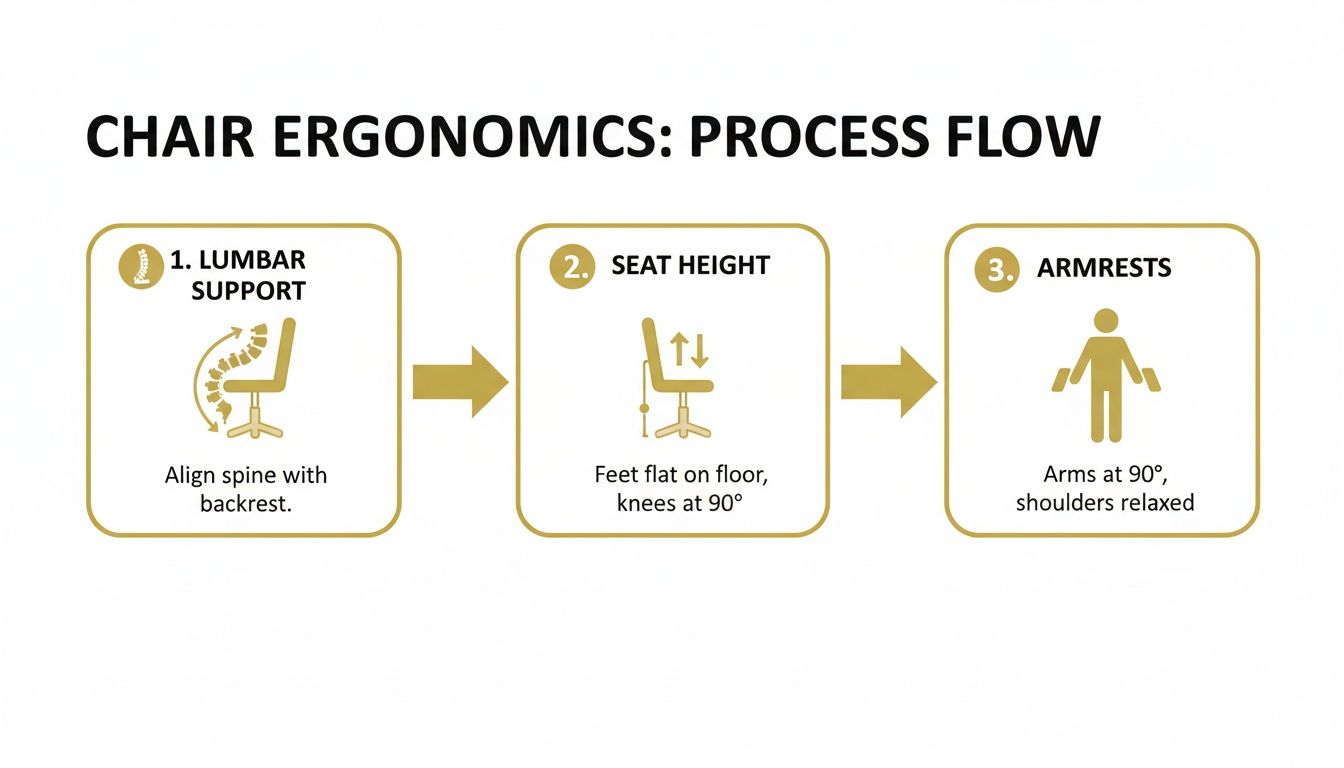
As you can see each adjustment builds on the one before it creating a fully supportive seating position from start to finish.
-
Set Your Seat Height: Start by adjusting your chair’s height until your feet are resting flat on the floor. You’re aiming for your knees to be at or just slightly below a 90-degree angle with your thighs parallel to the ground. This gives you a stable base and encourages good circulation.
-
Adjust The Seat Depth: With the height sorted check the depth of the seat pan. You should be able to slide two or three fingers between the front edge of the seat and the back of your knees. This simple check stops the seat from pressing on nerves and makes sure your back is in full contact with the backrest.
-
Position Your Lumbar Support: Now slide the lumbar support until it fits snugly into the natural curve of your lower back. It should feel like it’s holding you not pushing you forwards. Getting this part right is absolutely crucial for preventing lower back strain.
-
Fine-Tune Your Armrests: The final touch is the armrests. Adjust them so your shoulders can stay relaxed and your elbows rest comfortably at around a 90-degree angle. This takes the weight off your neck and shoulders easing any tension in your upper body.
By following these straightforward steps you can be sure your ergonomic chair is delivering on its promise. It stops being just a piece of furniture and becomes a powerful tool for your health and wellbeing at work.
Creating a Fully Ergonomic Workstation
An ergonomic chair is the heart of a healthy workspace but its full potential is only unlocked when it’s part of a complete system. You might have the best chair in the world perfectly adjusted but if your monitor is too low or your keyboard is too far away you’re just swapping back pain for neck and shoulder strain.
Thinking about the entire desk setup is what creates a truly supportive environment. It’s a holistic approach that ensures every element from screen height to mouse position works in harmony to support your team’s wellbeing. This is exactly how we approach a professional office fit-out in Essex or Cambridge creating high-performance environments that look after your people from head to toe.
Beyond The Chair: Key Workstation Adjustments
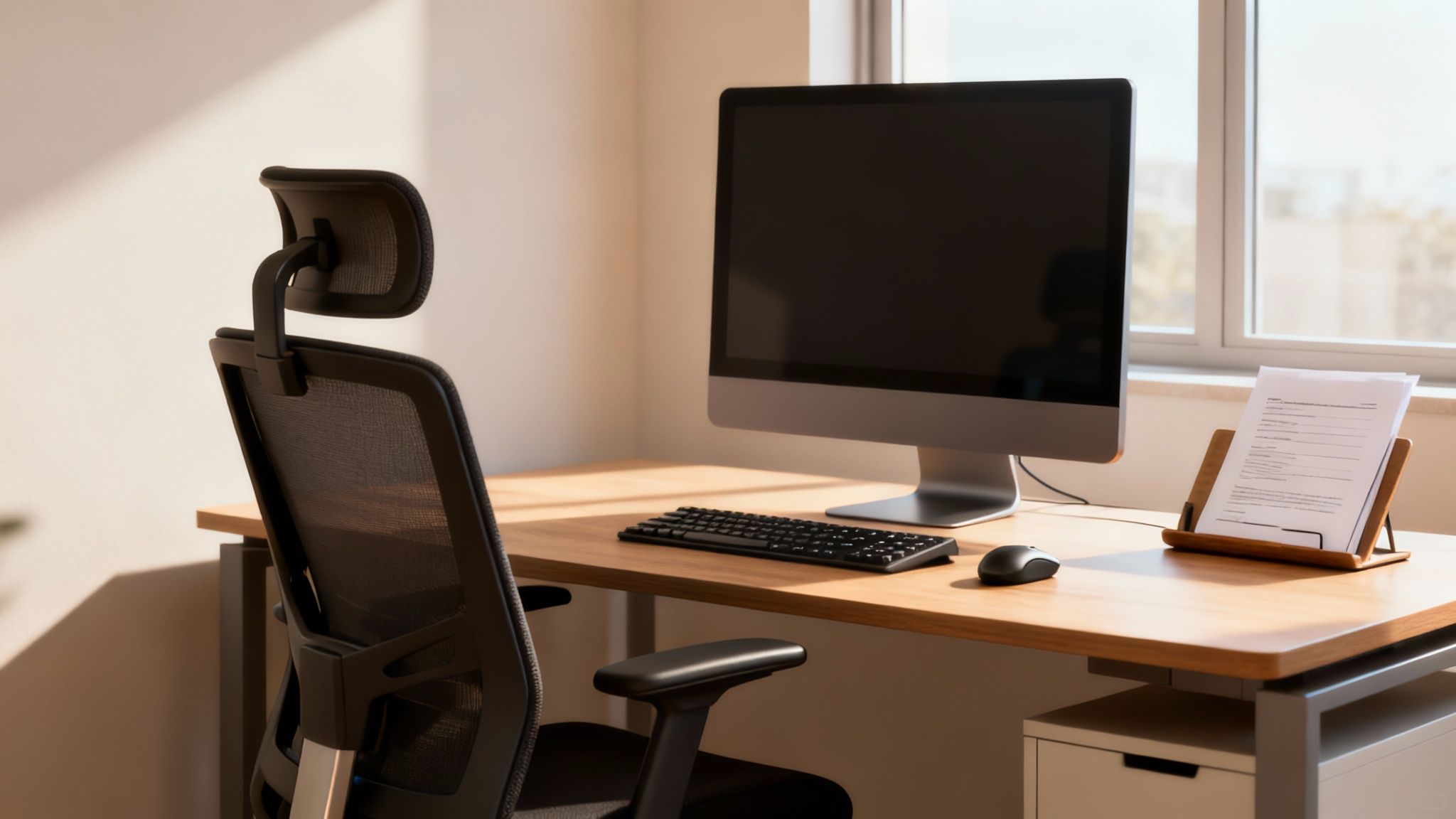
To build a truly ergonomic setup you need to look at how your team interacts with their entire desk. It’s a chain of small simple adjustments that leads to a big improvement in comfort and focus.
- Monitor Height and Distance: Your screen should be directly in front of you about an arm’s length away. The trick is to position the top of the monitor at or just below eye level. This stops you from craning your neck up or hunching down to see properly.
- Keyboard and Mouse Placement: Keep your keyboard and mouse close together on the same surface. When typing your elbows should stay tucked in close to your body and your wrists should be straight not bent up or down. A wrist rest can help but it’s no substitute for correct positioning.
- Desk Space and Layout: There must be enough room under the desk for your knees thighs and feet. Clearing the area of clutter allows for those natural posture changes we all make. Keep frequently used items like your phone within easy reach to avoid constant stretching and twisting.
“The ideal posture is your next posture. A truly ergonomic workstation is one that not only supports a neutral position but also makes it easy and natural to move and shift throughout the day.”
Integrating Ergonomics Into Your Office Design
Creating a workspace that prioritises ergonomics is about more than just individual desk setups. It involves thoughtful space planning to manage things like screen glare from windows and ensuring there are different zones for different kinds of tasks. It’s really about building an environment where comfort and productivity go hand in hand.
For companies looking to learn more about adaptable seating our article on dynamic office seating explores how movement is a key part of workplace wellbeing. A well-designed office considers every detail to foster a healthier more engaged workforce.
The Business Case For Investing In Ergonomic Seating
Choosing the right chair for back pain ergonomics isn’t just another overhead cost; it’s a strategic investment in your most valuable asset your people. The return you see from this is tangible showing up in hard business metrics that go way beyond simple comfort.
For any business especially in competitive hubs like London and Chelmsford absenteeism is a huge drain on resources. When staff are off with back pain workflows are disrupted and the rest of the team feels the pressure. By providing properly supportive seating you directly tackle one of the leading causes of musculoskeletal issues which can lead to a measurable drop in lost workdays.
Boosting Productivity And Focus
A comfortable employee is a focused employee. It’s that simple. When a team member isn’t constantly fidgeting to find a less painful position they can actually concentrate on the task at hand. The result? Higher quality work better efficiency and improved output across the board.
“An ergonomic chair doesn’t just prevent pain; it creates an environment where your team can perform at its best. This direct link between physical wellbeing and productivity is a powerful reason to prioritise ergonomic seating in your budget.”
This boost in performance contributes directly to your bottom line quickly turning the initial outlay on quality chairs into a very sound financial decision.
Attracting And Retaining Top Talent
In today’s workplace people expect their employer to genuinely care about their wellbeing. An office that’s been thoughtfully designed with high-quality ergonomic furniture sends a powerful message that you value your staff. For top candidates weighing up different job offers this can easily be the deciding factor.
What’s more a supportive environment boosts morale and loyalty which helps reduce the high cost of employee turnover. Investing in your team’s health is a clear signal that you’re a forward-thinking employer and that helps build a brilliant company culture. To learn more about how physical office improvements contribute to staff satisfaction read our guide on promoting wellbeing in the workplace.
Ultimately a great chair for back pain ergonomics is more than just a piece of furniture it’s a tool that nurtures your greatest asset and helps secure your business’s long-term success.
Choosing The Right Partner For Your Ergonomic Office Fit-Out
Getting your workplace ergonomics right involves so much more than just ordering a new chair for back pain ergonomics. To really feel the benefit you need a deep understanding of space planning workflows and how every element in your office interacts. It’s about seeing the bigger picture and that’s where a true specialist partner comes in.
This is exactly why we believe in a holistic approach. We don’t just supply furniture; we design and build entire environments that foster wellbeing and boost productivity from the ground up. This method ensures every component from the layout of desks to the type of lighting supports and enhances the investment you’ve made in your team’s seating.
A Seamless Design-And-Build Process
Our comprehensive design-and-build process offers a completely seamless transition for businesses in locations like Stansted and Braintree. We take care of everything from the initial consultation and space planning right through to the final installation and handover. Having that single point of contact removes all the usual stress and complexity from your project.
The result is a cohesive design where every detail has been considered. Your new workspace won’t just look professional it will function flawlessly for your people.
“Partnering with an expert ensures that your investment in ergonomics is fully maximised. We create spaces where people feel supported and can perform at their best turning your vision for a healthier workplace into a tangible reality.”
This commitment to quality and a detailed understanding of workplace ergonomics is what sets a professional fit-out apart. We build trust by delivering environments that are perfectly tuned to your business goals. For a deeper look into selecting the right team you can learn more about how to choose the best office fit out contractors for your project. By choosing an experienced partner like Gibbsonn Interiors you ensure a successful and impactful transformation.
Ready to transform your workspace? Speak to the Gibbsonn Interiors team today. We’re here to help you build a healthier more productive environment that works for your people.