
A commercial office fitout is more than just new desks and a fresh coat of paint. It’s the process of taking an empty space and turning it into a functional, inspiring workspace that truly works for your business.
This is about creating an environment that reflects your company culture, supports your team’s workflow, and ultimately makes people want to come to the office.
Table of Contents
- What Exactly Is a Commercial Office Fitout?
- The 5 Key Stages of a Successful Office Fitout Project
- How to Budget for Your Commercial Office Fitout
- Key Trends Shaping Modern Office Design for 2026
- The Paperwork: Navigating Compliance and Dilapidations
- How to Choose the Right UK Fitout Partner
- Got Questions About Your Office Fitout?
What Exactly Is a Commercial Office Fitout?
Think of an office fitout like moving into a new build home. The developer gives you the keys to a solid structure with walls, windows, and basic utilities but it isn’t a home yet. The fitout is the stage where you install flooring, fit the kitchen, paint the walls and bring in your furniture.
An office fitout is the same process but for your business. It is a major investment in your company’s future and creates an environment that can boost productivity, reflect your brand, and support your team’s wellbeing.
A well-executed fitout is more than an expense. It becomes a powerful business tool. In competitive areas like London or Cambridge, an exceptional workspace can be the deciding factor for attracting and keeping top talent.
Getting to Grips with the Lingo: CAT A vs. CAT B
When you explore commercial interiors you will hear the terms “CAT A” and “CAT B” used frequently. Understanding the difference is vital for planning your project and knowing who is responsible for what.
- Category A Fitout (CAT A): This is handled by the landlord. They provide a basic, empty space that is ready for a tenant. A standard CAT A finish includes raised floors, suspended ceilings, and core mechanical and electrical services. It’s a blank canvas ready for your vision.
- Category B Fitout (CAT B): This is where you, the tenant, take over. The CAT B fitout is all about making the space your own. It covers everything from partition walls for offices and meeting rooms to installing workstations, furniture, IT infrastructure and branding.
Simply put, CAT A prepares the space and CAT B makes it yours. For a more detailed look, property experts like Savills offer some great explanations.
Here is a quick breakdown of the different fitout types.
Understanding Office Fitout Categories
| Fitout Type | What’s Included | Best For |
|---|---|---|
| Shell and Core | The basic structure: framework, cladding, base plant and common areas like lobbies. | Developers or large corporations taking on an entire building and wanting full control. |
| Category A (CAT A) | The landlord’s finish: raised floors, suspended ceilings, basic M&E services and finished internal walls. | Landlords preparing a space for market and providing a blank canvas for tenants. |
| Category B (CAT B) | The tenant’s finish: partitioning, workstations, kitchens, branding, IT & AV and all furniture. | Any business moving into a CAT A space and needing to tailor it to their specific needs. |
| Turnkey (CAT A + B) | A seamless project where one partner manages everything from the CAT A finish to the final CAT B details. | Businesses wanting a single point of responsibility and a streamlined, hassle-free process. |
This table gives you a clear snapshot but remember every project is unique. The key is to understand your starting point and your end goal.
Why You Can’t Afford to Go It Alone
Managing a fitout in-house to save money is a false economy. It often leads to rising costs, frustrating delays, and a result that misses the mark.
A professional commercial office fitout partner is essential. They bring years of experience in everything from space planning to navigating complex UK building regulations. They ensure every detail, from meeting room acoustics to lighting quality, is optimised for performance.
For businesses in our local areas of Hertfordshire and Essex, partnering with a specialist like Gibbsonn Interiors in Bishop’s Stortford gives you expert guidance on your doorstep. We handle the project complexities so you can focus on running your business.
The 5 Key Stages of a Successful Office Fitout Project
An office fitout can feel like a huge task but it follows a clear, logical path. Breaking it down into stages makes the process manageable. Think of it as a roadmap guiding your project from an idea to a fully functioning workspace, ensuring nothing gets missed.
Understanding these five key stages helps you know what to expect, who is responsible for what, and how your vision will come to life. Let’s walk through the journey.
This visual shows how a space progresses from a basic shell to a fully customised CAT B environment ready for your team.
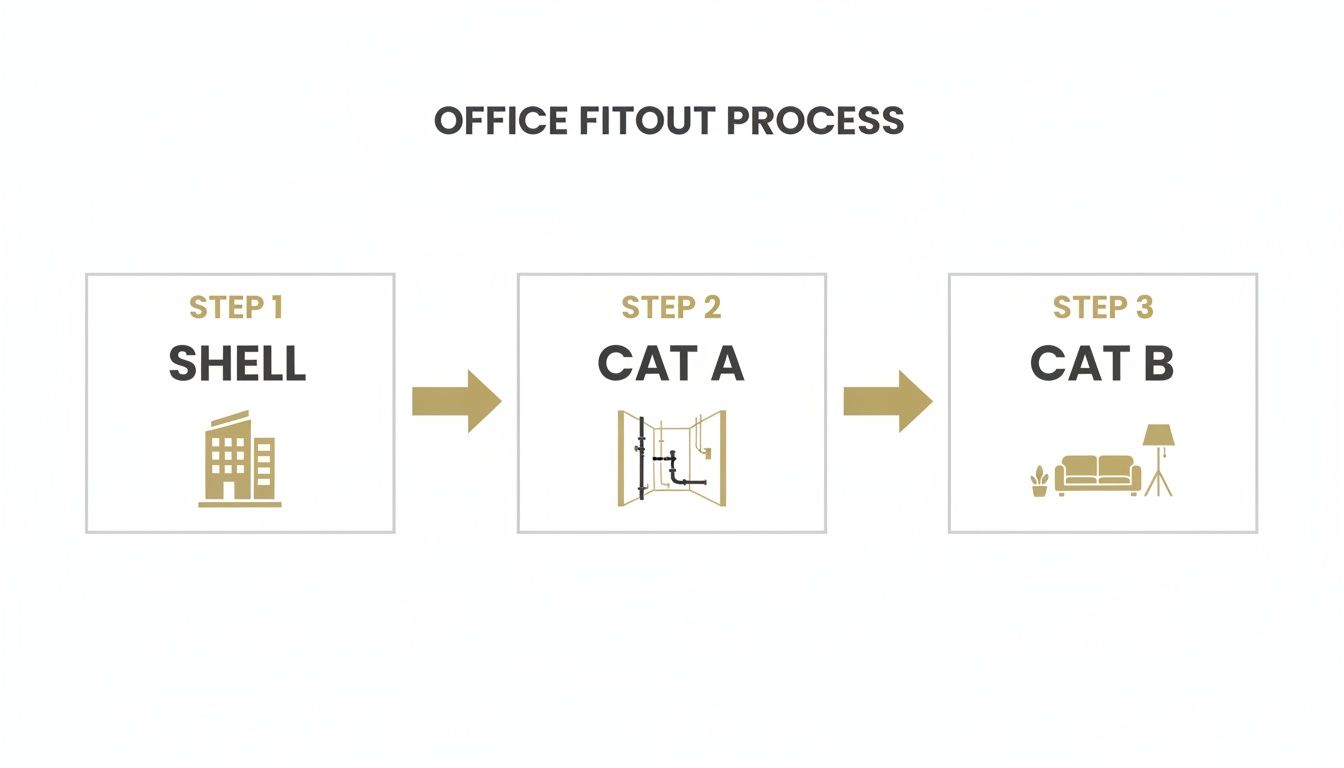
Each step builds on the last, adding layers of function and personality until the final workspace is complete.
Stage 1: Briefing and Workplace Consultancy
This is the most important stage of any commercial office fitout. It’s all about discovery. We sit down with you to understand not just what you want but why you want it. This means diving deep into your company culture, daily workflows and future business goals.
We will explore questions like:
- How do your teams collaborate day-to-day?
- What are the biggest frustrations with your current office?
- What technology is essential for you to operate effectively?
- Are you planning for growth in key areas like Bishop’s Stortford or London?
This isn’t just a chat. It’s a strategic analysis. A solid brief ensures the final design aligns with your business objectives and creates a workspace that helps you succeed.
Stage 2: Design and Space Planning
Once the brief is finalised our designers get to work turning your requirements into a tangible plan. This is where your vision takes shape through detailed 2D layouts, immersive 3D visualisations and mood boards. We explore different configurations to maximise every square foot, creating dedicated zones for focused work, collaboration and relaxation.
“Good design isn’t just about making things look nice; it’s about solving problems. The layout should make work easier, reduce friction in daily tasks, and create a natural flow of movement and energy throughout the office.”
We will present concepts for finishes, furniture, lighting and branding elements. It’s a highly collaborative phase involving your feedback until we land on a final design that you’re completely happy with and that works for your budget. For inspiration, the architecture and design resource Dezeen is a great place to see new office concepts.
Stage 3: Pre-Construction and Compliance
With the design signed off we move into the technical phase. This stage is all about preparation and paperwork and it’s the critical groundwork for a smooth construction process. Our team finalises the detailed technical drawings and specifications that the contractors will use to build the space.
Crucially this is when we handle all necessary permissions and ensure the design complies with UK Building Regulations. This covers everything from fire safety and accessibility to ventilation standards. We also produce a detailed schedule of works and finalise costs, giving you complete clarity before any work begins.
Stage 4: Construction and Installation
Now for the exciting part: the physical transformation. Your dedicated project manager will oversee all on-site activity, coordinating various tradespeople from electricians and plasterers to decorators and data cablers. They are your single point of contact and provide regular updates to ensure the project stays on schedule and on budget.
We manage every detail from the first partition wall going up to the final piece of furniture being installed. Health and safety is our top priority and we ensure the site is managed according to the strict CDM (Construction Design and Management) regulations, outlined by the Health and Safety Executive (HSE).
Stage 5: Handover and Aftercare
Once construction is complete we conduct a meticulous snagging process to ensure every detail meets our high standards. We then formally hand over the new workspace to you, providing a comprehensive pack with all relevant documentation, warranties and maintenance guides.
Our job doesn’t end when you get the keys. We provide robust aftercare to help your team settle in and to address any small issues that might arise. This commitment ensures your new office continues to support your business long after the project is finished.
How to Budget for Your Commercial Office Fitout
Getting the budget right is a critical first step in any commercial office fitout. It is easy to get carried away with design possibilities but grounding your vision in a realistic financial plan is what brings a high-performing workspace to life. The final cost is the sum of many different parts.
Here we will give you a clear breakdown of what drives the cost of a fitout. We will cover everything from the impact of your location to easily forgotten expenses so you can plan your investment with confidence.
Key Factors That Drive Your Fitout Costs
A few core elements will have a major impact on your final budget. Understanding these from the start means you can allocate your money where it matters most and make smart decisions.
- Location: Where your office is located plays a massive role. It is no surprise that prime city-centre spots, especially in hubs like London, come with much higher labour and logistics costs. Projects in surrounding areas like Hertfordshire or Essex will often be more budget-friendly.
- Level of Specification: This comes down to the quality of the materials, finishes and furniture you choose. A basic, functional finish will be vastly different in cost from a high-end design with bespoke joinery, premium flooring and designer furniture.
- Technology Integration: Think about how complex your tech needs are. A simple setup with standard data points is one thing but a fully smart office with integrated room booking systems, advanced video conferencing suites and automated lighting is a different financial commitment.
- Mechanical & Electrical (M&E) Works: Never underestimate the state of the building’s existing services. Things like air conditioning, ventilation, power and lighting can have a huge effect on the budget. If these systems need upgrading or reconfiguring it requires specialist work and can be a significant cost.
Uncovering the Hidden Costs
It’s not just about construction and furniture. Other costs need to be factored into your total budget to avoid any shocks later on. For a much deeper dive, take a look at our complete guide on the cost of an office fit out.
Here are a few of the most commonly overlooked costs:
- Professional Fees: This covers the expertise of your designers, project managers and other specialist consultants.
- Dilapidations: If you’re leaving an old space, you will have end-of-lease obligations to return it to its original state.
- Statutory Approvals: Don’t forget to budget for fees related to building control and any necessary planning permissions.
- Moving Costs: The physical cost of relocating your team, furniture and equipment all adds up.
Expert Tip: Always Include a Contingency Fund
No matter how carefully you plan, surprises can happen. We always advise clients to set aside a contingency fund of 5-10% of the total project cost. This buffer is your safety net for unforeseen issues or late-stage design changes, making sure the project stays on track without causing financial stress.
By understanding all these factors right from the start, you can approach your commercial office fitout feeling financially prepared and in control.
Key Trends Shaping Modern Office Design for 2026
The way we work is changing and our offices are adapting to keep up. A commercial office fitout today is not just about placing desks. It’s about creating an environment that supports flexibility, wellbeing and smart technology. The modern workspace has to be a destination that earns the commute and supports a range of work styles.
These are strategic moves that businesses in places like Bishop’s Stortford and across Essex are making to attract and keep the best people.
The Rise of Agile and Hybrid Workspaces
The old nine-to-five in a fixed cubicle is becoming a thing of the past. With hybrid working now the norm, the office must work harder to serve a dynamic workforce. This is where the agile workspace comes in.
An agile office is built around activity not assigned seating. It offers a variety of settings and staff choose the one that best fits their task.
Think of it like this:
- Collaboration Hubs: Open, relaxed zones with whiteboards and comfy seating, perfect for team brainstorming.
- Quiet Zones: Library-like areas designed for deep, focused work where interruptions are minimised.
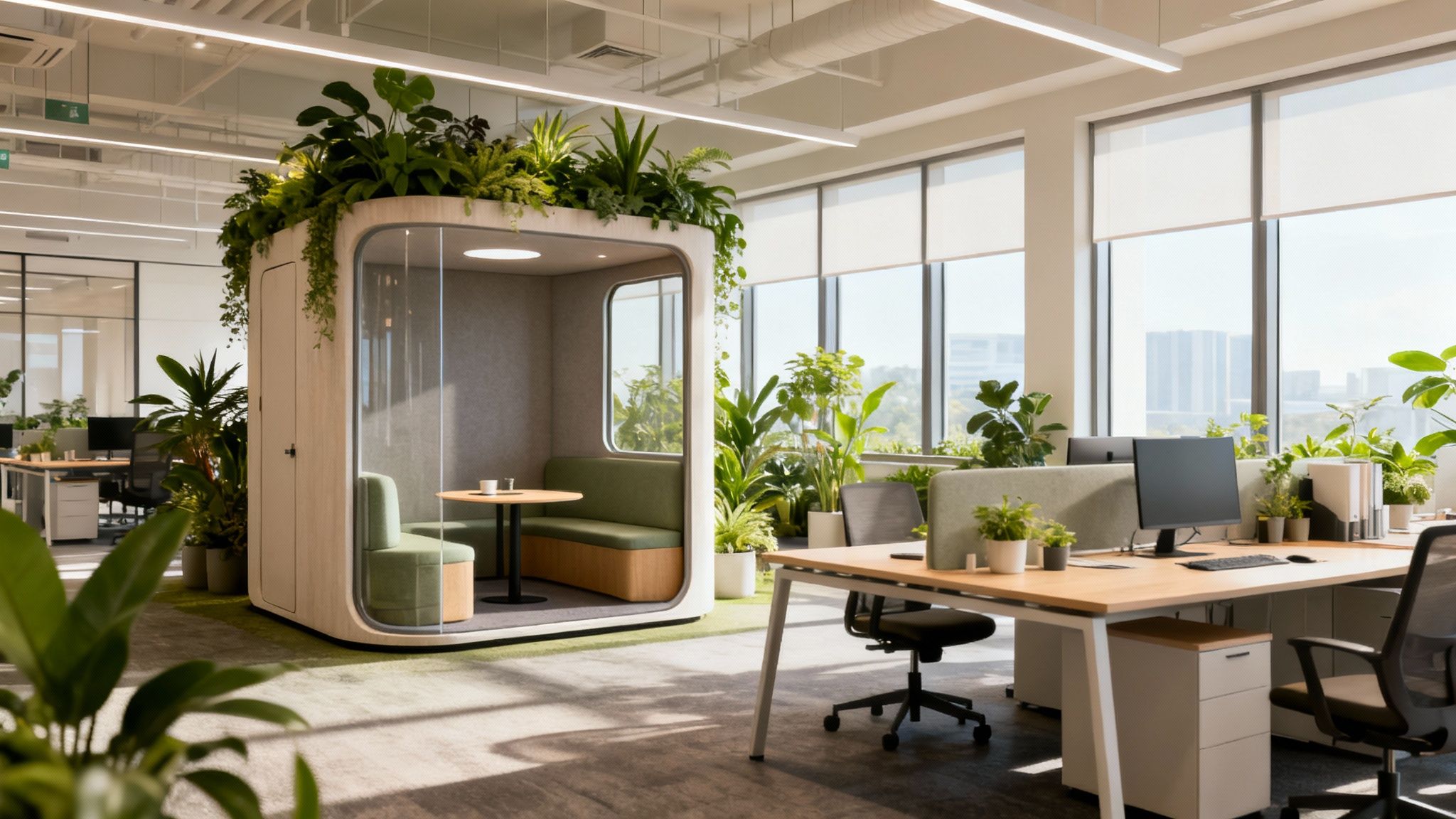
- Private Pods: Small, soundproof booths for confidential video calls or one-to-one chats.
- Social Spaces: Café-style areas that encourage casual conversations and build company culture.
This move towards flexibility is influencing the wider property market. As property specialists at Interaction point out, a drop in new office construction is making top-quality space harder to find, pushing adaptable, ready-to-go offices to the top of the list.
Embracing Sustainability and Biophilic Design
Employee wellbeing is now a top priority. Two key trends addressing this are sustainability and biophilic design which is the practice of incorporating nature into our built environments. People want to work for companies that show a commitment to both their staff and the planet.
A sustainable fitout means making conscious choices. This includes selecting recycled or locally sourced materials, installing energy-saving LED lighting and choosing furniture from environmentally responsible suppliers.
Biophilic design brings natural elements directly into the office. This includes living walls, indoor plants, natural light and materials like wood and stone. The results are powerful. As experts at RIBA confirm, it leads to lower stress, a boost in creativity and better air quality.
“The future of office design is flexibility. Workspaces must be able to adapt in real-time to the changing needs of the business and its people. Static, one-size-fits-all layouts are no longer fit for purpose.”
Integrating Smart Technology Seamlessly
Technology is the central nervous system of any modern office. Integrating it properly is a vital part of a forward-thinking commercial office fitout. Smart tech is about making the workspace more intuitive and removing daily frustrations.
This includes things like:
- Room Booking Systems: Digital panels on meeting room doors showing availability and allowing instant booking.
- Wireless Charging: Built directly into desks and breakout tables for convenience.
- Smart Lighting and Climate Control: Systems that adjust based on occupancy, saving energy and ensuring comfort.
- High-End AV Equipment: Video conferencing that works seamlessly, connecting in-office and remote team members.
This kind of tech smooths out the day and lets people focus on their work. For a deeper look at what’s on the horizon, read our insights on modern office design trends for 2026. By focusing on these key areas, you are not just creating a great-looking office. You are building a powerful asset for the future of your business.
The Paperwork: Navigating Compliance and Dilapidations
When you’re excited about designing a new office, it’s easy to forget the less glamorous side of things. Embarking on a commercial office fitout involves legal and contractual duties designed to protect your business, your team and your investment.
Getting this wrong can lead to costly fines and serious delays that can derail your project. The two biggest hurdles are compliance (the rules you must follow now) and dilapidations (your responsibilities at the end of your lease).
Getting to Grips with UK Fitout Compliance
Ensuring your new workspace is fully compliant is not just about ticking boxes. It’s about creating a safe, accessible and legal environment for everyone. While your fitout partner will handle the details, it’s important you understand the requirements.
In the UK the main areas you will encounter are:
- Building Regulations: These are the standards for almost all construction work. They cover fire safety, structural stability, ventilation and energy efficiency. You must have approval before any major work can start.
- The Equality Act 2010: This law requires your office to be accessible to people with disabilities. It impacts everything from doorway widths to washroom design.
- CDM Regulations (2015): The Construction (Design and Management) Regulations are about health and safety on site. They provide a formal structure to manage risks throughout the project. The Health and Safety Executive (HSE) has all the official guidance.
To help you get started, here’s a quick look at the key areas you will need to consider.
Fitout Compliance Checklist
| Compliance Area | What to Check | Why It Matters |
|---|---|---|
| Building Regulations | Fire escapes, structural changes, ventilation, electrical safety. | Ensures the building is safe and meets minimum standards. Non-compliance can lead to fines. |
| The Equality Act 2010 | Accessible entrances, wheelchair-friendly corridors, accessible toilets. | Guarantees your workspace is inclusive and avoids discrimination claims. It’s a legal duty. |
| CDM Regulations 2015 | Risk assessments, site safety plans, appointment of safety roles. | Protects everyone working on your project and your business from liability in case of an accident. |
This table is a starting point. A good fitout partner will handle all this as part of their service, giving you confidence that everything is being done correctly.
The Hidden Sting of Dilapidations
Of all the costs associated with a tenancy, dilapidations is the one that most often surprises businesses. It’s your legal duty to return the office space to the landlord in its original condition when your lease ends.
This means every partition, kitchen and piece of branding will probably have to be removed. If you don’t, the landlord will do it and send you a large bill. For businesses in key locations like Chelmsford or Stansted, this is a financial risk that needs to be managed from day one.
“A smart fitout strategy thinks about the end of the lease right from the start. By making clever design choices and having a crystal-clear understanding of your lease obligations, you can dramatically shrink your future dilapidations bill.”
How Your Fitout Partner Has Your Back
Trying to manage compliance and dilapidations on your own is a huge risk. An expert fitout partner proves their worth here. We become your single point of accountability and protect your interests.
Here’s how we turn these potential problems into a smooth process:
- We Read the Small Print: We will review your lease to understand your dilapidations liabilities, ensuring our designs don’t create expensive problems for you later.
- We Handle the Authorities: Our team manages all the paperwork and communications with local councils to get full approval under Building Regulations.
- We Design Smarter: We can suggest clever solutions that look great but are also easy to remove, such as modular pods instead of permanent rooms.
This proactive approach provides complete peace of mind.
How to Choose the Right UK Fitout Partner
Picking a partner for your commercial office fitout is the most important decision you’ll make. Get it right and they will turn your vision into reality. Get it wrong and you face budget blowouts, missed deadlines and a space that doesn’t work.
You need a specialist who understands modern workspaces and can guide you through every stage.
So, what should you look for?

Look for a Proven Track Record
Experience is your best guarantee of a smooth project. A partner with a strong portfolio of completed office fitouts has already handled the challenges you’re about to face. Ask to see their case studies and examples of work that match your scale and style.
A strong track record proves they know how to create productive environments and can spot potential issues before they become expensive problems.
Prioritise a Full Design and Build Service
Juggling separate designers, project managers and contractors can be chaotic. A design and build firm is a simpler, more accountable approach, giving you a single point of contact for the whole project.
This integrated model means the design and construction teams collaborate from day one. The benefits are significant:
- Clear Accountability: One team is responsible for everything.
- Accurate Budgeting: Costs are considered from the start, reducing the risk of surprises.
- Smoother Timelines: Coordination is more efficient, keeping the project on track.
Ensure They Have Robust Project Management
Exceptional project management holds a fitout together. A dedicated project manager is your representative on-site, making sure every detail is executed to the highest standard, on time and on budget. They coordinate the trades, manage suppliers and give you clear, regular updates.
A great project manager takes the stress off your shoulders, freeing you up to run your business while they handle the build.
The UK office market is seeing a flight to quality. As a recent market analysis from CoStar shows, businesses are investing in high-quality spaces to create workplaces people want to be in.
“Gibbsonn was a pleasure to work with. They took our brief and developed it into a fantastic design, keeping us informed throughout the build. The whole team worked professionally and the project was completed on time and within budget. We couldn’t be happier.”
Choose a Partner with Local Knowledge
Working with a fitout specialist who knows your local area, whether that’s Braintree or London, adds real value. They will have relationships with local suppliers and a network of trusted tradespeople, often leading to better pricing and smoother logistics. Our guide to selecting the right office fit out contractors has more tips on making this crucial choice.
By considering these points you can find a partner who understands your business goals and ensures your investment pays off for years to come.
Got Questions About Your Office Fitout? We’ve Got Answers.
To finish let’s answer a few questions we hear most often from clients about the commercial office fitout process. Understanding these common queries will help you plan your project with more confidence.
How Long Does a Typical Office Fitout Take?
The honest answer is: it depends. The timeline is shaped by the size of your space, the complexity of the design and the condition of the building.
As a rough guide, a medium-sized project for an office of around 50-100 people often takes between 8 to 12 weeks from starting on site to handover.
Several things can extend that timeline:
- Landlord Approvals: Getting the go-ahead from the building owner can add weeks to the pre-construction phase.
- Complex M&E Works: Significant changes to air conditioning, power or data infrastructure will add more time.
- Bespoke Joinery and Furniture: Lead times for custom-made items are longer than for standard products.
A good fitout partner will provide a detailed project programme from day one so you have a clear and realistic timeline.
What Is the Difference Between a Fitout and a Refurbishment?
These terms are often used interchangeably but they describe two very different projects.
A commercial office fitout starts with a blank canvas. You are typically taking an empty shell (a CAT A space) and building everything from scratch. This includes installing walls, kitchens and breakout areas and bringing in all new furniture.
An office refurbishment is about updating an existing, often occupied, workspace. The core structure is already there. The project might involve redecorating, replacing furniture, upgrading technology and adjusting the layout.
Can We Stay in Our Office During the Work?
Yes, in many cases, you can. Minimising disruption to your business is a top priority and a skilled fitout partner is an expert in managing projects in occupied spaces.
This is usually done through a carefully planned phased construction approach. We can complete one area at a time while your team continues working in another. We can also schedule noisier work like demolition to happen out of hours, either in the evenings or over a weekend, to ensure your business runs as smoothly as possible.
Ready to transform your workspace? Speak to the Gibbsonn Interiors team today.