

Embarking on an office refurbishment is a major investment in your company’s future. It’s a strategic move that can redefine how your organisation operates. Get it right and you create a space that boosts productivity, attracts top talent and truly reflects your brand’s ethos. Get it wrong and you risk budget overruns, significant operational disruption and a final workspace that simply fails to meet your team’s needs. This is where a detailed plan becomes your most valuable asset. A disorganised project can quickly spiral out of control. This leads to costly mistakes and extended timelines that impact business continuity whether you’re based in a fast-paced London hub or a growing Cambridge tech firm.
This comprehensive office refurbishment checklist is your definitive step-by-step guide to navigating the complexities of a modern office fit-out. It is meticulously structured to ensure every critical detail is covered from the initial pre-project brief and budget forecasting to the final handover and post-occupancy evaluation. We will break down essential stages including securing building regulations approvals, planning for technology infrastructure, assessing end-of-lease dilapidations and integrating sustainable design principles.
Our guide provides actionable insights for stakeholders across Essex and Hertfordshire. This includes office managers in Chelmsford to facilities teams near Stansted. By following this blueprint you can avoid common pitfalls, maintain control over your project and ensure the final result is a workspace that not only looks impressive but actively supports your business goals for years to come. Let’s build a workspace that works for you.
1. Comprehensive Space Planning and Needs Assessment
Before any walls come down or furniture is ordered the first critical step in any successful office refurbishment checklist is a comprehensive space planning and needs assessment. This foundational stage involves a detailed audit of how your current space is used, what is not working and what your future business objectives require. It moves beyond a simple headcount to analyse workflows, departmental adjacencies, technology integration and the specific needs of your team for both focused work and collaboration.
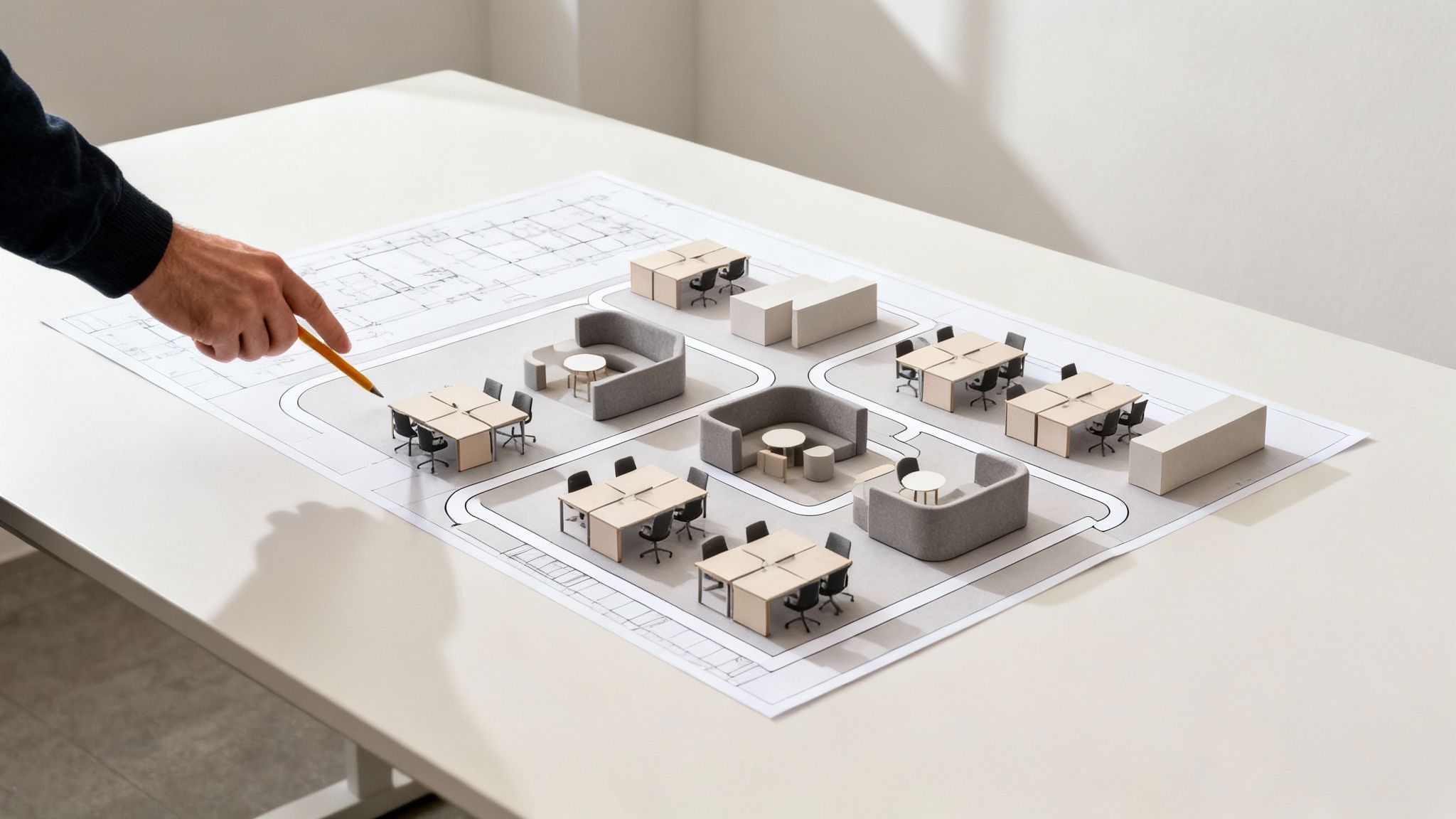
This process establishes a data-driven brief that informs every subsequent decision from the layout to the furniture selection. This ensures the final design is tailored to your organisation’s unique culture and operational demands. A thorough assessment prevents costly design changes later and maximises your return on investment by creating a space that actively supports productivity and employee wellbeing. For organisations in London or Cambridge looking to optimise their footprint expert guidance can identify inefficiencies and opportunities. For a deeper dive into this initial phase you can learn more about GIBBSONN’s approach to office design and space planning.
Actionable Tips for Needs Assessment
- Engage All Levels: Conduct surveys or workshops with staff from every department. They possess invaluable firsthand knowledge of daily workflow inefficiencies such as noise distractions or a lack of private spaces for confidential calls.
- Document Pain Points: Go beyond anecdotal feedback. Photograph underutilised areas, map out common foot traffic paths that cause disruption and list recurring complaints like booking meeting rooms or finding quiet zones.
- Project Future Growth: Don’t just plan for your current headcount. Consider your business’s 12 to 24-month growth projections to ensure the new layout remains functional and avoids feeling cramped within a year.
- Analyse Work Patterns: Observe how different teams work. Do they need large project tables, quiet pods for focused tasks or informal breakout areas for spontaneous brainstorming? This analysis is key to creating a truly agile environment.
2. Asbestos and Environmental Surveys
A crucial and legally mandated step in any UK office refurbishment checklist is conducting thorough asbestos and environmental surveys. This is especially true for buildings constructed before the year 2000. This is not an optional extra. It is a legal requirement under the Control of Asbestos Regulations 2012. Before any demolition, drilling or structural work begins you must identify and manage the risks associated with hazardous materials like asbestos which can be present in ceiling tiles, insulation, pipe lagging and flooring.
Failing to complete these surveys can lead to severe legal penalties, project-halting enforcement notices from the Health and Safety Executive (HSE) and most importantly serious health risks for contractors and employees. Many office buildings from the 1970s and 80s in business districts across London, Cambridge and Essex contain asbestos. Proactively managing this stage de-risks the entire project, prevents unforeseen budget blowouts and ensures a safe working environment for everyone involved from start to finish.
Actionable Tips for Asbestos and Environmental Surveys
- Plan and Budget Early: Treat surveys as a non-negotiable upfront cost in your initial project budget. Do not leave it as an afterthought as the findings can significantly impact both your timeline and finances.
- Engage HSE-Accredited Surveyors: Only use UKAS-accredited and HSE-licensed surveyors. This guarantees that the survey is conducted to the correct standard and that the report will be recognised by all regulatory bodies.
- Demand Detailed Hazard Maps: The survey report should include clearly marked-up floor plans or “maps” indicating the precise location, type and condition of any asbestos-containing materials (ACMs) found.
- Factor in Removal and Contingency: If asbestos is found and needs to be removed this requires a specialist licensed contractor. Factor these costs into your main refurbishment budget and add a contingency of at least 10% to cover potential complexities.
- Secure All Compliance Paperwork: Once removal is complete you must obtain a certificate of reoccupation and consignment notes for the waste. These documents are your legal proof of safe and compliant disposal and are essential for your project records.
3. Budget Definition and Cost Planning
Establishing a realistic and comprehensive budget is a non-negotiable step in any office refurbishment checklist. This stage moves beyond a simple top-line figure to a detailed breakdown of all potential expenditures. A well-structured budget provides clarity, manages stakeholder expectations and prevents scope creep. This ensures funds are allocated strategically to the areas that deliver the most value. It must account for capital costs like structural work and finishes as well as operational costs such as project management, professional fees and temporary relocations.
Without this financial roadmap a project can quickly run into difficulties leading to compromises on quality or an overrun that impacts the business’s bottom line. A detailed cost plan acts as a vital control mechanism allowing for informed decisions and preventing unforeseen expenses from derailing the project. For a clearer understanding of financial expectations for projects in London or surrounding areas like Braintree you can explore a detailed breakdown of the cost of an office fit-out.
Actionable Tips for Budget Definition
- Categorise Your Costs: Separate your budget into distinct categories: ‘must-haves’ (e.g. compliant M&E systems, essential workstations) and ‘nice-to-haves’ (e.g. high-end finishes, bespoke joinery). This allows for easier decision-making if savings are needed.
- Build in Contingency: Always allocate a contingency fund, typically 10-15% of the total project cost. This buffer is crucial for addressing unforeseen issues like the discovery of asbestos, unexpected structural problems or landlord-mandated changes.
- Include Soft Costs: Remember to budget for costs beyond construction. These include professional fees for designers and consultants, statutory fees for planning permission and building control, IT migration and the cost of business downtime or temporary accommodation.
- Benchmark and Verify: Obtain at least two to three detailed quotations from reputable fit-out contractors. Use their expert insights and previous project data to benchmark your estimates against real-world figures, ensuring your budget is grounded in market reality.
4. Building Regulations Approvals and Permits
Navigating the legal requirements of an office refurbishment is a non-negotiable part of the process. This stage involves securing formal approvals for any significant changes to your workspace including structural alterations, new mechanical and electrical (M&E) systems or fire safety upgrades. These permissions are not a mere formality. They are a legal requirement to ensure the safety, accessibility and energy efficiency of your refurbished office protecting both your employees and your business.
Managing this process correctly through a Local Authority Building Control officer or an approved private inspector is essential. Failure to do so can result in serious consequences including legal liability, voided insurance policies and significant complications when you eventually sell or let the property. For businesses in places like Hertfordshire or Essex getting this right ensures your project proceeds without costly delays or legal challenges. This culminates in the necessary completion certificates that validate your investment.
Actionable Tips for Building Regulations
- Engage Building Control Early: Do not wait until construction has started. Involve a Building Control officer during the design phase to review plans. This proactive approach identifies potential compliance issues early saving time and avoiding expensive redesigns.
- Delegate Liaison to Experts: If you are inexperienced let your design and build contractor manage communication with Building Control. They understand the technical language and submission requirements ensuring a smoother process.
- Budget for Inspection Fees: Remember to allocate funds specifically for Building Control. Fees for initial, mid-stage and final inspections can typically range from £2,000 to £8,000 depending on the project’s complexity.
- Obtain Specialist Certifications: Ensure that all electrical and gas installations are carried out by qualified and registered engineers. They must provide the official certificates required for the final Building Control sign-off; a general contractor cannot issue these.
- Maintain Meticulous Records: Keep a comprehensive file of all applications, correspondence, inspection reports and final certificates. This documentation is invaluable for future audits, property sales or lease negotiations.
- Consult Heritage Officers for Listed Buildings: If your office is in a listed building or a conservation area you must engage with local council heritage officers at the earliest opportunity. They have specific requirements that will heavily influence your design and construction methods.
5. Workplace Ergonomics and Health & Safety Planning
An effective office refurbishment checklist must prioritise the health, safety and wellbeing of your employees. This goes far beyond just ticking compliance boxes. It involves proactively designing a workspace that supports physical and mental health. Workplace ergonomics and health and safety planning is about integrating employee wellbeing into the very fabric of the design. It addresses everything from furniture and lighting to air quality and acoustics. This approach ensures compliance with UK regulations like the Health and Safety at Work etc. Act 1974 and DSE Regulations. It also reduces legal risks and absenteeism while boosting productivity and morale.

By embedding these considerations from the initial design phase businesses create an environment where staff feel valued and can perform at their best. For example tech companies that integrate sit-stand desks often see a 25-40% reduction in musculoskeletal complaints. Similarly post-COVID designs increasingly include biophilic elements like plants and natural light to support mental health. This focus on wellbeing is a powerful tool for attracting and retaining top talent in competitive markets like London and Cambridge.
Actionable Tips for Ergonomics and Health & Safety
- Conduct a Wellbeing Survey: Before finalising designs survey your team to identify current pain points. Ask specific questions about physical discomfort, noise distractions, thermal comfort and sources of workplace stress.
- Prioritise Natural and Task Lighting: Position desks and key work zones to maximise exposure to natural light. Supplement this with a task-ambient lighting strategy providing general overhead light alongside individual, user-controlled task lights at each workstation.
- Invest in Acoustic Management: Open-plan offices in busy areas like Essex or Hertfordshire require robust acoustic solutions. Use high-performance acoustic pods, sound-absorbing wall panels and desk screens to create zones for focus and reduce disruptive noise.
- Monitor Air Quality: Install CO2 monitors in high-density areas like meeting rooms and aim to keep levels below 1,000 ppm for optimal cognitive function. Specify low-VOC (Volatile Organic Compound) paints, adhesives and carpets to minimise indoor air pollutants.
- Integrate Sit-Stand Desks with Training: Provide ergonomic sit-stand desks but ensure staff are trained on how to use them correctly. Without proper guidance on posture and alternating between sitting and standing the ergonomic benefits can be lost.
6. Technology Infrastructure and Data/Comms Planning
In a modern office technology is the central nervous system. A crucial part of any office refurbishment checklist is planning your IT infrastructure including network cabling, power distribution, Wi-Fi coverage and server room requirements. This step is about more than just providing internet access. It is about future-proofing your workspace for evolving demands like 5G, the Internet of Things (IoT) and seamless cloud collaboration which are essential for supporting effective hybrid work models.
Integrating technology planning into the initial design phase prevents common but costly pitfalls like poor Wi-Fi dead zones, chaotic cable management and inadequate power for workstations. Post-COVID organisations are investing heavily in professional AV setups for video conferencing rooms often adding £15,000-£25,000 per meeting pod. Addressing these needs early in your project avoids expensive and disruptive remediation work after handover ensuring your new office is as functional as it is beautiful.
Actionable Tips for Technology Planning
- Engage IT Consultants Early: Involve your IT team or external consultants during the space planning stage not just before installation. Their input is vital for server room location, power requirements and cabling routes.
- Conduct a Wi-Fi Site Survey: Before finalising the design perform a professional Wi-Fi survey. Building materials like glass partitions and structural steel can severely impact signal strength and a survey identifies potential dead zones.
- Future-Proof Your Cabling: Install Cat6A or fibre optic cabling as standard. The marginal extra cost during refurbishment is insignificant compared to the expense and disruption of a retrofit in a few years.
- Over-Specify Power Distribution: Budget for at least 30% more power and data points than you currently need. This accommodates future growth and the increasing number of devices per employee without overloading circuits.
- Plan for Hybrid Collaboration: Test video conferencing setups with the user experience in mind. Consider room acoustics, camera angles, microphone pickup and screen visibility to ensure seamless communication for remote and in-office staff.
7. Dilapidations Assessment and Lease Compliance
Often overlooked until it is too late a dilapidations assessment is a crucial risk management component of any comprehensive office refurbishment checklist. This professional survey identifies a tenant’s repair and reinstatement obligations at the end of a lease. Ignoring this can lead to unexpected and substantial financial claims from landlords disrupting budgets and creating significant legal friction. The process involves a thorough inspection to determine what constitutes fair wear and tear versus what needs to be made good according to the lease terms.
Engaging with dilapidations early allows for proactive cost planning, negotiation and strategic remediation. For example a London West End tenant facing a £250,000 claim was able to reduce their liability to just £75,000 through a negotiated settlement based on a professional assessment. Understanding your obligations before your lease ends empowers you to control costs and manage the exit process smoothly. For expert guidance on navigating these complex lease-end requirements in London, Cambridge or the surrounding areas a specialist partner can provide invaluable support.
Actionable Tips for Lease Compliance
- Survey Early: Commission a professional dilapidations survey 12 to 18 months before your lease expires. This provides ample time to understand your liabilities, plan any necessary works and negotiate with the landlord from a position of strength.
- Establish a Baseline: At the start of any new lease request a formal Schedule of Condition from the landlord. If one isn’t available conduct and document your own baseline survey with photos to prevent being held liable for pre-existing issues.
- Prioritise Repairs: In disputes focus negotiations on critical items like structural issues, health and safety failings or building envelope problems. Cosmetic elements like paint and flooring often have more room for negotiation.
- Retain Meticulous Records: Keep all maintenance records, invoices for repairs and compliance certificates. This documentation serves as powerful evidence of diligent upkeep and can significantly strengthen your position during negotiations.
8. Sustainable Refurbishment and Energy Efficiency
Beyond aesthetics and layout a modern office refurbishment checklist must prioritise sustainability and energy efficiency. This involves integrating measures that reduce environmental impact and lower long-term operational costs. It means moving beyond baseline compliance to strategically select energy-efficient lighting and HVAC systems, specify low-carbon materials and implement robust waste reduction plans. For any major renovation UK Building Regulations mandate significant energy savings but market and tenant expectations often demand even higher standards.
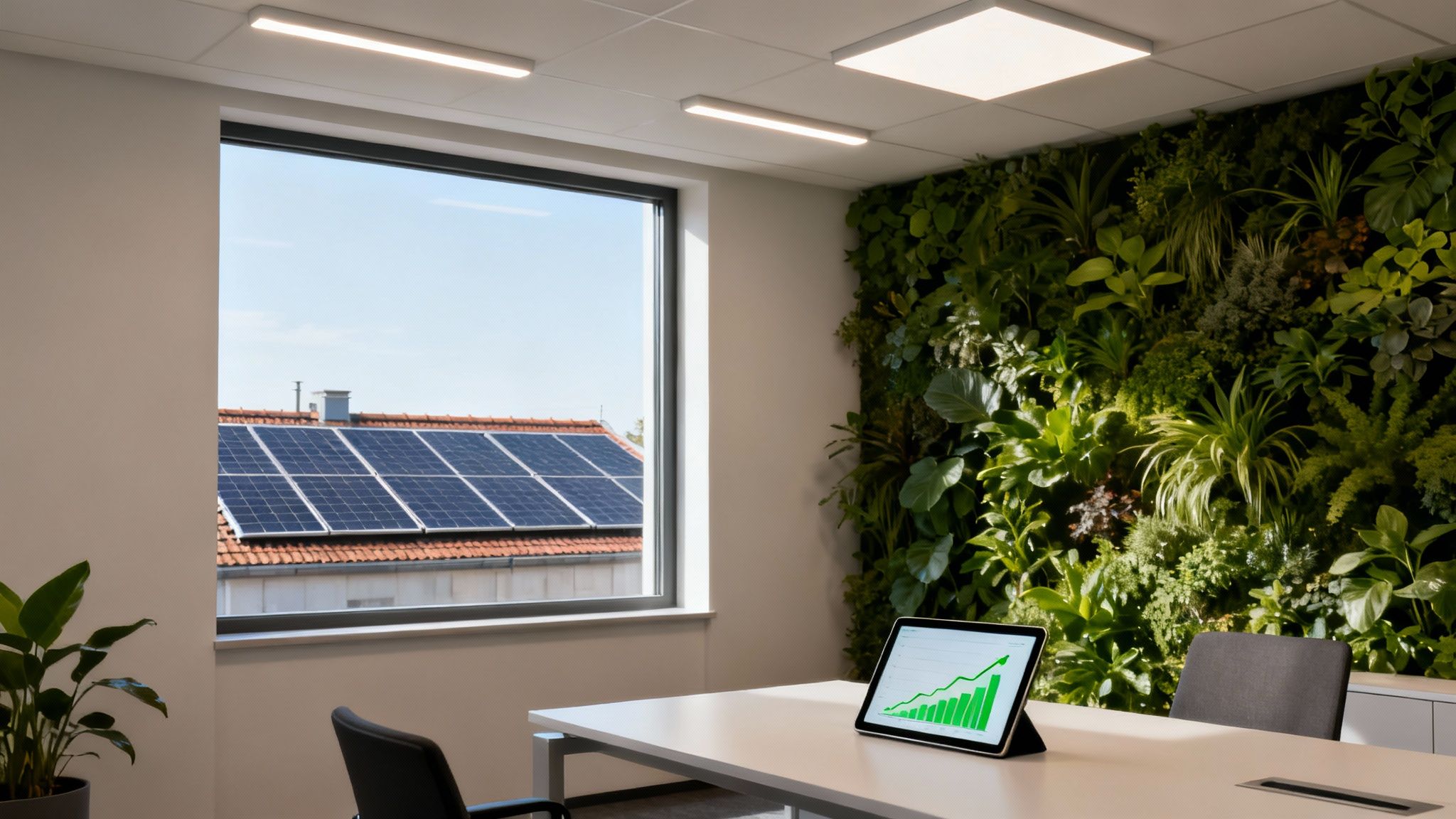
This focus on green credentials is no longer a niche concern. It is a core business imperative that directly supports ESG (Environmental, Social, and Governance) compliance, enhances brand reputation and improves the leaseability and value of a property. For instance a BREEAM ‘Excellent’ fit-out for a Milton Keynes firm achieved a 25% energy saving versus the baseline which significantly boosted its appeal to prospective tenants. A sustainable approach creates a healthier indoor environment for staff and delivers a clear return on investment through reduced utility bills and future-proofs the asset against rising energy costs and stricter regulations.
Actionable Tips for Sustainable Refurbishment
- Conduct an Energy Audit: Before any work begins commission a professional building energy audit. This will identify the most high-impact and cost-effective measures such as upgrading an office in Bishop’s Stortford from an EPC D rating.
- Prioritise Lighting and Controls: Start with LED lighting combined with occupancy and daylight sensors. This is often the lowest-cost upgrade with the fastest payback with some London office projects reducing lighting energy consumption by up to 70%.
- Specify Low-VOC Materials: Choose paints, carpets, adhesives and furniture with low or zero Volatile Organic Compounds (VOCs). This improves indoor air quality for employee wellbeing and carries a significant environmental benefit.
- Upgrade HVAC Systems: If the budget allows replacing older heating and cooling systems with modern heat pumps and heat recovery ventilation (HRV) can yield dramatic results. An office in Cambridge saw a 40% reduction in heating energy and better air quality after such an upgrade.
- Target Waste Reduction: Work with your contractor to establish a clear Site Waste Management Plan (SWMP). Aim to divert a high percentage of construction waste from landfill through reuse and recycling schemes.
9. Project Timeline Planning and Stakeholder Communication
A robust project timeline is the central nervous system of any office refurbishment. It governs everything from contractor mobilisation to furniture delivery. This critical planning stage involves mapping out every task, dependency and milestone to create a realistic schedule that minimises business disruption. It’s about more than just setting a completion date. It’s a strategic exercise in sequencing works, managing logistics and crucially keeping all stakeholders informed and aligned throughout the entire process. Without this projects risk delays, budget overruns and a breakdown in confidence.
Effective timeline management prevents operational chaos and ensures a smooth transition. This is particularly true for occupied buildings in busy areas like London or Cambridge. For example a full fit-out of a 10,000 sqm London office might take 16-24 weeks but a phased approach can allow partial occupation throughout. A clear communication protocol ensures that employees, landlords and even customers understand the schedule and any temporary impacts. The complexities involved underscore the value of professional management which is a key component of a successful commercial office fit out.
Actionable Tips for Timeline and Communication
- Develop a Master Schedule: Create a detailed Gantt chart that visualises the entire project. This should include all trades, key dependencies (e.g. plastering must be dry before painting) and critical approval gates like Building Control inspections.
- Build in Contingency: Even the best-laid plans can face unexpected issues. Always build a 10-15% schedule contingency into your timeline to absorb potential delays from supply chain issues or unforeseen site conditions.
- Establish a Communication Plan: Define how and when you will communicate with different stakeholders. This could involve weekly email updates for all staff, daily site reports for the project team and fortnightly steering group meetings for senior leadership.
- Sequence Works Logically: Plan the order of works to maximise efficiency and minimise disruption. Typically this means noisy and disruptive M&E works first followed by partitioning and finishing with flooring, decoration and furniture installation.
- Plan Logistics Meticulously: Coordinate weekly delivery schedules, arrange necessary parking permits and organise site security and waste removal well in advance. For occupied sites establish clear working hour restrictions to protect employees from noise and dust.
10. Quality Assurance, Testing, Handover and Post-Occupancy Evaluation
The final phase of an office refurbishment is not merely about handing over the keys. It’s a critical sequence of quality assurance, system testing, a structured handover and post-occupancy evaluation (POE) that validates the entire project. This stage ensures the finished space is safe, fully compliant and performs precisely as intended. It involves a meticulous process of snagging, commissioning all systems, providing essential training and gathering user feedback to fine-tune the environment.
This comprehensive validation protects your investment by identifying and rectifying issues before they impact your team’s return to the office. A formal handover provides you with all the necessary documentation for future facilities management. A POE offers data-driven insights to optimise the workspace and inform future projects. For businesses in Essex or Hertfordshire a well-managed handover ensures a seamless transition and long-term operational success forming a vital part of any professional office refurbishment checklist.
Actionable Tips for Testing and Handover
- Define Standards Early: Specify all quality benchmarks and testing protocols in the initial tender documents. Don’t leave critical standards like acoustic performance or network speed to the contractor’s discretion.
- Create a Handover Pack: Insist on a detailed handover pack. This must include as-built drawings, all Operation & Maintenance (O&M) manuals, warranty documentation for furniture and equipment and a list of emergency contacts for key systems.
- Conduct Independent Commissioning: For critical systems like fire safety, HVAC and IT infrastructure commission independent testing. This avoids any potential contractor bias and provides impartial verification that systems meet regulatory and performance standards.
- Schedule Post-Occupancy Reviews: Plan formal reviews at 30 and 90 days post-handover. This allows your team to identify any emerging defects or practical issues that only become apparent through daily use ensuring they are addressed promptly.
Office Refurbishment: 10-Point Checklist Comparison
| Item | 🔄 Implementation complexity | ⚡ Resource requirements | ⭐ Expected outcomes / 📊 Impact | 💡 Ideal use cases | Key advantages |
|---|---|---|---|---|---|
| Comprehensive Space Planning and Needs Assessment | Medium–High: stakeholder workshops, surveys (4–8 weeks) | Moderate: consultancy time, occupancy data, analysis tools | ⭐⭐⭐⭐ Optimised layouts, reduced redesign risk, productivity gains | Growing or hybrid organisations; pre-refurbishment strategy | Aligns space with business goals; prevents costly rework |
| Asbestos and Environmental Surveys | Medium: licensed surveys, sampling (adds 2–3 weeks) | Specialist surveyors, labs, remediation budget | ⭐⭐⭐ Legal compliance, health risk mitigation, avoids stoppages | Buildings built before 2000; any demolition/refurbishment work | Protects legal/insurance position; prevents mid-project halts |
| Budget Definition and Cost Planning | Medium: detailed cost modelling and value engineering | Cost consultants, multiple contractor quotes, benchmarking data | ⭐⭐⭐⭐ Predictable costs, prioritised scope, ROI clarity | Any refurbishment requiring financial approval or board sign-off | Prevents overruns; enables prioritisation and stakeholder buy-in |
| Building Regulations Approvals and Permits | High: applications, inspections, possible redesign (adds 4–8 weeks) | Design liaison, inspection fees, documentation effort | ⭐⭐⭐⭐ Statutory compliance, safe handover, insurability | Structural, M&E or fire-safety changes; major refurbishments | Removes legal/insurance risk; required for lawful occupation |
| Workplace Ergonomics & Health & Safety Planning | Medium: specialist assessments integrated into design | Ergonomist, acoustician, occupational health input, better fixtures | ⭐⭐⭐⭐ Improved wellbeing, reduced absence, higher productivity | High-density/open-plan offices; employee-centric workplaces | Enhances staff retention and duty of care; reduces sick leave |
| Technology Infrastructure & Data/Comms Planning | High: cabling, Wi‑Fi surveys, AV, cybersecurity design | IT consultants, AV integrators, higher upfront capex (8–12%) | ⭐⭐⭐⭐ Reliable connectivity, hybrid-work enablement, lower downtime | Hybrid models, secure-data environments, AV-heavy spaces | Future-proofs IT; reduces support burden and costly retrofits |
| Dilapidations Assessment & Lease Compliance | Low–Medium: survey, negotiation, remedial planning | Dilapidations surveyor, remediation contractors, contingency | ⭐⭐⭐ Quantified liability, negotiation leverage, budget clarity | Lease-end planning; tenants needing reinstatement guidance | Reduces unexpected landlord claims; protects deposits |
| Sustainable Refurbishment & Energy Efficiency | Medium–High: energy modelling, specification, certification | Sustainability consultants, premium materials, potential capex uplift | ⭐⭐⭐⭐ Energy/OPEX reductions (10–30%), ESG and leaseability gains | Organisations targeting Net Zero, improved EPC or BREEAM ratings | Lowers long-term costs; improves marketability and compliance |
| Project Timeline Planning & Stakeholder Communication | Medium: critical-path scheduling, phasing, logistics | Experienced PM, communication channels, coordination meetings | ⭐⭐⭐⭐ Minimised disruption, clear milestones, timely delivery | Occupied refurbishments; phased or multi-stakeholder projects | Keeps business running; reduces surprises and delays |
| Quality Assurance, Testing, Handover & POE | Medium: testing, commissioning, snagging, POE (adds 2–4 weeks) | Specialist testers, commissioning engineers, POE tools | ⭐⭐⭐⭐ Safe compliant handover, fewer post-occupancy defects | All projects requiring compliant, optimised handover | Validates performance; enables continuous improvement and warranties |
Ready to Transform Your Workspace?
Navigating the complexities of an office refurbishment can feel overwhelming. From the initial planning and needs assessment to the final handover and evaluation every element must work in harmony. This detailed office refurbishment checklist has provided a comprehensive roadmap. It guides you through the critical stages that define a successful project. We have unpacked the nuances of budgeting, the legalities of building regulations and the technical demands of IT and acoustic engineering.
The journey from a tired office to a vibrant productive environment is built on diligent planning and meticulous execution. The most crucial takeaway is that a refurbishment is far more than a cosmetic update. It is a strategic investment in your people, your culture and your brand’s future. By prioritising aspects like ergonomic design, sustainable practices and robust technology infrastructure you are not just changing the colour of the walls but fundamentally enhancing how your team works, collaborates and thrives.
Mastering Your Refurbishment: Key Takeaways
Recapping the most vital points from our checklist, successful projects are underpinned by three core principles:
- Proactive Planning: The work done before a contractor arrives on site is the most significant predictor of success. This includes everything from asbestos surveys and dilapidations assessments to detailed space planning that aligns with your future business goals. Rushing this stage almost always leads to costly overruns and compromises down the line.
- Integrated Expertise: An office refurbishment is a multi-disciplinary effort. It requires seamless coordination between designers, project managers, building control officers, IT specialists and furniture suppliers. Attempting to manage these threads without a central experienced project lead can quickly become overwhelming and inefficient.
- Focus on the End-User: Ultimately the space is for your people. Involving them in the process, understanding their needs through workplace analysis and prioritising their wellbeing through ergonomic and biophilic design will deliver the greatest return on investment. A beautiful office that doesn’t function for its inhabitants has failed in its primary purpose.
By embracing this structured approach you move from simply managing a project to strategically directing an organisational transformation. The benefits extend far beyond aesthetics leading to improved employee retention, increased productivity and a workspace that genuinely reflects your company’s values and ambitions. Whether you are a facilities manager in Cambridge or a business owner in Chelmsford a well-executed refurbishment can become a powerful catalyst for growth. The ultimate value lies in creating a physical environment that not only supports your current operations but also empowers your team to achieve what’s next. This checklist is your first most essential tool in making that vision a reality.
Ready to transform your workspace? Speak to the GIBBSONN Interiors team today. Whether you are planning a complete fit-out in Essex and Hertfordshire or a phased reconfiguration near Bishop’s Stortford, our team manages every stage to ensure minimal disruption and maximum impact. Our turnkey design-and-build service means you have a single point of contact responsible for delivering your project on time, on budget and to the highest standard.