
So, you’re planning a new office. It’s an exciting time, but the big question on everyone’s mind is always: what’s this going to cost?
Nailing down your budget upfront is the single most important step for a smooth project. In the UK, the average office fit out cost lands somewhere between £40 and £150+ per square foot. Where you fall on that spectrum depends entirely on your vision.
Think of it like choosing a new car. You could go for a reliable, no-frills model that gets the job done perfectly well. Or, you could opt for a mid-range version with more comforts and better tech. Then there’s the luxury option, the one with all the bells and whistles, premium finishes, and a serious wow factor. An office fit out follows the same logic.
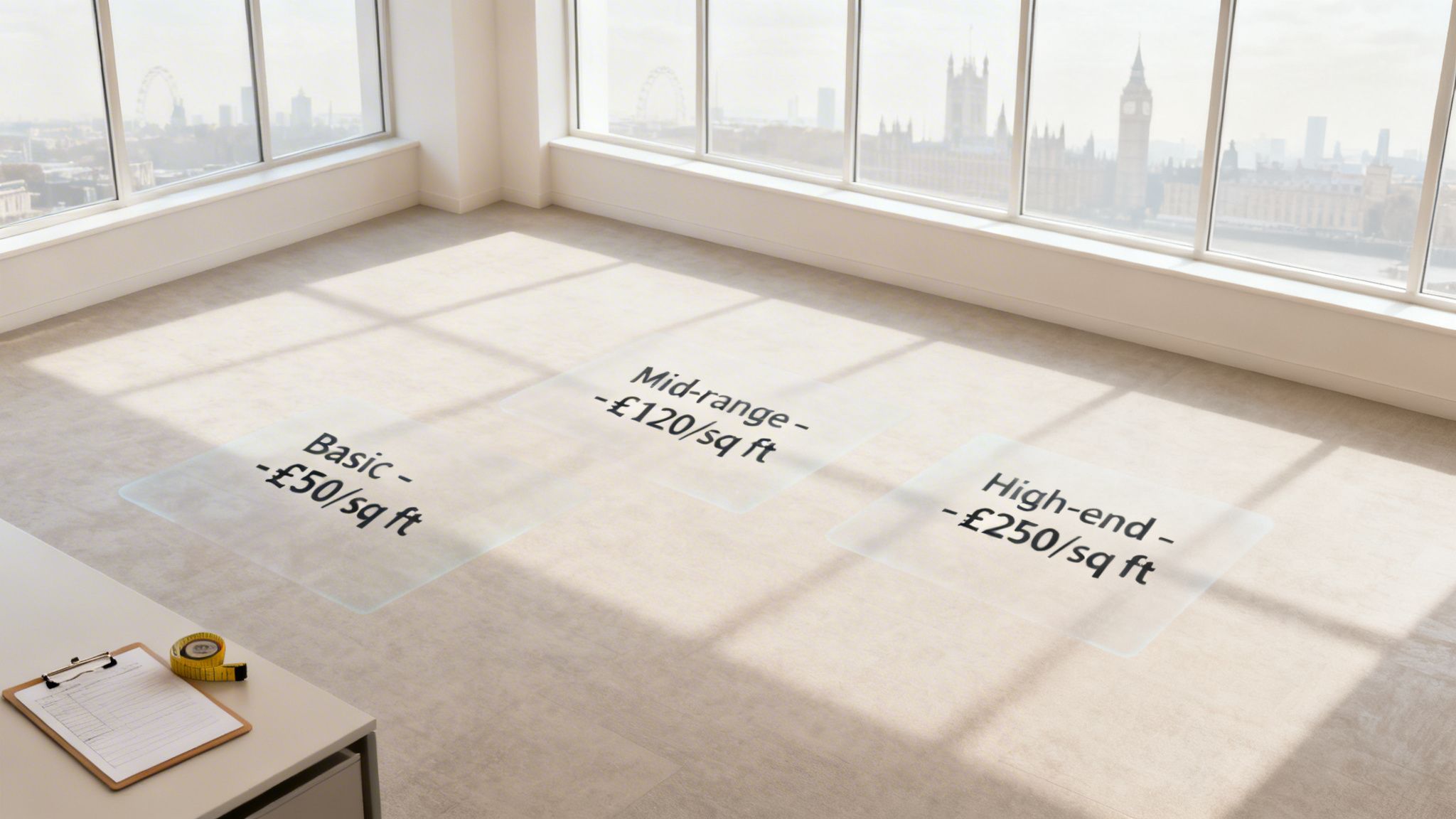
Table of Contents
- Typical UK Office Fit Out Costs
- Understanding Cat A and Cat B Fit Outs for 2026
- A Detailed Breakdown of Where Your Money Goes in 2026
- How Location and Quality Influence Your Final Cost for 2026
- Smart Ways to Manage Your Fit Out Budget for 2026
- Future Proofing Your Workspace Investment for 2026
- Frequently Asked Questions About Office Fit Out Costs
Typical UK Office Fit Out Costs Per Square Foot
To help you get a clearer picture, we’ve put together a simple breakdown of what to expect. These figures are a fantastic starting point for those initial budget conversations, whether you’re setting up a new HQ in Hertfordshire or giving your current space a much-needed refresh.
This table provides a quick overview of estimated costs for different levels of office fit out, helping you to ballpark your initial budget.
| Fit Out Level | Typical Cost Range (per sq ft) | Best For |
|---|---|---|
|
Basic / Good |
£40 – £60 |
Start-ups, functional spaces, or those on a tight budget needing essential finishes. |
|
Mid-Range / Better |
£60 – £90 |
Growing businesses wanting a balance of quality, aesthetics, and value. |
|
High-End / Best |
£100 – £150+ |
Established companies looking for a premium, client-facing environment with bespoke features. |
These cost bands give you a solid foundation for planning, but the real magic happens when we start looking at the details.
What Does Each Level Include?
A basic fit out is all about getting the essentials right to create a functional, working environment. You can expect:
- Standard partitioning and doors
- Good quality carpet tiles and simple decoration
- Functional lighting and power distribution
- Entry-level, durable office furniture
Stepping up to a mid-range project is where you start to introduce more design personality and higher-quality materials. This level often includes stylish glass partitions, better acoustics for focused work, a more impressive reception area, and a well-equipped kitchen or breakout space. It’s the go-to choice for businesses in hubs like Bishop’s Stortford that want to create a space that feels both professional and inspiring.
A high-end fit out, on the other hand, is designed to make a statement. We’re talking about bespoke joinery, premium finishes like stone or hardwood, sophisticated audio-visual systems, and unique, custom-designed features that bring your brand’s identity to life.
Understanding Cat A and Cat B Fit Outs for 2026
As you start exploring an office move or a much-needed refurbishment, you’ll quickly run into two key terms: Category A and Category B. Getting a firm grip on what they mean is the first, most crucial step in understanding the true cost of your fit out.
Let’s use a simple analogy. Imagine you’re getting a new home. The Cat A fit out is like the house after the builders have finished. You have walls, basic plumbing, and electrics. It’s a clean, empty shell, but you wouldn’t want to live in it just yet.
The Cat B fit out is everything that turns that house into your home. It’s the kitchen you choose, the carpets you lay, the walls you paint, and all the furniture you bring in to make it yours.
What Is a Category A Fit Out? The Landlord’s Bit
A Category A (Cat A) fit out is the baseline finish a landlord typically provides when you lease a commercial space. It’s all about getting the building ready for a tenant to come in and add their own bespoke touches. In essence, it’s the functional foundation of the office.
So, what does that usually cover?
- Raised floors and suspended ceilings: This creates the void space needed to run data cables, power, and install modern lighting.
- Basic mechanical and electrical (M&E) services: Think of the essentials like functional lighting, heating, ventilation, and air conditioning (HVAC) systems.
- Fire detection and safety systems: Core safety features like smoke alarms and sprinklers are installed and ready to go.
- Finished internal walls: The main perimeter and core walls will be plastered and primed, ready for a lick of paint.
A Cat A finish gives you a safe, functional, but completely empty space. It’s a blank canvas waiting for a business to stamp its identity on it, and it’s a standard you’ll find in commercial properties across the UK, from regional hubs to major centres like London.
What Is a Category B Fit Out? The Tenant’s Touch
This is where the magic really happens. A Category B (Cat B) fit out is the process of transforming that empty Cat A shell into a fully functioning workspace that truly reflects your company’s brand, culture, and day-to-day needs.
Frankly, this is the part we live for. It covers every element that makes an office feel like it belongs to you.
“A Cat B fit out is where we install everything from meeting rooms, kitchens, and breakout zones to branded graphics, specific lighting, and all your furniture. It’s the stage that creates the environment your team will work in every day.”
The Cat B stage is a massive part of your project and has the biggest impact on your final office fit out cost. It’s where all the decisions about how your team will work and feel are made.
Here’s a quick look at what’s involved:
| Cat B Element | Description |
|---|---|
|
Space Planning** |
Crafting the perfect layout with offices, meeting rooms, and collaborative zones tailored to your team. |
|
Partitions |
Building the internal walls, often using glass or solid materials, to create different spaces and zones. |
|
Finishes |
Choosing and applying paint colours, laying flooring like carpet or vinyl, and adding branded wall graphics. |
|
Furniture |
Selecting, supplying, and installing every desk, chair, storage unit, and piece of breakout furniture. |
This is by far the most creative and personal stage. It’s where your vision for the look, feel, and flow of your new workspace comes to life, ensuring it’s perfectly aligned with your business goals for 2026 and well into the future.
A Detailed Breakdown of Where Your Money Goes in 2026
So, you’ve got a rough per-square-foot figure in mind, but what does that actually buy you? An office fit out budget is a bit like a pie, made up of several key slices. Understanding what goes into each slice is the secret to avoiding any nasty surprises down the road.
Think of it like building a house. You don’t just pay for the bricks and mortar; you’ve also got the architect, the plumber, the electrician, and the decorator to account for. An office fit out works on exactly the same principle, with each specialist element contributing to that final number.
This visual gives a simple summary of the two main fit out types we’ve just covered, illustrating the journey from an empty shell to a fully functioning workspace.
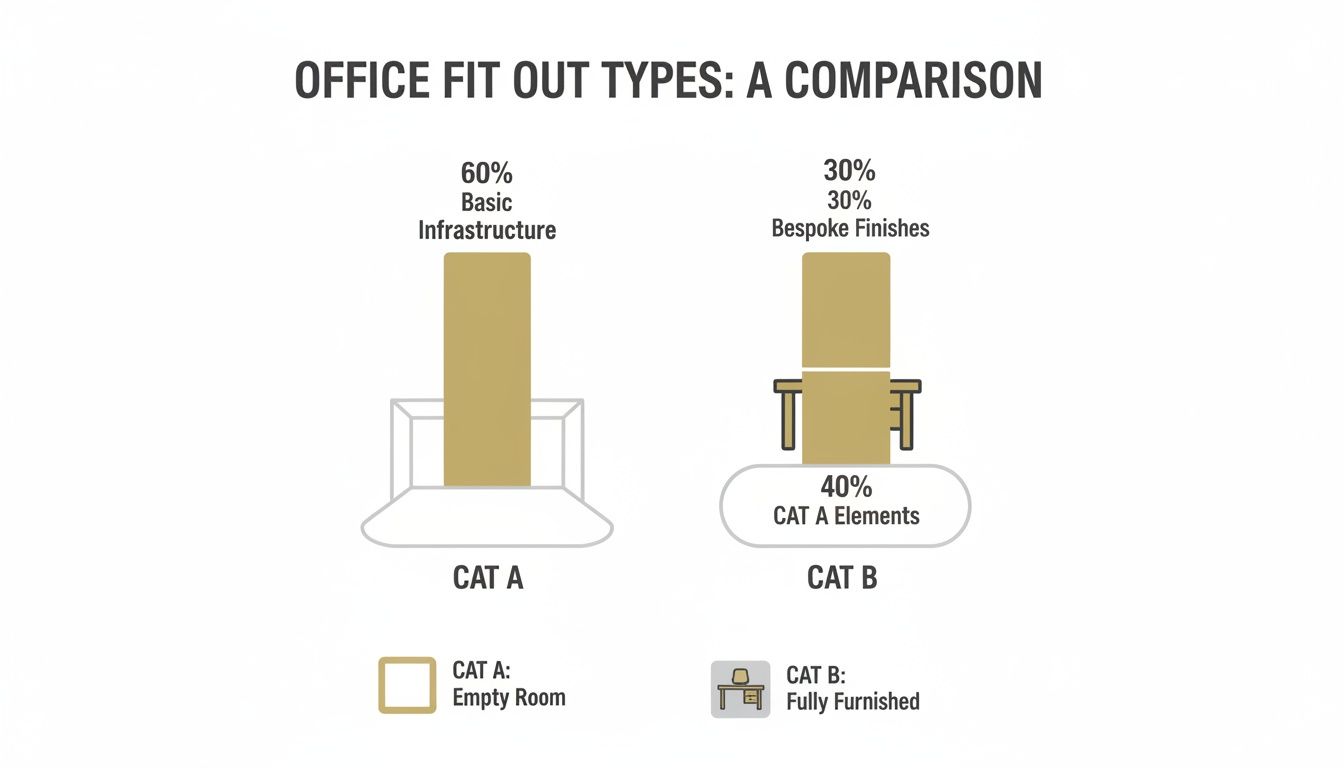
It’s clear that while a CAT A fit out lays the groundwork, it’s the CAT B stage that really brings the space to life and makes it uniquely yours.
Core Construction and Finishes
This is almost always the biggest chunk of your budget. It covers all the physical changes that shape your new office layout, the things you can see and touch.
We’re talking about building solid or glazed partitions to create meeting rooms and private offices, laying new flooring like carpet tiles or LVT, and decorating the space with your brand colours and identity. It also includes creating essential facilities like kitchens, tea points, and breakout areas. This is the work that turns an open-plan shell into a structured, functional environment ready for your team.
Mechanical and Electrical (M&E) Systems
Often hidden behind walls and ceilings, your M&E systems are the lifeblood of a modern office. This part of the budget covers everything from lighting and power distribution to heating, ventilation, and air conditioning (HVAC).
It doesn’t stop there. It also includes critical safety systems like fire alarms and sprinklers. A well-designed M&E system not only keeps your team comfortable and safe but also makes your office energy-efficient, which helps keep those long-term running costs down.
Furniture, Fixtures, and Equipment (FF&E)
Once the space is built, you need to furnish it. The FF&E budget covers every desk, chair, storage unit, and piece of soft seating your team will use day in, day out. This is one area where costs can vary dramatically depending on the quality, style, and ergonomics you opt for.
This is also where specialist equipment comes into play, from a bespoke reception desk that makes a great first impression to specific items for your breakout zones. To get a better handle on what you might need, our ultimate office fit-out checklist is a great place to start.
IT and Professional Fees
No modern office can function without a rock-solid IT infrastructure. This budget line is for all the essentials: data cabling, Wi-Fi networks, and any audio-visual (AV) tech you need for your meeting rooms.
Finally, you have professional fees and a contingency fund. Fees typically cover the cost of design, space planning, and project management, which usually account for 5-10% of the total project cost. A contingency fund, usually around 10% of the total, is an absolutely crucial safety net for any unexpected issues that might crop up during the build.
To give you a clearer idea, here’s a typical percentage-based breakdown for a standard office fit out.
Sample Budget Allocation for a Mid-Range Fit Out
| Cost Component | Percentage of Total Budget |
|---|---|
|
Construction & Finishes |
40% – 60% |
|
Furniture (FF&E) |
15% – 25% |
|
M&E Systems |
15% – 25% |
|
Professional Fees & Contingency |
10% – 15% |
Having a clear picture of these elements from the very beginning helps you plan your spending wisely and ensures every pound is working hard to create the best possible workspace for your team.
How Location and Quality Influence Your Final Cost for 2026
When you start trying to pin down the cost of your office fit out, you’ll quickly find two factors loom larger than all the others: where your office is located, and the level of quality you’re aiming for. Get your head around how these two drivers work, and you’ll have a much clearer picture of what your final budget will look like.
Think of it like this: the exact same project brief can have two wildly different price tags in two different cities. It’s not just about the rent. The cost of skilled labour, materials, and even the logistics of getting things to site can vary enormously across the country.
The Impact of Your Office Location
It’s no great secret that setting up shop in a major city centre carries a premium, and office fit outs are certainly no exception. A project in central London will nearly always cost more than an identical one elsewhere in the UK.
A few key things are at play here:
- Higher Labour Costs: Skilled tradespeople in major cities have higher living and running costs, and their rates reflect that. It’s as simple as that.
- Tricky Logistics: Getting materials, equipment, and teams into a congested city centre is a real headache. Congestion charges, limited parking, and strict delivery time slots all add layers of complexity and cost.
- Building Quirks: City centres are full of older buildings, which can hide a multitude of sins. You might uncover outdated electrical systems needing a complete overhaul or other structural surprises that bump up the budget.
Recent industry reports underline just how stark these regional differences are. In fact, London has been singled out as one of the most expensive markets in the world for an office fit out in 2026. A project in the capital can easily be 20-25% more expensive than one in a city like Manchester, driven primarily by labour and logistical hurdles.
Defining Quality and Its Effect on Cost
The other half of the equation is ‘quality’. This isn’t just about aesthetics; it’s about the durability of the materials, the sophistication of the technology, and the level of craftsmanship you invest in. The easiest way to think about it is a ‘good, better, best’ approach.
A ‘good’ quality fit out is all about being functional, durable, and cost-effective. The goal is to create a professional and practical workspace without the frills. This typically means standard carpet tiles, hard-wearing laminate finishes, and reliable, off-the-shelf furniture.
“Moving up to a ‘better’ quality level is where you start to invest more in your brand’s identity and your team’s experience. This is the sweet spot for many businesses looking for a balance of style and substance.”
At this level, you’ll start to see features like glass partitions to create a more open feel, enhanced acoustic panels to help people focus, and more ergonomic furniture. It’s about creating an environment that feels more considered and comfortable, making it a great fit for growing businesses in places like Essex.
Finally, a ‘best’ quality fit out is where you make a real statement with premium, often bespoke, elements. This could involve:
- Custom joinery for a one-of-a-kind reception desk or feature wall.
- High-end materials like natural stone, real wood veneers, or specialist flooring.
- Advanced smart technology integrated throughout the office for lighting, climate, and AV.
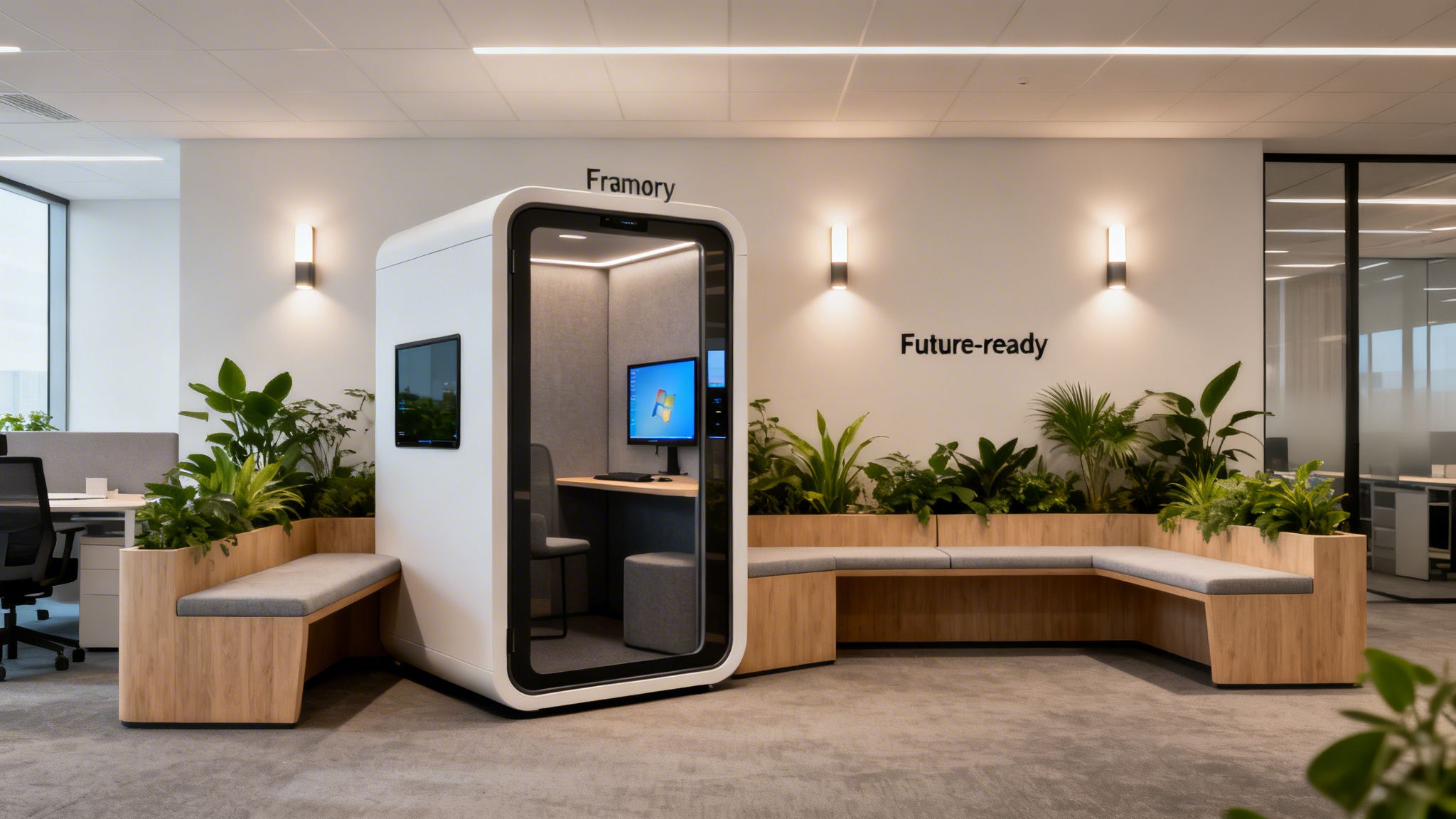
- Top-of-the-line acoustic solutions for ultimate privacy, like the pods from Framery.
Choosing this path significantly increases the office fit out cost, but the result is an exceptional space that becomes a powerful tool for attracting top-tier clients and talent. By understanding where you want to sit on this spectrum, you can strike the right balance between your company’s ambitions and your budget.
Smart Ways to Manage Your Fit Out Budget for 2026
Creating a brilliant new workspace doesn’t have to come with an eye-watering price tag. Far from it. Smartly managing your office fit out cost is all about making informed decisions that deliver the biggest impact without draining your resources. It’s a game of strategy, not just spending.
One of the most effective moves you can make is to bring a design and build partner on board right from day one. When a single, unified team handles both the design and the construction, communication flows, potential problems get flagged early, and the whole process is just smoother. This simple step can save you a fortune in costly late-stage changes and rework.
Get Creative with Cost Effective Solutions
You don’t always need to rip everything out and start again to achieve a fresh, modern look. In fact, some of the most impressive transformations come from incredibly clever, budget-friendly solutions.
Architectural wraps are a fantastic example. These high-quality vinyl films can be applied to almost any surface, think tired-looking doors, dated reception desks, or old wall panels. They convincingly mimic the look of premium materials like wood, metal, or stone, but at a fraction of the cost and with minimal disruption to your business.
It’s an incredibly quick and effective way to modernise an office without the expense, waste, and downtime of a full replacement. This approach is a game-changer for businesses in areas like Braintree looking for a fast and impactful upgrade.
Practical Steps for Smarter Spending
Beyond clever materials, there are several other practical strategies you can use to make your budget go further. These tips can seriously reduce your upfront spending and ensure every pound is working as hard as possible for you.
- Talk to Your Landlord: This is a big one. Before you even sign the lease, start a conversation about a landlord contribution. Many landlords are willing to offer a financial incentive or a rent-free period to help cover fit out costs, as it ultimately increases the value of their property. If you don’t ask, you don’t get.
- Phase Your Project: If the budget is tight, you don’t have to do everything at once. A phased approach lets you prioritise the most critical areas first, like the main workspace and essential facilities, and then tackle other zones later when more funds become available.
- Make Smart Furniture Choices: Furniture is a major expense, so you need to balance initial cost with long-term value. Investing in high-quality, ergonomic task chairs is non-negotiable for staff wellbeing and productivity. But you might be able to save on less-used items, like furniture for informal breakout areas.
- Reuse and Repurpose: Take a proper inventory of your existing furniture and equipment. Can anything be reused, reupholstered, or repurposed for the new space? This isn’t just a great way to save money; it’s also a much more sustainable choice.
“Effective budget management isn’t about cutting corners. It’s about being strategic, planning carefully, and knowing where to invest for the best return on both your finances and your team’s productivity.”
Thinking about these things from the very beginning will put you in a much stronger position. A well-managed budget means you can achieve a fantastic result without the stress of overspending. For more insights on keeping your project on track, check out our guide to effective office fit out project management.
Future Proofing Your Workspace Investment for 2026
An office fit out isn’t just an expense; it’s a strategic investment in your company’s future, your team’s productivity, and your power to attract top talent. To make that investment count for years to come, you have to think about tomorrow’s needs today.
Future-proofing isn’t about chasing fleeting trends. It’s about building genuine flexibility into the very bones of your workspace and embracing how we actually work now. Just a few years ago, things like sustainability or hybrid working felt like optional extras. Today, they are non-negotiable for any forward-thinking business.
Embracing Sustainability and Hybrid Work
Sustainability has moved from a buzzword to a core business principle. While choosing eco-friendly materials or installing energy-efficient systems might nudge your initial fit out cost upwards, the long-term savings on running costs are substantial. It also sends a powerful message to your clients and your team about what your company stands for. You can learn more about creating spaces that are kinder to the planet in our article on designing sustainable office spaces.
At the same time, the huge shift to hybrid working has completely redefined the office. It’s no longer just a place for heads-down desk work. It’s now a central hub for collaboration, connection, and those focused tasks that are impossible to do from the kitchen table.
“A future-proofed office needs a variety of settings. Think dedicated collaboration zones for team projects, quiet areas for deep concentration, and high-quality meeting rooms with integrated tech for seamless video calls.”
Investing in Flexible and Smart Solutions
This new way of working is driving demand for features that add real, long-term value. We’re already seeing factors like hybrid models and sustainability putting pressure on fit out costs heading into 2026. A recent Cushman & Wakefield report, for instance, showed that medium-spec costs in London jumped by 4% in just one year, driven partly by the need for better collaboration spaces and quality finishes.
So, how do you build a workspace that can actually adapt?
- Modular Meeting Pods: These private, acoustically sealed pods are a brilliant solution for adding quiet spaces to an open-plan layout without the permanence of building new walls. Brands like Vetrospace or BlockO offer fantastic, flexible options.
- Adaptable Furniture: Choosing furniture that can be easily moved and reconfigured gives you the freedom to evolve your layout as your team’s needs change over time.
- Integrated Technology: This one’s a given. Your space must have excellent Wi-Fi coverage, easy-to-use AV equipment, and plenty of power points to support a modern hybrid team.
By planning for these elements from day one, you create a dynamic environment that not only serves your business today but is ready for whatever comes next.
Frequently Asked Questions About Office Fit Out Costs
We field a lot of questions about the cost of an office fit out, and frankly, that’s a good thing. The best projects always start with curiosity and a bit of homework, so we’ve gathered a few of the most common queries we hear from clients.
Our goal here is to give you clear, straight-talking answers that will help you feel more confident as you start planning. Let’s jump in.
How Long Does a Typical Office Fit Out Take in 2026?
This is probably the most common question we get, but the answer is always, “it depends.” A simple refresh of an existing space is a world away from a full-scale transformation of an empty shell. The scope and complexity of your vision will set the pace.
To give you a rough idea of what to expect, here’s a general guide:
- Small Projects (up to 2,500 sq ft): You can generally plan for around 4 to 6 weeks from the first day of construction to handover.
- Medium Projects (2,500 to 10,000 sq ft): These typically need 6 to 12 weeks on-site, depending on the level of detail and bespoke work involved.
- Large Projects (10,000+ sq ft): For bigger, more intricate fit outs, you should set aside 12 weeks or more.
It’s crucial to remember that these timeframes cover the physical, on-site construction. You’ll also need to account for the upfront work, initial chats, design development, and getting any necessary permissions signed off. That can easily add several weeks to the start of your project, which is why early planning is so important for businesses in busy areas like Cambridge.
How Can I Get an Accurate Office Fit Out Cost Quote?
Getting a quote you can truly bank on comes down to one thing: detail. The more information and clarity you can give your fit out partner, the sharper their pricing will be. A fuzzy brief will only ever get you a fuzzy estimate.
A reliable quote is born from a detailed conversation that covers your company culture, your team’s daily workflow, and your vision for the future. A good partner will dig deep with questions to understand precisely what you need, not just what you think you want.
“The best quotes come from a deep understanding of your needs. We build our proposals based on detailed drawings and a clear specification, which means there are no nasty surprises waiting for you down the line.”
Do Your Initial Cost Estimates Include VAT?
This is a really important detail for your budget. As a rule, initial cost guides and estimates across the fit out industry are provided exclusive of VAT. This is standard practice, so it’s vital you remember to factor it into your overall project numbers.
When you receive a formal, detailed proposal from us, it will always state clearly whether VAT is included or excluded. You’ll have a completely transparent picture of the total investment needed. Always clarify this point with any potential partner to make sure your financial planning is spot-on from day one.
Ready to transform your workspace? Speak to the Gibbsonn Interiors team today.
Contact Us