
Table of Contents
- What Exactly Is Office Design and Build for 2026?
- The Real-World Benefits of a Design and Build Partner
- Our Step-by-Step Office Design and Build Journey
- Understanding Your Project Costs and Timelines
- Future-Proofing Your Workspace with Smart Design
- Navigating Dilapidations and Building Compliance
- Your Office Design and Build Questions Answered
When you hear the term office design and build, what comes to mind? For many, it’s a bit of a mystery. But in simple terms, it’s the most straightforward, joined-up way to create your perfect workspace.
Instead of you having to find an architect, then a separate building firm, and then acting as the go-between for the entire project, a design and build partner handles everything. From the very first sketch to the final handover of the keys, one expert team manages the entire journey. This single-point-of-contact approach makes your life simpler and the project faster and far more cost-effective.
What Exactly Is Office Design and Build for 2026?
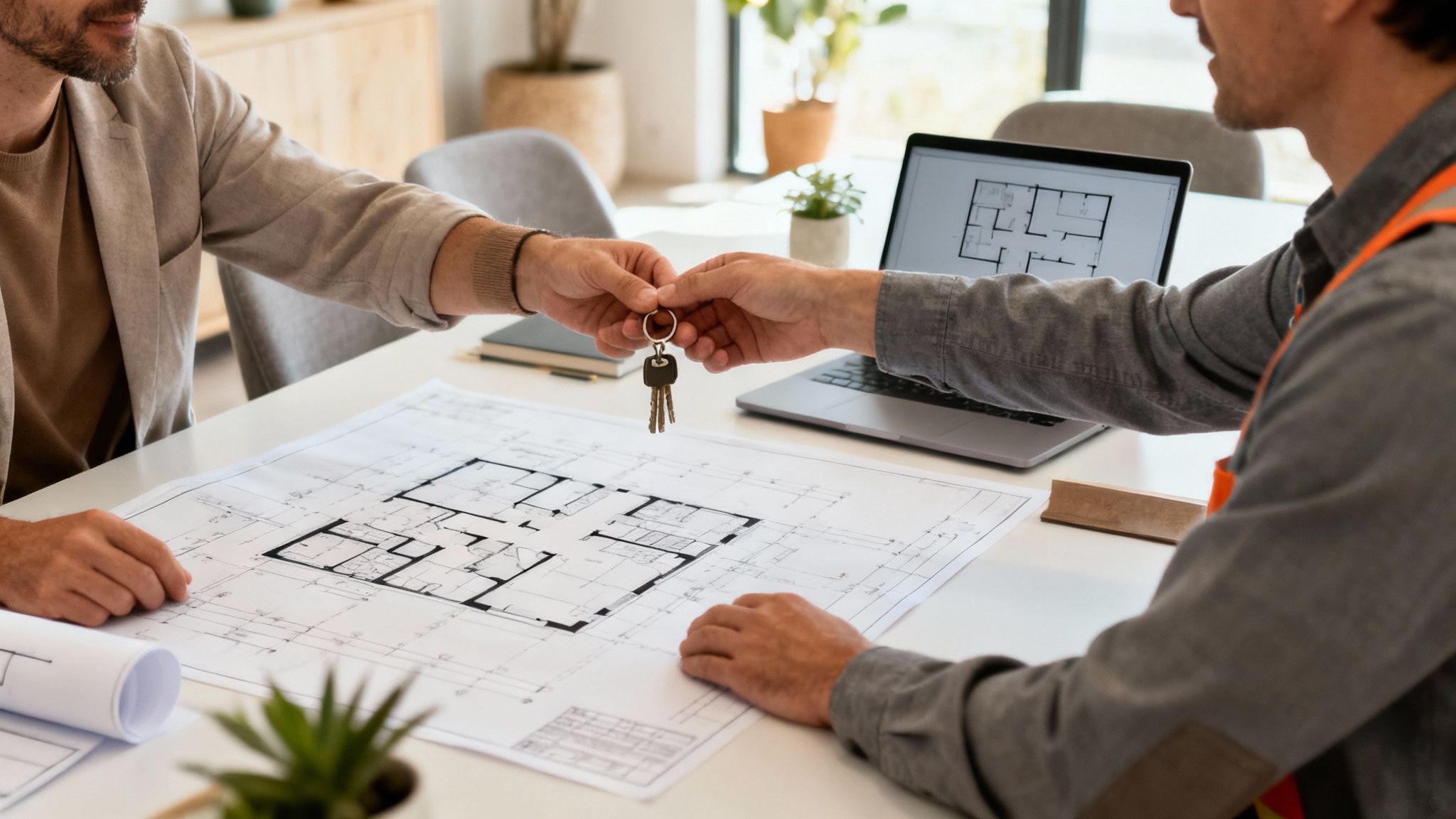
Think about the old way of doing things for a moment. You would hire an architectural firm, go back and forth on designs, and once you finally signed them off, you would then start the long process of finding a construction company to build it. You would be stuck in the middle, managing different contracts, timelines, and personalities, trying to keep everyone on the same page. It’s often a recipe for delays, budget creep, and a lot of stress.
The office design and build model completely flips that script.
It brings designers, project managers, and construction specialists together under one roof from day one. This creates a single team, all working towards the same goal, led by one project lead who is your only point of contact. For businesses in Bishop’s Stortford, London, or Braintree, it means a smooth, transparent process without the usual headaches.
One Team, One Goal
This collaborative approach is a game-changer. When the build team is involved during the design phase, they can spot potential building challenges or suggest more cost-effective materials before they become expensive problems on-site. This proactive thinking saves a huge amount of time and protects your budget from nasty surprises.
Whether your business is based in Cambridge, Chelmsford, Stansted, or anywhere across Hertfordshire and Essex, the mission is always the same: deliver a brilliant workspace, on time and on budget, with one friendly, accountable team leading the way.
So, how does this really stack up against the traditional, fragmented approach? Let’s break it down.
Design and Build vs Traditional Contracting
| Feature | Design and Build | Traditional Method |
|---|---|---|
| Accountability | A single point of responsibility. The buck stops with one company. | Split responsibility between designer and builder, can lead to finger-pointing. |
| Communication | Seamless and direct. Everyone is on the same team from the start. | Often fragmented. You’re the go-between for different companies. |
| Project Speed | Much faster, as design and building phases can overlap. | Slower and more rigid, with a strict sequence of stages. |
| Cost Control | Costs are set much earlier, giving you greater budget certainty. | Designs can be created without real-world build costs, leading to surprises. |
The difference is clear. The design and build model is built for efficiency and partnership, taking the weight off your shoulders and making sure the vision for your new workspace becomes a reality without the drama.
The Real-World Benefits of a Design and Build Partner
So, why has the office design and build model become the clear favourite for so many forward-thinking businesses? Put simply, it delivers real, tangible benefits that go well beyond just a good-looking office. It’s about making the whole journey smoother and getting a far better result for your team and your bottom line.
One of the biggest wins is having a single point of accountability. Instead of you having to play mediator between a separate designer and a builder, you get one dedicated project manager. This immediately cuts out the risk of crossed wires, blame games, or frustrating delays caused by teams that aren’t perfectly in sync.
For any business, but especially those in bustling commercial hubs like London or Cambridge, this unified approach is a massive time and stress saver.
Greater Cost Certainty from Day One
Keeping a tight grip on the budget is, understandably, a major priority for any fit-out project. The design and build method tackles this head-on by getting the construction team involved right from the very beginning.
Their on-the-ground expertise means they can provide realistic costings for design ideas as they’re being developed. This completely avoids the all-too-common problem of falling in love with a design, only to find out it’s way over budget when it goes to different builders. This early collaboration means your budget is actively managed, not just tracked, giving you the confidence that the price you agree is the price you’ll pay.
A More Creative and Functional Workspace for 2026
When designers and builders work shoulder-to-shoulder as one team, it genuinely sparks better ideas. The builders might suggest a new, innovative material or a clever building technique the designers hadn’t considered, while the designers can push creative boundaries, knowing the practical side is already being thought through.
This joined-up problem-solving results in a workspace that doesn’t just look impressive, but functions perfectly for your people. The focus is always on creating an environment that boosts your company culture and makes day-to-day work better. A well-designed office isn’t an expense; it’s a tool for success.
- Improved Productivity: It’s been shown time and again that when people have an environment that truly supports how they work, with the right mix of collaborative hubs and quiet focus zones, their productivity climbs. In fact, 74% of hybrid workers report feeling just as, or even more, productive.
- Enhanced Staff Wellbeing: A thoughtfully designed workspace sends a powerful message: you value your team. Great natural light, ergonomic furniture, and welcoming breakout areas all contribute to higher job satisfaction and help you hold on to your best people.
- Stronger Brand Identity: Your office is a three-dimensional billboard for your brand. A design and build partner makes sure your company’s values and identity are woven into the very fabric of the space, making a lasting impression on clients and new talent alike.
Whether your office is based in Bishop’s Stortford, Chelmsford, or anywhere across Hertfordshire and Essex, these benefits are universal. You can learn more about what to look for in our guide to choosing the right design and build company.
Our Step-by-Step Office Design and Build Journey
So, how does an idea for a better workspace actually become a reality? It’s a great question, and we believe the process should be completely transparent from start to finish. We’ve fine-tuned our office design and build journey to be a genuine partnership, making sure you’re looped in at every important moment.
Let’s pull back the curtain and show you exactly how we turn a vision into a vibrant, functional office. We break the entire project down into clear, manageable stages so you always know what’s happening, what’s next, and who to talk to. It’s all about creating an exceptional space with the least possible disruption to your day-to-day business.
Stage 1: Workplace Consultancy and Briefing
Everything kicks off with a conversation. This first step is probably the most important, as it lays the foundation for everything that follows. We call it workplace consultancy, but really, it’s about us getting to know you, your business, and your people on a much deeper level.
We don’t just ask how many desks you need. We dig into the details:
- Your Company Culture: What’s the real vibe of your business? Are you all about high-energy collaboration, or is there a genuine need for quiet, focused zones?
- Your Team’s Needs: How do your departments actually work? What are the daily frustrations with the current layout, and what would genuinely make their day better?
- Your Future Goals: Where is the business heading in the next few years? We design for where you’re going, not just for where you are now.
This detailed brief becomes our roadmap. It ensures every single design choice we make is tied directly to a business need, whether your office is in Bishop’s Stortford, London, or anywhere across Hertfordshire and Essex.
Stage 2: Creative Design and Space Planning
With a rock-solid brief in hand, our creative team gets to work. This is the exciting part where your ideas start to take shape visually. Using the information from our initial chats, we begin space planning. Think of it as creating a blueprint for productivity.
We map out the natural flow of the office, figuring out the best spots for team hubs, private pods, meeting rooms, and breakout spaces. This is followed by the creative design, where we develop mood boards, 3D visuals, and sample palettes that bring your brand identity to life. It’s a completely collaborative process; we’ll present ideas and refine them with your feedback until we land on a design you absolutely love.
This flow chart shows how our joined-up approach delivers clear benefits at every stage.
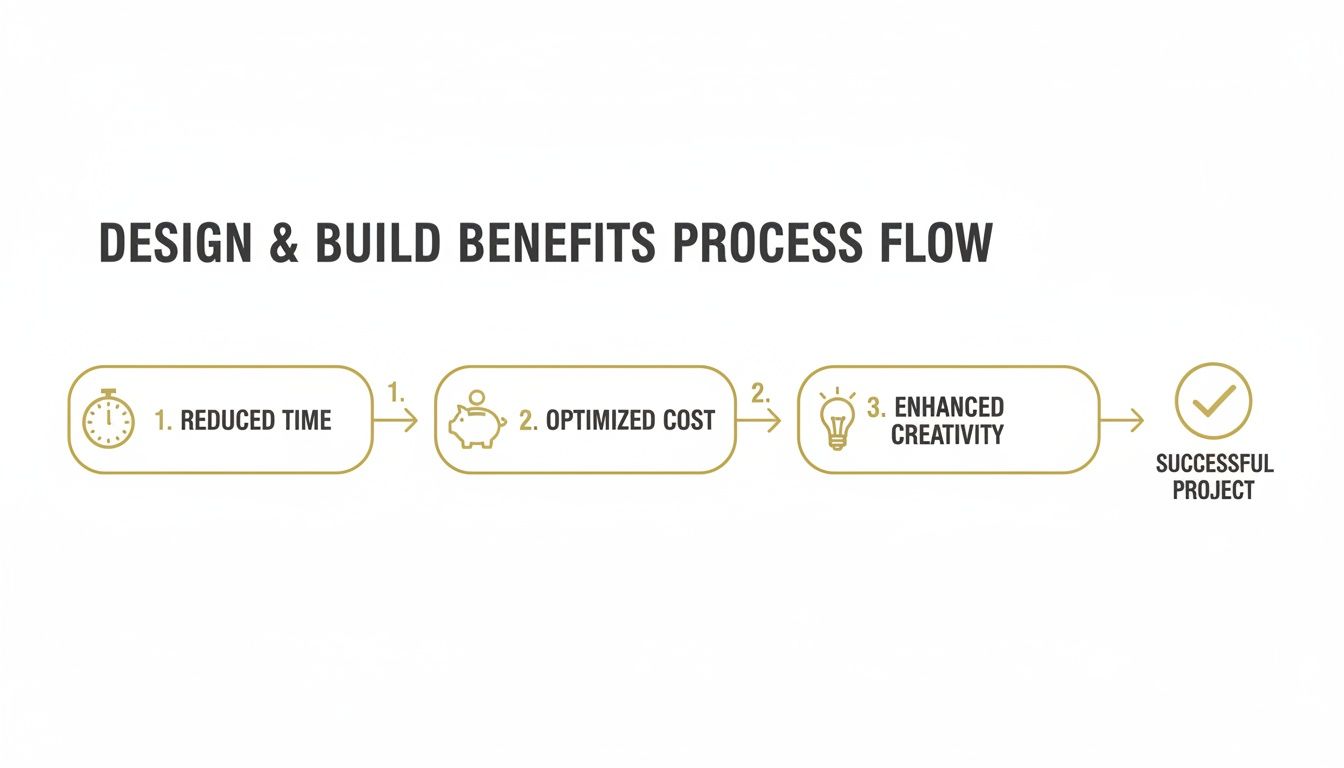
It makes it obvious that by fusing design and build into one process, projects move faster, costs are kept in check, and the potential for creative, practical solutions is massively increased.
Stage 3: Navigating Approvals and Regulations
Before a single wall comes down or goes up, there are some important boxes to tick. Every office fit-out has to follow building regulations, health and safety standards, and sometimes planning permissions. This part of the process can seem daunting, but for us, it’s a core part of the service.
Because we’re managing both the design and the construction, we make sure compliance is built in from the very first sketch. Our team handles all the necessary paperwork and deals with local authorities and building control on your behalf. Whether your project is in Braintree or Cambridge, we take care of the red tape so you don’t have to.
Stage 4: Construction and Installation
Once the designs are signed off and all the permissions are in place, our on-site team takes over. This is where the real transformation happens. Your dedicated project manager will oversee every single aspect of the build, from partitioning and electrics to flooring and decoration.
We get it, you still have a business to run. Our commitment is to keep disruption to an absolute minimum, which we do through careful scheduling, constant communication, and working efficiently to hit our agreed timelines.
Stage 5: Handover and Beyond
The final stage is always the most exciting: handing over the keys to your new workspace. We’ll do a thorough walk-through with you to make sure every last detail is perfect and meets the high standards we set for ourselves.
But our relationship doesn’t end there. We provide you with a full handover pack containing all the vital documents and certificates. We’ll also be on hand to answer any questions as your team settles in, making sure the space works just as hard for your business as you do. From Chelmsford to Stansted, our goal is to deliver a workspace you’re genuinely proud of.
Ready to transform your workspace? Speak to the Gibbsonn Interiors team today.
Understanding Your Project Costs and Timelines
Whenever an office transformation is on the table, two questions always come up: “How much is this going to cost?” and “How long will it take?” Getting straight answers isn’t just helpful; it’s essential for making confident decisions, and it’s a huge part of what makes the office design and build approach so effective.
Getting a firm grasp on the what and why behind your project’s budget and schedule from day one helps you plan properly and kills the risk of nasty surprises down the road. Whether you’re planning a small refresh in Bishop’s Stortford or a major fit-out in central London, the core ideas are exactly the same.
What Really Shapes Your Office Fit Out Cost for 2026?
The final number on an office fit-out invoice is a mix of several key factors. It’s never just about the square footage; the level of detail and the technical complexity of the job play a massive role.
Here are the main cost drivers you need to have on your radar:
- Specification of Finishes: This is all about the materials you choose, and it makes a huge difference. Think bespoke joinery, high-end flooring, and premium lighting versus standard, off-the-shelf options.
- Mechanical and Electrical (M&E) Systems: This is a big one. The complexity of your heating, ventilation, air conditioning (HVAC), and electrical systems can easily become a major slice of the budget. Upgrading to smart, energy-efficient systems might cost more up front, but the long-term savings can be significant.
- Office Furniture: The choice between standard desking and high-spec ergonomic furniture will naturally shape the budget. The same applies to everything from breakout furniture and meeting room tables to storage solutions.
- Location and Building Condition: The state of the building itself is a key factor. A brand-new empty shell might need everything installed from scratch, whereas an older building could need more work to get it up to modern standards.
Recent industry analysis shows that fit-out costs are climbing. A 2025 guide from Cushman & Wakefield revealed that average costs in London were anywhere from £126 to £308 per square foot, all depending on the level of specification. You can dig into the complete breakdown of UK office fit-out costs to see how these numbers shift from city to city.
A Realistic Look at Project Timelines
Just like with costs, the timeline for a design and build project depends on its size and complexity. Knowing how long each stage typically takes is key to managing everyone’s expectations. Our transparent process means you’ll know what’s happening and when, whether your project is in Braintree, Cambridge, or anywhere across Hertfordshire.
To give you a clearer picture, here’s a simple breakdown of typical timelines based on project size.
| Project Size (sq ft) | Typical Timeline | Best Suited For |
|---|---|---|
| Up to 2,500 | 4 – 8 Weeks | Small office refurbishments or creating specific new zones within an existing space. |
| 2,500 – 10,000 | 8 – 14 Weeks | A full floor fit-out for a medium-sized business, involving multiple new spaces and M&E work. |
| 10,000+ | 14+ Weeks | A complete, multi-floor transformation or a complex fit-out from a shell and core state. |
These are a guide, of course, but the design and build model is brilliant for speeding things up. Because the design and construction planning phases can overlap, we can often shave valuable time off the traditional schedule. It’s an efficient approach we bring to clients across Chelmsford, Stansted, and the wider Essex region.
If you’re wondering about the financial side of your project, take a look at our deeper dive into the cost of an office fit out.
Ready to transform your workspace? Speak to the Gibbsonn Interiors team today.
Future-Proofing Your Workspace with Smart Design
The world of work doesn’t stand still, and your office shouldn’t have to, either. A truly effective workspace is one that not only meets your needs today but is also flexible enough to adapt to whatever tomorrow brings. This is what we mean by “future-proofing”, and it’s a core part of any smart office design and build strategy.
It’s all about creating a space that can evolve with your team, your technology, and your business goals. For companies in fast-paced environments like Stansted or Chelmsford, this adaptability isn’t just a nice-to-have; it’s essential for long-term success. The good news is, achieving this flexibility doesn’t always need a huge, disruptive overhaul.
Introducing Flexibility with Modular Meeting Pods
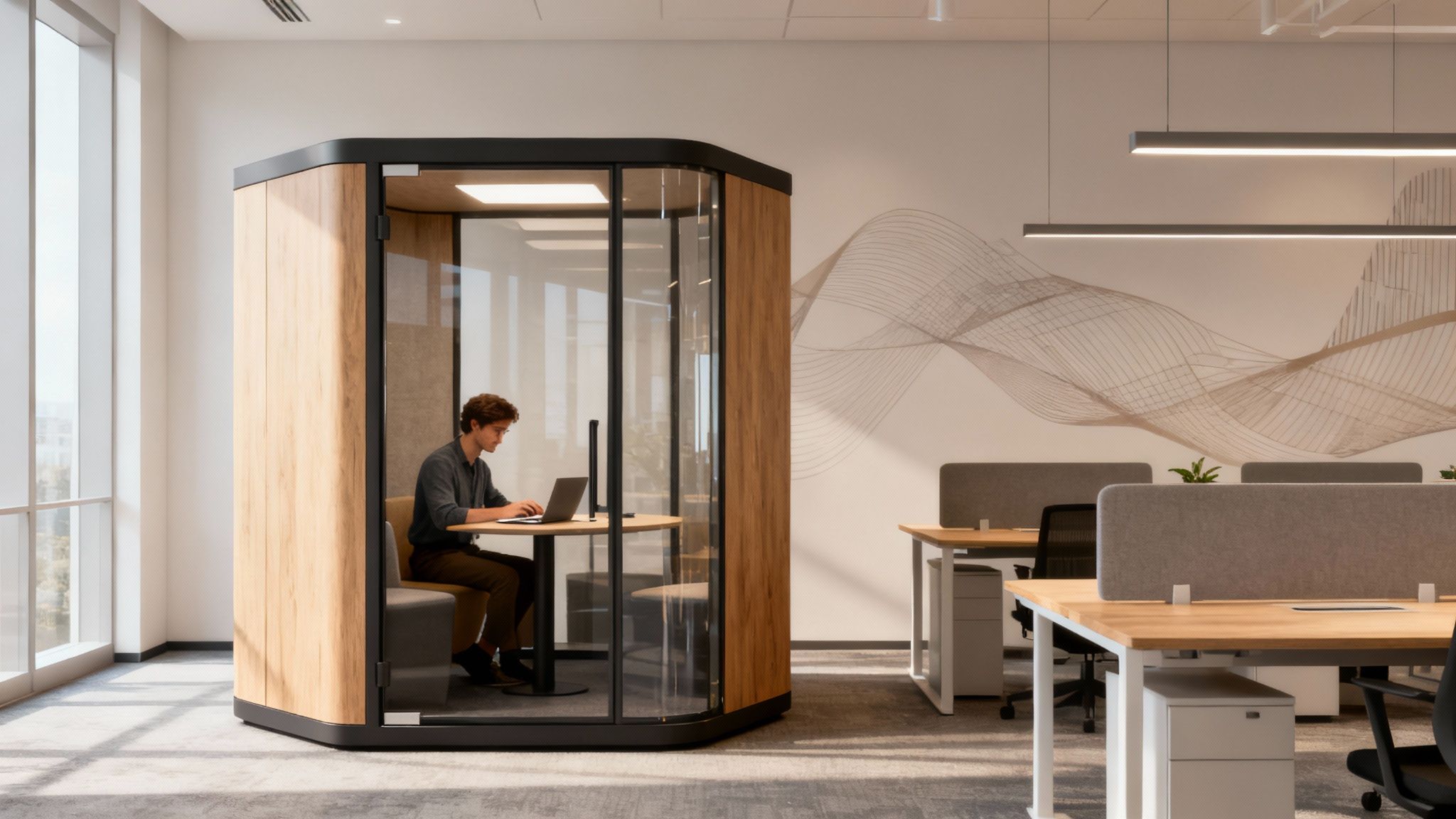
One of the simplest yet most powerful ways to make an office more adaptable is with modular meeting pods. Think of them as high-quality, self-contained rooms that can be dropped right into an existing open-plan space. They offer an instant fix for one of the biggest headaches in modern offices: the lack of private, quiet zones.
These pods are brilliant for a few key reasons:
- Acoustic Privacy: They provide a soundproofed haven for confidential calls, focused work, or one-to-one meetings without distractions.
- Quick Installation: Unlike building traditional partitioned rooms, pods from top manufacturers like Vetrospace, BlockO, or Framery can be installed with minimal disruption to your team.
- Total Flexibility: If you decide to reconfigure your office layout or even move to a new building, you can simply dismantle the pod and take it with you.
This kind of agility is invaluable. It allows you to respond quickly to your team’s changing needs without committing to permanent, structural changes that are costly to undo.
Transforming Surfaces with Architectural Wrapping
Another fantastic tool for future-proofing your space is architectural wrapping. This is a clever and incredibly cost-effective technique that involves applying a specialist vinyl film to existing surfaces to completely change their look and feel.
Instead of the expense and mess of replacing tired-looking doors, reception desks, wall panels, or even kitchen units, we can wrap them. This instantly revitalises the space with a fresh, modern aesthetic, and the process is fast and clean. It’s a perfect solution for businesses across Hertfordshire and Essex looking to make a big visual impact without a big budget or long downtime.
The growth in office refurbishment tells a clear story. The UK’s interior design sector, a key part of office design and build, grew to £1.9 billion in revenue by 2025. This was largely driven by refurbishments, which made up 83% of new office activity as companies worked to create spaces that would attract hybrid workers back. You can find more detail in this interior design industry report.
By combining smart solutions like modular pods and architectural wraps, you create a workspace that is truly built for the future. You can also explore how these fit into a wider strategy in our article on designing sustainable office spaces for 2026.
Navigating Dilapidations and Building Compliance
Beyond the creative vision and exciting designs, every office project has a serious side. Two of the most critical parts are dilapidations and building compliance. Getting these right isn’t just good practice; it’s your shield against hefty fines and stressful legal battles down the road.
Because we handle everything under one roof with our office design and build model, these crucial details are built in from day one. We ensure your new space isn’t just beautiful but also bulletproof, giving you total peace of mind, especially for our clients in Braintree and across Essex.
What Are Dilapidations?
If you’re a tenant, ‘dilapidations’ is a word you really need to get to grips with. Put simply, it’s your contractual duty to hand the property back to the landlord in its original state when your lease is up. It’s all there in the small print of your lease agreement.
This usually means stripping out everything you’ve added (partitions, bespoke branding, unique flooring) and fixing any wear and tear that goes beyond the everyday. Get this wrong, and you could be facing a massive claim from your landlord. It’s the kind of nasty surprise no business needs at the end of a tenancy.
Our team takes the entire dilapidations headache off your plate. We’ll dive into your lease, figure out exactly what’s needed, and carry out all the reinstatement work to a high standard. It’s the best way to avoid disputes and unexpected bills.
Staying Compliant with Regulations in 2026
Every single office fit-out or refurbishment in the UK is governed by a whole host of building regulations and health and safety standards. These rules cover everything from fire safety and wiring to accessibility and airflow. They aren’t optional; they’re there to keep everyone in the building safe.
Trying to navigate this complex web of regulations can be daunting, to say the least. This is where having a single design and build partner really proves its worth. We have the expertise to weave compliance into the design from the very first sketch, not just bolt it on as an afterthought.
The market trend towards refurbishment makes this even more critical. In the first half of 2025, an enormous 83% of new office activity in the UK was refurbishments, not new builds. In London, the figure was around 80%, a clear signal that businesses are choosing to upgrade what they already have. You can dig into these UK office market trends for more detail.
For businesses all over Hertfordshire, from Bishop’s Stortford to Cambridge, we manage all the necessary paperwork and approvals. This gives you the confidence that your new workspace is fully compliant and ready for the future.
Ready to transform your workspace? Speak to the Gibbsonn Interiors team today.
Your Office Design and Build Questions Answered
Starting an office design and build journey always sparks a few questions. To give you some clarity, we’ve gathered the most common queries we hear from clients in Bishop’s Stortford, London, and beyond. Our goal is to give you straightforward answers so you feel completely confident about the path ahead.
How Long Does a Typical Project Take?
This really comes down to the size and complexity of what you need. A smaller office refresh in a place like Braintree might be done and dusted in 4-6 weeks. On the other hand, a full-floor fit-out could take anywhere from 3-6 months.
The beauty of the design and build model is how much it streamlines everything. Because the design, pricing, and construction planning stages can overlap, we often save a huge amount of time compared to the old-school methods. We’ll always give you a detailed project schedule from the very start, so you know exactly what’s happening and when.
What If We Want to Make Changes During the Build?
It’s completely normal for ideas to shift and evolve once you see a space taking shape. Changes are just a natural part of the process, and with our design and build approach, they’re simple and stress-free to manage.
All it takes is a quick chat with your dedicated project manager. They are your single point of contact for absolutely everything. They’ll quickly work out how the change might impact the budget and timeline, get your sign-off on any adjustments, and then get the on-site team moving. It keeps the whole process transparent and avoids any potential confusion or delays.
Do You Work with Businesses Across the Region?
Absolutely. While we handle many projects in central hubs like Cambridge, we take real pride in serving businesses across the wider region. We have deep local roots and have delivered stunning projects for clients in both Chelmsford and Stansted.
We’re regularly working with companies of all sizes throughout Hertfordshire and Essex. Our team brings the exact same level of quality and commitment to every client, no matter where they’re based. We’re passionate about creating exceptional workspaces for the businesses that make our local area thrive.
Ready to transform your workspace? Speak to the Gibbsonn Interiors team today.