

Is your office holding your business back? An outdated or badly designed workspace doesn’t just look tired, it can drain productivity, dent your brand image, and make it harder to attract top talent. This guide is your straightforward map to choosing and working with the best commercial interior fit out companies, helping you turn your office from a simple overhead into your most powerful asset for 2026 and beyond.
Table of Contents
- Finding Your Ideal Commercial Fit Out Partner
- How To Define Your Project Scope And Budget
- Choosing Between Turnkey And Traditional Models
- A Practical Checklist for Vetting Your Fit Out Company
- Bringing Your New Workspace Vision To Life
- Common Questions About Commercial Fit Outs
Finding Your Ideal Commercial Fit Out Partner

So, What Is A Commercial Fit Out Anyway?
Simply put, a commercial fit out is the process of taking an interior space and making it perfectly suited for your business. This could mean fitting out an empty shell from scratch or completely redesigning your current office to create a functional, branded environment that empowers your team and impresses your clients.
It goes far beyond a new coat of paint and some new desks. A proper fit out is a strategic project that looks at everything from workflow and acoustics to employee wellbeing and brand identity. It might involve installing new glass partitions, overhauling the lighting system, or creating bespoke breakout areas that encourage collaboration.
The demand for these thoughtfully designed spaces is growing fast. According to market analysis by IBISWorld, the UK’s interior design industry, which includes commercial interior fit out specialists, is on track to become a £1.7 billion market by 2025-26. This boom is driven by a clear understanding that great spaces boost productivity and attract top talent.
The Turnkey Solution: Your Route to a Stress-Free Project
One of the smartest ways to approach a fit out is with a turnkey solution. This is where a single, expert company manages the entire project from the first sketch to the final handover. It completely removes the headache of you having to juggle dozens of different contractors, suppliers, and schedules.
This all-in-one model is perfect for businesses that need a seamless transformation with minimal disruption to their daily operations. Whether you’re based in a major hub like London or elsewhere in the UK, a trusted turnkey provider delivers a consistent, high-quality result without the stress.
We’ve designed this guide to walk you through everything you need to know, from setting your project goals for 2026 and choosing the right procurement path to vetting potential partners and managing the project from start to finish.
Looking for bespoke pod solutions or interior support? We’re here to help.
How To Define Your Project Scope And Budget
Before you pick up the phone to speak with commercial interior fit out companies, it’s vital to get your own house in order. A clear idea of what you want to achieve is the foundation of any successful project. Without it, you’ll find it nearly impossible to get accurate quotes, and you risk costly changes down the line.
So, let’s start with the big questions. What’s the real reason for this project? Are you looking to spark better team collaboration, make room for a growing headcount, or just refresh a brand image that feels a bit dated? Perhaps you’re dealing with end-of-lease dilapidations. Whatever it is, getting your main goals down on paper is the critical first step.
Building Your Project Wishlist for 2026
Once you’ve sorted out your goals, you can get into the practical needs of the space. This is where you get specific about the “what” and “how” of your future office. A simple checklist is a great way to organise your thoughts.
- Headcount and Growth: How many people do you need to accommodate right now? More importantly, what are your growth projections for the next three to five years?
- Work Styles: Think about how your teams actually work. Do you need more private offices for focused tasks, open-plan desking, or flexible hot-desking zones for a hybrid workforce?
- Meeting Spaces: What kind of meetings do you hold? You might need a mix of large boardrooms, small huddle rooms for informal chats, and perhaps soundproof pods for confidential calls.
- Support Areas: Don’t forget the essentials that make an office tick. This covers everything from the kitchen and breakout areas to storage and your reception space.
- Technology Needs: What’s the plan for your IT setup? Consider data cabling, power socket locations, and the AV equipment needed for modern meeting rooms.
This list doesn’t need to be set in stone, but it gives any potential fit out partner a solid basis for a meaningful conversation. It’s particularly useful for projects in growing business hubs across Essex and Hertfordshire.
Setting A Realistic Fit Out Budget
Budgeting for a commercial fit out can feel like a dark art, but it becomes much clearer when you break it down. Your total cost will ultimately depend on the size of your space, the quality of finishes you choose, and the overall complexity of the work.
A good way to get a rough idea is to estimate costs on a per-square-foot basis. This helps you set realistic expectations.
The latest market data from Cushman & Wakefield gives us a great snapshot of how costs can vary across the UK. Below is a look at their 2025 figures, which are a valuable tool for planning a 2026 budget.
Typical UK Office Fit Out Costs Per Square Foot
| Specification Level | London (£/sq ft) | Birmingham (£/sq ft) |
|---|---|---|
| Low Specification | £166 | £135 |
| Mid Specification | £207 | £171 |
| High Specification | £275 | £226 |
Source: Cushman & Wakefield, 2025 UK Office Fit Out Cost Guide
As you can see, a medium-specification fit out costs around £207 per square foot in London, while the same level of finish is closer to £171 in Birmingham. This kind of regional data is vital for setting an achievable budget. You can explore the full fit out cost report on cushmanwakefield.com for a deeper look.
Finally, a word of advice from experience: always set aside a contingency fund. We recommend around 10% of the total project budget to cover any unexpected issues that might pop up. For an even more detailed breakdown, you might find our guide on how much an office fit out really costs in 2026 helpful.
Coming to the table with a clear scope and a realistic budget puts you in a powerful position to find the right partner for your project in places like Braintree.
Choosing Between Turnkey And Traditional Models
So, you’re ready to get your commercial fit-out project off the ground. One of the first, and most important, decisions you’ll make is how you want to manage it all. It’s a choice that will shape your budget, your timeline, and frankly, your stress levels for the next few months.
Essentially, you have two main routes you can go down. The first is what we in the industry call the traditional model. You hire an architect or designer to draw up the plans, then you go out and find a separate building contractor to make it all happen.
The other, and increasingly common, route is the turnkey model, often called design and build. With this, you work with a single company that handles everything. One team, one contract, from the first sketch to the final handover.
Getting to Grips with the Traditional Approach
The traditional method puts you firmly in the driver’s seat. You have total control. You pick the designer whose vision you love, and you separately tender the construction work to find a contractor at the right price. Some people find that this separation allows for incredible creativity, as the designer isn’t limited by what an in-house build team can or can’t do.
But here’s the catch: that control comes with a heavy admin price. You become the go-between for the designer and the builder. And trust us, when things don’t line up perfectly (and they often don’t), it can quickly turn into arguments over who is at fault, leaving you stuck in the middle with delays and surprise costs. For a busy manager, juggling all those moving parts can feel like taking on a second job.
The Clear Advantages of a Turnkey Solution
This is where the turnkey model really shines. It’s a completely joined-up process. Because the design and construction teams are under one roof, they work together from day one. This means your space is designed with a constant, practical eye on how it can be built and the budget. No nasty surprises down the line.
The single point of accountability is the game-changer here. There’s no finger-pointing because there’s only one company responsible for delivering the project on time and on budget. That’s it. For businesses we work with, this means they can get on with running their company while we, the experts, handle the entire fit-out. If you want to dig a bit deeper into this approach, you can read more about what a turnkey project actually involves.
Here’s a quick breakdown to make the choice clearer:
Comparing Turnkey And Traditional Models
| Feature | Turnkey (Design and Build) | Traditional Model |
|---|---|---|
| Responsibility | One single point of contact | Multiple contracts to manage |
| Cost Control | Costs are clear from the start | High risk of budget creep |
| Timeline | Much faster project delivery | Longer due to separate phases |
Ultimately, it all comes down to what you value most. If you have the time, the expertise, and the desire for detailed control over every single supplier, the traditional route might be for you.
However, for the vast majority of businesses looking for efficiency, cost certainty, and a process that doesn’t drain their resources, the turnkey model is the obvious choice. We find this is especially true for clients in bustling areas such as Cambridge.
A Practical Checklist for Vetting Your Fit Out Company
Choosing the right fit out partner is, without a doubt, the most critical decision you’ll make for your project. The reality is that not all commercial interior fit out companies are created equal.
You have to look past the glossy brochures and slick websites to find a team you can genuinely trust with your vision and budget. This checklist comes from our own experience in the industry, designed to help you see through the noise and make a confident choice.
Look at Their Past Work
First things first: get a real sense of what they can do. A company’s portfolio is the ultimate proof of their skill and experience.
- Review Their Portfolio: Don’t just glance at the photos. Look for projects that mirror your own in size, sector, and complexity. If you’re creating a new corporate HQ, their experience with small retail units is far less relevant.
- Check the Quality: Zoom in on the details. Does the finish look high-quality? Do the spaces feel thoughtfully put together? A great partner will showcase a range of styles, not just a one-size-fits-all approach.
- Ask for Case Studies: Any firm worth its salt will have detailed case studies ready to go. These should walk you through the client’s original brief, the challenges they faced, and exactly how they delivered the final result.
Verify Their Credentials and Reputation
Your fit out partner is taking responsibility for a significant investment and a complex build on your property. You absolutely must be sure they are credible, reliable, and operate to the highest safety standards.
This part is non-negotiable. Ask to see proof of their health and safety accreditations, such as CHAS or SafeContractor. You also need to confirm they hold adequate public liability and professional indemnity insurance. A reputable company will have these documents on hand and will provide them without any hesitation.
Ask the Right Questions
Once you have a shortlist, it’s time to dig into the specifics. The way a company answers your questions says a lot about their honesty, processes, and professionalism. Walking into these meetings with a prepared list of questions is essential.
To get a true feel for a potential partner, you need to go beyond surface-level questions. We’ve put together a table of key questions we believe every client should ask. Use these to properly assess and compare the companies on your shortlist.
Key Questions To Ask Potential Fit Out Partners
| Category | Question To Ask |
|---|---|
| Team & Process | Who will be my dedicated project manager? |
| Communication | How often will we receive progress updates? |
| Financials | Can you provide a detailed breakdown of all costs? |
| Aftercare | What warranties do you provide on your work? |
Listen carefully to their responses. A confident, experienced partner will have clear, straightforward answers. If you sense any hesitation or feel like they’re being vague, consider it a major red flag. They should be able to walk you through their entire project management process, explaining how they manage timelines, ensure quality control, and deal with any unexpected issues that pop up.
Ultimately, choosing your fit out partner is about finding a team that not only has the right technical skills but also understands your vision and communicates with honesty and clarity. Taking the time to do this careful vetting work upfront is the best way to ensure your project is in safe hands.
Ready to transform your workspace? Speak to the Gibbsonn Interiors team today.
Bringing Your New Workspace Vision To Life
You’ve done the hard work of selecting your partner from the crowd of commercial interior fit out companies. Now for the exciting part: watching your vision become a real, working space. This is where the plans on paper start to take shape.
The journey always kicks off with detailed design sessions. This is where a good fit-out partner really proves their worth, taking your initial ideas and turning them into professional space plans and mood boards. It’s a highly collaborative process, refining layouts to perfect the flow and atmosphere until it feels just right.
From 2D Plans To 3D Previews
Once the floor plans are agreed, we move into the world of 3D visualisations. Honestly, this is one of the most reassuring steps for any client. These are detailed, computer-generated images that show you exactly how your finished office will look and feel, right down to the textures, lighting, and furniture. It lets you make confident decisions long before anyone picks up a tool.
Managing The Build With Minimal Disruption
With the designs signed off, the on-site construction gets underway. We can’t stress this enough: clear communication is absolutely vital during this phase. Your dedicated project manager is your single point of contact, and they should be giving you regular progress updates. No one likes unwelcome surprises on a building site.
A major concern for any active business is, of course, disruption. Thankfully, there are plenty of modern techniques we use to keep things running smoothly.
- Phased Works: We can break the project down into manageable stages. This allows parts of your office to stay fully operational while we work on other areas.
- Out-of-Hours Work: A lot of the noisy or disruptive work, like demolition or drilling, can be scheduled for evenings or weekends to avoid disturbing your team.
- Modern Solutions: Clever products can make a huge difference. Architectural wrapping can resurface walls and furniture almost overnight, while installing pre-fabricated modular pods from brands like Framery gives you new meeting spaces with far less mess and downtime than traditional construction.
This infographic shows the key steps for vetting a fit-out company before you even get to this stage.
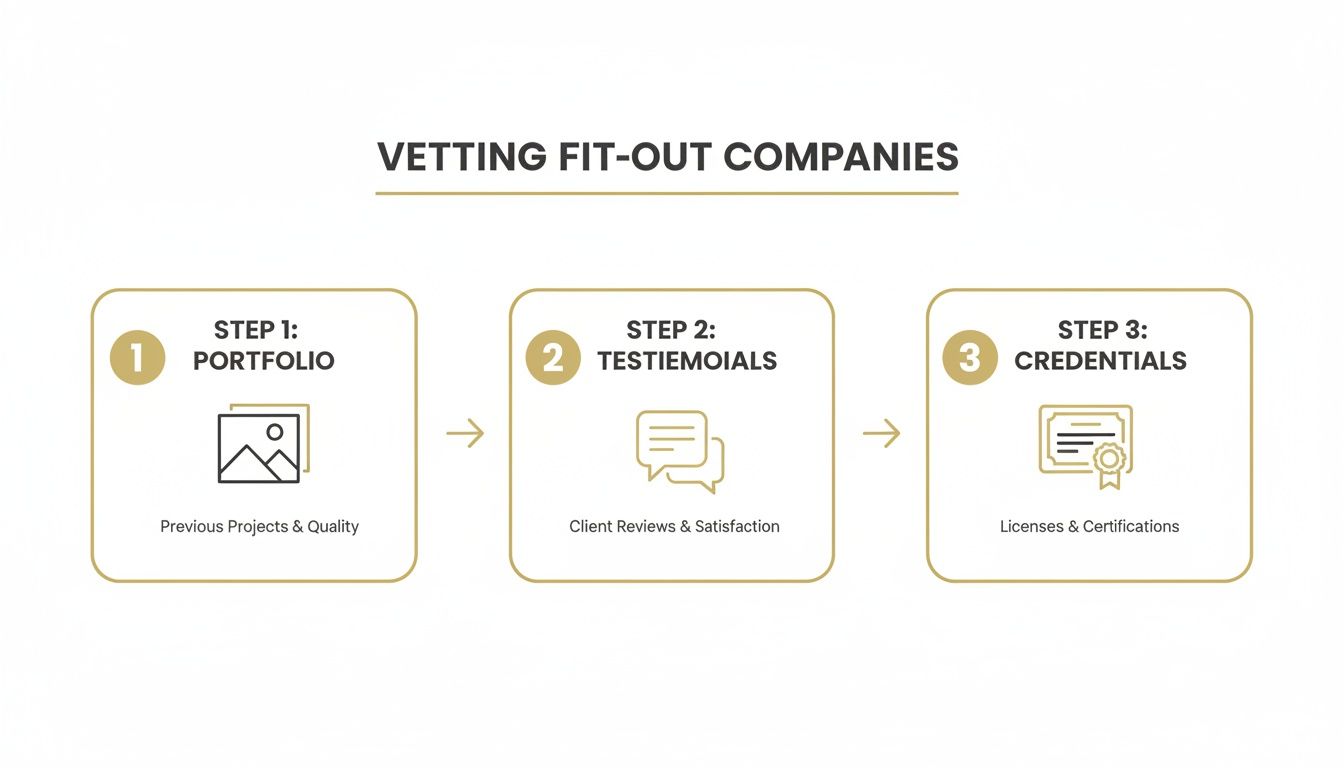
As you can see, assessing a company’s past work, client feedback, and formal credentials is the foundation of a successful partnership.
The Final Handover
As the project winds down, your fit-out partner will invite you for a final walkthrough. This is your chance to conduct a detailed “snagging” review. You’ll create a list of any minor imperfections that need fixing, whether it’s a small paint scuff or a misaligned door handle. Any professional firm will work through this list diligently before the official handover.
At Gibbsonn, we’ve managed countless projects for clients across the UK. We know from experience that a well-managed process is every bit as important as the final result. You can get a deeper insight into our methods in our article on office fit out project management for 2026.
The handover isn’t just the end of a project. It’s the beginning of a new chapter for your business, in a space that truly supports your team and your goals.
Looking for bespoke pod solutions or interior support? We’re here to help.
Common Questions About Commercial Fit Outs
Starting a fit out journey naturally brings up a lot of questions. We get it. Over the years, we’ve found that clients, whether they’re setting up in a growing hub like Bishop’s Stortford or an established commercial centre, often have the same things on their minds.
Here’s a rundown of what people ask us most, answered from our firsthand experience in the field.
How Long Does a Typical Office Fit Out Take?
This is the classic ‘how long is a piece of string’ question, but we can give you some solid guidelines. The timeline is always tied to the size and detail of your vision.
A straightforward office refresh might be wrapped up in 4 to 6 weeks. However, a more ambitious, multi-floor design and build project will realistically take anywhere from 4 to 6 months from start to finish. Key things like design approvals, bespoke furniture lead times, and any structural changes all play a part. A trustworthy partner will always provide a clear schedule of works, so you know what’s happening from day one.
What Is the Difference Between a Cat A and Cat B Fit Out?
This is a key concept in our world. Think of a Category A (Cat A) fit out as the blank canvas your landlord provides. It’s the basic shell, usually complete with raised floors, suspended ceilings, and the main mechanical and electrical services ready to go.
A Category B (Cat B) fit out is where we come in to make that space uniquely yours. This is the exciting part, covering everything from building new offices and meeting rooms to installing custom flooring, decorating, and adding all your furniture, branding, and IT equipment.
How Much Should I Budget For an Office Fit Out in 2026?
Budgeting is always a major consideration, and planning ahead is crucial. A good rule of thumb is to think in terms of a per-square-foot cost. For projects in 2026, a basic refurbishment will likely start from around £100 per square foot.
For a high-specification fit out in a prime location, you could be looking at £300+ per square foot. Your fit out partner should work with you to build a detailed cost plan that aligns your budget with your goals. We always advise clients to set aside a contingency fund of around 10%, it’s just smart planning for any unforeseen issues. For projects in busy commercial zones like Stansted Airport, this kind of early, detailed budgeting is absolutely vital.
What Are Dilapidations and How Can a Fit Out Company Help?
Dilapidations is the legal term for a tenant’s duty to return a commercial property to its original state when the lease ends. This usually involves stripping out your fit out, removing partitions, repairing wear and tear, and redecorating back to a neutral state.
This can be a stressful and costly process if not handled correctly. A full-service fit out company can take this entire burden off your shoulders. We can look at the ‘schedule of dilapidations’ issued by your landlord, carry out all the required works efficiently, and even help you negotiate a fair settlement. Getting an expert involved can save you a significant amount of time and money at the end of your tenancy.
Ready to transform your workspace? Speak to the Gibbsonn Interiors team today.