
A small office doesn’t have to mean small ambitions. For many businesses in bustling hubs like London, Cambridge, or Bishop’s Stortford, a compact footprint is a commercial reality. The challenge isn’t the size but how you use it. A poorly organised small space can feel cramped, chaotic and stifle productivity. But with a strategic approach even the most modest office can become a dynamic, efficient and inspiring hub that punches well above its weight.
This guide moves beyond generic tips to deliver actionable office design ideas for small spaces. We will explore practical strategies that create room to breathe, collaborate and grow. You will discover how to implement clever solutions from modular meeting pods that add flexible privacy to vertical storage systems that reclaim valuable floor space. We’ll also cover multi-functional furniture, smart zoning in open-plan layouts and the power of architectural wrapping to refresh your environment without a full-scale fit-out.
Whether you’re a facilities manager planning a complete refurbishment in Hertfordshire or an office manager in Essex looking for quick wins, these solutions are designed for you. Each idea is crafted to help UK businesses unlock the hidden potential within their workspace, proving that thoughtful design can make a significant impact no matter the square footage. We’ll explore how to maximise natural light, integrate technology seamlessly and implement systems like hot-desking to support modern, flexible work patterns. Prepare to transform your small office into a highly functional and impressive environment.
1. Modular Meeting Pods and Acoustic Booths
Open-plan offices are excellent for fostering collaboration but can be a nightmare for noise and privacy. For small spaces, building traditional meeting rooms is often impractical as it involves costly structural changes and permanently reduces your flexible floor space. This is where modular meeting pods and acoustic booths come in, offering one of the most transformative office design ideas for small spaces without the need for a full-scale refurbishment.
These self-contained, prefabricated units are essentially “rooms within a room.” They arrive flat-packed and can be assembled in just a few hours, creating acoustically isolated areas for focused work, confidential calls or small team meetings. Leading manufacturers like Framery have popularised these solutions, which are now staples in modern co-working spaces and tech hubs from London to Cambridge.
Why Pods are Perfect for Small UK Offices
The primary benefit is flexibility. Unlike a permanent partition wall, a pod can be moved if you decide to reconfigure your layout or even relocate to a new office. They provide instant privacy and acoustic control, helping to reduce noise pollution and distractions which are major productivity killers in open environments. A creative agency in Hertfordshire, for instance, might use single-person phone booths to manage noise while a healthcare provider in Essex could deploy larger pods for private patient consultations.
Actionable Tips for Implementation
To make the most of meeting pods, strategic planning is key. Consider the following:
- Placement is Paramount: Position pods near existing power and data points to avoid messy, hazardous cable runs across the floor.
- Maintain an Open Feel: Use pods with glass fronts, especially in high-traffic areas. This prevents the office from feeling segmented and maintains natural light flow.
- Manage Usage Effectively: Implement a digital booking system or simple “occupied/vacant” signage to manage shared access and avoid conflicts.
- Ensure Design Cohesion: Integrate the pod into your existing design scheme. Customise the exterior colours and interior finishes to match your company branding and office furniture.
By providing dedicated quiet zones, you empower your team to work more effectively without sacrificing the collaborative benefits of an open-plan layout. For a deeper dive into their benefits, you can explore more about rethinking shared spaces with freestanding booths and pods on gibbsonninteriors.com.
2. Vertical Storage and Wall-Mounted Systems
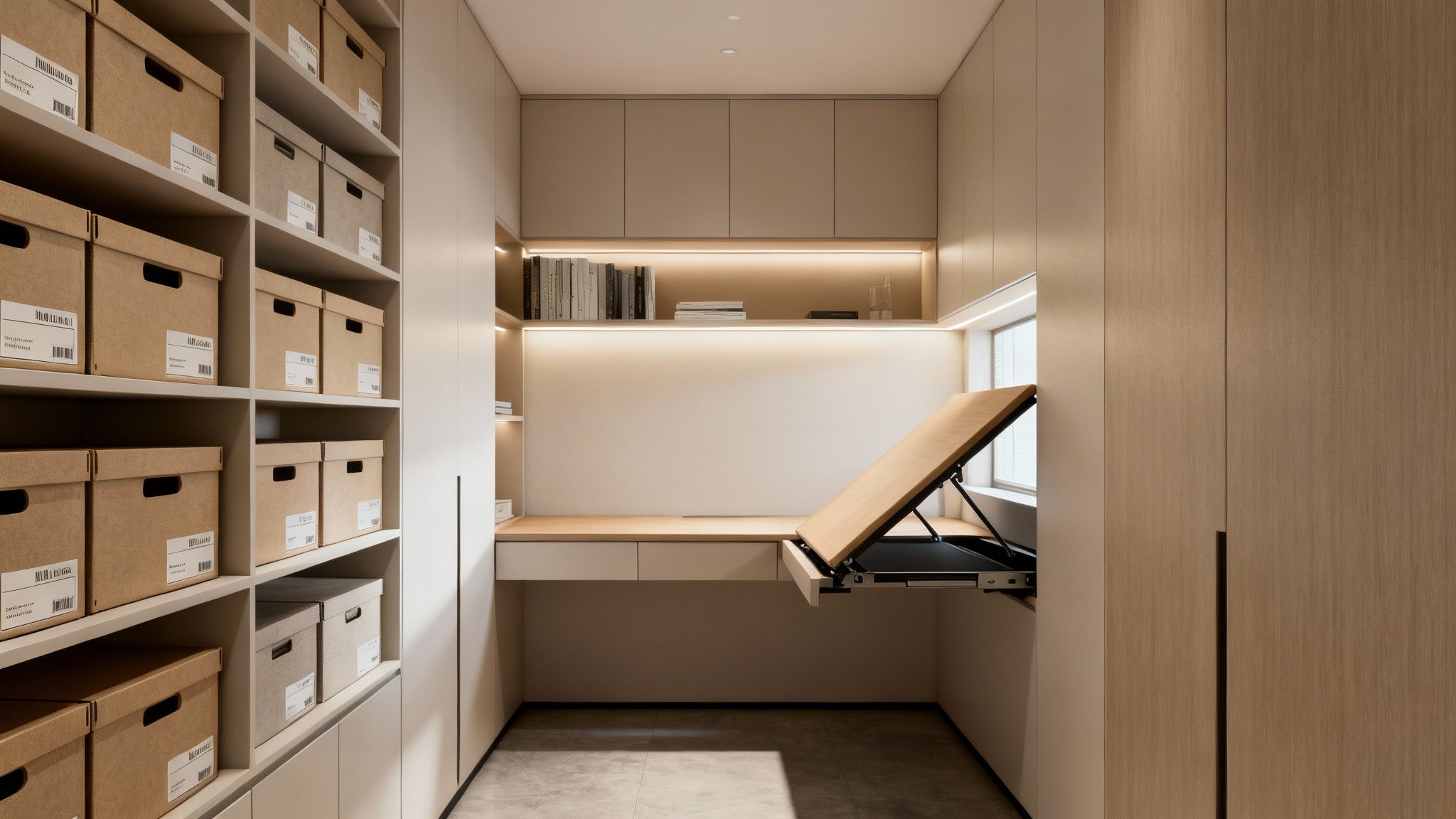
When floor space is at a premium, the most effective strategy is to look up. Traditional floor-standing cabinets, bookcases and filing systems consume valuable square footage that could be used for desks, breakout areas or circulation routes. Utilising vertical space with wall-mounted systems is one of the smartest office design ideas for small spaces, creating an organised, uncluttered environment by shifting storage from the floor to the walls.
This approach, popularised by minimalist Scandinavian design, involves using floor-to-ceiling shelving, floating cupboards and modular wall grids. These solutions not only maximise storage capacity but also draw the eye upward, creating an illusion of greater height and spaciousness. They transform unused vertical planes into highly functional and aesthetically pleasing storage assets.
Why Vertical Systems are a Game-Changer for UK SMEs
The core benefit is reclaiming the floor. By moving storage onto the walls, you free up the main office area, making the space feel larger and less cramped. This is particularly crucial for SMEs in dense urban centres like London or Braintree, where every square foot counts. A creative agency in Hertfordshire, for example, could use floor-to-ceiling shelving for materials and archives while a healthcare facility in Essex could implement wall-mounted systems in compact staff areas to store essential supplies without obstructing walkways.
Actionable Tips for Implementation
To implement vertical storage effectively, thoughtful planning is essential. Consider these tips:
- Conduct a Structural Survey: Before installing heavy shelving, always check the load-bearing capacity of your walls. This is a critical safety step to prevent damage or accidents.
- Maintain Visual Cohesion: Use materials and finishes that match your existing office decor. Consistent colours and textures prevent the storage from looking like an afterthought and create a seamless, integrated look.
- Prioritise Ergonomics: Keep frequently accessed items at a comfortable mid-height, roughly between shoulder and waist level, to avoid unnecessary stretching or bending.
- Integrate Lighting: Install LED strip lighting above or below shelves to improve visibility and add a sophisticated aesthetic touch. This turns a simple storage unit into a design feature.
- Label Everything Clearly: A well-organised system only works if people can find things. Use clear, consistent labelling to ensure staff can locate items quickly and maintain order.
By embracing a vertical storage strategy, you can dramatically increase your office’s efficiency and perceived size without needing a larger footprint.
3. Multi-Functional Furniture with Integrated Storage
In a small office, every square foot is prime real estate. Clutter accumulates quickly and dedicating space to single-purpose items is a luxury most compact workplaces cannot afford. Multi-functional furniture with integrated storage is one of the most intelligent office design ideas for small spaces as it combats clutter and enhances utility without demanding a larger footprint.
This approach involves selecting dual-purpose or convertible pieces that serve several functions simultaneously. Think desks with built-in drawers and shelving, bench seating that opens up to reveal storage or modular tables that can be nested or reconfigured. Championed by pioneers like Herman Miller and inspired by Japanese space-efficient design, these solutions reduce the total number of furniture items needed, creating a more open, organised and flexible environment.
Why Multi-Functional Furniture is a Game-Changer
The core benefit is radical space efficiency. Instead of needing a separate desk, filing cabinet and set of shelves, one well-designed piece can do it all. This frees up valuable floor space for circulation and makes the office feel less cramped. A tech startup in Stansted could use compact workstations with integrated cable management and storage to keep team areas tidy while co-working spaces in Cambridge often use nesting tables to quickly adapt a single room from a training layout to a collaborative workshop.
Actionable Tips for Implementation
To successfully integrate these pieces, a strategic approach is necessary. Consider the following tips:
- Assess Real Needs: Before purchasing, analyse your team’s daily workflows. Prioritise furniture that solves your most significant challenges, whether that’s document storage, tech management or seating flexibility.
- Test Durability: For convertible furniture, the mechanisms are crucial. Test the smoothness and sturdiness of any moving parts before committing to a large order to ensure they can withstand daily office use.
- Check Ergonomic Standards: Ensure any multi-functional desk or seating meets UK workplace health and safety standards for height and adjustability to protect employee wellbeing.
- Choose Modular Systems: Opt for furniture ranges that are modular. This allows you to add, remove or reconfigure components as your team’s needs evolve over time.
By investing in furniture that works harder, you create a more agile and productive workspace that can adapt to changing demands without requiring more space.
4. Open-Plan Layout with Strategic Zoning
For many small businesses, the thought of an open-plan office can be daunting, often associated with noise and a lack of privacy. However, when executed correctly, removing unnecessary walls creates an illusion of space and fosters a collaborative atmosphere. The key is strategic zoning, one of the most effective office design ideas for small spaces because it creates distinct functional areas without resorting to solid partitions that shrink the environment.
This approach uses design elements to subconsciously guide people and define zones for different activities. Instead of walls, you use furniture placement, changes in flooring materials, different colour schemes or acoustic ceiling features to delineate areas. This maintains a sense of openness and light while ensuring the space is organised and efficient. Tech companies across London and Cambridge have long championed this model to balance collaboration with focused work.
Why Zoning Works for Smaller UK Workplaces
The main advantage is maximising every square metre. You can create a reception area, a collaborative breakout space and a focused work zone all within a single, cohesive room. It avoids the dark, cramped feeling that multiple small, enclosed offices can create. A university administrative office in Essex, for example, could use departmental brand colours and low-height storage units to separate teams, preserving an open, accessible feel for students and staff alike.
Actionable Tips for Implementation
Effective zoning requires careful planning to avoid creating a chaotic, undefined space. Consider these tips:
- Use Low-Height Dividers: Employ screens or shelving around 1.2-1.5 metres high. This provides a sense of separation and acoustic baffling at desk level while allowing light and sightlines to flow freely above.
- Define with Flooring: Use different flooring materials or colours to mark transitions between zones. For instance, durable LVT in high-traffic walkways and carpet tiles in quiet work areas.
- Implement Colour Coding: Paint a feature wall or use coloured furniture to visually assign a purpose to a specific area, like a green-themed zone for relaxation and breakout sessions.
- Leverage Strategic Lighting: Use different types and temperatures of lighting to define zones. Bright, cool task lighting can be used for workstations while warmer, ambient lighting can create a more relaxed feel in collaborative spaces.
By thoughtfully organising your layout, you can achieve the best of both worlds: the spacious, collaborative feel of an open plan and the structure of a traditional office. You can discover more about the principles behind effective layouts by exploring the essentials of designing office space on gibbsonninteriors.com.
5. Compact Hot-Desking and Hot-Lockers Systems
The traditional model of one desk per employee is becoming increasingly obsolete, especially for businesses with hybrid work policies. For companies trying to maximise a limited footprint, this outdated approach wastes valuable square footage. Hot-desking, also known as hoteling, is a dynamic solution that offers one of the most effective office design ideas for small spaces by treating desks as a shared resource rather than a personal asset.
This flexible seating model allows employees to book an available workspace for the day or a specific period, complemented by secure personal “hot-lockers” for their belongings. This system dramatically reduces the total number of desks required, freeing up space for other vital functions like collaborative zones or quiet areas. This approach has been widely popularised by co-working giants like WeWork and adopted by forward-thinking financial firms in the City of London and government departments looking to optimise their estate costs.
Why Hot-Desking is a Game-Changer for SMEs
The primary advantage is space efficiency. If only 60% of your team is in the office on any given day, you don’t need desks for the other 40%. This allows a growing business in a high-rent area like Cambridge to accommodate more staff without needing a larger office. It also promotes a cleaner, more minimalist environment and encourages cross-departmental interaction as employees sit in different locations each day. A consulting company in Hertfordshire could use this model to reduce its physical footprint while supporting its mobile workforce.
Actionable Tips for Implementation
A successful hot-desking system requires careful planning, not just removing names from desks. Consider these key steps:
- Analyse Occupancy Data: Before committing, measure your peak desk usage over several weeks. This data will tell you exactly how many desks you truly need.
- Invest in Booking Software: Implement a user-friendly desk booking system that integrates with existing calendar tools like Outlook or Google Calendar. This prevents confusion and double-bookings.
- Design Smart Locker Areas: Position lockers in a central, easily accessible location. Ensure they are secure and large enough to hold a laptop bag, coat and personal items.
- Establish Clear Protocols: Create and communicate clear guidelines for desk usage, including cleaning and sanitising the space at the end of the day for the next user.
- Maintain Team Hubs: While promoting flexibility, consider creating “neighbourhoods” or zones for specific teams to ensure departmental cohesion isn’t lost.
- Prioritise Wayfinding: Use clear signage and floor plans to help staff and visitors easily find their booked desk, meeting rooms and amenities.
6. Architectural Wrapping and Surface Renewal
Undertaking a full structural renovation is often out of the question for small offices due to high costs, disruption and landlord restrictions. However, that doesn’t mean you’re stuck with dated or uninspiring interiors. Architectural wrapping and surface renewal offer one of the most impactful and non-disruptive office design ideas for small spaces, allowing for a complete aesthetic transformation without the need for demolition.
This technique involves applying high-performance, self-adhesive films to existing surfaces. Think of it as a durable, commercial-grade “skin” that can instantly change the appearance of walls, doors, reception desks, columns and even old cabinetry. Specialist firms like GIBBSONN Interiors have perfected this service, using premium materials from manufacturers like 3M to deliver rapid transformations for businesses across the UK.
Why Wrapping is a Smart Choice for SMEs
The core benefit is achieving a high-end look on a modest budget and tight timeline. Unlike traditional refurbishment, wrapping generates minimal dust, noise and waste, allowing your office to remain operational during the process. A tech startup in Cambridge could modernise its reception area over a single weekend or a healthcare clinic in Chelmsford could update its interiors overnight to meet new branding guidelines without cancelling appointments. It’s a sustainable choice too as it upcycles existing fixtures rather than sending them to landfill.
Actionable Tips for Implementation
To ensure a flawless and lasting finish, careful planning is essential.
- Assess and Prepare Surfaces: Wrapping films require a smooth, clean and non-porous substrate. Conduct a thorough assessment to ensure all surfaces are properly prepared before application.
- Choose High-Quality Materials: Opt for durable, commercial-grade architectural films from reputable suppliers. These offer superior longevity, cleanability and resistance to scratches and wear.
- Maintain Visual Cohesion: Use consistent textures or colours across large areas to create a sense of unity and make the space feel larger. Use branding elements to reinforce your company identity.
- Plan for Minimal Disruption: Although less disruptive than construction, schedule the application for outside of core working hours, such as evenings or weekends, to avoid any impact on your team’s productivity.
By renewing existing surfaces, you can completely refresh your office aesthetic quickly and cost-effectively. For a comprehensive guide to planning your next project, review this detailed office refurbishment checklist on gibbsonninteriors.com.
7. Integrated Technology and Cable Management
Trailing wires, cluttered power strips and visible data cables are the enemies of a clean and efficient workspace. In a compact office, this visual clutter not only looks unprofessional but also consumes valuable desk and floor space while posing a trip hazard. Integrated technology and cable management is a strategic approach that hides this essential infrastructure within the office fabric, delivering one of the most impactful office design ideas for small spaces.
This approach involves planning your power, data and communication systems from the outset. Instead of retrofitting solutions, cables are routed through purpose-built channels in furniture, flooring and walls. Leading manufacturers like Herman Miller champion these systems, which include everything from discreet floor boxes and desktop power modules to sophisticated under-desk cable trays and ceiling trunking, ensuring a seamless and functional environment.
Why Integration is Essential for Small UK Offices
The primary benefit is maximising usable space. By eliminating cable mess, you reclaim desk and floor areas, making the environment feel larger and more organised. This is crucial for high-density workspaces, such as a financial services firm in London or a growing tech start-up in Cambridge, where every square metre counts. Well-managed tech infrastructure also supports agility, allowing teams to reconfigure layouts or hot-desk without wrestling with a tangled web of wires, boosting productivity and reducing IT support requests.
Actionable Tips for Implementation
Effective cable management requires foresight and coordination. Consider these key steps:
- Conduct a Technology Audit: Before you begin, map out your team’s current and future power and data requirements. This prevents you from under-provisioning your new setup.
- Prioritise Wireless Solutions: Where possible, use Wi-Fi, wireless chargers and Bluetooth peripherals to minimise the number of physical cables needed.
- Plan for Future Growth: Design your infrastructure with 20-30% extra capacity. This future-proofing allows you to add new equipment or team members without a major overhaul.
- Integrate into Furniture: Choose desks and workstations with built-in cable management features like channels, trays and integrated power sockets. This is the cleanest and most effective solution.
- Label Everything: Implement a clear, colour-coded labelling system for all cables and ports. This saves significant time and frustration during maintenance or troubleshooting.
By thoughtfully integrating your technology from the start, you create a safer, more professional and highly functional workspace that allows your team to focus on what truly matters.
8. Natural Light Maximisation and Lighting Design
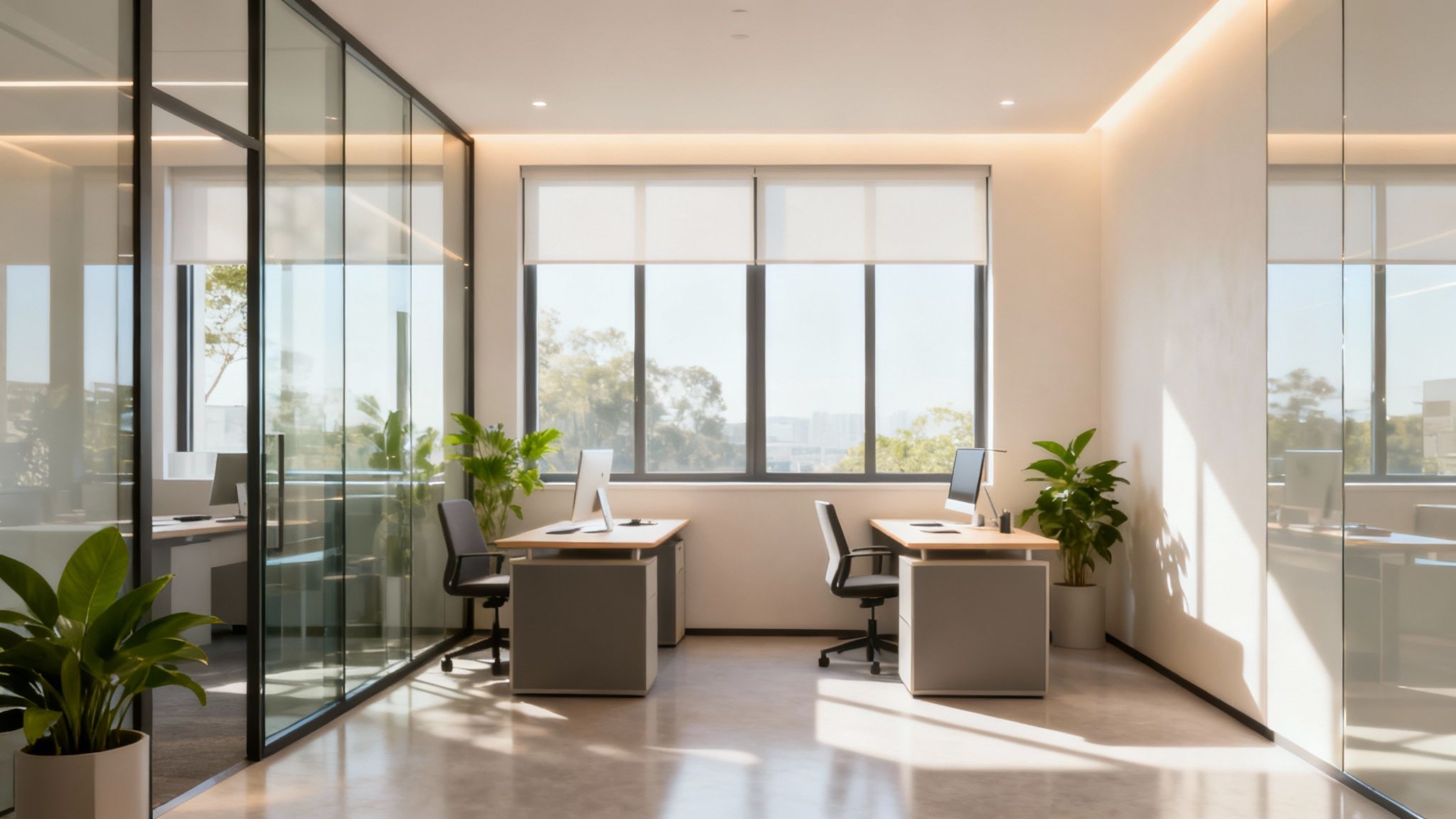
Effective lighting is one of the most powerful yet often overlooked office design ideas for small spaces. The right strategy can make a compact area feel open, airy and significantly larger than its actual dimensions. It involves maximising the natural light that enters the space and supplementing it with a layered, well-planned artificial lighting scheme to create a bright, inviting and productive atmosphere.
This approach goes beyond simply installing brighter bulbs. It is a holistic design philosophy that considers how light moves through a space, how it reflects off surfaces and how it impacts employee mood and wellbeing. By reducing shadows and dark corners, you create an illusion of depth and openness, transforming a cramped office into a comfortable and dynamic workspace. Tech companies across Cambridge and London have embraced this, prioritising light-filled environments to boost creativity and attract top talent.
Why Lighting is a Game-Changer for UK SMEs
The primary benefit is the dramatic impact on perceived space. A well-lit room feels more expansive and less claustrophobic. Furthermore, abundant natural light is intrinsically linked to improved employee wellbeing, reducing eye strain and boosting morale, as advocated by sources like ArchDaily. For businesses in Essex or Hertfordshire where new-build office spaces may be limited, optimising the light in an existing unit is a cost-effective way to enhance the environment without structural changes.
Actionable Tips for Implementation
To harness the full potential of lighting in your small office, consider these practical steps:
- Map Your Light: Before rearranging furniture, conduct a simple site assessment to understand how natural light enters and moves throughout the day and across different seasons.
- Prioritise Window Access: Position desks and primary workstations as close to windows as possible. Avoid using tall storage units or solid partitions that block natural light paths.
- Use Reflective Surfaces: Choose light, neutral paint colours like off-white or soft grey for walls to bounce light around the room. Gloss or satin finishes reflect more light than matte ones.
- Implement Layered Lighting: Don’t rely on a single overhead source. Use a combination of ambient (general), task (focused desk lamps) and accent lighting to create a balanced and flexible environment.
- Control Glare Smartly: Use translucent or automated blinds that manage harsh sunlight and glare without completely blocking out natural light, ensuring a comfortable working environment all day.
8-Point Small-Office Design Comparison
Solution | Ideal Use Cases 💡 | Key Advantages ⭐ |
|---|---|---|
Modular Meeting Pods and Acoustic Booths | Confidential calls, flexible offices, healthcare consultations | Rapid install, relocatable, compliant |
Vertical Storage and Wall-Mounted Systems | Compact offices, archives, education, staff areas | Maximises space, low cost, tidy |
Multi-Functional Furniture with Integrated Storage | Startups, co-working, budget-conscious teams | Reduces clutter, cost-efficient, multifunctional |
Open-Plan Layout with Strategic Zoning | Creative agencies, tech teams, flexible workflows | Flexible, cost-effective, enhances light |
Compact Hot-Desking and Hot-Lockers Systems | Hybrid workforces, corporates reducing estate costs | Significant footprint reduction, flexible working |
Architectural Wrapping and Surface Renewal | End-of-lease, branding refreshes, hospitality, retail | Fast, low-cost visual overhaul, minimal disruption |
Integrated Technology and Cable Management | Finance, tech HQs, education labs, AV-heavy spaces | Neat, safe, scalable connectivity infrastructure |
Natural Light Maximisation and Lighting Design | Wellbeing-focused offices, healthcare, education | Boosts mood and productivity, energy-efficient |
Ready to Transform Your Compact Workspace?
Maximising a small office is a puzzle of creativity, strategy and expert execution. Throughout this guide, we’ve explored a powerful toolkit of office design ideas for small spaces, proving that a limited footprint doesn’t have to mean limited potential. From the acoustic privacy of modular meeting pods to the clever efficiency of vertical storage and multi-functional furniture, the core principle remains the same: every square metre must earn its keep.
Translating these ideas from a list into a cohesive, high-functioning reality is the critical next step. It’s about more than just buying a few space-saving desks or installing wall shelves. True transformation comes from a holistic approach where layout, lighting, technology and branding work in harmony to create a space that feels expansive, organised and aligned with your company’s culture. The goal is to create an environment where your team can collaborate, focus and thrive, not just exist.
Key Takeaways for Your Small Office Transformation
Reflecting on the solutions we’ve covered, several key themes emerge as non-negotiable for success:
- Embrace Modularity and Flexibility: The modern workplace is dynamic and your space must be too. Solutions like acoustic booths, hot-desking stations with smart lockers and configurable furniture allow your office to adapt to changing team sizes, tasks and work styles without a complete overhaul.
- Think Vertically and Horizontally: Don’t just plan your floor space. Utilise wall height for storage, shelving and even branding. Architectural wraps can renew surfaces without the cost and disruption of replacement while clever zoning carves out distinct functional areas from an open plan.
- Integrate, Don’t Intrude: Technology and its accompanying cables can quickly clutter a small office. Integrated power, data ports and sophisticated cable management systems are essential for maintaining a clean, professional and hazard-free environment.
- Prioritise People and Wellbeing: A well-designed small office should never feel cramped or oppressive. Maximising natural light, implementing a strategic lighting design and managing acoustics are fundamental to creating a comfortable and productive atmosphere. These elements directly impact employee satisfaction and performance.
From Ideas to Implementation: Your Next Steps
Armed with these office design ideas for small spaces, you’re now in a strong position to evaluate your current workspace and envision its future. The journey from concept to completion requires careful planning, budget management and skilled execution. Whether you’re considering a few quick wins like decluttering and adding better lighting or a longer-term fit-out project, a clear roadmap is essential.
This is where specialist knowledge becomes invaluable. An experienced fit-out partner can help you navigate the complexities of space planning, product sourcing and project management, ensuring your investment delivers maximum return. They can conduct a detailed workplace assessment to understand your unique needs and transform a collection of great ideas into a single, seamless and inspiring design. At Gibbsonn Interiors, we thrive on these challenges. We have extensive experience delivering bespoke office fit-outs and refurbishments for businesses across Bishop’s Stortford, Essex, Hertfordshire and London. We blend innovative design with practical project management to create spaces that work harder for you. Don’t let a small footprint limit your potential.
Ready to unlock the full potential of your workspace? The team at GIBBSONN Interiors specialises in creating intelligent, functional and beautiful small office environments. Contact us today for a consultation and discover how we can transform your vision into a reality.