

Ever looked up at the high ceiling in your warehouse or office and thought, “what a waste of space”? You’re not alone. That’s precisely the problem a mezzanine floor is designed to solve. It’s a clever, self-contained intermediate floor built between the main floors of a building, turning all that unused vertical height into valuable, functional space.
Table of Contents
- Unlocking Your Building’s Hidden Potential
- The Real Benefits Of Adding A Mezzanine
- Choosing The Right Type Of Mezzanine
- Navigating UK Building Regulations
- Bringing Your Mezzanine Design To Life
- Understanding Project Costs And Timelines
- Common Questions We Hear About Mezzanine Floors
Unlocking Your Building’s Hidden Potential
Think of it like putting a solid, wide shelf inside a tall cabinet. You instantly create more usable surface area without making the cabinet itself any bigger. For businesses in bustling UK hubs like London or Cambridge, where every square foot counts, this is a genuine game-changer. It’s a smart way to get more room for offices, storage or operational areas without the huge cost and disruption of moving.
A mezzanine isn’t just an extra level, it’s a strategic asset. Because it’s usually built as a freestanding structure, it doesn’t need to rely on the building’s own columns for support. That independence is what makes it such a flexible and powerful solution for businesses ready to grow.
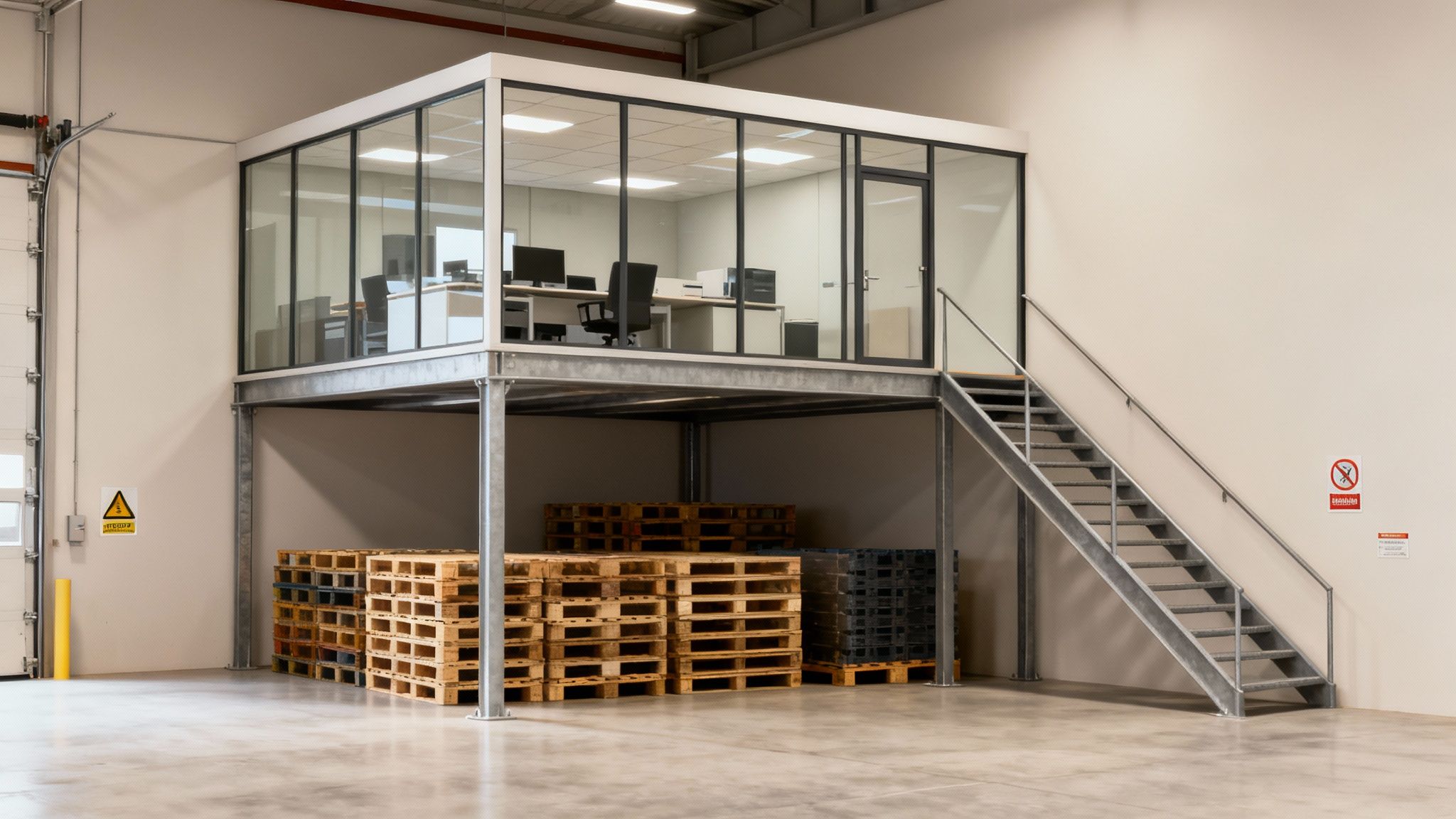
What Is a Mezzanine Made Of?
The backbone of nearly every modern mezzanine floor is structural steel. It’s what provides the immense strength and durability needed to support anything from a suite of office desks to pallets of heavy stock.
A typical mezzanine structure is made up of a few key components:
- Steel Columns: These are the legs of the structure. They bear the entire load and transfer it safely down to the ground floor slab.
- Primary Beams: These are the main horizontal supports that connect the columns, forming the core frame.
- Joists: Smaller beams, often called purlins, run between the main beams to create the grid that will support the floor itself.
- Decking: This is the actual floor surface. Most often, we use 38mm high-density particle board, but for specific industrial uses, you might see alternatives like steel chequer plate or composite decking.
This modular, component-based approach is what makes installing a mezzanine so quick and surprisingly un-disruptive. Unlike a traditional construction project, most of the parts are fabricated off-site. They’re then brought in and assembled with minimal interruption to your day-to-day operations. This is a massive plus for businesses in busy areas like Bishop’s Stortford or Chelmsford that can’t afford to shut down.
Visual Tip: By tapping into unused vertical space, a mezzanine can often double the usable floor area of a high-ceilinged building. This makes it one of the most efficient ways to maximise the value of your commercial property without extending its physical footprint.
The real beauty of a mezzanine is its versatility. It can be designed to house new offices, breakout areas, extra storage or even entire production lines. The final design and fit-out are completely tailored to what you need, making sure the new level becomes a seamless, integrated part of your workspace.
Understanding how to make the most of this new space is crucial. It’s not just about adding square footage, it’s about making every square foot work harder for your business. To see how this fits into a bigger picture, you can learn more about our approach to office floor planning.
The Real Benefits Of Adding A Mezzanine
So, what’s really driving so many businesses to choose a mezzanine over a more traditional expansion? The answer is simple. It’s an incredibly effective solution to one of the biggest real-world challenges companies face which is outgrowing their space. The benefits aren’t just about adding a new floor, they have a real impact on your budget, your flexibility and how your team works day-to-day.
At its heart, the biggest win is optimised space. A mezzanine lets you tap into all that unused vertical volume in your building. You can essentially double your usable floor area without the headache of extending the building’s footprint, carving out essential room for new departments, extra storage or much-needed breakout zones.
A Smarter Financial Decision
Let’s be honest, one of the most compelling reasons to go for a mezzanine is the cost. It’s an incredibly cost-effective move. When you stack up the investment against the staggering expense and operational disruption of moving to a new property or building a full-blown extension, the difference is night and day.
It’s no surprise the UK mezzanine floor market is projected to grow at a healthy 5.7% annually from 2025 to 2035. This growth is fuelled by this exact advantage. Installing a mezzanine can be 50-70% cheaper than building new, making it a game-changer for businesses that want maximum impact without breaking the bank. This makes it a brilliant solution for businesses in growing areas like Braintree or Stansted looking to expand intelligently.
Think about it: you get to sidestep the hefty fees for architects, months of disruptive construction and potential relocation costs. A mezzanine delivers a much higher return on investment, giving you the space you need, faster and for a fraction of the cost. That’s capital you can pour back into other areas of your business.
Unmatched Flexibility And Adaptability
Business needs are never static. What works today might not work tomorrow. This is where a mezzanine really shines, its incredible flexibility. Unlike a permanent concrete floor, most mezzanine structures are modular by design. This means we can create something for your specific needs right now but it can be modified later as your business evolves.
This adaptability is a huge asset. If your operational layout needs a rethink down the line, the mezzanine can be adjusted. Even better, if you eventually decide to relocate, the entire structure can be dismantled and potentially reinstalled in your new premises. It’s an investment in space that can genuinely move and grow right along with you. For businesses feeling the squeeze, understanding these kinds of adaptable solutions is key. You might find our guide on office design ideas for small spaces useful.
Boosting Your Operational Efficiency
A well-planned mezzanine floor isn’t just extra square footage, it’s a direct route to improved operational efficiency. By creating a distinct new level, you can logically separate different business functions. Imagine a warehouse in Chelmsford moving its admin offices up onto a mezzanine. Suddenly, the entire ground floor is freed up purely for logistics and stock.
This kind of separation streamlines workflows, cuts down on foot traffic in busy operational areas and just creates a more organised, productive environment. It lets you create quiet, focused office spaces above the noise of a workshop or storage area, giving each team the specific environment they need to do their best work. This is how a simple structure becomes a powerful business tool.
Choosing The Right Type Of Mezzanine
Not all mezzanines are created equal and choosing the right structure is vital for making sure your new space is safe, efficient and genuinely fit for purpose. The decision really boils down to how you plan to use the floor, the layout of your building and the load it needs to bear. Getting to grips with the main structural types is the first step toward making a smart choice for your business.
Each type brings its own distinct advantages to the table. Some are designed for maximum flexibility, letting you adapt as your business grows, while others are built to become a permanent, heavy-duty part of your building. Let’s break down the most common options you’ll encounter.
Freestanding Mezzanines
A freestanding mezzanine is exactly what it sounds like. It’s an independent structure that stands on its own columns. It doesn’t rely on the building’s existing framework for support which makes it an incredibly versatile option. This is often the go-to choice for businesses in leased properties or where interfering with the building’s main structure simply isn’t an option.
Because it’s a self-supporting system, it can be installed almost anywhere within a building that has enough headroom. This makes it perfect for creating additional office space, light storage areas or production zones within an open-plan warehouse or commercial unit. Its modular design also means it can be modified, extended or even relocated in the future, offering fantastic long-term value.
This short infographic shows the core benefits that mezzanines bring to a business.
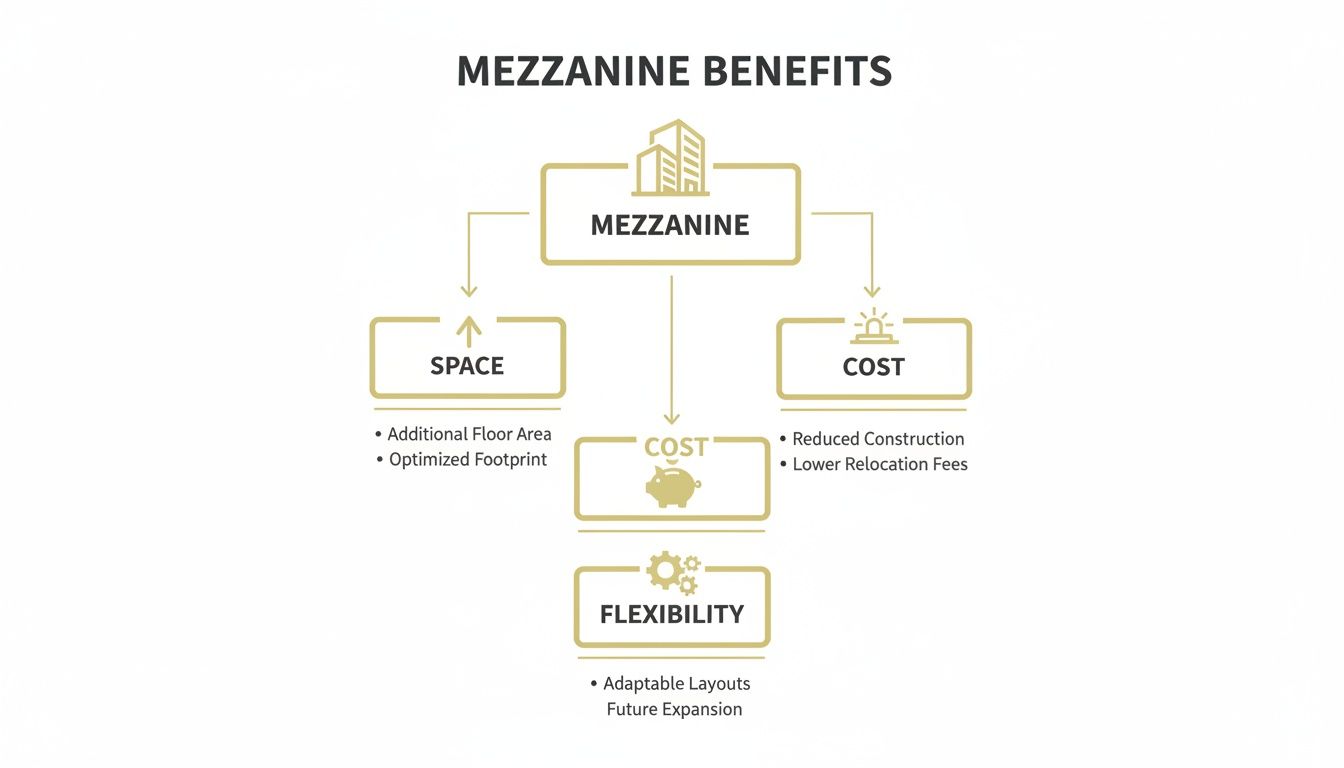
As the visual hierarchy shows, the primary benefit is gaining space, which directly leads to cost savings and operational flexibility.
Rack Supported Mezzanines
For businesses focused on storage and logistics, a rack-supported mezzanine is a brilliantly efficient solution. Instead of using separate columns, the mezzanine floor is built directly on top of and supported by heavy-duty pallet racking systems. This creates a clever, two-in-one structure that truly maximises your storage density.
This design is perfect for warehouses and distribution centres where every cubic metre counts. You get high-density shelving or racking on the ground floor with a usable floor level above it, which is ideal for storing smaller items, setting up packing stations or even housing administrative offices overlooking the main operation. It’s a seamless way to integrate storage and workspace, streamlining workflows in a busy environment.
Structural Steel Mezzanines
When you need to support some serious weight, a structural steel mezzanine is the undisputed champion. Unlike a freestanding system, this type of mezzanine is engineered to integrate directly with the building’s own structural components, like its main steel frame or load-bearing walls. It effectively becomes a permanent part of the building itself.
This heavy-duty approach is non-negotiable when the mezzanine needs to support substantial loads. Think entire office departments with multiple staff and heavy equipment, complex machinery or large-scale production lines. For businesses in manufacturing or those planning a significant, permanent expansion, a structural mezzanine provides the strength and stability required. This is a common solution for major projects in industrial hubs around Essex and Hertfordshire, where maximising operational capacity is key.
The right mezzanine choice comes down to balancing three factors: its intended use, the load it must carry and its required longevity. A clear understanding of these needs will point you directly to the best structural solution for your workspace.
Navigating UK Building Regulations
Installing a mezzanine floor isn’t just another fit-out project. It’s a serious structural addition and that means it has to be safe, compliant and properly signed off. Getting your head around the legal side of things from the very beginning will save you a world of costly headaches and delays down the line.
For any business thinking about adding a mezzanine, getting the regulations right isn’t just a good idea, it’s non-negotiable. This process is what guarantees your new space is completely safe for your team and protects your investment for years to come.
One of the first questions we always get is about Planning Permission. And there’s good news here. In most cases, you won’t need full planning permission for a mezzanine floor. They often fall under ‘permitted development’ rights, especially if they are fully self-contained and don’t change how your building looks from the outside.
But don’t mistake that for a free-for-all. While you might get to bypass the planners, you absolutely must comply with UK Building Regulations. This is a crucial distinction. Building Regulations are there to ensure the health and safety of everyone in and around buildings. They cover everything from structural integrity and fire safety to accessibility and every single mezzanine has to be designed and built to meet these strict standards.
The Key Pillars of Compliance
Navigating the world of Building Regulations can sound pretty intimidating but a good design and build partner will handle all the heavy lifting for you. They’ll be the ones preparing and submitting a detailed application to either the local authority or an approved independent inspector on your behalf. This application is the blueprint that proves exactly how the proposed structure meets every single legal requirement.
The regulations are broken down into several key areas, known as ‘Approved Documents’. For any mezzanine project, three are absolutely critical:
- Part A (Structure): This is all about making sure the mezzanine is structurally sound. It looks at everything from the strength of the steel columns and beams to the floor’s load-bearing capacity. Critically, it also confirms that your building’s existing ground slab can actually support the weight of the new structure.
- Part B (Fire Safety): This is vital for protecting your people. It sets out the rules for fire detection systems, clear and safe escape routes and fire protection for the structure itself. For instance, if the mezzanine is large or used for office space, its underside might need to be fire-rated to provide 60 minutes of fire resistance.
- Part M (Access and Use): This ensures the new space is accessible to everyone, including those with disabilities. It covers the design of staircases, the inclusion of proper handrails and where necessary, providing lift access.
Working with an experienced team is the safest way to ensure your design is fully compliant from day one. We handle the technical drawings, structural calculations and regulatory submissions, so you can focus on your business without worrying about the legal details.
Making Compliance Work for You
Getting compliance right isn’t just about ticking boxes, it’s about smart planning that can actually speed things up. For example, knowing the rules helps you make better, faster decisions. It’s a key insight that over 80% of mezzanine applications under 240 sqm are permitted development, which completely bypasses the need for full planning consents.
Combine that regulatory flexibility with the fact that mezzanines can boost rental yields by 15-20% and it’s easy to see why they’re such an attractive option for landlords and tenants looking for a rapid, value-adding space solution. You can read about the rise of the mezzanine floor in UK buildings to see just how popular this trend has become.
An expert partner will design your mezzanine with these rules baked in from the very beginning. This proactive approach avoids costly redesigns and ensures your project, whether in London or Cambridge, runs smoothly, on time and on budget, delivering a safe and highly functional new space.
Bringing Your Mezzanine Design To Life
This is where your vision really starts to take shape. Once we’ve settled on the right structural approach and ticked all the regulatory boxes, we get to the exciting part: designing and fitting out your new mezzanine floor. It’s a process of transforming thin air into a vibrant, functional space that’s a perfect fit for your business.
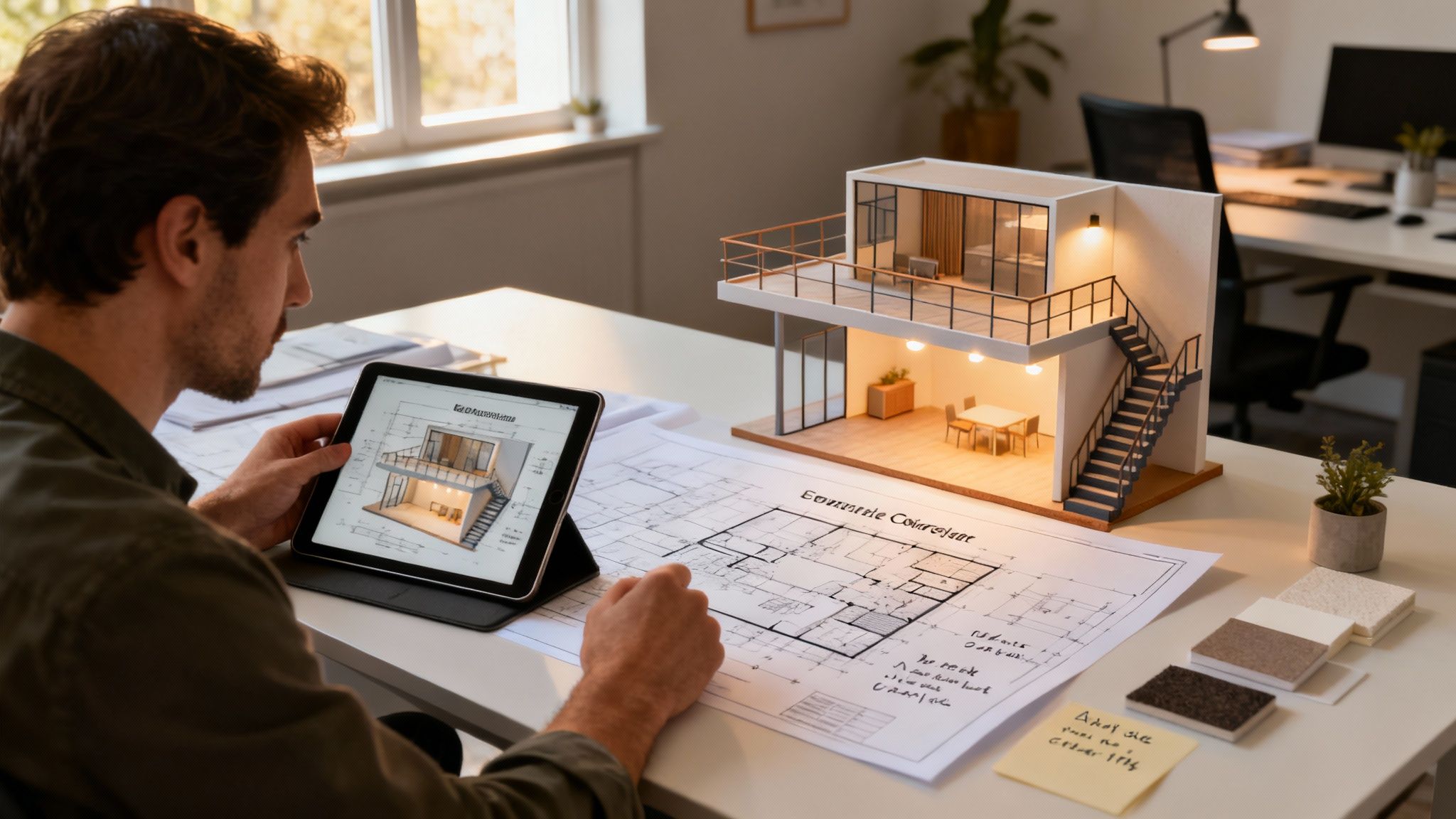
The design stage is all about the details. We’re not just building a floor, we’re creating an environment. That means carefully thinking through every element to make sure the new level is safe, comfortable and a place where your team can do their best work.
Critical Design Considerations
Getting the design right from the outset is crucial for a successful project. A few key elements need close attention to ensure the mezzanine isn’t just safe and compliant but becomes a genuine asset to your workspace.
Here’s what we focus on:
| Design Element | Why It Matters | Key Considerations |
|---|---|---|
| Load Capacity | The foundation of safety and function. It ensures the floor can support everything you plan to put on it, from people to heavy equipment. | Office use vs. storage vs. machinery. Must be calculated by a structural engineer to meet specific needs. |
| Access & Egress | Essential for user safety and efficient workflow. This covers how people and goods get on and off the mezzanine. | Location of staircases for fire escape, inclusion of handrails, potential need for a goods lift. Must comply with Part M of UK Building Regs. |
| Lighting & Ventilation | Critical for creating a comfortable and productive environment. A poorly lit or stuffy space is unpleasant and inefficient. | Maximising natural light, strategic placement of artificial lighting, ensuring adequate air circulation to prevent heat build-up. |
Integrating Your New Space Seamlessly
A great mezzanine should feel like it was always meant to be there, not just bolted on as an afterthought. The goal is to weave it into your existing workspace, creating a cohesive and connected environment that genuinely enhances your company culture.
This goes way beyond just matching paint colours. It’s about creating purpose-built zones that add real value. Imagine transforming your new level into a dynamic hub with dedicated areas for:
- Meeting Pods: Carve out quiet, focused spaces for collaboration, away from the buzz of the main office floor.
- Breakout Areas: Give your team a relaxed space to recharge and connect, fostering a positive and healthy workplace culture.
- Extra Desking: Seamlessly expand your team’s capacity without the cost and disruption of moving premises.
By focusing on smart design, we ensure the mezzanine doesn’t just add square footage, it elevates how your team works together. Our experience creating these integrated spaces for businesses across Hertfordshire and Essex has shown us that a well-designed mezzanine is a powerful tool for growth.
The most successful mezzanine projects are those where the design is driven by purpose. It’s not just about what the space is but what it enables your business to do. A thoughtful fit-out can transform a simple structure into the most valuable area in your building.
This practical approach has become a cornerstone of commercial property optimisation in the UK. In fact, the European mezzanine market surpassed USD 1.5 billion in 2022, proving just how effective they are. For our clients, mezzanines offer a fast-track solution for office refurbishments that can double floor space, with installations often completed in just 4–6 weeks. You can discover more about the mezzanine floor market growth and its impact.
Understanding Project Costs And Timelines
Trying to budget for a mezzanine can feel like a big undertaking but breaking down what drives the cost is actually quite straightforward. While it’s impossible to give a one-size-fits-all figure without a detailed brief, we can walk through the key factors that influence the final investment and give you a clear picture of the project journey.
The biggest cost drivers are the fundamentals of the structure itself. The overall size of the mezzanine is the most obvious one. A larger floor simply requires more materials and labour. Just as important is the load capacity. A floor designed for light office use will be far more economical than one engineered to support heavy machinery or dense storage, which demands thicker steel and stronger columns.
Key Factors Influencing Your Budget
Beyond the basic structure, the level of fit-out will significantly shape your budget. A simple storage deck, for instance, will cost much less than a fully serviced office level.
You’ll need to consider these elements:
- Materials: Standard 38mm particle board is the default for decking, but if you need specialised finishes like steel chequer plate, that will add to the cost.
- Access: The type and number of staircases you need, along with any requirements for goods lifts, will be factored into the final price.
- Fire Rating: This is a crucial one. A mezzanine used for office space or other permanently occupied areas will require 60-minute fire protection to its underside. It’s a necessary expense for safety and compliance.
- Fit-Out Services: Integrating lighting, power sockets, data cabling and HVAC systems is what transforms an empty platform into a functional workspace. This will be a key part of the overall cost. For a deeper dive into budgeting, our article on the cost of an office fit-out provides a comprehensive overview.
Mapping Out a Typical Project Timeline
One of the greatest advantages of a mezzanine is the sheer speed of installation. Unlike traditional construction, the whole process is designed for minimal disruption, getting your new space up and running much, much faster.
The real efficiency comes from off-site fabrication. While we’re handling the design and approvals, all the steel components are being precisely engineered and manufactured at a separate facility. This means the on-site installation phase is remarkably swift, often taking just a few days or a couple of weeks for a standard structure.
The project timeline generally follows a clear, logical path:
- Initial Consultation & Site Survey: We’ll visit your premises, whether you’re in Bishop’s Stortford or London, to understand your needs and take accurate measurements.
- Design & Quotation: Our team gets to work creating a bespoke design, complete with structural calculations and provides a detailed, transparent quote. No hidden surprises.
- Regulatory Approval: We handle the paperwork, submitting the necessary applications for Building Regulations approval on your behalf.
- Off-Site Fabrication: Once we have the green light, all steel components are manufactured to the exact specifications.
- On-Site Installation: Our team arrives on-site to assemble the main structure, followed by the fit-out of electrics, partitioning and all the finishing touches.
This streamlined process ensures your business experiences the least possible downtime while gaining a high-value, fully functional new level.
Common Questions We Hear About Mezzanine Floors
Even with the best-laid plans, it’s completely normal to have questions before committing to a project like a new mezzanine. We’ve pulled together some of the most frequent queries we get from business owners and managers across areas like Bishop’s Stortford and Braintree. Our goal is to give you straightforward answers that provide the clarity you need to move forward with confidence.
Do I Really Need Planning Permission?
This is the big one and the answer is, more often than not, no. In the UK, most mezzanine floors fall under ‘permitted development’ rights. This is especially true if the structure is demountable and its size doesn’t push the building’s overall footprint beyond certain limits. It means you can often sidestep the lengthy and sometimes complex planning permission process.
However, and this part is non-negotiable, you must always comply with Building Regulations. These rules are there for a reason, covering everything from structural integrity and fire safety to safe access. The simplest way to guarantee you’re fully compliant, without any last-minute surprises, is to partner with an expert right from the start.
How Much Weight Can It Actually Hold?
There’s no off-the-shelf answer here. The load capacity is designed entirely around what you need it to do. A mezzanine can be engineered for a massive range of uses, from light-duty office space (typically around 3.5-5.0 kN/m²) all the way up to heavy industrial storage or machinery support (10.0+ kN/m²).
When we first sit down to talk, we’ll dive into how you envision using the space. Will it be for desks and breakout areas? Meeting pods? Or will you be storing pallets on racking? This conversation is what allows our structural engineers to design a floor with the precise load rating needed for safe, efficient operations.
The key takeaway is that how you plan to use the floor dictates its entire structural design. Getting this right from day one ensures the final build is not only safe but perfectly optimised for its job.
How Long Will The Installation Take?
One of the best things about a mezzanine project is just how quickly it all comes together. While the full timeline includes design work and off-site fabrication, the actual on-site build is incredibly fast and planned to cause as little disruption as possible to your day-to-day business.
For a standard installation, the on-site assembly can often be wrapped up in just a few days or a couple of weeks. Because all the core components are precision-engineered and manufactured elsewhere, our team can arrive and work efficiently to get your new level up and running far faster than any traditional construction method would allow. For any business that needs to grow without hitting the pause button, this rapid turnaround is a huge advantage.
Ready to transform your workspace? Speak to the Gibbsonn Interiors team today.