
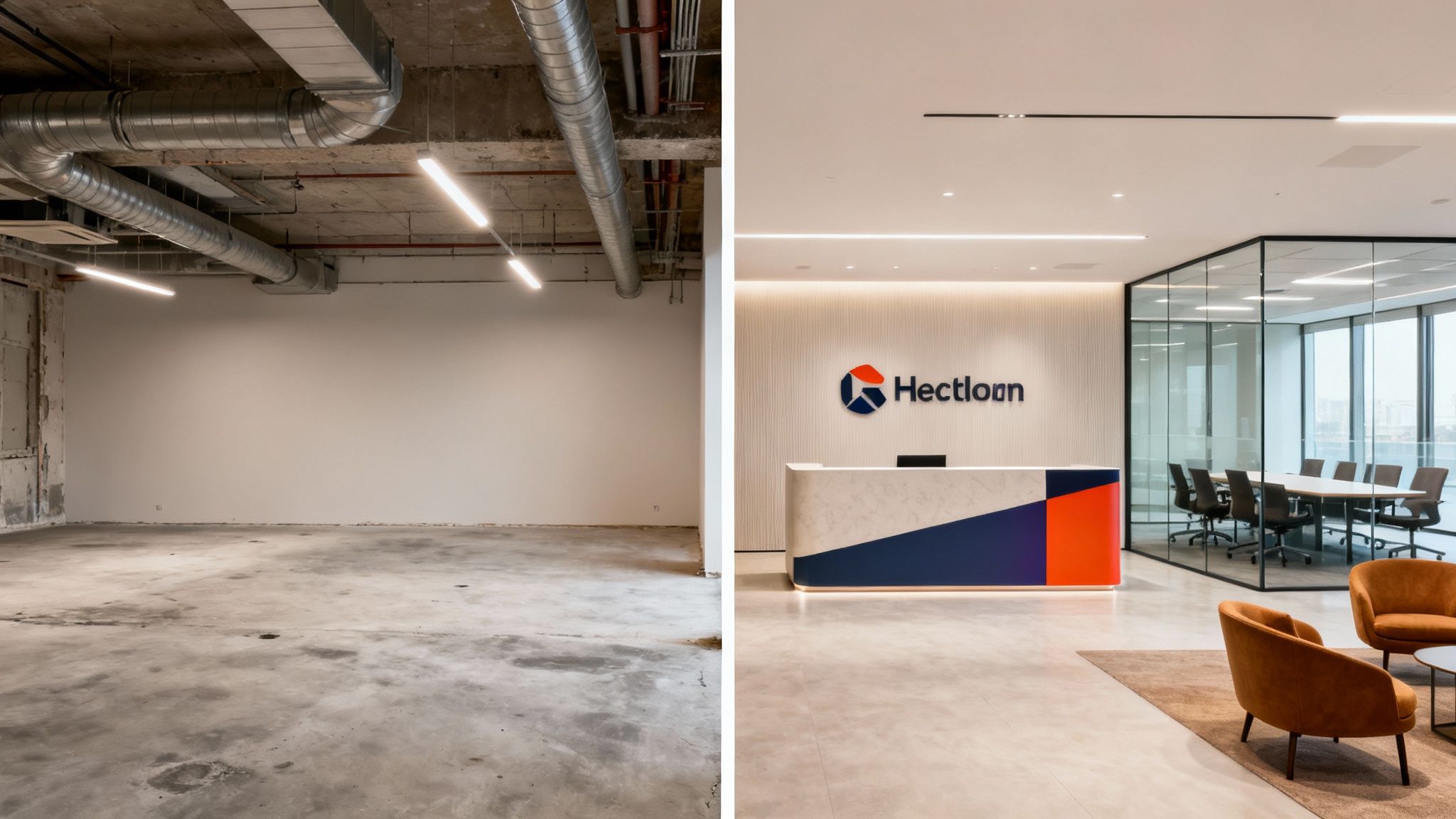
So, you have a new commercial space. Right now, it’s probably just four walls and a floor – a blank canvas. An interior fit out is the process that turns that empty shell into a fully functioning, ready-to-use workspace that truly feels like your own.
It’s about taking that raw space and making it not just habitable but an environment designed specifically for your team to thrive in.
What Exactly Is an Interior Fit Out?
Think of it this way: you have bought a new pair of shoes but they came in a plain, empty box. The box does the basic job of holding them but that’s it. A fit out is like customising that box – adding soft lining, creating dividers and putting your name on it to make it the perfect home for those shoes.
In the world of commercial property, your new office space is that empty box. It’s often just a concrete shell a landlord provides. The fit out is the skilled, hands-on process of transforming it into a purpose-built environment that reflects your company’s identity and supports everything your team does, day in and day out.
This is much more than just slapping on a coat of paint and picking out some desks. It’s a proper construction process that blends the practical with the aesthetic, creating a workspace that works as hard as you do.
What Does a Fit Out Include?
A fit out project is a complex orchestra of different trades and disciplines, all working together to create a unified space. Typically, it involves putting in place:
- Essential Building Services: This is the hidden-away infrastructure that makes a modern office tick – think lighting, power sockets, data cabling, fire safety systems and air conditioning.
- Architectural Elements: This is where you start to see the layout take shape. We’re talking about building partition walls for private offices and meeting rooms and installing suspended ceilings or raised access flooring.
- Finishes and Fixtures: This is where the personality of the space comes to life. It includes everything from flooring and painting to installing doors, reception desks and kitchenettes.
- Furniture and Branding: The final layer is all about making it yours. This includes workstations, seating, storage and weaving your company branding throughout the space with signage and signature colour schemes.
An effective interior fit out directly influences how people feel and perform at work. It’s not just about creating a space that looks good; it’s about designing an environment that boosts productivity, encourages collaboration and supports employee wellbeing.
Why It’s More Than Just Construction
A successful fit out doesn’t start with a hammer and nails; it starts with a conversation. The entire process is built on a foundation of meticulous planning and smart design. Before any building work begins, we need to get under the skin of your business and understand exactly how you operate.
This deep dive involves detailed office design and space planning to ensure the final layout is a perfect match for your workflow and company culture.
Whether you’re in a bustling commercial hub like London or a growing town like Bishop’s Stortford or Cambridge, the goal is always the same: to create a workplace that is not only functional but becomes a genuine asset, helping you attract top talent and drive your business forward.
Decoding the Different Types of Fit Out
Getting to grips with the language of an interior fit out is the first step towards a project that runs smoothly and delivers exactly what you need. It’s a bit like ordering a coffee – if you don’t know the difference between a latte and a cappuccino, you might be disappointed with what you get. In the world of commercial interiors, the key terms you’ll hear are Category A, Category B and Turnkey.
For businesses across Essex and Hertfordshire, understanding these terms is vital. They clearly define who is responsible for what, preventing confusion and making sure everyone is on the same page. Let’s break them down.
Category A Fit Out: The Landlord’s Blank Canvas
Think of a Category A fit out (or ‘Cat A’) as the landlord’s part of the deal. Their goal is to get a commercial space ready for a tenant by creating a clean, functional but essentially empty shell. It’s the blank canvas, waiting for an artist to bring it to life.
The space isn’t a working office just yet but all the fundamental services and basic finishes are in place. It’s a safe, professional starting point.
A standard Cat A fit out usually covers:
- Mechanical and Electrical Services: This means the basic lighting, air conditioning and fire detection systems are installed and working.
- Raised Floors and Suspended Ceilings: These are put in to create a neat void for hiding away cables and services, giving the office a tidy, uncluttered look from the start.
- Basic Finishes: This includes simple decoration on the internal walls and sometimes some basic flooring.
- Communal Area Finishes: The landlord often completes shared areas like lifts, toilets and reception areas to a high standard as part of this stage.
Once the Cat A work is done, you’re left with a clean, safe and fully functional box, ready for you to make your own.
Category B Fit Out: Bringing Your Brand to Life
This is where you, the tenant, take the reins. A Category B fit out (‘Cat B’) is the exciting process of transforming that blank Cat A canvas into a workplace that truly reflects your company’s brand, culture and the way you actually work. This is the stage where the space becomes yours.
The Cat B phase covers every single detail needed to make the office fully operational and uniquely suited to your business. It’s where design choices become reality, from the layout of meeting rooms and breakout zones to the colour of the carpets and the graphics on the walls. For any business, whether in Chelmsford or Braintree, this is the phase that turns a generic shell into a powerful business asset.
A Cat B fit out typically involves:
- Layout and Partitioning: Building the individual offices, meeting rooms, quiet zones and kitchen or tea point areas that your team needs.
- Full Design and Finishes: Installing specialist flooring and feature lighting and applying paint, bespoke graphics and branding elements that tell your company’s story.
- IT and AV Infrastructure: Setting up all the data cabling, server rooms and audio-visual equipment needed for modern collaboration.
- Furniture and Fixtures: Supplying and installing all the desks, chairs, storage and even custom-built joinery like a statement reception desk.
Turnkey Solutions: The All-in-One Approach
A Turnkey fit out offers a complete, end-to-end solution where a single partner, like us here at Gibbsonn Interiors, manages the entire project from concept to completion. It’s an approach that combines both the design and construction phases under one roof, giving you a single, dedicated point of contact and total accountability.
For many businesses, this is the most straightforward and stress-free option. It removes the headache of juggling multiple contractors, designers and consultants. We handle everything for you, from the initial workplace strategy and design concepts all the way through to handing you the keys to your new office.
Comparing Fit Out Types: Cat A vs Cat B vs Turnkey
To make it even clearer, here’s a simple table comparing the three main approaches. It helps to see at a glance what each type covers and who is typically holding the reins.
| Feature | Category A (Landlord) | Category B (Tenant) | Turnkey (Single Partner) |
|---|---|---|---|
| Primary Goal | Create a lettable ‘blank canvas’ | Customise the space for business needs | Deliver a ready-to-use workspace from start to finish |
| Responsibility | Landlord | Tenant | Single design and build partner (like Gibbsonn) |
| Key Elements | Basic M&E, suspended ceilings, raised floors | Partitions, branding, furniture, IT, full finishes | Includes all Cat B elements plus full project management |
| Outcome | A functional but empty shell | A fully branded and operational office | A complete, hassle-free project handover |
Ultimately, choosing the right path depends on your specific circumstances, your lease agreement and how much involvement you want to have in the day-to-day management of the project.
Navigating the Interior Fit Out Process Step by Step
A well-run interior fit out isn’t something that just happens. It’s a carefully choreographed process, a clear, logical journey that turns an idea on a sketchpad into a fully functioning, breathing workspace. Think of it as a roadmap with distinct stages, each one building on the last to guarantee a brilliant result.
This roadmap is your guide through the entire project, whether your business is rooted in Hertfordshire or branching out to a new London site. Getting to grips with these stages gives you clarity and confidence, so you always know what’s happening and what to expect next.
Stage 1: Workplace Strategy and Briefing
This is the bedrock of the entire project. Before anyone even thinks about a single wall, we have to nail down your ‘why’. This initial phase is all about discovery, where we dive deep with you to understand your business from the inside out.
We’ll get into your company culture, how your teams work day-to-day and what your biggest ambitions are. The aim here is to forge a detailed project brief that will act as our North Star for every decision that follows. It ensures the final design isn’t just a pretty face but a strategic tool for your business.
Stage 2: Concept Design and Space Planning
With a solid brief in our hands, the creative sparks can really start to fly. This is where we begin to visualise what your new workspace could be. Our design team will get to work on initial concepts, putting together mood boards and 3D visuals that bring the ideas to life right in front of your eyes.
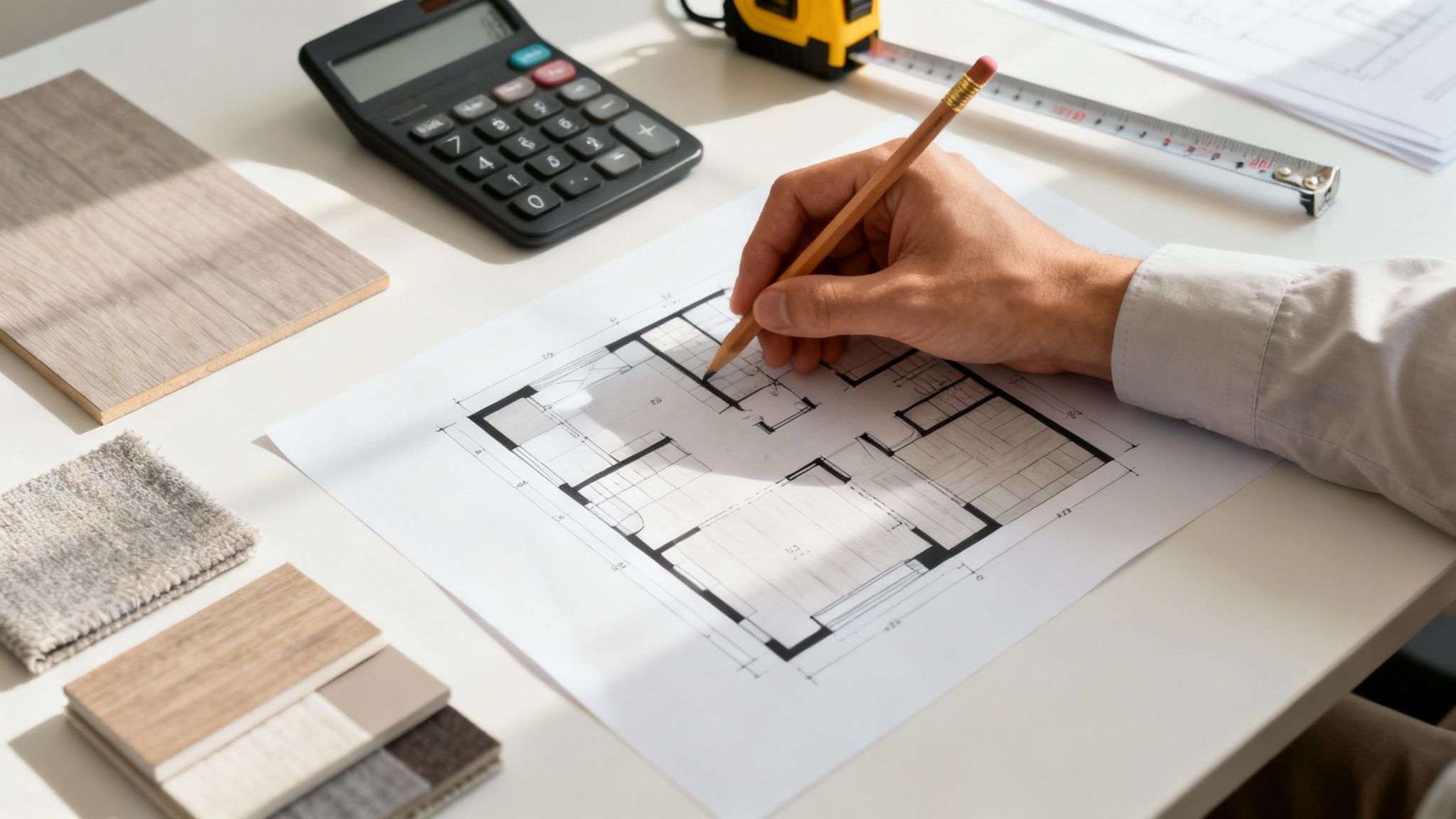
Space planning is a massive part of this stage. We create detailed floor plans, mapping out exactly how your teams will move, collaborate and interact within the space. The goal is to make sure every square foot is pulling its weight, striking the perfect balance between buzzy collaborative zones and quiet areas for deep focus. It’s all about designing a space that not only works efficiently but just feels right.
A great design isn’t just about how a space looks; it’s about how it makes your team feel and perform. This stage connects your business goals directly to the physical environment, ensuring the fit out delivers real value.
Stage 3: Detailed Design and Specification
Once you’re happy with the big picture, we zoom in on the technical details. This is where the vision gets translated into a concrete, practical blueprint. We finalise every single element, from the exact materials and finishes for floors and walls to the specific models of lighting fixtures and furniture.
This results in a full specification document, which meticulously details every product and finish. This painstaking process leaves no room for guesswork, locks in quality and gives us the clarity we need for spot-on budgeting and a smooth ride once we get on-site.
Stage 4: Budgeting and Procurement
We believe in total transparency when it comes to cost. Using the detailed design and specification, we can provide a fixed and comprehensive budget for your interior fit out. This gives you complete cost certainty before a single tool is picked up, wiping out any chance of unwelcome surprises down the line.
Once the budget gets the green light, we handle all the procurement of materials, furniture and specialist trades. We lean on our established network of trusted suppliers to source high-quality products at competitive prices, managing all the logistics so you don’t have to lift a finger.
Stage 5: Regulatory Approvals and Compliance
Every commercial fit out in the UK has to play by the rules. This stage is all about making sure your project is fully compliant with all legal requirements, including Building Regulations, fire safety and accessibility standards.
We take care of all the necessary applications and paperwork for you, liaising directly with local authorities in areas like Essex or Cambridge to secure the approvals needed. It takes the administrative headache away from you and guarantees your new workspace is 100% safe and legal.
This simple flowchart shows how the different types of fit out we’ve discussed fit together over the course of a project.
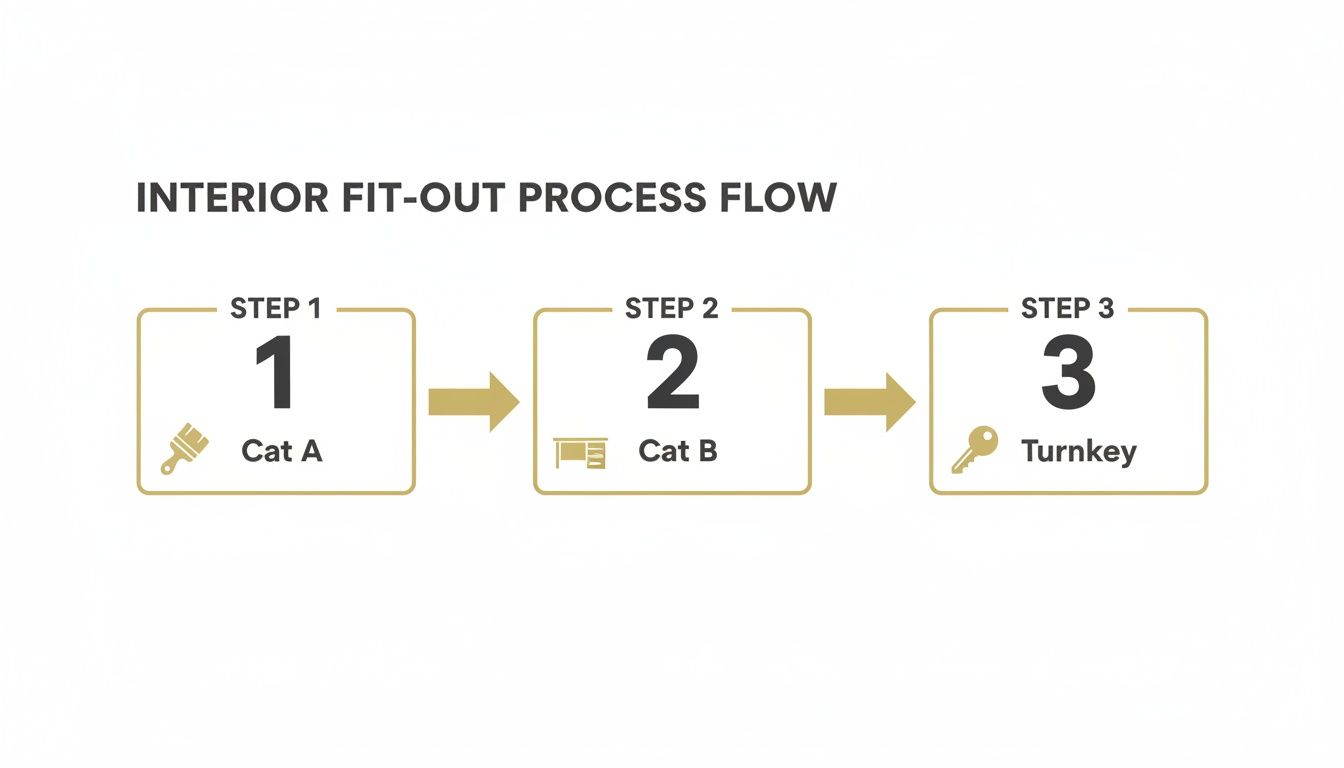
As the visual shows, a Turnkey solution is the all-encompassing option, covering the entire journey and handing you a space that’s ready to go from day one.
Stage 6: Construction and Project Management
Now for the exciting part, where the physical transformation happens! Our on-site teams get to work bringing the detailed designs to life. The whole process is overseen by a dedicated project manager, who will be your single point of contact from start to finish.
We’re big believers in clear and constant communication. You’ll get regular progress updates and we’ll manage all the different trades on-site to ensure the project stays on schedule and meets our exacting quality standards. Our aim is to make the construction phase as seamless and disruption-free as we possibly can.
Stage 7: Handover and Post-Occupancy Support
The final stage is the moment we hand over the keys to your brilliant new workspace. We’ll walk through with you, conducting a thorough inspection to make sure every last detail is perfect. You’ll receive a full handover pack containing all the important documents, manuals and warranties.
But our partnership doesn’t end there. We stay in touch after you’ve moved in, checking that everything is working just as it should and helping your team settle into their new environment. This ongoing commitment ensures your interior fit out is a success for years to come.
How to Budget for Your UK Office Fit Out
Right, let’s get to the question on everyone’s mind: what’s this going to cost? Thinking about the budget for an interior fit out can feel daunting but with the right approach, it becomes a completely manageable process.
The industry standard here in the UK is to work out costs on a per-square-foot basis. This gives you a solid, reliable starting point for estimating the total investment your project will need.
Of course, a simple square footage calculation is just the beginning. The final figure is shaped by a handful of key factors that really define the scope and quality of your new workspace. Getting your head around these cost drivers is the secret to making smart financial decisions and avoiding nasty surprises down the line.
Key Factors That Influence Your Budget
The total cost of your fit out is a direct result of the choices you make during the design and planning stages. No two projects are ever the same and it’s your unique vision that will ultimately set the budget.
Here are the main elements that will influence the final price tag:
- Location and Building Condition: Geography plays a huge part. A project in central London will naturally have higher labour and logistics costs than one in a regional hub like Braintree or Chelmsford. The age and condition of the building are also crucial, older properties often need more work to bring them up to modern standards.
- Level of Specification: This is one of the biggest variables. Are you after a simple, functional workspace or a high-end, luxurious environment? The quality of materials you choose for flooring, walls and furniture will have a massive impact on the overall cost.
- Design Complexity: A straightforward open-plan layout will always be more cost-effective than a complex design with bespoke joinery, curved partitions and intricate ceiling details. The more custom features you add, the higher the investment.
- Technology and M&E Systems: The complexity of your mechanical and electrical (M&E) systems is a major cost driver. This covers everything from basic power and lighting to advanced air conditioning, data infrastructure and sophisticated audio-visual systems for meeting rooms.
Understanding Typical UK Fit Out Costs
To give you a clearer picture, it helps to look at industry benchmarks. According to a recent guide from real estate experts Cushman & Wakefield, the cost for a typical office fit out in London can range from £126 per sq ft for a basic specification up to £308 per sq ft for a high-end finish. This highlights how your vision and chosen quality level shape the budget.
Working with a design-and-build partner like Gibbsonn provides a major advantage: cost certainty. By managing both the design and construction, we can provide a fixed, detailed budget early on. This gives you complete transparency and control over your investment from day one.
Achieving Cost Certainty
This integrated approach helps you avoid the common pitfalls of unexpected expenses and budget creep. We design to your budget, ensuring creative decisions are always aligned with your financial goals. Our detailed breakdown means you know exactly where every pound is going.
This financial clarity is crucial. For a deeper dive into managing your investment, you can check out our comprehensive guide on the cost of an office fit out. It offers further insights to help you plan effectively and get the best possible value from your project.
Modern Trends Shaping Workplace Fit Outs for 2026
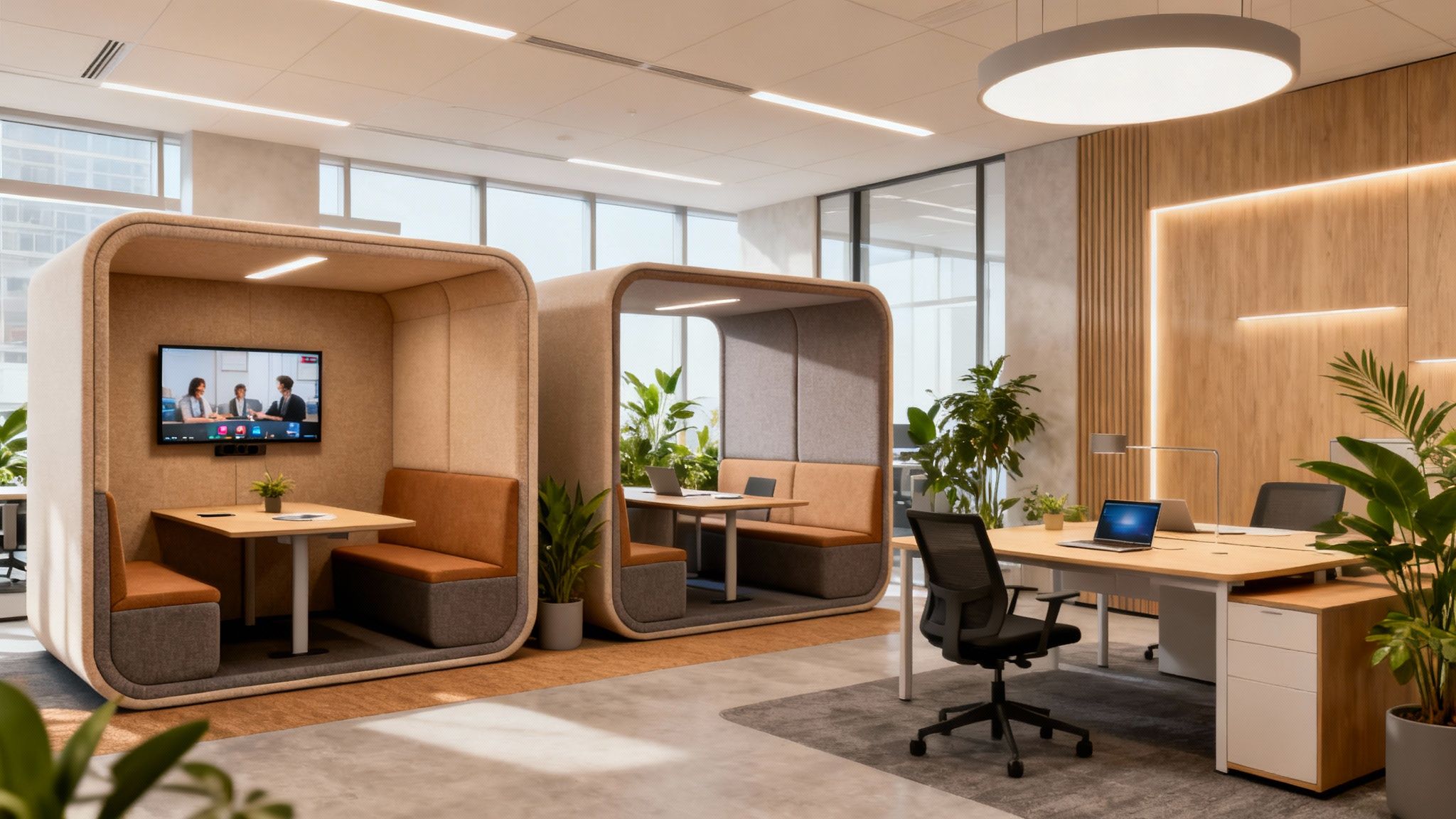
The world of work has completely shifted and our offices are racing to keep up. A modern interior fit out isn’t just about a fresh coat of paint anymore; it’s a strategic answer to new employee expectations and evolving business needs. Today’s projects are all about putting flexibility, wellbeing and real collaboration at the heart of workplace design.
One of the biggest changes is the move towards creating spaces ready for hybrid work. The office is no longer simply a place to park yourself at a desk from nine to five. It’s now a central hub for teamwork, innovation and connection, a destination that has to offer something genuinely better than working from home.
This has created a clear ‘flight to quality’. We’re seeing many companies reduce their overall office footprint but invest more heavily in premium, Grade A spaces. A well-designed, amenity-rich environment is now seen as a critical tool for attracting and keeping the best talent in a tough market.
The Rise of Flexible and Adaptable Spaces
The demand for flexibility is reshaping office layouts across the UK. Static, one-size-fits-all designs are out, replaced by dynamic environments that can adapt to different tasks and team sizes on the fly. This is where modular solutions really come into their own.
A truly flexible fit out often includes:
- Movable Walls and Partitions: These allow teams to easily reconfigure a space for a new project or a last-minute all-hands meeting.
- Modular Furniture: Think desks, seating and storage that can be rearranged to support different work styles, from focused individual tasks to collaborative huddles.
- Multi-functional Zones: We design areas to serve different purposes throughout the day, a café space, for example, that doubles as an informal meeting area or a hot-desking spot.
This adaptability is especially vital as businesses in Essex, Hertfordshire and London look to create future-proof offices. A flexible workspace can evolve with your company, saving you from more costly reconfigurations down the line and ensuring your office remains a valuable asset for years to come.
A Focus on Wellbeing and Technology
Beyond just being flexible, employee wellbeing has rightly climbed to the top of the priority list. A modern interior fit out now weaves in elements designed to support both physical and mental health.
A workplace that prioritises wellbeing isn’t a luxury; it’s a necessity. It sends a powerful message to your team that you value them as people, which boosts morale, creativity and loyalty.
This means incorporating biophilic design to bring a touch of nature indoors, improving acoustics to cut down on distracting noise and providing ergonomic furniture that genuinely supports comfort. Technology is the other key player. Seamless AV equipment, simple room booking systems and rock-solid connectivity are no longer nice-to-haves; they are absolutely essential for a productive modern workplace.
Freestanding pods and booths are a perfect example of these trends coming together. They offer private, acoustically insulated spaces for focused work or important calls right in the middle of a bustling open-plan office. To get a better sense of their impact, have a look at our guide on revolutionising workspace dynamics with freestanding booths and pods.
Ultimately, a modern fit out is a strategic investment in your people and your company’s future.
Why Your Fit Out Is a Powerful Business Investment
It’s easy to see an interior fit out as just another line item on a budget but that’s a huge missed opportunity. A far smarter approach is to see it for what it truly is: a powerful, strategic investment in the future of your company. When done right, the returns from a professionally executed fit out go far beyond a simple facelift, delivering real benefits that strengthen your bottom line and set you up for long-term success.
A thoughtfully designed workspace has a direct, measurable impact on how your team performs. By getting the ergonomics right, optimising layouts for different work styles and creating a genuinely positive atmosphere, a fit out can significantly boost productivity and make employee wellbeing a priority.
Attracting and Retaining Top Talent
In today’s fierce job market, your office is one of your most powerful recruitment tools. A well-designed, modern workplace acts as a magnet, showing potential hires that you are a forward-thinking employer who genuinely invests in their people.
That same commitment is just as important for keeping your existing team happy and engaged. A great office environment improves morale and makes employees feel valued, and that feeling is absolutely critical for long-term retention.
Expressing Your Brand and Culture
Your physical workspace is the most powerful, three-dimensional expression of your brand. It’s your chance to bring your company’s values and culture to life in a way a website or a brochure never could.
An interior fit out translates your brand story into a physical experience. It tells clients, partners and employees who you are and what you stand for the moment they walk through the door.
This isn’t just about sticking a logo on the wall. It’s about crafting an entire atmosphere that embodies your company’s personality, whether that’s high-energy and collaborative or calm and deeply focused.
Aligning With Future Priorities
Investing in your workspace proves you’re a serious player. The UK’s interior fit out market is a multi-billion-pound industry, a figure that shows just how many leading businesses are actively using their offices as strategic assets. You can discover more about the trends shaping the UK fit out market and see where the industry is heading.
On top of that, a modern fit out is a prime opportunity to improve your building’s environmental, social and governance (ESG) credentials. By choosing sustainable materials and installing energy-efficient systems, your project can enhance your company’s reputation and align your business with future-focused priorities, appealing to clients and talent alike.
Got Questions About Interior Fit Outs? We’ve Got Answers.
When you’re considering a new workspace, a lot of questions pop up. It’s completely normal. To help clear things up, we’ve put together some straightforward answers to the questions we hear most often from our clients. Think of this as the final piece of the puzzle you need before starting a proper conversation about your own interior fit out.
How Long Does an Office Fit Out Take?
Every project has its own rhythm and the timeline really hinges on the size and complexity of the job. A simple refresh for a small office might only need four to six weeks on-site. But for a more typical Category B fit out in a medium-sized space, say, 5,000–10,000 sq ft—you’re likely looking at 10 to 16 weeks for the actual construction phase.
It’s crucial to remember that this doesn’t include the vital design, planning and approval stages that come first. Getting this initial phase right is what makes the rest of the project run smoothly. Here at Gibbsonn, we map out a detailed project programme from day one, giving you a clear and realistic timeline you can count on.
What’s the Difference Between a Fit Out and a Refurbishment?
This is a great question and it’s easy to see why the terms get mixed up. At its core, an ‘interior fit out’ is about taking a basic shell, like a completely empty unit from a landlord and building a brand-new workspace from the ground up. You’re starting with a blank canvas.
A ‘refurbishment’, on the other hand, is all about breathing new life into an existing, operational office. This could be anything from a simple cosmetic lift with new paint and furniture to a complete overhaul of the layout and building services. We specialise in both, shaping our approach to fit what your space and business truly need, whether you’re in the heart of London or out in Bishop’s Stortford.
A fit out starts with a blank canvas, while a refurbishment breathes new life into an existing one. Both are focused on creating a better workspace but they start from very different points.
Do I Need Planning Permission for My Fit Out?
For most fit out projects that are purely internal, you won’t need to go through the full planning permission process. However and this is a big one, you will absolutely need to comply with UK Building Regulations. These aren’t optional; they cover critical health and safety areas like fire safety, accessibility, structural integrity and ventilation.
If your project touches the building’s exterior, like adding new windows, or changes its fundamental use (turning a warehouse into an office, for example), then planning permission from the local council is almost certainly required. Our team handles all the red tape for you, making sure your project is fully compliant, legal and safe.
Can We Stay in Our Office During the Project?
Yes, in many cases, you can. It’s often possible to phase a project to keep disruption to a minimum, allowing your team to stay operational while the work is underway. This kind of approach demands meticulous planning and tight coordination. We often schedule the noisiest or most disruptive work for evenings or weekends to make it work.
Careful management of dust, safety and access is paramount. We frequently develop phased construction plans for our clients in busy areas like Stansted and Cambridge, ensuring they can carry on with their business while we transform the space around them. It all comes down to a close partnership and clear communication, something we pride ourselves on.
Ready to transform your workspace? Speak to the Gibbsonn Interiors team today to discuss your vision and discover how we can bring it to life.