
Thinking about an office transformation can feel overwhelming. You’ve got architects, project managers, construction firms… the list of specialists to juggle seems endless. A design and build company cuts through that complexity by acting as your single, unified team for the entire project. Instead of you coordinating all the moving parts, one company manages everything from the first sketch to the final handover. It’s an all-in-one approach designed to make the whole journey smoother.
What Is the Design and Build Model?

Let’s use an analogy. Imagine commissioning a bespoke suit the old-fashioned way. You’d buy fabric from one supplier, take it to a pattern cutter and then finally hand it over to a seamstress. If the sleeves end up too short, who’s to blame? The seamstress might point to the pattern and the cutter could blame the fabric. You’re stuck in the middle, trying to get different specialists who aren’t on the same team to sort it out.
Now picture visiting a master tailor who handles everything under one roof. They consult with you on the style, source the perfect material, take your measurements and stitch the final garment. That’s the design and build model.
Because one firm oversees the entire process, there is total accountability. Any issues are handled internally by a team that’s already collaborating, ensuring the final result is exactly what you envisioned. Design and build companies bring this same joined-up logic to office fit-outs and refurbishments.
One Team, One Goal
The traditional construction method, often called design-bid-build, works very differently. The client first hires an architect to create a full set of drawings. These plans are then sent out to various building contractors who bid against each other for the work. This approach almost guarantees a division between the people who designed the space and the people who have to build it.
The architect’s vision might not line up with the builder’s practical or budgetary realities which often leads to delays, spiralling costs and friction. When something goes wrong, it can quickly descend into a blame game between separate companies.
Design and build completely removes this friction. The key benefits of having a unified team are clear:
- A Single Point of Contact: You get one dedicated project manager who is responsible for absolutely everything. This makes communication and decision-making incredibly straightforward.
- Seamless Collaboration: Designers, project managers and construction experts are all at the same table from day one. This fosters creative problem-solving and makes sure the design is not only inspiring but also perfectly buildable.
- Total Accountability: With a single contract, there’s no finger-pointing. The responsibility for delivering your project on time and on budget rests entirely with your design and build partner.
For businesses in bustling hubs like London, Cambridge or Bishop’s Stortford, this model provides much-needed clarity and peace of mind. It turns a complex, multi-layered process into a genuine partnership, one focused on creating a workspace that truly empowers your team and drives your business forward.
The Real-World Benefits of a Single Partner
Deciding on a design and build partner does more than just shorten your list of contacts. It completely changes the way your project takes shape, bringing real, tangible advantages in accountability, cost control, speed and the final quality of your new workspace. For businesses across Essex and Hertfordshire, these benefits mean less risk and a much better return on investment.
So why are so many UK businesses turning to this integrated model for their office fit-outs? It all boils down to four crucial improvements over the old way of doing things.
Single Point of Accountability
Picture this: you’ve gone the traditional route. The new ventilation system isn’t working as it should. The mechanical contractor points the finger at the architect’s design. The architect, in return, suggests the contractor used the wrong equipment. And you? You’re stuck in the middle, trying to mediate a dispute between two separate companies whose main interest is protecting themselves.
A design and build company makes this problem disappear. Because one team is responsible for both the design and the delivery, there’s nowhere to hide.
With one contract and one team, the buck stops here. Accountability is baked into the model, ensuring problems are solved collaboratively and quickly, not debated endlessly.
This unified responsibility creates a proactive, solution-focused mindset from day one. The whole team is geared towards delivering a brilliant outcome, not defending their corner.
Cost Certainty and Value Engineering
In a traditional project, you often don’t know the full cost until the builders submit their tenders based on a completed design. If those bids come in way over budget, you’re left with a painful choice: find more money or head back to the drawing board for expensive redesigns.
Design and build companies on the other hand build cost management in from the very beginning. The construction and design teams work hand-in-hand to create a plan that’s both inspiring and financially realistic.
This early collaboration opens the door for value engineering, the art of finding smarter, more cost-effective ways to get the same high-quality result. For instance, the team might suggest a different material or a building technique that shaves costs without watering down the design vision. This approach keeps your budget front and centre throughout the process, preventing any nasty surprises when the final invoice arrives.
Design and Build vs Traditional Procurement: A Comparison
To really see the difference, it helps to put the two approaches side-by-side. The table below breaks down the key distinctions, showing why a single-source partner often provides a smoother, more efficient path to your new workspace.
| Feature | Design and Build Model | Traditional Model (Design-Bid-Build) |
|---|---|---|
| Accountability | Single point of responsibility for design and construction. | Divided between architect and contractor; potential for disputes. |
| Cost Management | Budget is integrated from the start; value engineering is ongoing. | Full costs are unknown until after the design and bidding phases. |
| Project Speed | Overlapping phases (fast-track); quicker completion. | Linear, sequential process; longer overall timeline. |
| Collaboration | Designers and builders work as one team from day one. | Teams work in separate silos; communication can be a challenge. |
| Risk for Client | Reduced risk as the D&B firm owns the entire process. | Higher risk; client must manage multiple contracts and relationships. |
Ultimately, the choice comes down to how involved you want to be and how much risk you’re willing to take on. For most businesses, the integrated design and build model offers a far more streamlined and predictable journey.
Faster Project Completion
In any commercial project, time is money. The traditional design-bid-build process is strictly linear, one phase has to be completely finished before the next can even start. This naturally stretches out the project timeline.
The design and build model allows for a much faster, overlapping schedule. Key tasks can happen at the same time:
- Early Procurement: Long-lead items like bespoke joinery or specialist equipment can be ordered while the final detailed drawings are still being polished.
- Site Preparation: Initial work on-site can kick off as soon as the core layout is agreed, running in parallel with the detailed design phase.
- Integrated Teams: When designers and builders are in constant contact, questions from the site are answered in hours, not days, stopping small hiccups from turning into costly delays.
This agile process means you can be in your new office much sooner, minimising disruption and letting your team get productive in their new environment faster. The demand for this kind of efficiency is clear in the UK’s fit-out market. While the overall UK construction market is projected to reach £168.6 billion in 2025, it remains highly fragmented. This has made turnkey specialists who can deliver complex office transformations with a single point of contact incredibly appealing. You can explore more about these market dynamics in the full UK construction industry report on BusinessWire.com.
Enhanced Quality and Innovation
When designers and builders operate in their own separate worlds, the creative vision can easily get lost in translation. A contractor who is only focused on the build might not fully appreciate the subtle intentions behind a design choice, resulting in a finished space that just misses the mark.
In a design and build team, everyone shares ownership of the final result. The builders understand the ‘why’ behind the design and the designers get the benefit of the practical, real-world knowledge from the construction crew. This powerful synergy often sparks more innovative and effective solutions, ensuring the finished workspace isn’t just built correctly but is a truly exceptional place to be.
Your Project Journey From Concept to Completion
It helps to know what a design and build project actually looks like on the ground. Instead of a clunky, disjointed series of handovers between different companies, think of it as a fluid journey where each stage flows logically into the next. At Gibbsonn Interiors, we guide our clients from that first spark of an idea to a fully functioning, inspiring workspace, managing all the complexity so you don’t have to.
The whole process is structured to be clear and collaborative. You’ll always feel informed and in control but without ever getting bogged down in the tiny details. Let’s walk through the typical stages of a commercial office fit out.
Stage 1: Workplace Strategy and Briefing
Honestly, this is the most important part of the entire project. Before a single line is drawn, we need to get to the heart of your ‘why’. We’ll sit down with you to define what you really need to achieve, asking some critical questions:
- What are your business goals for the next five years?
- How do you want your team to feel and work in the new space?
- What are the biggest frustrations with your current office?
- What does your brand stand for and how can the space reflect that?
This deep dive ensures the final design isn’t just a pretty picture; it’s a strategic tool for your business. For clients in busy commercial hubs like Chelmsford and Stansted, getting this brief right is the bedrock of a successful project.
Stage 2: Concept Design and Visualisation
Once we have a rock-solid brief, our creative team gets to work. This is where your vision starts to become something you can see and touch. We develop initial space plans, mood boards and 3D visuals that bring the concepts to life. You’ll see how different layouts could work and get a real feel for the proposed materials, colours and furniture.
This is a totally collaborative stage. We’ll present our ideas, you’ll give us feedback and we’ll refine the concepts together until they perfectly capture your goals and company culture. It’s an exciting phase where the potential of your future workspace really starts to hit home.
At this point, the project is all about possibilities. We translate your business needs into a design language, creating a blueprint that is both functional and inspiring. This ensures the space we build will actively support your team’s success.
Stage 3: Detailed Design and Cost Finalisation
With the concept signed off, we zoom in on the technical details. This stage involves finalising every last specification, from the exact lighting fixtures and flooring to the complete mechanical and electrical plans. Our designers work hand-in-glove with our pre-construction team to produce a full package of construction drawings.
Crucially, as we finalise these details, we also lock in a fixed and fully itemised cost for the entire project. This transparency is one of the biggest benefits of the design and build model. You get a firm budget before any major work kicks off which completely eliminates the risk of nasty surprises down the line.
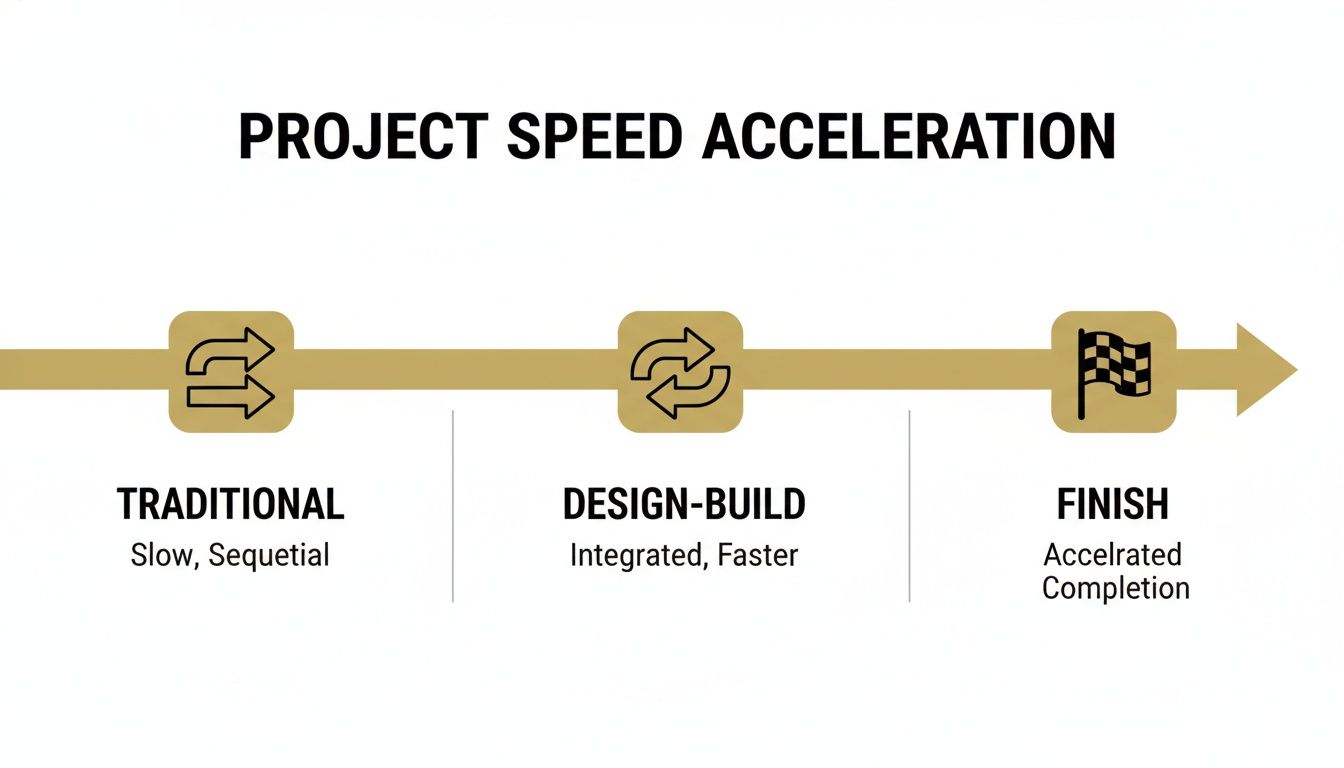
This diagram shows just how much faster an integrated design and build project can be. By overlapping the design finalisation with early site prep and ordering materials, we get you into your new workspace far quicker than the old-fashioned, linear approach.
Stage 4: Construction and On-Site Management
And now the build begins! A dedicated project manager becomes your single point of contact throughout this entire phase. They’ll give you regular updates and oversee every single thing happening on-site. We manage it all, including:
- Health and Safety: Making sure the site is fully compliant with all UK regulations. No shortcuts.
- Quality Control: Meticulously checking that all work meets our demanding standards.
- Supplier Coordination: Juggling all the different tradespeople and material deliveries to keep the project running like clockwork.
Our goal is simple: to make the construction phase as smooth and disruption-free as possible, letting you focus on what you do best, running your business.
Stage 5: Handover and Ongoing Support
Once the final lick of paint is dry, we’ll walk through the space with you for a thorough inspection to make sure every detail is perfect. Then we officially hand over the keys to your new workspace, along with a comprehensive pack containing all your warranties and maintenance guides.
But our partnership doesn’t end there. We’re always on hand to offer post-completion support, helping your team settle in and answering any questions that pop up. This commitment ensures your new office continues to work for you long into the future.
How to Navigate Project Costs and Contracts
Let’s be honest: one of the biggest anxieties for any business diving into an office fit out is the budget. The design and build model is built from the ground up to give you cost certainty and shield you from those dreaded financial surprises. It’s all about getting from a vague estimate to a fixed, reliable figure as early as humanly possible.
This clarity is baked into the agreements we use. In the UK, a lot of projects run on standard industry contracts like the JCT Design and Build Contract. This isn’t just paperwork; it’s a legal framework that puts the responsibility for both the design and the construction squarely on one company. What does that mean for you? A single, fixed cost for the entire project, right from the start.
Understanding What Influences the Price
The final price tag on your office transformation isn’t pulled out of thin air. It’s shaped by a few key variables and having a partner who can give you a detailed cost breakdown is absolutely essential for making smart decisions.
A good design and build firm will sit down with you and walk through every factor that drives your budget. It’s about finding that sweet spot between your aspirations and commercial reality. The main cost drivers usually boil down to:
- Level of Specification: The choice of materials and finishes makes a huge difference. Think flooring, lighting, bespoke joinery and high-spec acoustic panels, it all adds up.
- Mechanical & Electrical (M&E) Needs: If you have complex needs for air conditioning, data cabling, power distribution or specialist lighting, that will naturally require more investment.
- Structural Changes: Any work that touches the building’s core structure, like removing walls or adding a new staircase, is always going to be a major part of the budget.
- Location and Access: The simple logistics of getting materials and people to a site in central London or Cambridge can be very different from a project in a more accessible area like Braintree.
Getting a clear handle on these elements is what allows for truly transparent budget management. For a much deeper dive into the numbers, check out our detailed guide on the cost of an office fit out.
Mitigating Financial Risk
In a market as volatile as ours, managing financial risk is more critical than ever. Material costs can spike and supply chain issues can cause delays but an integrated design and build partner acts as your buffer against this uncertainty. Because we handle design, procurement and construction under one roof, we can secure prices and order materials early on, locking in costs before they have a chance to climb.
This proactive approach is vital in the current UK construction climate. While there are signs of growth, clients are rightly focused on managing risk and getting maximum value from refurbishments rather than expensive new builds.
In an environment where UK construction output can be unpredictable, the design and build model offers a vital layer of financial protection. It allows firms in Hertfordshire and Essex to adapt existing floorplates and boost wellbeing, aligning with modern hybrid working patterns without the budgetary guesswork.
Recent analysis backs this up, showing that design and build specialists are in high demand for their ability to manage complex projects with tight budget control. For business leaders, this means having the clear financial data needed to build a compelling case for investing in a future-ready workplace. You can discover more about the 2025 UK architecture outlook on milientsoftware.com to see how the industry is adapting. Ultimately, this integrated model provides the commercial peace of mind you need to focus on the long-term benefits of your new space.
How to Choose the Right Design and Build Partner
Choosing the right partner is hands-down the most critical decision you’ll make for your office transformation. The entire project’s success, from hitting your budget and deadline to the final quality of the workspace, hinges on finding a firm that truly gets your vision and has the track record to prove they can deliver it.
This isn’t just about hiring a builder; it’s about finding a genuine strategic partner. With so many design and build companies out there, it can feel overwhelming to know what to look for. A slick website is one thing but you need to dig deeper to see if they have the capability and reliability to back it up.
Scrutinise Their Portfolio and Experience
First things first: look at what they’ve actually done. A strong portfolio is non-negotiable but don’t just get swept away by glossy photos. You need to look for real, tangible evidence that’s directly relevant to your project.
As you review their past work, ask yourself a few key questions:
- Sector Experience: Have they worked with businesses in your industry? A firm that understands the specific demands of a London legal practice will be far better equipped than one that only does retail fit outs.
- Project Scale: Does their portfolio showcase projects of a similar size and complexity to yours? You need to be confident they have the team and resources to handle the scale you need.
- Design Quality: Look beyond the latest trends. Does their work show a real understanding of space planning, ergonomics and how to bring a brand identity to life? The designs should be strategic and functional, not just fashionable.
A good portfolio tells a story of problems solved and visions realised. It should give you absolute confidence that they’ve tackled challenges just like yours before.
Verify Their Reputation and Reliability
Client testimonials and detailed case studies are your best window into a company’s real-world performance. While a short quote on a website is nice, you should be looking for in-depth case studies that walk you through a project from the initial brief right through to the final handover. These show you how the firm thinks and, crucially, how they handle the process.
A great design and build partner doesn’t just deliver a space; they deliver a seamless experience. Client feedback is the best measure of their ability to manage communication, stick to deadlines and handle the inevitable challenges that arise during a build.
Don’t be afraid to ask for references you can actually speak to. A confident, reliable company will be more than happy to connect you with previous clients. This is a vital step for verifying their project management skills and their commitment to client satisfaction.
Ask the Right Questions During Consultations
The initial consultation is your chance to interview potential partners. This is where you can really gauge their professionalism, their design philosophy and whether they’re a good cultural fit for your own business. Come prepared with a list of specific questions to make sure you cover all the important ground.
Here are a few critical questions to ask:
- Who will be my day-to-day contact? Knowing the team structure and who will be managing your project is vital for clear communication.
- How do you manage health and safety on-site? A professional firm will have robust procedures and be able to provide clear documentation without hesitation.
- What is your approach to sustainability in design and materials? This demonstrates their commitment to modern, responsible building practices.
- Can you explain your supply chain? A reliable and vetted supply chain is absolutely key to keeping a project on track and on budget.
This line of questioning will help you move beyond the sales pitch and understand how they truly operate. Choosing the right team is much like selecting the best office fit out contractors; you need a partner who is transparent, experienced and genuinely invested in your project’s success.
Time to Reimagine Your Workspace?
Throughout this guide, we’ve explored how the design and build model offers a more efficient, transparent and value-driven path to creating a workspace that truly works. It’s a method built on genuine partnership, not just rigid contracts, aligning creativity, technical know-how and commercial reality from day one.
At Gibbsonn Interiors, our speciality is bringing bespoke fit out and refurbishment projects to life, spaces that don’t just look good but also inspire your teams and drive your business forward. We’re proud to serve businesses across the UK, from our local roots in Bishop’s Stortford and Essex to the bustling commercial hubs of London and Cambridge.
Your Strategic Interiors Partner
When you choose to work with a design and build company like us, you get a single, dedicated team managing every last detail. We handle the complexities of workplace strategy, detailed design, procurement and the on-site build itself. This all-in-one approach guarantees a seamless process with minimal disruption to your day-to-day operations.
You can get on with what you do best, running your business, while we craft an environment that reflects your ambition and empowers your people. We believe a great workspace is more than just four walls; it’s a powerful business tool that can boost productivity, attract top talent and bring your company culture to life.
Our commitment is to turn your vision into a tangible asset. We blend creative design with practical, on-the-ground expertise to build something brilliant together, ensuring your investment delivers real, lasting value for years to come.
Let’s Get Started
If you’re ready to create a workplace that positions your business for future success, our team is here to guide you. We manage the entire journey, from the initial brief to the final handover, guaranteeing clarity, quality and accountability every single step of the way.
Ready to transform your workspace? Speak to the Gibbsonn Interiors team today.