
Thinking about a new office? It’s an exciting move but the process can seem complex. When you hear the term commercial office fit out, what does it actually mean?
Simply put, it’s the whole process of turning an empty commercial space into a workspace that’s ready for your team. It covers everything that happens between the landlord handing over the keys to a bare shell and you opening the doors to your company’s new home. For businesses in Bishop’s Stortford, Essex, Hertfordshire and London, getting this right is key to creating a space that attracts and keeps top talent.
Table of Contents
- What Is a Commercial Office Fit Out Really?
- Your Step-by-Step Fit Out Journey
- Decoding Commercial Office Fit Out Costs
- Navigating Critical Rules and Regulations
- How to Choose the Right Fit Out Partner
- Your Commercial Fit Out Questions Answered
What Is a Commercial Office Fit Out Really?
The most important thing to understand is the split between what the landlord provides and what you as the tenant are responsible for creating. This is where you’ll hear the terms ‘Category A’ and ‘Category B’. Understanding this difference is the foundation of any successful office move.
Think of it like renting an unfurnished flat. The landlord gives you the basics like plastered walls, standard lighting, heating and maybe a raised floor. That’s a Category A fit out. It’s a clean, safe and functional box but it’s not somewhere a business can actually operate.
From Empty Shell to Bespoke Workspace
This is where you come in. Your responsibility is the Category B fit out. This is the exciting part where we bring the space to life, turning that blank canvas into an environment that reflects your brand, supports your team’s workflow and ticks all your operational boxes.
This second stage is the real heart of a fit out project. It’s a completely bespoke process that covers:
- Shaping the Space: Building the floor plan with partitioning to create individual offices, meeting rooms, breakout zones and kitchens.
- Adding the Finishes: Laying flooring, choosing wall coverings, installing feature lighting and adding branded graphics that reflect your company’s identity.
- Plugging Everything In: Installing all the critical IT infrastructure, data cabling and audiovisual gear for your meeting rooms.
- Bringing in the Furniture: Selecting and placing every desk, chair, storage unit and collaborative sofa to build a productive and comfortable environment.
To put it plainly: Cat A is the landlord’s blank canvas; Cat B is your finished masterpiece. Getting this right from the start is the key to a smooth project.
Comparing Cat A and Cat B Fit Out Projects
| Feature | Category A (Landlord’s Space) | Category B (Tenant’s Workspace) |
|---|---|---|
| Responsibility | Landlord | Tenant |
| Purpose | To create a safe, lettable shell | To create a fully functional, branded workspace |
| MEP Services | Basic mechanical, electrical, and plumbing to a central point | Distribution of services to outlets, workstations, and specific areas |
| Finishes | Basic suspended ceilings, raised floors, plastered walls | All final finishes: flooring, paint, wall coverings, feature lighting |
| Layout | Open plan, no internal partitions | Creation of offices, meeting rooms, kitchens, and breakout spaces |
| IT & Data | No specific IT infrastructure | Full data cabling, server room setup, AV installation |
| Furniture | None | All desking, seating, storage, and specialised furniture |
| Branding | Neutral | Bespoke branding, signage, and graphics |
As you can see, Category A provides the essential foundations but Category B is where the magic really happens, turning an empty unit into a tailored business environment.
Expert Tip: A key mistake we see businesses make is underestimating the scope of a Category B fit out. It’s so much more than just buying furniture; it’s a detailed construction project that defines the entire experience for your team and clients.
It’s also important to distinguish a fit out from a refurbishment. A refurb involves updating an existing, perhaps tired-looking, office. A fit out almost always begins from a more basic shell. For companies in competitive hubs like London, Cambridge, or Bishop’s Stortford, a well-planned fit out isn’t just a necessity. It’s a powerful tool for attracting and keeping the best people. It lets you build a workplace from the ground up that is perfectly tuned to your business.
Your Step-by-Step Fit Out Journey
A full commercial office fit out might seem like a huge task but it follows a clear, structured path. When you break the project down into logical phases, the process becomes far more manageable.
Think of it as a roadmap where each stage builds on the last. With the right partner managing the process, it’s a seamless transition from start to finish.
This visual shows how the core responsibilities shift from the landlord’s basic Cat A shell to your own finished Cat B workspace.
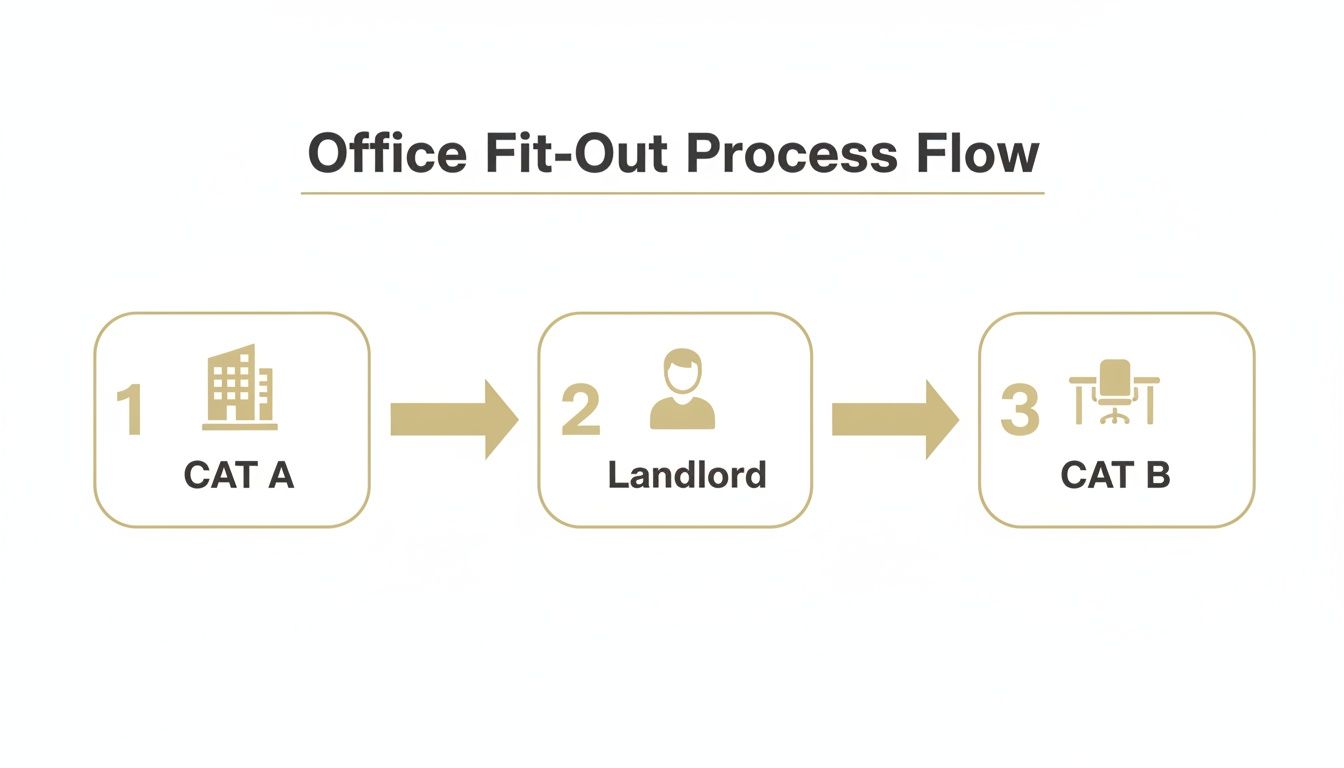
The journey clearly starts with the foundational space provided by the landlord before moving into the tenant-led phase where your unique workplace is brought to life.
Stage 1: Discovery and Briefing
Honestly, this is the most crucial part of the entire project. It’s where we sit down with you to understand not just what you want but why you want it. This isn’t about picking paint colours just yet; it’s about defining the purpose of your new workspace.
Together, we’ll dive into the big questions:
- What are your business goals? Are you looking to spark more collaboration, attract the best talent, or create a more efficient workflow?
- How does your team really work? We’ll get into the details of daily activities, departmental needs and your plans for future growth.
- What is your company culture? The design should be a physical extension of your brand values and identity.
A thorough brief becomes the guide for every decision that follows, ensuring the final result is perfectly aligned with your business objectives. It prevents costly changes down the line and lays a solid foundation for success.
Stage 2: Design and Space Planning
With a strong brief in hand, our creative team gets to work. This is where your vision starts to take shape. We translate the ‘what’ and ‘why’ from the briefing stage into a concrete ‘how’.
This phase involves creating detailed 2D floor plans and immersive 3D visualisations. You’ll see exactly how your new office will look and feel, from the layout of desks and meeting rooms to the flow of people between departments. This is a truly collaborative process. We present concepts, you give us feedback and we refine the designs until they’re just right. Our team are experts in office design and space planning, making sure every square foot works for you.
Stage 3: Approvals and Compliance
Before any construction begins, we need to sort out the paperwork. This phase is all about making sure your new workspace is safe, legal and fully compliant with all UK regulations. It’s a complex area but we manage it all on your behalf.
This typically includes:
- Building Regulations: Ensuring the design meets all the standards for fire safety, accessibility and structural integrity.
- Landlord Approval: Submitting the detailed plans to your landlord to get their official consent.
- Planning Permission: If the fit out involves changes to the building’s exterior, this may be needed from the local council.
Navigating this web of regulations is one of the biggest benefits of working with a fit out specialist. We handle the technical submissions and approvals, giving you complete peace of mind that everything is being done correctly.
Stage 4: Construction and Build
Now for the exciting part – where the physical transformation happens. Our project managers and on-site teams take the approved designs and bring them to life. With a detailed schedule locked in, we coordinate all the tradespeople from electricians and plumbers to partitioners and decorators to ensure the project runs on time and meets the highest quality standards.
We’ll give you regular progress updates so you always know what’s happening. Our focus is on delivering exceptional craftsmanship with minimal disruption, which is especially important for projects in busy areas like Essex, Hertfordshire or London.
Stage 5: Handover and Aftercare
The final stage is the handover. We’ll walk through the completed space with you for a thorough inspection to ensure every last detail meets your expectations, a process known as ‘snagging’. Once you are completely happy, we hand over the keys to your new workspace.
But our relationship doesn’t end there. We provide a comprehensive handover pack with all the necessary documentation, manuals and warranties. We also remain on hand to offer support as your team settles in, making sure your new office continues to serve your business perfectly for years to come.
Decoding Commercial Office Fit Out Costs

Let’s get straight to the big question on every client’s mind: how much will this cost? Budgeting for a commercial office fit out can feel difficult but the costs can be broken down into clear, predictable ranges. Understanding these figures is the first step toward making a smart investment.
The most common way to estimate costs is on a per-square-foot basis. Think of it as a baseline that we can then adjust depending on the level of finish you’re after, the complexity of the design and of course, location. Whether you’re in the heart of London or a regional hub like Chelmsford or Cambridge, this approach helps create a realistic financial roadmap.
Understanding Specification Levels
Not all fit outs are created equal and the final bill is heavily influenced by the specification level you choose. We generally group these into three distinct categories.
- Low Specification: This is your functional, no-frills approach. It covers the essentials: standard partitioning, basic finishes, simple lighting and durable, entry-level furniture. It’s a solid, cost-effective solution for getting a space up and running quickly.
- Mid Specification: This is the sweet spot for most businesses, striking a great balance between quality and value. Here you’ll find better-quality finishes, more sophisticated lighting, some bespoke joinery and a higher standard of furniture and tech integration.
- High Specification: This is the premium tier. We’re talking high-end materials, custom-built features, advanced audiovisual and smart building technology and designer furniture. It’s all about creating a showpiece office that makes a powerful statement about your brand.
It’s vital to align your specification level with your business goals and budget from the start. For a deeper dive into what drives these expenses, check out our detailed guide on the cost of an office fit out.
Key Factors That Influence Your Budget
Beyond the spec level, several other key elements will affect the final price. It’s really important to factor these in during the planning phase to avoid surprises down the line.
The condition of the base building is a huge variable. A newer Cat A space will need far less work than an older building that requires big upgrades to its mechanical and electrical (M&E) systems. Complex M&E requirements like specialist air conditioning or dedicated power for server rooms will also add to the budget.
On top of that, the amount of technology and AV equipment you plan to install can be a significant cost driver. Finally, the choice of furniture, fixtures and equipment (FF&E) represents a large slice of the budget, with bespoke or designer pieces costing substantially more than standard items.
Expert Tip: A well-defined budget isn’t just about spending less; it’s about spending smart. By putting your money into the areas that matter most to your team’s productivity and wellbeing, you can achieve a fantastic return on your investment.
Estimated UK Commercial Office Fit Out Costs Per Square Foot
To give you a clearer picture, let’s look at some illustrative figures. The table below provides a guide to what you might expect to pay for different specification levels in London versus key regional cities. These numbers reflect current market rates and typical variations in labour and material costs.
| Specification Level | London (per sq ft) | Regional Hubs (e.g., Cambridge, Chelmsford, per sq ft) |
|---|---|---|
| Low Specification | £125 – £160 | £100 – £130 |
| Medium Specification | £160 – £220 | £130 – £180 |
| High Specification | £220 – £310+ | £180 – £260+ |
Remember, these figures are a guide but they offer a solid starting point for your financial planning. By working closely with an experienced partner, you can develop a detailed, transparent budget that aligns perfectly with your vision and delivers maximum value.
Navigating Critical Rules and Regulations
An office fit out is much more than picking out new furniture and a fresh coat of paint. It’s a proper construction project and that means it has to be safe, legal and accessible to everyone.
Understanding all the rules and regulations can feel difficult but getting it right is non-negotiable. This is where having an experienced partner really pays off. We live and breathe this stuff, so you can get on with running your business knowing your new workspace will be fully compliant.
Let’s break down the main areas you need to be aware of.
Understanding Building Regulations
Think of Building Regulations as the legal minimum standards for how buildings are designed, constructed and altered in the UK. They’re not the same as planning permission; this is all about the technical side of things to ensure people are safe.
For a typical office fit out, these regulations cover a lot of ground:
- Fire Safety: This is the big one. It governs everything from fire alarm systems and escape routes to using fire-resistant materials to stop a fire from spreading.
- Ventilation: A stuffy office is an unproductive office. Regulations make sure there’s enough airflow to keep the environment healthy and comfortable.
- Structural Safety: Any new walls or major additions can’t just be thrown up. They need to be structurally sound and can’t put the original building’s integrity at risk.
- Energy Efficiency: The rules also set standards for lighting, heating and insulation to make sure your new space isn’t wasting energy.
Before any work begins, you’ll need Building Regulations approval from your local authority or a certified inspector. It’s a mandatory step.
Accessibility and the Equality Act
Your office needs to work for everyone, regardless of their physical abilities. The Equality Act 2010 is very clear on this, requiring employers to make ‘reasonable adjustments’ so that their premises don’t disadvantage anyone with a disability.
In a fit out, this translates to practical design choices. Are the corridors and doorways wide enough for a wheelchair? Are light switches and reception desks at a sensible height? Are there accessible toilets? A great workspace goes beyond just ticking boxes; it creates a genuinely inclusive environment where every member of your team can feel valued and do their best work.
Expert Tip: A truly successful workspace is not only beautiful and productive but also fundamentally safe and inclusive. Overlooking compliance isn’t just a legal risk; it’s a failure to care for your most important asset, your people.
Health and Safety CDM Regulations
The Construction (Design and Management) Regulations 2015, or CDM for short, are the health and safety rulebook for every UK construction project, including your fit out. They’re designed to make sure health and safety is considered from the very beginning.
CDM assigns specific legal duties to the client (that’s you), the principal designer and the principal contractor. As the client, you have a responsibility to see the project is managed safely. A good fit out partner will take on the key roles, managing all site safety, coordinating the different trades and making sure all the paperwork is in order.
Landlord Consent and Planning Permission
Before any physical work can begin, you’ll need the green light from your landlord. This usually means submitting your detailed design plans for them to approve, which they’ll formalise with a ‘licence to alter’. It makes sense, they want to be sure your plans won’t harm the building’s structure or value.
For most internal Cat B fit outs, you won’t need planning permission. However, if your project changes the outside of the building in any way, like new windows or external signage, then you’ll almost certainly need to apply for planning permission from the local council, whether you’re in Braintree, Stansted or central London.
How to Choose the Right Fit Out Partner

Without a doubt, selecting your fit-out partner is the most important decision you’ll make. This single choice will have the biggest impact on your budget, timeline and the final quality of your new workspace.
Get it right and the whole process feels smooth. Get it wrong and it can quickly become a source of stress and unexpected costs.
The partner you choose isn’t just a supplier. They become your trusted advisor, your project manager and the single point of contact responsible for bringing your vision to life. This is especially true for businesses in bustling commercial hubs like London, Bishop’s Stortford and Cambridge.
Traditional vs Design and Build
Historically, a commercial office fit out followed a traditional path. A business would hire an architect to draw up the plans and then ask a separate contractor to do the building work.
This old-school method creates a split between design and construction, which is often where problems start.
The modern, more efficient approach is the design and build model. Here, one company takes complete ownership of the entire project from the first sketch to the final handover. This creates a single line of accountability. The design and construction teams are on the same side from day one, meaning designs are practical, budgets are realistic and communication is simple.
This integrated approach brings major advantages:
- Faster Timelines: Because the design and build phases can overlap, the whole project moves much quicker.
- Budget Certainty: Costs are locked in much earlier, reducing the risk of surprises down the line.
- One Point of Contact: You have one dedicated project manager, making communication and decision-making straightforward.
- Better Collaboration: The team designing your space is the exact same team building it, ensuring nothing gets lost in translation.
Key Questions to Ask Potential Partners
When you’re looking at potential fit-out partners, you need to look beyond the price. A great team will answer your questions with confidence and transparency.
Start by asking about their process. How do they handle the initial briefing? A good partner will want to understand your business goals and company culture before they even think about floor plans.
Ask to see their portfolio. Have they worked with companies of your size or in your industry before? Look for proof of their work in your local area, whether that’s Essex or Hertfordshire, as this shows they have local knowledge of suppliers and regulations.
And finally, always ask for client testimonials or references. There’s no better way to get an honest insight into a company’s work ethic than by speaking to people who have already worked with them.
Expert Tip: The right partner doesn’t just build your office; they build your vision. They should feel like an extension of your own team, fully invested in creating a space that helps your business succeed.
Looking for Quality and Long-Term Value
Choosing a partner is a real investment in your company’s future. We’re currently seeing a major ‘flight to quality’ across the market, where businesses are prioritising top-tier workspaces to attract and retain the best talent. This trend is completely reshaping commercial office fit out projects all over the UK.
Recent research from ArchDaily and other industry leaders shows that in Central London, a record amount of office space taken up was Grade A stock as businesses chase the very best environments. This is fuelling demand for fit-outs that can elevate buildings with better sustainability, acoustics and staff amenities. You can discover more insights on how quality is shaping the UK office market.
Your fit-out partner needs to be a specialist who understands these trends. They should deliver a future-proofed workspace that provides genuine long-term value, not just a quick fix.
Your Commercial Fit Out Questions Answered
Starting a commercial office fit out journey always brings up a few practical questions. It’s completely normal. To help you feel confident, we’ve put together some straightforward answers to the queries we hear most often from our clients across Bishop’s Stortford, Essex, Hertfordshire and London.
This section covers everything from project timelines and keeping your business running to what happens when your lease is up.
How Long Does a Typical Commercial Office Fit Out Take?
This is a big question but there’s no single answer. The timeline for any fit out depends on its size, complexity and the level of finish you’re after. That said, we can give you a pretty reliable guide based on the project’s scale.
For smaller offices under 5,000 sq ft, the whole process from the first design sketch to handing over the keys typically takes between 8 to 12 weeks. This gives us enough time for proper planning, ordering materials and the on-site build without cutting corners on quality.
For a medium-sized project from 5,000 to 15,000 sq ft, you’re looking at a more realistic timeframe of 12 to 20 weeks. Bigger spaces naturally mean more detailed design work, longer lead times for materials and a more involved construction phase. For particularly large or highly intricate fit outs, the project can stretch beyond 20 weeks.
Expert Tip: A crucial part of how we work is giving you a detailed project schedule right from the start. This means you have a clear view of every milestone, from design sign-off to the final handover day, so there are no surprises.
How Can We Minimise Business Disruption During the Fit Out?
Keeping your business running smoothly is our top priority, especially when we’re working in an occupied office. Your team’s productivity is paramount and we have several proven strategies to make the fit out process as seamless as possible.
One of the most effective tactics is a phased approach. We can carve up the office into distinct zones, completing the work in carefully managed stages. This lets your team shift into newly finished areas while work continues in other, safely segregated parts of the office.
Another great strategy is simply working when you’re not. We can schedule the noisier, more disruptive tasks like demolition or drilling for evenings and weekends. This makes a massive difference to the impact on your team’s day-to-day operations.
But above all else, clear and constant communication is key. We’ll work closely with your team to map out a detailed logistics plan. This way, everyone knows what’s happening and when and we can ensure the site is always kept clean, safe and securely separated from your staff.
What Are Dilapidations and How Do They Relate to a Fit Out?
Dilapidations are a critical but often overlooked part of any commercial lease. Simply put, it’s your contractual obligation as a tenant to hand the property back to the landlord in its original state when your lease ends.
This almost always involves stripping out all the changes you made during your Category B fit out. This process, known as reinstatement, could mean taking down partitions, lifting bespoke flooring and removing all your data cabling to return the space to its original ‘Cat A’ shell.
A smartly planned fit out considers these end-of-lease responsibilities right from day one. We can help you understand the specific clauses in your lease and design a workspace that’s not just brilliant for you now but is also simple and cost-effective to reinstate down the line. A bit of foresight here can save you from hefty, unexpected penalties from your landlord.
Are Modular Pods a Good Alternative to Building Meeting Rooms?
Absolutely. Modular meeting pods are a fantastic and increasingly popular alternative to building traditional meeting rooms. They bring a whole host of benefits that are perfectly in tune with the needs of a modern, agile workspace.
Here’s why they’re such a great idea:
- Superb Acoustics: Pods are engineered for excellent sound insulation, creating genuinely private spaces for focused work, confidential calls or team huddles without disturbing the rest of the office.
- Flexibility and Mobility: Unlike a fixed wall, a pod is a freestanding asset. You can easily move it if you decide to change your layout or even take it with you to your next office.
- Speed and Cleanliness: Installation is incredibly quick and clean. Compared to the dust and noise of traditional construction, a pod can often be assembled and ready to use in a single day.
- Potential Tax Benefits: In many cases, pods can be classed as furniture rather than a permanent structural change, which can offer attractive advantages when it comes to capital allowances.
We partner with leading manufacturers like Vetrospace and BlockO to deliver high-quality, stylish pod solutions that add immediate value to any office. If you have more practical questions, you’ll find plenty more answers in our frequently asked questions section.
Ready to transform your workspace? Speak to the Gibbsonn Interiors team today. We’re here to help you create an office that inspires your team and drives your business forward.