
That constant background hum in your office? It’s more than just a minor distraction. Unchecked workplace noise is a silent killer of productivity, a major source of employee stress and a surprising reason why good people leave. It’s a hidden cost that quietly chips away at your bottom line day in and day out.
Table of Contents
- Why Office Noise Is More Than a Minor Annoyance
- Pinpointing Your Office Noise Problems
- Designing a Smarter Layout for a Quieter Workplace
- Choosing the Right Acoustic Materials and Finishes
- Using Modular Pods for On-Demand Acoustic Privacy
- Your Office Noise Reduction Questions Answered
Why Office Noise Is More Than a Minor Annoyance
Think about it. The persistent chatter from a nearby team, the rattle of the air conditioning and the endless chorus of phone calls create an environment where deep work is almost impossible. Every little interruption forces the brain to reset its concentration. Over a whole day those tiny resets add up to a staggering loss of productive time and a serious spike in frustration.
Imagine a busy marketing firm in a central London open-plan office. The sales team is on calls, designers are hashing out a new campaign and the content team is desperately trying to write. Without proper acoustic design all those competing sounds blend into a chaotic mess. The writers can’t focus, the designers can barely hear each other and the sales team’s calls are constantly disrupted. This isn’t just a theory; it’s the daily reality for countless businesses.
The Real Cost of a Noisy Workplace
The impact of a noisy office goes well beyond simple irritation. When your team can’t concentrate the quality of their work suffers and deadlines start to slip. This kicks off a stressful cycle where pressure builds, morale plummets and talented staff start looking for a better working environment. The cost of recruiting and training a replacement is substantial making a noisy office a direct threat to your company’s financial health.
This isn’t just an office problem. Noise is a massive issue affecting communities across the country. It has become so significant that UK authorities are constantly tracking complaints.
A national noise survey found an average of 149 complaints per 10,000 people. The social costs of urban road noise alone are estimated at a staggering £7-10 billion each year in England. This shows how urgent the need for proactive acoustic management is in our commercial spaces. You can dig into the full details in the official noise survey from the CIEH.
Adopting a Holistic Acoustic Strategy
Tackling the noise problem isn’t about chasing complete silence. A totally silent office can feel eerie and stifle the collaborative buzz you want. The real goal is to create a balanced acoustic environment where different kinds of work can happen side-by-side without everyone disrupting each other. This means thinking about noise reduction as a fundamental part of your office design not just an afterthought.
A smart strategic approach usually involves a mix of three things:
- Controlling sound at the source like investing in quieter equipment.
- Blocking the path of sound using partitions, screens or pods.
- Absorbing sound that bounces off hard surfaces like acoustic panels, soft furnishings and carpets.
When you start looking at office acoustics through this lens you can shift from a reactive to a proactive mindset. Instead of just putting out fires you can design a workspace that supports focus, collaboration and employee wellbeing. This isn’t a luxury; it’s a core component of a high-performance workplace that pays for itself in productivity and staff loyalty.
Pinpointing Your Office Noise Problems
Before you can get a meaningful reduction of noise you have to get to grips with where it’s coming from and what kind of problem you’re dealing with. Just throwing solutions at the wall without a proper diagnosis is an expensive guessing game.
A methodical approach ensures you invest in the right strategies for your specific challenges whether that’s in a bustling office in Bishop’s Stortford or a corporate hub in Chelmsford.
First things first: become an observer. Walk through your workspace at different times of the day and just listen. What do you hear? Is it the constant, low hum of the HVAC system or the sharp, unpredictable sounds of conversations and ringing phones? Telling the difference is crucial.
Creating a Simple Noise Map
You don’t need sophisticated equipment to get started. A simple ‘noise map’ is a surprisingly effective way to visualise your acoustic hotspots. Just print out a copy of your office floor plan and grab a few coloured pens.
- Red Zones: Mark areas where noise is consistently high and disruptive. Think open collaboration areas, kitchens or right next to the sales team’s desks.
- Amber Zones: These are your moderately noisy areas like main walkways or spaces that suffer from sound bleeding over from the red zones.
- Green Zones: Pinpoint the quietest spots where focused work is actually possible. These are your baseline areas.
This simple exercise gives you a clear visual guide to where your biggest acoustic challenges lie. It helps you see patterns you might otherwise miss like how sound from the breakout area constantly spills into what’s supposed to be a quiet workstation zone.
The cost of not addressing these noisy areas is significant affecting everything from daily output to staff retention. This isn’t just a minor annoyance; it’s a bottom-line issue.
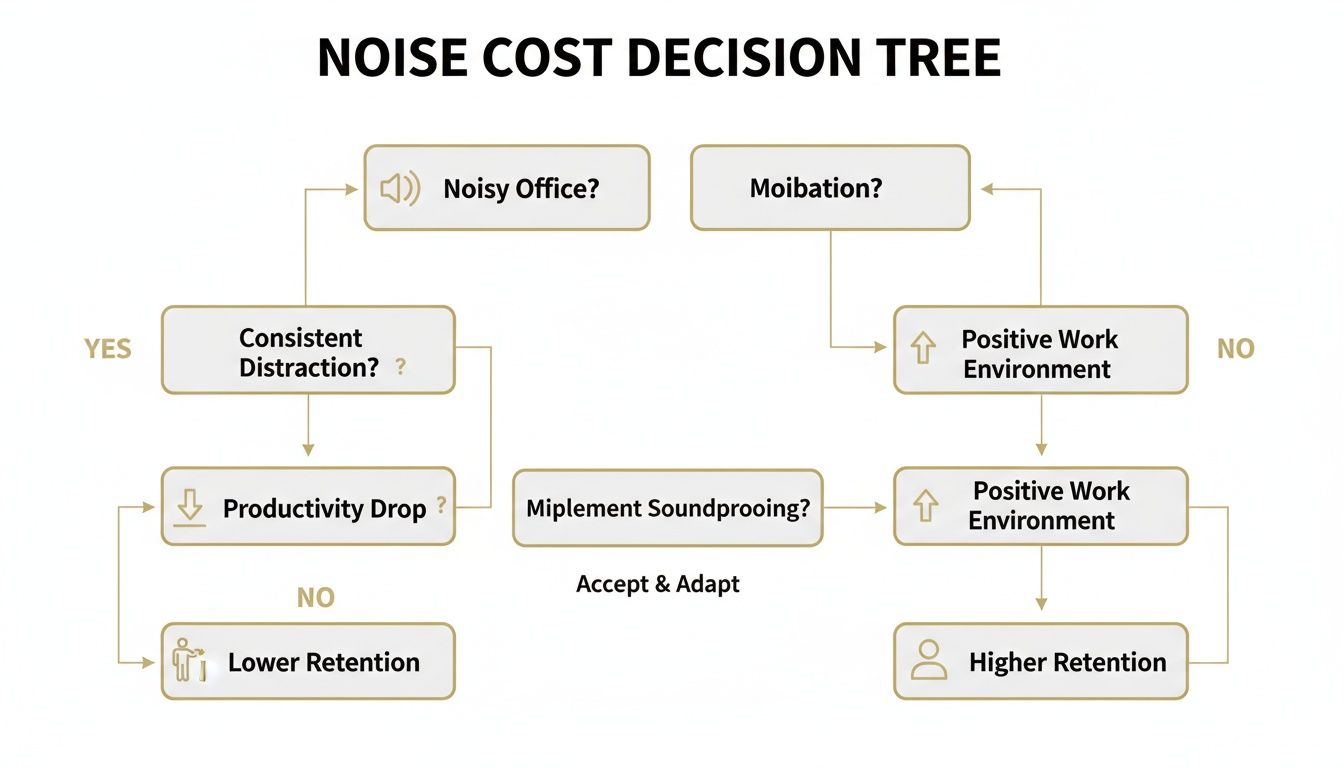
As you can see a noisy environment directly links to tangible business costs. Tackling acoustics isn’t just an operational expense it’s a strategic investment.
Different sounds disrupt work in different ways. Some are a low-level hum that chips away at focus while others are sudden and jarring completely breaking concentration. Here’s a quick look at some common culprits.
Common Office Noise Sources and Their Impact
| Noise Source | Acoustic Characteristic | Primary Impact on Staff |
|---|---|---|
| HVAC Systems | Constant, low-frequency hum | Reduces overall concentration, can cause fatigue. |
| Conversations | Unpredictable, intelligible speech | Highly distracting, particularly for complex tasks. |
| Phone Calls | Sudden, high-frequency, repetitive | Breaks focus instantly; a major source of irritation. |
Understanding these distinctions helps you move from a general complaint of “it’s too loud” to a specific diagnosis of the problem which is the key to finding the right solution.
Gathering Feedback from Your Team
Your employees are your best source of information. They experience the office’s soundscape every day and can provide invaluable insights that a simple walkthrough might miss.
A short, anonymous survey is an excellent way to gather this data without making anyone feel uncomfortable.
Ask targeted questions like:
- Which specific noises do you find most distracting during your workday?
- Are there particular times of day when the office is noticeably louder?
- Do you have a space where you can go to concentrate without interruptions?
This direct feedback is gold. It transforms the problem from a general “it’s too loud” into specific, actionable issues like, “the coffee machine is too close to the finance team,” or “we desperately need a private space for video calls.”
By combining your own observations with employee feedback you create a complete picture of your acoustic health. This diagnostic approach allows you to move forward confidently knowing you’re about to solve the right problems.
Designing a Smarter Layout for a Quieter Workplace
Before you look at acoustic panels or sound-absorbing materials your first and most powerful tool for achieving a meaningful reduction of noise is your office layout. How you arrange your space does so much of the heavy lifting guiding sound and creating a naturally more peaceful environment.
When we approach a refurbishment or a new fit-out we always insist on thinking about acoustics from day one. It’s far more effective and more affordable to be proactive rather than trying to patch up noise problems after the fact.
Creating Acoustic Zones
The smartest strategy is to divide the office into distinct ‘zones’ based on the kind of work that happens there. We call this acoustic zoning and it’s brilliant at stopping the sound from a lively brainstorming session from derailing someone doing deep, focused work.
Think about all the different activities happening in your office. You’ve got collaborative areas, individual desk work, informal catch-ups and high-traffic social hubs like the kitchen. Each one generates a completely different level of noise.
By intentionally separating these functions you create a more harmonious workspace. It’s not about building walls everywhere but about creating clear, functional boundaries that respect different work styles and acoustic needs.
This approach acknowledges that a modern office needs a blend of quiet and collaborative spaces to thrive. The key is making sure they don’t clash.
Practical Layout Strategies for Noise Control
Intelligent layout design uses simple but powerful principles like physical distance and clever placement to manage sound. Here are a few actionable strategies we’ve used for clients in Cambridge and Braintree that make a real difference.
- Buffer the Buzz: Use less noise-sensitive areas as buffers. Think storage units, printer stations or even hallways placed between your quiet zones and your noisy hubs. These elements act as physical barriers absorbing and blocking sound.
- Isolate High-Traffic Areas: The kitchen and breakout areas are almost always the loudest spots. Position them as far as you can from desks that require high concentration. If space is tight use partitions or even office pods to contain the chatter.
- Mind the Walkways: Plan major foot-traffic routes away from the main banks of desks. The constant movement and conversation from people walking past can be a huge source of distraction.
Putting these ideas into practice transforms your layout into an active part of your noise reduction strategy.
Using Furniture as a Sound Barrier
Don’t underestimate the acoustic power of your furniture. Large, solid items can be strategically placed to block and absorb sound waves acting as mini-partitions within an open-plan space.
For example, tall shelving units filled with books or plants are excellent at breaking up sound pathways. We often use high-backed sofas in breakout areas to create a semi-enclosed space that soaks up conversation stopping it from spilling out into the wider office.
Think of your furniture as more than just functional; it’s a flexible and stylish tool for acoustic management.
Furniture’s Role in Noise Management
| Furniture Item | Primary Acoustic Function | Best Placement |
|---|---|---|
| High-Backed Sofas | Absorb and contain sound | In collaborative or breakout zones |
| Bookshelves/Shelving | Block and diffuse sound waves | As dividers between different work zones |
| Large Planters | Absorb and scatter sound | Near noisy areas or along walkways |
By integrating these layout principles into your workplace design from the start you build a solid foundation for a quieter, more productive office. It’s a smart, cost-effective first step towards a better acoustic environment for everyone.
Choosing the Right Acoustic Materials and Finishes
Once you’ve got your layout sorted the next layer of defence against unwanted noise is all about the materials you choose. Getting the finishes right can single-handedly transform a harsh, echoey space into a calm, focused environment. Your team will feel the difference immediately.
This isn’t about just covering every surface in thick fabric. It’s a more thoughtful process of selecting smart, high-performance materials that absorb, block and diffuse sound without cramping your office’s style. It’s where the practical decisions really start to pay off.
Wall and Ceiling Solutions
Hard, flat surfaces are the biggest culprits when it comes to reverberation. Think of an empty room every clap echoes because the sound waves have nowhere to go but bounce. Acoustic wall panels and clever ceiling treatments are designed to stop this dead in its tracks.
- Acoustic Wall Panels: These are specially engineered panels that soak up sound waves preventing them from bouncing back into the room. They come in a massive range of colours, textures and shapes so they often double as a stylish design feature.
- Ceiling Baffles and Clouds: In offices with high ceilings sound has a lot of room to roam. Baffles which hang vertically and clouds which are horizontal panels are suspended from the ceiling to catch and absorb sound before it can travel across the whole workspace.
Even subtle changes can make a huge impact. Consider a large-scale urban project in London that found using low-noise asphalt on roads cut daytime noise by around 2 decibels (dB). This small shift dramatically reduced the number of residents affected by high noise levels. It’s a powerful real-world example of how choosing the right surface material in your office can achieve a similar reduction in sound pollution.
The Impact of Flooring and Furnishings
What’s underfoot matters just as much as what’s on the walls. Hard flooring like polished concrete or laminate might look sleek but acoustically it does nothing to help. Sound simply bounces right off it.
Soft flooring on the other hand is your best friend for sound absorption. Commercial-grade carpet tiles are an excellent choice. Not only do they soak up ambient background noise but they also deaden the sound of foot traffic a major source of distraction in busy offices.
Don’t overlook the simple power of soft furnishings. Things like curtains, upholstered furniture and even large fabric artworks all provide more surfaces to absorb stray sound waves contributing to a quieter, more pleasant environment.
As you weigh up these material choices it’s also worth thinking about their environmental impact. Many modern acoustic products are now made from recycled materials which fits perfectly with the growing demand for healthier, more eco-conscious workplaces. We dive deeper into this topic in our guide to creating sustainable office spaces.
Acoustic Material Comparison for Office Interiors
| Acoustic Solution | Primary Function (Absorb/Block) | Best Use Case |
|---|---|---|
| Fabric Wall Panels | Absorb | Reducing echo in meeting rooms and open-plan areas. |
| Ceiling Baffles | Absorb | Controlling noise in large spaces with high ceilings. |
| Carpet Tiles | Absorb | Quieting foot traffic and general ambient noise. |
By layering these different materials and finishes throughout the office you create a comprehensive acoustic strategy. The result is a space that feels more comfortable, focused and ultimately more productive for everyone.
Using Modular Pods for On-Demand Acoustic Privacy
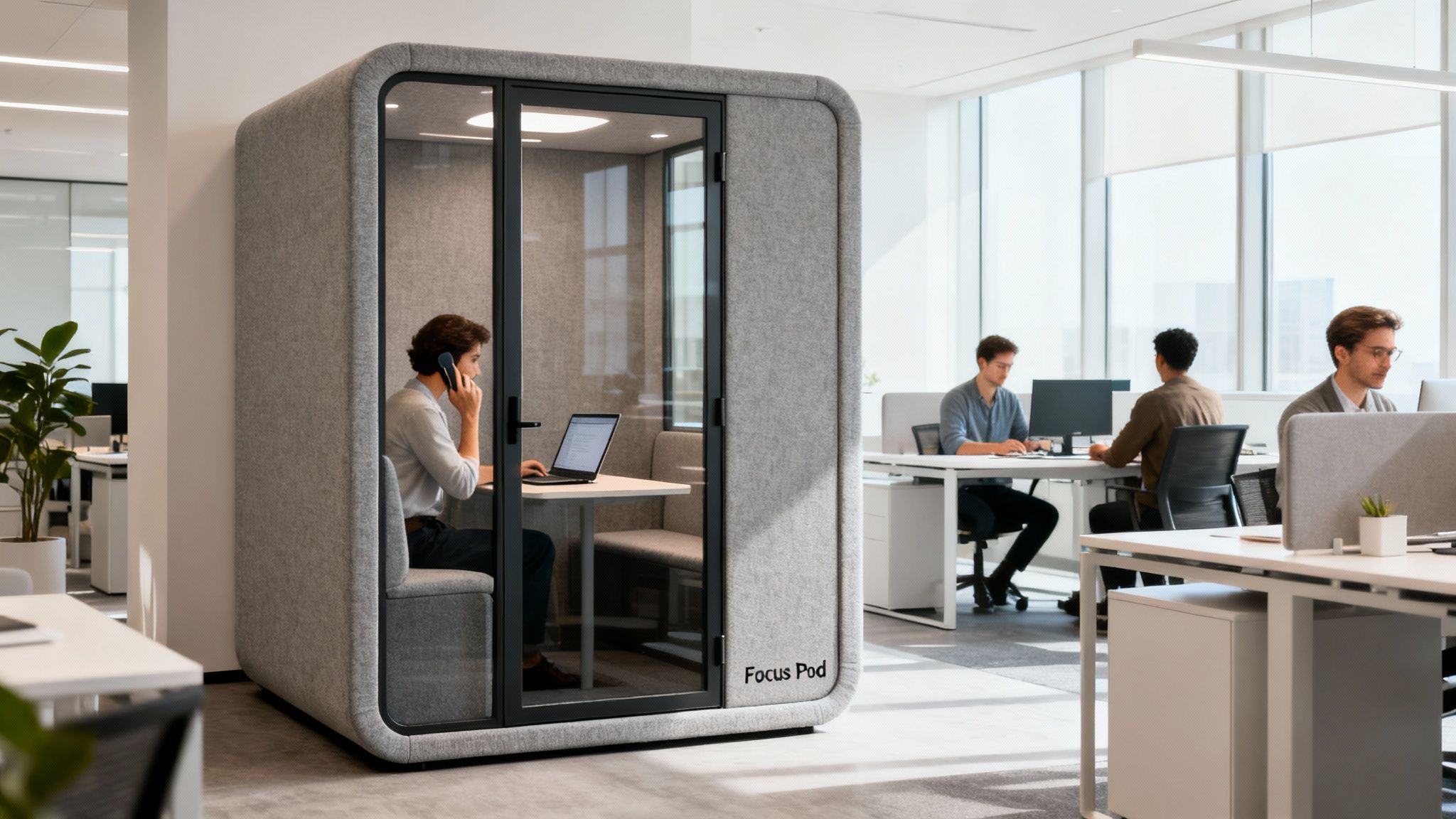
For all the benefits of an open-plan office there are times when your team just needs a door to close. When a confidential call comes in or a deadline demands absolute focus that constant background hum becomes a serious barrier. This is where modular pods have become one of our go-to tools for immediate reduction of noise. Blocko are Quiet Mark certificated for acoustics.
These freestanding rooms-within-a-room offer an instant escape from the surrounding office. Manufacturers like Vetrospace and Framery have perfected the art of creating acoustically sealed environments that can be dropped straight into an existing layout with minimal fuss. They give you an on-demand sanctuary for private conversations or simply an hour of uninterrupted deep work.
Flexibility Over Fixed Construction
One of the biggest advantages of pods is their sheer flexibility. Building traditional partitioned meeting rooms is a disruptive, often lengthy process that involves construction, wiring and decorating. It’s also a permanent decision; once those walls are up your layout is locked in.
Modular pods however are a completely different story. They’re delivered as self-contained units and can often be assembled in just a few hours. This speed means you can address your noise problems almost immediately without bringing your office to a standstill for weeks.
A key benefit we always point out to clients is that pods are classed as furniture, not a permanent structure. This means if you decide to reconfigure your office layout or even move to new premises in Hertfordshire you can simply dismantle the pod and take it with you.
This adaptability makes them a far more cost-effective and future-proof investment compared to fixed construction.
A Real-World Scenario
Picture a busy tech company we worked with near Stansted. Their open-plan office was fantastic for team collaboration but a nightmare for the sales team who need to make private calls to clients all day. The background chatter sounded unprofessional and was incredibly distracting and they were always fighting over the two existing meeting rooms.
Instead of a major, disruptive refurbishment they decided to install three single-person acoustic pods. We placed them strategically near the sales area providing instant, soundproofed spaces for calls. The best part? The disruption was almost zero the pods were installed overnight.
The impact was immediate:
- The sales team could finally conduct calls with complete privacy and clarity.
- The overall noise level in the main office dropped noticeably.
- The existing meeting rooms were freed up for larger, collaborative sessions.
This simple addition completely transformed the office’s functionality. For a deeper look into this topic you might be interested in our article on revolutionising workspace dynamics with freestanding booths and pods.
Shielding from External Noise
Pods aren’t just effective against internal chatter; they also provide a brilliant shield against noise from outside. For businesses located near busy roads or transport hubs this is a huge advantage. We’ve seen how well-engineered acoustic solutions work in other sectors too.
For example, despite a rise in air traffic aviation noise around major airports like Stansted has fallen significantly. Between 1998 and 2010 the number of people exposed to high noise levels dropped by nearly 40% thanks to quieter aircraft and smarter operating procedures. This shows that targeted acoustic technology works whether it’s for an entire airport or a single office pod. You can learn more about these advancements in noise control on Sustainable Aviation’s website.
By integrating modular pods you give your team the power to choose their own acoustic environment. They get the quiet they need exactly when they need it allowing them to be far more productive and less stressed.
Your Office Noise Reduction Questions Answered
Tackling workplace acoustics can feel like a complex puzzle. To help you move forward with clarity we’ve put together answers to the most common questions we hear from clients across London, Essex and Hertfordshire. This is our straightforward advice pulled directly from years of hands-on experience.
How Much Disruption Will an Acoustic Refit Cause?
This is always the first question and for good reason you can’t afford significant downtime. The level of disruption depends entirely on the solutions you choose. Installing something like modular pods for example is incredibly fast. We can often get them in and set up overnight or over a weekend meaning there’s almost zero impact on your team’s working week.
Even things like fitting acoustic wall panels are much cleaner and quicker processes than people imagine. A well-planned project which we insist on phases the work to ensure your business continues to operate smoothly. It’s all about smart planning.
What Is the Average Cost of Improving Office Acoustics?
There’s no “one size fits all” answer here as the cost is tied directly to the scale and complexity of your noise issues. A simple but effective solution might involve adding some strategically placed acoustic panels and a few soft furnishings which could be a few thousand pounds. A more comprehensive project with ceiling baffles, new flooring and multiple office pods will naturally be a larger investment.
The key is to reframe this as an investment in productivity not just an expense. The return comes from improved focus, fewer mistakes and better staff retention. We often work with clients to create phased plans that align with their budgets ensuring every pound spent delivers a measurable reduction of noise.
We always start with a detailed assessment to pinpoint the most impactful, cost-effective solutions first. This makes sure you get the best possible return solving your biggest noise problems without overspending.
How Can We Maintain a Quieter Office After the Refit?
The physical environment is only half the story; your workplace culture plays a massive role. Once you’ve invested in acoustic improvements it’s vital to establish some clear guidelines to maintain the benefits. This isn’t about creating a library-like atmosphere but simply fostering mutual respect.
A few simple policies can make a world of difference:
- Encourage using designated spaces: Gently guide teams to use pods for calls and dedicated collaborative zones for group chats.
- Set expectations for noise levels: A simple reminder about “headphone zones” or keeping voices low in quiet areas helps reinforce considerate behaviour.
- Lead by example: When the leadership team respects the acoustic zones everyone else is far more likely to follow suit.
By combining a well-designed space with mindful workplace habits you create a sustainable acoustic environment that supports everyone.
Ready to transform your workspace? Speak to the Gibbsonn Interiors team today. We’re here to help you design an acoustic environment that truly works for your business.