
Think of an office fit out contractor as the master builder for your new workspace. They’re the single expert partner who takes a project from a blank page or a tired old office and turns it into a place your team loves to be. They manage everything and everyone to get the job done right.
What an Office Fit Out Contractor Really Does
An office fit out contractor is the specialist firm that manages and delivers the entire transformation of your workspace. Their job is to take your vision and make it a physical reality by coordinating all the different trades, suppliers and designers needed to bring it all together. It is their responsibility to ensure the whole process is smooth, efficient and perfectly managed from the first conversation to the final handover.
Many businesses are surprised by just how much is involved. One of the first things we often clarify is the difference between a ‘fit out’ and a ‘refurbishment’.
Fit Out vs Refurbishment
Imagine you have just been handed the keys to a brand-new, completely empty building shell. A fit out is the process of building a finished office inside that shell. It involves installing everything from walls, ceilings and flooring to lighting, kitchens and data cabling to make it a functioning workplace.
A refurbishment, on the other hand, is all about working with what you already have. Think of it like a major home renovation. You might be knocking down walls to create a more open-plan feel, installing a new breakout area or completely redecorating to modernise the space. You’re upgrading an existing, operational office to make it better.
This table gives a quick overview of the kind of services a full-service contractor like Gibbsonn Interiors handles:
Fit Out Contractor Services At a Glance
| Service Category | What It Includes |
|---|---|
| Workspace Consultancy | Analysing your needs, understanding your culture and developing a strategic brief for the new space. |
| Design and Space Planning | Creating 2D and 3D designs, floor plans and mood boards that bring the vision to life visually. |
| Project Management | The day-to-day running of the project including timelines, budget tracking and coordinating all teams. |
| Construction & Installation | All physical works: partitioning, ceilings, flooring, joinery, mechanical & electrical (M&E) systems. |
| Furniture & Finishes | Sourcing, supplying and installing all office furniture from desks and chairs to breakout seating and storage. |
| Compliance & Approvals | Managing all statutory requirements including building regulations, planning permissions and health & safety. |
| Handover & Aftercare | Final snagging, providing operating manuals and offering ongoing support after you’ve moved in. |
Ultimately, a good contractor provides a complete turnkey solution, taking the entire burden off your shoulders.
The Design and Build Model Explained
The most effective and popular way to handle these projects today is with a ‘design and build’ model. This is an all-in-one approach where a single company like your fit out contractor is responsible for both the design and the construction. Instead of you having to hire an architect, then find a separate project manager and then tender for a builder, you get one unified team from start to finish.
This integrated approach just makes sense for a few key reasons:
- A Single Point of Contact: You have one dedicated project manager who is your go-to for everything. It simplifies communication massively and means you always know who to call.
- Real Budgetary Control: Because the design and construction teams are working together from day one, the creative vision is always grounded in financial reality. There are no nasty surprises.
- Massively Reduced Risk: With one company fully accountable for the entire project, the risk of miscommunication, delays or blame-shifting between different parties completely disappears.
This streamlined process is especially valuable in fast-paced commercial hubs like London, Cambridge and Bishop’s Stortford, where getting things done efficiently is non-negotiable. With the huge demand for high-quality, hybrid-ready offices, experienced contractors have become essential. In fact, recent data shows that office take-up in London is over 7% above its long-term average, pushing landlords and tenants to rely on specialists who can deliver quality quickly. You can read the full research about UK office space demand to get a better sense of these market shifts.
Walking Through Your Office Fit Out Journey
Starting a new office fit out is an exciting time but knowing the path from that first flicker of an idea to the final handover is what makes a project truly successful. A professional fit out contractor helps turn what can feel like a mountain of complexity into a clear, manageable journey. We manage each phase meticulously, making sure your vision comes to life on schedule and within your budget.
This whole process kicks off with your ambition. It’s about so much more than new desks and a lick of paint; it’s about shaping a space that truly empowers your team, shouts about your brand and supports your goals for the future.
Phase 1: The Briefing and Discovery
This first stage is the bedrock for everything that comes next. We begin with a proper conversation to get right to the heart of what you want to achieve. We’ll talk about your company culture, your day-to-day workflows, how your teams collaborate and what’s causing friction in your current space. This isn’t about ticking boxes; it’s a deep dive into the DNA of your business.
We’ll explore some key questions together:
- What are your main business goals? Are you trying to improve staff retention, attract top talent or give productivity a serious boost?
- How do you see your team working in 2026 and beyond? Do you need more buzzing collaborative zones, quiet pods for deep focus or flexible areas for specific projects?
- What’s your realistic budget and ideal timeline? This helps us align the creative possibilities with your financial and operational plans right from the get-go.
Getting this discovery phase right ensures the final design is perfectly tuned to your operational needs, not just what looks good on paper.
Phase 2: Design and Space Planning
Once we have a rock-solid brief, our design team gets to work, turning your requirements into something you can see and feel. This is where creativity and practicality shake hands. Drawing on all the insights from our discovery sessions, we develop initial concepts and floor plans that make the absolute most of your square footage.
This is a very collaborative phase. We’ll present you with detailed 2D layouts and immersive 3D visualisations that let you virtually walk through your future office. You’ll see how different areas connect and get a genuine feel for the space. We also put together mood boards with samples of fabrics, flooring and finishes, making sure every single element feels true to your brand. Great design is everything and you can learn more about our approach to office design and space planning to see how we build functional, inspiring environments.
A well-planned office isn’t just about cramming in more desks. It’s about designing a workflow that reduces friction, encourages spontaneous interaction and gives people the right kind of environment for the task at hand. Nailing this can directly impact employee happiness and your bottom line.
Phase 3: Pre-Construction and Approvals
With the design signed off, we move into the technical pre-construction phase. This is where your dedicated project manager steps up, translating the approved designs into detailed construction drawings for our teams on site. This covers everything from electrical and data layouts to plumbing and HVAC specifications.
This stage is also about navigating all the necessary compliance and approvals. Our team handles all submissions to local authorities for building regulations and, if needed, planning permissions. We make certain that every part of the project meets strict UK Health and Safety standards. This careful prep work is what prevents costly delays down the line and ensures a seamless shift into the construction phase.
Phase 4: Construction and Handover
This is the exciting part where your new office actually takes shape. Our site team, led by your project manager, gets the build underway. Communication is absolutely key during this stage. You’ll get regular progress updates as we coordinate all the different tradespeople from partitioners and electricians to decorators and furniture installers to ensure they work efficiently and to the highest standard.
We manage all the site logistics to keep disruption to a minimum, which is especially important if you’re refurbishing an occupied office in a busy area like Chelmsford or Cambridge. Once the build is complete, we carry out a thorough snagging process to make sure every last detail is perfect before the final handover. You’ll receive a complete handover pack with all documentation and warranties and we’ll personally walk you through your new space. Our job isn’t done until you are 100% happy and ready to move in.
This visual shows how we break down the journey into three core stages from your initial vision to the final handover.
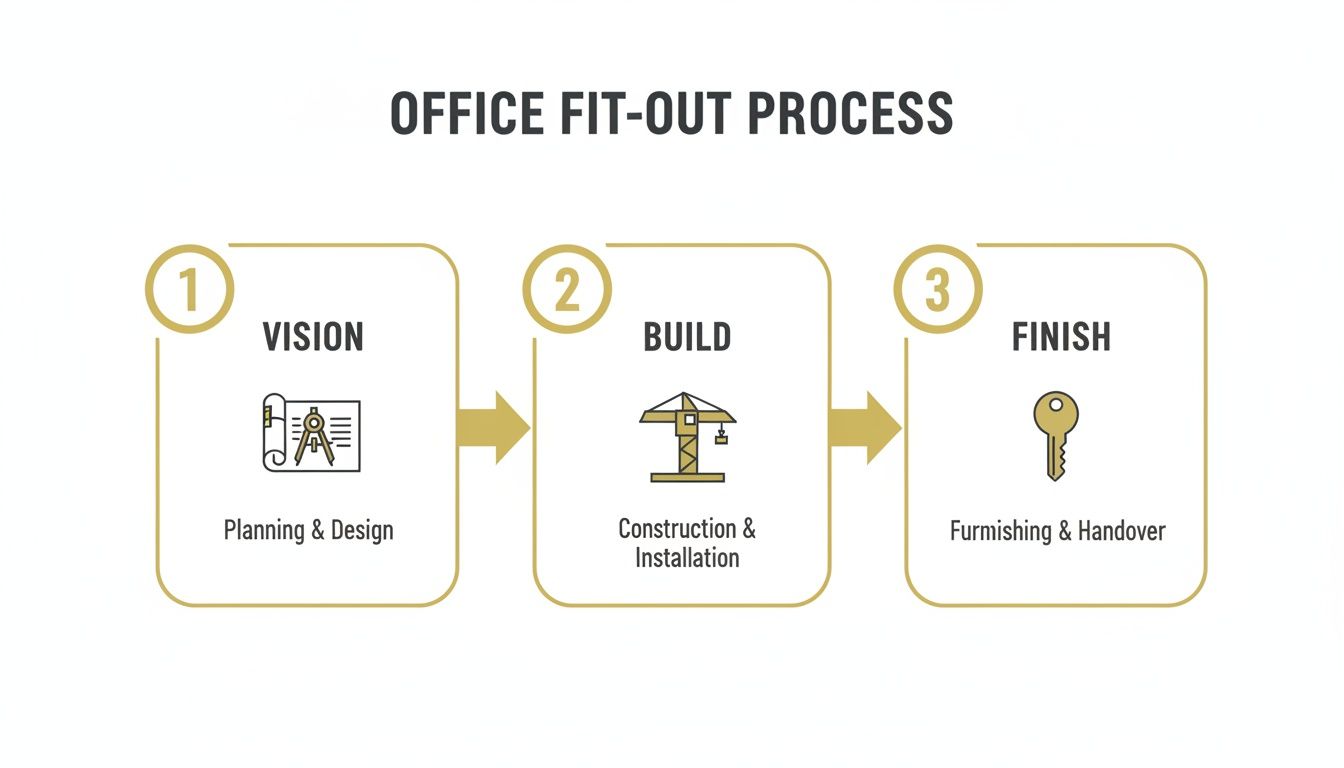
This structured flow shows that a successful fit out is a methodical process, not just a building project, with strategic planning underpinning every single step.
Understanding Your Project Costs and Timelines
Let’s get straight to it. The first two questions on every client’s mind are always ‘How much is this going to cost?’ and ‘How long will it take?’. Getting real clarity on your budget and schedule isn’t just a preliminary step; it’s the foundation of a successful office fit out.
Of course, there is no magic number. The final figures are shaped by your ambition, the current state of the space and the quality of the finishes you have in mind.
Key Factors Shaping Your Budget
Several core elements will steer the total investment needed for your project. If you understand these drivers from the get-go, you can make smarter decisions and set a budget that’s grounded in reality.
- Location: It’s no surprise that project costs vary across the UK. Running a project in a major city like London is naturally more expensive than in regional hubs like Chelmsford or Braintree simply down to labour and logistics.
- Building Condition: Are you starting with a clean, empty shell (a Cat A fit out) or are you dealing with a tired, existing office that needs a complete strip-out? The building’s starting point dictates how much foundational work is needed, which has a direct knock-on effect on the budget.
- Specification Level: The quality of materials, fixtures and furniture is a huge cost driver. Are you after functional, durable finishes or are you envisioning high-end, bespoke solutions with all the latest tech?
- Complexity of Design: A straightforward open-plan layout will always be more cost-effective than a design filled with numerous private offices, intricate partitioning and specialist acoustic installations.
For a deeper dive into the numbers, have a look at our detailed guide on the cost of an office fit out. It breaks things down further to help you plan your finances effectively.
Real World Cost Benchmarks
To give you a practical starting point, office fit out contractors in the UK often categorise projects by a cost per square foot (sq ft). These figures are a brilliant benchmark for initial financial planning.
- Basic / Light Refresh (£60 – £90 per sq ft): This usually covers cosmetic tweaks like new carpets, a fresh coat of paint and some new furniture. It’s perfect for a quick refresh without any major structural work.
- Mid-Range / Good Quality (£90 – £150 per sq ft): This is the sweet spot for a full fit out. We’re talking new partitions, meeting rooms, a modern kitchen, quality furniture and a full mechanical and electrical package.
- High-End / Premium (£150+ per sq ft): At this level, you’re investing in bespoke joinery, high-end materials, advanced audiovisual technology and premium design features that create a truly standout workspace.
It’s important to know that market conditions are pushing these figures up. Across the UK, costs have been rising as expectations around wellness, sustainability and technology have grown. A recent guide from JLL shows a medium-spec fit out in London now averages around £207 per sq ft with high-spec projects hitting £308 per sq ft, making it one of the most expensive cities globally for premium office fit outs.
Mapping Out Your Project Timeline
Just like the budget, the project timeline is completely dependent on its scale and complexity. A clear, well-managed schedule is absolutely essential to minimise disruption and ensure a seamless move into your new home.
A realistic timeline prevents a ripple effect of delays. Proper planning by an experienced contractor accounts for everything from design approvals and furniture lead times to the physical construction, ensuring your move-in date is a goal we hit, not just a guess.
Here are a few typical timelines to give you a feel for what to expect:
- Small Office Refresh (up to 2,500 sq ft): If you’re focused on decoration and new furniture, you can expect this to take around 4–6 weeks.
- Medium Fit Out (2,500 – 10,000 sq ft): A full Cat B fit out of this size covering design, approvals and construction typically takes between 10–16 weeks.
- Large-Scale Project (10,000+ sq ft): For major transformations or multi-floor projects in locations like Stansted or Cambridge, a timeline of 16–24+ weeks is much more realistic.
The initial planning phase is without a doubt the most critical part of this process. A good office fit out contractor will sit down with you to map out a detailed, phased schedule that works around your business operations and keeps everything firmly on track.
Meeting Modern Compliance and Sustainability Goals
A truly great office does more than just look the part. It has to be a safe, compliant and responsible space that not only protects your team but also reflects what your company stands for. For many businesses, navigating the web of regulations is a daunting prospect but for any professional office fit out contractor, it’s a core responsibility and a seamless part of the project.
This isn’t just about ticking boxes. It’s about safeguarding your investment and most importantly, ensuring the wellbeing of everyone who steps foot inside. From the very first design sketch to the final handover, compliance is woven into every decision.
At the same time, sustainability has firmly shifted from a “nice-to-have” to a business necessity. A forward-thinking fit out is a green fit out, creating a healthier environment for your team that can also deliver some serious long-term cost savings.
Navigating Essential UK Regulations
Think of your fit out partner as your expert guide through all the statutory duties. They take complete ownership of making sure the project hits every legal requirement, leaving you free to focus on what you do best which is running your business.
It’s a complex landscape but it boils down to a few key areas:
- Building Regulations: These are the non-negotiable standards for design and construction. They cover everything from the building’s structural stability and fire safety to its energy efficiency and accessibility for all.
- Fire Safety (The Regulatory Reform (Fire Safety) Order 2005): This legislation is critical. It dictates that your office must be safe for every occupant, meaning your fit out has to include the right fire detection systems, crystal-clear escape routes and fire-resistant materials where needed.
- Health & Safety (CDM 2015): The Construction (Design and Management) Regulations 2015 are fundamental. They place specific duties on the client, designer and contractor to proactively manage health and safety from the initial planning stages right through to completion.
A professional contractor doesn’t just follow these rules; they design with them in mind from day one. This proactive approach is what prevents costly last-minute changes and ensures your new workspace in Hertfordshire or Essex is not only stunning but fundamentally safe and legal.
Building a Sustainable and Future-Proofed Workspace
Beyond the legal must-haves, modern businesses are increasingly judged on their environmental and social credentials. A sustainable fit out makes a powerful statement about your company’s commitment to the future and is a brilliant way to attract and keep top talent.
The focus now is all about creating spaces that perform better, both for people and for the planet. It involves thinking carefully about everything that goes into the project, from the materials we choose to the energy the office will consume day-to-day.
Key Elements of a Green Office Fit Out
Bringing a sustainable workspace to life involves several interconnected strategies and your contractor can help you pinpoint the solutions that will make the biggest difference.
These often include:
- Energy Efficiency: Simple changes can have a huge impact. Installing smart LED lighting, high-performance heating and cooling (HVAC) systems and designing to maximise natural light can slash your building’s energy use and running costs.
- Sustainable Materials: Choosing materials with a low environmental footprint is key. This could mean opting for products with high recycled content, using low-VOC (Volatile Organic Compound) paints for better air quality and sourcing local timber to cut down the project’s carbon footprint.
- Waste Reduction: A well-managed project is a low-waste project. It all comes down to careful planning, ordering the right amount of materials and working with recycling partners to divert as much as possible from landfill.
This intense focus on high-performance systems is also reshaping how budgets are spent. The technical side of a fit out, like the Mechanical & Electrical (M&E) services, now frequently accounts for over 25% of the total project cost. It’s a clear reflection of the industry’s move towards better ventilation, smarter lighting and future-ready technology. You can discover more insights about these cost trends from JLL to see exactly how these investments are shifting.
How to Select the Right Fit Out Partner
Choosing your fit out partner is easily the single most important decision you’ll make for your entire office transformation. Think of it as a true partnership. Get it right and you’re on track for a smooth, predictable process and a brilliant result. The wrong choice, however, can lead to spiralling costs, endless delays and a space that just completely misses the mark.
So how do you confidently pick the right office fit out contractors for your vision? It all boils down to asking the right questions, checking their credentials and getting a genuine feel for how they operate. A great contractor will be an open book, happy to show you their experience and build trust from the very first conversation.
Evaluating Experience and Track Record
First things first, you need to dive into their past work. A contractor’s portfolio is their CV and it should show you not just what they can do, but whether they have specific, relevant experience for your project and your location, whether that’s in Cambridge, Stansted or Braintree.
Look for a strong portfolio of finished projects that feel similar in scale and style to what you have in mind. Don’t just get distracted by the glossy photos; take the time to read their case studies. What challenges did they have to overcome? How did they help a client achieve their specific business goals? This gives you a much deeper insight into their real-world problem-solving skills.
The real value of an experienced contractor is their ability to see around corners. They’ve managed dozens of projects so they can anticipate potential issues from supply chain delays to unforeseen site conditions and have contingency plans ready to go. This proactive management is what keeps a project on track.
Another powerful step is to simply ask for client references. Speaking to a past client for ten minutes can tell you more than any website ever could. Ask them about the contractor’s communication, their project management and how they handled any unexpected issues that cropped up.
Key Questions for Your Shortlist
Once you have a shortlist of potential partners, it’s time to dig a bit deeper. A structured chat or a formal tender process will help you compare them on a level playing field. Your goal here is to understand their capabilities of course, but also their culture and communication style.
Picking the right contractor requires a bit of homework but it’s time well spent. This simple checklist helps you ask the right questions and evaluate each potential partner consistently, making your final decision much clearer.
Contractor Vetting Checklist
| Evaluation Area | Key Questions to Ask | What to Look For |
|---|---|---|
| Process & Workflow | Can you walk me through your entire process from brief to handover? | A clear, structured and transparent process that makes sense to you. |
| Project Management | Who would be my dedicated point of contact? How often can I expect updates? | A single, dedicated manager and a clear communication schedule. |
| Team & Suppliers | Do you use in-house teams or subcontractors? How do you ensure their quality? | A proven network of trusted suppliers and a rigorous quality control process. |
| Local Experience | Can you show us projects you’ve completed in our area like in Chelmsford? | Evidence of successful projects nearby, showing familiarity with local regulations. |
| Cost Management | How do you ensure budget transparency? How do you handle project variations? | Open-book pricing and a formal, fair process for managing changes. |
| Health & Safety | What are your health and safety procedures? Can you provide your track record? | A robust H&S policy, relevant accreditations and a demonstrable safety record. |
Their answers should give you a gut feeling about how organised, transparent and client-focused they are. Trust that feeling.
Checking Credentials and Stability
Finally, before you sign on the dotted line, it’s vital to carry out some basic due diligence. Any professional and financially stable contractor will have no problem providing this information.
Make sure they have the necessary accreditations from recognised industry bodies. You should also check that they hold comprehensive insurance including public liability and professional indemnity cover. This is what protects you and your project from risk. A quick check of their financial stability provides that final layer of confidence that they are a reliable partner capable of seeing your project through to a successful completion.
Got Questions? We’ve Got Answers
Starting an office fit out can feel like stepping into a new world and it’s natural to have a lot of questions. We get it. To help clear things up and give you the confidence to move forward, we’ve answered some of the most common queries we hear from our clients across London, Essex and Hertfordshire.
What Is The Difference Between A Cat A And Cat B Fit Out?
Think of it like this: a Category A (Cat A) fit out is the landlord handing you the keys to a brand-new but completely empty house. It’s a blank canvas. You’ll have the basic structure in place like raised floors, suspended ceilings and the core mechanical and electrical services. It’s functional but it’s not yours.
A Category B (Cat B) fit out is where the magic happens. This is when we step in to turn that empty shell into a space that reflects your brand and the way your team works. It’s all about the detail: building partition walls for new offices and meeting rooms, laying your chosen flooring, installing bespoke lighting and adding those all-important finishing touches like branded graphics and a fully-fitted kitchen. We live and breathe Cat B projects, turning your vision into a reality.
How Can We Minimise Disruption During The Fit Out?
Keeping your business running smoothly is our top priority. The key to minimising disruption isn’t a secret formula; it’s just really good planning. As seasoned office fit out contractors, we map out a meticulous schedule that’s built around your operational needs from day one.
Often, this means taking a phased approach, transforming one area of your office while your team carries on working in another. We can also schedule the noisy, messy work for evenings or weekends. Throughout it all, our project managers keep the lines of communication wide open so you always know what’s happening and when. It’s all about working smart and respecting your time.
How Long Does a Typical Office Fit Out Take?
Honestly, it depends entirely on the scale and complexity of what you’re looking to achieve. There’s no one-size-fits-all answer.
A straightforward cosmetic refresh for a smaller office in Bishop’s Stortford might only take 4 to 6 weeks. On the other hand, a full-scale Cat B fit out for a medium-sized company covering everything from design and approvals to construction is more likely to be in the 12 to 16 week range. For larger, multi-floor projects, you could be looking at several months. The most critical step is setting a realistic timeline right at the start, which is a fundamental part of our process.
For even more detailed answers, feel free to dive into our full list of frequently asked questions about the entire fit out journey.
Ready to transform your workspace? Speak to the Gibbsonn Interiors team today.