

The office sounds busy, but not in a good way. One person is on a sales call, two people are talking through a project, someone else is trying to join a Teams meeting, and the quietest room in the building is already booked. That's the point where most facilities managers start looking at acoustic office partitions.
The problem is that many guides stop at product photos and vague promises about noise reduction. They don't explain what works in a UK office, what fails on site, or how to balance privacy, layout flexibility, compliance and appearance without wasting budget.
Table of Contents
- Introduction Why Most Guides on Acoustic Partitions Miss the Mark
- The Business Case for Quiet in Your 2026 Office
- Your Sound Solution A Guide to Partition Types and Materials
- Decoding the Jargon Understanding Acoustic Performance in 2026
- Your Buyer's Checklist How to Select the Right Partitions
- Beyond Soundproofing Design, Installation and UK Compliance
- Transform Your Workspace Today
Introduction Why Most Guides on Acoustic Partitions Miss the Mark
Most advice on acoustic office partitions is too generic to be useful. It talks about screens, panels and pods as if every office has the same layout, the same noise pattern and the same compliance needs. That isn't how real projects work.
A small tenant office dealing with daily video calls has a different problem from a larger open-plan floor trying to protect meeting room privacy. A landlord preparing a Cat A to Cat B upgrade faces different decisions again. The right answer depends on whether the issue is echo inside a space, speech carrying between spaces, or a lack of flexible rooms for hybrid working.
That gap matters more now because office layouts change faster than they used to. A 2023 British Council for Offices survey found that 68% of occupiers plan to use more flexible partitions and glazed screens to switch between dense and sparse occupation, yet many acoustic partition articles still don't explain how to place those elements so they support UK acoustic targets without creating permanent walls, as noted in this British Council for Offices survey reference.
Most buying mistakes happen before the order is placed. Teams choose a product category before they define the actual noise problem.
There is also a UK-specific issue that many guides skip. They mention sound absorption in broad terms but don't connect that to Part E, real speech privacy, reverberation time, ceiling conditions, floor finishes, or the simple fact that installation gaps can undermine a strong specification.
What buyers actually need
Facilities managers usually need straight answers to practical questions:
- Will this stop overheard conversations? Some systems reduce echo well but won't provide proper privacy.
- Can the layout change later? Modular systems suit hybrid workplaces better than fixed construction in many cases.
- Will the office still feel open and bright? Glazed systems often help with light flow, but the glass build-up matters.
- Is the detail package complete? Seals, doors, head details and service penetrations often decide real-world performance.
That's where acoustic office partitions need to be judged. Not as a design accessory, but as part of a working office strategy.
The Business Case for Quiet in Your 2026 Office
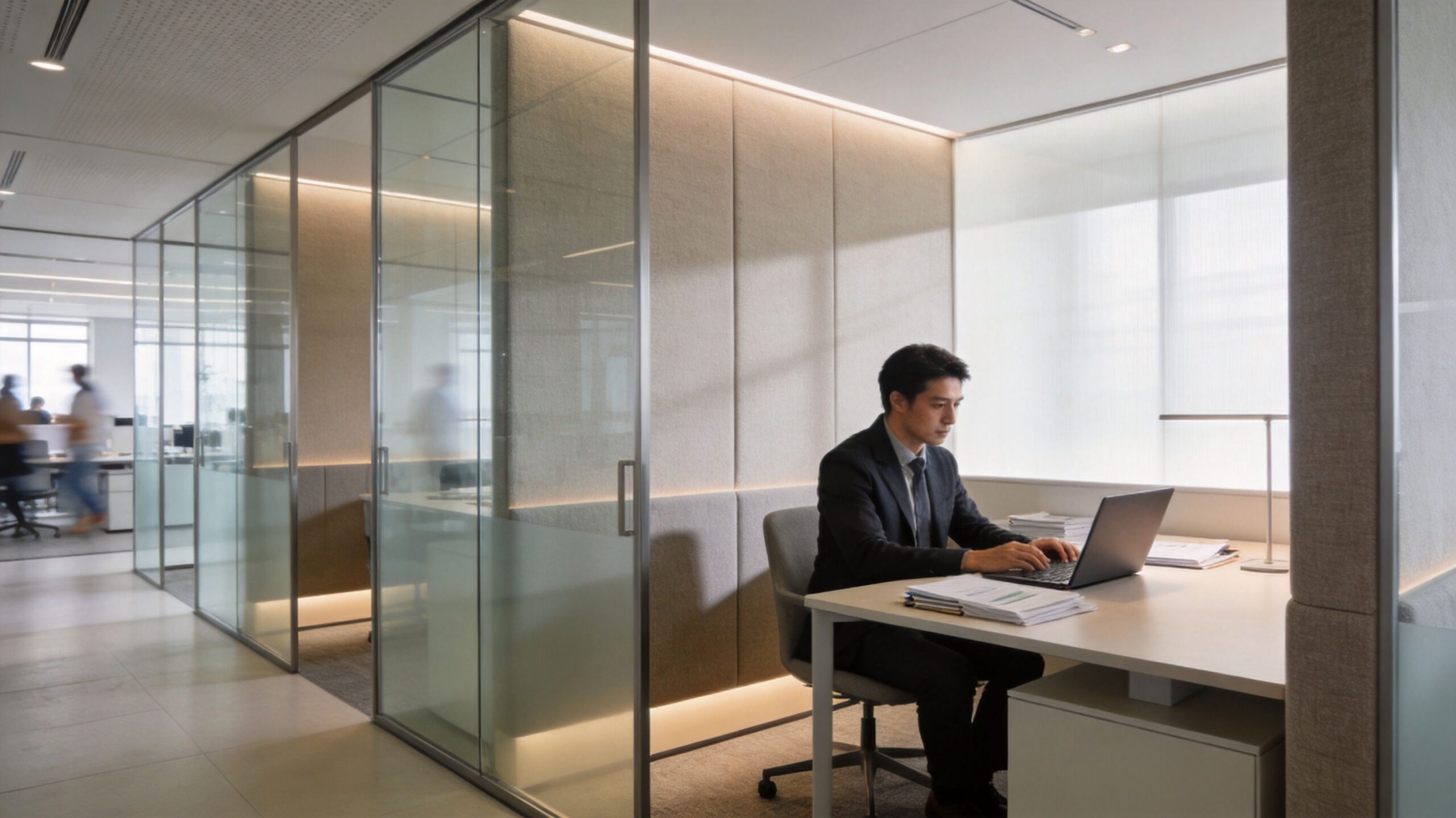
Noise isn't only annoying. It changes how people use a workplace. If staff can't find a place to focus, they work around the building, avoid certain desks, take private calls in circulation areas, or stay at home when they need concentration. That makes the office feel badly planned, even if it looks impressive.
A good acoustic strategy fixes that by creating choice. People get open areas for collaboration, enclosed spots for confidential conversations, and calmer zones for focused tasks. That's a better use of floor space than leaving everyone to compete with the loudest voice nearby.
Why buyers are investing now
This isn't a niche issue. According to Cognitive Market Research data referenced by Molteni, Europe holds 26% of the global $1,627.5 million acoustic partitions market in 2025, with the UK accounting for 18.69% of Europe's revenue. The same source states the UK market is $423.2 million in 2025, up 85.47% from $361.7 million in 2021, and projects $576.7 million by 2033 at 3.9% CAGR. That source also notes that partitions can reduce reverberation by up to 50%.
That growth tells buyers something important. Acoustic control has moved from nice-to-have to standard workplace planning. Offices are expected to support different modes of work on the same floor plate, often within the same hour.
In high-pressure workplace markets such as London offices, that matters because the physical environment affects how useful the office feels day to day. If the workplace supports concentration, meetings and hybrid patterns properly, staff are more likely to use it as intended.
Practical rule: If people keep leaving their desks to find a quieter place, the office already has an acoustic problem, whether anyone has measured it or not.
What good acoustic partitions give back
The strongest return usually comes from four improvements:
- Better focus: Staff can work without every nearby call becoming part of their task.
- Clearer zoning: Open collaboration areas stop spilling into spaces meant for private work.
- Improved wellbeing: A calmer office feels easier to use and less tiring over a full day.
- More flexibility: Teams can rework layouts faster than they could with solid construction alone.
Buyers looking at wider open-plan strategies can also review this related guide on how to reduce noise in an open plan office, especially where partitions need to sit alongside ceilings, finishes and furniture planning.
Your Sound Solution A Guide to Partition Types and Materials
Not all acoustic office partitions solve the same problem. Some are built to block sound between rooms. Others mainly absorb echo within an open area. Some do both reasonably well, but only when the surrounding construction supports them.
The simplest way to choose well is to start with the function, then check the material, build-up and installation detail.
Glazed partitions
Glazed partitions are common because they divide space without making the office feel smaller. They suit meeting rooms, manager rooms, touchdown spaces and internal fronts where natural light matters.
Single-glazed systems are often chosen for appearance, speed and cost. They can work well where the main aim is space definition and a modest improvement in separation. They are less convincing where speech privacy is the main requirement.
Double-glazed acoustic glass systems are a stronger choice when buyers need private meeting rooms or call spaces. The cavity and laminated glass build-up help control sound transmission more effectively than a simple single pane. This is why a full specification matters more than the word "acoustic" on its own.
Fabric-wrapped and wool panels
These panels are useful when the problem is reverberation inside a room or open area. They absorb reflected sound rather than forming a hard barrier between spaces. That makes them good for banks of desks, breakout zones, collaboration corners and circulation areas with too many hard surfaces.
They also soften the visual feel of an office. Fabric and wool finishes can add warmth where glass, metal and plasterboard dominate. That's often helpful in refurbished spaces that feel harsh after a modern fit-out.
What they won't do on their own is create proper speech privacy between enclosed rooms. They help the room sound calmer, but they are not a substitute for a well-detailed glazed or solid partition where confidentiality matters.
A room can feel quieter and still leak conversation. Absorption and isolation are not the same thing.
Freestanding and modular screens
Freestanding and modular screens suit workplaces that need agility. They can divide bench desking, frame temporary project zones, and create quick acoustic separation without major building work.
This category is especially useful when headcount shifts week to week. A modular screen can help reshape a floor quickly, which is often more realistic than committing to fixed construction too early.
The trade-off is performance. A screen that doesn't run floor to soffit won't block sound in the same way as a full-height partitioned room. It can improve comfort, reduce direct distraction and create visual boundaries, but it won't behave like a sealed room.
Fully enclosed office pods
Pods sit at the top end of the privacy and flexibility spectrum. They're designed for focused work, private calls, small meetings or short bursts of confidential discussion within an otherwise open office.
Well-known brands in this area include Vetrospace, BlockO, and Framery. These products are often attractive because they arrive as defined units with integrated lighting, ventilation and a clear acoustic use case.
Pods are valuable when a team needs enclosed rooms but can't, or doesn't want to, rebuild the floor plate. They're also useful in leased space where future reconfiguration is likely. For readers comparing wider enclosed options, this guide to office meeting pods is a helpful next step.
Acoustic Partition Comparison
| Partition Type | Best For | Typical Cost |
|---|---|---|
| Glazed partitions | Meeting rooms, private rooms, keeping light flow | ££ to £££ |
| Fabric-wrapped and wool panels | Reducing echo in open areas | £ to ££ |
| Freestanding and modular screens | Agile layouts and quick zoning | £ to ££ |
| Fully enclosed office pods | Calls, focused work, small private meetings | £££ |
For buyers also thinking about surrounding construction, this soundproofing guide from Airtight Spray Foam Insulation is useful background on how different materials affect noise control more broadly. It helps clarify why partitions work best when the rest of the fabric is considered too.
Decoding the Jargon Understanding Acoustic Performance in 2026
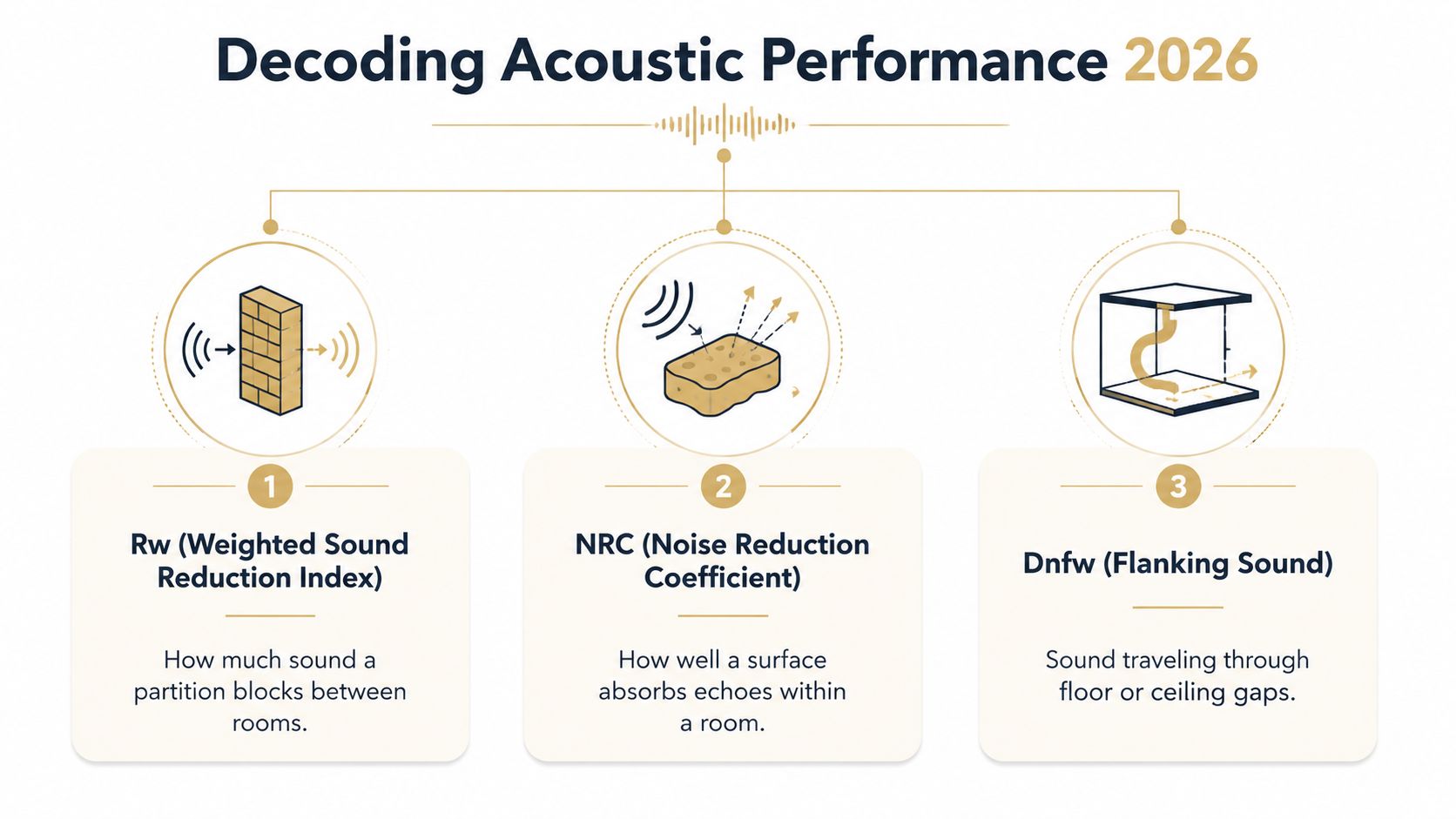
Acoustic specifications can look more technical than they really are. Most buyers only need to understand three ideas. How well a partition blocks sound, how well a surface absorbs echo, and whether sound is sneaking around the system through gaps or surrounding construction.
That first measure matters most when people are deciding between glazed systems for offices and meeting rooms.
Rw means sound blocking
Rw is the weighted sound reduction index. In simple terms, it tells buyers how well a partition reduces sound passing from one side to the other. Higher generally means better speech privacy.
According to Komfort's guide to acoustic partitioning, a single-glazed partition typically achieves Rw 37-41 dB, which means normal speech is still audible, though more muffled. The same guide states that double-glazed systems with PVB laminate cores can reach Rw 49-54 dB, making even loud conversations barely intelligible. It also explains that the laminated core can reduce sound transmission by up to 50% compared to standard single glazing.
That difference is why two glazed meeting rooms can look nearly identical but perform very differently in use.
NRC means sound absorption
NRC stands for Noise Reduction Coefficient. This is less about blocking sound through a partition and more about soaking up sound within a space. A useful way to think about it is a sponge for echo.
If a meeting room has lots of glass, hard flooring and a painted plasterboard ceiling, voices bounce around inside it. That can make the room feel loud even if the partition itself is well specified. In that case, panels, ceiling treatments and soft finishes become part of the acoustic answer.
STC and why UK buyers usually see Rw instead
STC means Sound Transmission Class. It serves a similar purpose to Rw, but buyers often see it in US literature rather than UK project documentation.
For most UK office fit-outs, Rw is the more familiar number. That's the rating many contractors, consultants and suppliers will use when discussing partition performance in local projects.
When a supplier says a system is acoustic, ask for the tested rating and the build-up. Marketing language doesn't protect privacy. Specifications do.
A final point matters just as much as the rating itself. Lab performance and site performance are not always the same. If head tracks, abutments, doors or service penetrations are poorly detailed, sound can still get through paths around the partition.
Your Buyer's Checklist How to Select the Right Partitions
Buying acoustic office partitions gets easier when the brief is clear. Problems start when a team asks for "more privacy" without defining what that means in daily use. A room for HR conversations is not the same as a touchdown booth for quick calls. A collaboration area beside sales desks needs a different treatment from a boardroom.
Start with the real noise problem
Ask what people are complaining about.
- Overheard conversations: This usually points to a need for stronger sound separation between spaces.
- General office buzz: This is often a reverberation problem, which means absorption may matter more than full enclosure.
- Lack of quiet rooms: Pods, enclosed rooms or better zoning may be the ideal solution.
- Too much layout rigidity: Modular systems may suit the office better than fixed walls.
A short staff walkthrough usually reveals the truth quickly. If the noisiest points are around circulation routes, printers, kitchen edges or open meeting spots, the fix may be as much about planning as products.
Match the product to the way the office works
The next step is to match the system to operational reality.
Some workplaces need high privacy all day. Others need a flexible background solution that improves comfort but can move when teams change. Buyers should also think about how often the office hosts visitors, whether confidential calls happen at desks, and whether daylight needs to pass deep into the plan.
Key question: Is the aim to stop sound travelling between spaces, or to make a busy area feel less chaotic?
Budget matters too, but it should be judged against use. A cheaper screen that doesn't solve the problem is poor value. A better-performing partition that prevents a room from being avoided every day is usually the stronger investment.
Ask the supplier the questions that matter
Before signing off a scheme, buyers should ask for clear answers on these points:
- What tested acoustic performance does the system achieve?
- How does the door affect the overall result?
- What seals, tracks and abutment details are included?
- Will the partition integrate with existing ceilings, lighting and services?
- Can it be reconfigured later without major waste?
- What finish options support branding and privacy at the same time?
The safest buying decision is usually the one where the supplier explains what the product won’t do as clearly as what it will do.
That last point matters. Honest limitations are a sign of a serious fit-out partner.
Beyond Soundproofing Design, Installation and UK Compliance
Acoustic performance doesn't sit in isolation. Partitions change how an office looks, how it flows, how services are coordinated and whether the finished space meets regulatory expectations. A strong scheme gets all of those things working together.
Design still matters
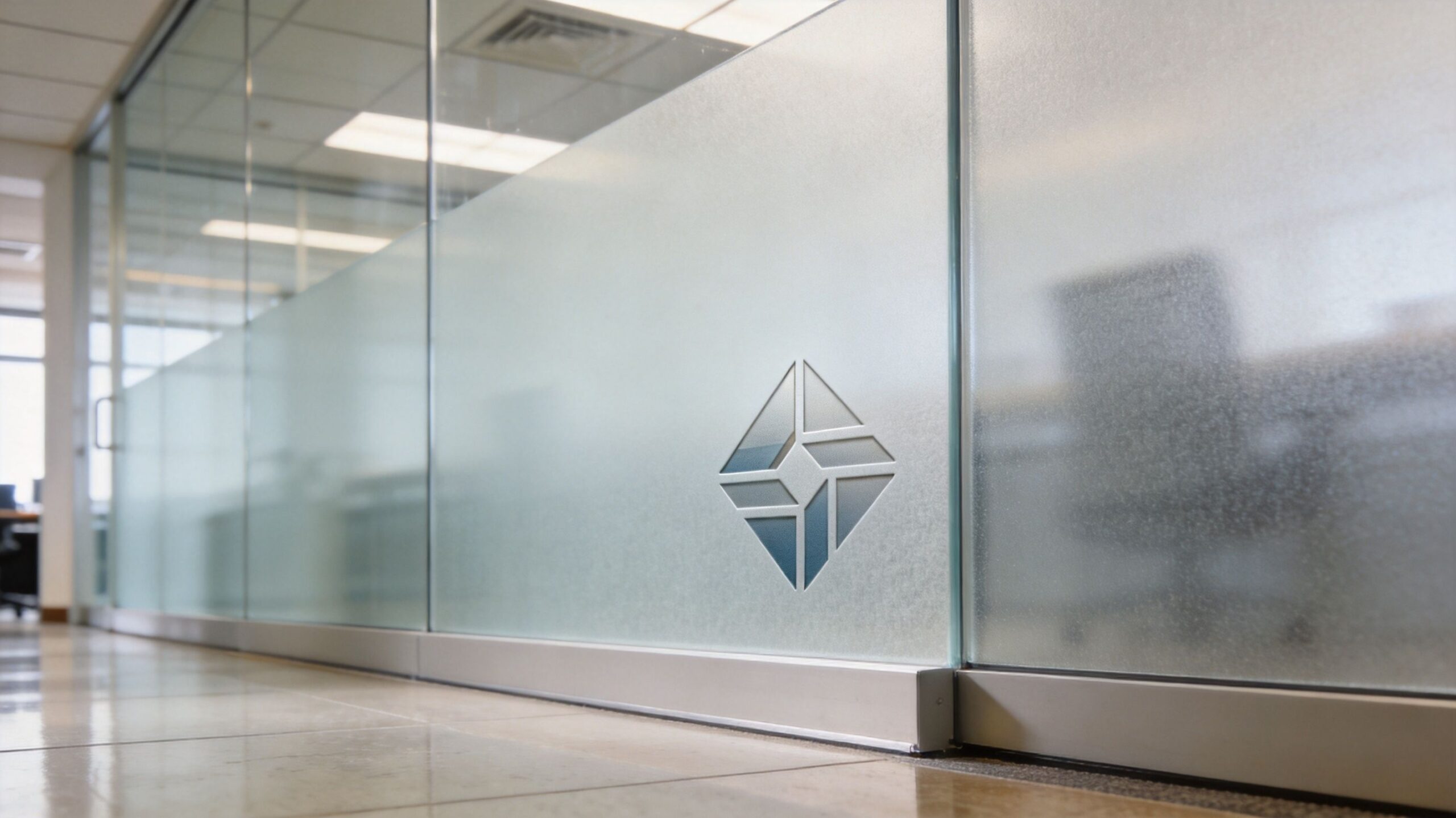
Buyers often focus on noise first, then realise later that the partition line affects light, branding and room feel. That's why manifestation, frame finish, solid bands and film details should be considered early.
Glazed systems can preserve openness, but they can also feel exposed if there's no visual privacy. Frosted bands, gradient film, switchable privacy options or carefully placed solid elements can make a room more usable without making it feel boxed in.
This is also where local delivery knowledge helps. Office projects in Cambridge often need a balanced approach that keeps the workplace refined and professional while still handling practical acoustic demands. Across Essex and Hertfordshire, the same issue appears in refits where existing layouts were never designed for constant video calls and hybrid occupancy.
Installation is where good products can go wrong
A well-specified partition can disappoint if the site detail is weak. Uneven floors, unsealed abutments, loose head details and poorly integrated doors all reduce performance.
This is especially true with sound flanking. Noise doesn't always go through the partition. It can travel over it, around it, or through adjoining elements if the installation isn't thought through properly.
UK guidance referred to in this NRC publication on office partition performance and compliance states that Approved Document E recommends an Rw rating of 45-50 for partitions between private office spaces. The same source notes that lower ratings allow intelligible speech to pass and highlights the importance of Class A fire-rated seals and correct installation to prevent sound flanking.
For teams dealing with ceilings and service coordination, this related guide to suspended panel ceilings is worth reviewing because overhead conditions often affect partition performance more than buyers expect.
Good acoustic results depend on the line where the partition meets everything else, not just the partition itself.
A wider compliance review should also include fire strategy. This practical guide to commercial fire safety is a useful reference for buyers checking how fit-out decisions interact with broader safety obligations.
Compliance needs to be built in from day one
UK projects need acoustic thinking and fire safety thinking to happen together. That includes the partition type, the glazing build-up, the seals, the door sets, the ceiling interface and the way services pass through or around the system.
The safest approach is to treat acoustic office partitions as part of the full fit-out package, not a late-stage add-on. That avoids the common problem where a room looks complete on handover but still leaks speech because the surrounding detail was never resolved properly.
Transform Your Workspace Today
Acoustic office partitions work best when they are chosen for the right reason. Some should block speech between rooms. Some should absorb echo in open areas. Some should give the office flexible private spaces without major rebuilding. The difference matters, because the wrong category often looks fine but solves very little.
For UK buyers, the decision also sits inside a bigger picture. Layout change, hybrid work, Part E expectations, fire safety, ceiling conditions, doors and site detailing all affect the final result. That's why a good acoustic outcome usually comes from careful planning rather than a quick product swap.
A quieter office is rarely just about silence. It's about making the workplace easier to use. Staff can focus, managers can hold private conversations, and the floor plan starts doing its job properly.
Choosing acoustic office partitions with that mindset leads to better spaces and fewer expensive mistakes.
Ready to transform your workspace? Speak to the GIBBSONN Interiors team today. Looking for bespoke pod solutions or interior support? They're here to help. Contact Us