
You’ve been told to deliver a fit-out. The lease clock is ticking, staff still need to work, and every supplier seems to use different language for the same thing. That’s where most office projects start to drift. Not because the design is wrong, but because the procurement route wasn’t clear enough at the start.
That risk is real. A 2023 UK Construction Industry Council report noted that 68% of commercial refit projects exceed timelines due to poor procurement specifications, and that traditional methods can add 20-30% to project timelines for SMEs. For a business trying to relocate, refurbish, or stay operational during works, that’s not a technical problem. It’s a business problem.
A practical procurement design and build approach gives one joined-up route from brief to handover. It reduces crossed wires, makes pricing easier to compare, and helps a client keep control of outcomes even without a large in-house property team. For firms in Hertfordshire and for businesses planning change in London, that usually matters more than textbook procurement theory.
Table of Contents
- Your Ultimate 2026 Guide to Design and Build Procurement
- Is Design and Build Right for Your Project
- Preparing Your Brief and Budget for 2026
- Navigating The Procurement Tendering Process
- Understanding Contracts and Managing Negotiations
- Handover Compliance and Future Proofing
Your Ultimate 2026 Guide to Design and Build Procurement
The phrase procurement design and build sounds more complicated than it is. In simple terms, it means choosing one route that joins design, cost planning, delivery, and fit-out construction under one main responsibility. For office projects, that tends to work well because workplace decisions are linked. A change to partitions affects acoustics. A change to power affects furniture. A late decision on meeting pods affects ventilation, fire strategy, and programme.

The trouble starts when those links are broken up between too many separate appointments. A client may appoint a designer, then tender to a contractor, then discover that parts of the design are hard to build within the budget or time allowed. By then, the business is already committed.
A clearer route is to treat procurement as a sequence of decisions, not a paperwork exercise. For anyone who wants a simple overview of the wider procurement process steps, that framework is useful because it shows how early choices shape later risk.
Why office fit-outs need a different mindset
An office fit-out isn’t only a construction project. It’s also an operations project. Teams may still be working on site. IT cutovers may need to happen overnight. Landlord approvals, building rules, and access restrictions can slow things down if they’re picked up too late.
That’s why generic design and build advice often misses what matters to SMEs. A warehouse shell and a live office floor are not procured in the same way. Office projects need sharper front-end thinking about phasing, staff disruption, furniture migration, glass partition layouts, acoustic privacy, and specialist items such as modular pods.
Practical rule: If the brief doesn’t explain how the business needs to keep running, the tender price won’t protect the business from disruption.
What usually works and what usually doesn’t
What works is a brief that explains outcomes in plain English, a tender list made up of firms with fit-out experience, and a contract that sets out who approves changes and by when. Clients don’t need to know every technical detail. They do need to know what success looks like.
What doesn’t work is rushing to price before the basics are settled. That usually leads to false savings at tender stage, followed by expensive clarification, delay, and compromise later.
A sound procurement design and build route for an office fit-out normally includes:
- A clear business case that explains why the move or refurbishment is happening now
- Employer's Requirements that describe layout, function, performance, and brand intent
- A realistic programme with approval dates, landlord sign-off points, and move deadlines
- A short tender list of contractors who can show office fit-out examples, not just general construction work
- A fair evaluation method that looks beyond headline price
For firms around Essex and for occupiers managing first-time change, that joined-up approach is often the difference between a fit-out that feels controlled and one that feels reactive.
Is Design and Build Right for Your Project
Some projects benefit from total design control before a contractor is brought in. Office fit-outs usually need something different. They need speed, joined-up decision making, and fewer gaps between concept, technical design, and buildability.
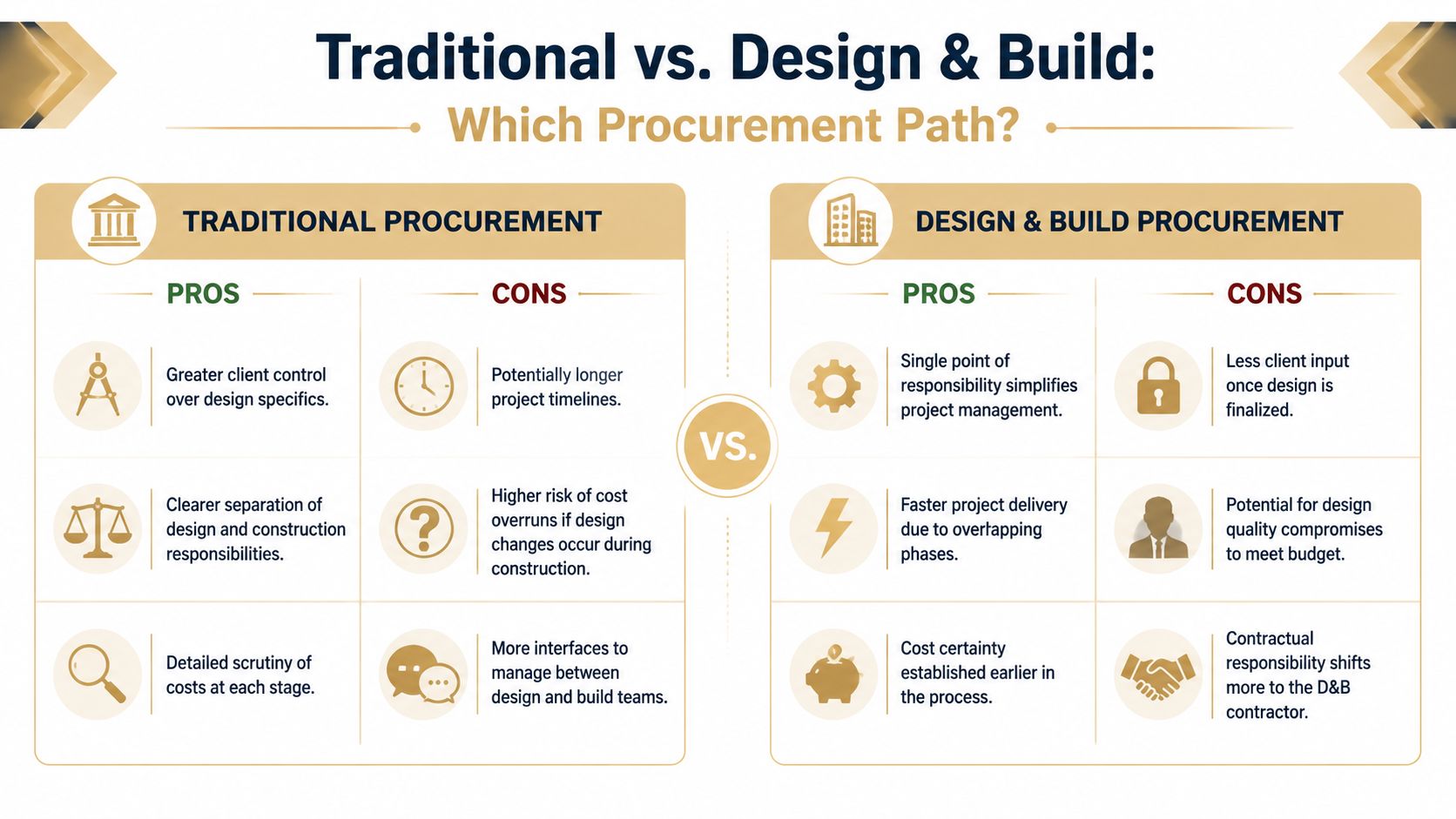
Research from RICS and CIOB shows that design-and-build projects typically improve delivery speed by an average of 20%, reduce overall project cost overruns by 10–15%, and experience 18% fewer disputes compared to traditional routes. For a client trying to plan a relocation, phased refurbishment, or lease event, those aren’t abstract benefits. They affect whether the project stays manageable.
What design and build means in practice
With Design and Build, one main contractor takes responsibility for developing the design and delivering the works. The client still sets the brief, approves key decisions, and controls the standard required. But the day-to-day coordination sits in one place.
That matters when office elements overlap. Ceiling changes affect lighting layouts. Partition shifts affect fire doors and access control. Furniture plans affect power and data. Under design and build, those decisions are more likely to be resolved within one team rather than passed back and forth.
A practical example is a fit-out that includes tea points, glazed offices, open-plan desking, and pod products such as Framery, Vetrospace, or BlockO. These are not plug-and-play decisions. They touch acoustics, floor loading, ventilation, power, and circulation. One integrated team can usually coordinate those points faster.
Where traditional procurement still suits
Traditional procurement can still be right if the client wants a fully developed design before contractor appointment, or if there are strong internal technical teams able to manage multiple consultants and interfaces. Some organisations prefer that route where design sign-off must be settled in detail before any pricing exercise begins.
It can also suit projects where the aesthetic concept is highly specialised and the client is prepared for a longer route to site. That said, many SMEs don’t have time for long design stages followed by a separate build tender and then a fresh round of value engineering.
The route should fit the client’s internal capacity, not just the building.
Design and Build vs. Traditional Procurement
| Factor | Design and Build (D&B) | Traditional (Design-Bid-Build) |
|---|---|---|
| Responsibility | One main point of accountability | Separate design and construction appointments |
| Programme | Design and construction can overlap | Delivery is usually more sequential |
| Cost control | Budget is tested against buildability earlier | Cost certainty often comes later |
| Client input | Strong at brief and approval stages | More direct input during design development |
| Risk of interface issues | Lower if scope is well defined | Higher because more parties must coordinate |
For many office occupiers, the practical question isn’t whether design and build is perfect. It’s whether it reduces avoidable friction. In most fit-out situations, it does.
For a fuller overview of how this route is commonly structured in office interiors, the design and build service overview gives a useful reference point.
Preparing Your Brief and Budget for 2026
A fit-out tender is only as good as the brief behind it. If the brief is vague, the bids will be vague too. If the budget is unrealistic, the whole process becomes a negotiation with reality.

In procurement design and build, the client’s main control document is usually the Employer's Requirements. This sets out what the contractor must deliver. It doesn’t need to read like a legal textbook. It does need to be clear, complete, and tied to business need.
What should go into Employer's Requirements
A good brief starts with operational reality. How many people use the space now. How many are expected within the lease term. Which teams need focus space, collaboration space, secure storage, reception presence, or client-facing areas. If hybrid working is in play, the brief should describe peak occupancy, not just total headcount.
It should also identify fixed constraints early, including landlord rules, access hours, core building services, fire strategy limits, and any need to keep part of the office live during works. These details often shape the programme more than finishes do.
Where specialist products are likely, the brief should say so. Examples might include glazed partition systems, architectural wrapping, joinery, AV rooms, or acoustic pods. If the client is considering a turnkey route, this guide to what a turnkey project is helps clarify where responsibility starts and stops.
A practical brief checklist for office fit-outs
Some clients freeze when asked to produce a brief because they think they must solve the design themselves. They don’t. They need to describe the outcome, constraints, and priorities.
A strong office brief usually covers:
Business drivers
Lease expiry, team growth, return-to-office plans, client experience, or departmental reorganisation.Space schedule
Open desks, meeting rooms, focus rooms, breakout areas, kitchen points, lockers, print points, reception, and storage.Adjacency needs
Which teams need to sit together. Which functions need privacy. Which spaces must stay near windows or shared resources.Technical requirements
Power density, data needs, Wi-Fi expectations, AV requirements, access control, and any specialist ventilation issues.Brand and feel
Whether the space should feel formal, creative, calm, premium, or strong. Reference images help here.Compliance and landlord matters
Approval routes, building manuals, fire requirements, and reinstatement obligations.Success measures
Better use of space, easier collaboration, improved privacy, or lower day-to-day friction.
Client-side warning: If a requirement is important but not written down, it often becomes a variation later.
How to set a budget that can survive real decisions
The budget should cover more than construction. Office projects often include furniture, IT, AV, removals, landlord fees, approvals, and contingency for change. Leaving those outside the early budget is one of the most common reasons a project feels like it has run over before it has even started.
A sensible budget conversation asks three things. What must be done. What would improve the outcome. What can wait for a later phase. That creates room for priority-based decisions without damaging the whole concept.
A simple way to organise early budget thinking is shown below.
| Budget area | Include in early plan | Notes |
|---|---|---|
| Core fit-out works | Yes | Partitions, finishes, M&E alterations, joinery |
| Furniture and pods | Yes | Include lead times and installation assumptions |
| IT, AV and security | Yes | Often procured separately but still affect programme |
| Professional fees and approvals | Yes | Landlord and building sign-off can affect timing |
| Contingency | Yes | Allows for unknowns and client-led changes |
One option in this market is GIBBSONN Interiors, which provides office fit-out, refurbishment, workplace consultancy, space planning, installation, and reconfiguration within a design-and-build route. For a client reviewing possible delivery models, that kind of joined-up scope can make comparisons easier because the responsibilities are clearer.
For businesses in Bishop’s Stortford and across Essex, the strongest early move is still the simplest one. Write the brief properly. Then test every tender response against it.
Navigating The Procurement Tendering Process
Tendering often feels more formal than it needs to be. In office fit-outs, the aim is straightforward. Shortlist the right firms, issue clear information, compare responses fairly, and appoint the team most likely to deliver the outcome with the least friction.
The industry trend supports that approach. According to the DBIA 2023 Mid-Cycle Survey Report, competitive best-value selection is the dominant procurement method for design-and-build projects, and this approach has been shown to improve adherence to project timelines by up to 17% compared to lowest-bid models.
What each tender stage actually means
A PQQ or pre-qualification stage is the filter. It checks whether a contractor is financially stable, properly insured, experienced in similar work, and capable of operating in occupied buildings if needed. This stage helps avoid many mistakes. A firm may be a good builder and still be a poor fit for a live office environment.
An ITT or RFP is the main request for proposal. It should include the brief, site information, programme targets, pricing format, and response rules. If tender returns are expected as signed digital files, clients sometimes run into unreadable attachments. This practical guide to a solution for unreadable P7M files can help if formal submissions arrive in a format the team can’t open easily.
Tender interviews matter as much as paperwork. They show whether the proposed team understands phasing, client communication, lead times, and approval points. A polished document can hide a weak delivery plan. A careful interview usually exposes it.
For clients wanting background on the wider process in UK construction, this overview of procurement in construction is a useful companion piece.
A simple best-value scoring matrix
Lowest price can be attractive, but it rarely tells the full story. A fit-out contractor may submit a lean figure by excluding awkward items, making assumptions, or pricing a programme that doesn’t reflect reality. Best-value scoring creates a better comparison.
A practical matrix can look like this:
| Criteria | What to look for | Weighting approach |
|---|---|---|
| Price and clarity | Complete pricing, clear assumptions, obvious exclusions | High |
| Design response | How well the proposal solves the brief | High |
| Programme and logistics | Phasing, access plan, live environment controls | Medium |
| Team and experience | Named people and relevant fit-out examples | Medium |
| Risk and compliance | Method for approvals, H&S, building rules | Medium |
The exact weighting depends on the project. A live office may weight logistics and phasing more heavily. A flagship workspace may put more emphasis on design response and finishes. The important point is consistency. Every bidder should be scored on the same basis.
Good tenders are comparable. Great tenders are comparable for the right reasons.
Understanding Contracts and Managing Negotiations
Once the preferred bidder is chosen, the contract turns a proposal into a working commitment. At this stage, many clients either relax too early or become overly adversarial. Neither helps. A fit-out contract should be clear enough to prevent confusion and balanced enough to support delivery when pressure arrives.
In UK interiors work, a JCT Design and Build Contract is common. The form itself is standard, but the schedules, amendments, and contract particulars shape how risk is shared in practice. Clients don’t need to become contract specialists overnight. They do need to know where problems usually sit.
Clauses that deserve close attention
The first area is scope. If the Employer's Requirements are loose, the contract may still be valid, but arguments later become more likely. Scope gaps usually appear around landlord works, client-supplied items, IT, furniture installation, specialist equipment, and approval responsibilities.
The second is change control. Office projects often evolve during design development. Teams ask for extra focus rooms. A director wants a larger boardroom. The landlord asks for extra fire stopping detail. The contract needs a clear method for instructing, pricing, and approving changes before they happen.
The third is programme and delay. Practical completion dates should be realistic and linked to actual access constraints. It’s wise to read delay provisions carefully, especially where building management approval, restricted hours, or client decisions could affect progress.
A useful checklist for reviewing warning signs is this guide on how to spot contract red flags. It won’t replace legal review, but it helps a client ask sharper questions before signing.
Commercial sense matters: The contract should describe how the job will really be delivered, not how everyone wishes it would be delivered.
What good negotiation looks like
Good negotiation is not about stripping every risk out of the contract and pushing it to the other side. That usually comes back later as defensive pricing, excessive exclusions, or relationship breakdown. Better negotiation tests assumptions and makes responsibility explicit.
Clients should ask:
- Who owns design approvals if comments come from the landlord or building manager late
- What happens to long-lead items if finishes are not approved by a set date
- How interim payments are assessed and what evidence supports them
- Which items are provisional and what triggers firm pricing
- What the defect process looks like after practical completion
This short video gives a useful overview of contract thinking in construction and why the wording around risk really matters.
Negotiation also needs the right people in the room. Commercial leads should review payment and risk. Project leads should review programme and approvals. Facilities teams should review operational constraints. Problems tend to grow when one person signs off a contract that affects three other departments.
For businesses in Chelmsford and for tenants across Hertfordshire, the strongest contract is rarely the longest one. It’s the one that says who does what, by when, and what happens if that changes.
Handover Compliance and Future Proofing
A fit-out isn’t finished when the last contractor leaves site. The handover phase decides whether the space is easy to occupy or full of loose ends. Good contractors plan handover early, not in the final week.
What a proper handover includes
At practical completion, the client should expect a structured pack that covers operation and maintenance information, health and safety files, warranties, certificates, and as-built records where relevant. Staff also need clear guidance on how the space works in day-to-day use, especially where meeting room technology, access control, lighting controls, or acoustic pods are involved.
A sensible final walk round usually checks more than defects. It should confirm room labels, furniture layouts, key storage, comms cabinet access, cleaning arrangements, and whether landlord sign-off conditions have been met. On leased space, reinstatement obligations and future dilapidations should stay on the radar from day one, not just at lease end.
Future proofing the space after practical completion
The most durable office fit-outs can adapt without major upheaval. That usually means choosing systems that allow reconfiguration, keeping service access practical, and avoiding layouts that only work for one team structure. A rigid plan may look tidy on handover and become a problem a year later.
For occupiers in Stansted and in Braintree, that flexibility matters if headcount, team patterns, or client-facing needs change during the lease. A well-procured design and build project should leave the business with a space that works now and can still absorb change later.
Ready to transform your workspace? Speak to the GIBBSONN Interiors team today. For customized advice on procurement design and build, office fit-outs, refurbishments, and workplace change, Contact Us.