

A lot of businesses reach the same point at once. The team has grown, the office no longer fits how people work, meeting rooms are always full, quiet space is hard to find, and the whole place starts to feel like it belongs to a different version of the company.
That’s where commercial interior design uk stops being a nice-to-have and starts becoming a business decision. A well-planned workplace can support focus, improve how clients see the business, and make better use of every square foot. In 2026, that matters more than ever for SMEs, landlords, tenants, and facilities teams trying to balance cost, compliance, and day-to-day disruption.
Table of Contents
- Your Workspace Is More Than Just Walls It Is Your Biggest Asset
- What Commercial Interior Design Really Means for Your Business
- The 2026 Fit-Out and Refurbishment Process From Start to Finish
- How to Budget Your Commercial Fit-Out Project in 2026
- UK Regulations Your Project Must Comply With
- Choosing the Right Commercial Fit-Out Partner
- Frequently Asked Questions About Commercial Interior Design
Your Workspace Is More Than Just Walls It Is Your Biggest Asset
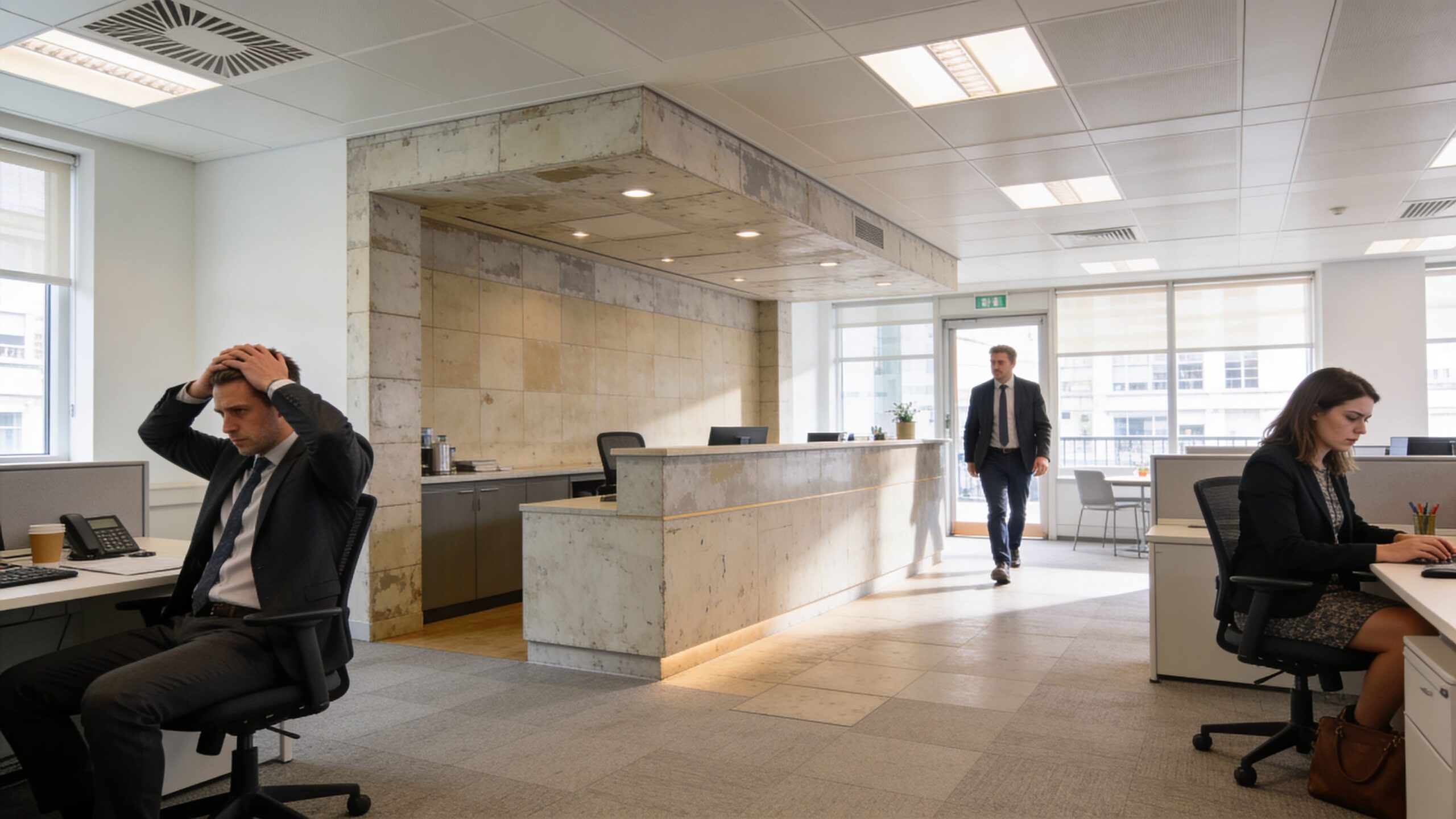
An office can subtly work against a business. Noise spreads too easily, teams sit in the wrong places, storage creeps into valuable floor area, and visitors walk into a space that doesn’t match the quality of the service on offer.
That’s why smart workplace design isn’t about decoration. It’s about using space to help the business run better.
The workplace now carries more responsibility
For many firms, the office has to do several jobs at once. It needs to support quiet work, team sessions, hybrid meetings, client visits, and informal catch-ups. If the layout hasn’t kept up, people feel it straight away.
That shift helps explain why the market keeps moving. The UK interior design market is projected to grow from £1.7 billion in 2026 to USD 6,125.5 million by 2030, with the number of interior design businesses up 2.9% year on year, according to Grand View Research’s UK interior design market outlook.
In practical terms, businesses across the country are treating workspace as an operational asset. That is just as true in London as it is in Cambridge, where changing team structures and growing companies often put pressure on existing layouts.
Practical rule: If a workspace creates friction every day, it’s already costing more than it looks.
What tends to go wrong in tired offices
Some problems are obvious. Others build up slowly.
- Too much open plan: Teams lose focus because every call, chat, and video meeting spills across the floor.
- Poor zoning: Quiet tasks happen beside collaboration areas, which means neither works properly.
- Weak first impression: The space feels dated, pieced together, or out of step with the brand.
- No flexibility: Headcount changes, but the office can’t adapt without more disruption.
A better design approach starts with function. Who needs privacy. Who needs visibility. Which teams need adjacency. Where clients arrive. Where circulation gets blocked. Those details shape whether a space feels effortless or frustrating.
Good design earns its place
A successful workplace doesn’t need to be extravagant. It needs to be deliberate. Glass partitions can divide teams without cutting out daylight. Modular pods can create private meeting and focus areas inside an existing footprint. Refreshed finishes can lift perception without a full strip-out.
Commercial interior design uk works best when it solves business problems first. The visual result should follow from that, not distract from it.
What Commercial Interior Design Really Means for Your Business
Commercial design gets reduced to finishes far too often. In reality, the strongest projects combine layout planning, technical coordination, brand thinking, and staff wellbeing into one joined-up solution.
That’s why the right design choices often feel simple once they’re in place. The work happened earlier, in planning.
It starts with space planning
A business rarely needs more room as much as it needs better use of the room it already has. That can mean reshaping circulation, removing dead corners, creating proper touchdown areas, or changing the ratio between desks, meeting areas, and support space.
A good layout should answer practical questions such as:
- Where does focused work happen
- Where can people talk without disturbing others
- How do visitors move through the space
- Which teams need to sit close together
- Where do storage and print points belong
When those questions aren’t answered early, the space usually ends up fighting itself.
Brand expression is part of the job
Brand in a workplace isn’t just signage on a wall. It shows up in tone, material choice, lighting, joinery, reception design, and how formal or relaxed the space feels.
A client walking into an office forms a view in seconds. If the business promises quality and precision, but the workspace feels temporary or cluttered, the room sends a different message. The best offices make the business feel coherent without needing to overstate it.
A workplace should feel like the company that occupies it, not like a generic shell with logos added later.
Wellbeing is a design issue not a perk
Comfort, acoustics, privacy, natural light, and ergonomic choices all shape how people work through the day. Through these elements, commercial interiors move well beyond appearance.
The strongest schemes usually balance several needs at once:
| Design focus | What it changes | Why it matters |
|---|---|---|
| Acoustic control | Reduces spill from calls and conversations | Helps people concentrate |
| Visual openness | Keeps light moving through the space | Makes the office feel larger and calmer |
| Ergonomic setup | Supports posture and task comfort | Improves day-to-day usability |
This is also where products need to be chosen carefully. Glass partitions are useful when teams want openness without full exposure. Acoustic pods such as Framery, Vetrospace and BlockO can create private meeting zones inside open-plan floors, but only if the acoustic performance, ventilation, and placement suit the way the office is used.
Design should support behaviour
The office works best when the environment nudges people in the right direction. A well-placed breakout area encourages informal interaction. A badly placed one turns into a noise source beside workstations. A meeting pod near the busiest path may look good on plan but feel awkward in use.
That’s the value of commercial interior design uk. It turns space into a working system, not just a finished room.
The 2026 Fit-Out and Refurbishment Process From Start to Finish
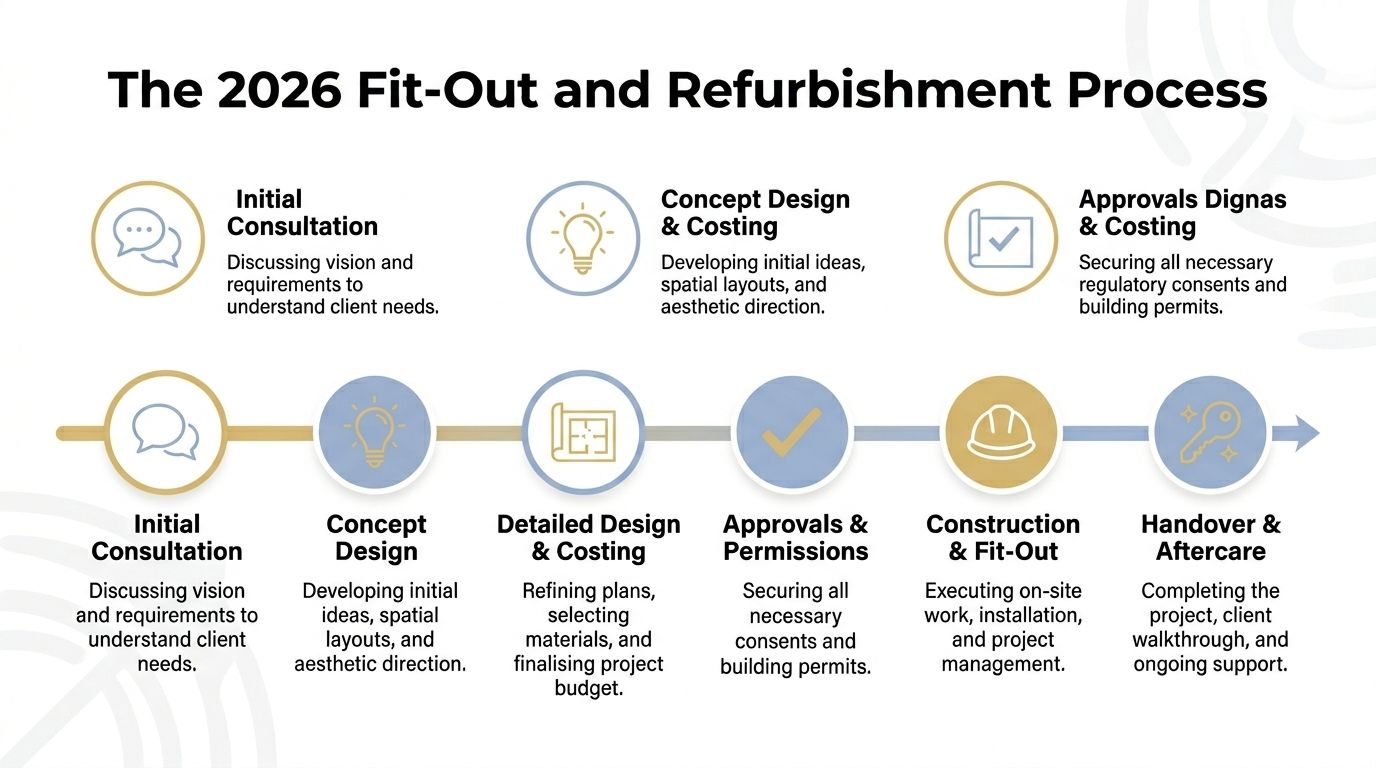
A fit-out feels far more manageable when the process is clear. Most problems on commercial projects come from gaps between design, cost, approvals, and delivery. A proper sequence keeps those gaps closed.
Start with how the space is really used
The first stage is not picking finishes. It’s understanding the brief properly. That includes team size, working patterns, storage needs, client-facing areas, privacy requirements, and any lease or landlord constraints.
This is also the point where key terms matter:
- Cat A: A base building finish, usually including essentials such as ceilings, lighting, and services, but not the customized workspace.
- Cat B: The fitted workplace itself, including partitions, furniture, branding, meeting rooms, tea points, and specialist areas.
- Dilapidations: Work needed at lease end to return a space to the condition required under the lease.
For businesses planning a refurbishment, a practical checklist helps. This office refurbishment project plan template is useful for mapping responsibilities and early decisions.
Move from concept to buildable detail
Once the brief is clear, the concept design stage shapes the overall plan. That usually includes layout options, zoning, a visual direction, and the first pass at how the office should feel and function.
After that comes detailed design. During this phase, projects either become buildable or start drifting. Materials are selected, partitions are coordinated, power and data locations are fixed, furniture is aligned with the layout, and costing is refined against the actual scope.
A simple process table keeps expectations clear:
| Phase | Key Activities | Your Involvement |
|---|---|---|
| Brief and survey | Measure space, define needs, review constraints | Confirm priorities and budget direction |
| Concept and detail | Layouts, finishes, technical coordination, costing | Review options and sign off decisions |
| Build and handover | Site works, installation, snagging, final checks | Approve programme and final walk-through |
Deliver with control not guesswork
On site, sequencing matters. Strip-out, partitioning, flooring, decorations, joinery, furniture, and final commissioning all need to happen in the right order. That is where project management earns its value.
A structured process also matters for safety. Poorly planned fit-outs account for 30% of the 65,000 construction-related injuries reported annually by the HSE, and following the CDM Regulations 2015 can reduce incidents by 35% and cut project delays by up to 28%, according to the HSE guidance on CDM 2015.
Site reality: Most disruption comes from poor sequencing, unclear decisions, or late approvals, not from the fitting-out work itself.
Businesses in specialist environments often feel this most sharply. A project near Stansted Airport may carry tighter access and security rules, while a growing office in Milton Keynes may need phased works around active teams and planned expansion.
A smooth handover should include more than keys and a tidy space. It should cover snagging, user guidance, compliance records where needed, and a clear aftercare route if adjustments are required after occupation.
How to Budget Your Commercial Fit-Out Project in 2026
Budget questions usually come too late. By then, teams have already built expectations around a layout or look that may not match the available spend. A better route is to set the budget framework before design choices become fixed.

What usually drives cost
A fit-out budget is shaped by scope more than by style alone. The biggest factors usually include the condition of the existing space, the amount of mechanical and electrical work, the number of enclosed rooms, furniture specification, and how much bespoke joinery is needed.
Three projects can all look modern when finished, yet carry very different budgets because the underlying works are not the same.
Common cost drivers include:
- Services changes: Moving lighting, air conditioning, power, or data can shift the budget quickly.
- Partitioning and pods: Private rooms, glazed fronts, and acoustic booths add function, but they also add coordination and installation cost.
- Programme pressure: Fast-track projects often need tighter sequencing and longer working hours.
- Dilapidations overlap: Lease-end obligations can compete with money planned for the new fit-out.
The office fit-out cost guide for 2026 is a useful starting point when comparing likely levels of spend.
Where value comes from
Not every pound should go into visible finishes. Some of the best returns come from choices that improve usability.
According to IBISWorld’s UK interior design activities data, architectural wrapping can deliver an aesthetic refresh at 40-60% lower cost, a well-designed ergonomic space can support a 15-20% uplift in productivity, and modular systems can offer a 25% faster ROI because they are easier to adapt over time.
That changes how budgeting should be approached. Instead of asking only what a project costs, it makes more sense to ask what the business needs the space to do better.
A useful budgeting split often looks like this:
| Spend area | What to protect | What can be reviewed |
|---|---|---|
| Core function | Layout, acoustics, lighting, ergonomics | Decorative extras |
| Long-term value | Durable finishes, flexible systems | One-off trends |
| Brand impact | Reception, client-facing rooms, key touchpoints | Lower-priority back-of-house areas |
A short visual guide can help teams think through those priorities before signing off scope.
When a lighter-touch upgrade makes more sense
A full refit is not always the right answer. Sometimes the better commercial choice is to keep the bones of the office and target the elements that people notice and use most.
That might mean:
- Architectural wrapping for doors, tea points, walls, and tired surfaces
- Selective partitioning to introduce privacy where noise is the issue
- Modular booths or pods for calls, one-to-ones, or focused work
- Furniture reconfiguration instead of wholesale replacement
Budget test: If the space functions reasonably well but looks tired, a smart refresh often beats a full strip-out.
This is often the right route for SMEs trying to control spend while still making the office feel current, practical, and client-ready in 2026.
UK Regulations Your Project Must Comply With
Compliance is where many office projects become more complex than expected. A scheme can look straightforward on plan, then run into issues once fire routes, accessibility, ventilation, acoustics, or approvals are reviewed properly.
That’s why compliance needs to be built into the design from the start, not checked at the end.
Building Regulations affect design choices early
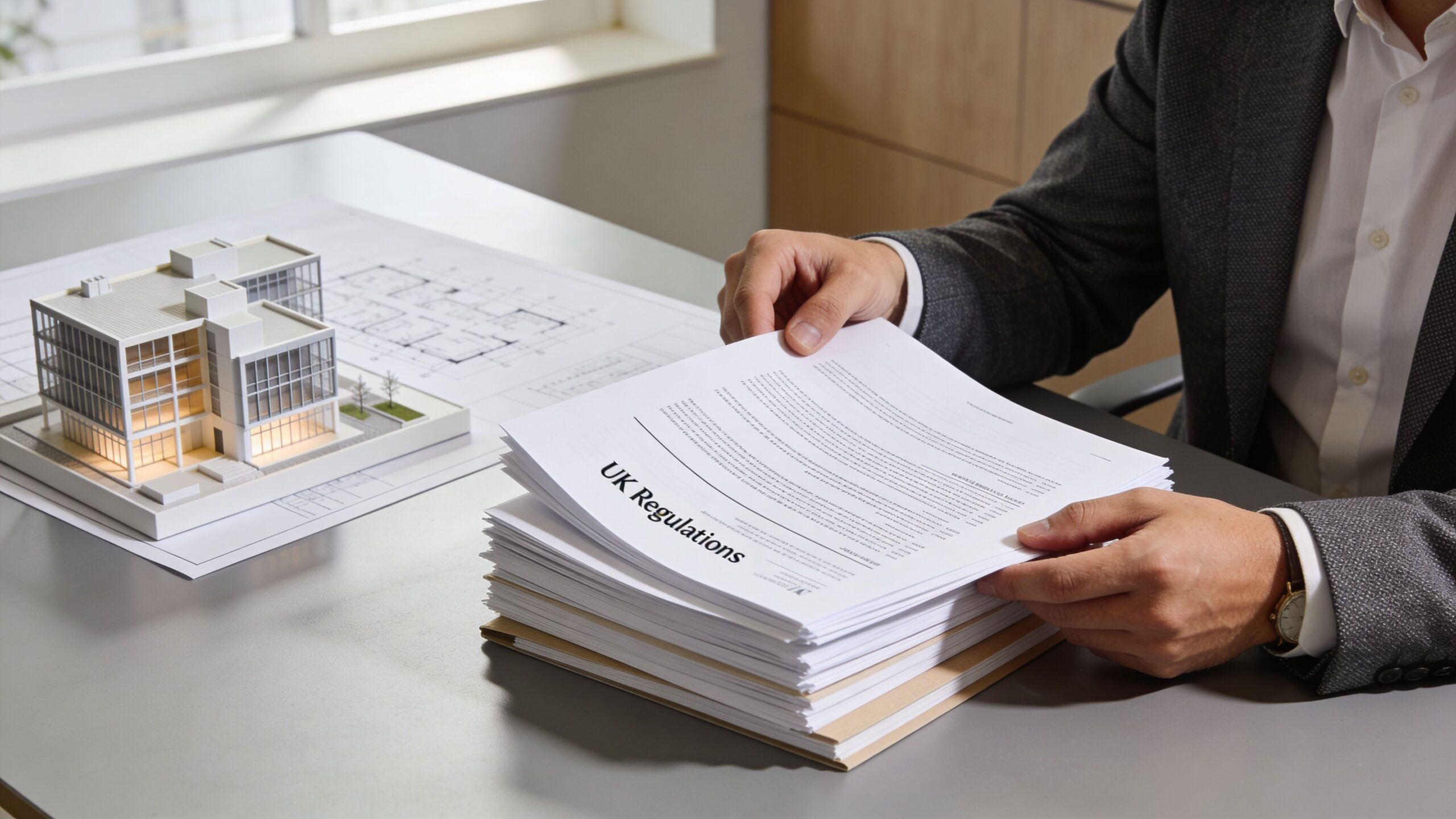
In UK commercial fit-outs, Building Regulations apply to new works and significant refurbishments. They cover essentials such as structural safety, fire safety, ventilation, drainage, accessibility, energy performance, and sound insulation.
That has direct design consequences. Partition systems, door widths, escape routes, fire ratings, glazing details, and service layouts all need to align with the relevant requirements. A feature that looks simple in a moodboard may need a very different specification once it sits on a real plan.
According to this guide to UK commercial building regulations, compliance is mandatory and Approved Document B sets requirements such as minimum escape route widths, while Approved Document E requires partitions to meet sound reduction targets. The same guidance notes that following these rules is linked with reduced commercial fire incidents and that better acoustic control helps limit distraction in open-plan spaces.
CDM changes how projects are planned and managed
The legal side of project delivery doesn’t stop with Building Regulations. The Construction Design and Management Regulations 2015 affect how commercial work is organised, who is appointed, and how health and safety information is managed.
For clients, that means the project should have clear roles, proper risk planning, and a structured approach to site activity. It also means early attention to known issues such as asbestos risk in older buildings, dust from cutting works, access control, and the safety of occupied premises if the office stays live during refurbishment.
A compliant project tends to make better decisions earlier. That usually means fewer surprises during the build.
Accessibility and fire safety cannot be left until the end
Accessibility is not an optional extra and should never be treated as a late-stage add-on. Door clearances, circulation routes, turning space, reception layout, WC access, and meeting room usability all need consideration at planning stage.
Fire safety is similar. It reaches further than extinguishers and alarm points. It affects compartmentation, travel distance, signage, materials, and the specification of doors and glazed systems. A fire-rated glass partition is not just a design feature. It can be part of the life safety strategy of the space.
Compliance should shape the brief, the layout, and the specification. If it only appears during technical review, the project is already behind.
This matters for businesses of every size, including occupiers in Bishop’s Stortford that may be adapting existing premises rather than starting with a new shell. Early checks protect budget as much as they protect safety.
Choosing the Right Commercial Fit-Out Partner
A fit-out partner has a bigger effect on the final result than most clients expect. The drawings can be strong and the budget can look sensible, but if communication is weak or delivery is fragmented, the experience quickly becomes harder than it needs to be.
The best appointment decision usually comes down to how a company thinks, not just what it promises.
What a strong partner does differently
A capable partner asks sharper questions early. They want to know how the office operates, what cannot be disrupted, who signs off decisions, what the lease says, and where the risk sits.
They also understand that current workplace expectations are not only about appearance. The 2025 Workplace Sector Report from Commercial Interiors UK highlights sustainability, wellness, inclusive design, connection, and technology, with biophilic design identified as the leading 2025 fit-out trend because natural elements can improve concentration, mood, and creativity, as noted in Commercial Interiors UK’s workplace sector report.
That matters when choosing a partner because a modern project needs joined-up thinking. It is not enough to install a nice office. The space has to support real behaviour and current expectations.
A clear explanation of that delivery model appears in this guide to what a turnkey project means.
The right fit-out partner doesn’t just price drawings. They protect the brief, challenge weak decisions, and keep design, cost, compliance, and build moving in the same direction.
Questions worth asking before appointment
Not every client needs the same type of partner. An occupied office, a phased refurbishment, and a lease-end dilapidations project all need slightly different strengths.
These questions usually reveal a lot:
- How do they manage live environments: A good answer should cover phasing, access, noise control, and communication with staff on site.
- Do they understand compliance: They should talk comfortably about approvals, coordination, and technical risk, not just finishes.
- Can they show similar work: Sector relevance matters. An office job, a healthcare setting, and a public estate project all behave differently.
- Who is accountable day to day: Clients need to know who is leading decisions once work begins.
A business comparing partners in Braintree may have different priorities from a landlord managing works in Dartford, but the same principle applies. The right team should reduce uncertainty, not add to it.
Frequently Asked Questions About Commercial Interior Design
Good questions usually come up once teams begin comparing options. Most are less about design taste and more about timing, disruption, approvals, and whether the project is worth doing now.
How long should an office fit-out take
The answer depends on scope, approvals, and how much technical work sits behind the visible changes. A light refurbishment can move quickly. A full fit-out with new partitions, services changes, furniture procurement, and compliance sign-off takes longer.
What matters most is not the headline duration but whether the programme is realistic and sequenced properly.
Is it better to refurbish or fully refit
That depends on what is wrong with the space. If the layout still works and the main issue is that the office looks dated, refurbishment is often the better route. If the space no longer supports the team, a deeper fit-out usually makes more sense.
In Essex and Hertfordshire, many occupiers are balancing those two options against lease terms, staff expectations, and budget pressure rather than choosing on appearance alone.
Can work happen while the office stays occupied
Often, yes. But that only works if phasing, safety, access, and communication are thought through in detail. Some businesses can stay in place with weekend or out-of-hours works. Others are better served by temporary swing space for the noisiest phases.
A simple rule applies. If occupied working is part of the brief, it needs to shape the build plan from day one.
What if the project includes dilapidations
Dilapidations should be reviewed early, especially if the business is moving or negotiating lease end obligations. Those works can affect budget, programme, and what makes sense to reuse in the next space.
The strongest approach is to look at reinstatement, removals, reconfiguration, and any salvage or re-use opportunities as one joined-up plan instead of treating dilapidations as an afterthought.
Are pods and glazed rooms worth it
They can be, if they solve a real problem. Pods and glazed meeting rooms are most useful where teams need privacy, call space, or acoustic separation without losing openness. They are least useful when added because they look current but sit in the wrong place or duplicate underused rooms already in the office.
Used well, they can improve how an open-plan office performs. Used badly, they become expensive obstacles.
What should clients prepare before speaking to a fit-out company
A short list helps:
- Team and headcount needs: Current numbers and any likely growth
- Pain points in the current space: Noise, lack of meeting rooms, poor flow, tired finishes
- Budget direction: Even a range is better than none
- Lease information: Break dates, reinstatement obligations, landlord approvals
- Decision makers: Who needs to approve scope, spend, and design
That level of preparation usually leads to a better first conversation and a more useful proposal.
Ready to transform your workspace? Speak to the GIBBSONN Interiors team today. Whether the priority is a full office fit-out, a smart refurbishment, dilapidations support, or bespoke pod solutions, practical guidance is available from first brief to final handover. Contact Us to book a consultation and start planning a workspace that works harder in 2026.