
Is your office looking a bit tired? Feeling more like a throwback than a hub of innovation? If you’re wondering whether a simple lick of paint will do the trick, it might be time to think bigger. An office refurbishment is more than just new furniture. It’s a smart investment in your company’s future, shaping how your team works together, creates, and feels about your brand.
Table of Contents
- Your 2026 Guide to a Winning Office Refurbishment
- Choosing the Right Type of Office Refurbishment
- How to Budget for Your Office Refurbishment Costs
- Navigating Key UK Rules and Regulations
- The Five Stages of a Successful Refurbishment Project
- Inspiring Ideas for Your 2026 Modern Workspace
- Your Office Refurbishment Questions Answered
Your 2026 Guide to a Winning Office Refurbishment
In a world where hybrid working is the new normal, your office needs to earn its keep. A great workspace is now one of the best tools you have for attracting and holding onto top talent. This guide is your complete roadmap to a successful office refurbishment here in the UK. We’ll break down everything from the different types of projects to the nitty gritty of costs, legal rules, and timelines.
Whether you’re based in a bustling hub like London or a growing town in Essex, we’ll show you how a well planned project can turn your workspace into a real asset, a place that boosts performance and truly shows off your company’s spirit.
Why Refurbish Your Office in 2026?
Let’s be honest, the role of the office has changed for good. It’s no longer a place people have to be for heads down work. It’s now a destination, a central point for collaboration, for soaking up company culture, and for sparking the kind of ideas that just don’t happen over a video call. An outdated, uninspiring office doesn’t just look bad; it actively works against your business goals.
A modern refurbishment can deliver real results:
- Attract and Keep Top Talent: In a competitive job market, a fantastic work environment can be the deciding factor.
- Boost Productivity and Wellbeing: Thoughtful design creates spaces that help people focus, reduce stress, and promote a healthier team.
- Adapt to Hybrid Working: You can build a flexible mix of spaces that supports both your in office and remote teams perfectly.
- Strengthen Your Brand: Your office is a three dimensional expression of your company’s values. Make it count.
The Market Shift Towards Refurbishment
The trend across the UK is crystal clear: businesses are choosing to reinvent their current spaces rather than move or build from scratch. It’s a smarter, more sustainable, and often cheaper way to create the high quality workspace you need to succeed. From agile tech startups in Bishop’s Stortford to established firms across Hertfordshire, companies are waking up to the power of a great refurbishment.
This isn’t just a hunch; the data backs it up. A landmark Deloitte survey revealed that a staggering 83% of new office space started in London during 2023 consisted of refurbishment projects, not new builds. This dramatic shift is fuelled by a need for speed and the huge demand for modern, efficient environments suited to new ways of working.
And what about your people? A Microsoft study found that 41% of workers are considering a job switch, with the quality of the work environment being a key factor for over half of them. The message is clear: your office space matters more than ever.
Ready to transform your workspace? Speak to the Gibbsonn Interiors team today.
Choosing the Right Type of Office Refurbishment
When it comes to office refurbishment, one size definitely doesn’t fit all. Picking the right path for your project is vital, and it depends on your specific goals, your budget, and even the small print in your lease. Getting to grips with the main types of office refurbishment UK firms offer is the first step to making a smart investment.
A refurb can be anything from a quick cosmetic update to a complete transformation, right down to the bare walls. Each approach serves a different purpose, runs on a different timeline, and comes with a different price tag. Making the right choice from the start means you won’t overspend or, just as importantly, undersell your vision.
The Light Touch Refresh
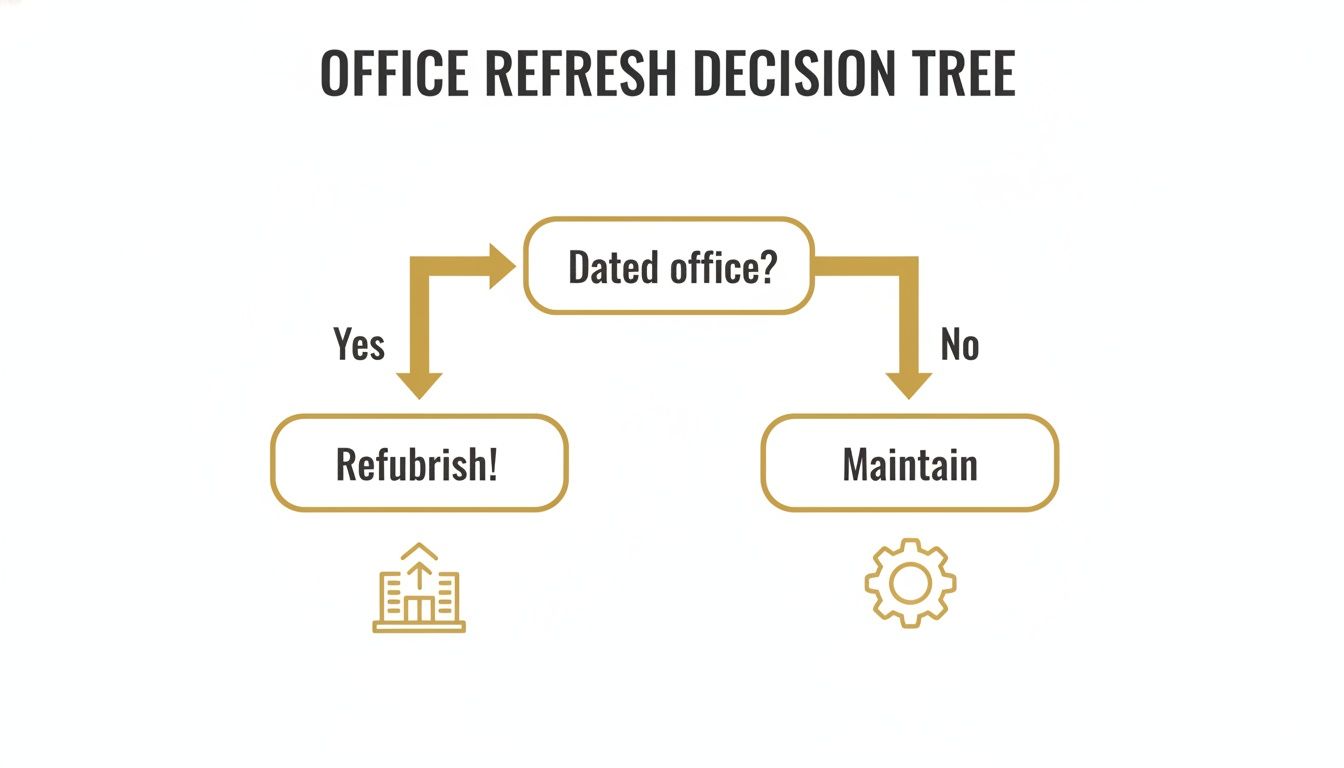
The simplest and fastest route is what we call a light touch or cosmetic refresh. You can think of it as giving your office a facelift. It’s all about the look and feel, and it can dramatically improve a space without the noise and disruption of major building work.
This approach is perfect for businesses that need a quick, budget friendly boost to their environment. It’s also a great option for landlords trying to make a property more appealing to potential tenants. A light touch refresh typically includes things like:
- A fresh coat of paint in a more modern colour scheme.
- New carpets or flooring to replace tired, worn out surfaces.
- Updated office furniture and better ergonomic seating.
- Improved lighting for a brighter, more welcoming atmosphere.
Cat A and Cat B Fit-Outs Explained
Once you start looking at a more involved office refurbishment UK project, you’ll hear the terms ‘Category A’ and ‘Category B’ crop up. These are industry standard terms that define two very different stages of preparing an office for a tenant.
Think of Cat A as the landlord creating a clean, functional but empty shell. Cat B is where the tenant comes in to add their personality and create a space that actually works for their team.
A Category A (Cat A) fit out is typically the landlord’s job. It involves getting the space to a basic, functional ‘blank canvas’ state, ready for a tenant to move in and customise. It’s all about laying the essential groundwork.
Then you have the Category B (Cat B) fit out. This is the stage where a tenant truly makes the space their own. It’s all about putting in the specific layout, branding, and features your business needs to operate effectively and reflect your company culture.
To make it clearer, here’s a simple breakdown of how these two types compare.
Comparing Office Refurbishment Types
This table breaks down the common types of office refurbishment to help you decide which is right for your business.
| Refurbishment Type | Best For | Typical Scope |
|---|---|---|
| Category A | Landlords preparing a space for lease. | Raised floors, suspended ceilings, basic mechanical and electrical services. |
| Category B | Tenants creating a bespoke workspace. | Meeting rooms, offices, breakout areas, kitchens, branding, and IT setup. |
Getting the right balance between these stages is key to a successful project that meets everyone’s needs.
The Turnkey Design and Build Solution
For businesses that want a completely seamless, stress free process, a full turnkey or design and build project is the ultimate solution. This is a complete, end to end service that covers every single part of the refurbishment, from the very first sketch to the final handover. At Gibbsonn Interiors, this is our speciality.
This all in one approach is ideal for busy managers in places like Hertfordshire or in thriving business hubs like Cambridge, who need an expert partner to manage the entire project. You get a single point of contact and one dedicated team responsible for everything, which ensures crystal clear communication and total accountability. If you’d like to learn more, we cover this in detail in our guide on what a turnkey project involves.
How to Budget for Your Office Refurbishment Costs
So, let’s talk about the bottom line. Working out a realistic budget is one of the most critical first steps in any successful office refurbishment. Honestly, the costs can swing dramatically depending on the level of finish you’re after, the complexity of the work, and even your postcode. A high end project in a prime location like Braintree will naturally cost more per square foot than a simple cosmetic refresh elsewhere.
But thinking about your budget isn’t just about landing on a number; it’s about understanding what that number truly buys you. A well planned refurbishment is a powerful investment, not just an expense. When it’s done right, a thoughtfully designed office can deliver a fantastic return by boosting your team’s productivity, helping you keep your best people, and making a bold statement about your brand.
Understanding Average Refurbishment Costs in the UK
To give you a clearer picture, it’s helpful to look at some industry averages. These are guide prices, of course, but they offer a solid starting point for your financial planning. In our world, costs are almost always calculated per square foot or per square metre.
Here’s a general breakdown of what you might expect to pay:
- Basic Cosmetic Refresh: If you’re looking for a simple update, think fresh paint, new carpets, and minor repairs, you’re likely looking at a budget between £40 to £80 per square foot.
- Mid-Specification Refurbishment: This is the sweet spot for most businesses wanting a big upgrade. This level often involves creating new meeting rooms, refreshing breakout areas, and improving lighting and data infrastructure. Expect costs in the range of £80 to £150 per square foot.
- High-Specification Fit-Out: For a truly premium finish with high end materials, custom made joinery, advanced technology, and major structural changes, costs can easily climb to £150 to £200+ per square foot.
Working with a turnkey partner like Gibbsonn Interiors is one of the best ways to get a firm grip on these costs. We provide a single, transparent budget from the start, so there are no unwelcome surprises down the line. For a more granular look, check out our dedicated guide on understanding office refurbishment costs.
What Influences the Final Price?
Several key factors will nudge your budget up or down. Knowing what they are helps you make smarter decisions about where to invest and where you can be more economical.
| Factor | How It Affects Cost | Example |
|---|---|---|
| Level of Finish | Higher quality materials and bespoke items cost more. | Choosing real wood flooring over vinyl, or custom built reception desks. |
| Technical Needs | Complex IT, AV, and security systems add to the total. | Installing video conferencing suites or access control systems. |
| Furniture Choices | Ergonomic and designer furniture is a bigger investment. | Opting for high end ergonomic chairs versus standard office seating. |
Recent industry data really puts this into perspective. The Cushman & Wakefield 2024 UK Fit Out Cost Guide shows that a medium spec Category B refurbishment, a great standard for most corporate clients, costs around £207 per square metre in London and £171 per square metre in Birmingham. These figures reflect rising material costs and higher client expectations, a feeling shared by contractors, with 55% expecting that prices will continue to climb. You can discover more UK office statistics and cost insights on Flexioffices.co.uk.
Ultimately, nothing beats a detailed conversation with a refurbishment specialist to get an accurate cost for your unique project. Whether you’re planning a small scale update in Hertfordshire or a complete transformation in a major city, a clear financial plan is the key to a smooth, successful, and stress free project.
Looking for bespoke pod solutions or interior support? We’re here to help.
Navigating Key UK Rules and Regulations
Let’s be honest, the legal side of an office refurbishment can feel like a bit of a minefield. But it really doesn’t have to be. Any office refurbishment UK wide has to follow a key set of rules designed to keep your team safe, make the space accessible to everyone, and ensure everything is above board.
Think of these regulations not as obstacles, but as a blueprint for building a high quality, responsible, and future proof workspace. Getting this right is absolutely critical. Cutting corners can lead to expensive delays, fines, or even being ordered to tear out work you’ve just paid for.
The good news? With an experienced partner on your side, navigating this landscape is just another part of the process, handled for you from the very start.
Building Regulations and Fire Safety
First up are the Building Regulations. These are the non negotiable standards for all UK construction projects. They cover a whole host of areas, all with one goal in mind: ensuring the health and safety of people in and around the building.
For an office fit out, this means we’re paying close attention to:
- Structural Safety: Any changes to walls or the internal layout must keep the building structurally sound.
- Fire Safety: This is one of the most important aspects. It’s all about ensuring safe escape routes and robust fire prevention.
- Ventilation: The space has to have proper airflow to maintain a healthy environment for your team.
- Energy Efficiency: Any new lighting, heating, or cooling systems must meet modern performance standards.
Fire safety, in particular, is something we engineer into the design from day one. Your new office layout must have clearly marked escape routes, the right kind of fire doors, and a compliant fire alarm and smoke detection system. There’s no room for error here.
Accessibility and The Equality Act 2010
A modern workplace simply has to be an inclusive one. The Equality Act 2010 makes it a legal duty for employers to make ‘reasonable adjustments’ so that disabled team members and visitors aren’t at a disadvantage. This has a huge impact on how we design an office.
During a refurbishment, we’re constantly thinking about how everyone will navigate and use the new space. This means providing proper access for wheelchair users, making sure corridors and doorways are wide enough, and installing accessible toilet facilities. It’s not just a legal box to tick; it’s about creating a space that genuinely works for every single person.
Planning Permission and Dilapidations
Depending on the scope of your project, you might also need planning permission. This is usually needed if you’re making changes to the outside of the building, like new windows, extensions, or major signage, or changing the building’s official use. It’s a process we handle for clients across the country, from Essex to Chelmsford, making sure all the paperwork is managed correctly.
Finally, for tenants, there’s another word you need to know: dilapidations. This is your contractual duty to return the property to its original condition when your lease ends. A smart refurbishment can tackle this head on. By agreeing changes with your landlord upfront or by using smart, reversible solutions, you can avoid a massive headache and expense down the line.
Working with a specialist partner ensures all these legal boxes are ticked, leaving you free to focus on what matters, watching your vision for a new office come to life.
Ready to transform your workspace? Speak to the Gibbsonn Interiors team today.
The Five Stages of a Successful Refurbishment Project
So, you’re thinking your office is ready for a change? A truly great office refurbishment isn’t something that just happens by accident. It’s the result of a clear, structured process that turns your initial vision into a functional, inspiring reality. This journey, when managed properly, ensures every detail is accounted for, your budget is respected, and the final workspace genuinely supports your team.
Let’s walk through the five key stages of any well run project, from the very first conversation to the final handover.
Stage 1: Briefing and Discovery
This first step is, without a doubt, the most important. It’s where we sit down with you to listen and learn. We need to understand not just what you want, but more importantly, why you want it. What are your core business goals? What challenges does your current space present? What is your company culture really like?
This deep dive helps us pinpoint the project’s fundamental objectives and builds the foundation for everything that follows. It’s also the perfect moment to think about your future needs. The way UK offices are used has been reshaped by hybrid working, and clever space planning has never been more critical.
Stage 2: Design and Space Planning
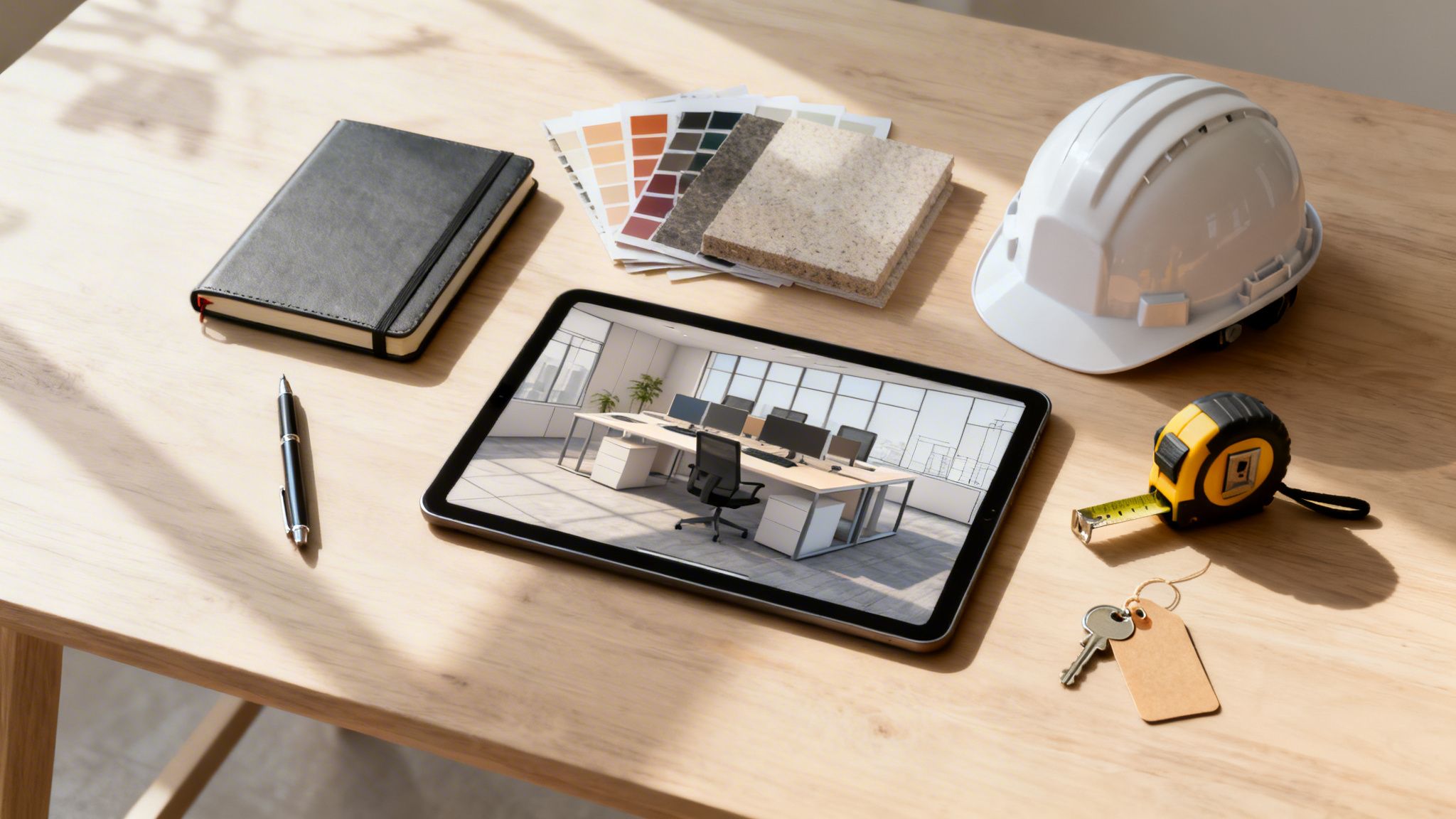
With a solid brief in hand, we start bringing your ideas to life. Our design team takes everything we learned during the discovery phase and translates it into a tangible, visual plan.
You’ll get to see detailed floor plans and stunning 3D renders that show you exactly how your new office will look, feel, and function. This is where we map out different zones for focused work, collaboration, and relaxation. We meticulously plan the flow of movement through the space and select the right materials, colours, and finishes that align with your brand and budget.
Stage 3: Procurement and Costing
Once we have a design you absolutely love, we move on to the numbers. For us, this stage is all about total transparency. We develop a detailed, fully costed proposal that breaks down every single expense, from materials and furniture to contractor fees and professional services.
Everything is specified and agreed upon upfront. This means you have complete clarity and confidence in the budget before any work begins on site. No surprises, no hidden costs.
Stage 4: Build and Installation
This is where the real transformation begins. Our dedicated project management team takes centre stage, coordinating all the tradespeople and meticulously overseeing the construction and installation process.
We place a huge emphasis on minimising disruption to your business, which is especially important if your team needs to remain operational during the project. Our site teams are experts at managing live environments safely and efficiently, ensuring the project runs smoothly, on time, and on budget.
Stage 5: Handover and Aftercare
The final stage is the moment we’ve all been working towards: handing you the keys to your brand new workspace. We’ll conduct a thorough walk through with you, explaining how every new system and feature works, and making sure you are completely happy with the result.
But our support doesn’t stop there. We provide comprehensive aftercare to help your team settle in and to address any minor snagging issues that may arise. Our goal is to ensure a seamless transition for your entire organisation.
To keep track of all these moving parts, we’ve put together a simple checklist that outlines the key activities at each stage of the refurbishment process.
Project Stage Checklist
| Project Stage | Key Activity | Main Goal |
|---|---|---|
| Stage 1: Briefing | Stakeholder workshops, site survey | Define project objectives and vision |
| Stage 2: Design | Space planning, 3D visualisation | Create a functional and aesthetic design |
| Stage 3: Procurement | Detailed costing, supplier selection | Finalise the budget and schedule |
| Stage 4: Build | Site management, construction | Execute the design to a high standard |
| Stage 5: Handover | Snagging, final checks, training | Ensure a smooth transition and client satisfaction |
This table serves as a high level guide to help you understand the journey from concept to completion. For a more granular breakdown, be sure to grab our comprehensive office refurbishment checklist.
Inspiring Ideas for Your 2026 Modern Workspace
When we talk about what a modern office should look like in 2026, the picture is radically different from what it was just a few years ago. The old model of uniform desks stretching out in every direction is well and truly gone. Today, the most effective workspaces are built on a foundation of flexibility, collaboration, and, crucially, employee wellbeing. A successful office refurbishment UK project isn’t about just one thing; it’s about weaving these elements together to create a dynamic environment where your team can thrive.
As workspace specialists, we’ve seen first hand what works. Here are some of the most powerful ideas shaping the offices of forward thinking organisations.
Embrace Transparency with Glass Partitions
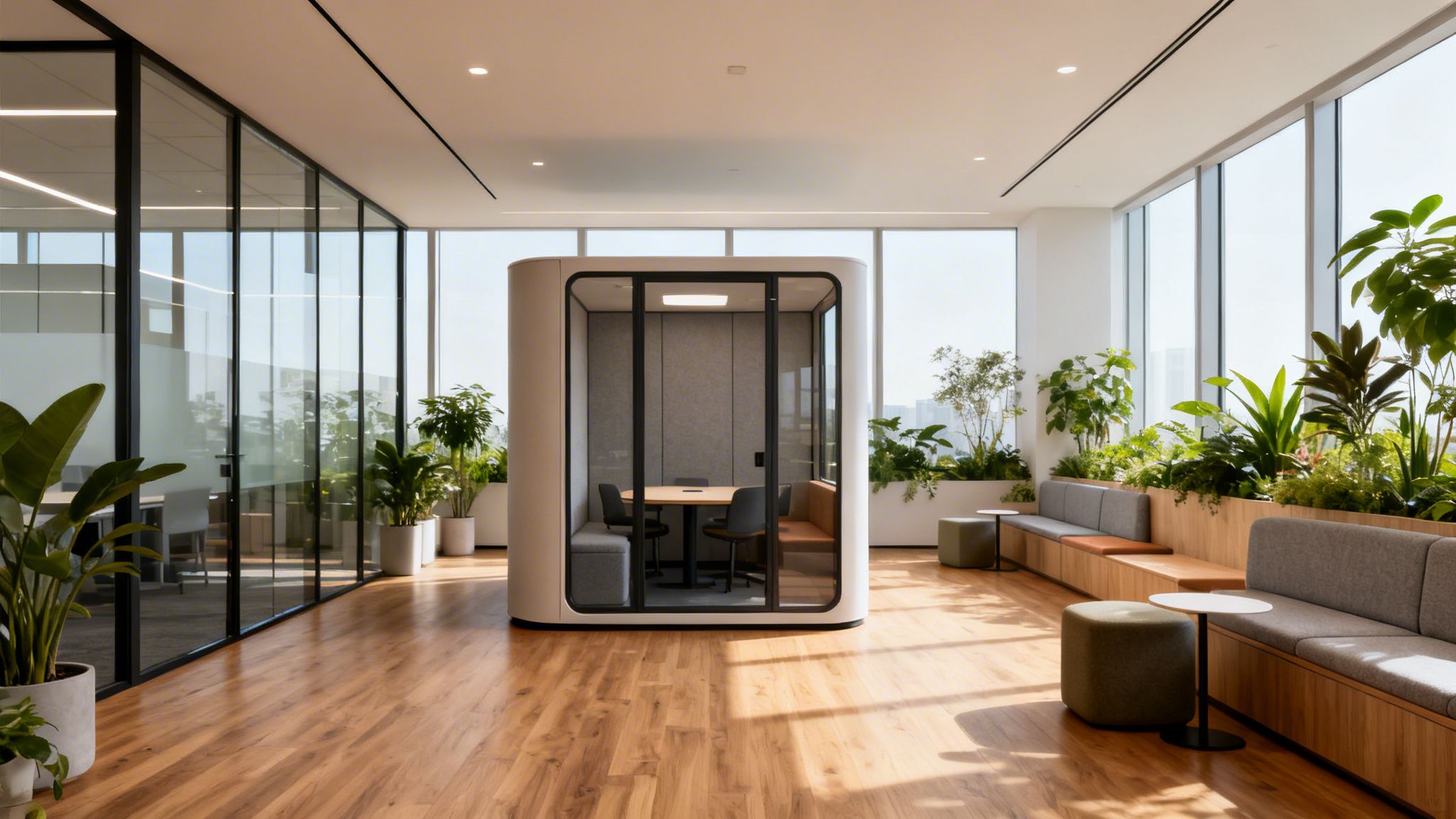
Open plan layouts are brilliant for fostering a sense of community, but they often fall short when it comes to noise control and privacy. This is where glass partitioning comes into its own. It’s the ideal compromise, allowing you to carve out separate offices and meeting areas without putting up solid walls that block light and connection.
This approach maintains a visual link across the floor, creating a culture of transparency while still providing the necessary acoustic separation for focused work or confidential chats. Sleek and modern, glass systems are a fantastic way to elevate the look and feel of your space.
The Power of the Pod
If you need pockets of true privacy within an open plan environment, modular meeting pods are nothing short of revolutionary. Think of them as self contained, acoustically sealed rooms that you can place almost anywhere, giving your team on demand quiet space.
They’re incredibly versatile and perfect for:
- Private phone or video calls: A quiet haven without disturbing the rest of the office.
- Intense focus work: A sanctuary from the ambient buzz when concentration is key.
- One-to-one meetings: A confidential setting for sensitive conversations.
Industry leaders like Vetrospace, Framery, and BlockO offer an incredible range of pods with outstanding acoustics and built in features. Integrating them is a smart, flexible way to solve the privacy puzzle.
Design with Different Zones in Mind
A truly successful office isn’t just one big room; it’s a collection of distinct environments, or ‘zones’, each tailored to a specific type of activity. This strategy, often called Activity Based Working, gives people the autonomy to choose the right setting for the task at hand.
You can create a vibrant mix of zones to support the entire workday:
| Zone Type | Purpose | Key Features |
|---|---|---|
| Quiet Zones | For deep concentration and individual work. | Acoustic panels, single desks, no phone call rules. |
| Collaborative Hubs | For brainstorming, teamwork, and group projects. | Whiteboards, large screens, flexible seating. |
| Social Areas | For relaxation, informal catch ups, and building culture. | Comfy sofas, coffee machines, games tables. |
This approach acknowledges a simple truth: no single desk setup can possibly support the diverse needs of a modern team.
Connect with Nature Through Biophilic Design
Never underestimate the profound impact of nature on our state of mind. Biophilic design is the practice of weaving natural elements into the workplace, think abundant live plants, natural materials like wood and stone, and maximising daylight.
The evidence is clear: this approach is proven to reduce stress, spark creativity, and improve overall wellbeing. From a growing tech hub in Milton Keynes to a corporate head office in Hertfordshire, it’s a simple yet powerful way to create a healthier, happier, and more productive workspace.
Ready to transform your workspace? Speak to the Gibbsonn Interiors team today.
Your Office Refurbishment Questions Answered
Considering an office refurbishment is a big step, and it’s completely normal for a lot of questions to pop up. It’s a significant project, after all. Having managed countless transformations across the UK, we’ve pretty much heard them all.
To help clear things up, we’ve put together straightforward answers to the queries we hear most often from clients.
How Long Does an Office Refurbishment Take?
This is the classic ‘how long is a piece of string?’ question, as the timeline really hinges on the scope of your project. A light, cosmetic refresh, think a new coat of paint and fresh carpets, can be turned around in as little as 2 to 4 weeks.
However, if you’re looking at a full CAT B fit out for a medium sized office, you’ll need to plan for a longer timeframe. The on site construction phase alone will likely take between 8 and 12 weeks. Crucially, that doesn’t account for the essential design and planning stages that happen long before a single tool is picked up.
Do I Need to Move My Staff Out During the Refurbishment?
Not necessarily. Many businesses we work with worry about the potential chaos and downtime, but with smart planning, you can often carry on working right through the project. We are experts at breaking down a refurbishment into carefully managed phases.
This means we can transform one section of your office at a time while your team carries on productively in another. For businesses in bustling areas like Dartford or anywhere in Essex, keeping the business running is non negotiable. A phased approach is one of the very first things we discuss to ensure your operations continue smoothly.
What Is the Difference Between a Refurbishment and a Fit-Out?
These two terms get thrown around a lot and are often used interchangeably, but there’s a subtle difference that’s good to know.
A refurbishment generally means breathing new life into an existing, occupied space. It’s all about improving and updating what you already have.
A fit out, on the other hand, usually involves taking a brand new, empty space, often just a concrete ‘shell’, and making it ready for you to move in. A CAT B fit out, for example, is the process that adds the meeting rooms, partitions, kitchen, and breakout zones that turn that empty shell into a workspace built just for you. In essence, a fit out is just one specific, and very common, type of refurbishment.
How Much Does a Refurbishment Cost?
The investment can vary widely, from around £40 per square foot for a simple refresh to more than £200 per square foot for a complex, high specification project. The final cost really depends on factors like your location, the quality of materials you choose, and the technical complexity of the work involved. For a more detailed look at how to plan your budget, check out our dedicated section on costs.
Ready to transform your workspace? Speak to the Gibbsonn Interiors team today.