
body { background-color: black; color: white; } h1, h2, h3, h4, h5, h6 { color: #164863; } a { color: white; }
Thinking about giving your office a new lease of life? It’s one of the best ways to boost team morale, sharpen productivity, and get your space working for the way we work now. Naturally, the first question on everyone’s mind is cost. An office refurbishment can range from a light refresh at around £70 per square foot to a complete, high-end transformation costing upwards of £300 per square foot.
The final number all comes down to the level of finish you’re aiming for.
Table of Contents
- Understanding 2026 Office Refurbishment Costs
- The Three Main Levels of Refurbishment
- Estimated 2026 Office Refurbishment Costs Per Square Foot
- What Really Drives Your Refurbishment Costs
- Budgeting by Square Foot vs Cost Per Person
- How to Create a Realistic Refurbishment Budget for 2026
- Smart Ways to Reduce Your Refurbishment Costs in 2026
- Common Questions About Office Refurbishment Costs for 2026
Understanding 2026 Office Refurbishment Costs
Budgeting for an office refurbishment is a bit like buying a car. You could go for a reliable, no-frills model that gets you from A to B, a comfortable mid-range option with a few welcome extras, or a top-of-the-line luxury vehicle packed with the latest tech. Each one serves a purpose, but they all come with very different price tags.
The same logic applies to your workspace. The cost of your project is tied directly to the specification you choose: the quality of the finishes, the ambition of the design, and how much new tech you want to weave into the fabric of the building.
The Three Main Levels of Refurbishment
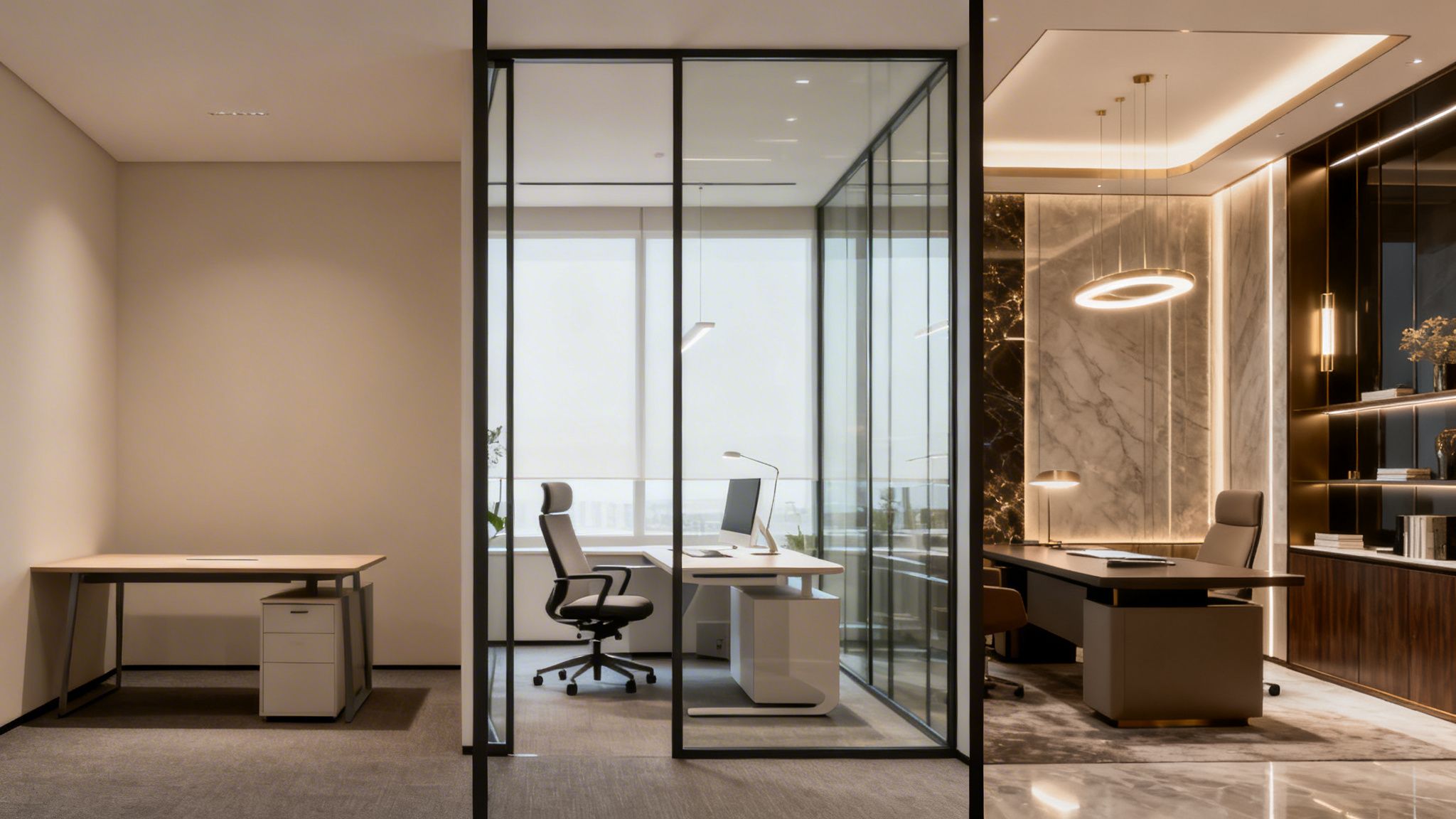
To give you a clearer picture of what to expect, we generally group projects into three main categories:
- Basic Refurbishment: This is a cosmetic-level update. Think a fresh coat of paint, new carpets, and perhaps some new, budget-conscious furniture. It’s a very cost-effective way to breathe new life into a tired space without major structural changes.
- Mid-Range Refurbishment: This is the most common path our clients take. It involves more noticeable changes, like installing new partition walls, upgrading to better lighting, investing in quality ergonomic furniture, and creating a brand-new kitchen or breakout area.
- High-Spec Refurbishment: This is a complete transformation from the ground up. It often includes premium materials, bespoke joinery, advanced AV and smart building technology, and significant upgrades to the mechanical and electrical (M&E) systems.
To give you a baseline, here’s a quick look at the average costs for each level.
Estimated 2026 Office Refurbishment Costs Per Square Foot
This table provides a quick look at the average costs for different levels of office refurbishment, giving you a baseline for your budget.
| Refurbishment Level | Average Cost (per sq ft) | What It Typically Includes |
|---|---|---|
| Basic (Light Touch) | £70 – £110 | New carpets, full redecoration, new lighting, and some basic furniture. |
| Mid-Range | £110 – £170 | Everything in a basic refresh, plus new partitions, better quality furniture, and a new tea point or kitchen. |
| High-Spec | £170 – £300+ | A full strip-out and redesign, bespoke joinery, high-end finishes, M&E upgrades, and advanced technology. |
These figures give you a solid starting point for a conversation about what’s achievable.
“Understanding these different levels is the first step in creating a realistic budget. It helps you align your ambitions with your available investment, ensuring there are no surprises down the line.”
From a simple spruce-up to a complete overhaul, every great project begins with a clear vision. A well-managed design and build approach is what ensures your budget is used effectively to create a space that truly works for your business. Defining your goals early on is the key to successfully managing your office refurbishment costs.
What Really Drives Your Refurbishment Costs
So, where does the money actually go when you refurbish an office? It’s not just one single expense but a blend of different elements. Getting a firm grip on these moving parts is the first step toward building a budget that works and, crucially, avoiding nasty surprises later on.
Think of it like building a custom car. The final price depends on the size of the chassis (your office footprint), how ambitious the design is (a simple runaround versus a high-performance machine), and the quality of the parts themselves (standard components versus bespoke, high-end ones). Your office project is no different.
When it comes down to it, the biggest things that shape your total refurbishment cost are the physical changes you make, the quality of the finishes you choose, and the technical systems you need to install or bring up to scratch.
Structural Changes and Layout
The single biggest cost driver, without a doubt, is the extent of physical changes you make to the space itself. A simple cosmetic refresh with new paint and carpets will always be on a different financial planet than a project that involves gutting and reconfiguring the entire floor plan.
Here’s where the costs can really start to climb:
- Partitions: Building new walls to create private offices, meeting rooms, or quiet zones is a major line item. Glass partitions, while fantastic for letting light flood through the space, will naturally cost more than traditional plasterboard.
- Flooring: Stepping up from standard carpet tiles to materials like engineered wood, luxury vinyl tile (LVT), or polished concrete will push the budget higher.
- Ceilings: Installing a new suspended ceiling or stripping everything back to expose the services for that raw, industrial aesthetic involves significant work.
- Bespoke Joinery: Custom-built reception desks, feature storage, or unique kitchen fittings add a real wow factor but carry a premium over off-the-shelf furniture.
The level of finish you specify for these elements has a huge say in the final number. A high-spec project in a city like London with premium finishes will have a much higher per-square-metre cost than a basic update.
Mechanical and Electrical (M&E) Works
Often hidden out of sight behind walls and in ceiling voids, your Mechanical and Electrical (M&E) systems are the unsung heroes of a great office and a serious cost consideration. These are the systems that keep your workspace comfortable, safe, and fully operational.
Major M&E costs often include:
- HVAC Systems: Upgrading or installing new heating, ventilation, and air conditioning is a substantial investment. This is particularly true if you’re adding modern fresh air systems to meet today’s wellbeing standards.
- Electrics and Data: If you change the layout, you’ll need new power sockets, data points for IT equipment, and updated wiring to handle your team’s tech demands.
- Lighting: Shifting from basic fluorescent panels to a modern LED lighting scheme or a smart control system can be a big ticket item, but it pays you back in long-term energy savings.
- Fire and Security: This is non-negotiable. Upgrading fire alarm systems and security access control to meet current regulations is an essential expense for compliance and safety.
These technical upgrades are what transform a space from just four walls into a modern, compliant workplace that actually supports productivity and employee wellbeing.
Furniture and Professional Fees
Once the construction dust has settled, furniture often emerges as one of the biggest single investments in an office refurbishment. This isn’t just desks and chairs; it covers everything from breakout area sofas to canteen tables and storage solutions.
Investing in your team’s health with high-quality ergonomic chairs and height-adjustable desks will cost more upfront than basic options, but it’s an investment that pays dividends. Similarly, installing flexible modular pods from specialists like Vetrospace provides incredible flexibility but represents a different level of cost compared to a traditionally built meeting room.
Finally, don’t let professional fees catch you by surprise. Your budget needs to account for designers, project managers, and any building control applications. These experts are essential for making sure your project is well-planned, legally compliant, and delivered smoothly. From our experience, we find that many businesses in areas like Hertfordshire really value having a single point of contact to manage all these moving parts.
Budgeting by Square Foot vs Cost Per Person
When you start putting numbers to your office refurbishment, you’ll quickly come across two main ways to approach the budget. You can calculate it based on the size of the space, which we call cost per square foot, or by the number of people who will be using it, known as cost per person. Both metrics are incredibly useful for painting a clear picture of your potential investment.
Thinking in square feet helps you get a firm grip on the construction and material costs tied directly to the physical footprint. On the other hand, framing it as a cost per person reframes the project as an investment in your team’s productivity and wellbeing. A growing business in Essex might find one more compelling than the other, depending on its immediate goals.
Calculating Cost Per Square Foot
Budgeting by square foot is the industry standard and by far the most common way to get a quick, reliable estimate. It’s a straightforward approach that links the cost directly to the physical size of your office. A simple cosmetic refresh will, of course, be a fraction of the cost of a full structural refit with high-end finishes.
Let’s put it into practice. A 10,000 sq ft office undergoing a mid-range refurbishment at £140 per sq ft would land you with a total budget of around £1.4 million. This figure gives you a solid, tangible number to work with for initial planning and financial forecasting.
It’s a simple calculation that scales easily, whether you’re looking at a small satellite office or a sprawling corporate headquarters. It also makes it much easier to compare quotes and understand how different choices in specification will directly affect your overall office refurbishment costs.
The infographic below shows the three main cost drivers that will influence your final per-square-foot figure: the level of finish, the quality of materials, and the amount of new furniture required.
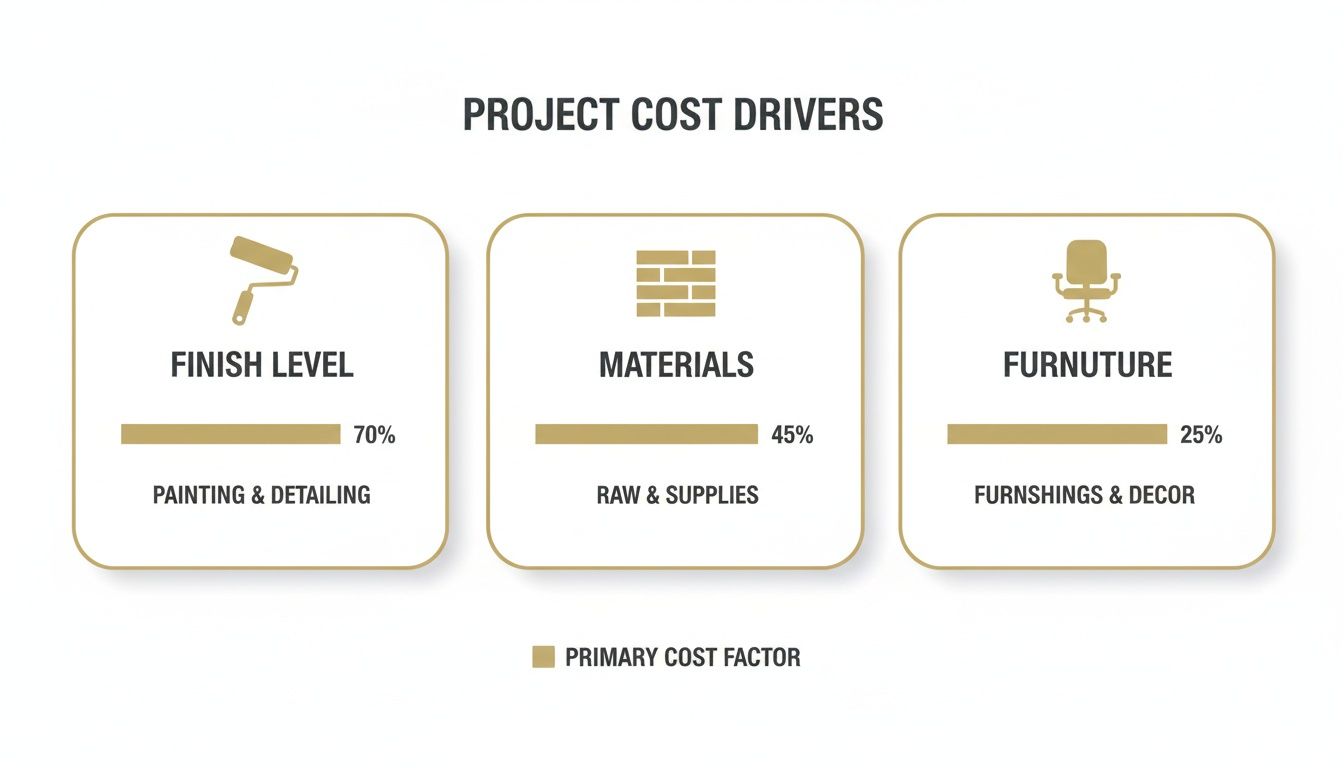
As you can see, these three elements are the biggest levers you can pull to manage your budget effectively.
The Cost Per Person Approach
Another powerful way to look at your budget is to divide the total cost by the number of employees. This method often feels more relatable, as it connects the investment directly to the people who will benefit most from the new space. It shifts the focus from a purely construction-based project to an investment in your company’s most valuable asset: its people.
If that same £1.4 million project was for an office of 100 employees, the cost per person works out to be £14,000. Thinking about it this way helps justify spending on vital elements like ergonomic furniture or improved wellness facilities. The return on investment here comes from improved staff retention, comfort, and productivity. This is especially powerful when making the business case for the project to stakeholders.
“Framing the budget as a ‘cost per person’ helps leadership see the refurbishment not just as an expense, but as a direct investment in team performance and satisfaction. It changes the entire conversation.”
Sample 2026 Budgets by Office Size
To bring all this to life, let’s explore how these figures translate into real-world budgets. The table below gives you a clearer picture of how specification levels impact total costs for different sized offices. This provides a practical starting point, whether you’re planning a project in a busy hub like Bishop’s Stortford or a quieter commercial park.
Sample Budgets by Office Size and Specification Level
See how different budgets translate into real-world projects for small, medium, and large offices.
| Office Size (sq ft) | Specification Level | Estimated Total Cost |
|---|---|---|
| 2,500 sq ft | Basic | £175,000 – £275,000 |
| 2,500 sq ft | Mid-Range | £275,000 – £425,000 |
| 2,500 sq ft | High-Spec | £425,000+ |
| 10,000 sq ft | Mid-Range | £1,100,000 – £1,700,000 |
| 20,000 sq ft | High-Spec | £3,400,000 – £6,000,000+ |
These examples should give you a good foundation for your initial budget discussions. Of course, every project is unique, and the final figure will depend on your specific vision and requirements.
How to Create a Realistic Refurbishment Budget for 2026
Thinking about an office refurbishment budget can feel like staring at a blank spreadsheet, but it doesn’t have to be intimidating. Getting the numbers right from the very beginning is the single best way to keep your project on track and avoid costly surprises down the line.
Believe it or not, the most critical first step has nothing to do with numbers at all. It’s all about your core motivation.
Start With Your Why
Before you even think about square metres or furniture costs, you need to be crystal clear on one thing: why are you doing this? Defining your main objectives is the foundation of your entire project, shaping every decision and justifying every pound spent.
Is your primary goal to…
- Increase headcount? Your budget will naturally lean towards clever space planning and high-density layouts to accommodate a growing team.
- Improve team wellbeing? You’ll want to earmark funds for biophilic design, quiet zones, breakout spaces, and high-quality ergonomic furniture.
- Update your brand image? The focus shifts to high-impact finishes in client-facing areas, bespoke joinery, and new branding elements.
- Support hybrid working? This means prioritising investment in hot-desking software, smart meeting room booking systems, and top-tier video conferencing tech.
Pinpointing your ‘why’ gives you a compass. It ensures your budget is channelled towards what truly matters for your organisation’s future, preventing money from being wasted on features that don’t serve the main goal.
Analyse Your Space and Needs
With clear objectives in place, it’s time to get practical. The first thing you need is an accurate measurement of your office’s total square footage. This is the baseline figure all initial cost estimates will be built upon.
Next, it’s time for a proper needs analysis. This is simply a deep-dive into what you currently have versus what you really need to achieve your goals. Create a wishlist of every single element you’d like to see in the new space. Don’t hold back or worry about costs at this stage; just get it all down on paper.
Your wishlist might include things like:
- New partitions (glass, solid, or acoustic)
- Flooring (e.g., carpet tiles, LVT, wood)
- Suspended ceilings and modern lighting
- Decoration, signage, and branded graphics
- A new kitchen or breakout tea points
- Washroom and WC upgrades
- All new furniture (desks, chairs, storage, soft seating)
- IT infrastructure and audio-visual equipment
- Mechanical and electrical upgrades (like air conditioning or ventilation)
This list becomes your project scope. Armed with this, you’re ready to have far more productive and meaningful conversations with potential design and build partners.
The All Important Contingency Fund
From our experience, no matter how meticulously you plan, refurbishments can uncover a few surprises. You might strip back a wall to find outdated wiring, or discover a structural quirk that wasn’t on any of the original building plans. This is exactly what a contingency fund is for.
As a rule of thumb, we always advise clients to set aside 10-15% of the total project cost for this very purpose. On a £200,000 project, that’s a £20,000 to £30,000 buffer. This isn’t ‘spare cash’; it’s an essential component of any robust budget.
“A contingency fund acts as a safety net. It protects your project from delays and ensures you can deal with surprises without having to compromise on the quality of the final result.”
Having this financial cushion gives you peace of mind, allowing you to tackle unforeseen office refurbishment costs without derailing the project or being forced into making painful cuts elsewhere.
Get Detailed Quotes
Once your wishlist is complete, you can begin reaching out to potential partners for quotes. Insist on getting a detailed, itemised breakdown rather than a single lump sum. A credible partner will provide a transparent quote that clearly separates the costs for labour, materials, furniture, and any professional fees.
This level of detail is non-negotiable. It empowers you to properly compare proposals, understand exactly what is and isn’t included, and see precisely where your investment is going. With this structured approach, any business, whether in a quiet corner of Hertfordshire or a busy hub like Cambridge, can take control of its budget.
Smart Ways to Reduce Your Refurbishment Costs in 2026
An ambitious office transformation doesn’t have to break the bank. With some forward thinking and a few smart decisions, you can keep a firm handle on your office refurbishment costs without sacrificing the quality or impact of the final space.
It really comes down to making choices that deliver the biggest bang for your buck. Whether you’re a startup or an established firm, every business can benefit from squeezing more value out of its budget.
Consider a Phased Approach
One of the best ways to make a large-scale project more digestible is to not do it all at once. A phased refurbishment simply means breaking the project down into smaller, self-contained stages that you tackle over time. This brings two massive advantages.
First, it lets you spread the cost over a longer period, which is much kinder to your cash flow. You could focus on the client-facing reception area in year one, for example, and then move on to upgrading the main workspace in year two. Second, it keeps disruption to a minimum, allowing your team to carry on working as we complete one area at a time.
“A phased project is a brilliant strategy for achieving your long-term vision without the financial pressure of a single, large-scale investment. It’s about being strategic and patient.”
Reuse and Repurpose What You Already Have
Before you allocate a huge slice of your budget to brand-new furniture, take a proper look around at what you’ve already got. You’d be surprised how often existing desks, storage units, and chairs are perfectly functional and just need a bit of a facelift.
A few simple changes can make a world of difference:
- Reupholstering: That tired-looking breakout sofa can be completely transformed with fresh, modern fabric for a fraction of the cost of a new one.
- Respraying: Metal filing cabinets or desk legs can be professionally resprayed to perfectly match your new colour scheme.
- Creative Rearranging: Sometimes, just moving furniture to create new zones and layouts can completely change the atmosphere of a space without costing a single penny.
This sustainable mindset doesn’t just cut down on waste; it frees up a significant chunk of your budget. You can then reinvest that money into high-impact areas that truly need a complete overhaul.
Choose Value-Driven Solutions
Keeping costs down isn’t about picking the cheapest option. It’s about finding clever alternatives that offer fantastic value and long-term durability.
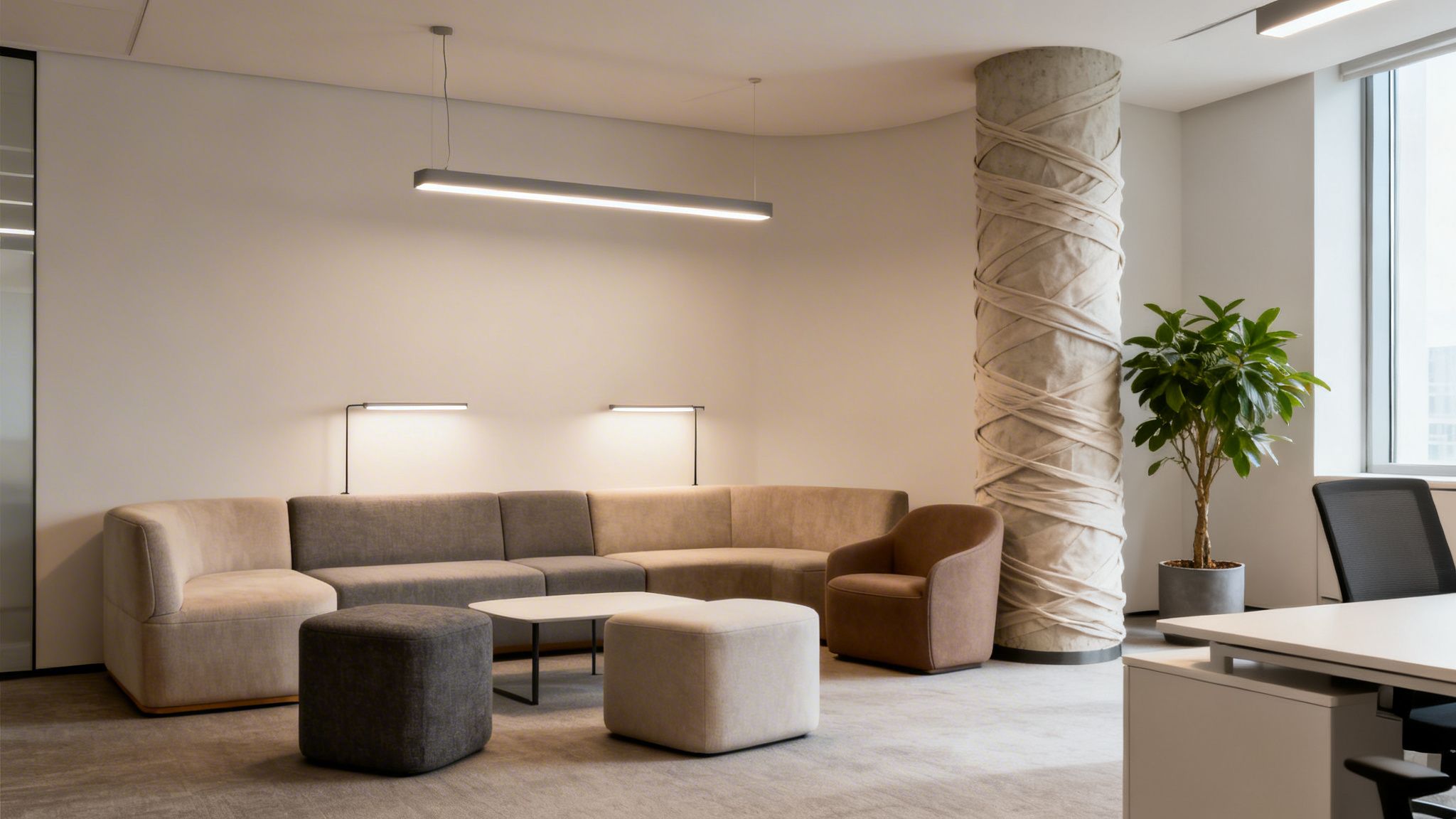
Architectural wrapping, for instance, is a complete game-changer. These high-quality vinyl films can be applied to almost any surface, completely updating the look of old doors, walls, or reception desks for far less than the cost of replacing them.
Likewise, opting for high-quality carpet tiles instead of broadloom carpet means that if one small area gets stained or damaged, you only have to replace a single tile, not the entire floor. Thinking strategically about these choices is the key to long-term value, which is why we’ve put together a guide on effective procurement in construction.
With your budget locked in and a vision taking shape, you’re on the home stretch. But before a single wall comes down or a new desk is assembled, there are a few final, crucial checks to run through. Think of this as the last line of defence: a to-do list that protects you from surprise legal snags and ensures the workspace you’re building today is one you’ll still love years from now.
Understand Your Lease Agreement
If you’re renting your office, your lease agreement is arguably the most important document in this entire process. Before you make a single change, you need to get intimately familiar with two key parts: the clauses on alterations and the rules around dilapidations.
Most commercial leases are very specific about what changes you can and cannot make. Getting your landlord’s consent in writing before any work starts isn’t just good manners; it’s a legal requirement. Skipping this step can land you in some serious hot water, from disputes to hefty financial penalties.
Then there’s the matter of dilapidations. This is your legal duty to return the property to its original state when your lease is up. It might feel a long way off, but planning for it during your refurbishment is one of the smartest things you can do.
“By documenting all changes and keeping dilapidations in mind from day one, you can save yourself a huge amount of money and stress when it’s time to move out.”
Thinking about the end at the beginning is what stops your refurbishment costs from coming back to haunt you. We break this down even further in our office refurbishment checklist for 2026.
Agree on Timelines and Minimise Disruption
A clear, realistic timeline is your project’s backbone. It maps out when each stage will be finished and, crucially, gives you that all-important final handover date. This allows you to plan your business operations around the work and keep your team in the loop.
This is where having a single turnkey partner really proves its worth. When one company is managing everything from the initial designs to the final build, you get a single point of contact and total accountability. This approach cuts through the noise and dramatically reduces the risk of the delays and miscommunications that often happen when you’re trying to coordinate multiple contractors.
Future-Proof Your Office Design for 2026 and Beyond
Finally, it’s vital to think beyond your immediate needs. The world of work is always shifting, so creating a space that can evolve with you is just common sense. Future-proofing your design isn’t about predicting the future; it’s about making smart choices now that give you freedom and flexibility later.
This could mean a few things in practice:
- Investing in movable pods: Instead of building permanent meeting rooms, using flexible acoustic pods from brands like Framery or BlockO means you can reconfigure your layout with minimal fuss as your teams grow and change.
- Installing a raised access floor: This creates a hidden void under the floor for all your power and data cabling. It makes moving desks, adding workstations, or changing layouts in the future incredibly simple.
- Choosing modular furniture: Furniture systems that can be easily reconfigured or added to give you the power to adapt your space without needing another major fit-out.
Putting in the thought at this final stage is what separates a good refurbishment from a great one. It’s how you turn a simple project expense into a powerful, long-term investment in your company’s success.
Common Questions About Office Refurbishment Costs for 2026
Embarking on a workspace refurbishment is an exciting prospect, but we know it comes with a lot of questions. To help you build a clear picture from the outset, we’ve put together answers to some of the most common queries we hear from clients as they start planning their project.
How Long Does An Office Refurbishment Take?
Honestly, there’s no single answer to this. The timeline really hinges on the scale and complexity of what you want to achieve.
A light, cosmetic touch-up in a smaller office, think new paint and carpets, can be wrapped up in just 2 to 4 weeks. But for a major overhaul, like a complete strip-out and Cat B fit out for a mid-sized office around 5,000 sq ft, you’re looking at a more realistic timeframe of 8 to 12 weeks for the on-site works.
And don’t forget about the crucial planning phase! It’s vital to factor in an extra 4 to 8 weeks before any tools are picked up. This time is essential for finalising designs, gathering quotes, ordering materials, and securing any necessary landlord or building control approvals.
What Is The Difference Between Cat A and Cat B Fit Out?
You’ll hear these terms thrown around a lot in the industry, so it’s worth getting to grips with what they really mean.
“Think of a Cat A fit out as the landlord preparing a blank canvas. A Cat B fit out is what turns that canvas into your unique workspace.”
A Category A (Cat A) fit-out is the basic shell provided by the landlord. It creates a functional but empty space, typically including essentials like raised floors, suspended ceilings, and the core mechanical and electrical services.
A Category B (Cat B) fit-out is where we step in to bring your vision to life. This is the bespoke stage, where we install everything that makes the office yours: from meeting room partitions and unique flooring finishes to all your furniture, branding, and kitchen or tea point areas.
Can We Stay In The Office During The Refurbishment?
Absolutely. In many situations, it’s perfectly possible for you to remain operational during the project. We manage this through a carefully planned phased refurbishment.
Working closely with your team, we’ll break the project down into manageable stages. We can complete work in one section of the office while your staff carry on their duties in another. Once a phase is finished, your team moves into the newly refurbished area, and we start on the next. It’s a fantastic way to keep your business running with minimal disruption, a top priority for our clients in busy hubs like Chelmsford.
Ready to transform your workspace? Speak to the Gibbsonn Interiors team today.