
Table of Contents
- Why Your Office Layout Is More Than Just Desks and Chairs 2026
- Your Blueprint for a Successful Office Design 2026
- Designing a Workspace That Puts People First 2026
- Future-Proofing Your Office for Adaptability and Growth 2026
- Navigating the Practical Side of an Office Redesign 2026
- Common Questions About Designing an Office Layout 2026
Designing an Office Layout to Boost Productivity 2026
A great office layout is about more than just arranging desks. It’s about crafting a space that boosts productivity, reflects your brand, and makes your staff genuinely want to come to work. Think of it as a strategic plan that considers workflow, company culture, and employee wellbeing to build a truly functional and inspiring environment.
Why Your Office Layout Is More Than Just Desks and Chairs 2026
Let’s be honest, a great office is more than just a place to plug in a laptop; it’s a reason to make the commute. In 2026, designing an office layout has moved far beyond simply fitting everyone in. The real challenge is creating a destination that supports how your team actually works, blending focused quiet zones with energetic hubs for collaboration.
This guide is your practical roadmap to making that happen. We’ll skip the jargon and give you a straightforward, hands-on look at how to translate your team’s needs into a physical space that delivers.
The Modern Workplace: A Commute-Worthy Destination
Hybrid working has completely changed the game. Today, the office needs to offer something people can’t get at home. It’s no longer just a requirement; it’s a powerful tool for attracting and retaining the best talent.
In fact, with a significant 26% decline in UK commuting between 2019 and 2022, the pressure is on to create ‘commute-worthy’ spaces that truly justify the journey. You can explore more on modern office furniture trends to see how this is shaping the market.
Whether you’re planning a full office refurbishment in Bishop’s Stortford or just reconfiguring a smaller space in Essex, the principles are the same. You need a layout that is flexible, engaging, and supportive of your unique company culture.
The benefits of thoughtful workplace design are huge, impacting everything from staff morale right through to your bottom line. To get there, we need to focus on a few key areas which we’ll explore in detail throughout this guide.
Here’s a quick look at the core principles we will cover to help you design a successful office layout for 2026 and beyond.
| Key Focus Areas for Modern Office Layout Design | Why It Matters |
|---|---|
| Brief & Requirements | The foundation for a design that meets real business needs. |
| Space Planning & Zoning | Creates dedicated areas for different types of work. |
| Ergonomics & Wellbeing | Supports employee health, comfort, and focus. |
| Flexibility & Future-Proofing | Ensures your space can adapt as your business grows. |
Getting these elements right is the secret to creating a workspace that not only looks great but performs brilliantly for your team and your business. Let’s dive in.
Your Blueprint for a Successful Office Design 2026
A great office layout doesn’t just happen. It’s not about picking out cool furniture or trendy paint colours. It starts much, much earlier, with a solid plan that’s built around how your team genuinely works, day in and day out. Get this foundation right, and you’ll create a workspace that actually helps your business thrive.
The very first thing you need is a detailed brief. This isn’t just a shopping list of desks and chairs; it’s a deep dive into what your business really needs. This means getting out there and talking to your people. You need to understand their daily grinds, what drives them mad about the current setup, and what would genuinely make their working lives better.
“The biggest mistake is designing a space based on assumptions. A layout that looks perfect on paper can fail completely if it doesn’t match the way your people actually collaborate and focus.”
Choosing the Right Space Model
Once you’ve got a real handle on what your team needs, you can start thinking about the kind of layout that will actually support them. There’s no single “best” option here; what works for a creative agency will be a disaster for a law firm. It’s all about weighing up the pros and cons.
Here’s a quick rundown of the most common styles to get you started.
| Layout Type | Best For | Potential Downsides |
|---|---|---|
| Open-Plan | Teams needing high levels of collaboration and communication. | Can be noisy and distracting for focused work. |
| Cellular Office | Roles requiring privacy, confidentiality, and deep concentration. | Can feel isolating and limit spontaneous teamwork. |
| Hybrid/Agile | Businesses with varied work styles and flexible attendance. | Requires careful planning to avoid feeling empty or crowded. |
For many businesses today, especially those here in Hertfordshire, a hybrid model often hits the sweet spot. It’s about giving people choice and variety, blending spaces for collaboration with areas for quiet concentration.
Smart Zoning and Flow
With a layout model in mind, the next step is to carve out distinct zones for different activities. This isn’t about throwing up walls everywhere. It’s about creating clear, purposeful areas that guide how the space is used.
Think about creating:
- Focus Zones: Quiet corners with single desks or pods for heads-down, uninterrupted work.
- Collaboration Hubs: Open areas with whiteboards and flexible seating where teams can brainstorm and bounce ideas around.
- Social Spaces: A comfy kitchen or breakout area that encourages those informal chats where real connections are made.
- Meeting Rooms: Proper enclosed spaces for private conversations and client presentations.
This simple flow chart captures the essence of the process, from understanding your team’s real needs to planning a layout that truly supports their wellbeing.
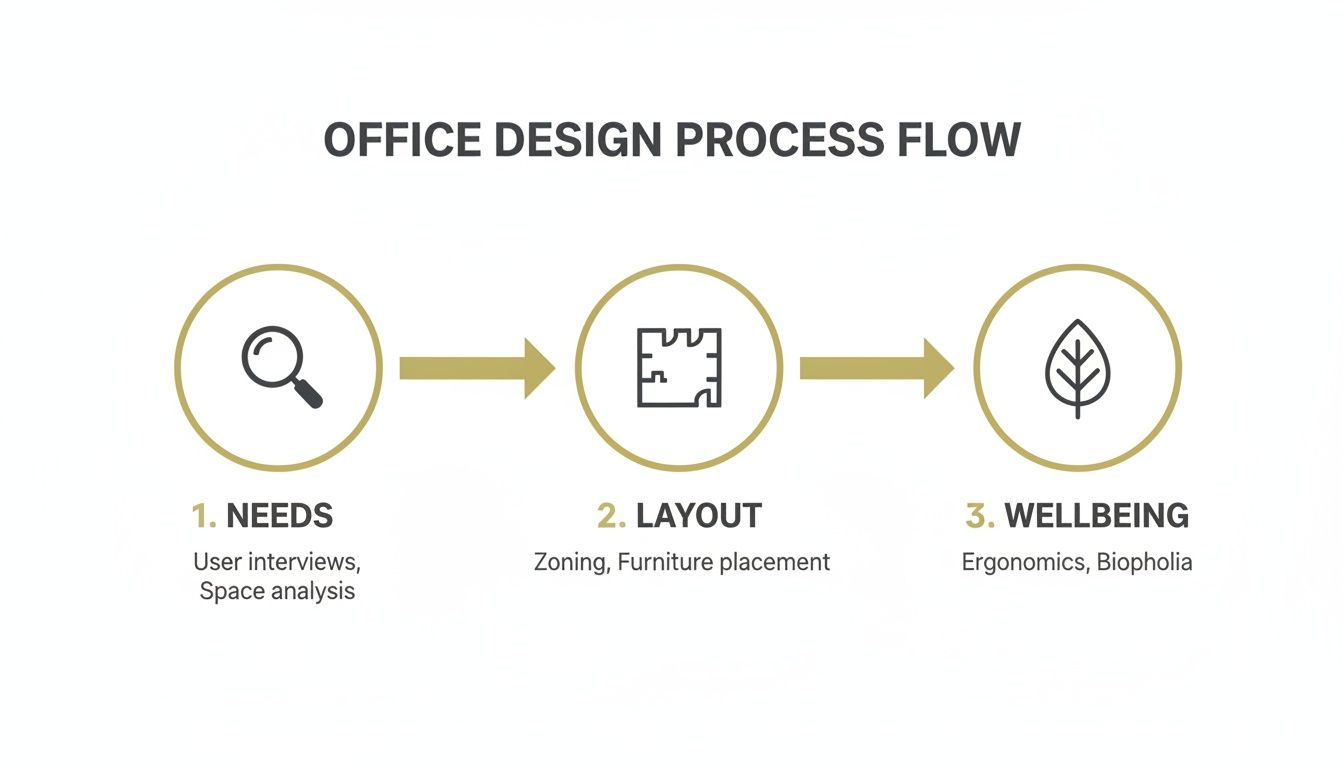
Starting with a deep dive into how your people work ensures every design choice, from the layout to the wellbeing features, is genuinely useful. It’s about building a functional space from the ground up.
Planning for Productivity
Finally, think logically about which teams need to be near each other. It’s often called ‘adjacency planning’, but it’s really just common sense. It makes perfect sense to put your sales and marketing teams close together, while the finance team will probably thank you for a quieter spot away from all the buzz.
This kind of strategic thinking is reshaping the UK office market. A conventional office now averages 150-200 square feet per employee, but a cleverly designed hybrid layout can slash that space requirement by up to 50%. For a business in a competitive market like London, this can translate into annual savings of up to £8,500 per employee.
By carefully working through these foundational steps, you’re not just creating a place to work. You’re designing an office layout that becomes a strategic asset for your business. For a more detailed look into this, check out our guide on effective office floor planning for 2026.
Designing a Workspace That Puts People First 2026
A truly great office layout isn’t just about looks; it’s about how it feels to work there. It’s a space where your team feels comfortable, supported, and can get on with their best work without fighting against their environment. This is the heart of human-centric design, and it’s all in the details that make a massive difference to daily office life.
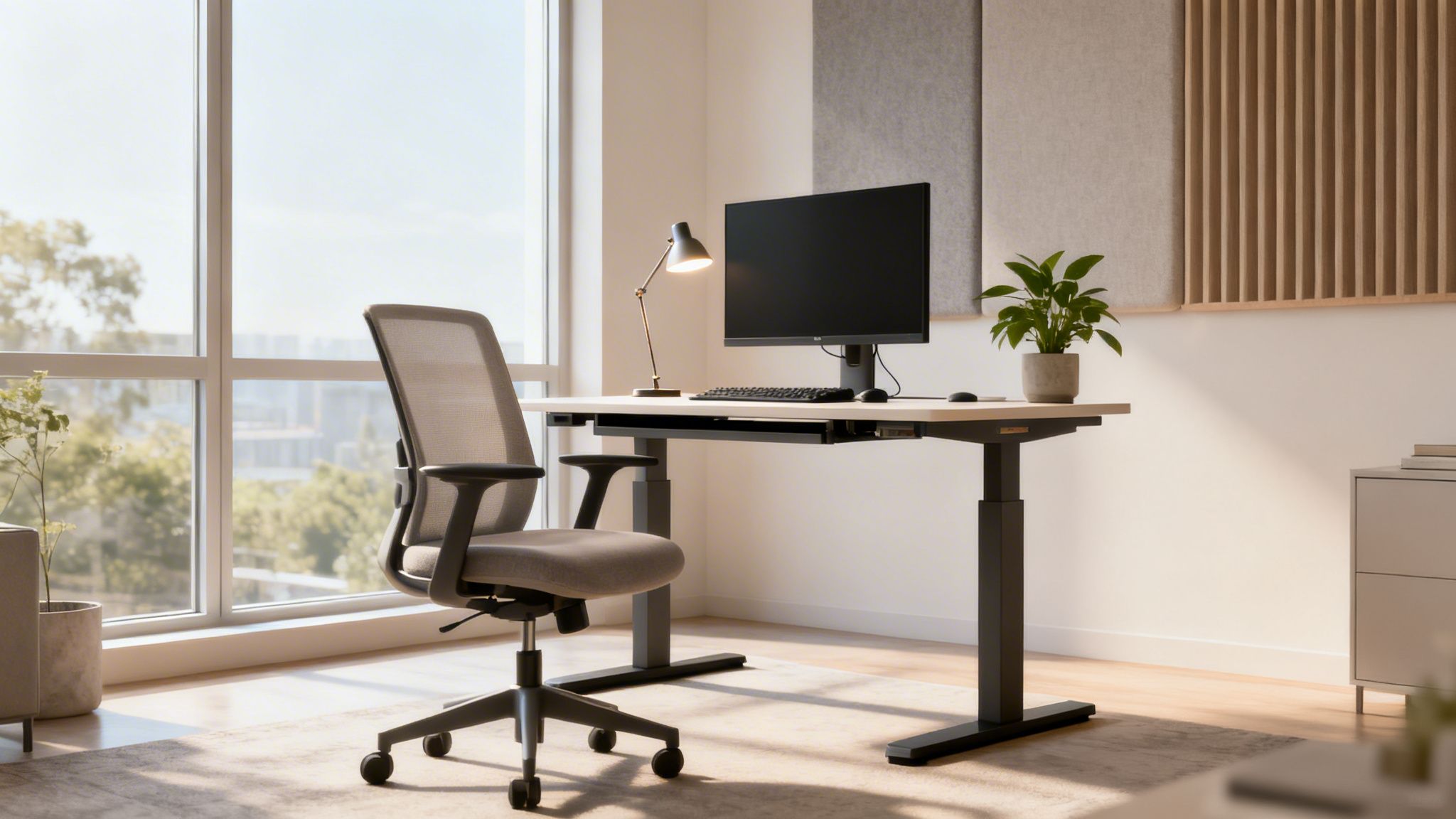
It all begins with ergonomics. So many people hear that word and just think of expensive chairs, but it’s much more than that. Proper ergonomic design means creating entire workstations that promote good posture, cut down on physical stress, and reduce the risk of those all-too-common aches and pains. We’re talking desk height, monitor position, and simply having enough room to move without feeling cramped.
Ergonomics: The Foundation of Comfort and Productivity 2026
It’s simple, really. When your team is physically comfortable, they’re more focused and productive. A poorly set-up workstation inevitably leads to back pain, eye strain, and general fatigue, which kills both performance and morale.
Good ergonomic practice boils down to a few key things:
- Adjustable Furniture: A good chair with lumbar support and adjustable height is non-negotiable. Sit-stand desks are also a game-changer, giving people the freedom to change their posture during the day.
- Correct Screen Placement: Monitors need to be at eye level to stop people hunching over. A good rule of thumb is that the top of the screen should be level with your eyes and about an arm’s length away.
- Supportive Accessories: Don’t underestimate the little things. Keyboard trays, footrests, and monitor arms might seem like minor extras, but they allow for a truly personalised setup that supports each person’s needs.
For any business, especially those in growing hubs like Braintree, investing in ergonomics isn’t a luxury. It’s fundamental to designing an office layout that keeps your team healthy and happy for the long haul.
Let There Be Light: The Power of Good Lighting 2026
Lighting is one of the most powerful, and often overlooked, tools in an office designer’s kit. The right light can lift moods, boost energy, and sharpen concentration. The wrong light? It’s a fast track to headaches and fatigue.
Natural light is the absolute gold standard. Study after study shows that daylight just makes people happier and more alert. So, the goal is always to maximise it. This could mean arranging desks near windows or swapping solid walls for glass partitions to let light flow deeper into the space.
“Never underestimate the psychological impact of a bright, airy space. Natural light connects us to the outside world and has a proven positive effect on wellbeing.”
Of course, you’ll always need artificial light, too. The trick is to create a layered system you can adapt for different tasks and times of day. A solid strategy usually includes:
| Lighting Type | Purpose |
|---|---|
| Ambient Lighting | This is your general, overall light. It needs to be bright enough for comfort, but never harsh. |
| Task Lighting | These are focused lights for specific workstations, like a desk lamp, to cut down on eye strain. |
| Accent Lighting | Use this to highlight architectural features or company branding, adding a bit of character to the space. |
Tackling Noise: The Acoustic Challenge 2026
Ask anyone in an open-plan office what their biggest frustration is, and I’d bet good money they’ll say “the noise.” The constant chatter, ringing phones, and general background hum are massive distractions that can completely shatter concentration.
Managing acoustics is absolutely essential when designing an office layout. You can start by using soft materials like carpets, acoustic wall panels, and high-backed sofas to absorb sound. Clever zoning also helps, keeping the noisy, collaborative areas well away from the quiet focus zones.
For true peace and quiet, though, office pods are a brilliant solution. Brands like Framery and Vetrospace offer self-contained, soundproof pods that you can just drop into an open-plan layout. They create genuinely private spaces for important calls or an hour of deep, uninterrupted work. It’s the best of both worlds.
Future-Proofing Your Office for Adaptability and Growth 2026
Your business isn’t static, so why should your office be? From experience, I can tell you that a truly smart office layout is one that can grow and change right alongside your team. It avoids the need for a costly, disruptive overhaul every few years.
This forward-thinking approach is all about building in adaptability from day one. It means moving away from fixed walls and heavy, permanent furniture. Instead, you create a space that’s light, agile, and ready to be reconfigured at a moment’s notice.
Embracing Flexibility in Office Design 2026
A flexible office is built on elements that can be easily moved, rearranged, and repurposed. This puts the power back in your hands, letting you create new zones and change your layout without calling in the builders.
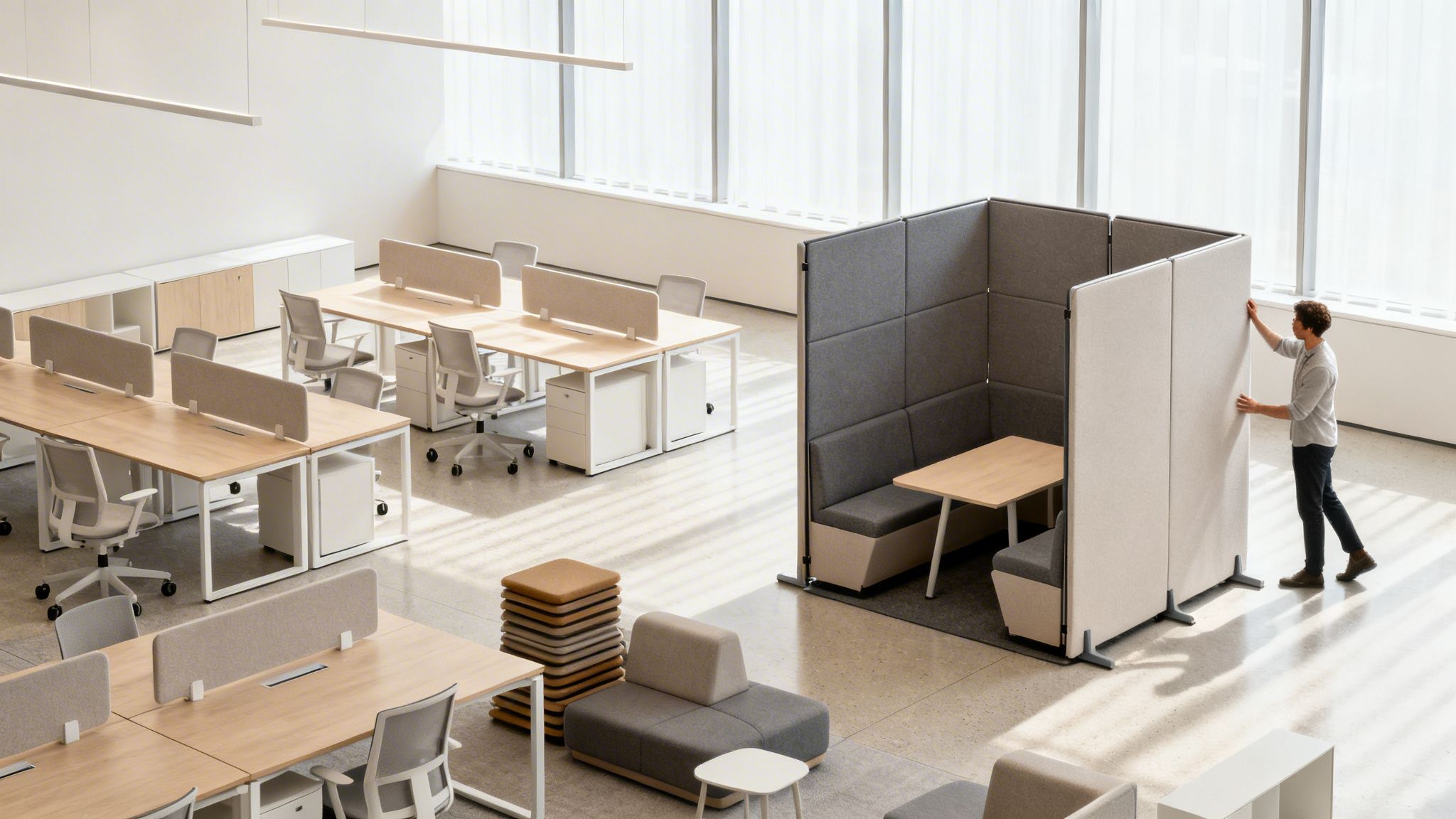
The real stars of the show here are modular furniture and movable partitions. They give you incredible control over your space.
- Modular Seating: Think sofas and chairs that can be separated and reconnected. This allows you to create small, intimate meeting spots one minute, and larger, open social areas the next.
- Movable Desks: Lightweight desks on castors are a game-changer. They can be quickly grouped for a team project and then separated again for individual focus work.
- Acoustic Screens: These movable partitions don’t just divide a space visually; they help manage noise, creating temporary quiet zones within a larger open-plan area.
This kind of agility is invaluable. A space that functions as a training room in the morning can easily become a collaborative project hub in the afternoon. It’s a core principle when designing an office layout that needs to keep up with the pace of modern work. For a closer look at the possibilities, you can learn more about the versatility of modular office furniture in our dedicated guide.
Planning Ahead for Growth and Tech 2026
Future-proofing isn’t just about furniture; it’s also about planning for the things you can’t see. Your team will hopefully grow, and your technology will definitely change. A good layout anticipates these needs right from the start.
When it comes to team growth, think in terms of zones rather than just individual desks. By creating flexible team areas, you can easily accommodate new starters without having to reshuffle the entire office. A well-designed layout has that extra capacity built right in.
Your tech infrastructure is just as critical. I’ve seen it time and again: there’s nothing worse than realising you don’t have enough power sockets or data points for a growing team.
“A future-proofed office has a robust digital backbone. Plan for more power and data access than you think you need today, because you will certainly need it tomorrow.”
Consider integrating raised access flooring or accessible ceiling voids from the outset. These make it much easier and cheaper to run new cables as your tech evolves. This kind of foresight, particularly for businesses across Chelmsford, can save a huge amount of time and money down the line.
Cost-Effective Ways to Refresh and Adapt 2026
Future-proofing also means having options for refreshing your space without a full refurbishment. As your branding evolves or surfaces start to look tired, you need a quick and effective way to update your office’s look and feel.
This is where clever solutions like architectural wrapping come in. This is a specialised vinyl film that can be applied to almost any surface: from walls and doors to reception desks and storage units.
It allows you to completely change the colour, texture, and finish of your interior features without the cost, mess, or disruption of replacing them. It’s a fantastic tool for keeping your workspace looking fresh and aligned with your brand, ensuring your investment continues to pay off for years to come.
Navigating the Practical Side of an Office Redesign 2026
Getting a new office layout right is about more than just inspiring design concepts. It’s about getting to grips with the practical, behind-the-scenes details that make or break a project. This means tackling legal compliance, budgeting, and project management head-on from the very start.
Nailing these fundamentals early on is the secret to a smooth process. It helps you dodge expensive surprises down the line and ensures the finished space isn’t just beautiful, but also safe, legal, and delivered on schedule.
Staying Compliant and Safe 2026
Before you dive into picking out furniture and finishes, it’s vital to understand your legal responsibilities. The UK has several regulations governing office design, and getting this wrong can be a costly, time-consuming mistake to fix.
The Equality Act 2010 is a major one. It mandates that your new layout must be accessible to everyone, regardless of disability. This has a real impact on everything from the width of your corridors and doorways to the height of reception desks and the provision of accessible toilets.
Then there’s the whole world of health and safety. You’re required to ensure your design includes clearly marked fire escape routes, adequate ventilation, and proper emergency lighting. These aren’t just ‘nice-to-haves’; they are non-negotiable legal requirements designed to keep your people safe. Any experienced fit-out partner will have this knowledge baked into their process, ensuring your design is fully compliant from the very first sketch.
Managing Your Budget and Timeline 2026
Talking about money is one of the most critical steps in designing an office layout. A clear, realistic budget empowers you to make smart decisions and keeps the entire project grounded. When you’re estimating costs, you have to think far beyond the obvious.
Your budget needs to account for several distinct areas:
- Construction and Fit-Out: This is the nuts and bolts, things like partitioning, flooring, and all the electrical work.
- Furniture and Equipment: From every desk and chair to the appliances in the kitchen and the tech in your meeting rooms.
- Professional Fees: This covers the expertise of your design and project management team.
- Contingency Fund: This is a big one. Always, always set aside around 10-15% of your total budget for those inevitable unexpected issues. It’s a real lifesaver.
To give you a clearer picture, here’s a typical breakdown of how a project budget might be distributed. Of course, the percentages will shift depending on the specifics of your own project.
| Category | Percentage of Budget |
|---|---|
| Construction & Building Works | 45% |
| Furniture, Fixtures & Equipment | 30% |
| Professional Fees & Design | 15% |
| Contingency | 10% |
For larger or more complex projects, especially in busy hubs like Cambridge, breaking the work into phases is an incredibly effective strategy. It means you can refurbish one area of the office at a time, allowing your business to remain fully operational with minimal disruption. It’s a smart way to manage a significant change without grinding everything to a halt.
“A well-planned project isn’t just about what you do, it’s about how you do it. Phasing a refurbishment allows a business to evolve its space without sacrificing its daily operations.”
Choosing the Right Partners 2026
At the end of the day, the success of your office redesign often hinges on the team you choose to bring it to life. You need a partner who not only understands your vision but also respects your budget and can expertly manage all the moving parts of a fit-out.
I always recommend looking for a company that offers a full design-and-build service. This integrated approach gives you a single point of contact responsible for everything, from the initial concept drawings right through to the final installation. It streamlines communication and ensures everyone is pulling in the same direction.
A truly great partner will take the time to really understand your business, your culture, and how your team actually works. They’ll be the ones to guide you through the compliance maze, help you stretch your budget further, and manage the entire project so you can stay focused on running your business. This is crucial whether your project is in a major city like Stansted or a quieter part of Hertfordshire.
Common Questions About Designing an Office Layout 2026
When you’re about to embark on a new office plan, it’s only natural to have a million questions. Over the years, we’ve heard them all, from budgets and timelines to acoustics and accessibility. To give you a head start, we’ve tackled some of the most common queries we get from clients, offering clear, straightforward answers to help you kick off your project with confidence.How Much Space Do I Really Need Per Employee 2026?
The old days of packing as many desks as possible into a floor plate are long gone. Thank goodness. Today, it’s all about the quality and variety of the space, not just a simple headcount calculation. The entire focus has shifted to creating a dynamic environment that supports how people actually work, rather than just lining them up in rows.As a general rule of thumb, a traditional setup still hovers around 150-200 square feet per person. But that figure gets thrown out the window as soon as you introduce a hybrid model. If your team is only in the office two or three days a week, do you really need a dedicated desk for every single person? Absolutely not.
Instead, you can reclaim that footprint and reinvest it into creating what people really want: more shared collaboration zones, private meeting rooms, and quiet pods for deep focus. This could bring the average down closer to 100-120 square feet per person. The only way to get it right is to analyse how your team truly operates and design the space around their needs.
What Is the Biggest Mistake to Avoid in Office Design 2026?
Without a doubt, the single most common, and costly, mistake we see is failing to involve employees in the planning process from the very beginning. Far too often, major decisions are made in a boardroom by senior management, based on assumptions about how their people work. This almost always leads to a beautiful, expensive office that simply doesn’t function for the people using it every day.“The best designs are born from genuine user insight. An office layout that ignores the day-to-day needs of the people using it is destined to fail, no matter how good it looks on paper.”
For instance, a company might pour its budget into a huge open-plan area to “boost collaboration,” only to find their teams are constantly distracted and desperate for a quiet corner to concentrate. The fix is simple, but it’s so often overlooked: talk to your people. Use surveys, run workshops, and have informal chats to get real feedback on what works for them and what drives them mad about the current setup. A design built on this insight is infinitely more likely to be a success.
Can I Manage an Office Redesign Myself to Save Money 2026?
Trying to manage a full office fit-out yourself might seem like a smart way to cut costs, but it can quickly become a false economy. A professional design and build partner does so much more than pick paint colours and order furniture. They’re the ones managing everything from initial space planning and compliance checks to coordinating dozens of tradespeople and keeping the whole project on schedule.They also have established relationships with suppliers, which means they can secure better pricing on furniture and materials than you could ever get on your own. More importantly, they bring a deep understanding of the tangled web of building regulations, health and safety laws, and project management logistics.
Juggling all of that while trying to run your business is a recipe for costly mistakes, frustrating delays, and a phenomenal amount of stress. Bringing in a professional gives you a single point of accountability for the entire project, ensuring a much smoother process from start to finish. This is especially true for businesses in busy commercial centres across Essex.
How Can I Make My Open-Plan Office Less Distracting 2026?
Noise. It’s the number one enemy of focus in almost every open-plan office. The secret to winning the battle isn’t to build solid walls everywhere, but to create clever acoustic ‘zones’ that absorb and block sound. When designing an office layout, you can use several smart strategies to dial down the volume.Here are a few tactics that really work:
- Acoustic Surfaces: Installing acoustic panels on walls and ceilings, or using materials like cork and felt, can make a massive difference in how sound travels.
- Smart Furniture: High-backed sofas and armchairs are brilliant for creating small, quiet nooks. They physically block and absorb sound, creating instant pockets of peace.
- Strategic Layout: Think of large items like shelving units or banks of storage as natural barriers. Placing them strategically breaks up the space and disrupts sound-waves.
Another fantastic solution is to install modular office pods. These are essentially self-contained, soundproof rooms that you can drop right into your existing layout. They provide genuinely private spaces for phone calls, video meetings, or sessions of deep, uninterrupted work. Products from innovative companies like BlockO or Vetrospace are perfect for this, letting you keep the collaborative energy of an open layout while giving your team the quiet focus zones they need.
Ready to transform your workspace? Speak to the Gibbsonn Interiors team today.
Contact Us