
An office floor plan is so much more than a technical drawing of walls and furniture. It’s the operational blueprint for your entire business. A strategic layout directly influences productivity, staff wellbeing and even your brand’s identity. Getting the floor plan right is the first and most critical step in creating a workspace that genuinely works for you.
Table of Contents
- The Blueprint for a Better Workplace
- Choosing the Right Office Layout for Your Team
- Practical Space Planning to Maximise Your Office
- Embracing Flexible and Modular Design
- Meeting UK Building Regulations and Standards
- How We Bring Your Vision to Life
- A Few Common Questions About Office Floor Plans
The Blueprint for a Better Workplace
Think of an office floor plan as the very foundation of your company’s physical culture. It dictates how teams interact, how information flows and ultimately, how people feel as they go about their day.
A poorly planned space can quickly lead to bottlenecks, constant distractions and a tangible sense of frustration. On the flip side, a well-designed layout can spark collaboration, sharpen focus and create a positive, energetic atmosphere that you can feel the moment you walk in.
For businesses in competitive hubs like Bishop’s Stortford or the fast-paced environments of London and Cambridge, an optimised floor plan isn’t a luxury, it’s a powerful business tool. It’s not just about fitting in desks but about engineering a space that actively helps you hit your goals. This understanding is the true starting point for any successful office fit out or refurbishment.
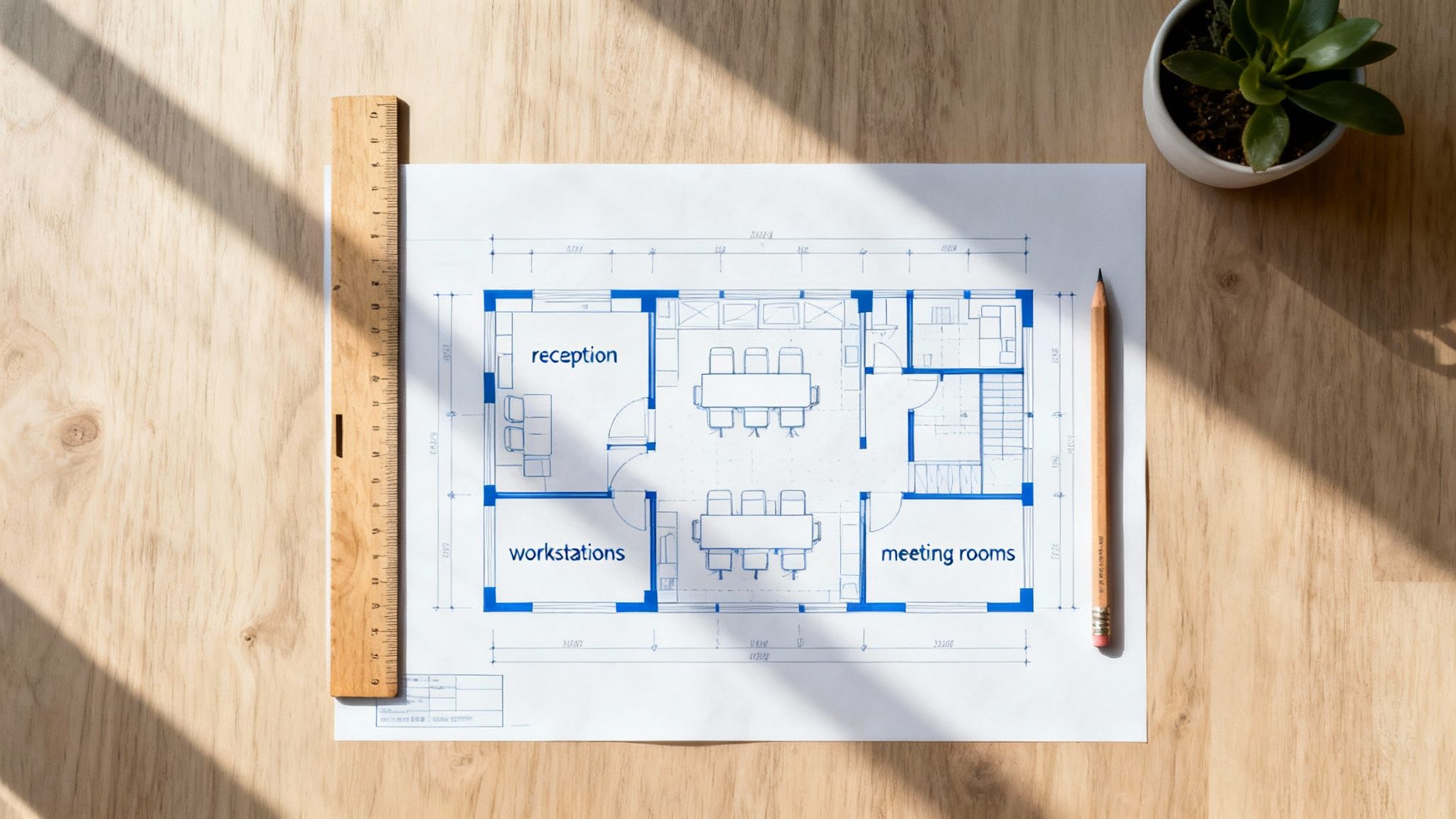
Core Factors in Space Planning
Before we jump into specific layout types, it’s vital to get a handle on the core elements that every great floor plan shares. These are the principles that work together to create a balanced and effective environment.
- Functionality: How will people actually use the space day-to-day? It must support your specific workflows, not get in their way.
- Flow: How do people move around the office? Clear, intuitive pathways are essential to avoid congestion and wasted time getting from A to B.
- Flexibility: Can the space adapt as your business evolves? A modern office must be able to accommodate growth and shifts in how we work.
Thinking about these factors from the very beginning ensures your investment will serve you well for years to come. You can explore more on this in our guide to modern office design trends. A successful layout isn’t just about today, it’s about creating a future-ready workplace.
The Impact on Your Team
At the end of the day, the goal of any office floor plan is to empower your team. The right environment has a huge impact on morale and staff retention.
When people have the spaces they need to do their best work, whether that’s a quiet corner for deep focus or a dynamic area for a team brainstorm, they feel valued, engaged and are far more productive.
To bring it all together, here’s a quick look at the key elements of a great floor plan and the direct impact they have on your business.
Key Elements of a Successful Office Floor Plan
| Core Element | Why It’s Crucial | Direct Business Impact |
|---|---|---|
| Space Allocation | Ensures teams have adequate room to work comfortably and efficiently. | Improves employee comfort and reduces feelings of being cramped or isolated. |
| Acoustic Design | Manages noise levels to reduce distractions and ensure privacy in meeting rooms. | Boosts concentration, protects sensitive conversations and reduces workplace stress. |
| Natural Light Access | Maximises exposure to daylight for all employees, not just those near a window. | Enhances employee wellbeing, elevates mood and can improve sleep patterns. |
Getting these foundational elements right isn’t just about aesthetics, it’s a strategic decision that pays dividends in productivity, creativity and overall team happiness.
Choosing the Right Office Layout for Your Team
Picking the right office floor plan isn’t just about making the place look good. It’s about creating a space that genuinely reflects your company’s culture and the way your team actually works. What works for a high-energy tech startup in Chelmsford will be a world away from the needs of a corporate head office in London demanding quiet and concentration.
Let’s walk through the most common floor plans for offices and figure out which one is the right fit for your business. Each layout has its own personality and strengths and understanding them is the first step toward building a workspace that helps your people thrive.
The Open-Plan Office
This is the one most people picture when they think of a modern office. Open-plan design strips away most interior walls, creating one large, communal workspace. The whole idea is to tear down barriers, both literally and figuratively, to spark communication, transparency and a real sense of community.
Think of it as a busy creative workshop, where ideas can fly across the room in an instant. It’s brilliant for fostering a collaborative buzz which is why you see it so often in creative agencies and fast-moving tech firms. The trade-off, of course, is the potential for noise and a lack of privacy, which can make it tough for some people to get their heads down and focus.
The Cellular Office
At the complete opposite end of the spectrum is the cellular office. This is the traditional setup with a series of individual, private offices typically branching off a central corridor. Each person or small team gets their own self-contained space.
This layout is the undisputed champion of privacy and minimising distractions. It’s the go-to for professions that demand deep concentration or handle sensitive information, think law firms, financial services or R&D teams. While it’s fantastic for quiet, focused work, the downside is that it can feel a bit isolating and put the brakes on that spontaneous, cross-departmental chatter.
Activity-Based Working (ABW)
Activity-Based Working, or ABW, is a far more fluid and dynamic way of thinking about office space. Instead of giving everyone a fixed desk, you provide a whole menu of different work settings, each designed for a specific type of task. Your team then moves between these spaces throughout the day, choosing the spot that best suits what they’re doing.
Imagine your office is made up of different “neighbourhoods”. You could have a quiet “library” zone for deep focus, a vibrant “town square” for team huddles, private phone booths for calls and comfy lounges for informal chats. This approach gives people control over their environment, which is a massive boost for both job satisfaction and productivity.
“An ABW approach empowers employees to choose their ideal work setting for any given task. This flexibility not only boosts productivity by aligning the environment with the work but also signals a high level of trust in your team, which is crucial for morale and engagement.”
The Hybrid Model
The hybrid model is rapidly becoming the layout of choice and for good reason. It cleverly blends the best bits of the open-plan and cellular worlds. You’ll typically find a main open area for collaboration, complemented by a mix of private offices, quiet pods and enclosed meeting rooms. For a deeper look at zoning your space effectively, check out our guide on designing modern office space.
This balanced approach offers a versatile “best of both worlds” solution that works for all sorts of different personalities and tasks. A team in Braintree, for example, could kick off their day with a stand-up in the open area before retreating to private booths for focused project work. Its adaptability is its greatest asset, making it a superb all-rounder for almost any business.
This move towards more flexible, adaptable workspaces isn’t just a hunch, it’s a major trend across the UK. According to research from ArchDaily, flexible office space is becoming increasingly popular. As you can see from the UK serviced office market report from IBISWorld, investing in flexible floor plans for offices is simply smart business.
Practical Space Planning to Maximise Your Office
Moving from layout theory to practical application is where a good office floor plan becomes a great one. Mastering space planning isn’t about pulling out complex formulas but about making smart, intentional decisions that genuinely support how your team works day-to-day. This is how you turn every square metre into a valuable asset.
A clear, practical guide is essential for any business leader or facilities manager looking to get the most out of their workspace. It all starts with understanding your fundamental needs and translating them into a physical layout that just works. This is exactly how we help our clients in places like Hertfordshire and Essex create efficient, satisfying work environments.
Calculating Your Space Requirements
Before you even think about moving a single desk, you need a handle on how much room you actually need. A common guideline here in the UK is to allocate between 75 to 150 square feet per employee. But that’s just a starting point, not a hard-and-fast rule.
The final number really depends on your chosen layout. An open-plan design might sit happily at the lower end of that scale, while a cellular office packed with private rooms will naturally demand more space per person. The key is to find the right balance between individual workspace and the shared, collaborative and social areas that are so vital for a healthy company culture.
This diagram gives a simple overview of how different layouts cater to collaboration, privacy and flexibility.
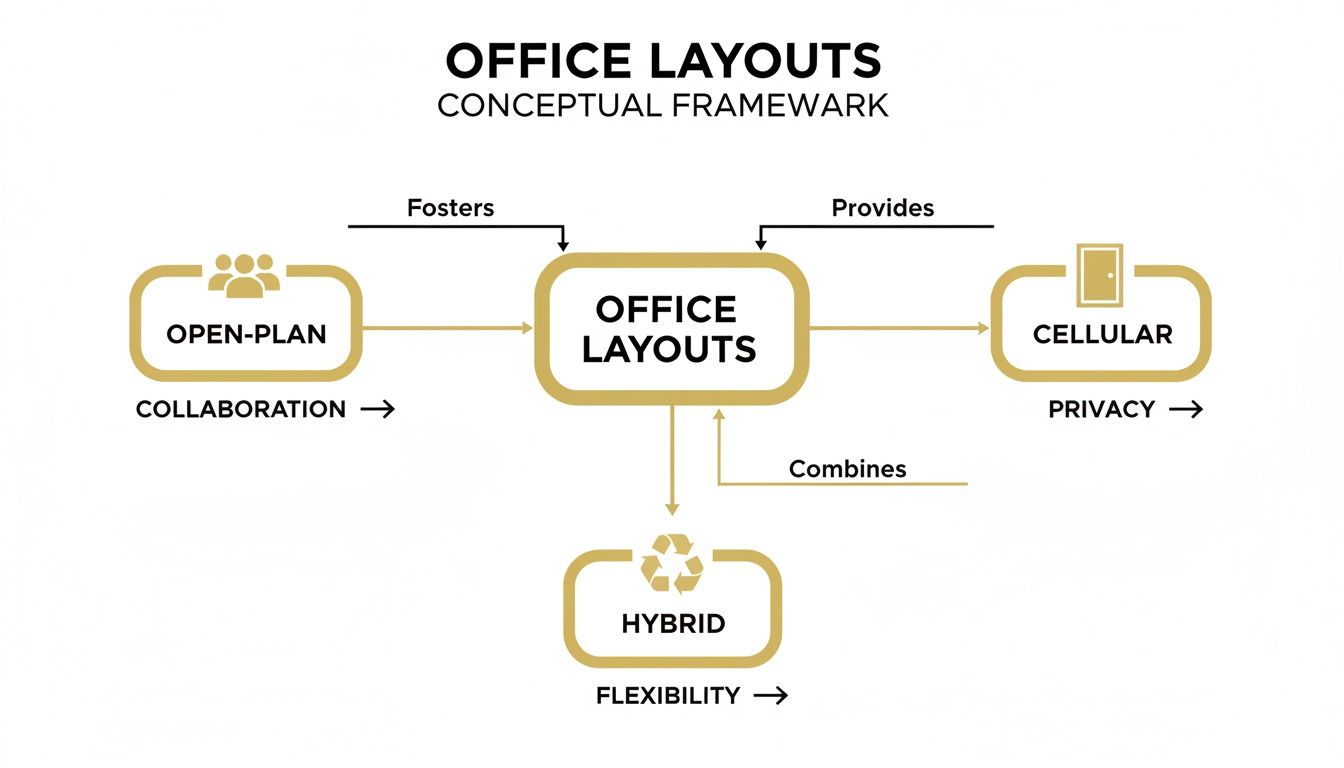
As you can see, your choice of floor plan has a direct, immediate impact on how your team can interact and focus throughout the day.
Designing for Flow and Zoning
Once you’ve got your space calculation sorted, the next step is planning the flow of the office. Think of circulation paths as the invisible corridors people use to move around. Good ones are intuitive and wide enough to prevent bottlenecks, especially around busy spots like kitchens or popular meeting rooms. Nobody wants a traffic jam on the way to the coffee machine.
Next up, think about zoning. This is simply about strategically grouping different types of spaces together.
- Focus Zones: Quiet areas tucked away from high-traffic paths, designed for deep concentration.
- Collaboration Zones: Energetic hubs with whiteboards and flexible seating that encourage teamwork.
- Social Zones: Relaxed breakout areas or kitchens that give your staff a place to connect and recharge.
Proper zoning ensures that a noisy team meeting doesn’t derail someone next door who’s trying to finalise a report. It’s all about creating an environment that respects different work styles and needs.
This careful planning is especially critical in high-value property markets. At the end of 2023, Grade A office space in London’s West End was costing around £137.50 per square foot per year, while the same quality space in Leeds was just £36. That staggering difference shows why every inch of a London office has to be optimised, making efficient floor plans for offices a financial necessity, not a luxury.
A Practical Checklist for Your Space
Getting started can feel a bit daunting but breaking the process down into manageable steps makes everything much clearer. A structured approach means you won’t miss any critical details during the planning phase.
“A great floor plan isn’t just about fitting everyone in. It’s about creating a space where people want to be. It should reduce friction, support different tasks and make the working day easier and more enjoyable for your entire team.”
We’ve put together a detailed guide to help you through every stage. For a step-by-step approach to planning your layout effectively, have a look at our comprehensive office space planning checklist. It’s an invaluable tool for making sure your new layout is a complete success.
Embracing Flexible and Modular Design
The days of the static, one-size-fits-all office are well and truly over. Businesses grow, teams pivot and new projects pop up out of nowhere. The traditional, fixed office layout simply can’t keep up, in fact, it often holds companies back. Today’s most effective floor plans for offices are built for agility, allowing the space to adapt just as quickly as the business itself.
This is where a modular approach really shines. Forget about thinking in terms of permanent walls and disruptive, costly construction projects. Instead, imagine your workspace as a set of adaptable building blocks you can reconfigure with minimal fuss. This ensures your environment is always supporting what your team needs now, not what they needed a year ago.
The Power of On-Demand Spaces
One of the biggest grumbles in any open-plan office is the struggle to find a quiet spot. Whether it’s for a confidential client call or a quick team huddle without distractions, privacy is a precious commodity. The answer doesn’t have to be a major building project. This is where brilliant innovations like modular meeting pods come into their own, giving you high-performance, acoustically private spaces that can be installed in hours, not weeks.
Brands like Vetrospace and BlockO are leading the charge here. These self-contained ‘rooms within a room’ are a genuine game-changer for open-plan environments. Think about it: you could add a fully equipped, soundproof meeting room to your office over a single weekend. It’s an incredibly powerful way to add crucial functionality without the expense and downtime of traditional construction.
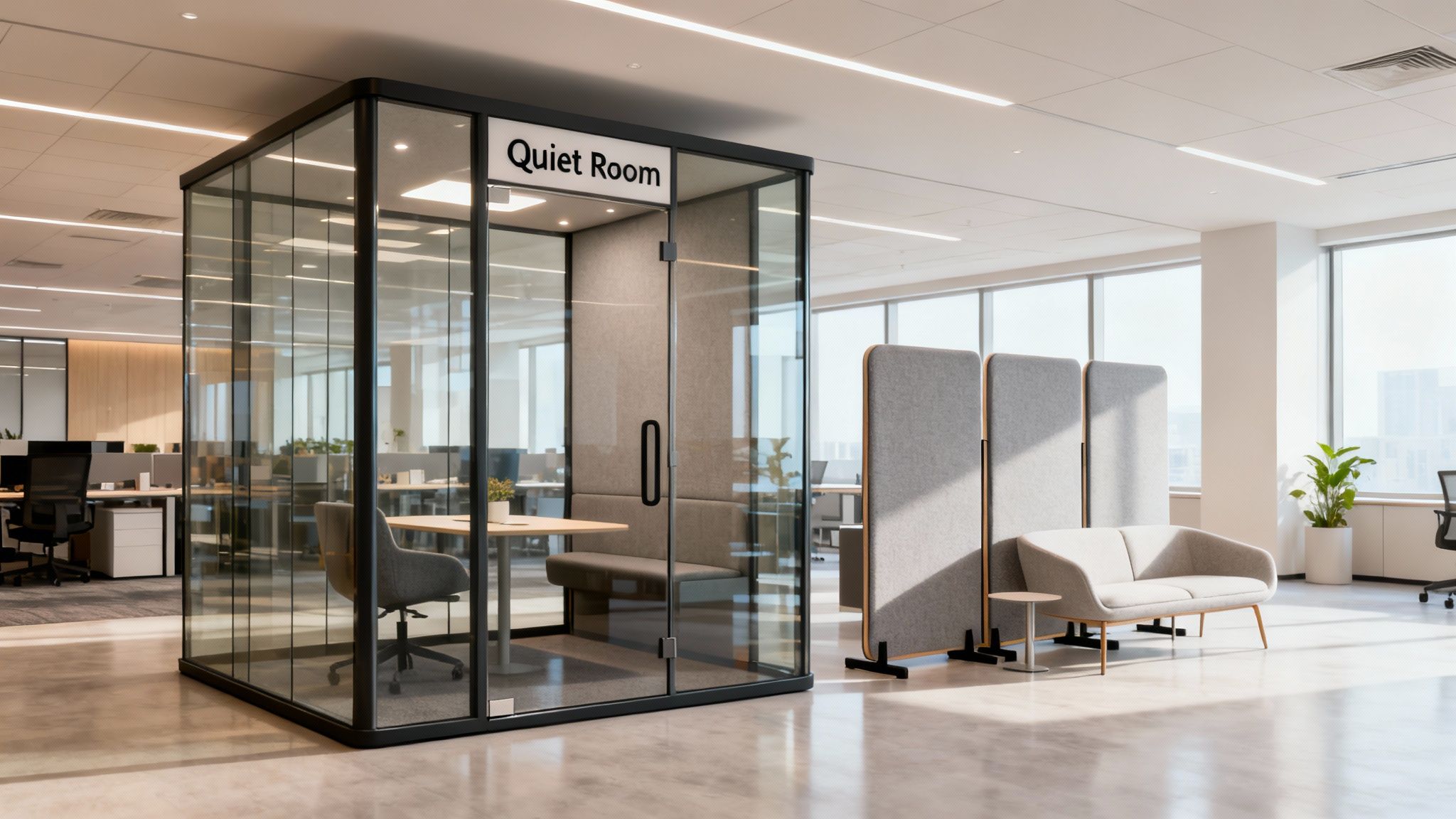
As you can see, you can create a dedicated, private space without killing the open, collaborative vibe of the wider office. It’s the best of both worlds.
Cost-Effective Refresh with Architectural Wrapping
Flexibility isn’t just about moving walls around, it’s also about having the freedom to refresh your space without breaking the bank. As you reconfigure your layout, you’ll often find that existing surfaces, doors or bits of furniture no longer match the new look and feel. This is where architectural wrapping comes in as a smart, sustainable solution.
Instead of ripping out and replacing perfectly good items, high-quality vinyl wraps can be applied to almost any surface to give it a completely new lease of life.
- Update a tired reception desk to create that killer first impression.
- Rebrand meeting room doors with fresh new colours or sophisticated wood-grain finishes.
- Give kitchen cabinetry a facelift for a fraction of the cost of a full refit.
This technique is a fast and cost-effective way to keep your workspace looking sharp and on-brand, especially when you’re making other changes. It cuts down on waste and minimises disruption, making it an essential tool in any flexible design playbook.
“A truly flexible office is one that can be changed both structurally and visually with ease. Modular pods provide the structural adaptability, while architectural wrapping offers the aesthetic agility, creating a workspace that is truly future-proof.”
At Gibbsonn Interiors, we help businesses in places like Stansted and Braintree build these kinds of adaptable environments. By integrating smart, modular solutions into their floor plans for offices, we empower them to create spaces that grow and change right alongside them, delivering fantastic long-term value on their investment.
Meeting UK Building Regulations and Standards
A brilliant office floor plan is about so much more than just looking good and helping people work better. It has to be a safe, accessible and fully compliant space. Let’s be honest, navigating UK building regulations can feel like wading through treacle but it’s a non-negotiable part of any successful office design or refurbishment.
Getting it right isn’t just a box-ticking exercise. It gives you complete peace of mind that your workplace is safe for every single member of your team.
At Gibbsonn Interiors, we get our hands dirty with these complexities so you don’t have to. We make sure every tiny detail of your layout, from fire escape routes to the width of a doorway, meets the required legal standards. This commitment is baked into our design and build process from the very first sketch, protecting both your people and your business.
Fire Safety First
Of all the regulations, fire safety is probably the most critical. The core principle is beautifully simple: everyone must be able to get out of the building quickly and safely in an emergency.
Your office floor plan absolutely must have clear, unobstructed escape routes. This means corridors and doorways need to meet specific width requirements and you have to have the correct fire-rated doors and signage in all the right places. We meticulously plan these escape paths to ensure they’re intuitive and efficient, avoiding dead ends or confusing layouts that could cost precious seconds when it matters most.
Accessibility for All
Creating an inclusive workplace isn’t just a nice-to-have, it’s a legal requirement under the Equality Act 2010. This act mandates that office environments must be accessible to people with disabilities and your floor plan is where that commitment starts.
This boils down to a few key considerations:
- Wheelchair Access: Are corridors, doorways and key facilities like kitchens and toilets wide enough for wheelchair users?
- Level Access: Have all unnecessary steps been eliminated? Where a change in level is unavoidable, are there ramps?
- Accessible Facilities: Do toilets and other amenities meet specific dimensional and fitting requirements?
An accessible design really does benefit everyone, creating a more comfortable and easy-to-navigate space for both staff and visitors.
Health and Safety in the Workplace
Beyond fire and accessibility, your layout has to follow the guidelines set out by the Health and Safety Executive (HSE). These regulations cover a surprising amount, from ensuring adequate space per person to providing sufficient ventilation and lighting. A well-considered floor plan for your office is a direct contributor to a healthier work environment, helping to reduce workplace stress and boost wellbeing.
This is more important than ever. The UK office market is facing a serious supply shortage, with new space expected to represent only 21% of total supply in Q3 2025. This pressure means more and more companies are looking to reconfigure their current layouts rather than move. Our expertise in smart space planning ensures you can meet all these standards while making every single square metre count. You can dive deeper by reading the full UK office market analysis from CBRE.
By partnering with a team that understands these regulations inside and out, you can get back to focusing on your business, confident that your new workspace is not only inspiring and functional but completely compliant.
How We Bring Your Vision to Life
Creating an exceptional office floor plan is part science, part art. It’s about more than just arranging desks. It’s about capturing the very essence of your company, your culture, your goals, your daily rhythms, and translating that into a physical space that genuinely works. At Gibbsonn Interiors, we don’t just design layouts. We build partnerships, taking you on a collaborative journey to bring your vision to life with precision and care.
This journey doesn’t start with a drawing board. It starts with a conversation, a deep dive into what really makes your business tick.
Our Step-by-Step Approach
Over the years, we’ve refined our process to be clear, collaborative and laser-focused on delivering results with minimal disruption to your daily operations. It’s a complete, end-to-end service designed to take you from a simple idea to a fully realised, high-performing workspace.
-
Workplace Consultancy: First things first, we listen. We run in-depth consultations to get under the skin of your company’s workflow, culture and ambitions for the future. This is far more than just a headcount. It’s about discovering how your teams truly collaborate, what tools they need to excel and what kind of environment will empower them to do their best work.
-
Collaborative Design: Armed with these insights, our designers get to work. We develop initial concepts, followed by detailed 2D and 3D floor plans that let you walk through the space virtually. This stage is highly interactive. We work closely with you, tweaking layouts and exploring different options until the design perfectly aligns with your vision and budget.
-
Seamless Project Management: Once the design gets the green light, our dedicated project management team takes the reins. We handle absolutely everything from coordinating specialist trades and managing timelines to navigating complex building regulations. You’ll have a single point of contact throughout, ensuring crystal-clear communication and complete accountability from start to finish.
-
Expert Fit Out & Refurbishment: This is where the designs leap off the page and into reality. Our skilled installation teams are masters of their craft, whether it’s a full office fit out from an empty shell in Cambridge or a complex office refurbishment in a live London building. We’re obsessed with quality craftsmanship and meticulous attention to detail.
-
Handover and Aftercare: Our job isn’t done when we hand over the keys. We conduct a thorough walkthrough with you to ensure every last detail is perfect and provide all the necessary documentation. Our relationship continues long after the project is complete, as we offer ongoing support to make sure your new space evolves with your needs.
A Partnership You Can Trust
Our goal is to make the entire process of transforming your workspace feel straightforward and maybe even enjoyable. We manage all the complexities behind the scenes, so you can stay focused on running your business. This unwavering dedication to a smooth, client-first experience is what sets us apart. But you don’t have to take our word for it.
“Gibbsonn’s design and build team were exceptional. They transformed our vision into a functional, vibrant workspace with minimal disruption. The entire process was seamless and the result has had a huge positive impact on our team’s morale and productivity.”
This is the standard we hold ourselves to on every single project, whether we’re working in a bustling corporate hub in Bishop’s Stortford or with a growing enterprise in Essex. We are committed to building future-ready workplaces that not only look fantastic but deliver tangible, lasting results for your business.
A Few Common Questions About Office Floor Plans
When you start digging into a new office layout, a lot of questions tend to surface. It’s completely natural. We’ve pulled together the most common queries we hear from our clients to give you some quick, clear answers. Think of it as a way to firm up the key ideas we’ve covered and help you move forward with confidence.
How much space do I really need per employee in the UK?
This is probably the number one question we get asked. While the official Health and Safety Executive (HSE) baseline is 11 cubic metres of volume per person, modern workspace planning is far more about usable floor area.
As a solid rule of thumb, we advise clients to budget for somewhere between 75 to 150 square feet per employee.
Where you land in that range depends entirely on the kind of layout you’re going for. A bustling, high-density open-plan office will sit at the lower end of that scale. In contrast, a cellular design with private offices will naturally demand more square footage. The only real way to nail down the perfect figure for your business is through a proper space planning consultation.
What’s the difference between an office fit out and a refurbishment?
It’s a great question and you’re not alone in wondering, the terms get mixed up all the time.
An office fit out is about starting from scratch. Imagine being handed the keys to an empty commercial shell. A fit out turns that bare space into a fully functioning, ready-to-use workspace. This is what happens in new builds and it covers everything from putting up walls and laying floors to installing all the electrics and plumbing.
On the other hand, an office refurbishment is about working with what you’ve already got. It’s about breathing new life into an existing office. This can be anything from a simple cosmetic refresh with new paint and furniture to a complete reconfiguration of the current floor plan. Here at Gibbsonn Interiors, we’re experts in delivering both right across the UK.
How can I stop my open-plan office from being so noisy?
Noise is the classic challenge of open-plan design but it’s one that can be managed brilliantly with the right approach. Acoustic management is absolutely vital.
One of the most effective tools in our arsenal is the modular meeting pod. These are essentially ‘rooms within a room’, providing fantastic sound insulation for private calls, one-to-ones or small team huddles without needing any permanent construction. It’s the perfect way to solve the noise problem while keeping the flexibility of your floor plans for offices.
“Of course, pods are just one part of a bigger acoustic strategy. We also look at installing sound-absorbing panels on walls and ceilings, bringing in acoustic-rated furniture and partitions and carving out designated quiet zones for deep, focused work. A multi-layered approach always delivers the best results.”
By combining these solutions, you can keep that vibrant, collaborative atmosphere you love about open-plan, without sacrificing the quiet, focused spaces your team desperately needs.
Ready to transform your workspace? Speak to the Gibbsonn Interiors team today.