
When you set out to design your office space, you’re doing far more than just picking out desks and chairs. You are crafting a strategic asset that can genuinely drive your business forward. A well-designed workspace has a tangible impact on everything from day-to-day productivity and team morale right through to your ability to attract and keep the best people. It is a direct investment in your team and the future of your brand.
Table of Contents
- Why Strategic Office Design Is a Business Imperative
- Building Your Foundation with a Solid Design Brief
- Mastering Space Planning for Hybrid Teams
- Weaving Your Brand and People into the Fabric of Your Office
- Future-Proofing Your Office with Smart and Sustainable Design
- Bringing Your Vision to Life with an Expert Partner
- Your Office Design Questions, Answered
Why Strategic Office Design Is a Business Imperative
In today's competitive landscape the office is no longer just a cost. It is a powerful way to shape company culture, spark collaboration, and look after employee wellbeing. The old model of uniform cubicles has been replaced by dynamic, human-centric environments built to support modern flexible and hybrid working.
For businesses all over the UK from ambitious start-ups in Bishop's Stortford to established firms in London, getting the office right is essential. The right design can solve real business challenges.
The Shift to Purpose-Driven Workspaces
People now expect more from their office. It has to be a destination that offers something they cannot get at home like seamless collaboration, specialist tech, or a genuine sense of community. This means creating a variety of spaces that cater to different kinds of work.
- Collaborative Hubs: Think open areas and breakout zones designed for teamwork and spontaneous problem-solving chats.
- Focus Zones: These are quiet corners or private pods where people can concentrate without distraction.
- Social Spaces: A great kitchen or lounge area encourages informal interactions that build strong team bonds.
- Wellbeing Rooms: Dedicated spaces for relaxation send a clear signal that you are committed to your team's welfare.
This diagram breaks down the core drivers behind any strategic office design project.
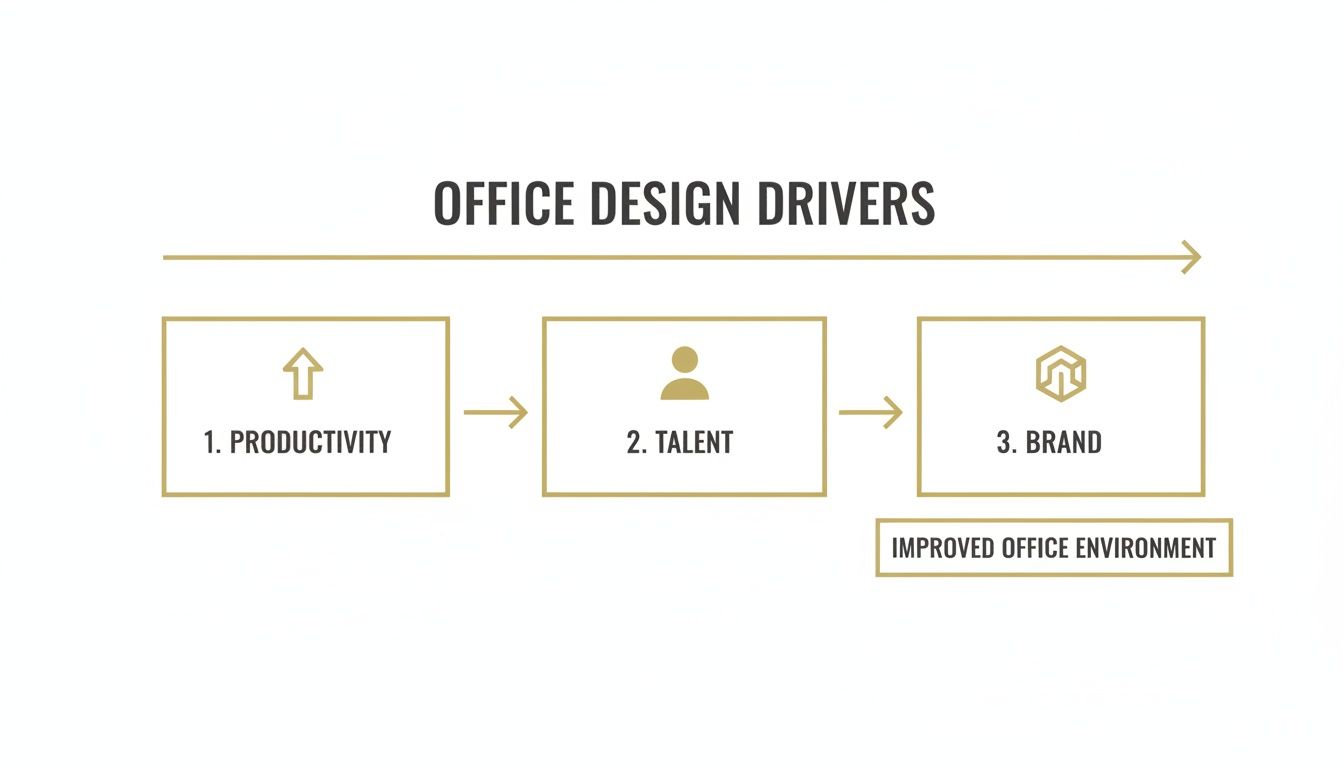
It is all about balancing three key goals: improving productivity, attracting and retaining talent, and strengthening your brand identity. A truly strategic design brings these elements together to create a workspace that really performs.
Responding to New Work Realities
The rise of hybrid working has completely changed how businesses view their physical footprint. Recent data drives this point home with 63% of UK business leaders actively reshaping their offices to better suit new work patterns. With interior refurbishments now accounting for a huge 83% of new office activity the focus has clearly shifted from expansion to optimisation. It is about creating higher-quality, purposeful spaces that make the commute feel worthwhile. You can find out more about how UK businesses are adapting their office space.
“A thoughtfully designed office sends a powerful message. It tells your employees they are valued and shows clients that your brand is professional, forward-thinking, and invested in quality.”
This guide is your roadmap to creating a workspace that delivers real returns. We will cover everything from initial planning and brand integration to future-proofing your investment, ensuring your office works just as hard as your team does.
Building Your Foundation with a Solid Design Brief
Before you think about picking a paint colour or a piece of furniture the most important part of your office design journey happens on paper. A detailed design brief is your blueprint for success. It is the document that captures what your organisation needs from its new workspace, making sure the end result is a strategic business asset not just a pretty space.
Trying to skip this stage is like building a house without plans. You risk creating a space that looks the part but fails to support how your teams actually work. A proper brief gets everyone on the same page from the start and prevents costly changes and misunderstandings down the line.
Asking the Right Questions
At the heart of any great brief is a deep understanding of your people and how they get things done. This is not just about counting desks. It is about digging into daily workflows, frustrations, and the aspirations of your team. For our clients in places like Bishop's Stortford and Chelmsford, we always kick things off with this kind of in-depth discovery.
To get started you need to pull in information from all corners of the business.
- Stakeholder Interviews: Sit down with department heads and senior management to get a handle on the big-picture business goals. Are you planning to grow the team by 20% in the next three years? Are you moving towards a more collaborative way of working?
- Employee Surveys: Go straight to the source and get feedback from the people using the space every day. Ask them what’s working, what is not, and what would genuinely make their working day better. Anonymous surveys often bring out the most honest and valuable insights.
- Workflow Analysis: Take time to observe how different teams interact. Does the sales team need to be near marketing for quick chats? Do your developers need a quiet zone away from the main office buzz? Mapping these connections is key to a functional layout.
This initial work translates abstract ideas like "company culture" into solid design requirements. It is the difference between vaguely saying "we want a collaborative space" and specifically defining that you need three small huddle rooms, a large project area with whiteboards, and a soundproofed pod for video calls.
Defining Your Operational Needs
Once you have gathered all that feedback you can start mapping out the practical requirements. A strong design brief should act as a comprehensive checklist covering every functional aspect of your future office. You need to think beyond aesthetics and focus on operational demands. For a good overview of regulations and accessibility the government's official Health and Safety Executive (HSE) workplace guidance is an excellent resource.
“A great design brief is the blueprint for success. It aligns everyone’s expectations and ensures the final space solves real business problems, not just style preferences.”
Your checklist should get into the specifics of everything that makes your office work.
- Technology: What are your IT infrastructure needs? Think about Wi-Fi coverage, the number and location of power sockets, server room requirements, and the audiovisual kit you'll need in meeting rooms.
- Storage: Be realistic about how much physical storage you need. This covers everything from personal lockers for staff to centralised archive filing and storerooms for office supplies.
- Acoustics: Where is acoustic privacy essential? Pinpoint areas for confidential chats, focused work, and noisy team activities so you can plan for the right sound management from the start.
- Accessibility: How will you make sure the space is inclusive for everyone? This means looking at everything from wheelchair access and ergonomic furniture to clear navigation and appropriate lighting for all.
By creating a detailed design brief you set a clear direction for the entire project. It becomes the foundational document that guides every decision, ensuring the final design is perfectly suited to your organisation’s unique identity and operational needs. This groundwork is vital whether you're based in a bustling hub like London or a growing town like Braintree.
Mastering Space Planning for Hybrid Teams
The way we work has changed and the traditional office with its rows of identical desks just does not work anymore. Today's office needs to be a dynamic ecosystem, carefully planned to support a hybrid workforce where people split their time between home and a central hub. When you design an office space for a modern team you are creating a destination with a clear purpose.
This means moving beyond simply providing desks and thinking instead about a variety of settings for different tasks. It is all about empowering your team with choice, allowing them to pick the right environment for whatever they need to do. This is fundamental to creating a workspace people genuinely want to commute to.
Exploring Agile Workspace Models
To create this kind of flexible environment many forward-thinking businesses are turning to agile workspace models. These layouts are designed to be fluid and adaptable, supporting a range of activities throughout the day.
One of the most effective strategies is Activity-Based Working (ABW). This model ditches the old idea of assigned seating. Instead it provides a 'menu' of specifically designed zones:
- Focus Zones: Quiet corners with single desks or high-backed chairs where employees can get their heads down without interruption.
- Collaboration Zones: Open-plan areas with large tables, whiteboards, and informal seating designed to spark teamwork.
- Social Zones: Comfortable lounge or kitchen areas that encourage chance encounters and informal chats that build team cohesion.
- Private Spaces: Small meeting rooms or acoustically sound pods for confidential calls and one-to-one discussions.
Another popular approach is to create "neighbourhoods" for specific teams. This gives each department a home base while still allowing individuals the freedom to move between different settings. We dive deeper into structuring these areas in our guide on effective office floor planning.
To help you decide what might work for you here is a quick breakdown of the most common layout models.
Comparing Office Layout Models
| Layout Model | Best For | Key Features |
|---|---|---|
| Open-Plan | Teams that require constant collaboration. | Minimal physical barriers and shared desks. |
| Activity-Based Working (ABW) | Hybrid teams with diverse tasks. | A variety of unassigned work settings. |
| Team Neighbourhoods | Larger organisations with distinct departments. | Designated zones for specific teams. |
Each model has its place but for most hybrid teams a blend of these concepts delivers the best results by offering both structure and flexibility.
Balancing Collaboration with Concentration
The biggest puzzle in modern office design is striking the balance between open collaborative areas and private quiet zones. An entirely open-plan office can be a productivity nightmare, leading to constant distractions. The solution is a thoughtfully zoned layout.
This means strategically placing noisy high-traffic areas away from spaces meant for concentration. Think about using physical barriers like shelving units, moveable partitions, or large plants to create visual and acoustic separation.
“The goal is to create an environment where a lively team meeting can happen just metres away from someone doing deep-focus work, with neither disturbing the other. That’s the sign of truly successful space planning.”
This is where modular solutions have become invaluable. Products like BlockO pods are a brilliant way to insert private, acoustically controlled spaces into an open-plan layout without the disruption of traditional construction. They provide instant quiet rooms for calls, video conferences, or solo work.
The Rise of Flexible and Modular Solutions
The demand for adaptable workspaces is completely reshaping the commercial property market. In fact, the UK's flexible workspace sector is projected to hit USD 6.48 billion a trend turbocharged by the April 2024 'day-one' flexible working law. This growth highlights a major shift towards agile fit-outs that can blend open-plan energy with private zones.
This is driving huge innovation in modular design. Instead of being locked into fixed walls businesses are choosing solutions that can be easily reconfigured as their needs evolve. We are talking about everything from moveable pods and modular furniture to architectural wrapping that can quickly update surfaces.
By embracing this flexibility you create a future-proof office that can grow and change alongside your business, ensuring your workspace remains a valuable asset for years to come.
Weaving Your Brand and People into the Fabric of Your Office
When you design an office space you are doing more than just picking out desks and chairs. You are crafting the physical story of your company and building a supportive environment for your team's health and happiness. It is where your brand comes to life and where you prove to your employees that their wellbeing is a top priority.
This is about more than just a logo on the reception wall. Real brand integration means weaving your company’s identity into the materials, colours, and flow of the space. At the same time putting employee wellbeing front and centre is no longer a 'nice-to-have' but an essential part of modern design that has a proven impact on reducing stress and sparking creativity.
Making the Workspace Unmistakably Yours
Your office is one of the most powerful branding tools you have. It needs to feel uniquely yours. This is not about superficial decoration but about translating your company’s values and culture into physical design choices.
A simple yet powerful place to start is your colour palette. Colours have a psychological effect so using your brand colours thoughtfully can reinforce your company's personality. A tech firm might use pops of a vibrant colour to signal innovation, while a law practice might lean on more subdued tones to convey trust.
But it goes deeper than paint. Think about how you can embed your company values directly into the office. This could be through:
- Custom Wall Graphics: Displaying your mission statement, key milestones, or company values in a visually engaging way.
- Material Choices: Selecting finishes and textures that reflect your brand’s character. A business focused on sustainability might use reclaimed wood, while a luxury brand could use polished marble.
- Furniture Selection: The style of furniture says a lot. Sleek minimalist pieces suggest a modern efficient culture, whereas comfortable furniture might reflect a more relaxed and creative one.
For businesses in places like Cambridge, there is also a cost-effective way to align existing surfaces with new branding: architectural wrapping. This technique allows you to transform doors, walls, and old furniture with new finishes, avoiding the cost of a full replacement.
Designing for Health and Happiness
A stunning office is a failure if it does not support the people who use it. Employee wellbeing has become a cornerstone of productive workplace design, impacting everything from focus and morale to staff retention. Creating a healthy environment is a direct investment in your team.
“A workspace that actively promotes wellbeing isn’t just a perk; it’s a fundamental requirement for a high-performing team. It demonstrates that you value your people as your greatest asset.”
Several key elements are crucial for designing a space that nurtures your team. We dive deeper into this in our guide to improving wellbeing in the workplace.
The Building Blocks of a Healthy Office
| Feature | Impact on Wellbeing | Practical Application |
|---|---|---|
| Ergonomics | Reduces physical strain and improves comfort. | Invest in adjustable chairs and sit-stand desks. |
| Biophilic Design | Lowers stress levels and boosts creativity. | Incorporate natural elements like plants and wood. |
| Lighting | Reduces eye strain and improves mood. | Maximise natural light and use smart lighting systems. |
These elements work together to create an environment where people feel comfortable, supported, and energised. Biophilic design in particular has a profound effect. Simply adding plants and natural textures connects us to the outdoors which has a restorative effect on our minds.
By thoughtfully combining a strong brand identity with a genuine commitment to employee wellbeing you create an office that is not only visually impressive but is a place where your team can truly thrive. It becomes a space that strengthens your culture, supports your people, and drives your business forward.
Future-Proofing Your Office with Smart and Sustainable Design
When you design an office space today you are making a bet on tomorrow. A forward-thinking workspace has to be adaptable, ready for new tech, and environmentally aware. It is about creating a physical environment that can grow with your business, not hold it back.
This means planning for flexibility from the get-go. Your team might expand or change how they work. A future-proofed design sees this coming and uses clever solutions to make reconfiguring easy, ensuring your investment stands the test of time. We help clients across Essex and Hertfordshire build this long-term value right into their projects.
Building in Agility and Adaptability
In a fast-moving world a static office layout is a liability. The secret to future-proofing is to build in agility from day one. This gives you the power to adapt your space with minimal fuss and cost as your operational needs change.
Think about these practical approaches:
- Modular Furniture: Opting for freestanding reconfigurable furniture systems instead of built-in joinery is a game-changer for flexibility. Desks, storage, and breakout seating can be moved around to create new layouts as teams form and reform.
- Moveable Partitions: Forget permanent walls. Modern partition systems can be installed and relocated with ease. This lets you resize meeting rooms or create new team zones without major work.
- Scalable Tech Infrastructure: You need to ensure your office has a robust digital backbone. This means planning for excellent Wi-Fi coverage everywhere and ideally installing a grid-based power and data system under a raised access floor. It lets you add new workstations wherever you need them.
This kind of thinking makes sure your workspace stays a productive asset, not a restrictive legacy.
Embracing Sustainable Design Principles
Sustainability is not just a "nice-to-have" anymore but a commercial necessity. Environmental regulations are getting stricter and both clients and employees are demanding greener credentials from businesses. A sustainable fit-out is simply a smart business decision.
“A sustainable design doesn’t just cut your environmental impact. It enhances your brand reputation, can improve property value, and almost always leads to lower running costs over the long term.”
Focusing on sustainability means making conscious choices at every stage of the project.
- Specify Sustainable Materials: Prioritise materials with high recycled content, low volatile organic compounds (VOCs), and proper sourcing credentials like FSC-certified timber.
- Energy-Efficient Systems: This is a big one. Install LED lighting with smart controls like occupancy sensors and daylight dimming. Upgrading to an efficient HVAC system can also slash your energy consumption.
- Waste Reduction: Plan to minimise construction waste from the start. We often use techniques like architectural wrapping to renew existing surfaces like doors and furniture. It diverts a huge amount from landfill compared to a full rip-out and replacement.
This proactive approach is vital as standards like the Minimum Energy Efficiency Standards (MEES) for commercial buildings continue to tighten. A sustainable fit-out is not just about ticking compliance boxes but about future-proofing your property's value and appeal.
Meeting Market Demands for Quality Spaces
The "flight to quality" in the UK office market is impossible to ignore. Tenants are increasingly seeking out buildings with strong environmental credentials. The latest market data shows that a staggering 68% of office transactions were for new or refurbished spaces.
Even more telling, buildings rated BREEAM 'Excellent' or 'Outstanding' accounted for 59% of this activity. With a limited supply of brand-new top-tier spaces high-quality refurbishment is now the main way to meet this demand. If you want the full picture you can explore the latest London office data here.
This trend puts huge emphasis on creating compliant, efficient, and desirable workspaces. By weaving smart technology and sustainable principles into your office design you create a space that not only attracts and keeps the best talent but also secures your asset's long-term commercial future.
Bringing Your Vision to Life with an Expert Partner
You have got the vision. The brief is nailed down, the strategy is set, and the plans for your new office space are looking fantastic. Now comes the moment of truth: turning those ideas into a physical, functioning, and inspiring workplace.
This is where all that detailed planning pays off. But it is also where things can get incredibly complex. You are suddenly juggling dozens of suppliers, coordinating various trades, and trying to keep everything on schedule and on budget. It can feel like a full-time job.
This is why leaning on a single expert partner can be a game-changer.
The Power of a Single Partner
Bringing in a turnkey design-and-build company simplifies everything. Instead of you managing a web of different contracts one dedicated team takes complete ownership of the project from the first sketch to the final handover.
A design-and-build approach gives you a single point of accountability. It makes communication a breeze and ensures the design you fell in love with is the one that gets built. Experience shows this model is far better at controlling costs and dramatically shortens project timelines, which means less disruption for your business. For businesses in hubs like Braintree or near major transport links like Stansted, that efficiency is vital.
We have put together a dedicated guide on this, explaining the benefits of working with design and build companies, if you want to dig deeper into how the process works.
Ultimately to successfully design an office space that hits your goals you need a partner who gets your vision and has the expertise to deliver it without a hitch.
“Your office is a strategic asset. A successful project is not just about the final look but about a smooth, predictable journey from concept to completion. An expert partner makes that journey seamless.”
With a clear strategy and the right team by your side you can create a workspace that does not just meet today’s needs but is geared up for whatever lies ahead.
Your Office Design Questions, Answered
Embarking on an office redesign is a big step and it is natural to have questions. Over the years we have heard them all. Here are our honest answers to the questions that come up time and again with our clients across the UK.
How Much Does It Cost To Design and Fit Out an Office Space in the UK?
This is the big one. The truth is office fit-out costs can vary massively depending on the location, the level of finish, and the scope of the work.
As a rough guide a straightforward refurbishment might start from around £40 per square foot. For a full-scale design and build project you could be looking at anything upwards of £150 per square foot.
The final figure jumps around because of things like structural alterations, the complexity of the tech, and the furniture you choose. The only way to get a real handle on your budget is to get a detailed quote from a specialist. This will give you a transparent breakdown based on your unique brief.
What Is the Biggest Mistake to Avoid When Designing an Office?
The one mistake we see more than any other is failing to talk to your employees during the planning stage. Too often a design is based on what the leadership team thinks people need, which rarely reflects how they actually work.
This is where common problems creep in like poor acoustics making focus impossible, not enough private spots for calls, or a lack of proper collaborative zones.
You can sidestep this entirely by running workshops or sending out surveys to get genuine feedback before any layouts are finalised. It is the single best way to ensure the finished design is functional and built for the people who will be using it every day.
How Long Does a Typical Office Fit-Out Project Take?
The timeline for a fit-out is all about the project’s size and complexity. A quick refresh for a small office could be wrapped up in just 2-4 weeks.
For a medium-sized project of 5,000-10,000 sq. ft. you would typically be looking at 8-12 weeks for the on-site construction. That is after a 4-6 week design and planning phase.
Larger projects can easily stretch to six months or even longer from the first conversation to handover. This is where working with a design-and-build company really streamlines things. Having a single team manage every stage keeps communication clear and delivery far more efficient, something our clients in Stansted and beyond really appreciate.
Ready to transform your workspace? Speak to the GIBBSONN Interiors team today.