
Ever had that sinking feeling when a vital piece of office equipment grinds to a halt? One minute everything's fine, the next you're dealing with a broken air conditioner on the hottest day of the year or a power cut that brings work to a standstill. It’s frustrating, costly, and completely avoidable. That’s where commercial maintenance services come in. Think of them as your building’s health plan, designed to stop small problems from turning into massive, expensive headaches.
This guide will walk you through everything you need to know. We’ll explain how the right maintenance strategy can keep your office safe, efficient, and professional, protecting your business from the disruption nobody has time for.
Table of Contents
- Why Your Workspace Needs a Health Check in 2026
- Understanding Your Maintenance Options in 2026
- How Smart Technology Is Changing Maintenance in 2026
- Choosing the Right Maintenance Partner
- Integrating Maintenance into Your Office Design
- The True Cost and Value of Maintenance
- Frequently Asked Questions
Why Your Workspace Needs a Health Check in 2026
It’s easy to let small jobs slide. A flickering light here, a scuffed wall there, or an air conditioning unit that seems to have a mind of its own. On their own, they might seem like minor annoyances. But when you add them all up, they start to affect everything, from your team's mood to the first impression you make on new clients.
Take a poorly maintained HVAC system, for example. It doesn't just make the office uncomfortable; it quietly drives up your energy bills and is a ticking time bomb for an expensive emergency repair. In a competitive business hub like London, a professional and well-kept workspace isn’t a luxury, it's a basic requirement.
A Strategy for Success
Let's be clear: effective commercial maintenance isn't just about fixing things when they break. It’s a strategic way to look after your property's value and make sure your office actively helps your business succeed. A proper plan covers everything from day-to-day cleaning to specialist jobs, making sure your office is always a safe, legal, and inspiring place to work.
Just consider the core benefits:
- Boosted Productivity: A comfortable, working environment lets your team focus on their jobs, free from annoying distractions.
- Enhanced Safety: Regular checks on electrics, fire alarms, and the building itself are essential for keeping everyone safe.
- Improved Brand Image: A pristine workspace sends a powerful message to clients and visitors. It says you’re professional, you care about the details, and you mean business.
- Cost Control: Being proactive with maintenance is the single best way to avoid eye-watering emergency repair bills and make your most valuable assets last longer.
This becomes especially important when you're thinking about your end-of-lease responsibilities. It’s a topic we cover in our guide explaining what a dilapidation survey is and how it affects you as a tenant.
“A well-maintained commercial space is more than just a building; it is a direct reflection of your company’s standards and a critical tool for business success.”
Whether you’re managing a brand-new office fit-out or looking after an established site in Hertfordshire, this guide gives you the expert advice you need. We'll cover it all, from the different types of maintenance services available to the latest smart technologies that are changing the industry.
Understanding Your Maintenance Options in 2026
So, what exactly are commercial maintenance services? It’s much more than just having a number to call when a leak appears. It’s a complete strategy for looking after your property and, just as importantly, your people. Getting your head around the different approaches to maintenance is the first step to building a plan that keeps your business running smoothly.
At its heart, every good maintenance plan is built on two ideas: being proactive and being reactive. The goal is to find a balance, but you should always aim to lean heavily on prevention. It's a bit like looking after your own health. You’re always better off with regular check-ups than waiting for a trip to A&E.
Planned Preventative Maintenance (PPM)
Think of Planned Preventative Maintenance, or PPM, as your building’s routine health check. It’s all about scheduled servicing and inspections of your most important systems and the building itself. The aim is simple: spot small issues before they snowball into massive, expensive headaches.
By committing to a PPM schedule, you’re actively preventing breakdowns. This proactive approach doesn't just get more life out of your assets, from air conditioning to electrics, it also makes sure they run efficiently, helping to keep those energy bills down. For any business, especially those with offices in places like Bishop’s Stortford, this is the secret to predictable budgets and minimal disruption.
Reactive Maintenance
On the other side, you have reactive maintenance. This is your emergency response, the team you call when something breaks unexpectedly. A burst pipe, a sudden power cut, or a broken door are all moments where you need a fast, effective fix to get back to business.
While even the best plans can't predict every single problem, a strong reactive maintenance service ensures that when things do go wrong, the impact on your business is kept to an absolute minimum. Quick response times are everything here; they protect your property from more damage and keep your team safe and productive.
Hard FM and Soft FM Explained
In the world of facilities management, you’ll often hear the terms ‘Hard FM’ and ‘Soft FM’. They’re simply a way to group the different services that keep a building running.
Hard FM (Facilities Management): This is all about the physical, structural parts of your building. It covers services often required by law, like electrical testing, plumbing, fire safety systems, and HVAC (heating, ventilation, and air conditioning) maintenance.
Soft FM (Facilities Management): This side of things focuses on the services that make a workplace better for the people in it. These services include things like cleaning, security, waste management, and even reception teams.
The infographic below shows how looking after your workspace with these services directly helps productivity, safety, and efficiency.
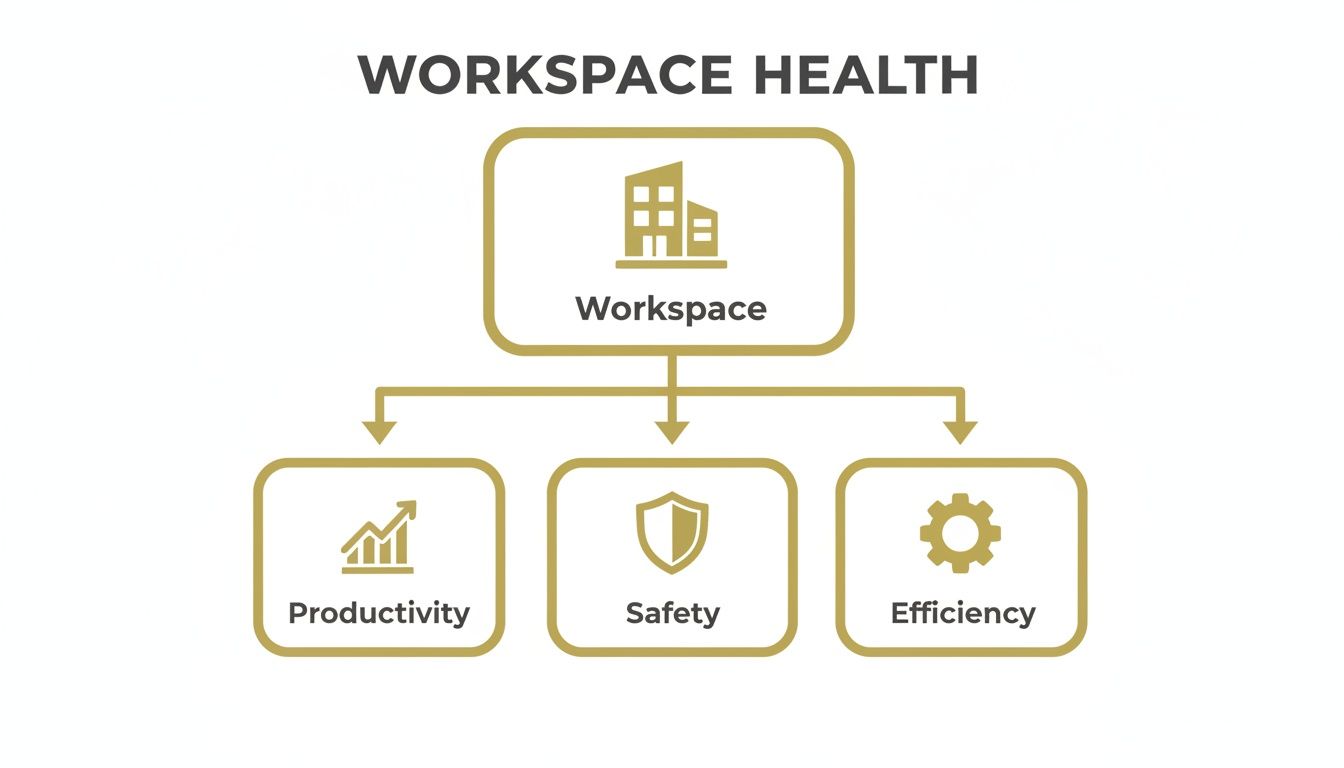
As you can see, a well-looked-after workspace is the foundation of a successful business, supporting both productivity and safety. This isn't just a theory; the numbers back it up across the UK.
According to the BCIS Economic Significance of Maintenance report, total maintenance spending in the UK hit an incredible £100.6 billion in 2024, which was an 8.3% jump from the year before. This figure really shows how vital commercial maintenance services are. The same report suggests repair and maintenance output is expected to grow another 10% between 2025 and 2030, driven by ageing buildings and tighter regulations.
A truly successful strategy combines all these elements. It brings together a solid PPM schedule with a reliable reactive service, covering both the hard and soft aspects of your building to create a space that’s safe, efficient, and genuinely welcoming.
How Smart Technology Is Changing Maintenance in 2026
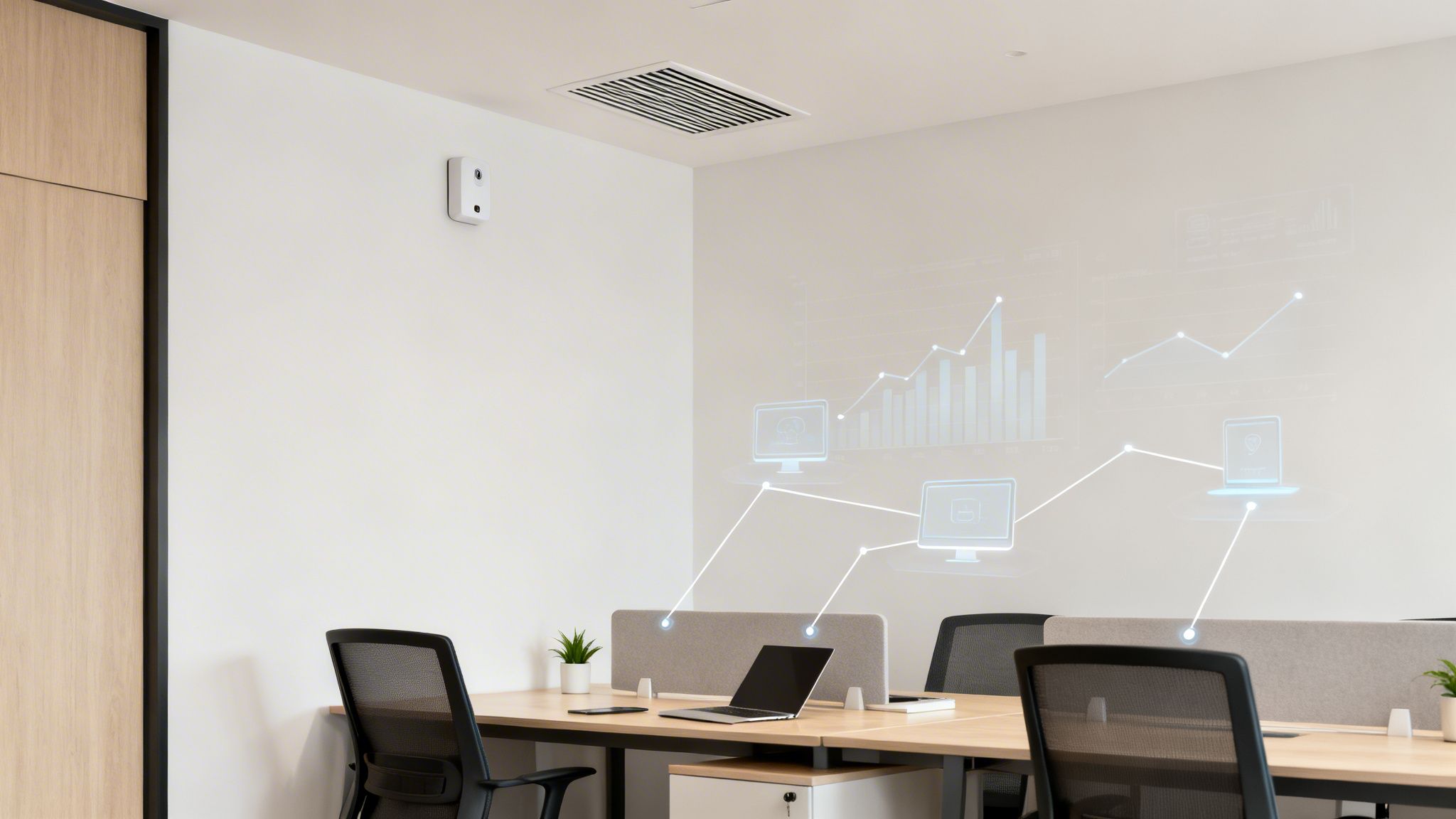
The days of waiting for something to break before fixing it are disappearing. The future of commercial maintenance services isn’t about reacting to problems, it’s about getting ahead of them. Imagine if your office building had its own fitness tracker, constantly monitoring its vital signs and warning you about an issue long before it becomes serious.
That’s the new reality of predictive maintenance. Instead of a wristband, we use a network of tiny, smart sensors, part of the Internet of Things (IoT), to keep a constant watch on your building's most important systems. These sensors gather real-time data on everything from your heating and cooling (HVAC) units to your lighting and even office partitions.
This constant stream of data is then analysed to spot small patterns, flagging when a part might be close to failing. This shift from reactive to proactive allows us to schedule repairs at a convenient time, putting an end to surprise downtime and the high costs of emergency call-outs.
The Power of Prediction
For any business, but especially one in a fast-paced hub like Cambridge, this kind of foresight is a game-changer. Downtime isn’t just a broken air conditioner; it’s a direct hit to productivity, staff morale, and even your client-facing operations. Predictive maintenance helps you stay ahead of the curve.
The growth in this area is incredible. According to Grand View Research, the UK predictive maintenance market was valued at an estimated £695.7 million in 2025 and is projected to explode to £4.38 billion by 2033. This huge shift in technology gives facilities managers the power to predict failures in everything from HVAC units to essential office equipment, turning what would have been costly disruptions into manageable, planned tasks.
More Than Just Savings
Beyond the obvious financial benefits, smart maintenance offers other powerful advantages. It directly helps your business achieve its environmental and social goals. After all, a system that runs at peak efficiency is one that uses less energy, which is a win for the planet and your bank balance.
This creates a healthier and more sustainable work environment, which has become a key factor in attracting and keeping top talent. By optimising your building’s systems, you’re not just preventing breakdowns; you are actively creating a workspace that supports wellbeing in the workplace.
“Predictive maintenance turns your building’s data into actionable insights, allowing you to fix tomorrow’s problems today. It’s the ultimate proactive strategy.”
What was once a complex technology for huge industrial plants is now becoming affordable for smaller businesses. For companies in regions like Essex, adopting this approach is a clear way to get a competitive edge. It sends a strong signal that you are committed to efficiency, sustainability, and operational excellence.
Choosing the Right Maintenance Partner
Picking the right partner for your commercial maintenance services is about more than just finding someone to do a job. It’s about trusting a key part of your business's health to an outside team. This isn't just about getting things fixed when they break; it's about building a relationship with experts you can rely on to protect your property and keep your business running smoothly.
Making the right choice goes well beyond a glossy brochure or a cheap price. The best maintenance providers become a true extension of your own team. They take the time to understand how you work and, in doing so, provide real peace of mind. For businesses in high-pressure environments, like a busy airport in Stansted, this level of reliability isn't a nice-to-have, it’s absolutely essential.
Vetting Potential Partners
Before you even think about signing a contract, it’s time to do your homework. A thorough vetting process is what separates the seasoned professionals from the rest. Your goal is to find a company that not only has a proven track record but also has the right qualifications and a genuine commitment to quality.
Start by looking into their experience in your specific industry. A team that understands the pressures of a corporate office will serve you far better than a generalist. Don't be afraid to ask for case studies or examples of their work with businesses like yours.
Next, get serious about checking their credentials. You must always confirm they hold the correct insurance, including public liability, and that their technicians have the necessary certificates for specialist work like gas or electricals. This isn’t just ticking boxes; it's a vital step in protecting your business from risk.
Understanding the Contract
The contract is where spoken promises become binding commitments. Two of the most important parts you’ll see are Service Level Agreements (SLAs) and Key Performance Indicators (KPIs). Don’t let the jargon put you off. They are simply clear, measurable promises about the standard of service you should expect.
- Service Level Agreements (SLAs): Think of these as the rules of the game. A solid SLA will define key terms, like the guaranteed response time for an emergency call-out (e.g., within 4 hours) or the fixed schedule for planned maintenance visits.
- Key Performance Indicators (KPIs): These are the numbers used to track whether the promises made in the SLA are actually being kept. Common examples include the 'first-time fix rate' (how often an issue is sorted on the first visit) or the 'PPM completion rate' (the percentage of planned jobs finished on time).
“A clear SLA isn’t just a document; it’s your assurance that your maintenance partner understands your priorities and is committed to meeting them.”
Comparing Maintenance Service Models
Commercial maintenance providers structure their fees in a few different ways. Getting to grips with these models will help you find the one that gives you the best value for your budget and business needs. Whether your premises are in Braintree or anywhere else, finding the right commercial fit is vital.
Here’s a simple breakdown of the most common pricing models to help you weigh your options.
| Service Model | Best For | How It Works |
|---|---|---|
| Fixed-Price Contract | Businesses wanting a predictable, fixed budget for all maintenance needs. | You pay a set monthly or annual fee that covers an agreed list of planned and reactive work. |
| Pay-As-You-Go | Companies with newer equipment and few maintenance needs, or for one-off jobs. | You only pay for the services you use, usually at an hourly rate plus the cost of materials. |
| Retainer Agreement | Businesses that need guaranteed emergency response times but have changing needs. | You pay a smaller monthly fee to have the provider on standby, with labour and parts charged separately. |
Ultimately, this decision is about more than just cost. It’s about finding a team that is transparent, reliable, and genuinely invested in your company's success.
Ready to find a maintenance partner that truly understands your workspace? Speak to the Gibbsonn Interiors team today.
Integrating Maintenance into Your Office Design
When do you usually think about maintenance? If you’re like most people, it’s when a light starts flickering or an air-con unit gives up. But the best commercial maintenance services actually begin long before anything needs fixing. The secret is to think about maintenance right from the start of your office design.
Instead of treating design and maintenance as two separate jobs, we see them as two sides of the same coin. By planning for future upkeep during the design phase, you’re not just creating a beautiful workspace; you’re setting it up for a longer, more efficient life. This foresight is about being proactive from day one, which dramatically lowers your long-term costs and prevents future headaches.
It’s a forward-thinking approach we build into every fit-out and refurbishment project we manage. This protects your investment and ensures your new space doesn't just look great on day one, but works beautifully for years.
Smart Material Choices Reduce Future Costs
One of the most effective ways to simplify future maintenance is by making smart material choices from the beginning. Choosing finishes and fittings based on how durable and easy they are to care for can slash long-term upkeep costs.
Here are a couple of real-world examples:
- Architectural Wrapping: Surfaces in busy offices always get scuffed and chipped. Instead of painting, which needs constant touch-ups, high-quality architectural wrapping offers a tough and easily cleanable finish. If a section gets damaged, it can be patched or replaced in minutes without the disruption of repainting a whole wall.
- High-Quality Glass Partitions: Investing in premium glass partitions is about more than just creating a modern, open feel. Cheaper alternatives scratch easily and often need special cleaning products. Quality glass, on the other hand, is tough, durable, and simple to keep looking new.
These decisions might have a slightly higher upfront cost, but they pay for themselves many times over by reducing the need for constant repairs and deep cleans. For businesses in a commercial hub like Chelmsford, this is a practical and strategic way to manage budgets effectively.
“Designing for maintenance isn’t an extra step; it’s the foundation of a smart, sustainable, and cost-effective workspace that stands the test of time.”
Designing for Easy Access
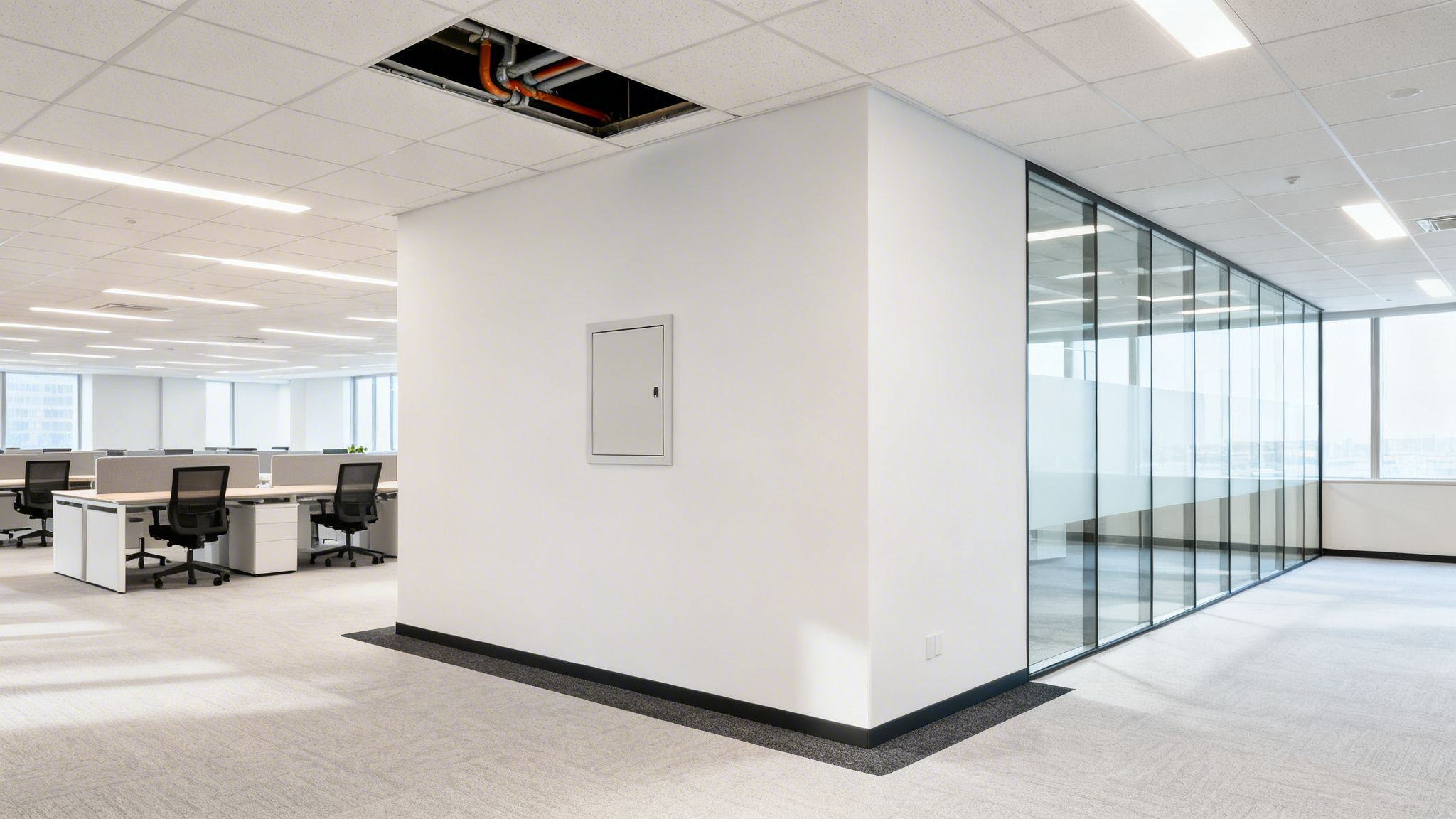
Another game-changer is designing for easy access to your building’s core systems. We’ve all seen it: maintenance panels stuck behind permanent cupboards or ceilings that have to be taken apart just to reach a hidden valve. These common design mistakes can turn a quick, simple fix into a costly and disruptive nightmare.
During the design phase, we carefully map out all critical systems, from plumbing and pipework to electrical wiring, data cables, and HVAC units.
By making sure these systems are easy to get to, through discreet panels, removable ceiling tiles, or cleverly placed service voids, we save you a huge amount of time and money on future repairs. When a technician can get straight to the problem without causing other damage, the job is done faster and with less disruption to your team. This focus on access is a simple but powerful part of effective commercial maintenance services.
This kind of forward-thinking is more critical than ever. According to Technavio, the UK facility management market is projected to grow by an enormous £16.55 billion between 2025 and 2030. This growth is being driven by new environmental goals and a major push for energy efficiency, changing how businesses manage their mechanical, electrical, and HVAC systems.
The True Cost and Value of Maintenance
When you think about commercial maintenance services, does your mind immediately jump to a cost on a spreadsheet? It’s a common way to look at it, but it completely misses the point. Good, proactive maintenance isn’t just another business expense; it's one of the smartest investments you can make in your company’s future, directly helping productivity, safety, and the lifespan of your property.
Viewing maintenance as simply a bill to be paid is a trap. It encourages businesses to cut corners and delay essential servicing to save a few pounds today. This approach almost always backfires, leading to much bigger, often hidden, costs down the road.
The Hidden Expenses of Neglect
Let's be clear: neglecting your workspace doesn't save money. It just postpones the expense and makes it worse. The real price of doing nothing shows up in ways that can seriously damage your business, from stopping operations to hurting team morale.
These deferred costs often sneak up on you:
- Sudden, Costly Downtime: When a critical system like your HVAC or IT servers unexpectedly fails, it’s not just a minor inconvenience. It stops work, frustrates your team, and can even damage your reputation with clients who rely on you.
- Sky-High Emergency Repair Bills: A planned service call is always cheaper than a panicked, last-minute emergency call-out. Reactive repairs for failed equipment come at a premium and usually involve more extensive and expensive work.
- Compliance and Safety Risks: Failing to maintain systems like fire alarms or electrical wiring isn't just a safety issue for your team; it can result in hefty fines, legal trouble, and even make your insurance invalid when you need it most.
- Reduced Asset Lifespan: Like a car, equipment that is looked after simply lasts longer. Neglect dramatically shortens the life of your most valuable assets, forcing you to pay for expensive replacements years before you should have to.
This is especially true for systems that use a lot of energy. You can see just how much poor upkeep can affect your bills by reading our article on the running cost of air conditioning.
The Clear ROI of a Proactive Plan
Now, let's flip the script. A well-thought-out, proactive maintenance plan, managed by a professional partner, turns those hidden costs into a clear, measurable return on your investment.
“Proactive maintenance is not an expense; it is one of the smartest financial decisions you can make for your commercial property.”
Investing in professional commercial maintenance services creates positive ripples that spread throughout your entire business. You get a safer, more productive environment for your staff, which has a direct and positive impact on their performance and wellbeing. You also get predictable, manageable budgets, finally free from the shock of unexpected five-figure repair bills.
Most importantly, you protect the long-term value of your property, making sure it remains a high-performing asset for years to come.
Ready to transform your workspace from a cost centre into a strategic asset? Speak to the Gibbsonn Interiors team today.
Frequently Asked Questions
When it comes to commercial maintenance, we find the same questions pop up time and again. If you're a business owner or facility manager, you've probably wondered about these yourself. Here are some of the common queries we help our clients with every day.
What Is the Difference Between Planned and Reactive Maintenance?
It’s a great question, and the answer gets to the heart of a smart maintenance strategy. We often explain it by comparing it to your car. Planned maintenance is your annual MOT and service. It’s the scheduled, proactive work designed to keep everything running perfectly and spot small issues before they become major failures. Think of an annual boiler check or a quarterly air conditioning service.
Reactive maintenance, on the other hand, is the frantic call to the breakdown service when your car grinds to a halt on the motorway. It’s the emergency response after something has already failed. This could be anything from a burst pipe flooding a storeroom to a total power outage. A good maintenance plan uses both, but the goal is always to rely on planned work to keep those costly, disruptive emergencies to a minimum.
How Often Do I Need Commercial Maintenance Services?
There’s no single, one-size-fits-all answer here. The right frequency really depends on the age, condition, and complexity of your building and all the equipment inside it. A brand-new office in a modern building will have different needs than a beautiful, older building with more character and older systems.
Some schedules are non-negotiable. Critical systems like your fire alarms and emergency lighting are governed by strict, legal testing schedules that you simply must follow. For other services, like changing HVAC filters or checking the general state of the building, a quarterly or annual schedule might be spot on. A good provider will sit down with you to create a tailored schedule that makes sense for your specific property, your budget, and your legal duties.
Can Maintenance Services Help With My Office Energy Bills?
Absolutely, and this is often one of the quickest and most obvious returns on investment from professional commercial maintenance services. A well-maintained HVAC system, efficient lighting, and a properly sealed building all work together to lower your energy use.
When your equipment is serviced regularly, it runs at its best instead of wasting energy just to function. This has a direct, measurable impact on your utility bills. For any business, but particularly those operating in competitive hubs like Milton Keynes, this is a powerful tool for controlling overheads while also showing a genuine commitment to your sustainability goals.
Ready to transform your workspace? Speak to the Gibbsonn Interiors team today.